
This year’s Copa América tournament has seen some quality football played from the group stage all the way to the semi-finals, the first of which Argentina managed to win, defeating Canada and becoming the only side to already book their place in the final at the time of writing.
Total Football Analysis has provided comprehensive coverage of the tournament throughout, including an in-depth analysis of the counterpressing tactics effectively deployed by Argentina, Uruguay, and Colombia — three teams that are interestingly all playing under the tutelage of an Argentinian head coach.
Today, we turn our attention to what’s been happening on the ball rather than off of it, with our tactical analysis and scout report identifying five standout U23s across the pitch who have proven vital for their respective teams in Copa América.
Before getting into the analysis, it’s worth noting that only those who have accumulated at least 250 minutes in the tournament have been considered for this analysis, and all stats/data have been sourced from Wyscout prior to either of the two semi-finals being played.
Furthermore, a notable absentee when it comes to discussing U23s who performed to a high level in this tournament is Brazil and Real Madrid star Vinícius Júnior, who you could make a strong argument for on merit; however, we analysed Brazil’s attacking dynamics; including an in-depth discussion on Vinícius and his role, earlier in the tournament in an analysis piece titled: “Dynamic Trio: How the positional rotations and flexibility of Brazil’s forward line can lead to Copa America glory and beyond – scout report” — so will be focusing our attention elsewhere for this one.
With that said, let’s get into the analysis.
Edgardo Fariña, 22 years old, Panama and CA Independiente
First up on our list is Edgardo Fariña (194cm/6’4”, 84kg/185lbs) of Panama and CA Independiente. Fariña is a right-sided centre-back who stood out in possession via relatively decent composure and accurate progressive passing with a respectable volume — having completed 6.62 progressive passes per 90 with an 82.76% success rate.
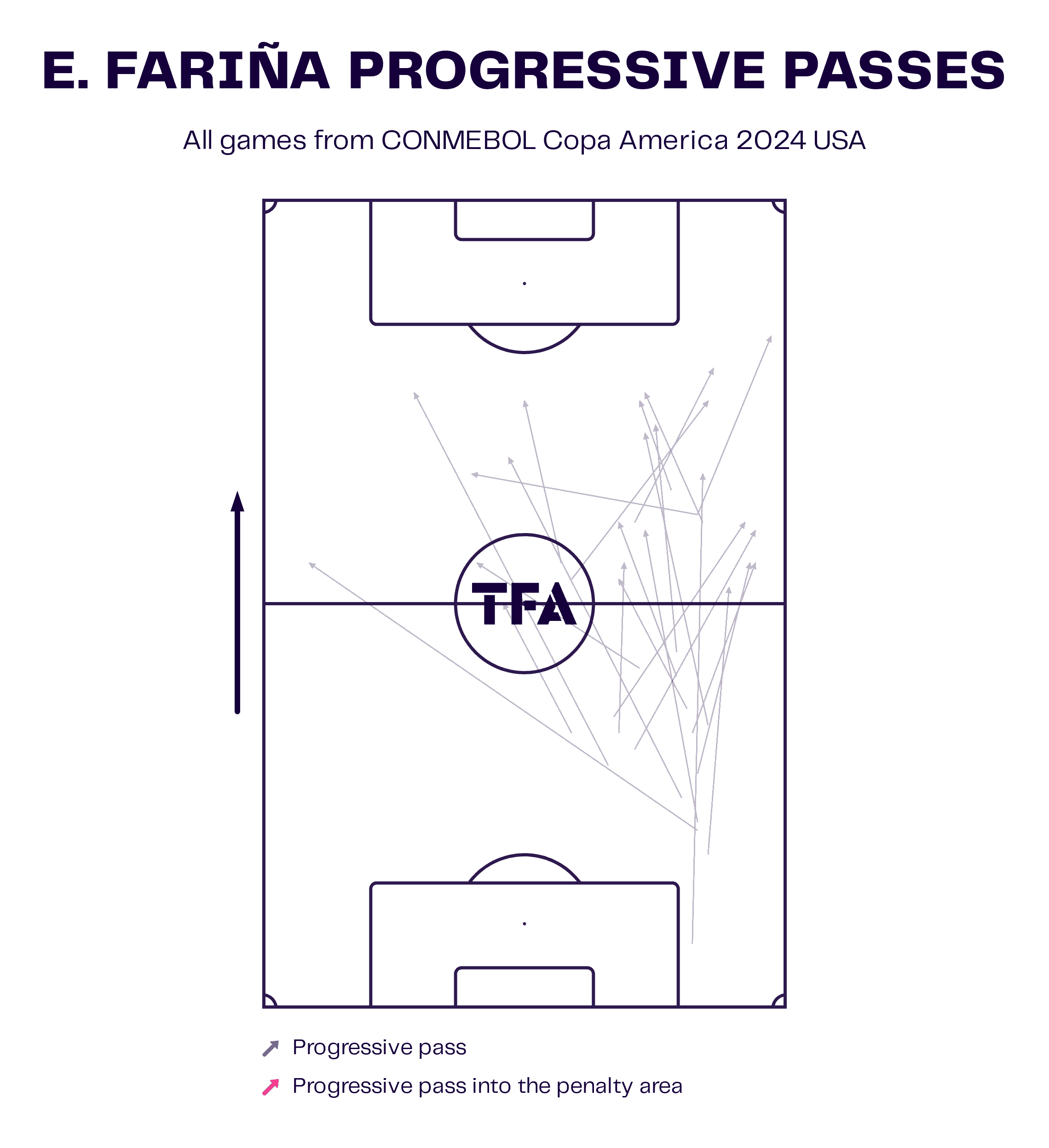
As figure 1 indicates, plenty of Fariña’s progressive passes came from deep and were of a longer nature, with a couple acting as switches of play across to the left-hand side of the pitch.
However, a good deal of the centre-back’s progressive passes were also played from a higher position, which allowed the 22-year-old Panamanian to act as a supplier for those positioned in the final third—he sent a good number of passes into the right half-space and through for attackers out on the right wing, as the image displays.
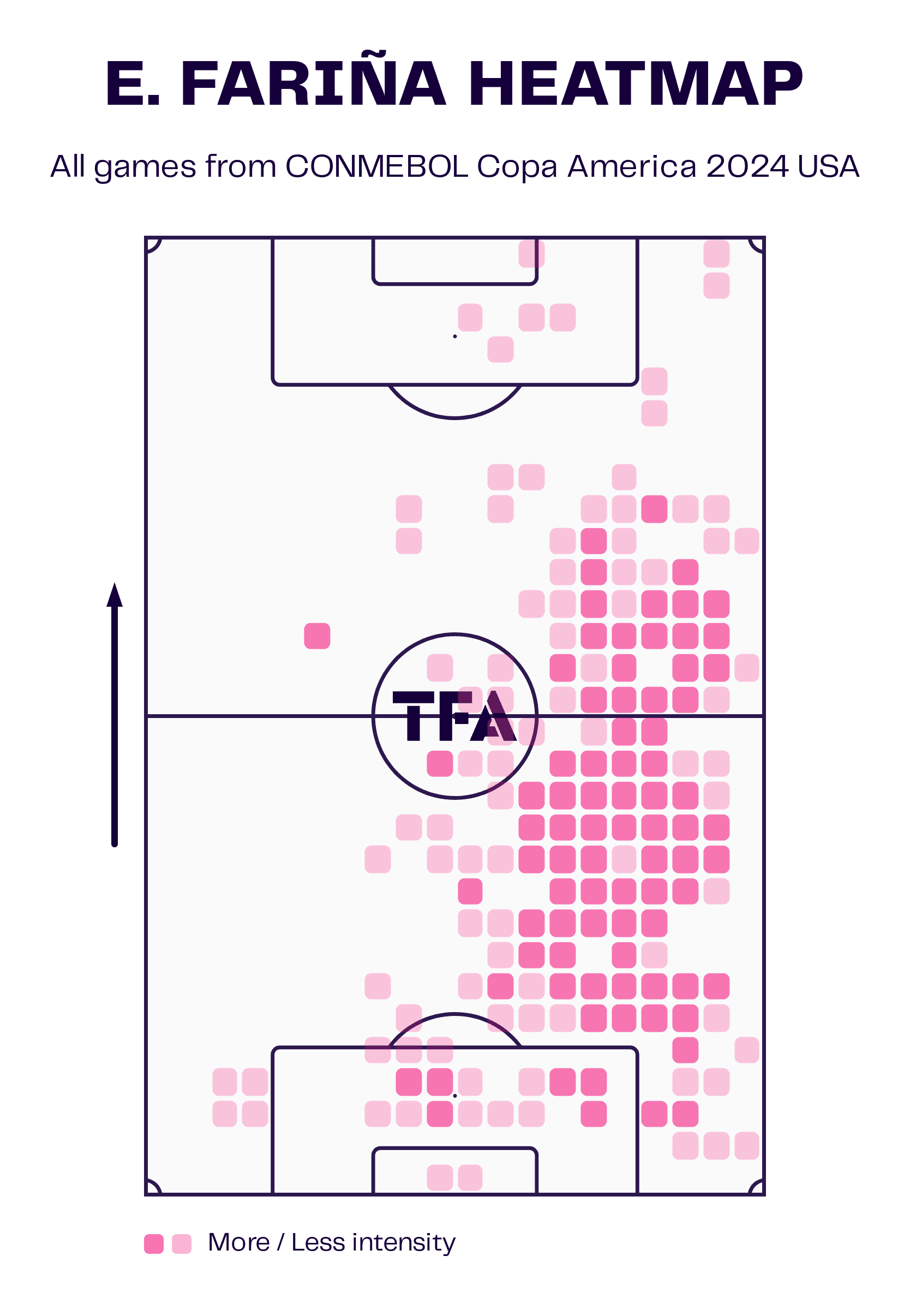
Again, as his heatmap shows, Fariña liked to carry the ball just into the opposition’s half at times. From the right centre-back position of a back-three with Panama, the centre-back had the freedom to explore slightly more advanced positions, with the security of two other centre-backs covering behind him.
At the same time, Fariña would advance just into the opposition’s half to pull off an interception if he deemed it necessary to protect his team at the back — this would, if successful, lead to the 22-year-old getting on the ball in the opposition’s half where he could send it forward for a teammate to hurt the opponents’ defensive line; this is one area where his quality on the ball proved important for Panama and their tactical setup.
Panama progressed into the knockout phase of Copa América for the first time this year, and 22-year-old Fariña played no small part in that. It’s no surprise to see his name now linked with several different European clubs of ‘Tier 2’ standard — a level that consists of the EFL Championship, Russian Premier League, Liga Portugal, Turkish Süper Lig, Argentine Primera División, Campeonato Brasileiro Série A, Belgian Pro League and Dutch Eredivisie based on our league ‘Tier Ranking’ system.
Alphonso Davies, 23 years old, Canada and FC Bayern
Slightly less out of left field, our next player takes us from centre-back to left-back as we move on to Canada and FC Bayern’s Alphonso Davies (185cm/6’1”, 77kg/169lbs), widely recognised as one of world football’s best full-backs.
Davies’ Canada side have now been knocked out of this tournament following their semi-final meeting with Argentina. Still, a journey to the last four in what was their first-ever Copa América appearance is nothing to be ashamed of by any means. The FC Bayern full-back played a significant role in what will go down as a successful Copa América participation.

As per our heatmap in figure 3, Davies had a very active role on the left-wing for Canada, getting involved heavily inside his own half all the way up to deep inside the final third.
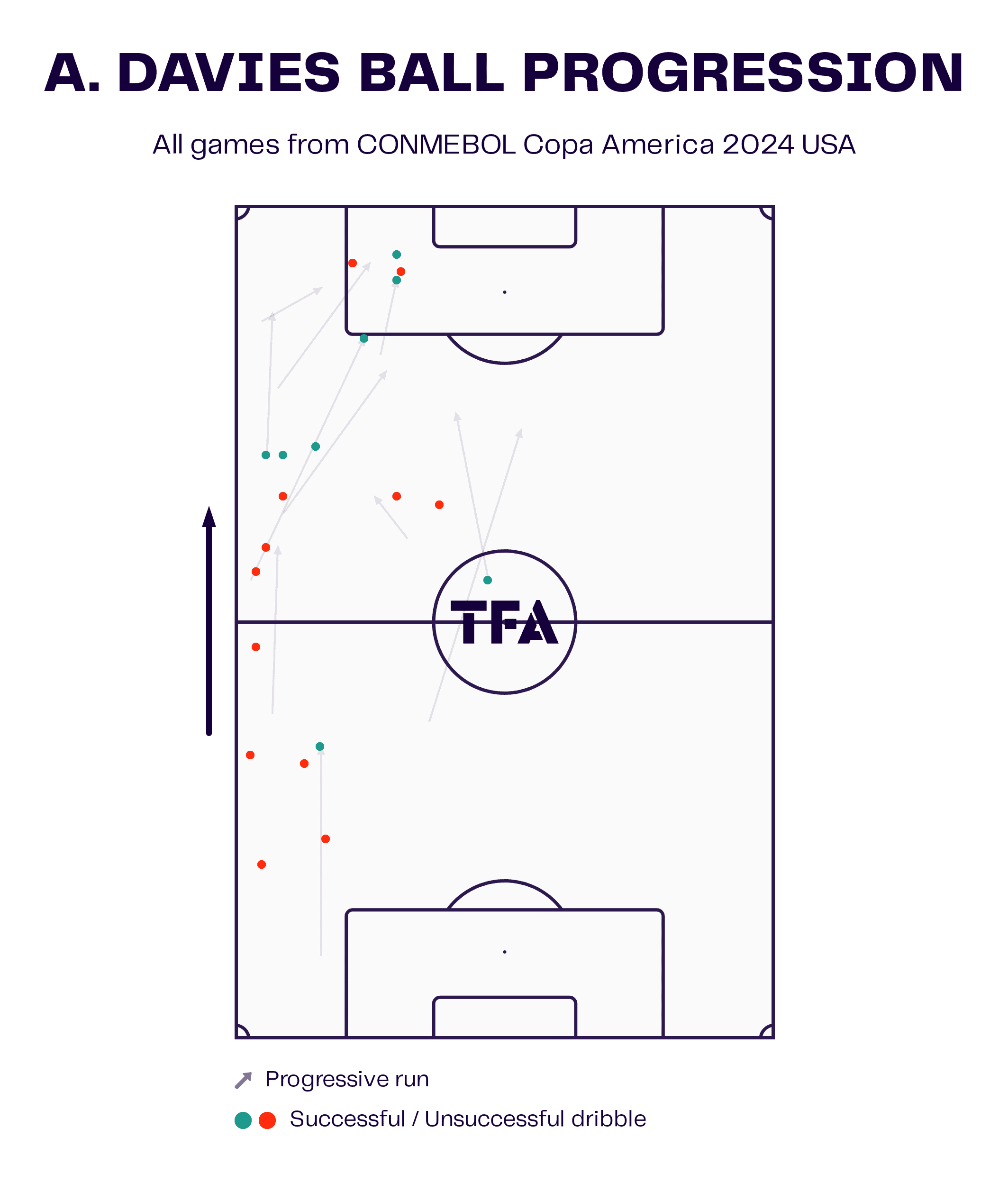
Davies’ ball-carrying ability played a key part in his creative role for Canada, with the left-back having completed 4.41 dribbles per 90 this tournament and 2.43 progressive runs per match while zooming up the left-wing and trying to get into decent positions for chance creation from where he could put an inviting ball into the box.
Notably, though, his dribble success was far higher in the final third than in deeper areas, with Davies conceding possession more often than he would’ve liked when trying to dribble out of his own half or even in the middle third of the pitch.
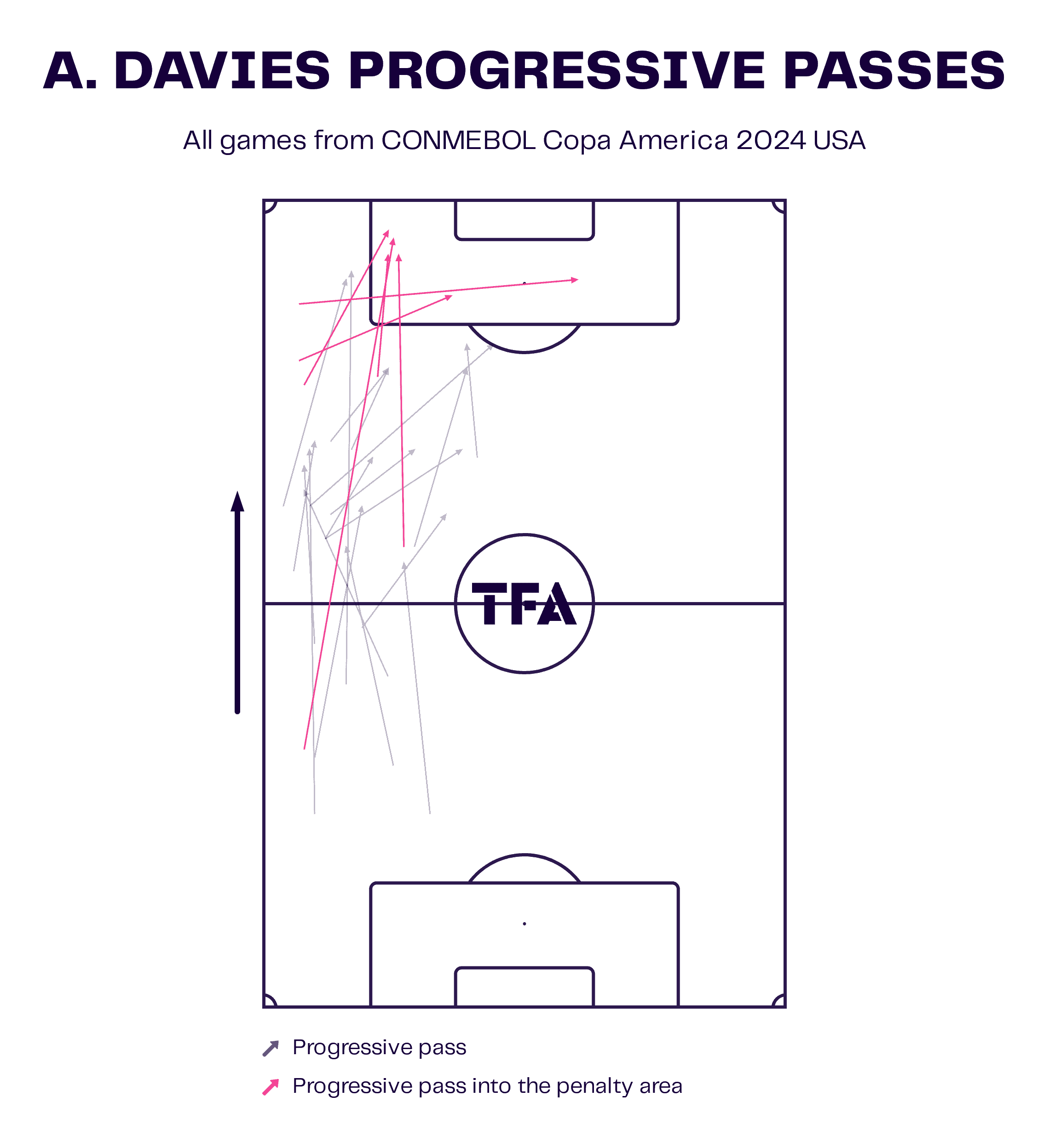
Where the FC Bayern man really stood out in possession, however, is in the area of progressive passing, with a progressive pass map on display in figure 5.
The 23-year-old completed 6.62 progressive passes per 90 in Copa América with an impressive 80% success rate. While Davies was heavily involved in various facets of his team’s possession play, he was a tournament standout in getting his team moving into the opposition’s penalty box, with Davies’ 2.87 passes into the penalty area a Copa América high for U23s.
Davies proved especially effective for Canada during transitional attacks. His ability to find space, receive, get his head up, and pick out a runner ahead was crucial for starting counterattacks. His pace and ball-carrying ability also helped him quickly get his side moving upfield into dangerous positions on the counter. Davies can definitely take some pride in his contributions to Canada this tournament.
Moisés Caicedo, 22 years old, Ecuador and Chelsea
Moving into central midfield, one clear standout for us to discuss was Chelsea midfielder Moisés Caicedo (178cm/5’10”, 71kg/156 lbs). Caicedo delivered some impressive performances for Ecuador during their Copa América journey, which ended on penalties to finalists Argentina in the quarter-final stage.
Caicedo emerged as a real leader on the pitch for La Tricolor during Copa América both on and off the ball. In possession, the 22-year-old exhibited the kind of bravery required of a deeper-lying midfielder while also progressing into more advanced areas of the midfield, at times, to act as more of a playmaker.
Caicedo completed 6.46 progressive passes per 90 during the tournament with a 72.41% success rate, while he completed 2.45 passes to the penalty area — trailing only Alphonso Davies and Vinícius Júnior in that area.
Furthermore, his 7.35 passes to the final third per 90 were bettered only by Edgardo Fariña and Julio Enciso.
So, we can already see that Caicedo stood out in positive terms in several different passing departments. He acted as a key passer from deep as well as from more advanced areas, showcasing his capability to break different lines up and down the pitch.
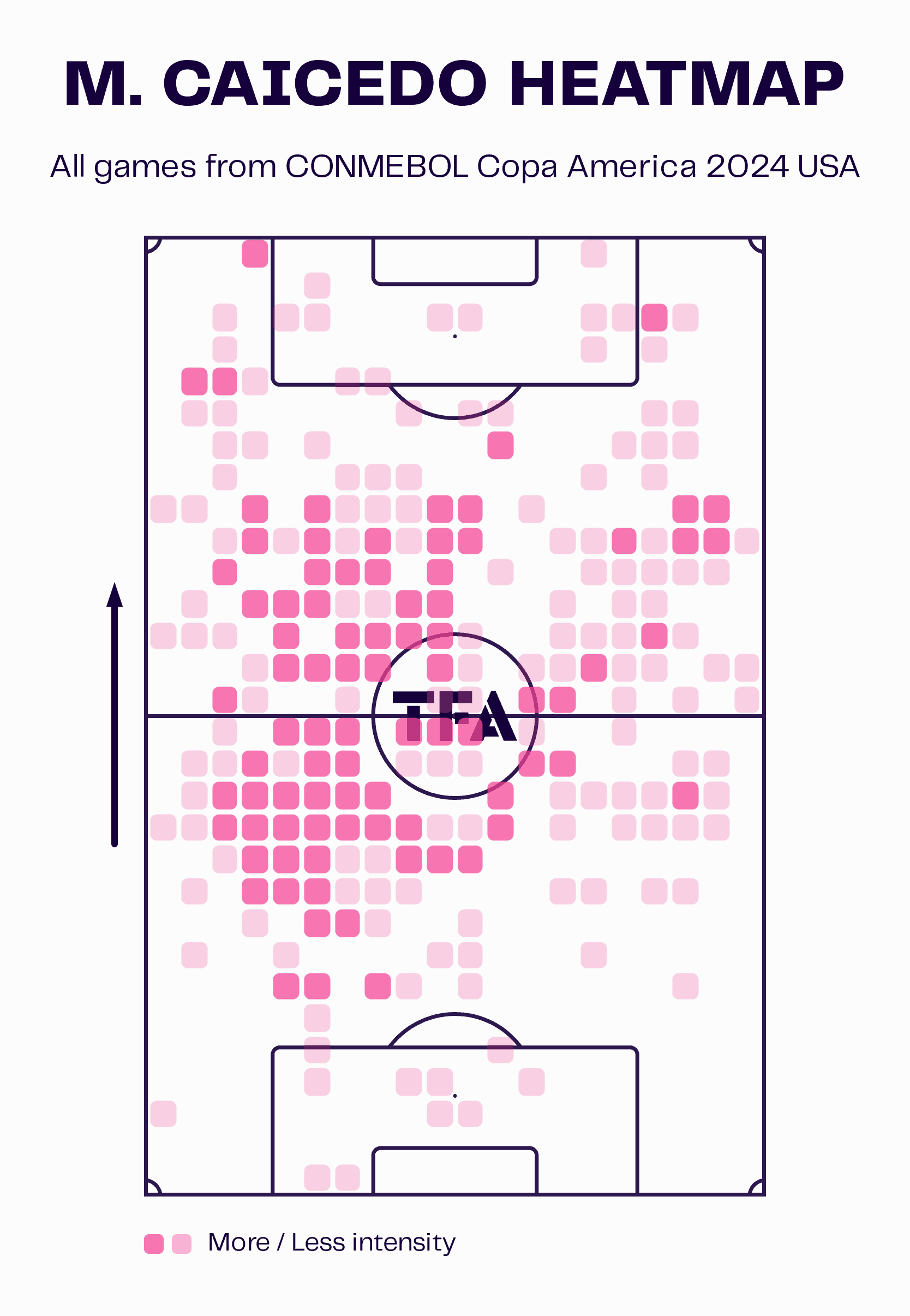
The Chelsea man’s heatmap further backs up our points on his activity in different parts of the midfield. Caicedo was primarily found in the left holding midfield position but would also get involved higher up in the left half-space, either by carrying the ball through pressure into that spot himself, as he often did in this tournament, or by running into that area to give his teammate a passing option to aim for as they tried to get into good positions for chance creation.
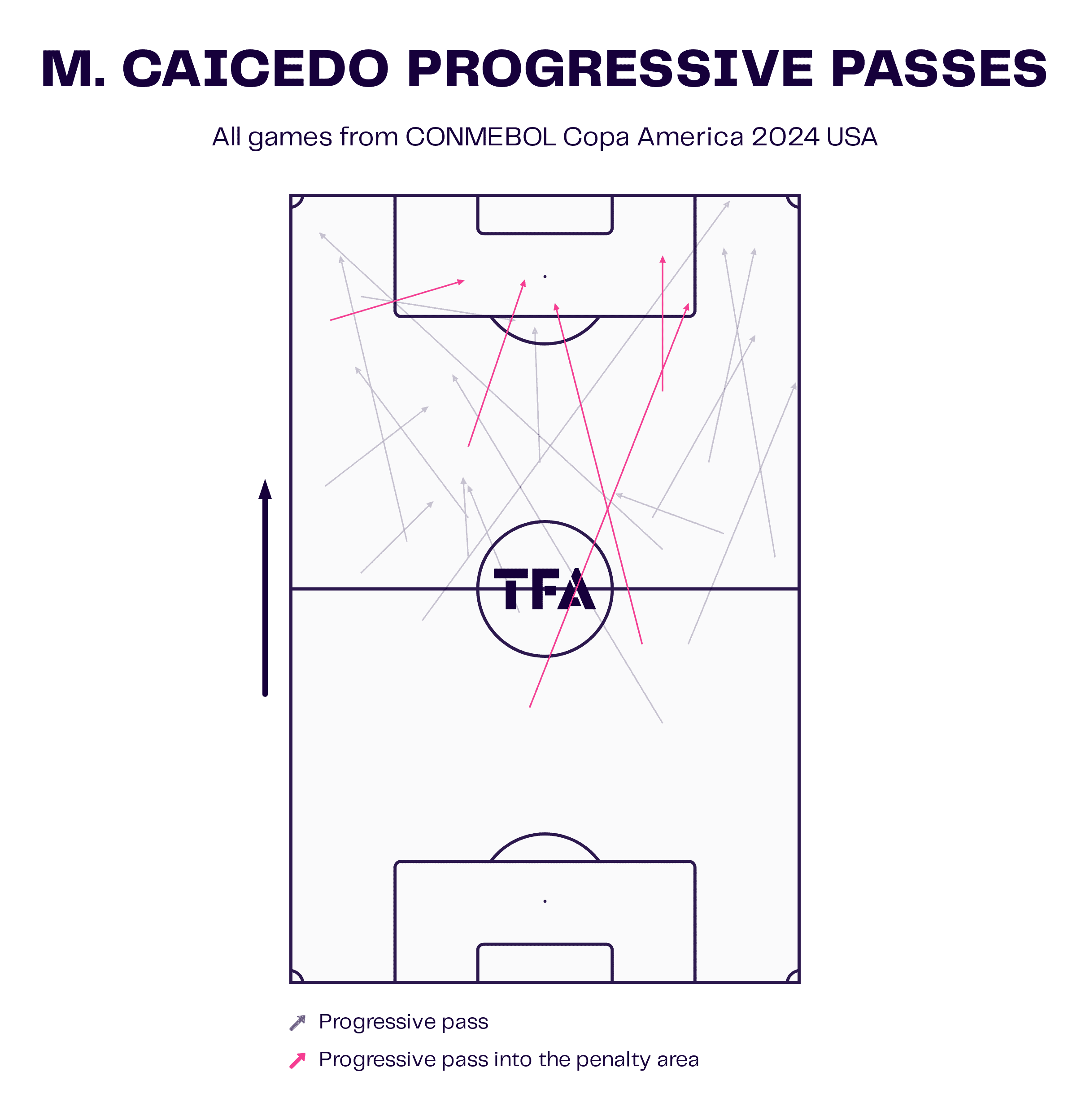
Interestingly, Caicedo’s progressive pass map shows that they didn’t typically come from any particular area; rather, their origins were dispersed from the very centre of the park to the left and to the right.
Regardless of where exactly they came from, however, Caicedo’s progressive passes typically ended up deep in the final third, either in the box or just wide of it for a winger to chase down and then put the ball into a highly threatening area.
The 22-year-old Chelsea midfielder performed this role asked of him to a high standard and performed as a key part of Ecuador’s progression and, indeed, chance creation phases during this tournament.
He frequently demonstrated effective scanning at appropriate times to properly inform himself about his surroundings — both in relation to teammates and opponents — he showed an excellent ability to distribute over short distance and longer distances based on what was needed at that moment, and while there were occasional issues with his first touch to work on, his passes were typically well-weighted and accurate in addition to being threatening — a great combination.
Julio Enciso, 20 years old, Paraguay and Brighton & Hove Albion
Next, we move from central midfield into attacking midfield, where we’re going to focus on Paraguay’s Julio Enciso (173cm/5’8”, 64kg/141lbs) of Premier League Brighton and Hove Albion.
Yes, Paraguay played just three games in this edition of Copa América, losing all three and getting knocked out in the group stage. Still, Enciso demonstrated enough of his individual quality despite playing in a poor side, to easily warrant a place on this list.
It’s worth noting that Enciso performed quite a free role within Daniel Garnero’s Paraguay setup, which saw him frequently pop up on the ball deep as well as in more advanced areas, and on the wings as well as centrally depending on where the ball was at that moment and, crucially, where there was space to be found.
As part of his relatively free role within Garnero’s overall structure, Enciso was required to drift around in search of space and a position from where he could be most threatening.

While crossing hasn’t been a very important area for Enciso in this tournament outside of set-piece delivery, the above viz does allow us to highlight a couple of key areas within his game — his heatmap, which again highlights the free nature of his role, which did not stick him to one particular position or zone but allowed him to explore within the opposition’s half, and his dribbles.
Enciso completed a whopping 10.71 dribbles per 90 in Copa América 2024, which is the most of any player in the tournament, regardless of age, with at least 250 minutes to their name. The Brighton attacker’s 50% dribble success rate is also decent, given his high volume of dribbles and the disparity in quality between his ultimately lacking Paraguay side and the formidable opposition in Colombia, Brazil and Costa Rica.
In terms of his dribbling, Enciso exhibited fantastic close control, impressive agility, and balance to back up his pace. The Paraguayan attacker used his bum effectively, in combination with his centre of gravity, to ride challenges and protect the ball from opponents when receiving to make up for his lack of strength to hold the ball up, making him quite difficult to challenge initially before setting off on his dribbles.
While some of his shooting was on the more speculative side and could do with refining, Enciso largely enjoyed a highly impactful Copa América for Paraguay and is well deserving of praise for his performances.
Kendry Páez, 17 years old, Ecuador and Chelsea
The fifth and final player on our list is also the youngest player on our list, in the form of 17-year-old Kendry Páez (177cm/5’10”, 67kg/147lbs) — another player of both Ecuador and Chelsea, though Páez will not officially become a Chelsea player until next summer, once he’s 18 years of age, with the forward remaining with Independiente del Valle — an Ecuadorian club developing a fine reputation as a breeding ground for talent, having produced Moisés Caicedo as well — until that time.
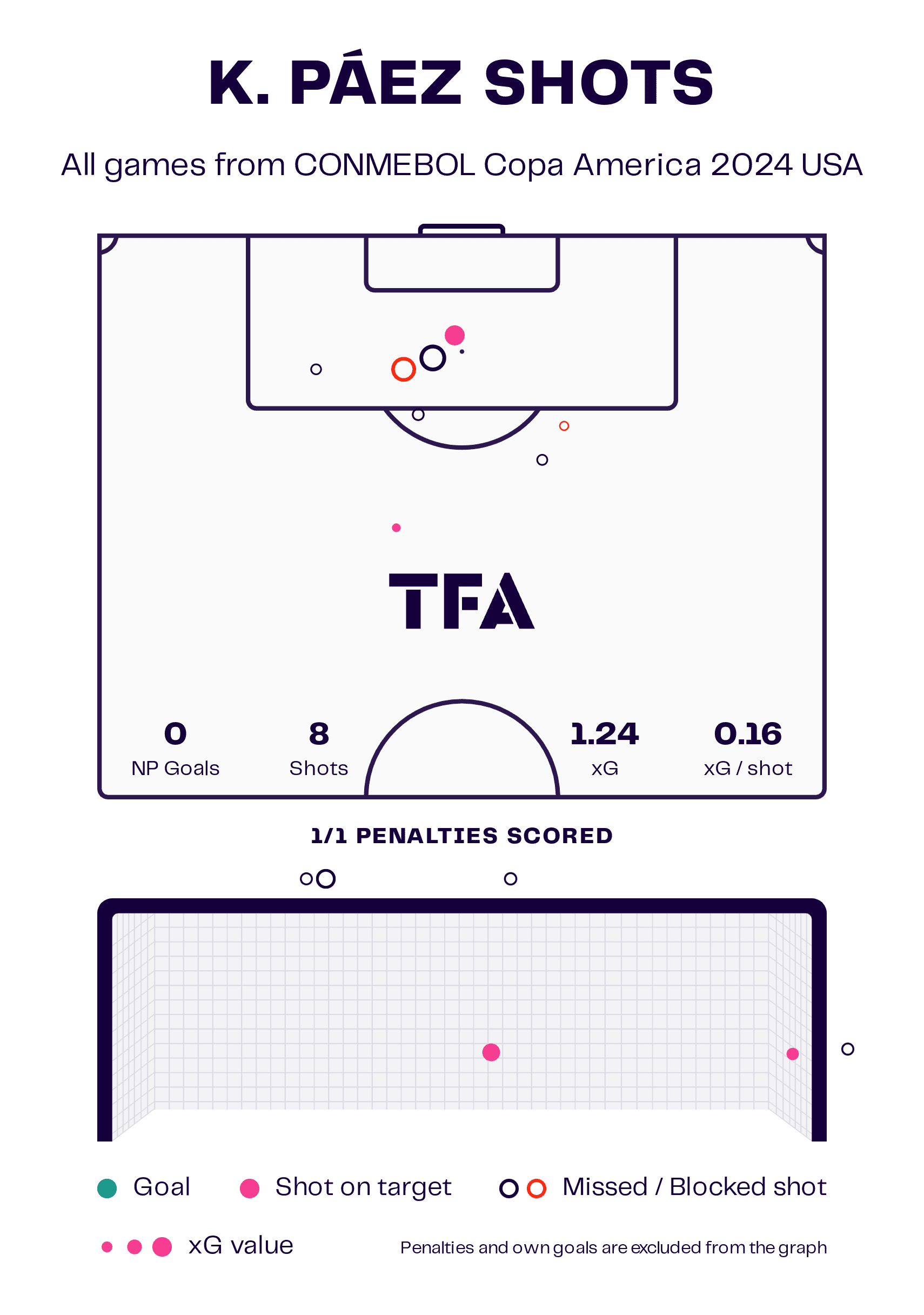
Scoring one penalty — not included on the graph or in the data displayed — Páez also took eight more shots during this tournament, generating an xG of 1.24. This averages out to 0.16 xG per shot — pretty impressive numbers indicative of intelligent shot selection and good positioning, which aren’t always the first attributes that spring to mind when dealing with young players but are a very good sign of the level of talent we’re talking about.
Páez is capable of getting plenty of power and curve behind his shots. It’s typical for him to receive, turn, get his head up, and get the ball out of his feet very quickly without much issue.
Furthermore, the young Ecuadorian is very good at generating a lot of power behind his shots without much of a run-up, though his shot accuracy was not of a great standard at Copa América so may represent a notable area for improvement.
At 17 years old, Páez delivered very solid performances for an Ecuador side that were far from favourites to do well in this competition but impressively took one of the favourites, Argentina, all the way to penalties in the quarter-finals thanks to the effort and performance levels of those on the pitch — this youngster included.
If he can maintain that level of work ethic, Páez represents a very exciting prospect to keep a close eye on.
Conclusion
In conclusion, we’ve identified Panama’s Edgardo Fariña, Canada’s Alphonso Davies, Paraguay’s Julio Enciso, and the Ecuadorian duo of Moisés Caicedo and Kendry Páez as five standout U23s at this summer’s Copa América. Brazil’s Vinícius Júnior was left off our list not due to performance but simply due to our previous analysis of him during this competition.
This tournament is usually a good one to track when it comes to keeping tabs on some of the world’s best up-and-coming youngsters, especially from the teams outside of the favourites, with Ecuador providing a great example of how top quality can be found within a side that just falls short of the standard to really make waves in the competition; the 2024 edition of the tournament was no different, with plenty of quality on display from those within the youth age range.
