
Federico Chiesa has been regularly linked with a move away from Fiorentina.
He has recently been heavily associated with a transfer this summer, with Manchester United and Chelsea reportedly the favourites for his signature.
Despite his tender age of 22, Chiesa already has 139 appearances for the Viola, a club he has represented at all levels, starting in the youth team during the 2014/15 season.
Capable of playing anywhere along the frontline, Chiesa’s versatility is an added bonus.
He has also been capped 17 times by Italy, so there is little surprise that he has attracted the attention of bigger clubs.
Fiorentina have had a tough few years, finishing 16th last season and currently standing 13th in Serie A, which does not strengthen their position when trying to keep hold of their best players.
The Italian has played a total of 2,065 minutes of football in Serie A this season for Fiorentina, adding nine goal contributions in this period (six goals, three assists), which averages one per every 229 minutes played.
In this Federico Chiesa scout report, we examine the critical role Federico Chiesa plays for Fiorentina, analysing the Italian’s contributions across the defensive, midfield, and attacking thirds of the pitch through tactical analysis.
Federico Chiesa Style of play
This season, Fiorentina have generally favoured a 3-5-2 formation under both Vincenzo Montella and Giuseppe Iachini, with this tactic being utilised in 59% of Serie A matches, in which Federico Chiesa has often lined up as a striker.
Despite being labeled in this role, the Italian would often operate from the flanks as he sought to involve himself in the game, favoring his more natural position as a winger.

This tendency is clearly evident when analyzing Federico Chiesa’s heat map.
The striker primarily operates from two areas of the pitch: the advanced area of the middle third and the attacking third.
He favours a position on either the left or right-hand side of the pitch, which is understandable considering his natural position as a winger.
It is from this area of the pitch that Chiesa can look to utilise his explosive speed and ability on the ball to isolate opposition or progress the ball through direct runs.

The above data visualization highlights Chiesa’s importance to Fiorentina; the young Italian has been fundamental to the team’s output this season.
As you can see, Chiesa is Fiorentina’s most threatening player in terms of goal contributions; he is the only player for the Viola who has added a significant number of goals and assists this season, with Erick Pulgar coming in second with four goals and three assists.
Federico Chiesa approach
Federico Chiesa relies on his explosive pace to power past opposing defenders into space beyond the defensive line.
The young Italian is a player who thrives off confidence, and at his best, he is extremely dangerous.
Chiesa’s speed and direct approach on the ball make him a key component to the counter-attack used by Fiorentina.

Before taking a closer look at Chiesa’s dribbling, with a particular focus on his attempts within the final third, I have produced the above data visualization to show where the Italian sits in relation to all wingers in Serie A.
Federico Chiesa is performing slightly below average in relation to his dribbles per 90, which sits at 5.32.
However, this figure is even more impressive, considering that the Italian has been deployed as a striker in 19 out of his 23 league appearances, which really signifies his desire to be involved in the game.
Chiesa can also boast the eighth-highest dribble success rate among this category of players, sitting above average at 59%.

The above image shows Chiesa’s dribbles in the league.
As you can see, the majority of these are within the attacking third and often take place within the outside vertical channel or within the half-space.
It is in these situations that Chiesa’s explosive pace and ability in a 1v1 situation make him such a threat to the opposition.
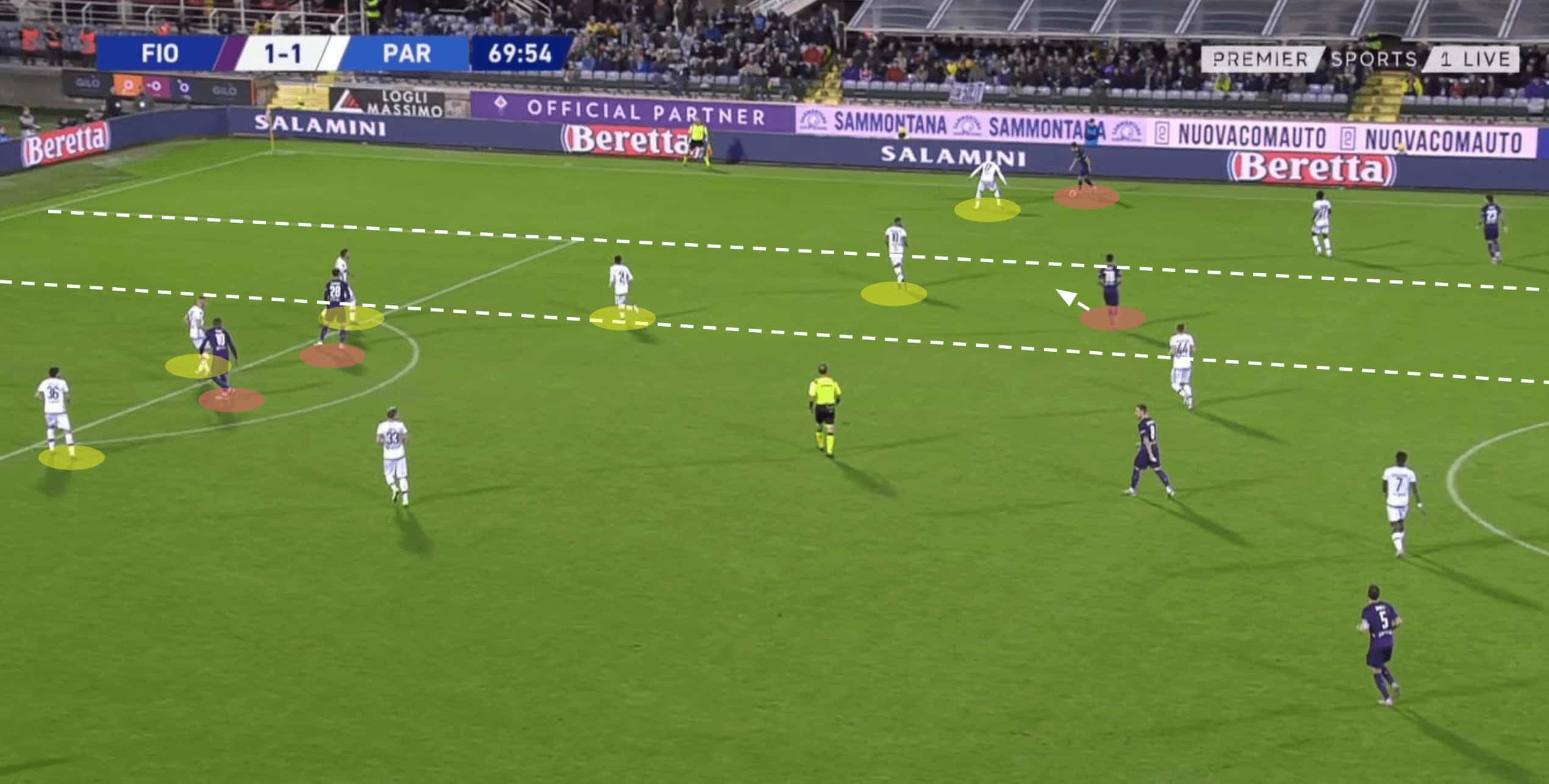
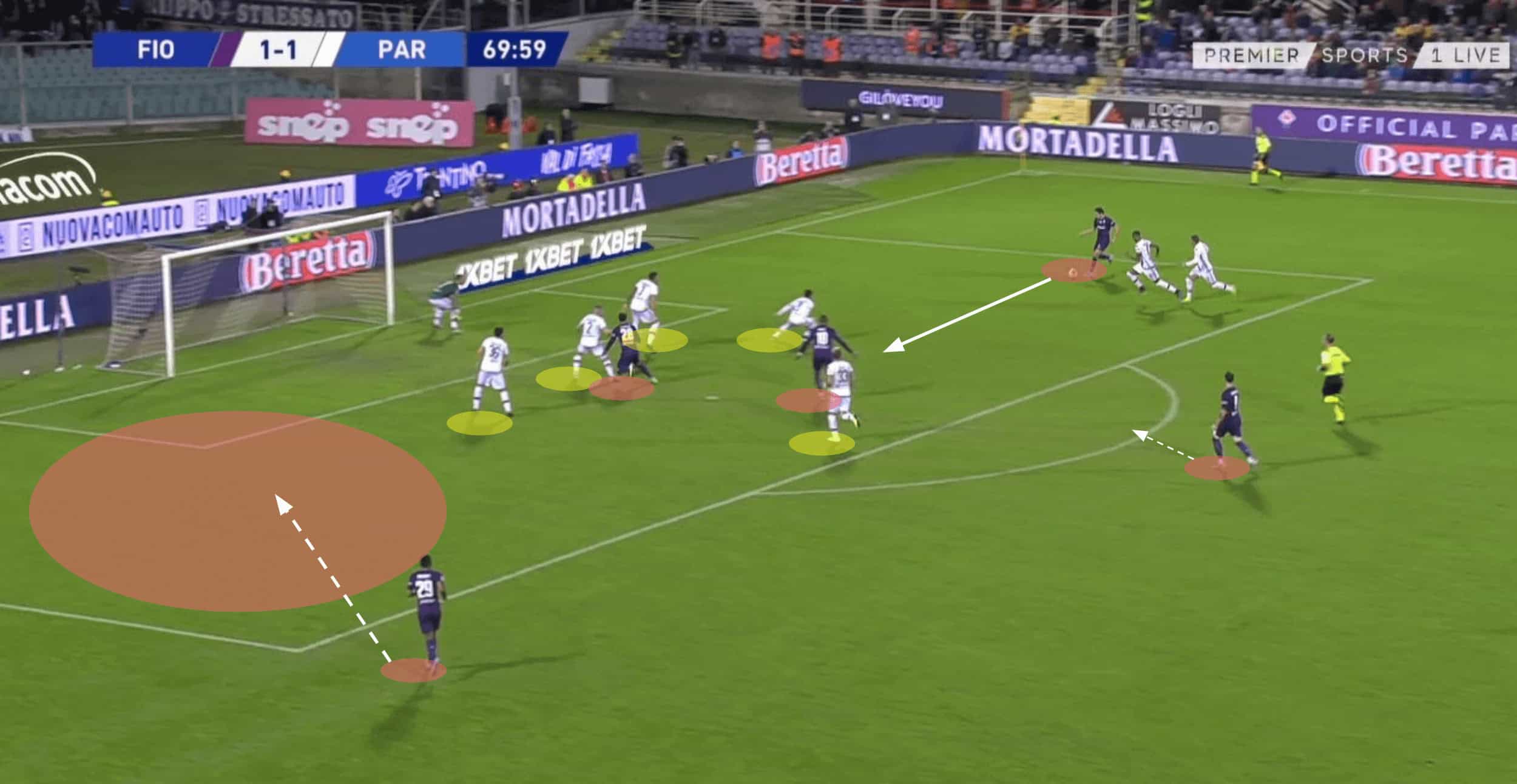
An example of Federico Chiesa’s ability to drive with the ball can be seen in the above image, firstly against Parma, Chiesa receives the ball in the outside vertical channel with Parma set up in their familiar compact block.
The Italian needs no second invitation to use his pace to exploit his marker and progress with the ball into the box, where he attempts to lay the ball off to Kevin-Prince Boateng in a compact area instead of identifying the space at the back post for the on-rushing Dalbert.
Another example of Chiesa’s ability on the ball can be seen below against Juventus, where Chiesa receives the ball in an extremely tough situation as he is about to come under significant pressure from three opposition players in the press.
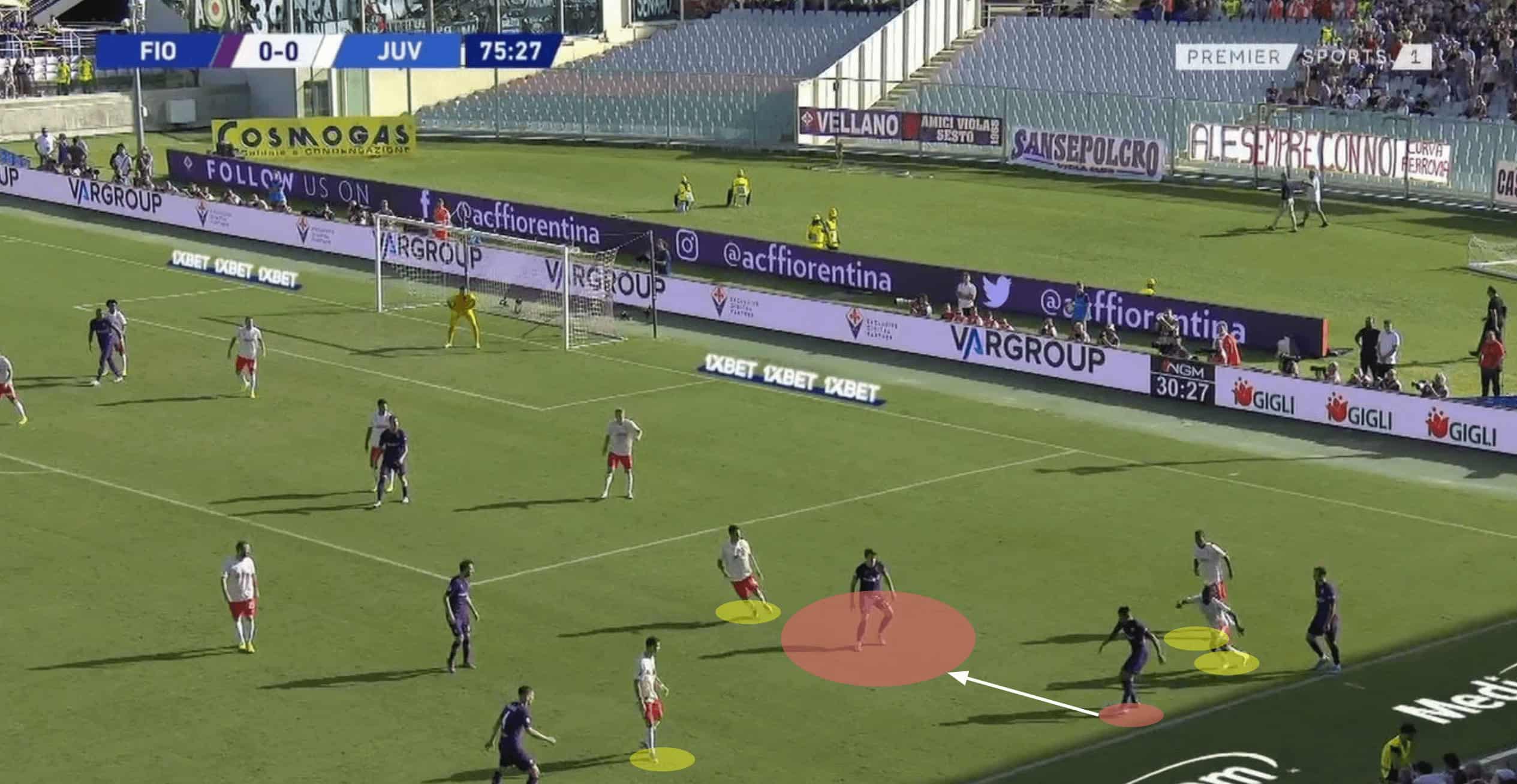
Here, Federico shows his press resistance, taking the ball under pressure and staying on it to make a positive action.
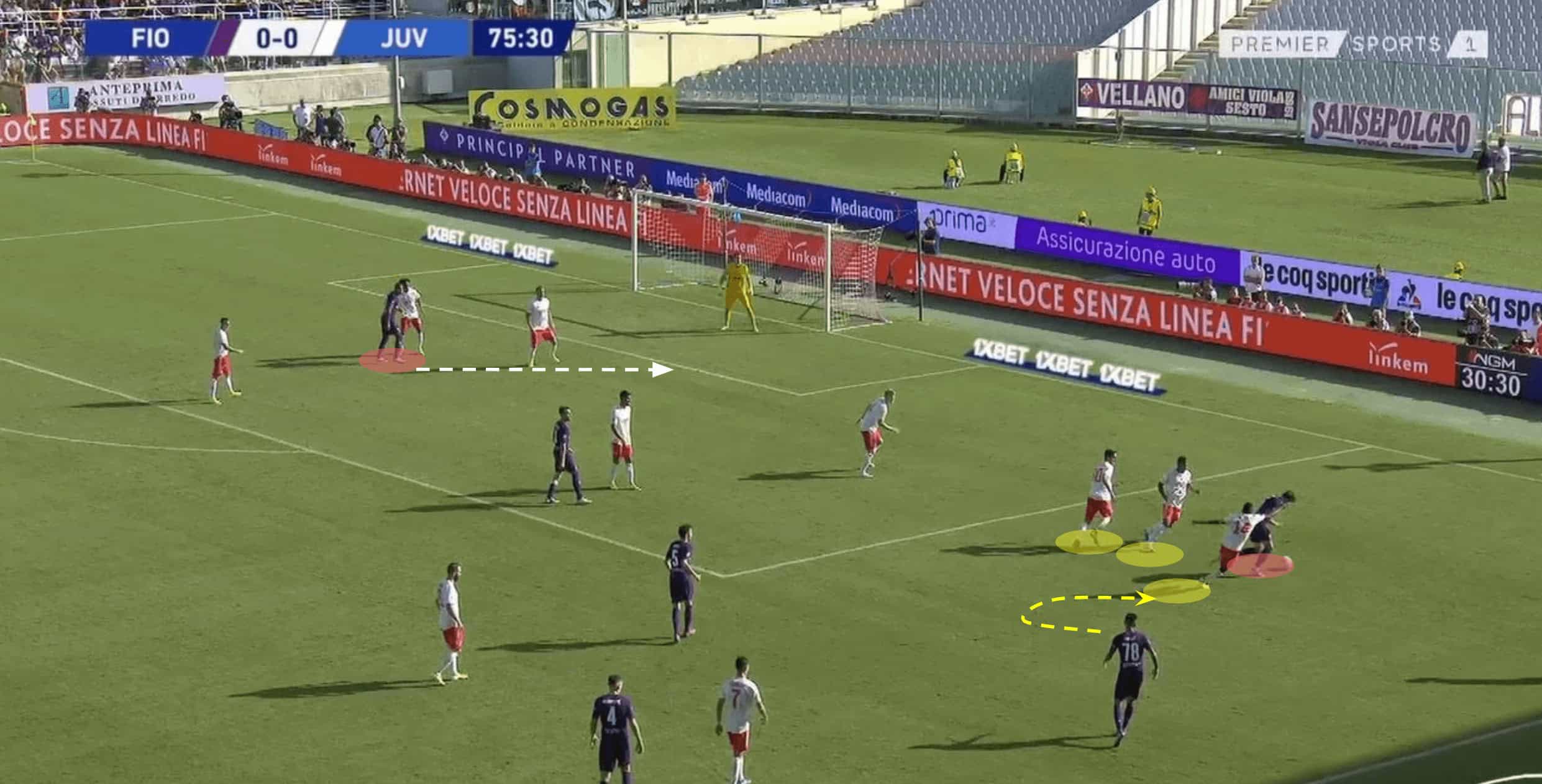
Below, the Italian uses his dribbling ability and unpredictable change of direction to power his way behind the defensive line and deliver a driven cross.
Federico Chiesa Decision making
If there is one area of Federico Chiesa’s game that he could look to fine-tune, it is his decision-making ability.
It could be argued that the Italian lacks experience in this department, which affects his ability to select the correct decision in relation to his timing of the pass or the option to shoot.
Like most young players, this is a quality that you normally see wingers develop over time, especially if they are to reach the heights of Raheem Sterling and Adama Traore, to name a few, both of whom had question marks over their end product during the early years of their careers.
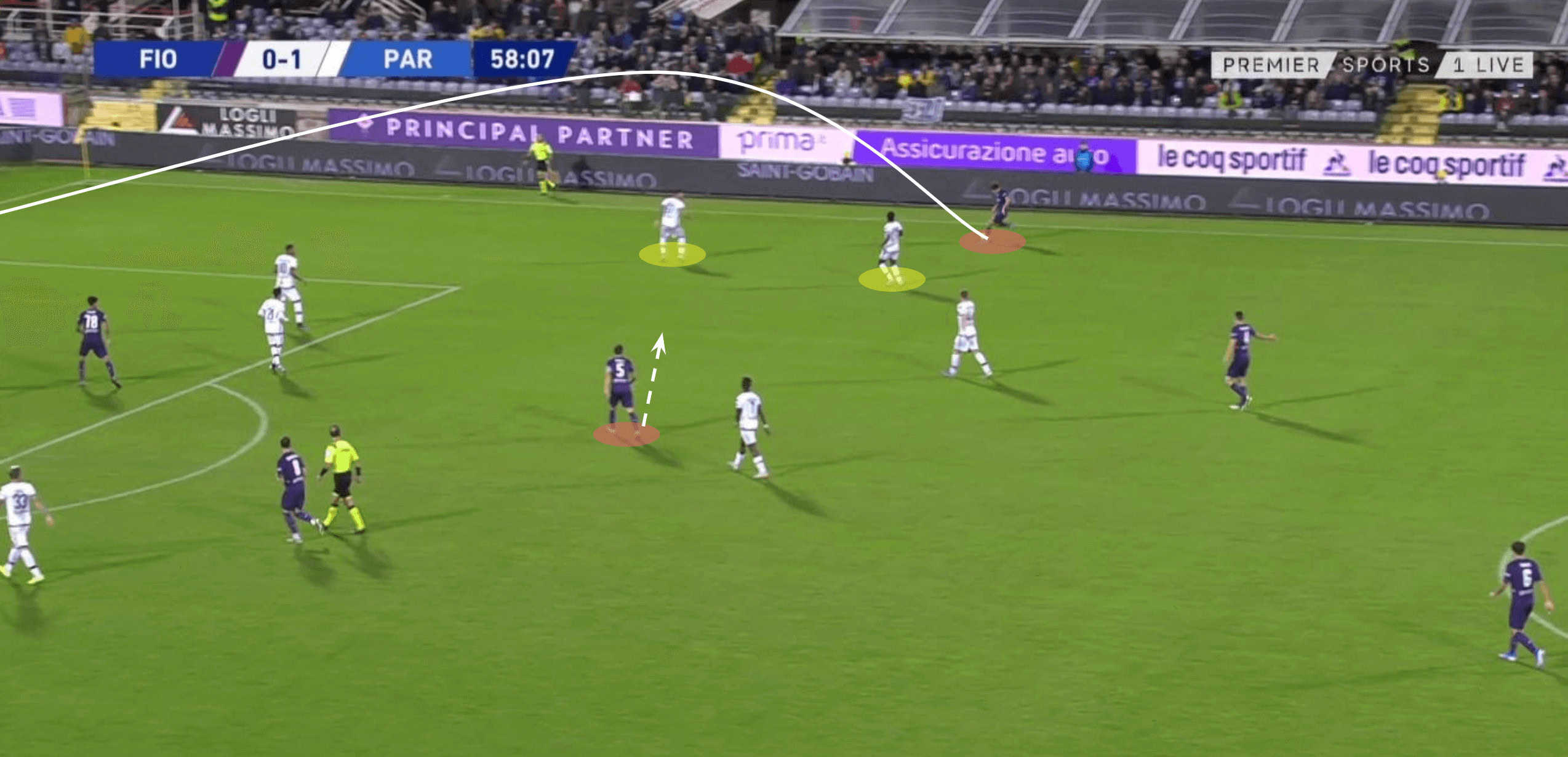
In the above image, we can see an example of Chiesa’s naivety as he delivers an early cross into the Parma box, for those of you who have studied Parma this year in Serie A you will know that they have been superb in dealing with the aerial threat.
The better option for Chiesa on this occasion would have been to pass the ball to Milan Badelj, who made a run to the vacant space.
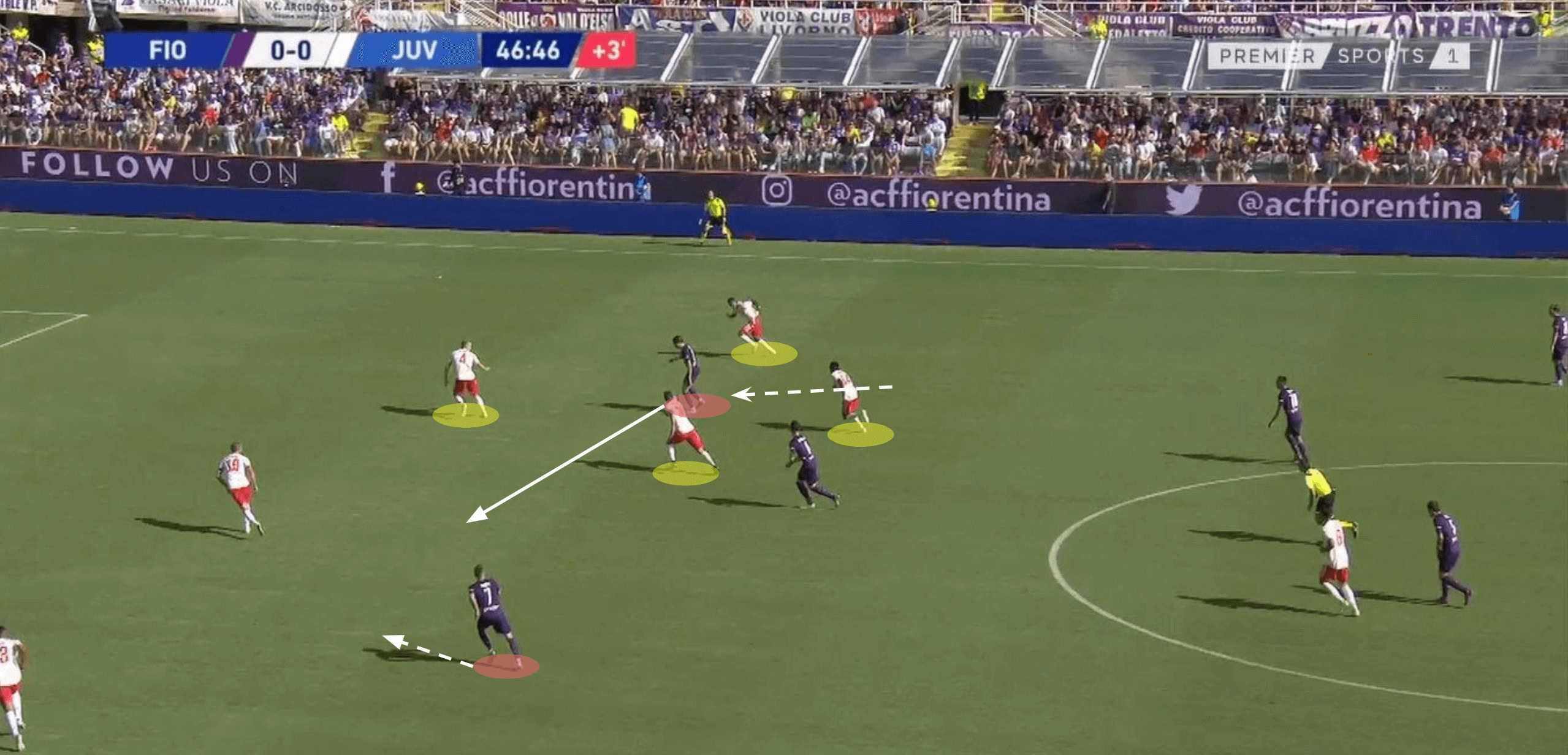
Another example can be found below, where Chiesa can be seen surrounded by Juventus players.
Instead of opting to play the ball to the supporting run of Frank Ribery, the Italian continues his run with the ball into Matthijs De Ligt, who makes an easy tackle.
Federico Chiesa Attacking entries
 The above image illustrates how Chiesa operates in the attacking third of the pitch, highlighting the Italians’ preference regarding penalty area deliveries.
I would like to draw your attention to Chiesa’s carries, with a particular focus on his entries from the left.
Notice the angle at which Chiesa enters the penalty area, and the 45-degree angle gives the Italian a much better chance of scoring should he take a shot across the goalkeeper, whereas the majority of his entries from the right would be attacking the outside shoulder of the defender, making the angle and chance of scoring more difficult.
Taking our analysis a little deeper by looking at Chiesa’s passing in key areas (advanced middle third and the attacking third) of the pitch, will give us an insight into how Chiesa can impact a game in attack.

As you would expect, Chiesa follows the ‘norm’ with regards to the longer passes in the attacking third, seeing a drop in accuracy.
This is expected, considering the area of the pitch, the box, which is more compact and has restricted passing lanes due to the reduced volume of free space.
My takeaway from this visualisation is that Chiesa’s passing ability has improved accuracy when operating from the left, given that he is right-footed, which comes as a surprise.
All passing rays highlight Federico’s ability to be an effective ball player at short distances, with the majority of these passes exhibiting high accuracy, making the Italian an integral figure when looking to play combinations in compact areas to create space for others off the ball.
Federico Chiesa Scoring Threat
Federico Chiesa has scored six goals this season in Serie A, a figure that is below his expected goals (xG) value of 8.5, indicating that he should have scored a few more times.
The Italian is a volume shooter and has taken 79 shots in the league, which ranks him in joint fourth place alongside Lautaro Martinez.

An analysis of his striking ability reveals that a significant proportion of his shots originate from areas with a very low xG figure, indicating that the likelihood of these shots being scored is often less than 10%.
Chiesa also has a shots on target figure of 42.7 percent, which sees him sit in the middle percentile in relation to this statistic for volume shooters.
Luis Muriel tops the charts with a figure of 55%, whilst Dries Mertens of Napoli has the lowest with 23%.
Federico Chiesa Defensive Phase
Fiorentina are relatively passive in the defensive phase; the Viola have a passes per defensive action value of 286, which sees them in the lower half of teams in relation to this metric.
Despite the team’s performance in relation to pressing, examining Chiesa’s defensive actions, particularly recoveries, reveals that the Italian has regained possession for Fiorentina more often through counter-pressing.

This is most likely to be due to Chiesa’s competitiveness.
The Italian certainly has a highly competitive edge, and this is amplified through Chiesa’s desire and work-rate, which are two key traits that the player shows regularly, either through chasing back to help support his side in defence or through dropping in deep to influence the game in the build-up phase of the attack.
Conclusion
There is no doubting Federico Chiesa’s impact for Fiorentina, the Italian is a key player for the Viola, his ability to affect the game through moments of individual brilliance paired with his versatility make him an attractive option for many clubs in Europe.
Federico Chiesa has very solid underlying numbers despite his pretty wild shot selection.
Decision-making certainly is an area in which Chiesa will need to improve, developing his knowledge of when to pass, shoot, and when to run with the ball.
The greater responsibility Chiesa has been enjoying for Fiorentina over the last few seasons has been mirrored by the way he has been utilized for Italy at the international level, where he has become an integral part of Roberto Mancini’s squad.
