
Anis Mehmeti (born 2001) is an attacking midfielder whose rise through English football has been shaped by resilience, sharp technical quality, and a mentality that refuses to settle.
Now a key figure at Bristol City and a full Albania international, he represents the modern creative midfielder who thrives through intelligence, movement, and relentless self-improvement rather than academy prestige.
A London-born talent with early stops at Fulham, Tottenham Hotspur, and Norwich City, Mehmeti’s path was never linear.
After leaving Norwich in 2020, he spent time at Woodford Town during the disrupted pandemic period, a step down on paper, but one that exposed his hunger, decisiveness, and competitive edge.
That mindset is what caught the attention of Wycombe Wanderers, who brought him into their new B-Team setup later that year.
At Wycombe, Mehmeti’s development accelerated fast.
His professional debut came weeks after signing, and it didn’t take long for him to grow from an impact substitute into a central figure in their attacking structure.
His first professional goal, a composed finish against QPR, was a glimpse of what would become his trademark: confidence in tight spaces, sharp ball-carrying, and an ability to shift momentum with one action.
By the 2021/2022 season, he was one of the most influential creative players in EFL League One, earning a contract extension and becoming a fan favourite for his directness and work ethic.
That growth earned him a move to Bristol City in January 2023 for a fee that became a club-record sale for Wycombe, a testament to both his value and his upward trajectory.
With the Robins under Gerhard Struber tactics, Mehmeti stepped into a more demanding tactical environment, where his versatility between the lines, clever positioning, and ball-progression qualities added a different dimension to the team’s attack.
His ability to receive under pressure, break through lines with quick touches, and carry the ball into dangerous areas makes him a constant problem for EFL Championship defences.
On the international stage, Mehmeti has followed a similar upward curve.
Representing Albania at youth levels, he earned his first U21 call-up in 2021 and scored on his debut in European qualifiers.
His senior debut in 2023 marked another milestone in a career built on consistent growth.
What sets Mehmeti apart is not just technique, but personality.
He plays with a mixture of confidence and edge, always demanding the ball, always trying to create, and always willing to take responsibility in difficult moments.
He’s an attacking midfielder built for the modern game: dynamic between the lines, aggressive in transitions, and capable of carrying, creating, or finishing attacks himself.
This Anis Mehmeti scout report and player analysis will dive deeper into his role at Bristol City, how his game has evolved since leaving Wycombe, and the attributes that make him one of the most intriguing creative profiles in the EFL Championship, and a player with the potential to climb even higher in European football.
Anis Mehmeti Stats
Anis Mehmeti is putting up elite attacking output for an attacking midfielder, and the data makes that impossible to argue with.
Below is a pizza chart visualising Anis Mehmeti’s performance in key metrics this season, expressed as percentile ranks, relative to other attacking midfielders from leagues of a similar level to the EFL Championship.
Anis Mehmeti Pizza Chart 2025/2026
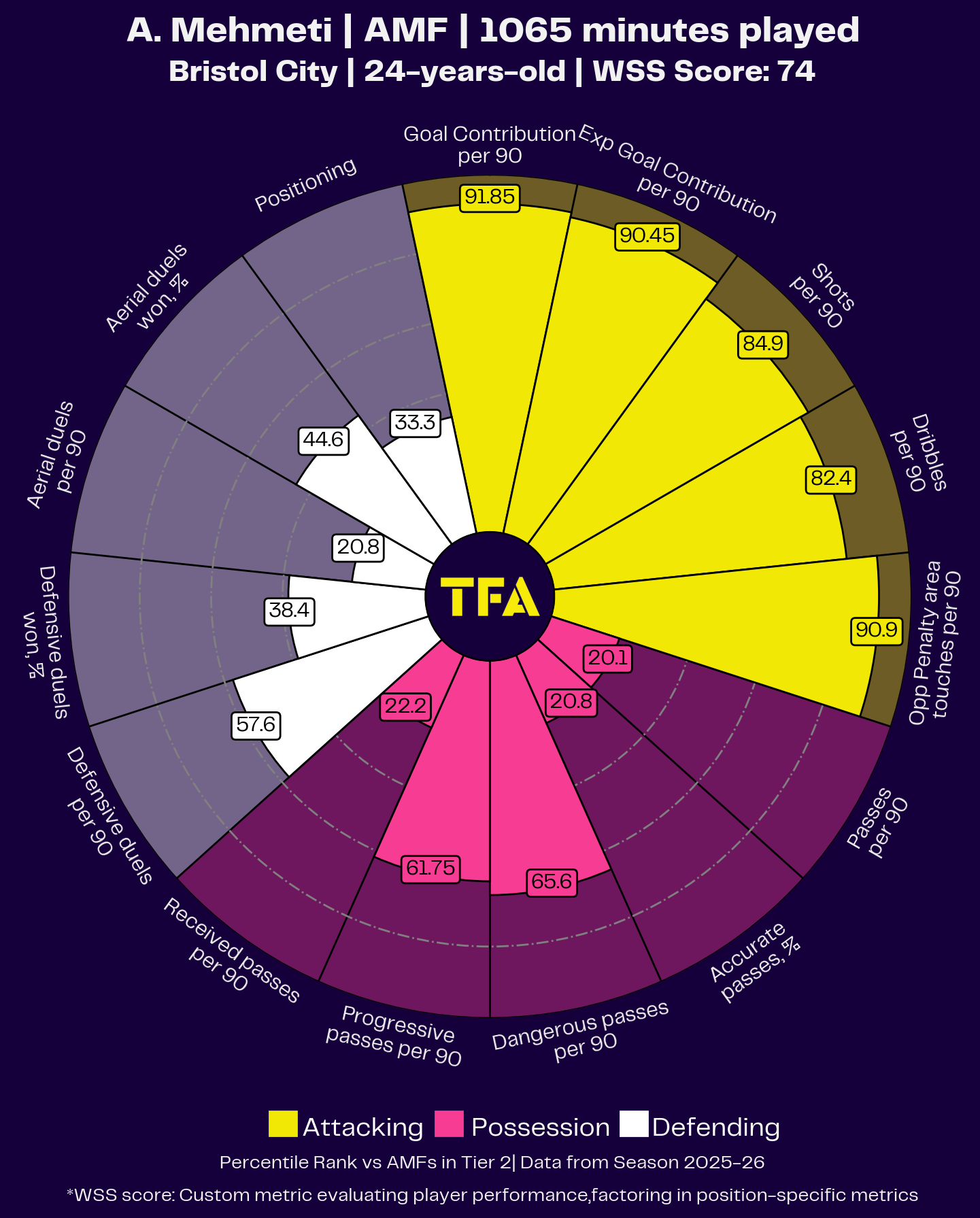
His Goal Contribution per 90 (91.85 percentile) and xG Contribution per 90 (90.45 percentile) sit at the top end of the spectrum.
When you add Shots per 90 (84.9 percentile) plus the absurd Opposition Penalty Area Touches (90.9 percentile), the picture becomes clear: he operates like a hybrid attacker who wants to finish moves, not run the entire structure of the attack.
His Dribbles per 90 (82.4 percentile) reinforce this, showing how aggressively he carries the ball, takes on defenders, and creates chaos higher up the pitch.
In possession, he’s competent but far from a high-volume playmaker.
Progressive Passes (61.75 percentile) and Dangerous Passes (65.6 percentile) prove he can advance play when he chooses to, but he doesn’t control tempo or act as the team’s connector.
The biggest red flags are Passes per 90 (20.1 percentile) and Received Passes per 90 (22.2 percentile), which are low for an AMF and signal long stretches where he isn’t involved, doesn’t demand the ball, and relies more on drifting into pockets than taking responsibility for possession.
It fits the eye test: moments of quality surrounded by gaps where he switches off or reacts late.
Defensively, the numbers tell you exactly why he shouldn’t be relied on in that phase.
His Defensive Duels per 90 (20.8 percentile) and Win Rate (38.4 percentile) are weak, showing he rarely wins challenges and offers little resistance in the press or in midfield battles.
His Aerial Duels per 90 (20.8 percentile) and average success rate add nothing either, which matches his profile.
Overall, the numbers confirm exactly who he is: a high-impact attacking threat with major gaps in involvement and defensive contribution.
Anis Mehmeti Style Of Play
Anis Mehmeti is a classic inverted left-sider who wants the game funnelled onto his right foot, receiving in the half-space, dropping a shoulder, and driving diagonally toward goal with tight, sharp touches.
He operates more like an inside forward than a touchline winger, relying on ball manipulation and timing rather than raw pace to open lanes.
On top of that, he’s the archetype of a goal-scoring midfielder: he pops up in dangerous pockets, arrives late in the box, and has the instincts to attack second balls and loose space the way Mason Mount does.
The Mason Mount/Fabio Carvalho blend actually fits: the same energy, same ability to combine between lines, and the same tendency to drift into central scoring positions instead of hugging the flank.
When he’s in rhythm, he links play and becomes a real threat arriving from midfield; when he’s not, he crowds spaces and slows the tempo.
Anis Mehmeti Attacking Output
Anis Mehmeti’s attacking output is the cornerstone of his game.
He behaves more like an inside forward than a traditional midfielder, constantly drifting into advanced pockets and arriving in the box at the right moments.
He positions himself aggressively between defenders, looks to attack the penalty area early, and consistently becomes the final action rather than the connector.
His instinct to drive towards goal and his willingness to take responsibility in the final third give him a genuine threat profile, even if his decision-making can still undermine the quality of those actions.
— Footie Clips (@FootieClips) November 30, 2025
Anis Mehmeti Dribbling
Anis Mehmeti’s dribbling is one of his standout tools in the EFL, especially when receiving on the half-turn and facing defenders directly.
He relies on tight touches, sharp body shifts, and quick changes of direction to create separation rather than raw pace.
Carrying the ball inside from the left, he forces defenders to retreat and opens shooting or combination lanes.
Beyond pure dribbling, he occasionally shows an eye for slicing passes, threading balls through tight channels to teammates in advanced positions.
The main limitation is consistency: while his ball-carrying can break lines and destabilise defensive structures, he sometimes holds onto the ball too long or takes an extra touch, allowing the initial opportunity to slip away.
Anis Mehmeti Finishing
Anis Mehmeti’s finishing relies heavily on timing and spatial awareness.
He arrives into scoring zones with good intuition, often attacking loose space rather than waiting for the game to develop around him.
His preferred actions, curling efforts when cutting inside, late arrivals at the edge of the box, and quick snapshots after carries, fit his profile well.
He’s not a cold-blooded, clinical finisher, but his movement and shot selection allow him to generate regular chances.
When he stays decisive and releases early, he becomes a genuine scoring asset; when hesitation creeps in, his finishing quality drops with it.
— Footie Clips (@FootieClips) November 30, 2025
Anis Mehmeti Positioning
Anis Mehmeti shows glimpses of intelligent attacking positioning: he often drifts into pockets between the lines and finds space to receive the ball, creating opportunities for himself and teammates.
These moments can unlock defences, especially against teams that leave gaps in midfield or between defenders.
However, his influence is inconsistent; at times, he reads the attacking phase well, while in other moments, he overcomplicates or delays the play, reducing effectiveness.
Off the ball in attack, he can struggle to maintain positional discipline, which can limit his team’s fluidity and options in high-intensity or structured systems.
— Footie Clips (@FootieClips) November 30, 2025
Anis Mehmeti Weaknesses
Anis Mehmeti’s biggest issue is decision-making, and it drags his whole game down.
He loves to show he can beat a man, but too often he turns simple actions into overcomplicated ones, holding the ball when the release is obvious, or finally passing it once the window has already closed.
It kills momentum and makes him look blind to teammates’ runs.
He also needs to sharpen his awareness in the final third: when to drive, when to combine, and when to shoot early rather than taking that extra touch that lets defenders recover.
Add in some inconsistency with his end product and a tendency to drift out of games when he’s not getting the ball in his favourite pockets, and you get a player who has the tools but wastes too many possessions. Cleaning up these choices would instantly raise his impact.
Conclusion
Anis Mehmeti projects as a high-impact, final-third attacker whose game is built on receiving high, turning quickly, and driving directly at defenders, which naturally pushes him toward transition-focused systems rather than structured positional play.
His profile may fit best in a 4-2-3-1 or 4-4-2 as an advanced playmaker who attacks space, or as an inverted winger in a 4-3-3, where he can carry inside and release runners.
He offers far less value in slower, possession-dominant systems, as he doesn’t control rhythm, lacks consistent scanning habits, and isn’t a natural connector in circulation.
Suppose he sustains his current Championship output while tightening the variability in his final actions.
In that case, he profiles as a dependable Championship starter with a realistic ceiling of attracting interest from lower-end Premier League sides or top-flight clubs in the Netherlands or Scotland, even those that prioritise ball-carrying threat and direct end product from advanced midfielders.
Should his efficiency plateau, he settles as a steady Championship piece; if he sharpens his decision-making and execution, he projects as a viable rotational option in a transition-oriented lower-Premier League setup.