
A bullfighter keeps waiting for his arrival in Europe, while he continues making merits in the Middle East.
Ezequiel ‘Equi’ Fernández is one of the most impactful Argentinian players to have emerged in recent times.
Making it to Boca Juniors first team at the same time as Valentín Barco, both Xeneize youngsters led the club to the 2023 Copa Libertadores final, which they ultimately lost 2-1 to Fluminense.
After that initial arrival into the first team, Equi became indispensable to Diego Martínez during the first semester of 2024.
As a structural piece of Boca Juniors, and as if he were a time machine, he brought back some of the most distinctive elements of Rioplatense holding midfielders from the golden age of Argentine football.
Ezequiel Fernández is a full ‘centro-jas’; a bullfighter with a flexible waist more typical of an attacker, strong use of both feet, and an overwhelming personality to impact the whole field.
Fernández surprisingly took his first step outside Argentina with Al-Qadsiah in Saudi Arabia.
Real Sociedad and Bayer Leverkusen showed interest in the player in this transfer market.
He has also had approaches from the Argentine National Team.
Called up by Lionel Scaloni in the FIFA international window for South American Qualifiers in September 2024, he showed a great level at the Olympic Games as a starting holding midfielder.
In this Ezequiel Fernández player analysis and scout report, we will examine Fernández’s immense talent and why there has been UEFA Champions League interest in the 23-year-old.
We will also look at his impact for Boca Juniors in two of the most important matches he has played so far: the Copa Libertadores final and a Superclásico against River Plate.
Ezequiel Fernández Style Of Play
Control From The Base
Ezequiel Fernández was part of a double pivot during his time at Boca Juniors under both Jorge Almirón and Diego Martínez.
However, he normally pushed his midfield partner away, sending him to occupy space between the lines.
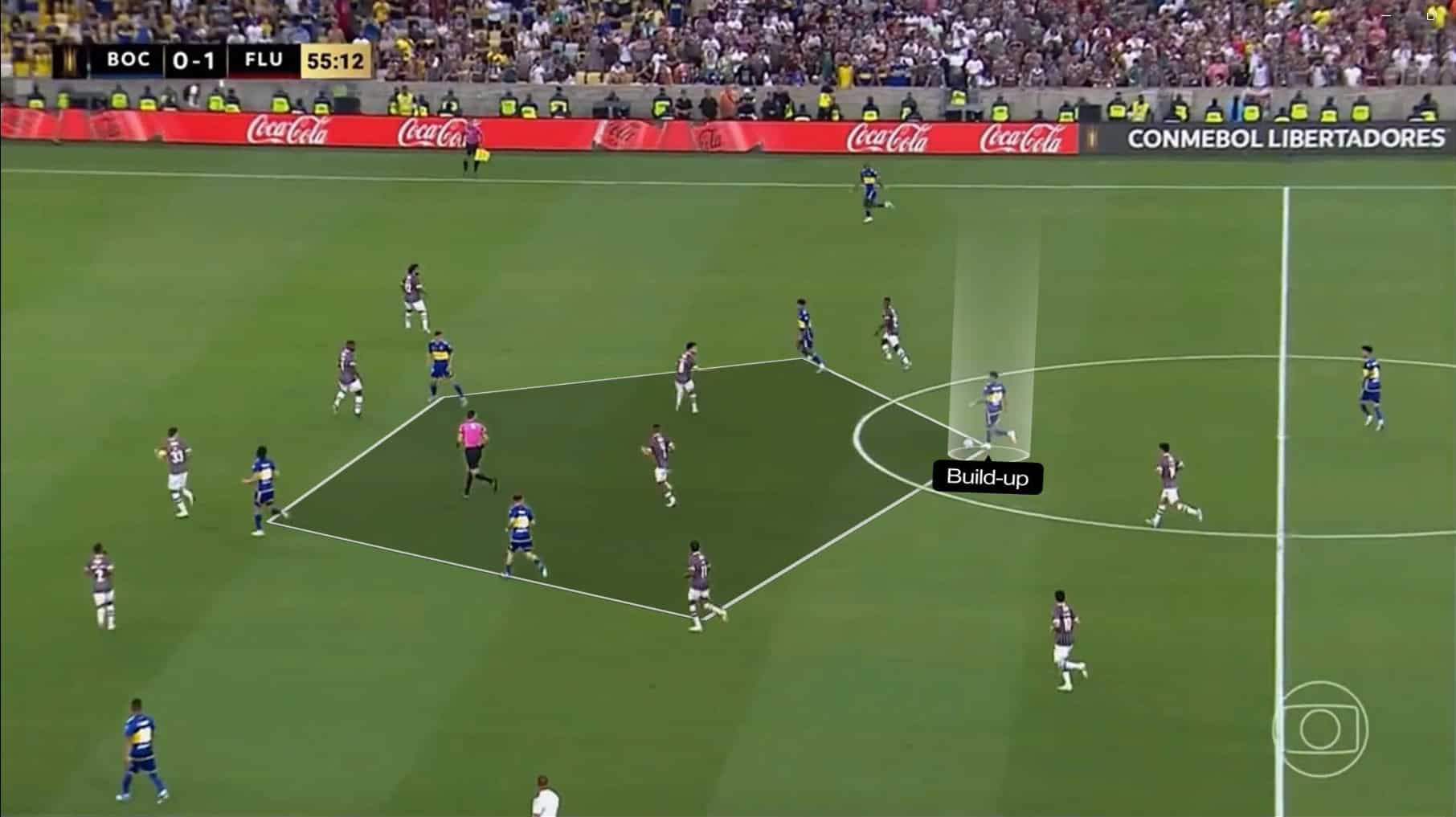
Therefore, Ezequiel Fernández usually had absolute control over the base of play, facing the field and having a good number of angles to take advantage of his wide passing range over both short and medium distances.
Here, in the build-up or first-phase construction, Ezequiel Fernández positioned himself behind the first line of pressure to exploit positional superiority and utilise both feet to receive on the far foot, thereby accelerating circulation.
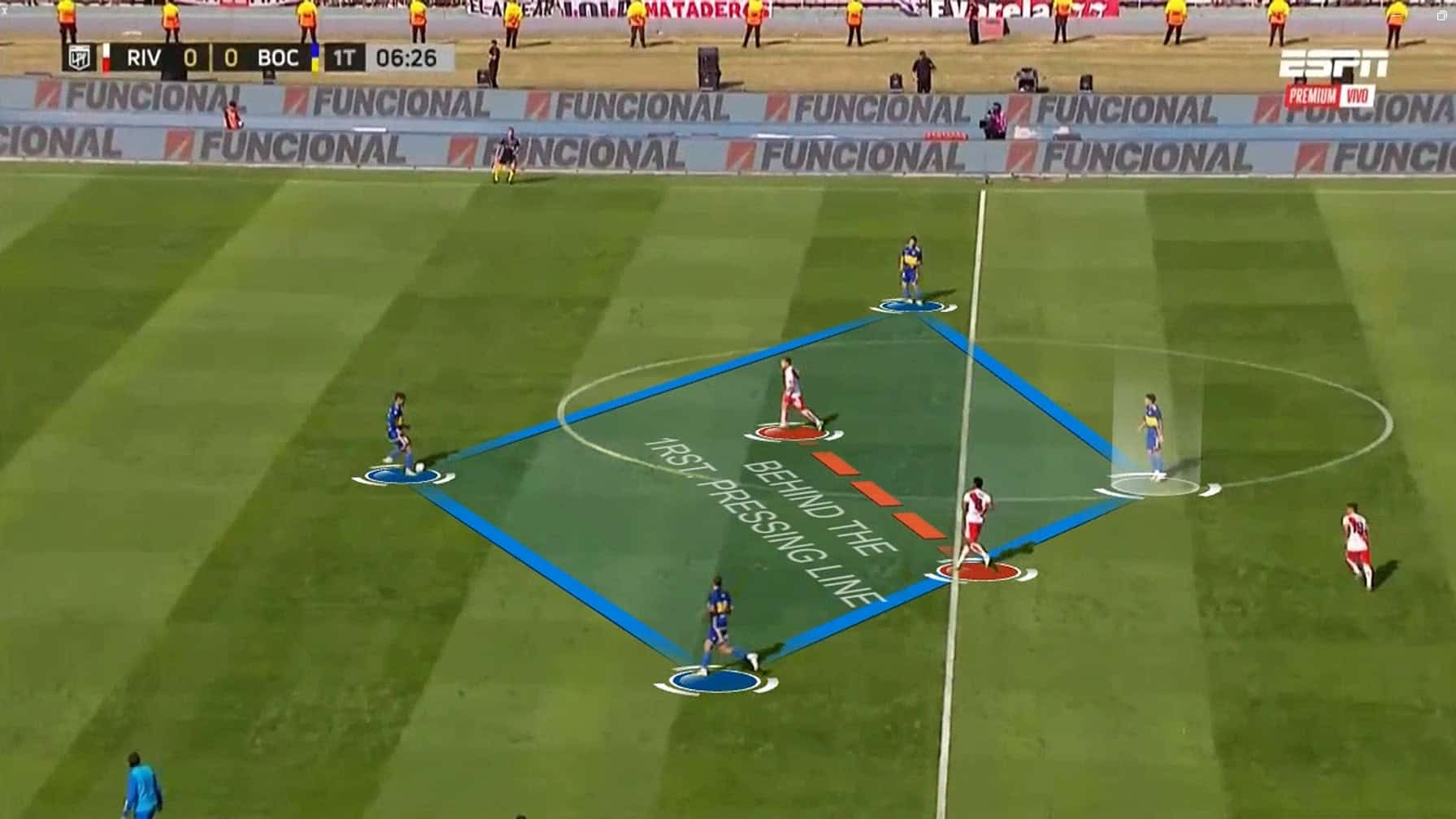
On other occasions, Ezequiel Fernández dropped between both central defenders to generate numerical superiority or receive facing the field of play (as the first passer) to attack by breaking the first line of pressure.
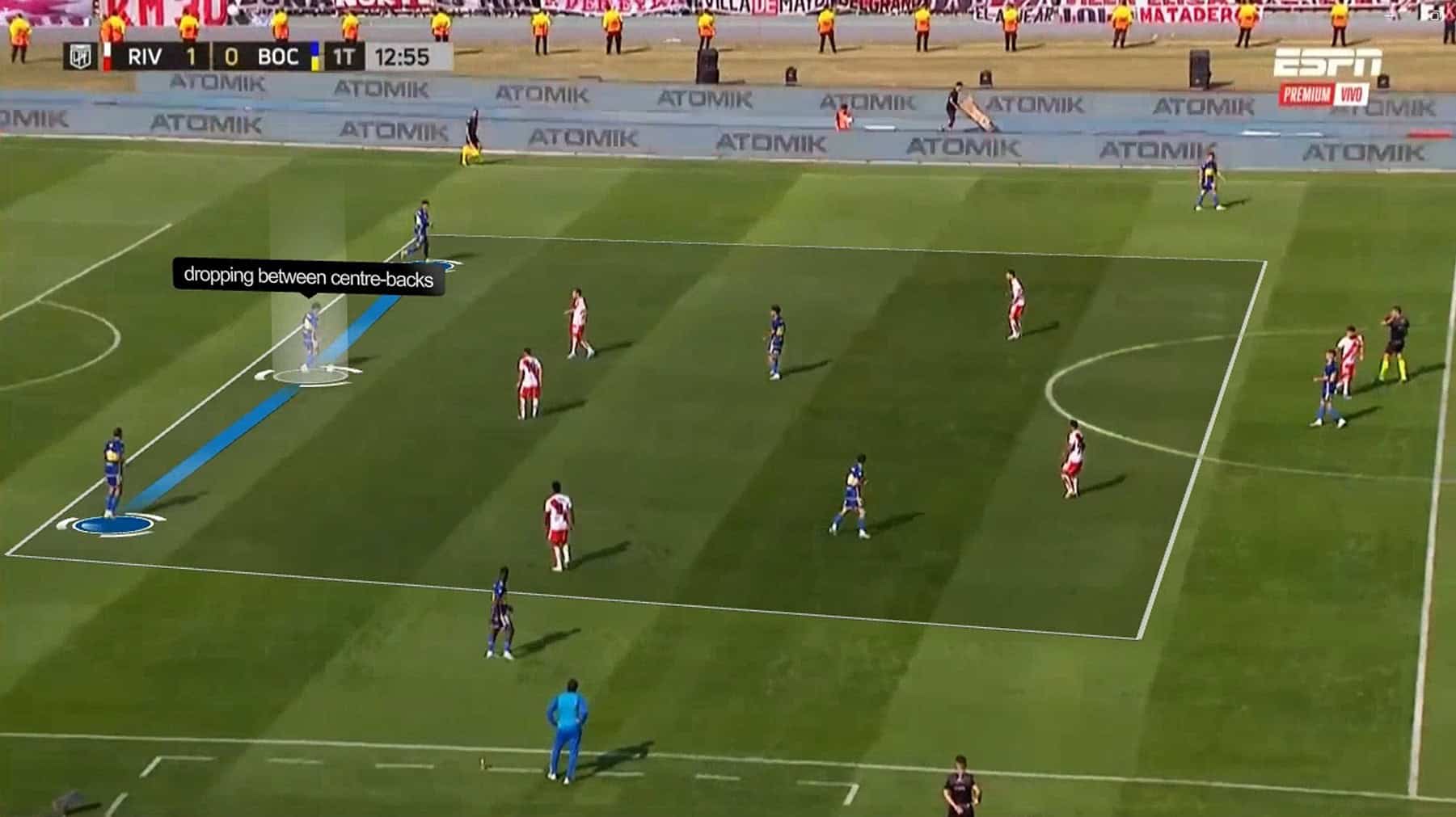
As we will see, Equi Fernández, beyond being a classic centro-jas (holding midfielder) who feels comfortable starting from the base, tends not only to move sideways but also vertically.
He is an organiser through movement who tends to repeat both short and long off-the-ball movements, climbing heights and absorbing pressure.
Equi Fernández Mocking Movements
It is necessary to escape rigid analytical frameworks that place Ezequiel Fernández only as a “classic pivot.”
One of Equi Fernández’s most recognisable behaviours is his constant dropping into the base of the play.
By retreating, he positions himself with the field in front of him, escaping immediate pressure and securing positional superiority over the opponent’s first line.
This movement not only allows him to act as the first passer in the build-up but also as the node that connects the defence with the intermediate heights, dictating tempo through sharp ground passes or turns that open new progressive lanes.
This habit of moving deeper to receive is always tied to an organising criterion upon reception.
He doesn’t just collect and release: he scans, profiles, and directs the next pass according to the flow of play.
Equi Fernández is more than a pre-existing mould, as explained through the dynamic that he generates in each play.
His short supporting movements allow him to continuously provide passing lines, absorb rival pressure, and sustain possession in deeper zones.
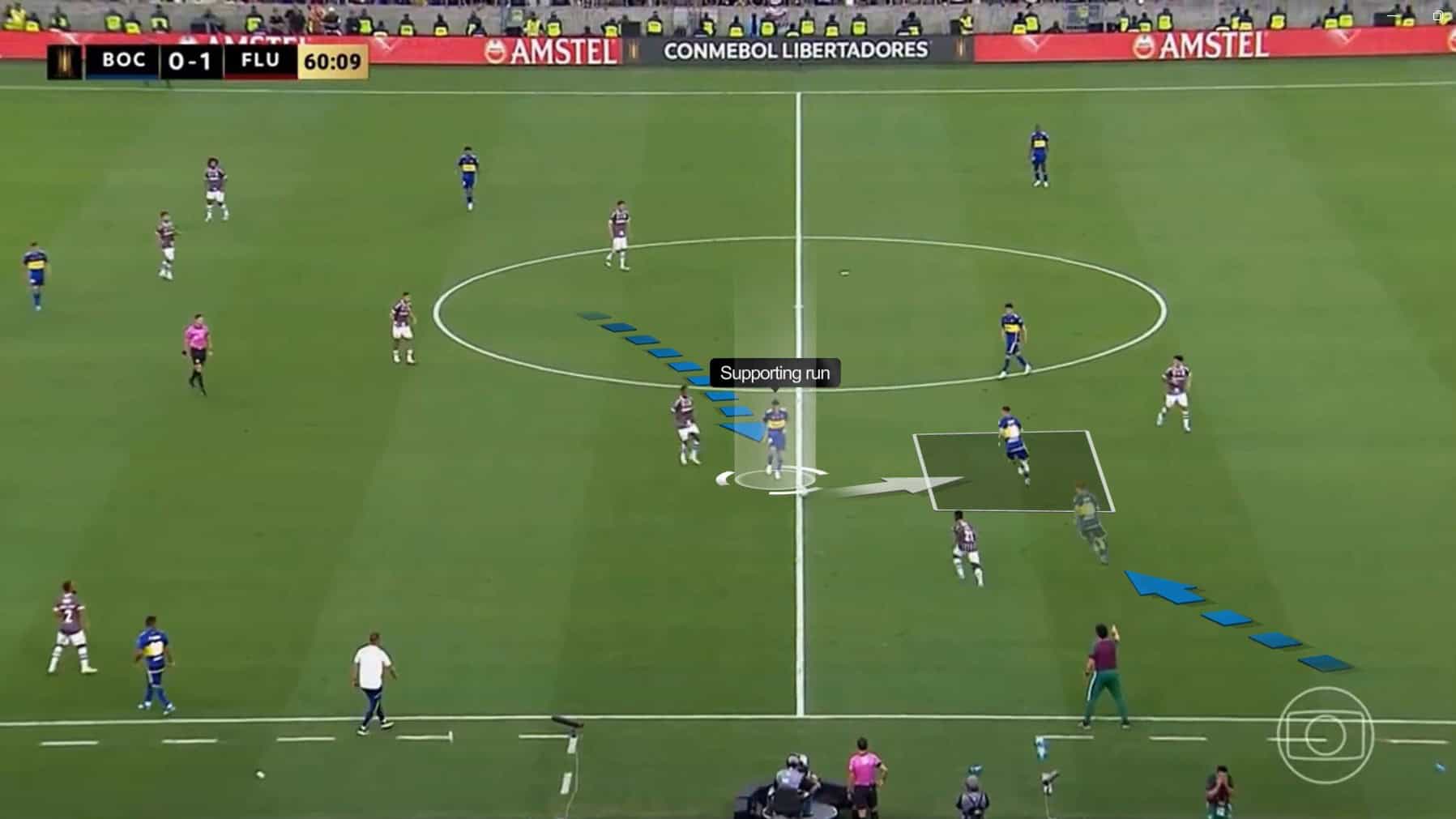
Far from limiting himself to that function, he also alternates with forward runs, climbing heights to receive in intermediate intervals and accelerate circulation.
This dual condition—support and rupture—turns his mobility into an offensive spring that gives the team fluency, keeping the game alive and projecting advantages beyond the opponent’s first line of defence.
Thus, what might seem like a holding midfielder anchored at the base is, in reality, a footballer who “mockingly” and permanently challenges our initial ignorance: a centro-jas not explained through stillness, but through his ability to move, offer himself and reactivate play with continuity.
Additionally, these constant movements generate indirect pressure on opponents, forcing them to readjust and make quick decisions that often create temporary imbalances.
This same dynamic allows Fernández or his teammates to find spaces to progress vertically or change the tempo of the game, making his influence extend beyond his contact with the ball to the team’s entire offensive structure.
Equi Fernández Hiding The Ball
Beyond his tactical awareness and mobility, one of Equi Fernández’s greatest virtues lies in his bodily resources to protect and manipulate the ball.
His powerful lower body provides a solid base to withstand contact and retain possession even under pressure.
At the same time, his active use of the arms allows him to keep opponents at a distance, creating just enough space to get into position or to connect with the next passing line.
This physical command is complemented by a flexible waist, supported by the flexion of his knees, which enables quick turns on his own axis in different directions.
These pivots, characteristic of his repertoire, are not merely aesthetic: they function as a tactical tool to evade pressure, shift the focus of play, and open new passing lanes.
To his physical resources, Fernández adds constant scanning of his surroundings, which allows him to anticipate the direction of the opponent’s pressure and orient his control towards the most favourable space.
In this sense, receiving with the far foot is not an isolated gesture but part of a broader cognitive-technical sequence: looking first, adjusting the body shape, and controlling the ball in a way that both protects possession and facilitates progression.
In this way, Equi Fernández combines strength, coordination, and sensitivity so that each reception not only secures the ball but also transforms into an advantageous action, whether by continuing circulation or by overcoming immediate pressure.
Equi Fernández Putting His Foot In
If Equi Fernández is in possession and good at keeping the ball away from your foot, defensively, he will pinch it until exhaustion.
His power is not limited to the offensive use of his body but also manifests in individual duels.
He stands out for his ability to pinch the ball, anticipating with his foot on the ball retained by the possessor.
He is always supported on a firm lower-body base (torso, waist, and legs) that gives him stability.
A strong upper body goes hand in hand with this, which allows him to go shoulder to shoulder and, at the same time, plant his foot in front of the rival to block the way forward.
This command in physical contact is complemented by an inexhaustible intensity in the repetition of efforts.
Equi Fernández immediately activates after a loss, chains successive duels to maintain pressure, and does not hesitate to jump outside his natural holding-midfielder zone to attack the opponent with his back turned.
This aggressiveness, far from being disorderly, responds to a fine reading of the moment: when to press, hold, and reiterate pressure until suffocating the possessor.
Equi Fernández unravels himself from the gaze that reduces him to an “organiser with good feet.”
In recovery, he shows another face: that of a footballer who combines physique, cunning and relentless will, a brutal repeater of efforts capable of conditioning the opponent both in his own half and in the rival’s.
Conclusion
The path of Equi Fernández shows a footballer who can no longer be read only as a prospect.
His control from the base, his support and rupture movements, his ability to turn and hide the ball, and his defensive intensity in duels shape a complete profile, with impact in all phases of the game.
Beyond the labels that try to reduce him (the “classic 5,” the “distributing pivot”), Ezequiel Fernández defines himself by his versatility within the same role: a holding midfielder who can provide continuity, accelerate circulation, break lines with the ball, support the team without it, and repeat defensive efforts with aggression.
This sum of qualities explains the interest of Champions League clubs and his progressive integration into Lionel Scaloni’s Argentina plans.
Everything indicates that he is ready to make the leap to Europe, not only as a bet for the future, but as a footballer already capable of competing with the elite.
At the same time, his maturity and consistency make him a natural candidate to consolidate himself in the Argentine National Team: a holding midfielder with classic Rioplatense traits but adapted to the demands of modern global football.
