
Thiago Almada floats across the pitch like any playmaker raised in the Rioplatense school.
He manages tight spaces, has lightning‑quick changes of pace, uses pauses as synonymous with rhythm, and delivers sharp passes (with a broad range of them).
However, despite floating and possessing the traits of a classic Argentine No. 10, his movements and runs are outside (or actually a fusion of all) those of No. 10s like Juan Román Riquelme, Pablo Aimar, Javier Pastore or Lionel Messi from 2022 World Cup.
The young Argentinian, developed in Vélez Sarsfield’s academy and who joined Olympique Lyonnais this year after winning the 2024 Copa Libertadores with Botafogo, is Argentina’s most sensational story this year.
A World Cup champion—having been called up by Lionel Scaloni and playing six minutes against Poland in the group stage—with practically a year to go until the next 2026 World Cup, Almada has sparked debate over earning a spot in the starting XI.
Messi’s absence during the March South American Qualifiers opened the door for Almada to start against Uruguay, where he was one of the standout performers and scored the only goal against Marcelo Bielsa’s side.
That brilliant breakthrough has become routine; he started the following three qualifiers—all in high-stakes matches:
- Started in the stunning 4‑1 win over Brazil at the Monumental (home),
- Assisted Julián Álvarez for a 1‑0 win against Chile away,
- Scored again to seal a draw in Buenos Aires against Colombia (home).
So yes, he’s not just numbers—he represents a shift in Scaloni’s ideas: how to handle intense pressing without sacrificing interior link‑play and asymmetries (while maintaining high representation of natural playmakers on the pitch: Rodrigo de Paul, Enzo Fernández, Alexis Mac Allister, Nico Paz, Leandro Paredes, and/or Thiago Almada himself).
Listen to this article free on the Total Football Analysis Podcast via Spotify, Apple Podcast, or RSS.
Back‑To‑Goal Second‑Striker Turned Enganche
Including Thiago Almada in Scaloni’s starting XI brings both fresh energy and a tactical solution to Argentina’s growing issues.
In his early days at Vélez, he played as a back‑to‑goal second striker, showing a remarkable ability to generate and manage chances independently.
Over time, he dropped deeper, broadening his vision and range of movements, and now often faces the goal from a more withdrawn position.
He has retained impressive lower-body strength—his balance and strong core make him especially effective under tight pressure.


Figure 1. Thiago Almada dropping into space behind the first line of pressure, using his arms to shield the ball and fend off man-oriented marking.
Scaloni has allowed him the freedom to roam the midfield, deploying him in various formations (left midfield in a 4‑4‑2 or second striker in a diamond) much like the liberty once afforded—though differently—to Lionel Messi.
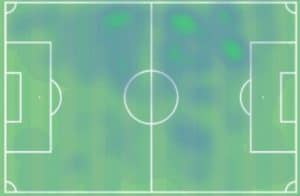
Heat Map: Clear preferred zone of influence on the central-left area.
Unlike Messi, who resisted pressure with exceptional vision and awareness, Thiago Almada handles pressure like his idol, Riquelme, using his body to shield the ball and maintain control with a sturdy upper frame.
Like Pablo Aimar, his low centre of gravity and hip‑leg coordination enable him to twist, turn, and deceive defenders with subtle feints.
His cerebral development is inseparable from his physicality—he dribbles instinctively because he’s a product of the street soccer culture (“potrero”).
“The virtuous footballer is, to a great extent, the result of compensating for many deficiencies, imperfections, and even physical flaws—limitations that often sharpened his ingenuity to overcome opponents who had the advantage in physical terms but who, interestingly, precisely because of their superior physical traits, found it difficult to be skillful, elusive, or even talented in the bodily control required to master the ball”.
— As explained by Dante Panzeri, legendary Argentine journalist and author of Football: The Dynamics of the Unforeseen (1967).
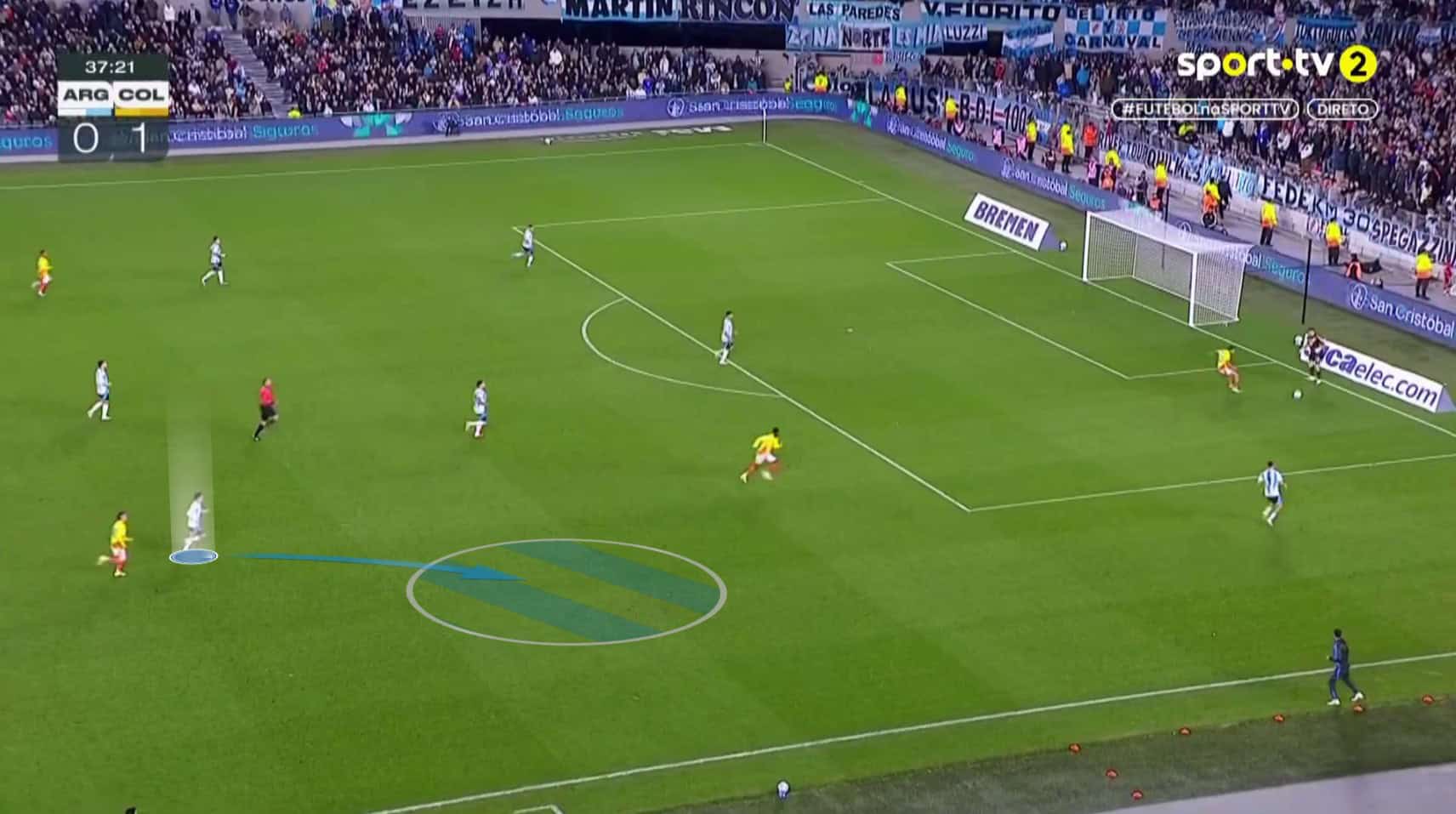
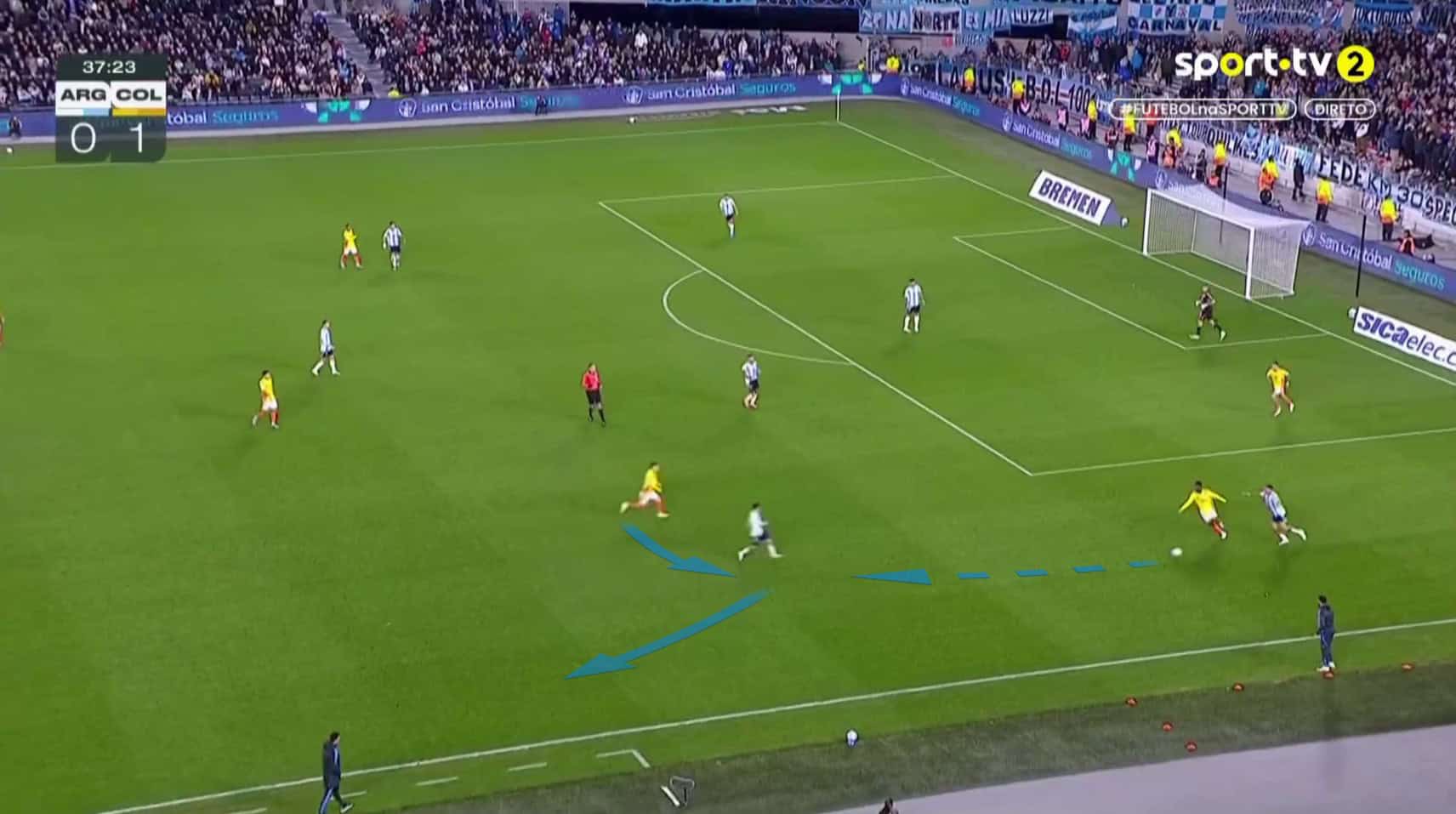
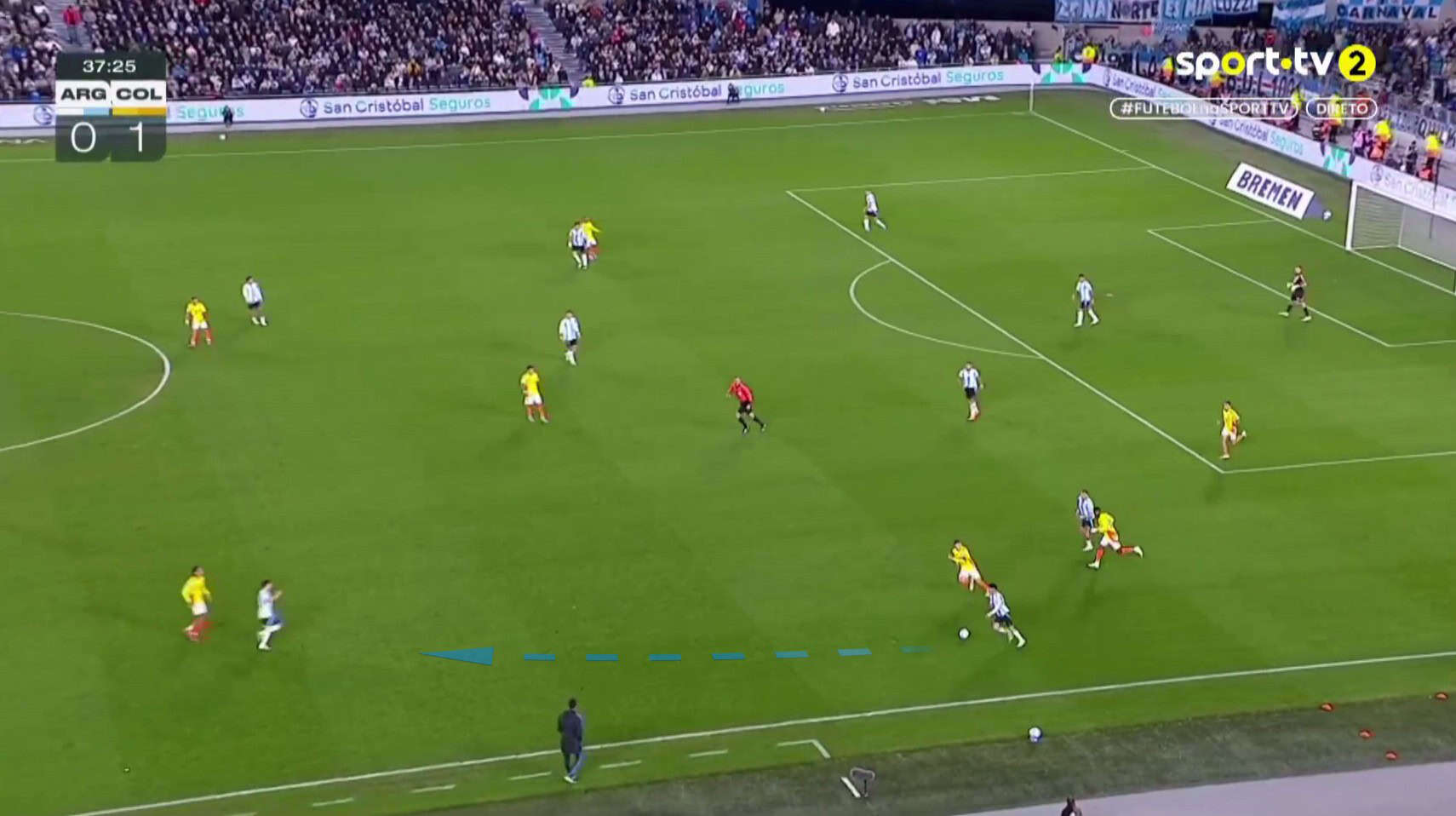
Figure 2. Thiago Almada drops with pressure on his back, evading his marker without touching the ball, using deceptive body orientation—initiating a hip turn in the opposite direction to outmanoeuvre his opponent and escape pressure.
These traits allow him to drop deep, win the ball from centre-backs, and initiate build‑up from deeper areas.
In recent qualifiers, he’s become a key part of Argentina’s early build-up, frequently initiating or restarting play.
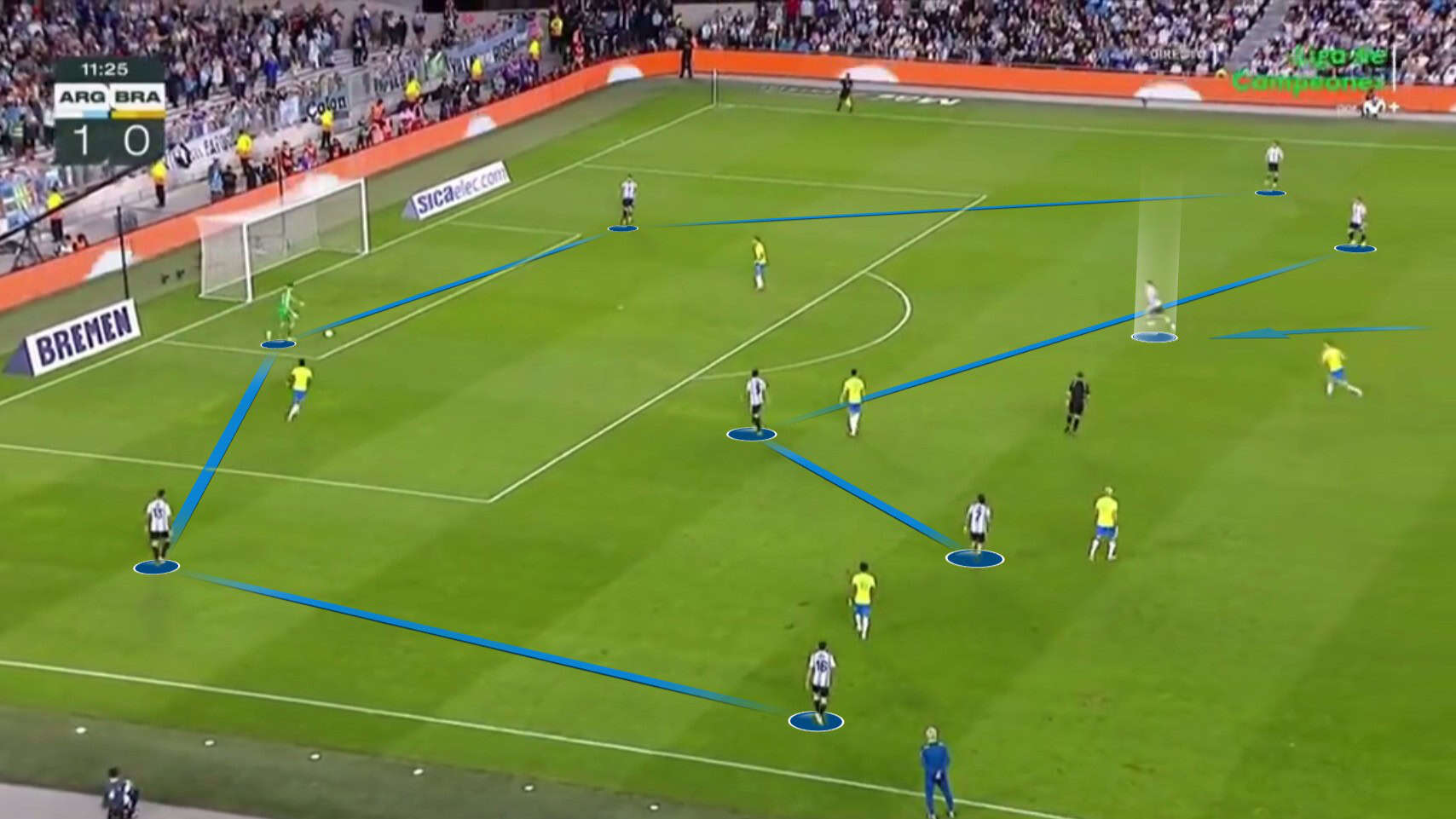
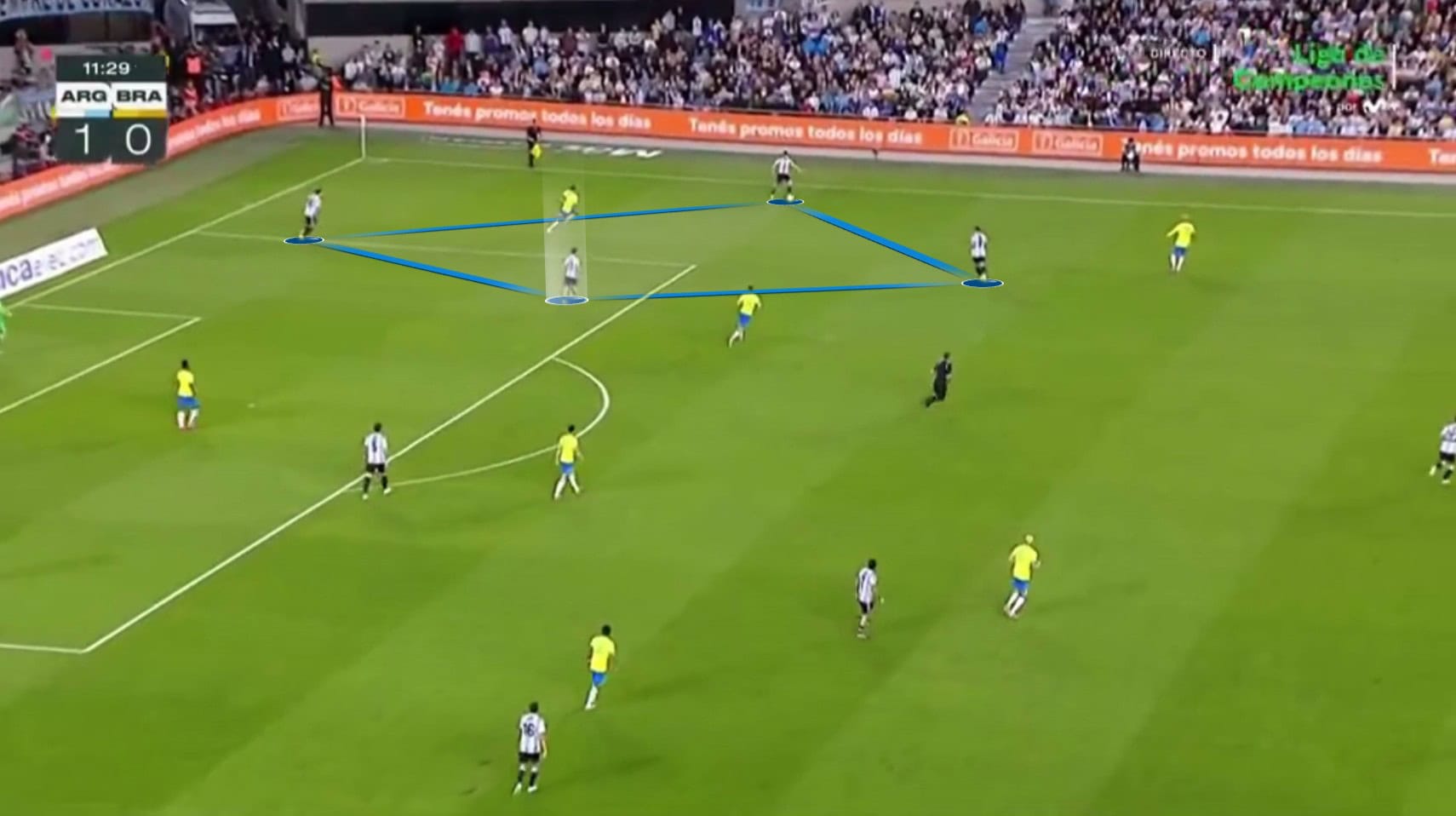
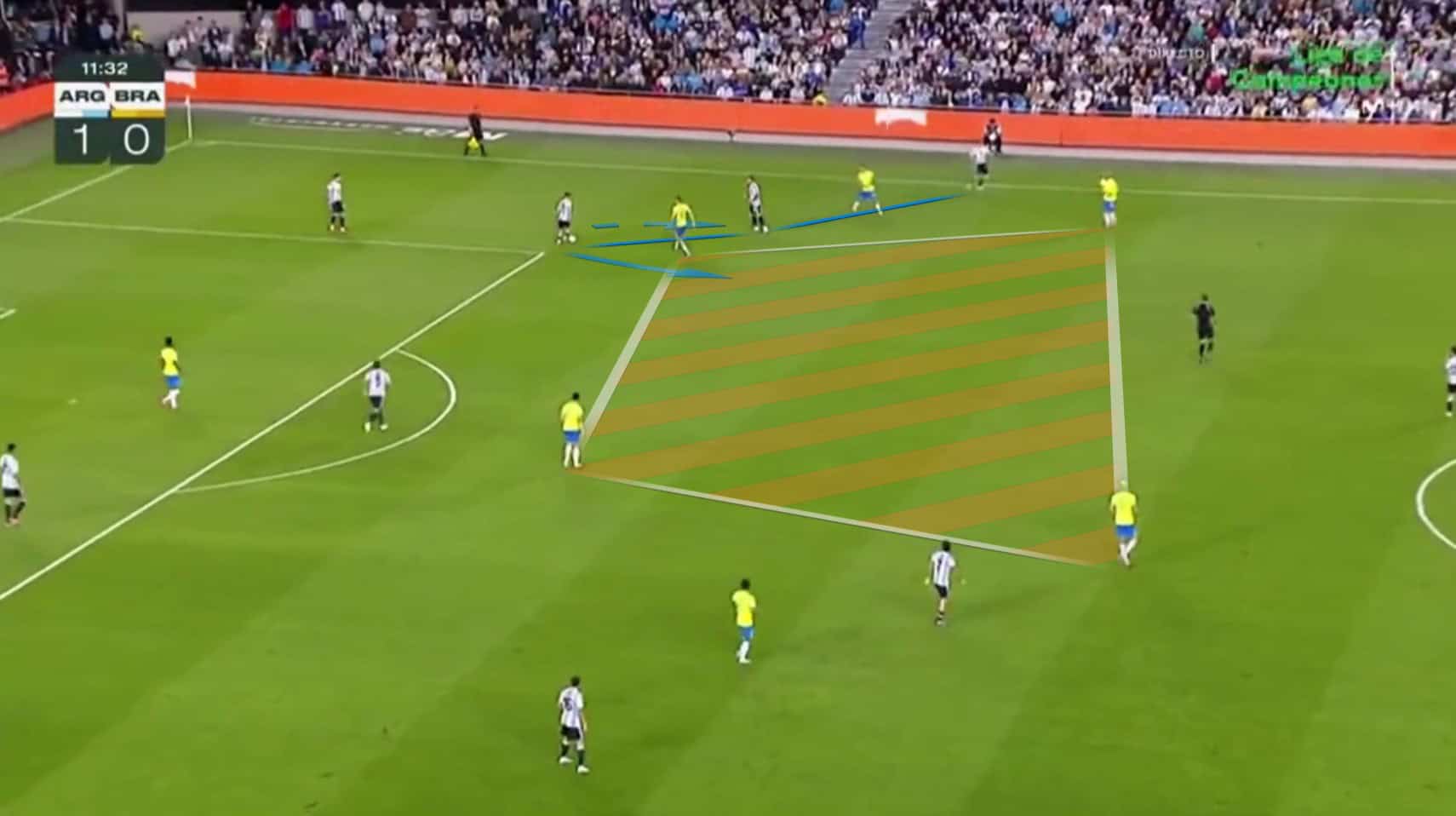
Figure 3. Thiago Almada drops into the build-up line during the first phase; his movement creates both numerical and dynamic superiority, particularly when play shifts toward the flank.
Ultimately, Thiago Almada is Scaloni’s functional wildcard—a player who thrives amid man‑oriented pressing and aggressive defensive setups, maintaining high-level game performances.
In short, it is a modern No. 10 emblematic of Argentina’s current winning identity—not just vision or rotation, but physical resilience under pressure while floating freely across the pitch.
From Long Runs To Short Movements
Although Thiago Almada’s resistance to pressing is central, the best explanation comes from Scaloni:
“Those who play well can play together; and those who play well next to others who also play well, play even better.
Thiago (Almada) is just now breaking into the team, but he’s been with the national setup for quite a while.
He can play inside, outside.
He moves very well in tight spaces and does an incredible amount of work”.
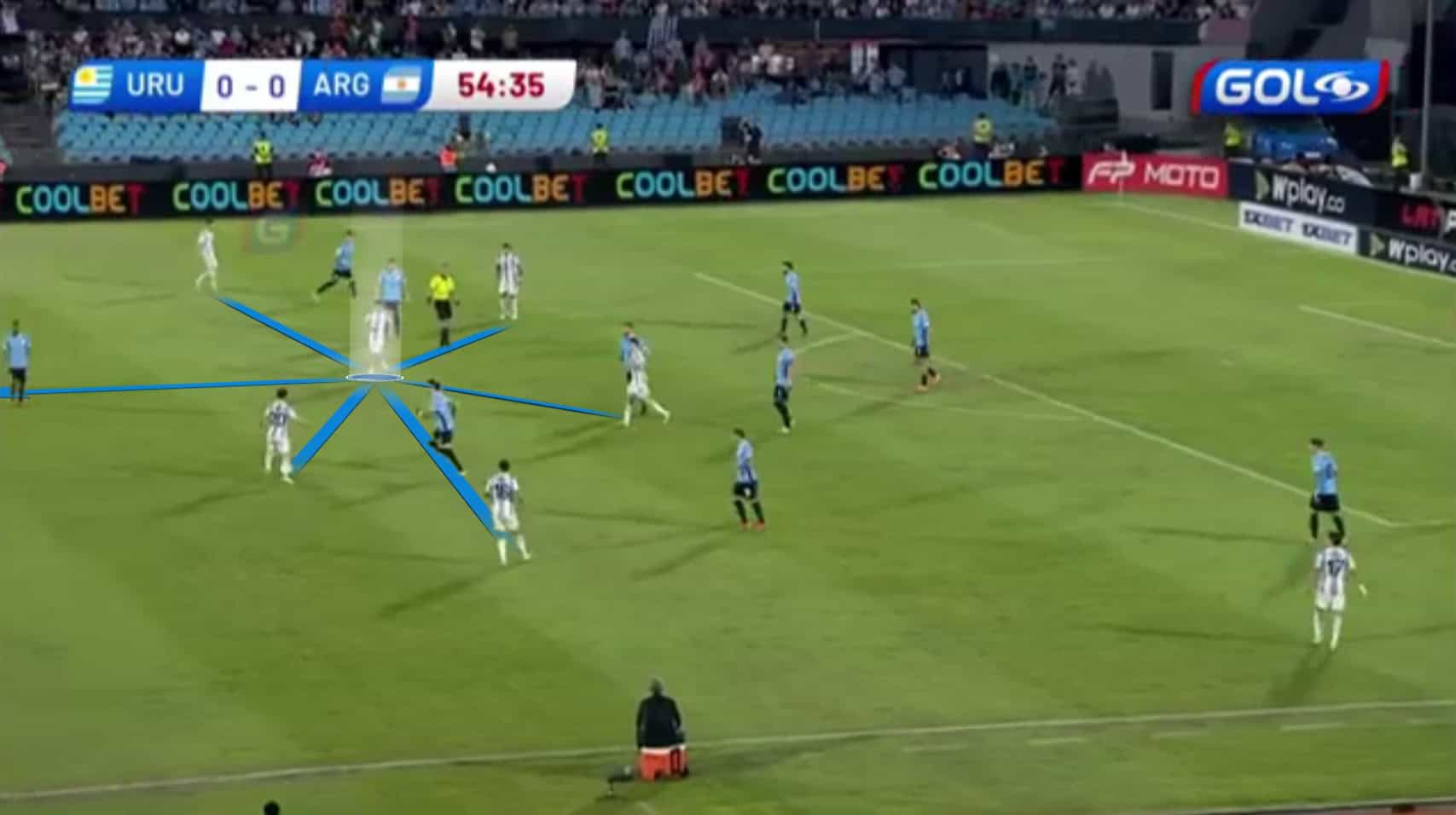
Figure 4. Enganchecentrismo: the playmaker as the gravitational centre of the game; Thiago Almada attracts multiple teammates around the ball, fostering tight combinations, technical density, and spatial control.
In essence, he’s an enganche who repeats effortlessly.
Unlike many classic Argentine attacking midfielders, he’s a hybrid between forward and midfielder, omnipresent, moving along both horizontal and vertical axes.
He not only drops deep to collect from centre-backs and bypass defensive lines but also frequently hovers between the lines or makes runs behind the defence.
His football IQ—floating across the pitch—is what cements his starting role.
Scaloni’s model relies on movement (time creation) to generate space, rather than occupying fixed zones.
In the Uruguay match, his lateral drops and wide runs dragged his marker out of position, creating width for Nicolás Tagliafico and opening buildup space, while allowing Álvarez to drift into midfield.
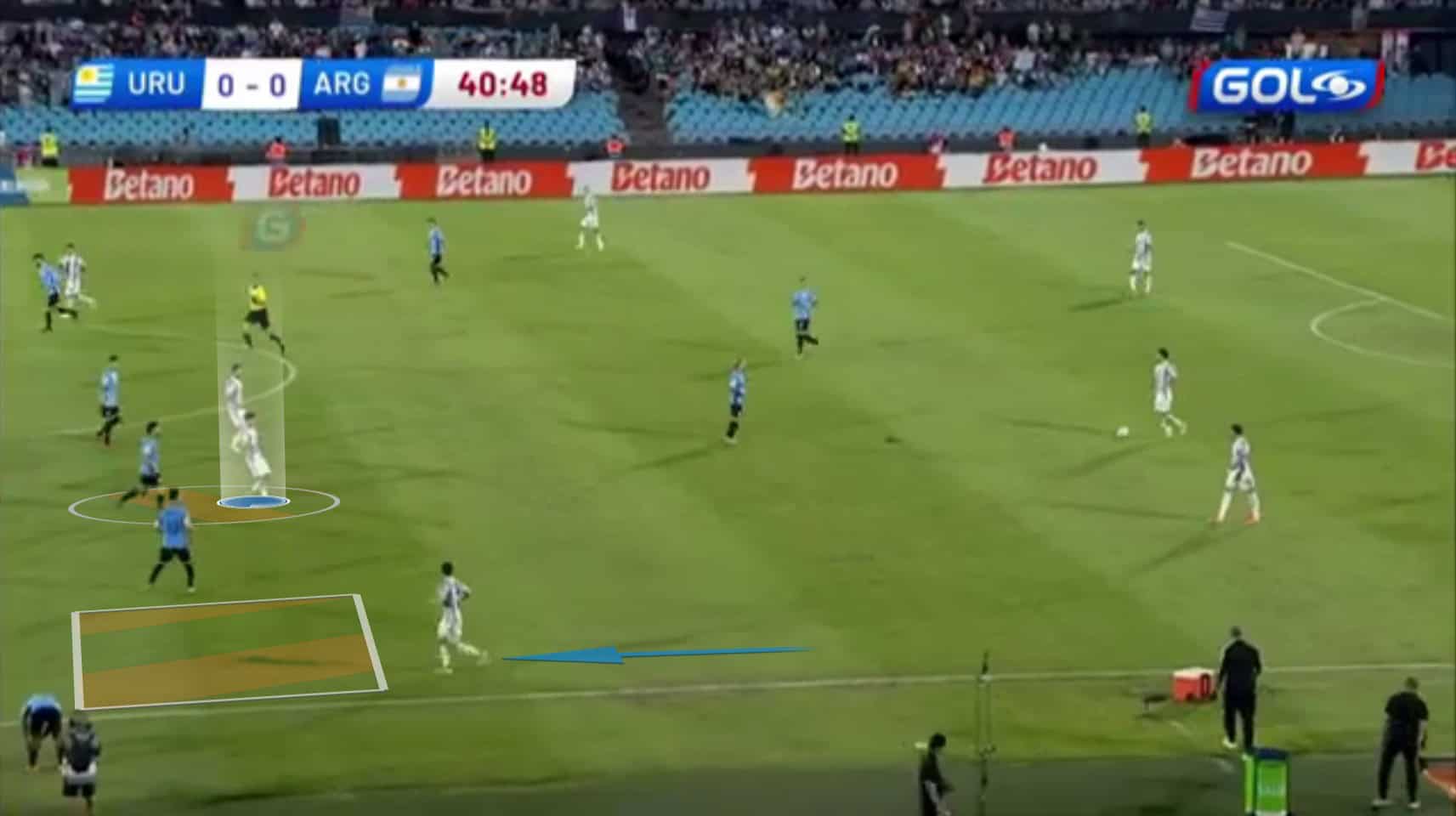
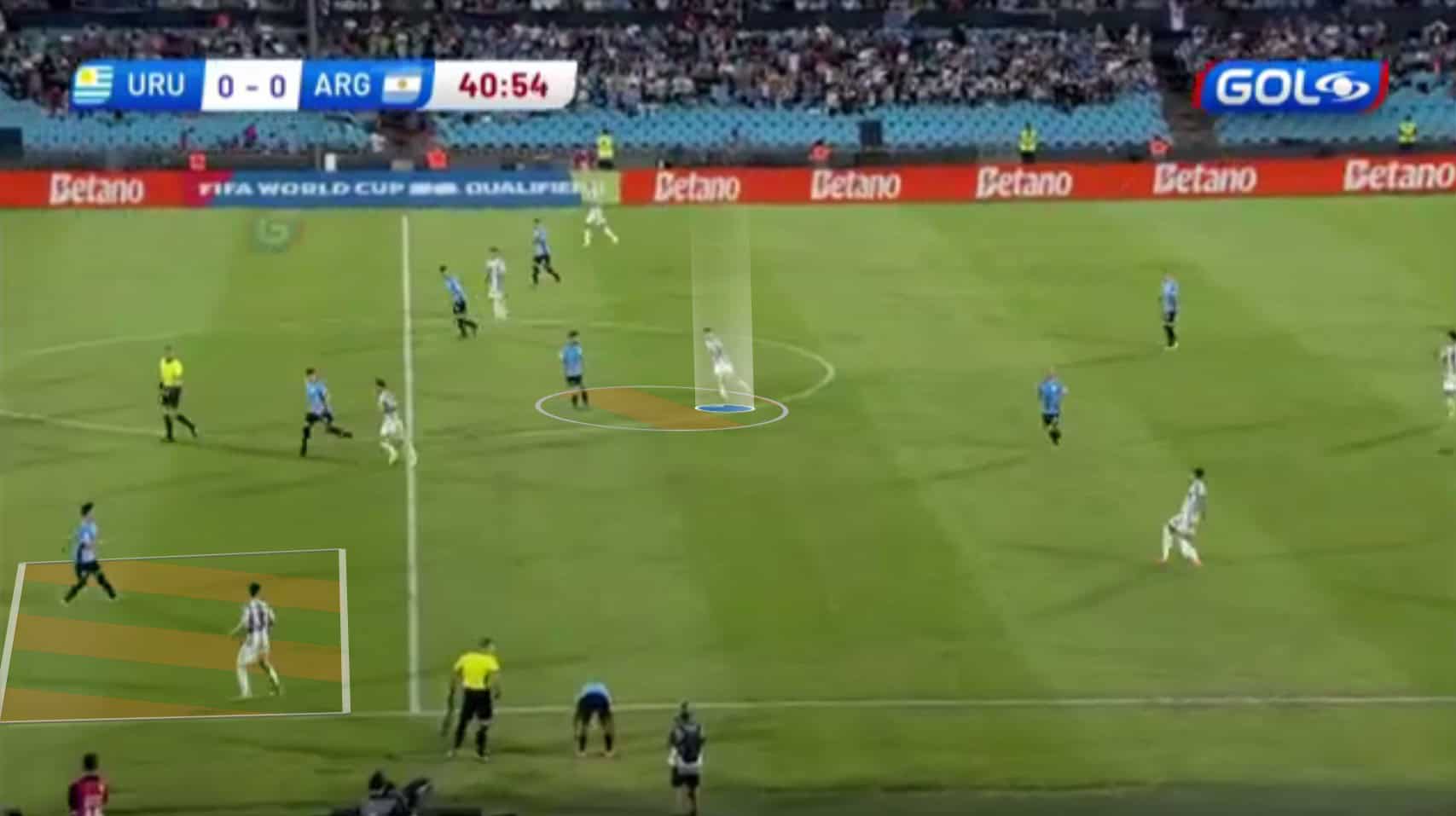
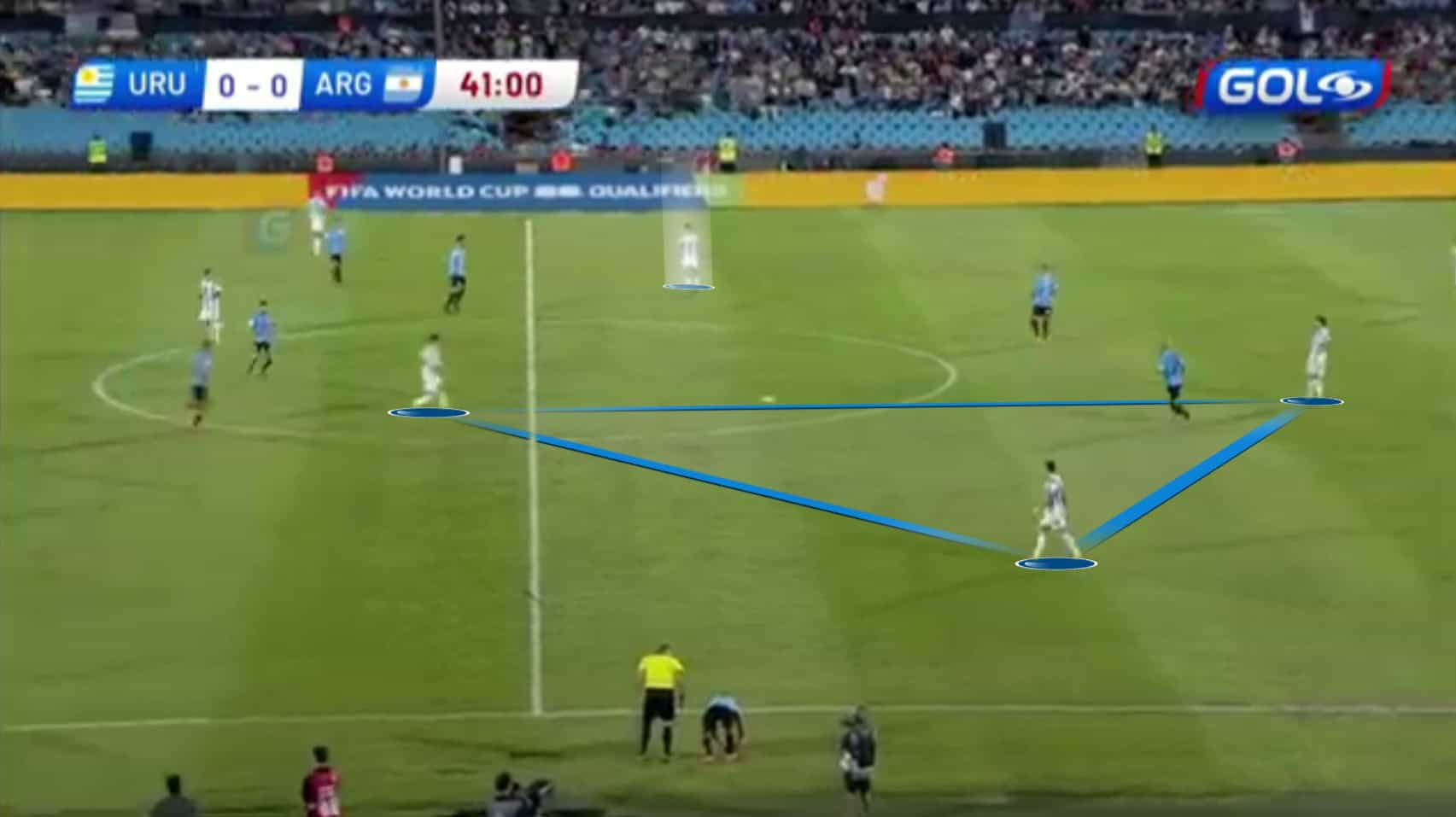
Figure 5. Thiago Almada’s lateral movement pulls his man-marker (the opposing right-back) out of position; this action frees the lane for Tagliafico to advance wide, opens interior space for the left centre-back during build-up, and allows Julián Álvarez to drop and engage in creation.
This mirrors the Rioplatense-school off‑the-ball movement.
He often uses one‑ or two‑touch passing, thriving in wall‑passes; part of why he fits so well in Scaloni’s system.
Patricio Hechem explains the style:
“La Nuestra is the opposite of positional play.
Argentine players like to be free and mobile, to get close to the ball, to receive, pass, and then go looking for it again.
They enjoy linking up, combining, even invading each other’s space to create plays and set up quick one‑twos”.
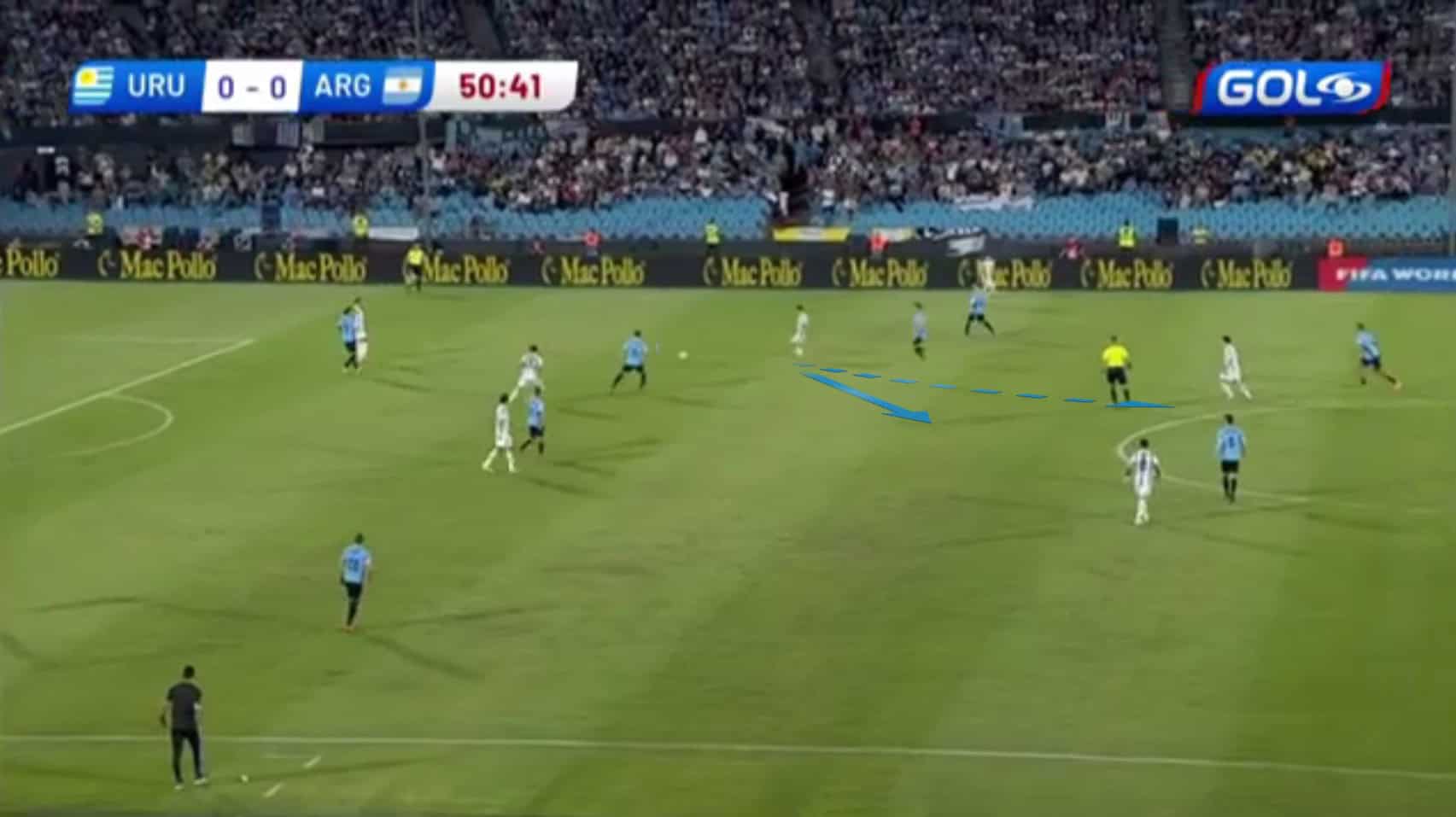
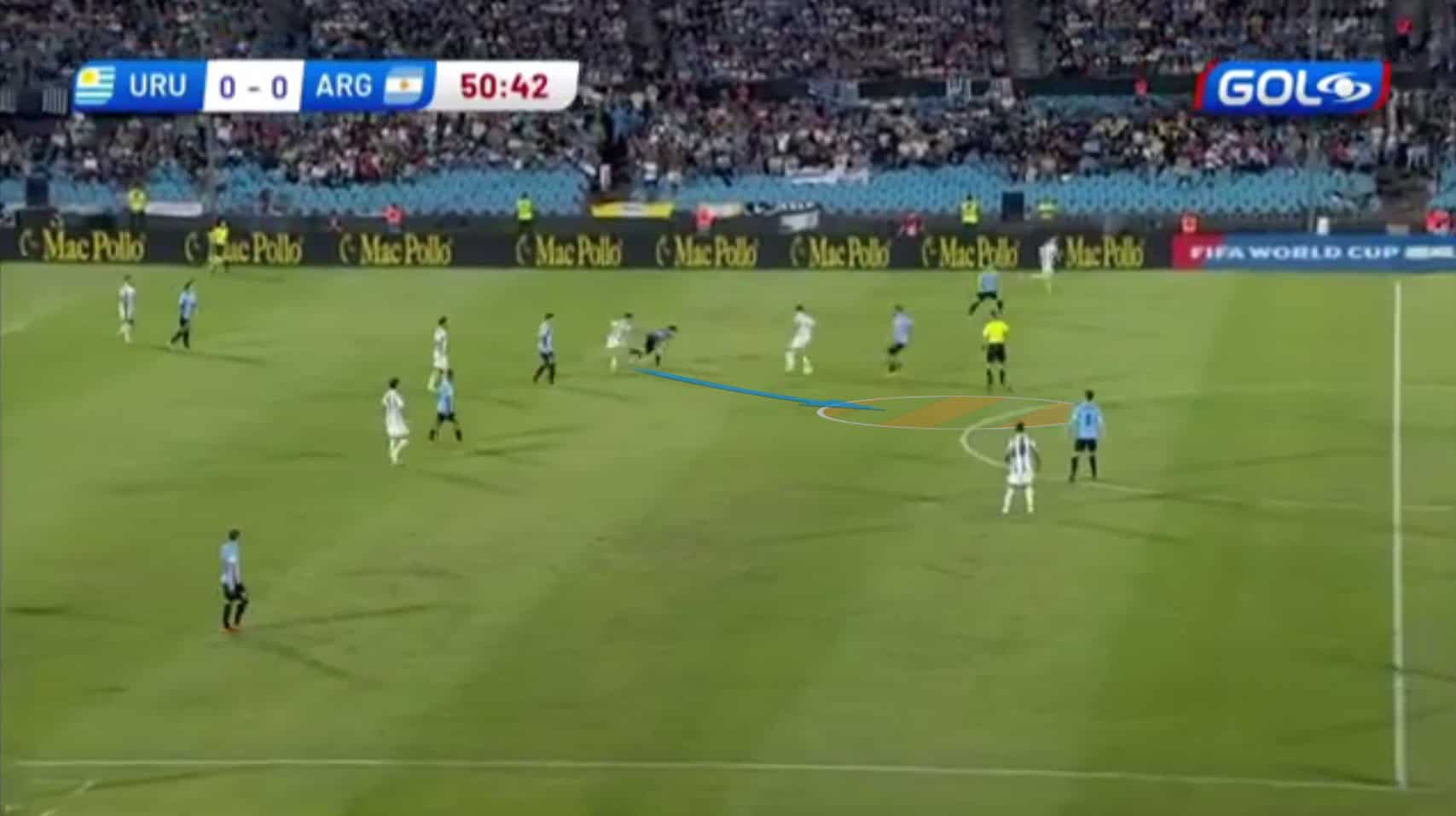
Figure 6. One of Scaloni’s trademark combinations: Thiago Almada receives with his back to goal, plays a one-touch pass to Julián Álvarez, and immediately attacks the return space; the sequence relies on footballing socio-affectivity—trust-based, intuitive partnerships—and dynamic superiority to solve situations of numerical equality.
This results in asymmetric shapes, diagonal passing lanes, to‑and‑fro patterns, dummy runs, and off‑the-ball feints.
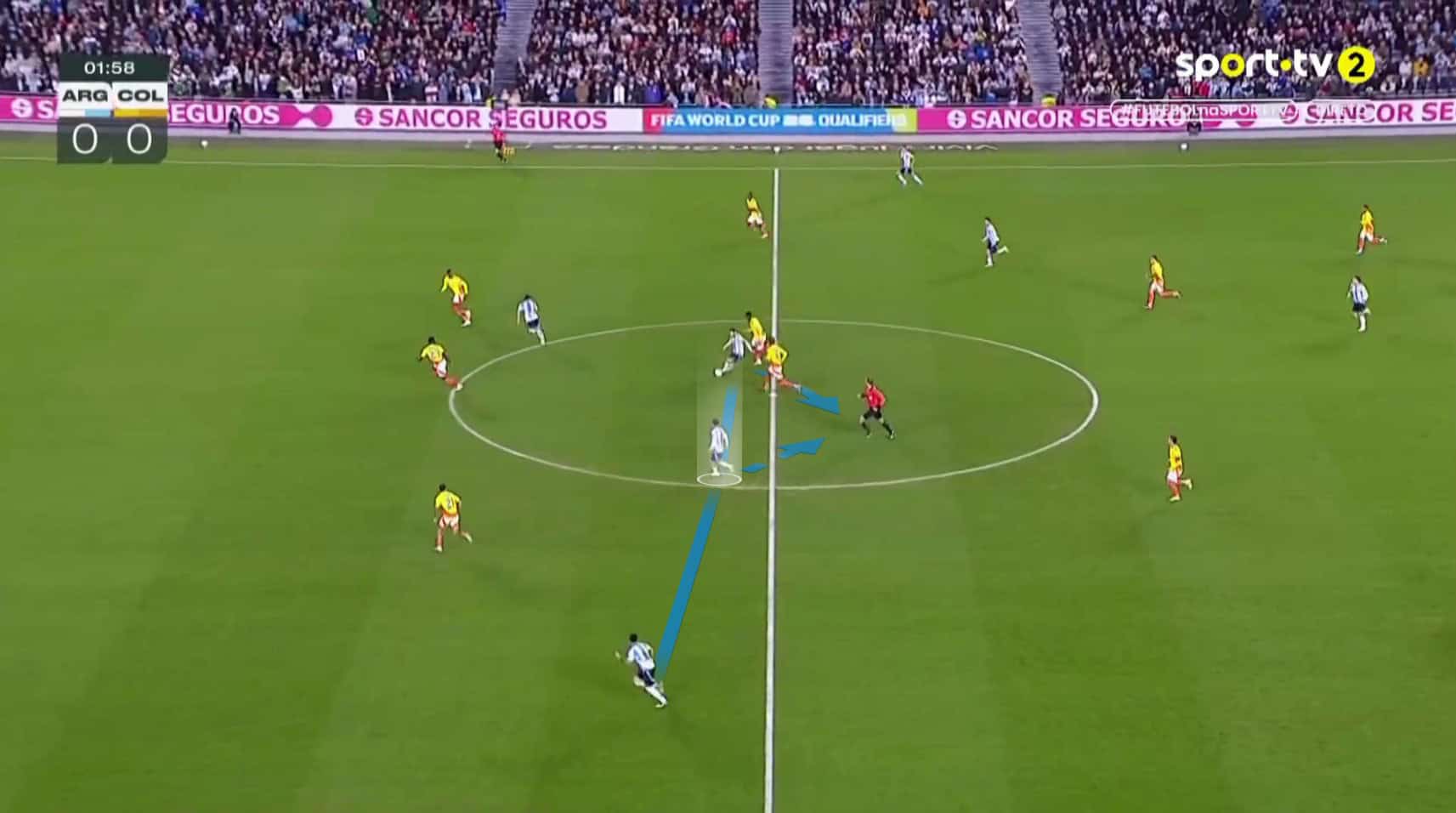
Figure 7. A classic asymmetrical structure aimed at building field “staircases”; Thiago Almada plays a one-two with Messi, who then switches the play to the highest step of the staircase, enabling vertical progression and rational spatial occupation.
Sometimes, when multiple playmakers converge, the focal point shifts to Almada; at other times, he acts as a forward, waiting on the weak side to receive and drive or orchestrate attacks.
Attacker’s Mentality
As mentioned, Thiago Almada is a No. 10 who has spent a long time playing more like a forward than a midfielder.
As a 2021 Total Football Analysis article on him at Vélez described:
“Almada is a very hardworking player with and without the ball, in both defensive and offensive phases.
In attack, he constantly seeks to receive—as previously analyzed—but he also makes progressive runs behind the rival defense to receive and stretch the backline, creating space for others”.
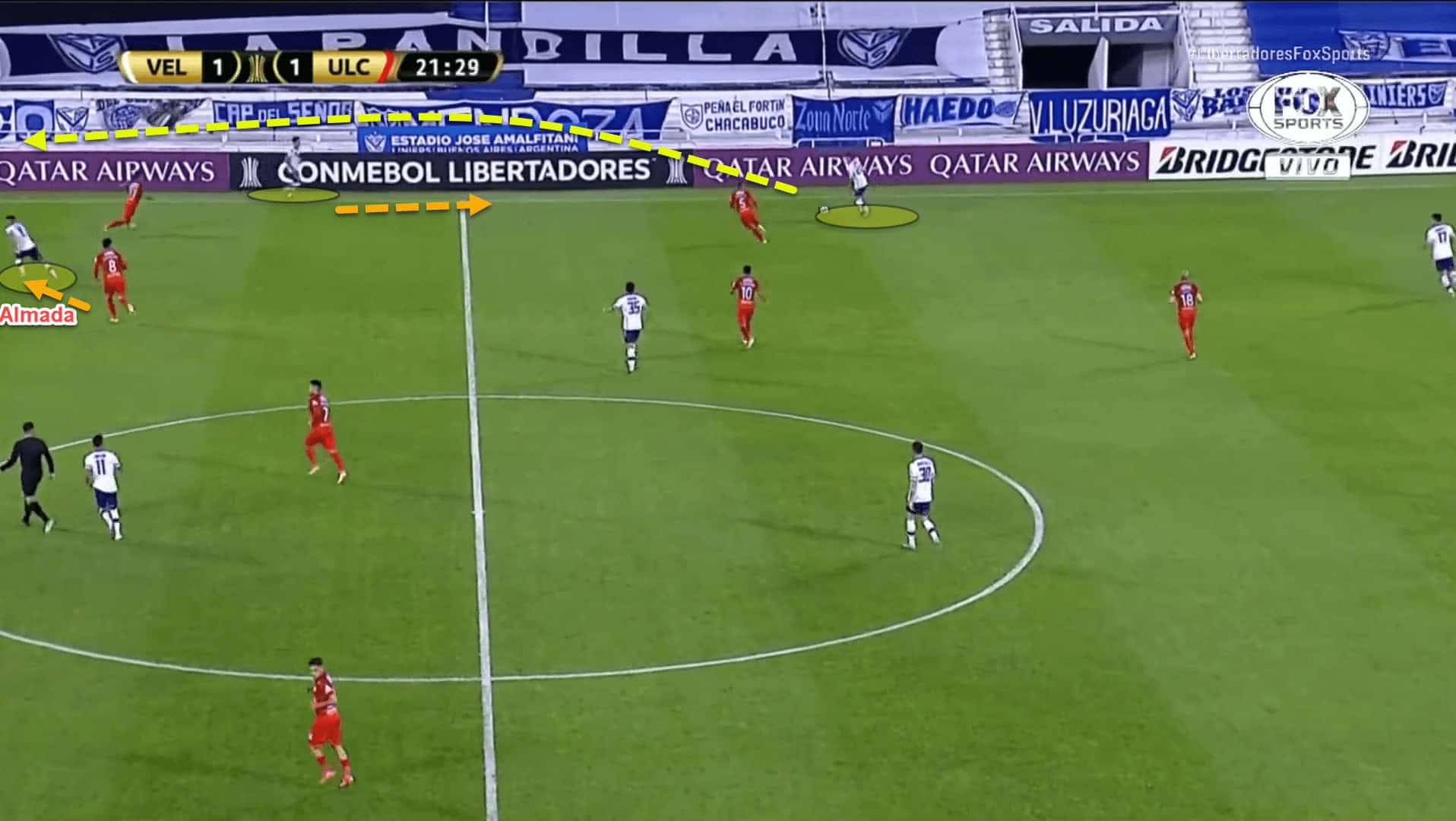
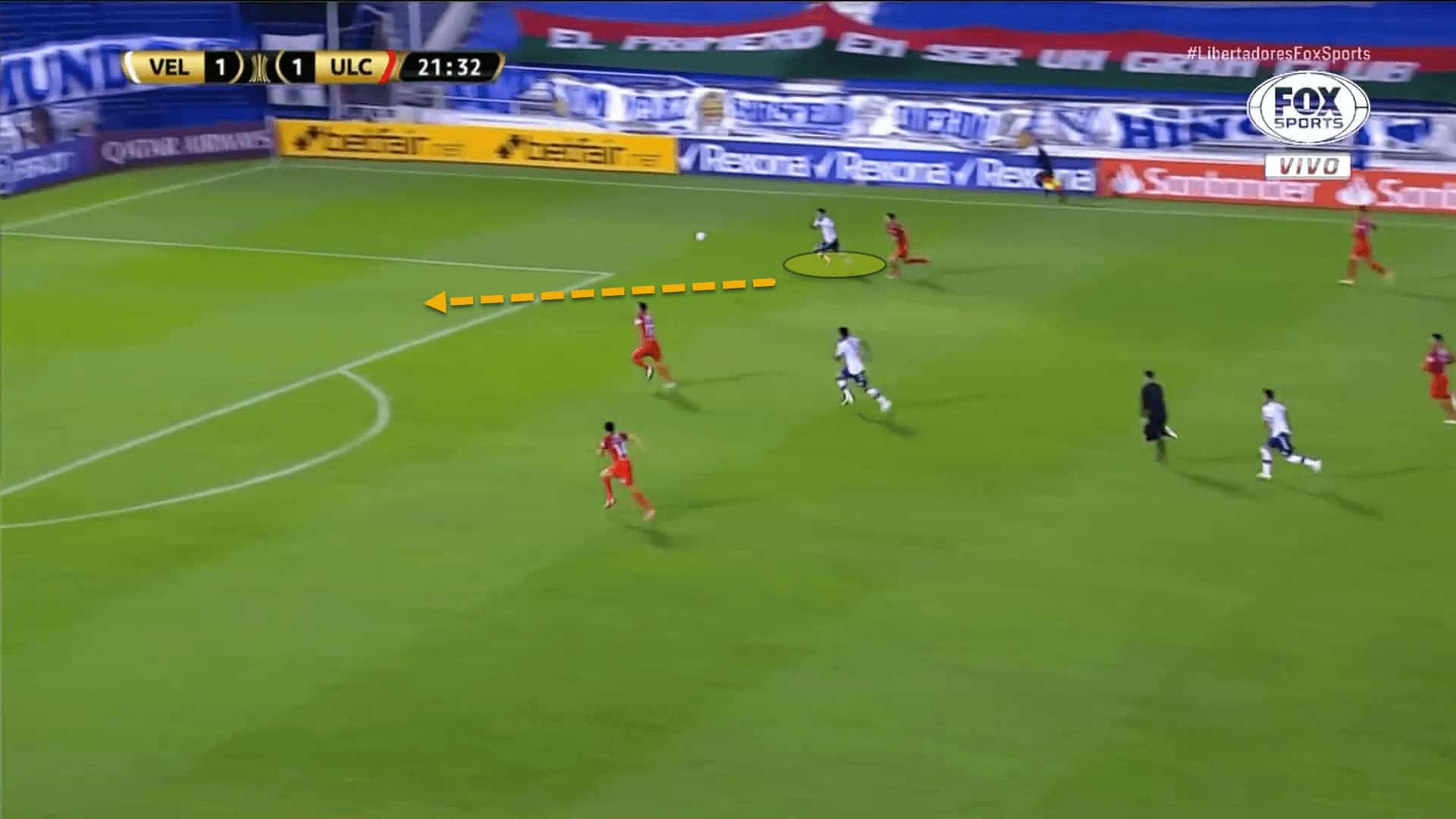
Figure 8. Thiago Almada exploits the space created after the full-back is drawn out by the winger, attacking with open field ahead and a clear Qualitative Superiority in a footrace against his marker, the central defender.
This is why he’s not a classic enganche: beyond his physical strength, Riquelme-like arm play, Aimar‑style low-centred dribbling, his movement behind defensive lines defines him.
He reads defenders’ shifts and times his runs into half-spaces, pulling defenders out of position.
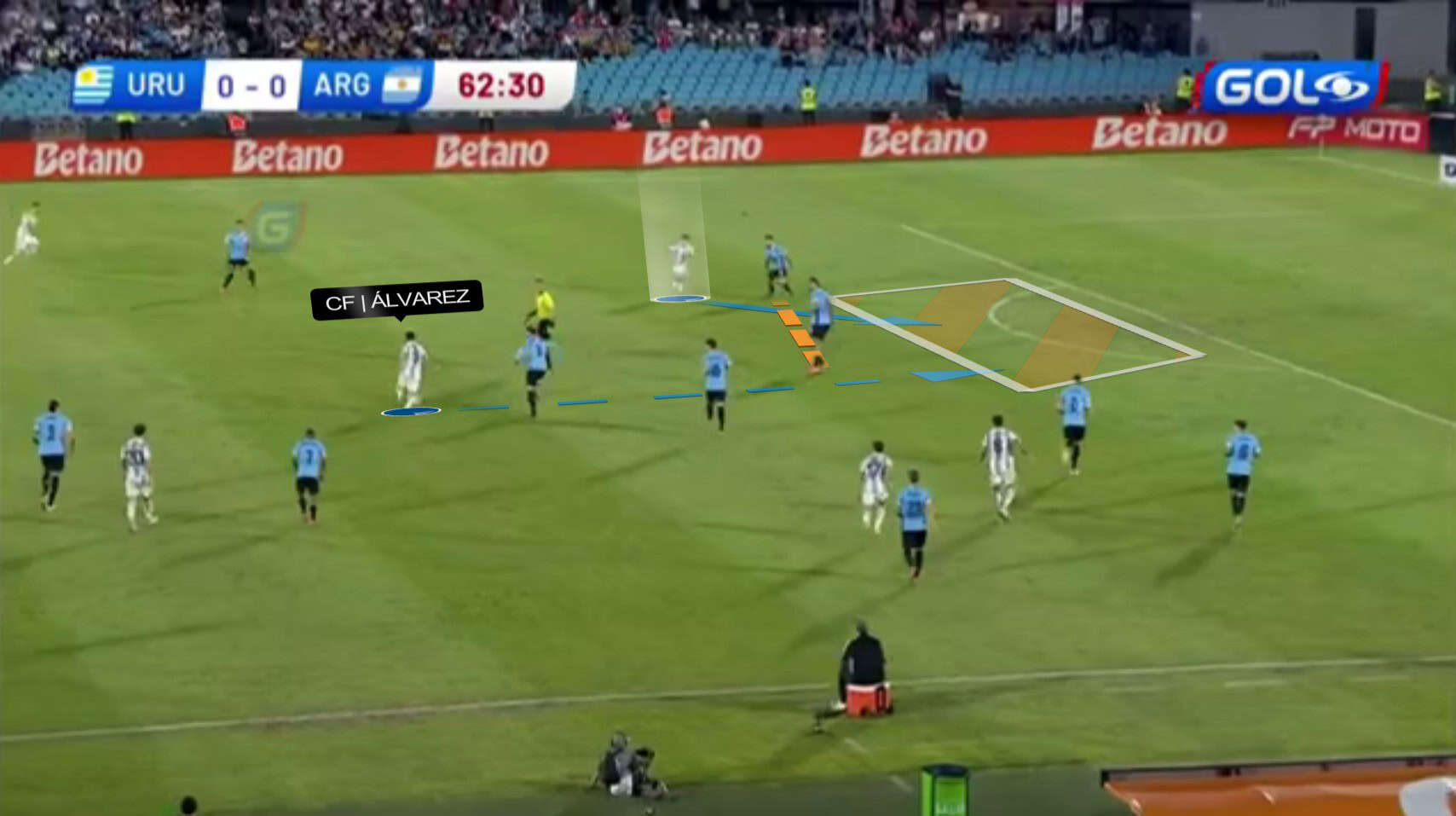
Figure 9. Thiago Almada positions himself high up the pitch, allowing Julián Álvarez to drop deeper and operate in lower areas. Almada then makes a penetrating run into the channel between the centre-back and full-back, creating a clear goal-scoring opportunity.
This allows Álvarez to influence creation by dropping while Almada occupies the line, or, if defenders are sucked in, making rupture runs into gaps to score like a surprise forward.
Conclusion
It may be premature, but Almada’s performances suggest he’s becoming the flagbearer of Argentina’s generational shift.
Symbolically, his entrance into the starting XI came due to Messi’s absence, reflecting deeper changes in Scaloni’s team.
From a super‑timing enganche like Messi—focused on specific actions and leaving pressure work to others—to an enganche more attacker than a midfielder, repeating relentless efforts, with great upper-body strength and omnipresence from the deep build‑up to line‑breaking runs.
Omnipresent because he has the technique to manage tight-space play, sensitivity to read the game, physical capacity to handle pressure—and above all, personality.
As his coach said:
“He steps up and wants to try things—and that’s the best trait a footballer can have, not being afraid to ask for the ball. He’s been a truly excellent breakthrough for us and it reassures us”.
