
When in possession, Marcelo Bielsa’s philosophy revolves around breaking the defensive lines to progress the ball through the thirds.
When breaking lines, the Argentinian settles a rank of priorities, placing the ball beyond the back line as the highest order.
Faced with the challenge of a compact defence, Bielsa’s team performs the “Up-Back-Through” combination to break the lines.
This tactical action creates vertical pockets with a third-man run, exploiting the space created.
This tactical analysis, in the form of coaching/training analysis, will involve one coaching session on how to use the “Up-Back-Through” (U-B-T) combination to break the backline.
In this analysis, we will demonstrate how this concept is integral to Leeds United’s tactics, which are employed in a wide range of situations throughout the Premier League.
Watch On YouTube
Theory and game situations
Nowadays, even attacking-minded coaches like Jürgen Klopp set their squads in a compact block when out of possession.
In a compact block, the defensive lines do not allow any pockets to play between the lines.
Against tight defences, the “Up-Back-Through” action breaks those lines vertically without resorting to shifting the defence horizontally.
As shown in the next picture, the U-B-T combination starts with a forward pass (UP) to a teammate who drops back and drags his mark.
The second part of the action is a lay-off (BACK) to a player facing forward who places the ball in the space created (THROUGH).
There should be a third-man run who exploits the area behind.
 Bielsa’s teams develop this combination throughout the game, should the forward pass (UP) drag a defender out of position.
Their teammates anticipate the play and place themselves for the back-through passes to collect the ball behind the lines.
Analysing a Leeds game, we can see that this action is a well-worked communication within the team.
The following picture shows Leeds performing this tactical football action in the middle third, collecting the ball behind the full-back.
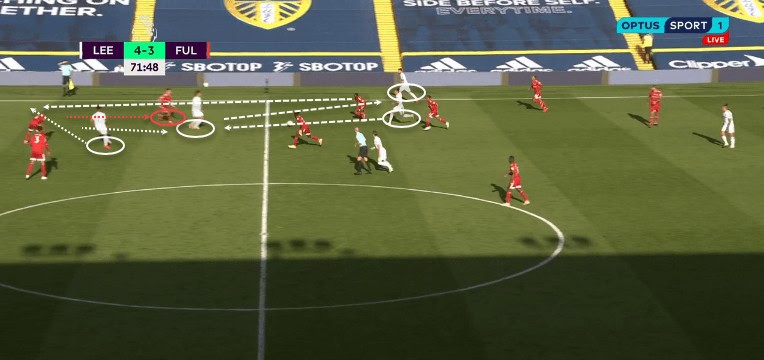
This action is a non-verbal communication performed by the entire team at any point on the pitch.
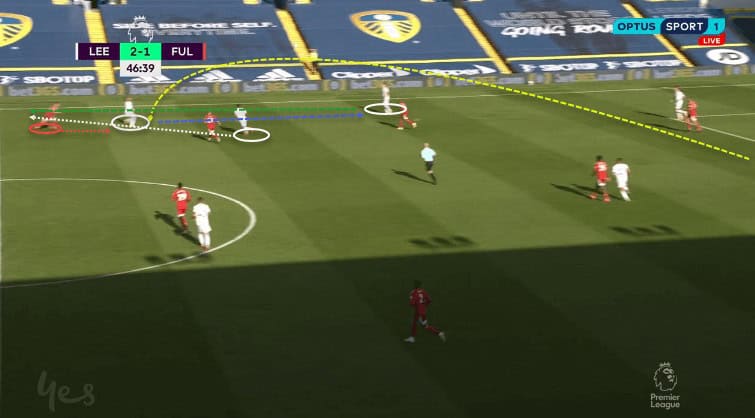
For example, the next shot depicts this action used in the build-up on the defensive third.
The keeper plays a long ball to the right flank (UP in yellow) and then lays it off to the full-back (BACK in blue).
The full-back plays a forward pass (THROUGH in green) for the inside midfielder, making the third man run (white) to collect the ball behind the midfield line.
We want to highlight that many teams use this action to create vertical pockets and break the lines.
In a more transitional league like the Bundesliga, we analysed this pattern mastered in the offensive transitions.
The following snapshot shows a goal scored by Bayern Munich using the U-B-T action to counter-attack.
Once the centre-back recovered the ball, which is not in the picture, he passed it forward to the striker, who dropped back.
The opposite centre-back tracks the run, falling out of position.
The advanced midfielder plays an instrumental role in the action, giving the striker the option to lay off the ball and anticipate the left-wing run behind the space created.

Training Session
As mentioned earlier, when breaking lines, Bielsa’s philosophy prioritizes getting the ball beyond the backline.
Should the U-B-T break the defensive line, it would generate a scoring opportunity.
Having this in mind, when designing the session, we would situate the practice in the area where we want to accomplish the desired action.
This training session aims to create the “Up-Back-Through” combination to penetrate the back line and create a goal-scoring opportunity.
We see an example of this action in the next shot.
Manchester City used the U-B-T combination in the final third to score.

The training session will consist of three drills that we present, finishing with a training game to assess its success.
We planned the session for 18 outfield players, plus two goalkeepers joining the team from the third drill.
We present the session as it flows chronologically, starting from the warm-up.
However, the session’s design began with game training, where we replicated the desired football situation exactly.
Warm-up
For the first part of this session, we designed a 3+3v3 rondo, focusing on the third-man concept and building into the U-B-T action.
Four players, two of each colour of the in-possession team, will play on the outside, as depicted in the next diagram, with different colours on opposite sides.
The remaining two players would move freely inside the rectangle, marked by the three defenders.
The constraint included in this rondo is that the player in possession can only pass to the other colour.
In this example, when the blues have the ball, they can only pass to the green.
If one of the defenders recovers the ball or forces a mistake, the defender’s team switches with the team responsible for the unsuccessful action.

Rondos encompass communication, decision-making, and the execution of those decisions, aligning perfectly with the coaching theory.
The colour constraint will overload the players with the third-man concept, which is essential for accomplishing the desired U-B-T action.
When a blue player has the ball, the blue teammates can not receive the ball.
This constraint will force them to implicitly start anticipating the next pass and provide options to the future receiver, in this case, the green players.
The coach should support the implicit learning with positive feedback on the desired behaviours: off-the-ball movements, angle positioning, body shape, and weight on the passes to create the third-man action.
To add a sense of direction and competition, we implement a defensive penalty: if the team in possession passes the ball from the back player to the front and back again to the start, the defending team must win the ball twice.
This rule embodies the principle of always trying to play forward, rather than just passing for the sake of passing.
We do not want to stop or overcoach at this point in the session, although the design will create that competence in players to anticipate the play, allowing the other colour to progress the ball to the far end.
Once we see the drill progressing smoothly, we will give the in-possession team an extra incentive to implicitly accomplish the U-B-T action.
The in-possession team will be encouraged to make a central combination pass between their teammates.
Should the in-possession colours combine centrally to get from back to front, it would be enough to punish the defenders for recovering the ball a second time.
Under this reward, we would start seeing different central combinations.
One possible outcome of breaking the lines would be the U-B-T action, as shown in the following diagram.
Using a reward, we would work on the desired football pattern in a real football situation.

Positioning game
The second part of the session will be a positioning game, using 6v3 rondo played in two grids separated by a central zone.
The ball will start in one of the grids in a 4v2 rondo, with the team in possession positioned as shown in the following diagram, with one player able to move freely on the inside of the grid.
The team in possession must connect with the inside player in the central zone to advance the ball to the next grid.
The side players would join the following grid, and the inside player would return to the starting grid if the ball advanced to the next grid.
One defender will join the upgrid to create the 4v2.
Once the ball is in the up-grid, the teams will have the same task: return it to the bottom grid.

Once defenders start reading the game, they will begin marking the inside player closely, as it is the one who can progress the ball to the other end.
At this time, we will introduce a progression allowing the player in the grid above to drop to the central zone, and the defender can follow.
The constraint included in this progression is that players are allowed only one touch in the central area.
As shown in the following diagram, any player in the bottom grid is allowed to advance the ball to the next grid if their teammate above bounces it from the central zone.

Players should start the rondo, assuming the positioning they would use in the game-specific situation that we are trying to replicate.
The end and start players should be holding midfielders or centre-backs.
The player inside should be an advanced midfielder or striker, as they will be working on the back-through action.
The side positions could vary from wing to full-back, executing the third-man run.
With this in mind, players should change positions to work on different aspects of the action.
Defenders must make a safe pass between their team to recover the ball.
Under this constraint, players need to react counter-pressing, increasing the intensity.
In this part, the coaching points would guide the players in their decision-making to progress the ball using the desired U-B-T action.
The high-positioned player should anticipate the play dropping to receive the forward pass, and players underneath the ball should be ready to play the through ball.
The coach should guide players on their passes, working on the weight and direction of the lay-off and through ball.
Finally, the wide players should be encouraged to time their runs, using the offside rule with the central zone.
The coach should reinforce the coaching points once the players have experienced the game-specific situation, raising their awareness of their competence.
Game Training
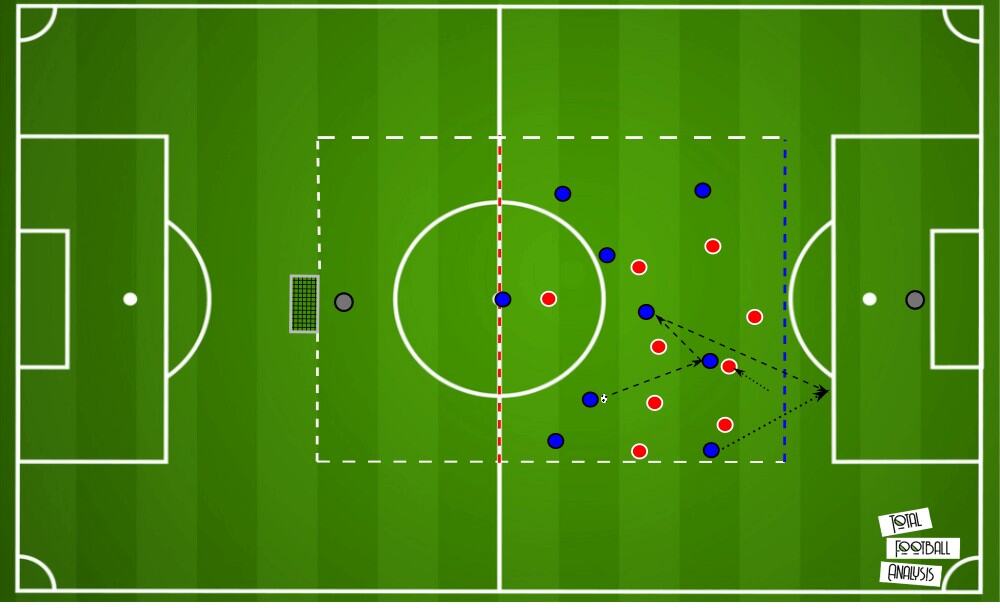
The third drill is the central part of the session. In it, we will work on the concept of “Up-Back-Through” in the specific situation we planned.
The game training would be a 9v9+GKs constraint game.
The design will help to overload players in communication, accomplishing the desired tactical action of progressing the ball behind the defensive line.
The game training will position the players in the middle third, with the coaching side set in a 3-3-3 formation (resembling the 4-3-3 used with only one centre-back) against a compact 4-4-1.
We want to challenge the team to break the lines without creating horizontal gaps.
To create this scenario, we will use only the central channel and the half-spaces, eliminating the wide lanes.
The blue team will start with the ball from the centre-back in the halfway line.
To score, they must first progress the ball through the blue dotted line, either by dribbling or passing.
Should they achieve this, only one defender can defend beyond the line.
If the red team wins possession of the ball, they will have 10 seconds to score on the opposing goal, first by dribbling or passing through the red line.
Only one blue defender can follow beyond the line.
The time constraint forces the red team to transition fast, giving more time to work with the coaching team.
Simultaneously, we implicitly work on both groups’ fast defensive and offensive transition principles.

This session aims to progress the ball beyond the defensive line using the U-B-T action, as depicted in the next shot.
In this drill, the coach reinforces all the concepts mentioned in the previous exercises, with a primary focus on the tactical aspects of the idea.
Forward players should drop to drag their marks out of position.
Players underneath the dropping player should position themselves, giving an option to receive the ball and play through balls.
Players not involved in those actions should anticipate the movement and time their runs to be onside, thereby exploiting the vertical gaps left in the defensive line.
Players should be encouraged to work on the different roles of the action.
Should the wing drop to receive the pass from the full-back, the holding midfielder should position to receive the back ball, and the striker will exploit the space behind the full-back, alternating roles.
Although the session aims to utilize the U-B-T combination, the coach will encourage players to be creative in breaking the line and executing various football actions.
Conclusion
This session would conclude with a regular game, where players compete and play freely.
In this part of the session, the coach should assess their success, determining whether the players can independently apply what they have learned in the earlier parts.
This session has covered one of Bielsa’s more frequently used concepts for breaking the lines at Leeds United.
It is a valuable idea to break the lines shared by many coaches, as shown before.
There is no one way to break the lines; this tactical action should not limit the players, but give them an extra tool when facing a compact block.
