
Two Spanish giants go head-to-head this weekend when Athletic Club takes on Barcelona in the Copa del Rey final in what will be a battle of two highly contrasting styles from a tactical perspective.
Athletic Club have been in a work in progress since manager Marcelino Toral replaced Gaizka Garitano in the first week of January, over three months ago but they are by far a better side to watch from a viewer’s point of view and are very interesting tactically with their counter-attacking but high-intensity style.
Marcelino’s first game in charge of Los Leones was against Ronald Koeman’s side interestingly enough, with the former coming out on top in a thrilling 3-2 victory. Subsequently, the pair met two more times after that, once in La Liga and once in the Supercopa final. Barcelona did the double over their competitors in the league, but Athletic Club managed to come out 3-2 victors in the Supercopa final, winning the club’s first trophy in quite some time.
Having already lost the rescheduled Copa del Rey final nearly two weeks ago against their Basque rivals Real Sociedad, Los Leones will be looking to make use of their second consecutive shot at the trophy but defeating an in-form Catalan side will be very difficult.
This game has not failed to entertain since Marcelino took the reins at the San Mames Stadium and so we expect yet another entertaining affair. This article will be a tactical analysis preview of the game between Athletic Club and Barcelona for the Copa del Rey final this weekend. It will be an analysis of the tactics that both sides will use, looking at how they will exploit and nullify each other.
Lineups & formations

Marcelino has been quite loyal to the 4-4-2 formation since becoming the Athletic head coach. He has also deployed a 4-2-3-1 at times though too but there is not too much difference between how they are set up in the two systems.
This season, Los Leones have used a 4-4-2 in 49 percent of their matches in all competitions while the 4-2-3-1 has been the second most used tactical system, being deployed in 33 percent of their matches, whilst the remaining 18 percent comprises the 4-2-2-2 and the 4-1-4-1. We are of the opinion that Athletic Club will set up in a 4-4-2 although the positioning of Raul Garcia as part of the front two can easily switch this to a 4-2-3-1.
We believe that Marcelino will start a back four of Ander Capa, Yeray Alvarez, Inigo Martinez, and Yuri Berchiche, sitting in front of the obvious choice in goal, Unai Simon. Berichiche has just returned from a spell on the sidelines and so if the manager has not deemed him fit enough to start, Inigo Lekue will more than likely replace him as the starting left-back.
The midfield double-pivot could comprise of Mikel Vesga and Unai Lopez, although Dani Garcia or Unai Vencedor may be given the nod too in the centre of the park. Iker Muniain is likely to return to the starting lineup whilst his compatriot Oscar de Marcos could be deployed wide on the right although Alex Berenguer may also be used instead of de Marcos.
Up front, we have gone for the typical pairing of Raul Garcia and Inaki Williams who complement each other quite well, particularly in games against tougher opposition.
For Barcelona, the 3-4-3 has worked well for them in recent games with Frenkie de Jong as a libero-type centre-back, coming out from the back and dictating play from the first line. Koeman switched to more of a 3-5-2 against Real Madrid in El Clasico by pushing de Jong into midfield but La Blaugrana were ultimately beaten by a solid Los Blancos side.
For this, we believe the Dutch coach will revert to the 3-4-3 with de Jong as the central centre-back, supported by Oscar Mingueza on the right and Clement Lenglet on the left, sitting in front of Marc-Andre ter Stegen. The double-pivot ahead of the back three is likely to consist of Sergio Busquets and young star Pedri, flanked by the experienced Jordi Alba on the left and Sergino Dest on the right as wingbacks.
We also foresee Koeman putting out his strongest front three of Antoine Griezmann, Ousmane Dembele, and none other than Lionel Messi.
Barca’s possession structure and de Jong’s positioning
Barcelona use a 3-4-3 base structure when they are in a positional attack, although this is not persistent as player’s positions change depending on space available and the situational differences the opposition has thrown at them. At times, the shape will look like a 3-2-5, other times a 3-2-4-1, and even a 2-3-5.
The two wide centre-backs of the three in the first line push wide to cover the width of the pitch. De Jong has been used as the central centre-back in multiple games recently and this is unlikely to change against Athletic Club at the weekend. De Jong is used in a ‘libero’ like role, as a central defender who comes out from the back and dictates play, moving into midfield at times to create a 2-3-5.
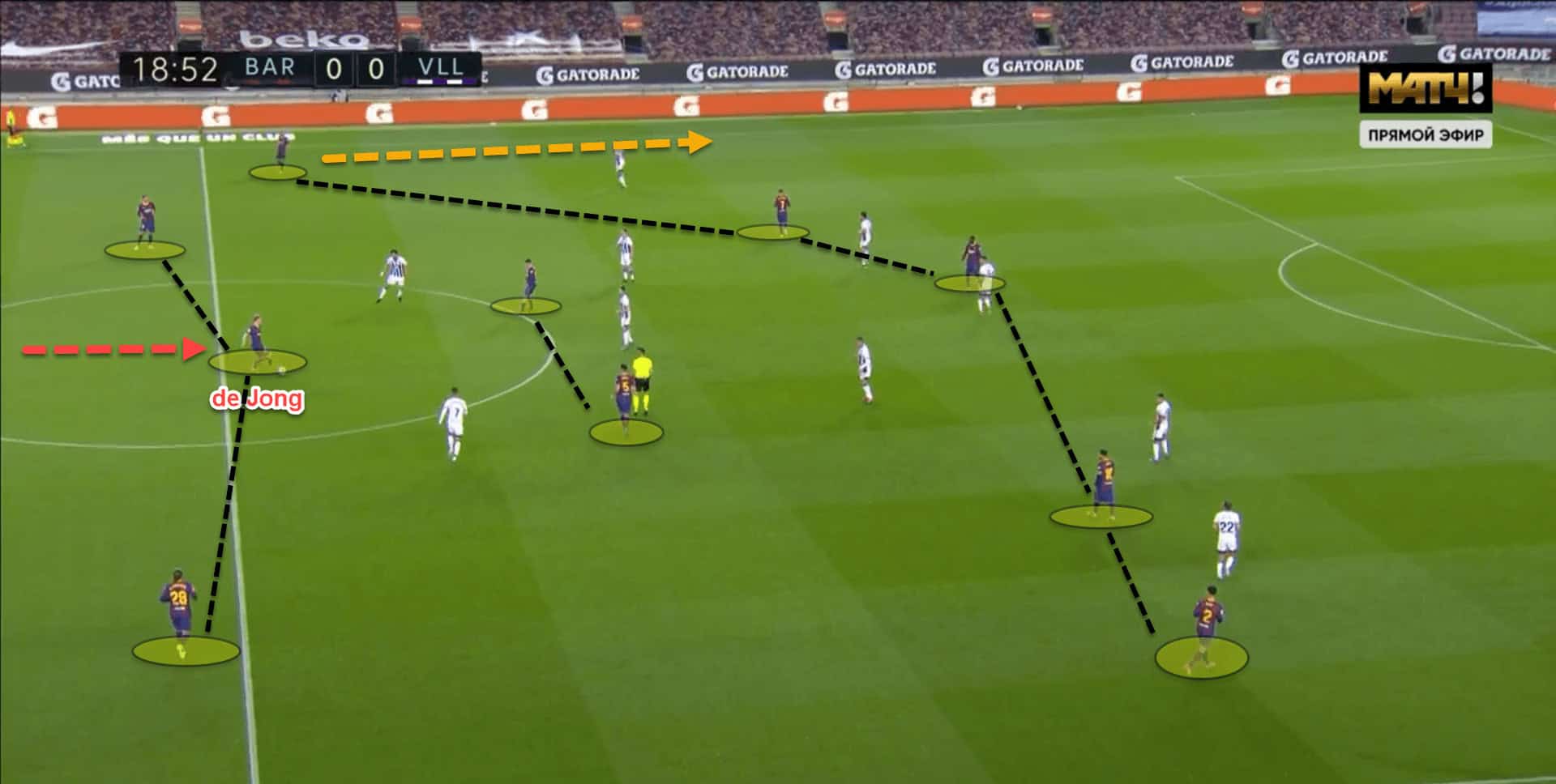
This benefits Barcelona in a few different ways as they are able to add an extra body in the central areas to overload the midfield if one of the wingers drop to receive too, but it also creates space for other players to move into, opening passing lanes for easy progression, particularly against teams who are sitting deep and compact, in which ball progression up the pitch can be stagnant and difficult.
The reason for this is because it forces players to engage in a duel with de Jong by pressing him, leaving space on their blindside. Teams set up quite pragmatically in a deep defensive structure against Barcelona, hence why they currently have an 18.45 Passes per Defensive Action Against (PPDA against) in La Liga this season and a passing rate of 18, so when de Jong comes out from the back into the midfield, it forces one of the players to sometimes upset that structure and press him.
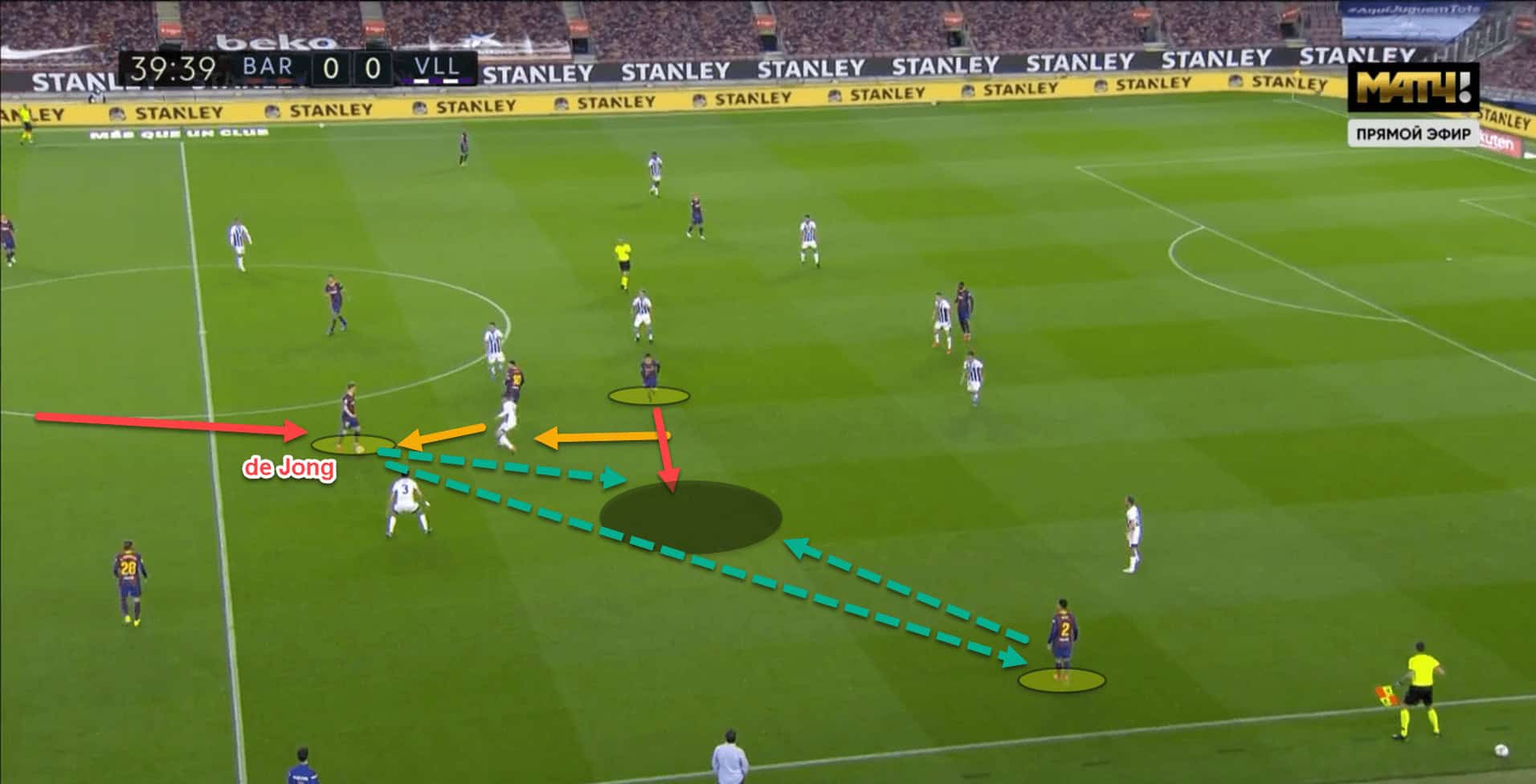
This could cause Athletic Club serious problems in the game at the weekend. Bilbao have a tendency to use a ‘staircase’ midfield when defending, similarly to Atletico Madrid. This means that one of their double-pivot will push up to close down a ball-near player who is unmarked, generally an opposition pivot player, whilst the other drops off and covers the space behind.
This can work for Athletic Club providing the midfielder who has pushed out to press has applied a cover shadow to the opposition players behind him. However, this does not stop the opposition from being able to quickly play around the defensive block to find the free man.
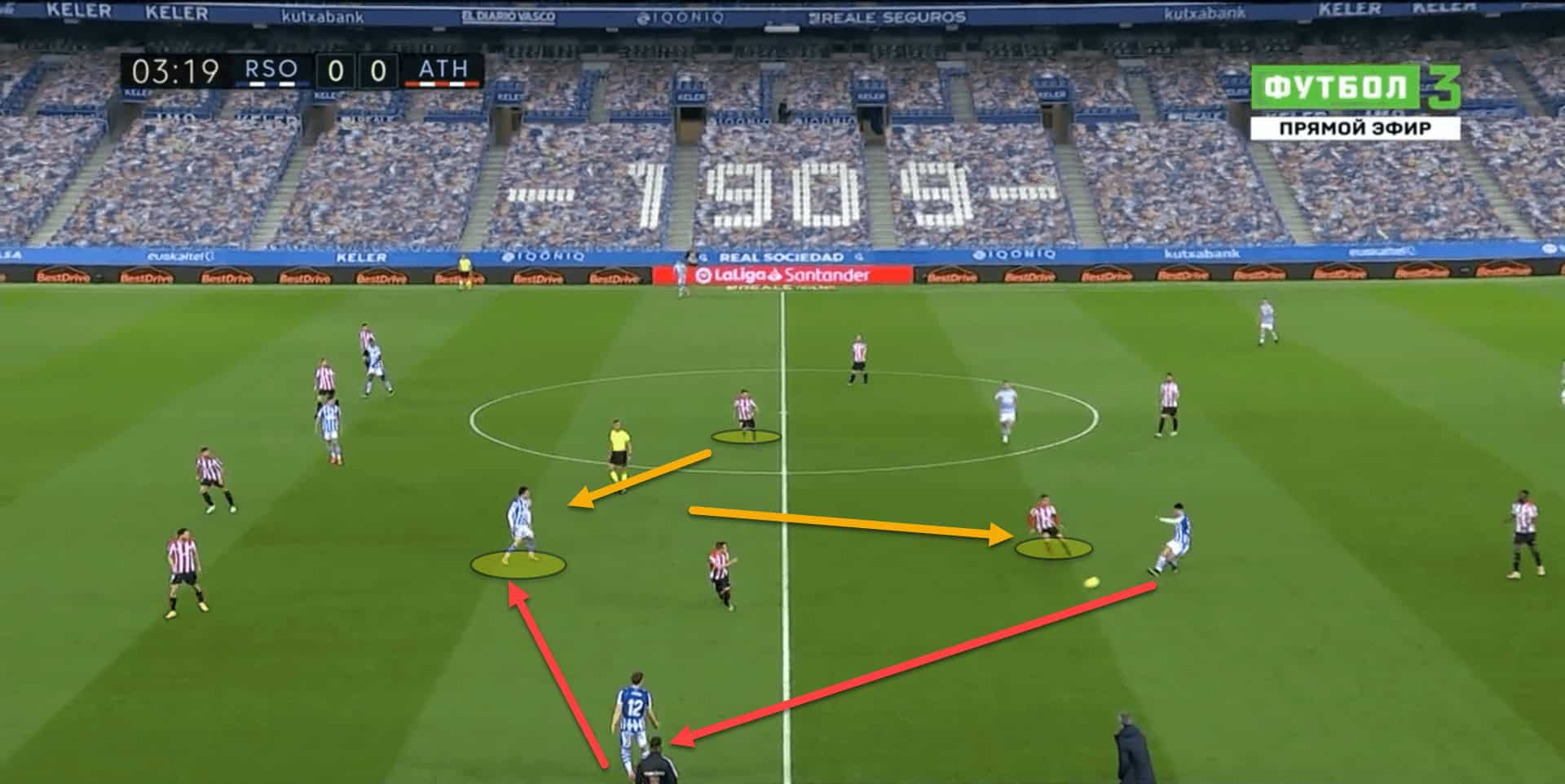
Here we can see this in action. The ball-near pivot player has pushed out to close down the Real Sociedad player on the ball, applying a cover shadow to the forward player in between the lines. However, the ball-far player has not reacted quick enough to drop and cover the man too, so a quick pass, using the fullback as a bounce pass to play around the block, has helped La Real get around this.
As the two Athletic centre-forwards will be occupied with the two wide centre-backs when pressing, it is possible that the ball-near pivot player may be forced to engage with de Jong when he comes out from the back, which of course could spell trouble for Marcelino’s side and create easy ball progression through the lines for Barcelona.
La Blaugrana have played the most progressive passes in La Liga by quite some margin with 2,408, as well as having the most progressive passes per 90 with 75.09 and the highest progressive passing accuracy this season boasting an 81 percent accuracy, so they will certainly take advantage of any deficient gaps in Bilbao’s press when looking to play through the thirds.

Beating the counterpress and balls into the channels
Athletic Club’s greatest strength heading into the Copa del Rey final on Saturday is their ability to hit teams on the break. A rational expectation for this match is that Barcelona will average at least 60 percent possession, potentially a lot more. So, Los Leones will need to be prepared to hit Koeman’s side at blistering speed from counterattacks when they gain possession of the ball.
On the other hand, from the four main phases of play in football (in possession, out of possession, defensive transition, and attacking transition) Barca’s weakest of the four would be in defensive transition. They counterpress their opponents hence why they currently boast a PPDA of 11.04, although Athletic do have a higher PPDA surprisingly with 10.02.
In the first meeting between the two managers back in January, particularly in the first half, Marcelino’s men took advantage of Barca’s poor counterpressing time and time again. Inaki Williams will be key in this due to his lightning-fast pace and strength to shrug off any defender.
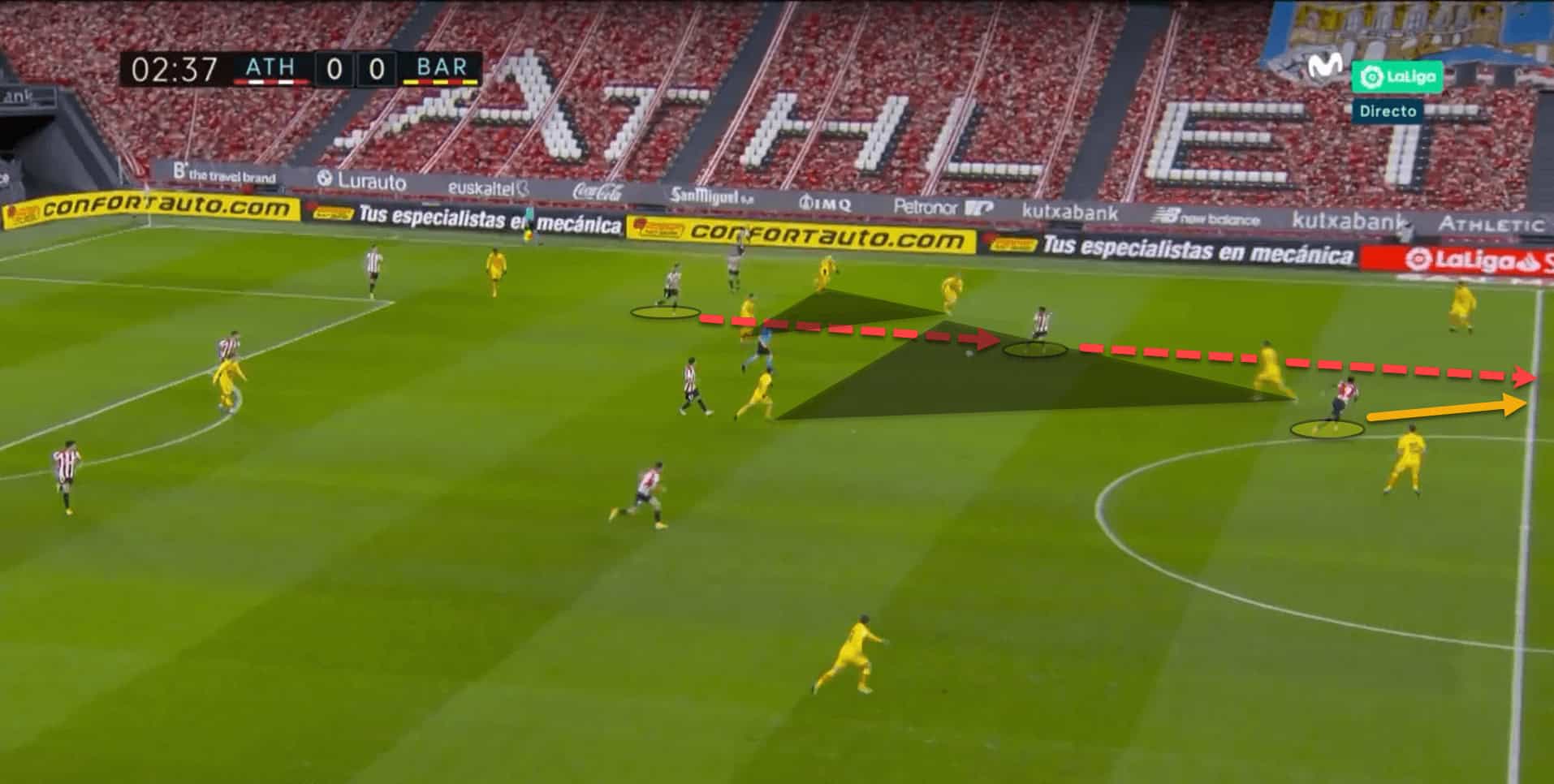
In this scenario, Athletic Club opened the scoring against the Catalans, winning the ball back deep in their own third and progressing it quickly, taking very few touches in the process. This move shown above was completed in just four passes from when they regained possession. The third pass beat the counterpress of three players whilst the fourth pass completely split Barcelona open, setting Williams through on goal, before the Spaniard slotted home past ter Stegen.
This quick break was completed in just 12 seconds by our calculations. Moving from the first third to the final third in such a rapid manner is exceptional and Athletic Club will need to constantly try and play through passes through Barca’s counterpress throughout the final at the weekend to really damage their opponents.
Athletic Club have played a high volume of through balls this season, mainly due to their direct style when they have possession, getting up the pitch as quickly as possible.

Mingueza possesses decent speed so Lenglet could definitely be the target of these counterattacks down his side instead. As well as playing a high volume of through balls for a team who average just 50.8 percent ball possession per 90, Athletic play quite a lot of balls into the channels. Williams, again, is generally the target for these direct passes, but at times it can be one of the wide players too, or perhaps even a fullback.
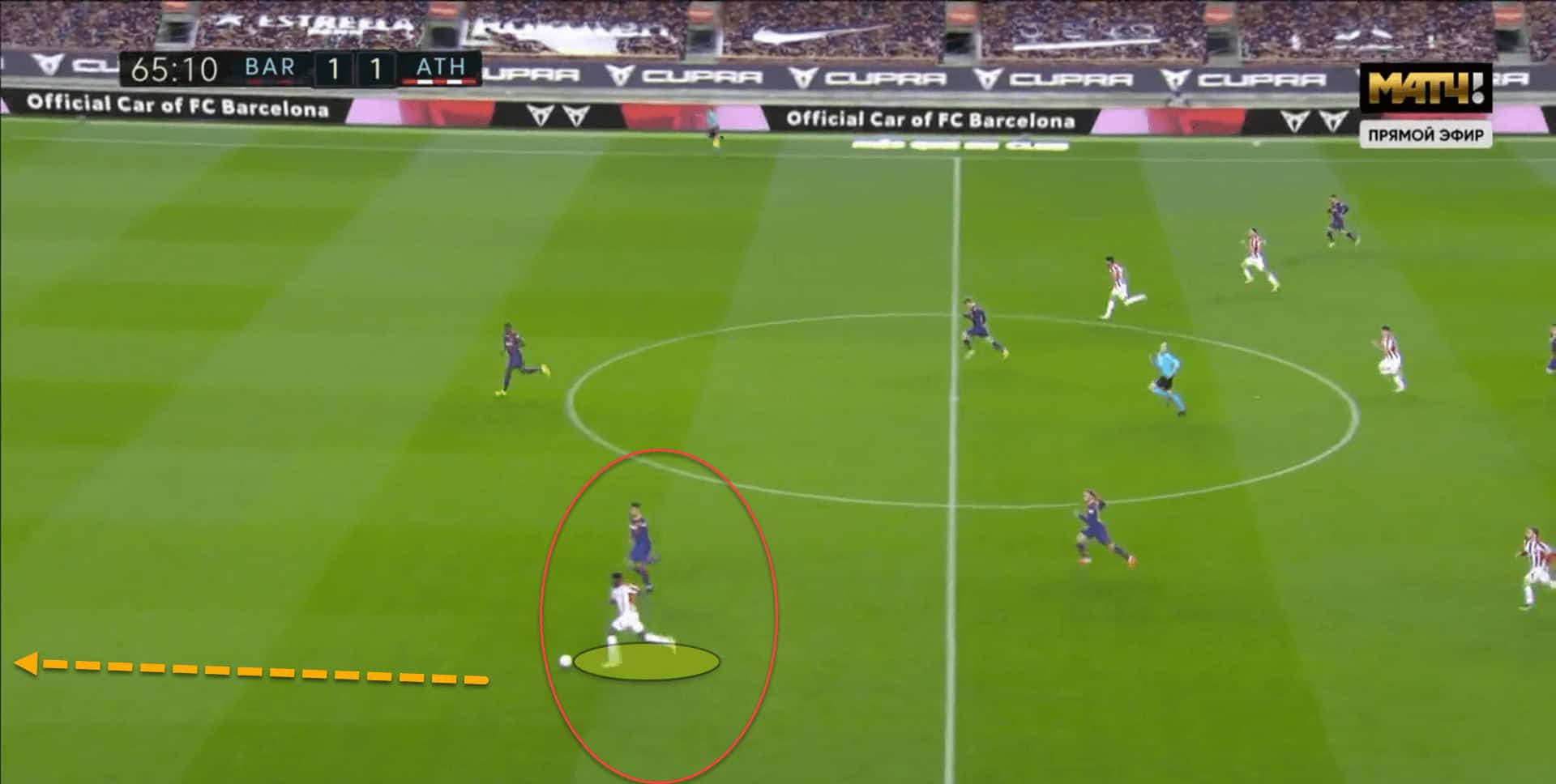
As we can see from this situation, Williams has been played in down the channel on the outside of the ball-near centre-back, isolating the pair in a duel. Barcelona play a very high line and push their fullbacks up high in line with the three forwards, meaning a lot of space is left on the flanks beside the central defenders, so Athletic Club will attempt to get Williams into as many of these types of situations as they possibly can to isolate a defender one-on-one where he is most likely going to beat them for pace. As already stated, Lenglet is not blessed with pace so he may be the main target of these balls.
Beating a low-block and Athletic Club’s wingers
Athletic Club play very pragmatically against better opposition, as we have already stated throughout this article. In their previous meetings against Barcelona under Marcelino, they have pressed La Blaugrana high but once Barca progressed to roughly the middle third of the pitch, they would drop off into a deep defensive structure, or a low block in better words.
This low block is a 4-4-2 and is very compact vertically as well as horizontally, smothering any space between the lines, which is something that will be very useful when defending against Barcelona – a side that always looks for numerical superiority between the lines. It will also be very useful when defending against a player like Lionel Messi because they can defend against the superstar with multiple bodies, making an impossible task slightly less impossible.
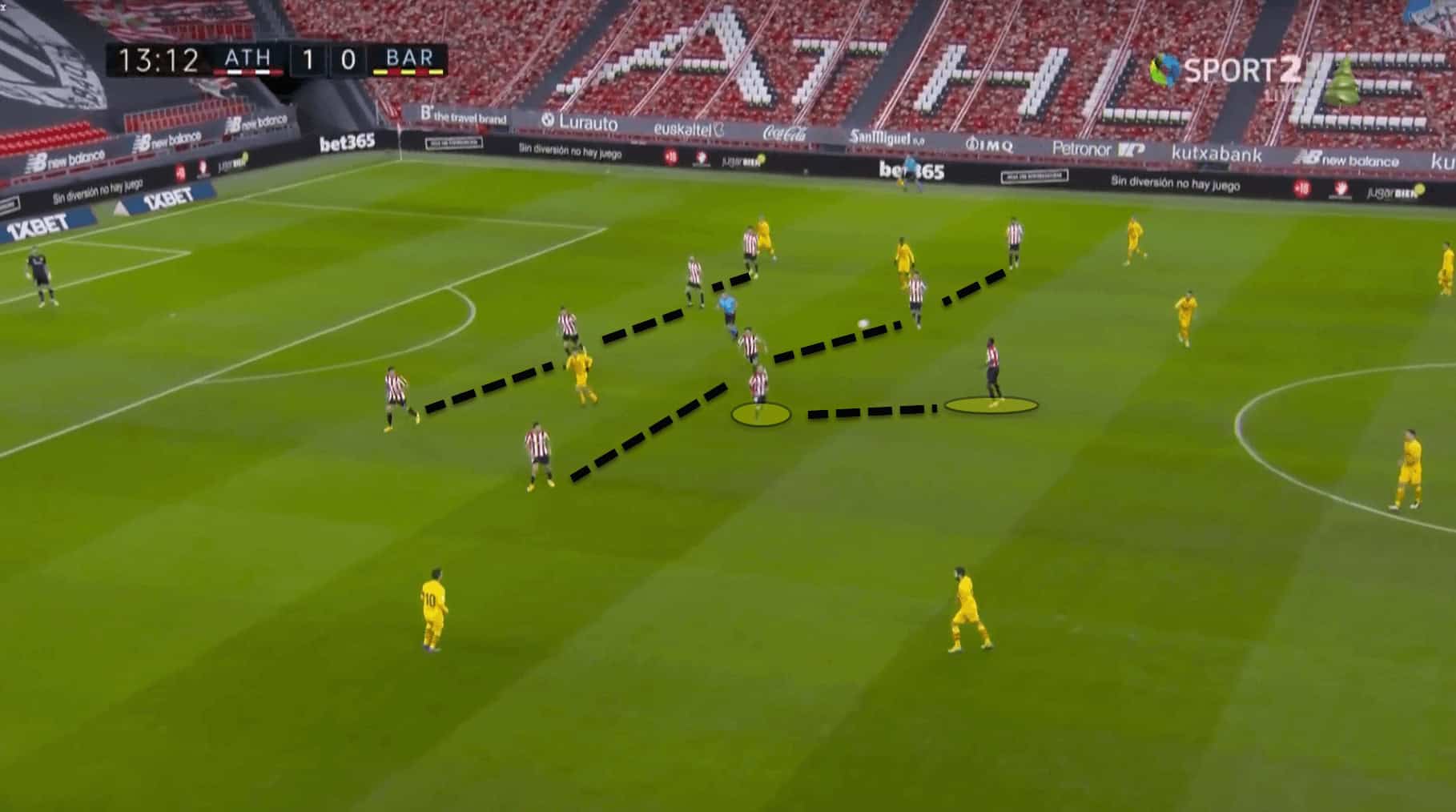
The problem with staying compact horizontally is that the defensive team cedes space out on the flanks for the team in possession to play into. From here, Athletic Club must shift their defensive block across to cover the space, which in turn leaves space on the ball-far side of the pitch for the team on the ball to switch the play into.
When the ball is switched, the defending team must shift across the low block once more quickly which will leave gaps in the block as the shifting may not be done in unison. In the last three outings, Marcelino’s men were punished on the second directional when Barca were switching the play to break down their low block. This means that Barcelona had switched the play from one side of the field to the other and then before Athletic could recover their defensive shape while shifting across, they played the ball quickly into the box for their attacking players to take advantage of the lack of defensive structure with the opposition.

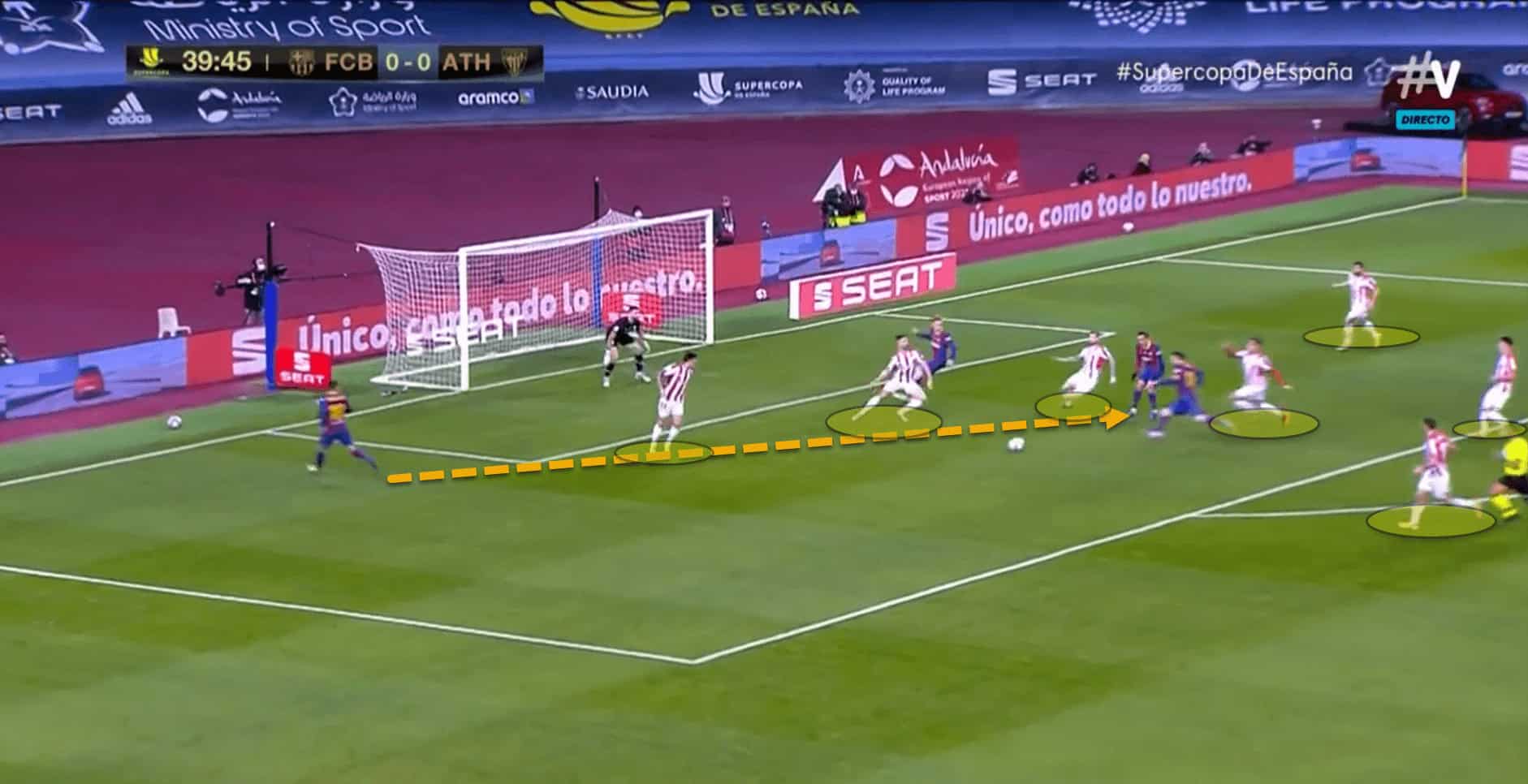
From these images, we can see that Messi had the ball in the right halfspace and quickly switched the play to Jordi Alba, slipping him in at the left halfspace. While Athletic Club were scrambling to get back across, Alba used the disorganisation of Athletic’s defence to hit the ball back in towards the penalty area on the second directional, finding Messi whose shot eventually fell to Griezmann who scored.
As it will be very hard to break Los Leones down centrally, Barcelona will certainly look to create gaps in their low block by switching the play constantly to create gaps for their centre forwards to eventually score into.
However, there is a way for Marcelino’s side to defend against this. This is strictly hypothetical though, but it is an interesting concept for them to try, despite it being very unlikely, and it comes from the El Clasico game last weekend.
Zinedine Zidane dealt with Jordi Alba’s threat on the left side by dropping Federico Valverde into the backline when they were defending in a low block in the defensive phases, to nullify the Spaniard’s threat on the left and prevent Barcelona from being able to find him when they looked to switch the play.
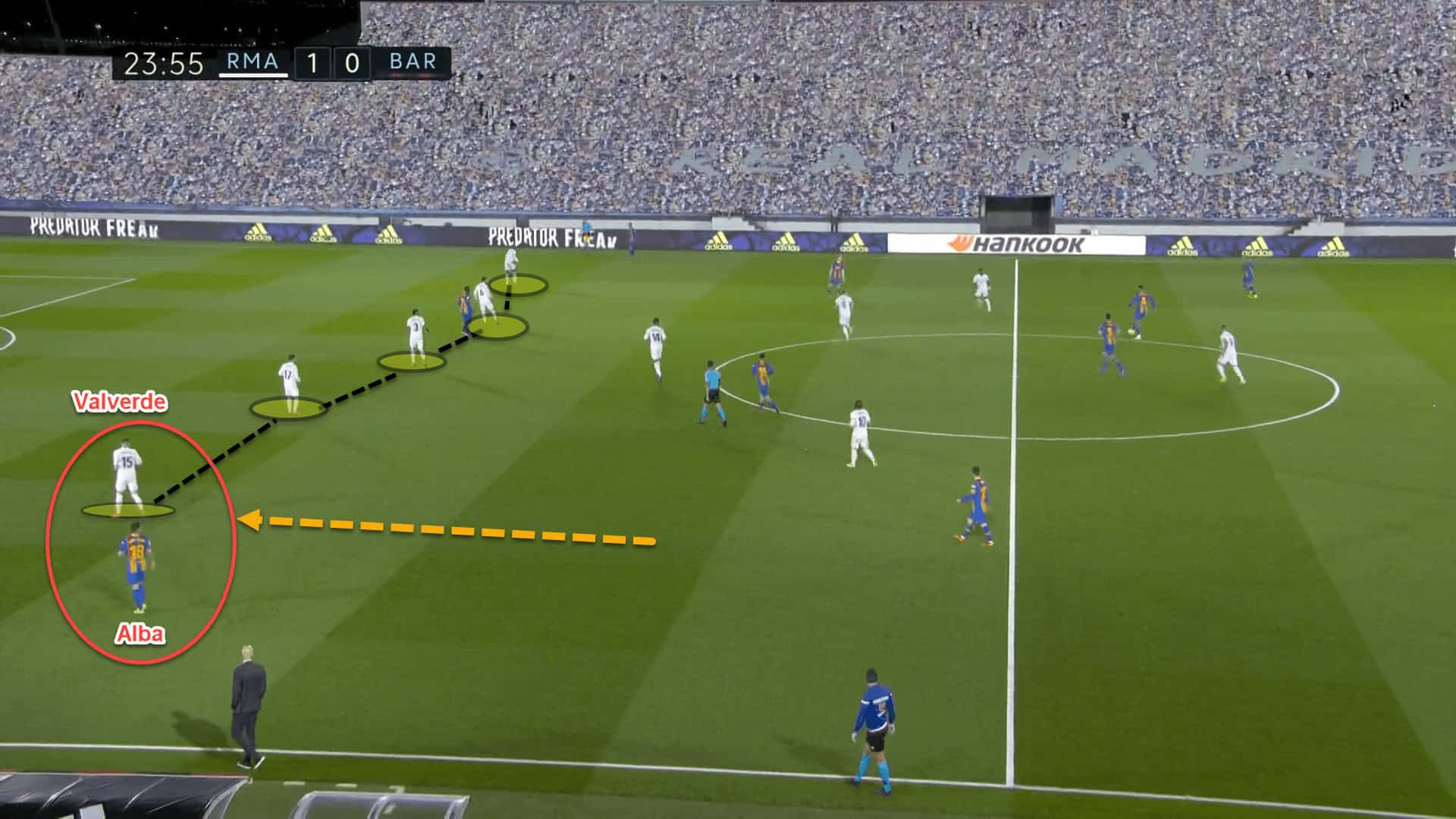
If de Marcos is deployed as the right-winger against Barca, he could potentially fulfill this role and nullify his compatriot down the right defensive side when La Blaugrana are attacking.
The right-back, most likely Capa, can simply tuck inside to become a third centre-back and Athletic Club will be able to cover the width of the pitch whilst staying compact, limiting the time it takes them to shift across to cover the wide areas and especially will help them to try and nullify the Barcelona left-back, one of La Blaugrana’s most underrated attacking outlets in the final third.
Conclusion
The history between the two coaches this season has told us that this is likely to be an entertaining affair between two very good Spanish sides. However, it will also be an interesting affair tactically with Athletic Club likely to wait for their opportunities before springing to life with blistering pace on the counter while Barcelona will dominate possession and be very cautious, waiting to find gaps to exploit.
Barcelona are the favourites, as they are in almost every game, but it would be naïve to rule out Los Leones to put La Blaugrana to the sword in yet another cup final this season.
