
The 2025 football summer transfer window presents clubs with an exciting opportunity to strengthen their squads with high-quality free agents who are out of contract.
This data analysis looks at all the top players available on free transfers across three key positions: attackers, midfielders, and defenders.
We aim to provide a detailed overview of the most promising candidates by examining their age, market value, and key performance metrics such as goals, assists, progressive passing, and defensive contributions.
From the clinical finishing of forward players like Mohamed Salah and Jonathan David to the creative brilliance of midfielders such as Kevin De Bruyne and Frank Anguissa and the defensive stability offered by Virgil van Dijk and Jonathan Tah, this data analysis provides insights into how these players might fit into different tactical frameworks.
Whether a team is seeking experience, immediate impact, or long-term potential, the 2025 EPL free agent market offers a wide range of options across all areas of the pitch.
2025 Free Agents Out Of Contract – Estimated Market Values
The table below presents a selection of notable free agents in the summer of 2025, ranked by their estimated market value (in €M).

2025 Forward Free Agents – A Diverse Range of Talent
The forwards available as free agents in the summer of 2025 showcase a diverse spectrum of talent, experience, and tactical versatility.
This analysis evaluates their performance metrics in relation to age and estimated market value, with a focus on productivity indicators such as goals, expected goals (xG), and goal contributions (G+A).
Impact Of Age On Attacking Performance (Goals + Assists)
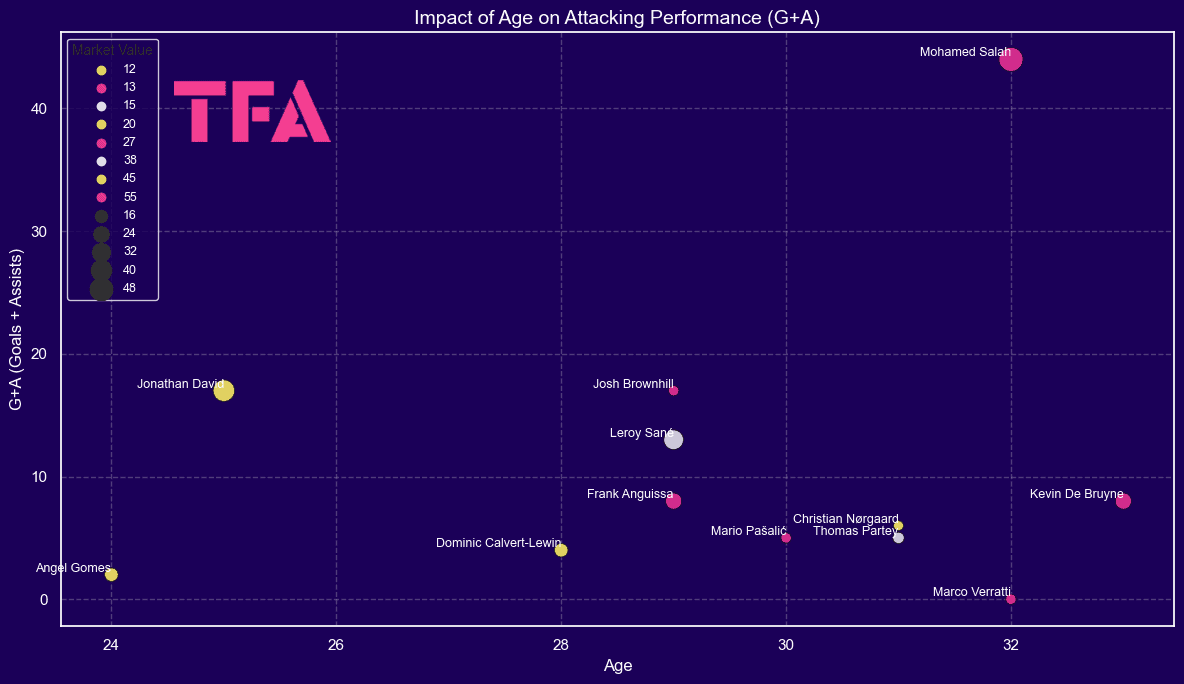
Mohamed Salah – Market Value & Age
Leading the list is Mo Salah, a high-profile forward aged 32, whose contract with Liverpool expires this summer.
His numbers defy the typical age-related decline.
With a market value of €55m, Salah recorded an astonishing 27 goals and 17 assists — a total of 44 goal contributions in just 30 matches and 2,657 minutes.
His non-penalty xG of 15 and xAG of 11.2 highlight the consistency and quality of his offensive output.
Despite being over 30, Salah remains elite, and his valuation reflects his ongoing impact at the highest level.
Jonathan David – Market Value & Age
Another notable forward is Jonathan David, aged 25, whose contract with Lille is set to expire.
His 14 goals and three assists reflect both finishing ability and versatility.
With a market value of €45m, his xG (14.1) and non-penalty xG (8.6) align closely with his output, indicating finishing efficiency.
His 50 total shots and 22 on target support his status as a consistent attacking threat.
Dominic Calvert-Lewin – Market Value & Age
By contrast, Dominic Calvert-Lewin, aged 28 and valued at €20m, posted a modest return of 3 goals and one assist in 22 appearances.
His xG of 6.1 points to underperformance — potentially due to confidence, fitness issues, or tactical fit.
Nonetheless, his underlying numbers suggest he remains capable of getting into scoring positions, which could appeal to clubs willing to invest in his resurgence.
Leroy Sané – Market Value & Age
Finally, Leroy Sané, at 29 and valued at €38m, bridges the gap between experience and peak performance.
With his Bayern Munich contract ending, Sané contributed nine goals and four assists in just 1,226 minutes.
His high xG (7.9) and xAG (4.2) confirm that he remains a dynamic attacking presence — particularly effective in systems that value width and direct dribbling.
Overall, this group of forwards includes a mix of high-value, high-output stars like Salah and Sané, consistent younger talents like Jonathan David, and underperforming but potentially undervalued options like Calvert-Lewin.
Age and market value provide important context, but on-pitch data such as xG and G+A ratios reveal the deeper story—making these forwards valuable targets for different club profiles depending on their tactical needs and financial strategies.
Evaluating Attacking Efficiency – Goals vs Expected Goals (xG)
One of the most insightful ways to evaluate attacking efficiency is by comparing a player’s actual goals to their expected goals (xG).
This relationship helps identify players who consistently outperform the chances they receive, as well as those who may underperform or suffer from poor finishing or bad luck.
In the context of the 2025 free agent pool, the forwards display a fascinating range of results when plotted along this axis.
2025 Forward Free Agents – Goals Vs Expected Goals (xG)
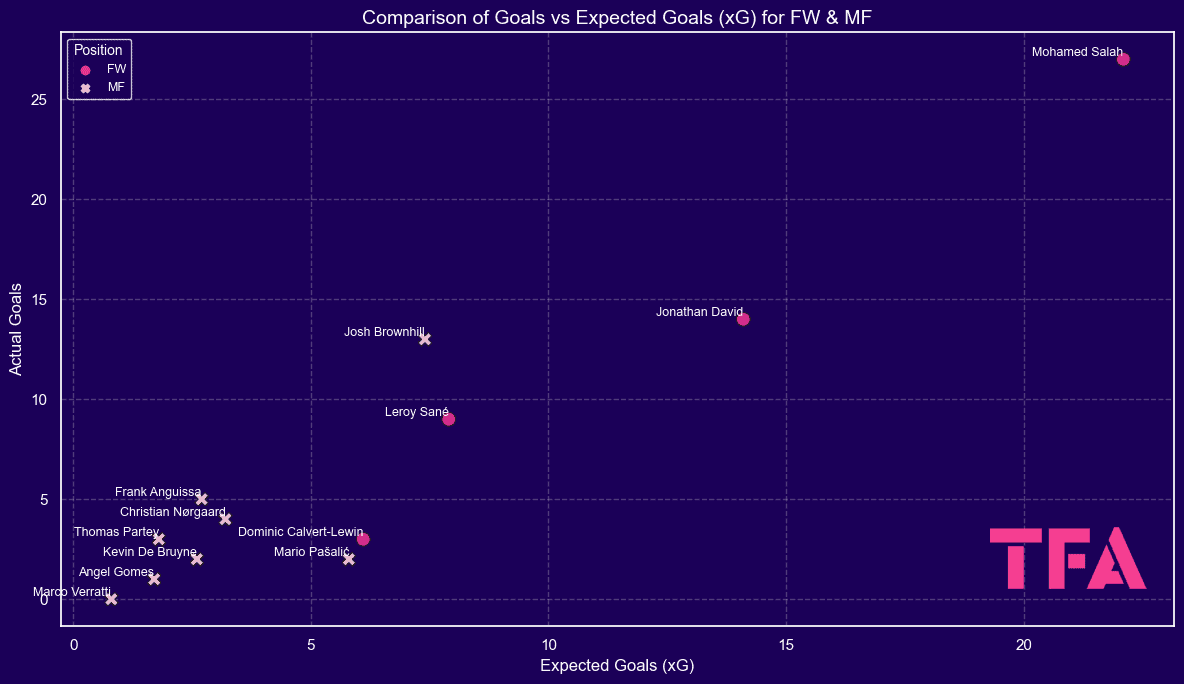
Mohamed Salah – Goals Vs Expected Goals (xG)
As shown in the figure above, Mohamed Salah leads the pack, scoring 27 goals from an xG of just 22.1.
This +4.9 goal difference above xG clearly indicates his elite finishing skills.
Salah consistently gets into dangerous positions, as reflected in his 98 shots, 45 on target, and his high involvement in progressive carries (124) and passes (114).
The data suggests that Salah is not only well-positioned in attacking phases but also executes with precision once he gets his chance.
Dominic Calvert-Lewin – Goals Vs Expected Goals (xG)
In contrast, Dominic Calvert-Lewin presents an interesting case study.
With only three goals scored from an xG of 6.1, he underperformed by -3.1 goals.
This could reflect a number of factors, including confidence, match fitness, or tactical misalignment at Everton.
However, the underlying numbers also point to his continued ability to get into scoring positions, which may appeal to clubs who believe they can restore his form.
Jonathan David – Goals Vs Expected Goals (xG)
Jonathan David closely aligns with his expected output: 14 goals scored from 14.1 xG.
This near-perfect match between expected and actual goals suggests he is a consistent and reliable finisher.
Notably, he managed this with 50 total shots and 22 on target, indicating a strong shot conversion rate and disciplined shot selection.
Leroy Sané – Goals Vs Expected Goals (xG)
On the other hand, Leroy Sané scored nine goals from an xG of 7.9, outperforming slightly, which supports his profile as a winger who contributes directly to goals despite playing in wider zones.
His high number of progressive carries (49) also illustrates how he generates his own chances through dribbling and movement.
These comparisons reveal critical nuances in attacking output.
Players who consistently outperform xG—like Salah—are often the difference-makers in tight matches.
Those with xG underperformance might be undervalued assets if clubs believe external factors (injuries, system fit) contributed to their low conversion.
In a market where efficiency is prized, analysing goals versus xG provides a sharper lens for evaluating true attacking value.
2025 Midfielder Free Agents – Balancing Creativity, Defense, & Value
The midfielders available as free agents in the summer of 2025 represent a mix of creative playmakers, box-to-box engines, and deep-lying disruptors.
When examining their profiles in terms of age and market value, it becomes evident how career stage and role-specific attributes influence valuation.
Unlike forwards, whose output is often measured in goals, midfielders are judged on a broader range of contributions, including build-up play, passing volume, and defensive involvement.
Midfielder Age Vs Market Value
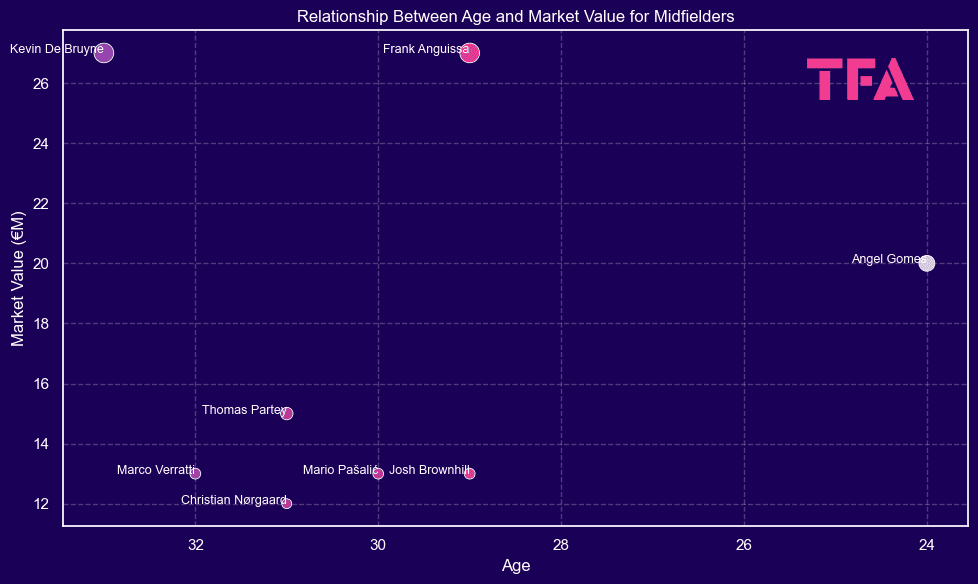
Kevin De Bruyne – Market Value & Age
At the top end of the experience spectrum is Kevin De Bruyne, aged 33, whose contract with Manchester City expires this summer.
Despite limited minutes this season (1,103 minutes in 20 matches), he recorded two goals and six assists, maintaining his status as a creative powerhouse.
His high xAG (6.1) versus only 2.6 xG confirms his primary role as a chance creator rather than a goalscorer.
Even at his age, De Bruyne’s value remains significant due to his technical quality and tactical intelligence.
Frank Anguissa – Market Value & Age
In comparison, André-Frank Zambo Anguissa (age 29, whose contract with Napoli expires this summer) offers a more balanced profile.
With five goals and three assists in 2,306 minutes, he contributed both defensively and offensively.
His 29 tackles, 29 interceptions, and over 1,000 passes completed show his box-to-box presence, while a solid xG of 2.7 and xAG of 2.1 prove his capacity to influence play in the final third.
At 29, his value reflects peak maturity and reliability.
Josh Brownhill – Market Value & Age
Josh Brownhill, aged 29 and valued at €13m, whose contract with Burnley expires this summer, is another well-rounded option.
He posted 13 goals and four assists—a highly productive season for a midfielder—with an xG of 7.4.
His relatively low market value may not reflect his actual contribution, suggesting a potential bargain for clubs seeking a goal-scoring midfielder with endurance (35 appearances, 2,870 minutes).
Younger midfielders such as Angel Gomes (age 24, whose contract with Lille expires this summer) present a different case.
Though he played fewer minutes (736), he produced 1 goal and one assist with strong underlying numbers (xG 1.7, xAG 2.1).
His limited usage but promising metrics make him a development project with upside, especially for teams willing to invest in nurturing talent.
Meanwhile, Marco Verratti and Thomas Partey, both over 30, show signs of reduced attacking output but remain structurally significant.
Marco Verratti – Market Value & Age
Marco Verratti, 32 years old, who’s been playing with Al-Arabi SC in Qatar since moving from Paris Saint-Germain in 2023, didn’t score or assist but contributed heavily in possession (1,265 passes completed).
Thomas Partey – Market Value & Age
At the same time, Partey combined defensive stability with three goals and two assists.
Partey’s contract with Arsenal expires this summer.
In sum, age and market value for midfielders don’t always correlate linearly.
Experience often offsets physical decline in value, while younger players can be undervalued due to reduced sample sizes.
Clubs seeking a balance between maturity, technical skill, and physical output can find value across this diverse midfield group.
2025 Midfielder Free Agents – Passing Metrics & Tactical Impact
Passing ability is often the defining trait of effective midfielders.
In this section, we analyse the passing metrics of the free-agent midfielders in the 2025 dataset—focusing on three main statistics: Passes Completed, Passes Attempted, and Progressive Passes.
These numbers offer a clear lens into a player’s role in build-up play, control of tempo, and ability to advance possession into dangerous areas.
2025 Midfielder Free Agents Passing Performance
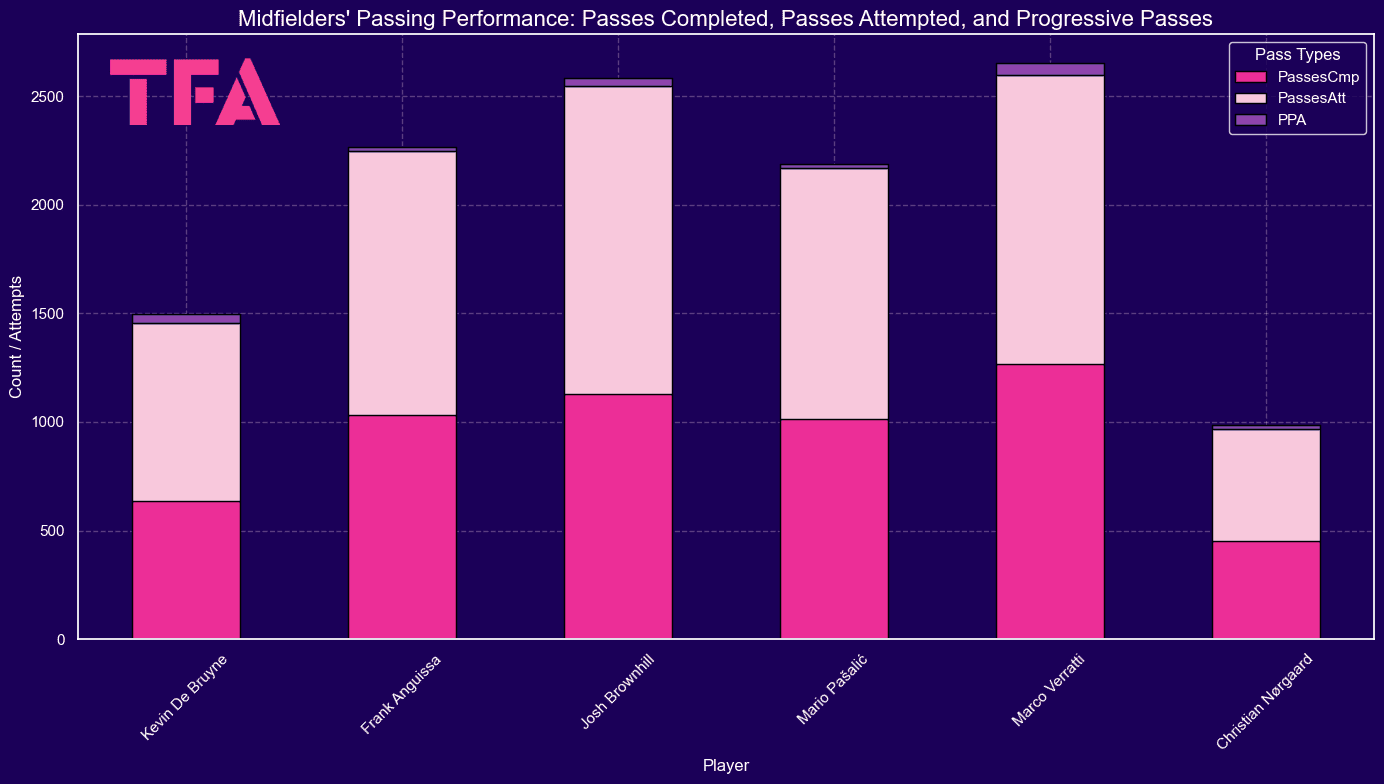
Marco Verratti Passing Performance
As shown in the figure above, Marco Verratti leads in terms of total passes completed (1,265) and passes attempted (1,333), boasting an impressive completion rate of nearly 95%.
His progressive passes (55) and 42 passes into the final third confirm his function as a deep-lying playmaker.
Although he didn’t contribute directly to goals or assists this season, his control over the game’s tempo and high passing volume are indicative of a metronomic midfield presence.
Thomas Partey Passing Performance
Similarly, Thomas Partey ranks among the top midfielders with 1,381 completed passes out of 1,579 attempted, achieving around 87.5% accuracy.
With 32 progressive passes, he shows he’s not just recycling possession but also moving the ball forward.
His 79 tackles and 41 clearances underline his dual role as a defensive midfielder and passer, showcasing his importance both with and without the ball.
Frank Anguissa demonstrates a well-rounded profile with 1,031 passes completed from 1,219 attempts and 120 progressive passes—the highest in the midfield cohort.
His willingness to play forward and break lines is clear, making him valuable for teams needing transitional play.
Additionally, his strong defensive metrics (36 tackles, 29 interceptions) make him a complete midfield engine.
Kevin De Bruyne Passing Performance
Kevin De Bruyne, despite limited minutes, completed 634 passes with 113 progressive passes, proving once again that his creative impact per minute remains elite.
His passing is not about volume but rather about incision and value per action.
Angel Gomes Passing Performance
Younger midfielder Angel Gomes also stands out in limited minutes: 295 passes completed from 364 attempts, along with 49 progressive passes in just 736 minutes.
His numbers hint at a progressive and forward-thinking style, which could blossom further with more regular playtime.
Josh Brownhill Passing Performance
On the other hand, Josh Brownhill shows solid consistency with 1,131 completed passes out of 1,418 attempts and 136 progressive passes.
His directness in passing complements his goal-scoring ability, suggesting he is equally valuable in breaking lines and finishing attacks.
The passing performance across these midfielders highlights a variety of styles—from Verratti’s possession dominance to Anguissa’s verticality and De Bruyne’s incisiveness.
Clubs seeking to control the midfield phase or add progressive intent will find multiple profiles here tailored to different tactical systems.
2025 Midfielder Free Agents – Age, Progressive Passing, & Market Value
Let’s examine the relationship between age, progressive passing, and market value for the midfielders among the 2025 free agents in more detail.
These three variables together provide a nuanced view of how player maturity, passing contribution, and market expectations align—or don’t, in some cases.
Comparison Of Midfielder Progressive Passing Vs Age
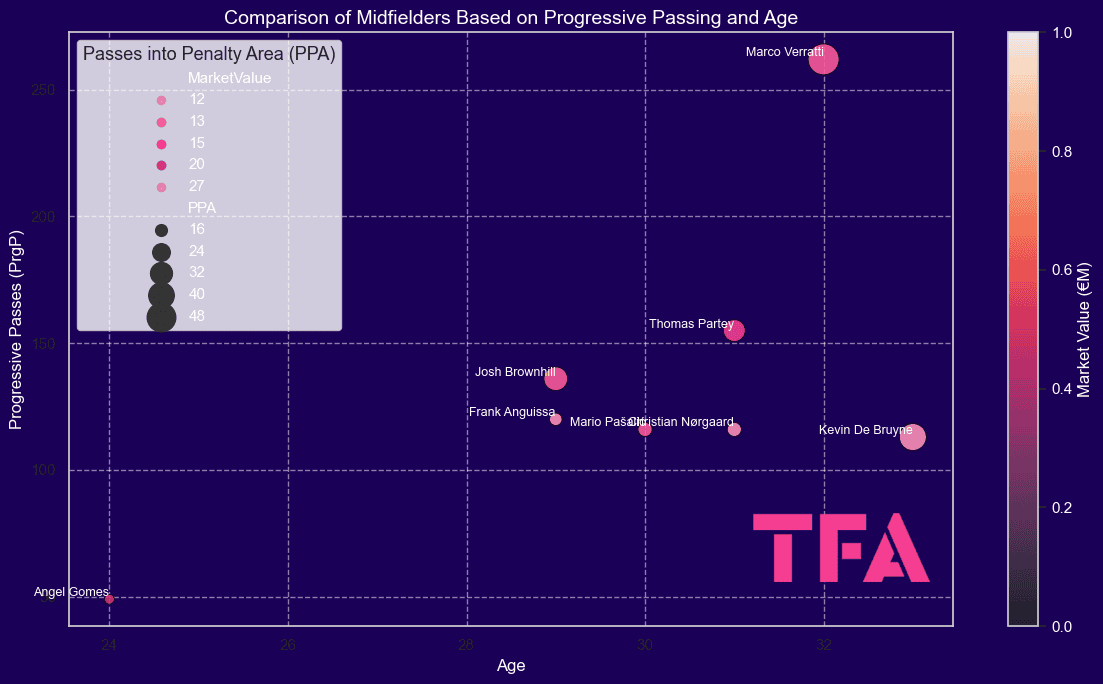
Frank Anguissa – Market Value, Progressive Passes, & Age
One of the standout profiles is Frank Anguissa.
At 29 years old, he boasts the highest number of progressive passes among midfielders (120) and a respectable market value of €27m.
His progressive play and physical presence make him a rare two-way midfielder, and at this age, he still operates within his athletic prime.
For clubs looking for an immediate-impact player who advances play and offers defensive steel, Anguissa offers a complete package with high value.
Josh Brownhill – Market Value, Progressive Passes, & Age
At the same age, Josh Brownhill has nearly as many progressive passes (136), but his market value is notably lower at €13m.
Despite an excellent goal-scoring season (13 goals), his lower valuation could reflect the fact that he plays for a relegation-threatened side (Burnley) or possibly stylistic mismatches with elite-level possession teams.
Still, the data suggests he’s a potential bargain: a 29-year-old midfielder with high progressive output and strong end product.
Kevin De Bruyne – Market Value, Progressive Passes, & Age
Kevin De Bruyne is 33 years old yet retains a high market value of €27m, supported by his 113 progressive passes in just over 1,100 minutes.
This per-minute efficiency is extraordinary.
His age might suggest declining physical levels, but his vision and creativity remain elite.
Clubs targeting short-term creative solutions or experienced leaders will view him as a premium choice, as shown in the graph below.
Angel Gomes – Market Value, Progressive Passes, & Age
For younger profiles, Angel Gomes (24) presents an interesting case.
He produced 49 progressive passes in only 736 minutes, demonstrating promising output per minute.
However, his current market value is just €20m, reflecting his limited game time and the need for further development.
He could be a shrewd acquisition for clubs with long-term planning in mind.
Christian Nørgaard – Market Value, Progressive Passes, & Age
Lastly, Christian Nørgaard (31) recorded 116 progressive passes and a moderate market value of €12m.
His consistent passing and defensive presence (66 tackles, 37 interceptions) make him a valuable squad option, especially for sides needing stability in midfield.
This analysis clarifies one thing: market value does not always scale linearly with progressive passing or age.
Teams that dig deeper into metrics—especially progressive contribution—may uncover undervalued gems like Brownhill or Gomes.
In contrast, others may prefer the reliability of seasoned operators like Anguissa and De Bruyne.
2025 Defender Free Agents – Profiles & Key Metrics
The defensive analysis of 2025 free agent defenders reveals various strengths in different defensive metrics, including blocks, clearances, interceptions, and tackles.
2025 Defensive Stats For Free Agent Defenders
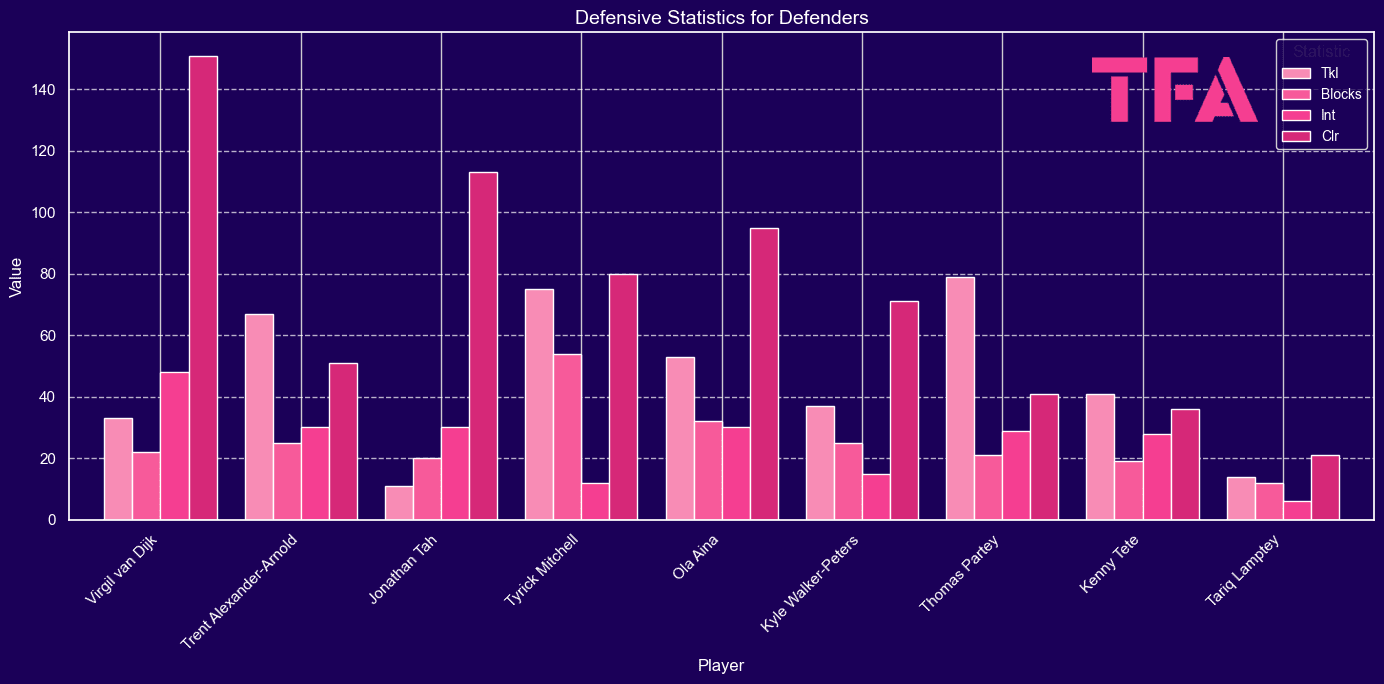
Virgil van Dijk Defensive Stats
Virgil van Dijk stands out with his excellent aerial presence and leadership, contributing significantly to clearances (151) and interceptions (48).
His ability to read the game allows him to dominate defensive situations, with his 33 clearances being crucial for Liverpool’s backline.
His relatively low block and tackle numbers are offset by his commanding presence and strategic positioning, which often prevents threats before they materialise.
Trent Alexander-Arnold Defensive Stats
As shown in the graph above, although more known for his offensive contributions, Trent Alexander-Arnold also excels defensively in certain areas.
With 62 clearances and 25 blocks, he plays a significant role in Liverpool’s defence, particularly in preventing crosses and aerial duels.
His versatility allows him to support both defensive and attacking transitions effectively.
Tyrick Mitchell Defensive Stats
Tyrick Mitchell’s defensive capabilities shine through his impressive tally of 75 tackles and 80 interceptions.
His ability to stop opponents in 1v1 situations and his consistency in winning aerial duels make him a key player in Crystal Palace‘s defence.
His clearances (138) and recovery efforts (84) show his reliability in clearing the ball under pressure.
Kyle Walker-Peters Defensive Stats
Kyle Walker-Peters, another standout in terms of defensive stats, recorded 113 clearances and 113 interceptions, displaying his adaptability and work rate.
His 48 blocks also reflect his commitment to stopping shots and crosses.
His defensive work has been critical in Southampton‘s setup, especially in maintaining a high defensive line while remaining effective in transition.
While these defenders may differ in their defensive styles, each brings a unique set of attributes to their respective teams.
Whether through aerial dominance, tackling precision, or situational awareness, their contributions go beyond basic statistics and are vital for their teams’ defensive stability.
Conclusion
Based on the analysis, the standout players for each position in the 2025 free agent pool include Mohamed Salah and Jonathan David in attack, offering both proven productivity and potential.
In midfield, Kevin De Bruyne and Frank Anguissa provide a mix of creativity and defensive solidity.
Defensively, Virgil van Dijk and Jonathan Tah offer leadership and reliability, while Kenny Tete stands out as a potential bargain.
Clubs looking for immediate impact or long-term investments will find valuable options across these categories, making the 2025 free agent market an intriguing prospect for all teams.
