
This tactical analysis of RC Strasbourg will analyse how Liam Rosenior has the Ligue 1 side fighting for European football with an exciting attacking style of play.
Rosenior took over the Alsace club in July 2024.
With three games of this season left to play, including one against UEFA Champions League semi-finalists PSG, Rosenior’s side still has a chance of qualifying for Europe’s premier competition.
Strasbourg has only qualified for UEFA competition once in the previous twenty seasons, so this represents Strasbourg’s best season for some years.
This impressive league campaign is all the more remarkable, considering Rosenior is working with the youngest average starting XI in the French top flight and, remarkably, one of the youngest squads in European football history.
After a rocky November in which Les Alsaciens lost all four of their games, they have lost just twice in all competitions since.
Rosenior has previously worked in the EFL as the interim manager of Derby County and Hull City.
In the 2023-24 season, the former Premier League player was nominated for the EFL Championship Manager of the Season award before being sacked despite achieving an impressive seventh-place finish with Hull.
BlueCo, which also owns Premier League side Chelsea, owns Rosenior’s current side.
As such, Rosenior has been tipped to lead the West London club one day.
This tactical analysis will dissect how Rosenior tactics have succeeded in France by focusing on his side’s attacking approach.
Examples from recent matches will be used to analyse how Strasbourg creates goal-scoring opportunities, including their build-up play from goal kicks and calm approach to attacking transitions.
How Does Liam Rosenior Set Up For Goal Kicks
Rosenior, who had long planned to become a coach by coaching the youth teams at every club he played for, has a distinct, attacking,possession-based style of play.
An important and effective element of this possession-based style is the detail Rosenior puts into his side’s build-up play from goal kicks.

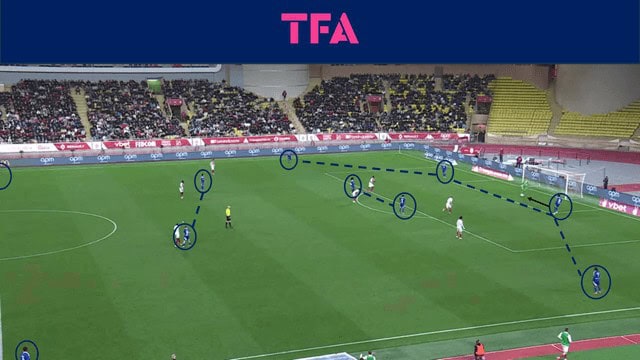
The above image illustrates how Rosenior has set up his team for short goal kicks in recent matches.
Although their typical in-possession formation is a 3-4-3, their goal kick shape changes to a 4-2-2-2, with a double pivot/box midfield, and two players high and wide on the halfway line.
The centre-back takes the goal kick by passing to his goalkeeper, a recent goal kick trend, before the goalkeeper pauses with the ball at his feet.
Strasbourg’s Serbian goalkeeper, Đorđe Petrović, is pivotal to Rosenior’s style of build-up play.
The above image shows the on-loan Chelsea keeper receiving the ball from a goal kick.
Petrović commonly puts his foot on the ball and begins a game of cat and mouse with the opposition forwards.
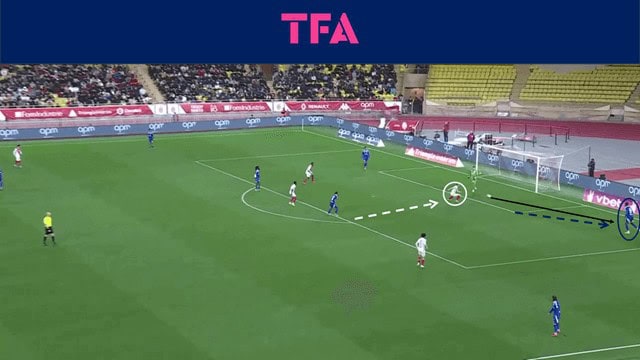
After receiving the ball from his centre-back, the former MLS keeper waits until he is pressed by one of the opposition forwards.
This example from their recent match against AS Monaco shows just how close Petrović will allow the forwards to come to him, directly in front of his own goal, before he releases the pass.
By waiting for the opposition player to get so close, the centre-back who played the initial pass is afforded time to move into a position wide of the opposition’s press.
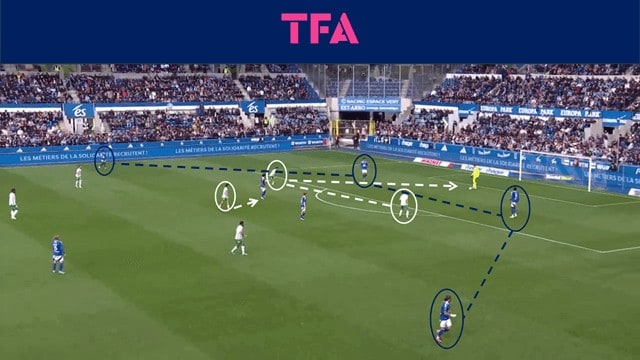
In this example against Saint-Étienne, the goalkeeper played a bounce pass goal kick to his right centre-back before waiting patiently to be pressed.
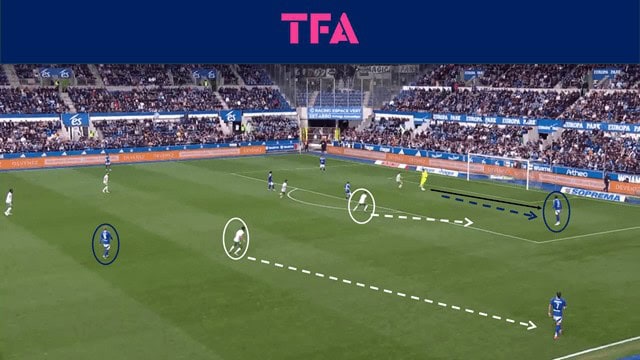
The left centre-back can now receive under only half pressure, on the outside of the opposition’s shape, with a clear passing lane to his teammate in the left-back position.
Should the opposition’s widest midfielder (circled) jump early to Strasbourg’s left-back, a straight, half-space pass can be played into one of their box midfielders.
Scoring Goals From Goal Kicks
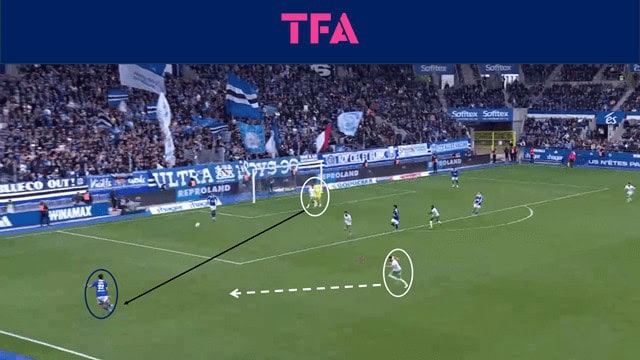
Strasbourg scored later in this same match against Saint-Étienne using the same concept.
The only difference here is that Petrović, who allowed the opposition to press forward to get close enough to make physical contact with him as the ball was released, elected to bypass his centre-back and go to his lowly positioned left-back.
By adopting such a deep position, almost in line with the edge of the box, the opposition’s widest midfielder has a long way to jump to press the ball.
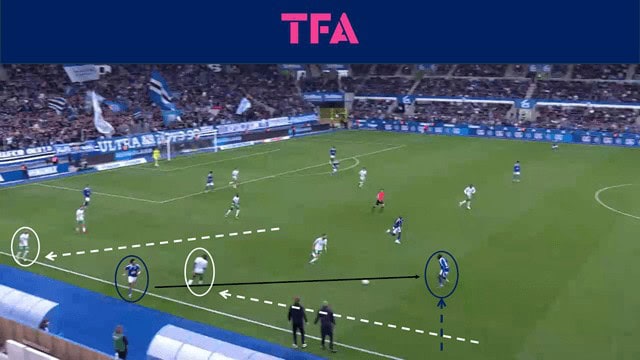
This distance allowed the right-back time to receive facing forward, get his head up, and skip past the onrushing midfielder (circled on the touchline).
Dribbling beyond the pressure caused the opponent’s left back to jump out of position to press the ball.
Strasbourg’s wide forward, who had remained high and wide behind the aggressive full-back, then moved inside to create an angle for a pass.
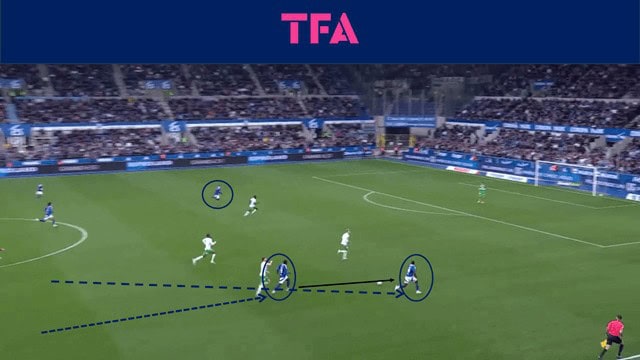
The wide forward drove into the opposition’s half with the ball at his feet whilst being supported by an overlapping run from his midfielder.
The forward then fed in his teammate down the side of the ball-near centre-back.
The ball-far wide-forward kept relative width on the blind side of his marker.
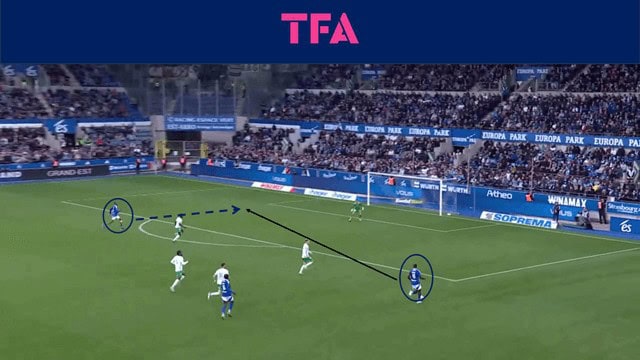
The forwards holding their width, on the outside of the backline, is a common trait in Strasbourg attacks.
This positioning means that when the ball reaches the edge of the opposition’s box and is about to be delivered, the defenders, who have eyes on the ball, do not know where the forward is and have to defend the cross while facing their own goal.
This allows the wide forward to sneak in at the back post area.
On this occasion, the defenders were able to get a touch to intercept the cross; however, because of their body orientation, they were only temporarily delaying the danger.
Strasbourg’s supporting midfielders collected the ball at the edge of the box and coolly volleyed in Strasbourg’s third goal.
Calmness In Transition
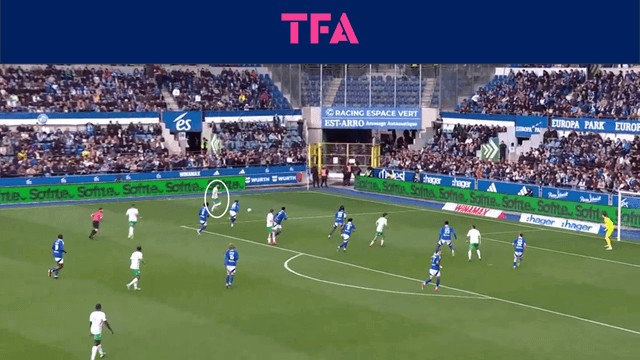
In the defensive phase, Strasbourg commonly bring all 11 players back behind the ball.
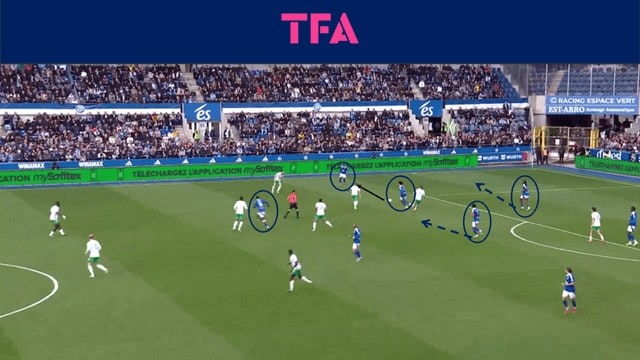
Instead of looking to play forward immediately, the players closest to the ball move towards it and form a rondo-like shape around the ball.
They calmly play the easiest pass to the nearest player in space, and play short passes in the box they have formed.
This delay in going forward allows their teammates time to take up more advanced positions.
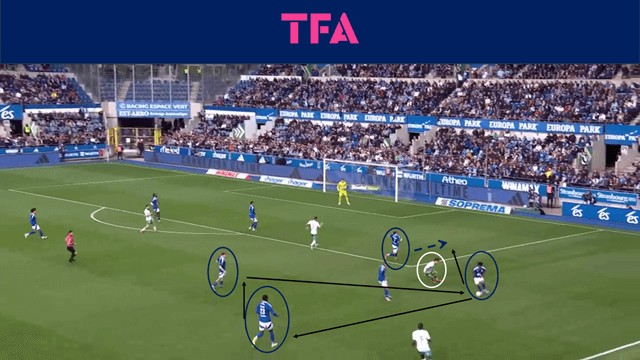
In this example, having swarmed around the ball to win it back from the opposition player circled, Strasbourg’s players were very condensed.
Again, the players nearest the ball moved towards it, replicating a possession box.
Even though it was possibly easier to play forward after the initial pass, Strasbourg was in no hurry to advance the ball.
Instead, they played backwards and moved the ball quickly around the counter-pressing opponent in a triangle.
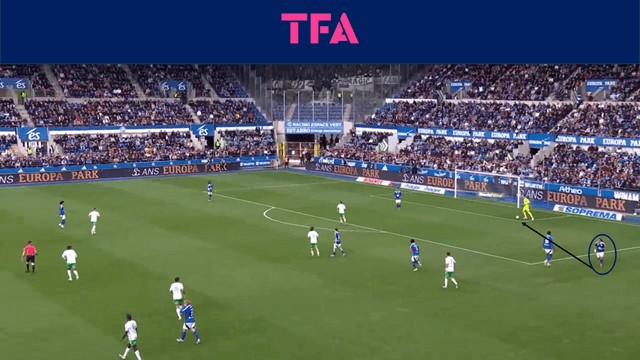
After playing four short passes, they played the ball back to the goalkeeper, who received it under no pressure.
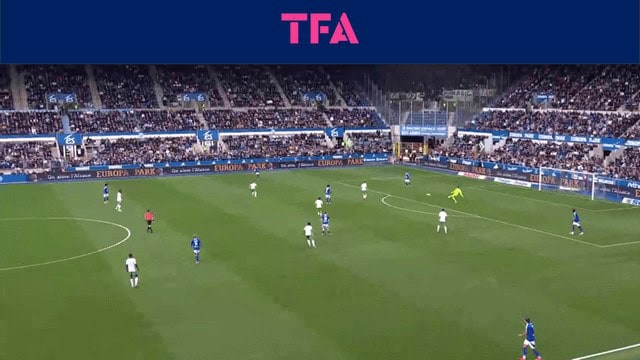
By working the ball back to the goalkeeper, they were able to regain their attacking starting positions and cover a larger area of the pitch.
Goalkeeper Petrović, as previously described, calmly stood with the ball at his feet to both give his outfield players time to regroup and to invite the press.
This allows Strasbourg to take up their recognisable starting positions and conduct pre-planned movements and phases of play.
Scoring Goals From Transitions
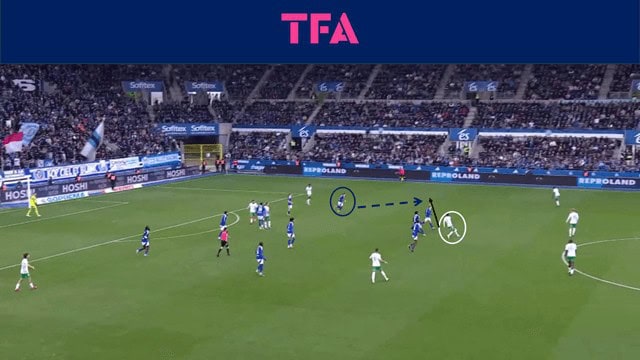
Strasbourg, later in the same match against Saint-Étienne, scored from a very similar circumstance.
The above image shows the moment Strasbourg, again with every player behind the ball, intercepts the ball after a sloppy opposition pass in midfield.
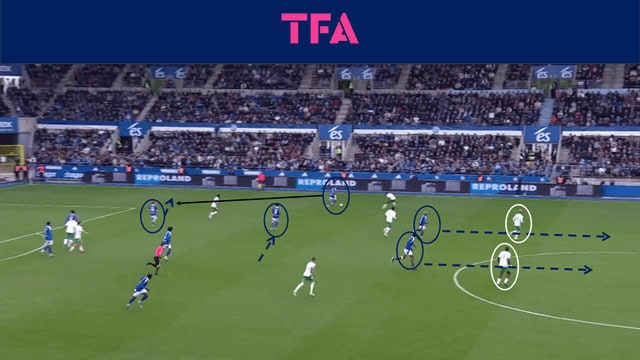 As soon as the ball is won, two players make runs in behind, and two make supporting movements towards the ball.
The temptation for most teams in this situation would be to put the ball immediately behind the opposition’s back line.
This is especially true if a team has fast forwards, as Strasbourg themselves have.
Instead of hitting the vast space in the opposition’s half, the intercepting player is extremely calm on the ball, turns away from the pressure, and plays the first pass backwards.
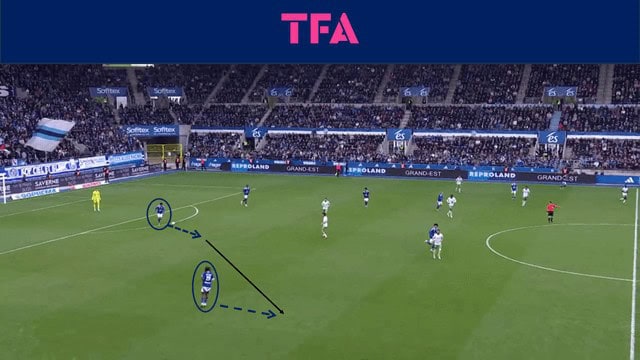 Within a few seconds, Strasbourg have moved the ball from another tight, rondo-like area, into space.
Their centre-back is able to comfortably gain possession of the ball and drive forward, with his team now in a more conducive shape to progress the ball safely.
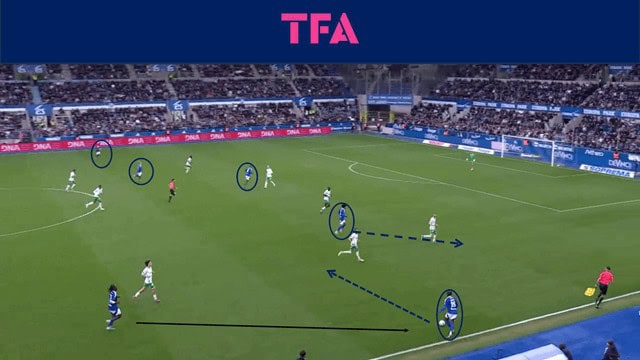 Now Strasbourg have five players, instead of just the original two, putting pressure on the opposition’s back line and spread across the five zones of the pitch.
They also have the ball carrier deep in the opposition’s half, under no immediate pressure.
Aided by the diagonal run of his forward, creating the required space, the wide player can dribble into the centre of the pitch.
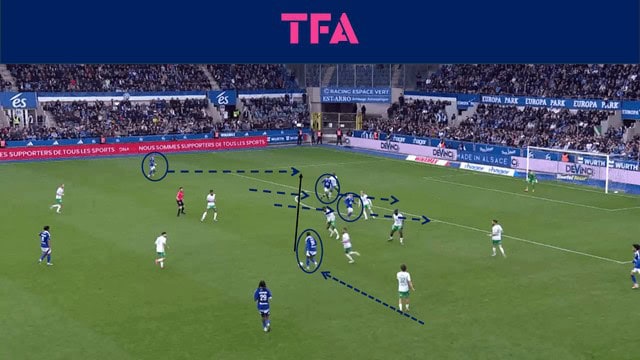 Once the wide player drives inside, the two central forwards make diagonal runs towards the goal.
This drags the defending players centrally and opens up the left wide player to receive free.
Again, although in slightly different circumstances, Strasbourg have occupied, and used, the full width of the pitch.
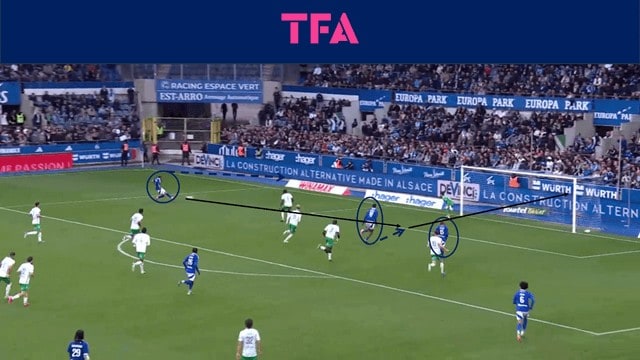 The wide player is able to receive inside the box with no pressure.
Now, the same two forwards that could have been sent to chase a hopeful ball in-behind from deep in their own half are left wide open to receive a low cross in the opposition’s box.
Conclusion
Liam Rosenior’s RC Strasbourg side is a great example of the modern-day, pre-planned approach to attacking, possession-based football.
Whilst their patterns of play are clearly rehearsed, they are by no means boring to watch.
The attacking movements and the speed at which they make these movements make them an exciting team to follow and fascinating to analyse.
By being extremely calm upon winning the ball back, they allow themselves the time to position their players where they can cause the opposition harm.
Rosenior’s side and their attacking style of play would be a welcome addition to next season’s Champions League.
