
This 2023/24 season will mark the tenth anniversary of Hull City reaching the FA Cup final, which they eventually lost to Arsenal through an extra-time Aaron Ramsey strike.
Hull enjoyed a brief venture into European football following on from that day at Wembley, but they have since endured some turbulent times on and off the pitch.
The Tigers were relegated the following season but returned to the Premier League at the first attempt via the playoffs.
Despite the promotion, then-manager Steve Bruce resigned before the commencement of their return campaign in the top flight due to an alleged dispute with the Allam family, the owners at the time.
Their latest stint in the top division did not last long, as an immediate return to the EFL Championship was confirmed.
During this time, the fanbase grew frustrated with the Allam family, with a notable lack of investment in the squad and disdain for suggestions of a rebrand to Hull Tigers.
The East Yorkshire side consolidated its position in the EFL Championship for the next two seasons, finishing 18th and 13th, respectively.
Hull declined, however, in the 2019-20 season.
Although the campaign started brightly, including a three-match winning streak in Autumn, the Tigers capitulated after the New Year, losing 16 of the final 20 matches.
Such an abysmal form confirmed their relegation to the third tier of English football.
Grant McCann ensured an immediate return to the second tier as Hull finished the 2020-21 season as champions of EFL League One.
In January 2022, fortunes changed off the pitch as Turk Acun Ilicali took over.
However, new arrivals in the boardroom led to departures in the dugout as McCann left the same month to be replaced by the Georgian, Shota Arveladze.
Arveladze helped Hull steer clear of relegation with a 19th-placed finish.
Although a poor start to the 2022-23 campaign sealed Arveladze’s fate.
He was subsequently dismissed in September 2022 and replaced by Liam Rosenior in November 2022.
In this Liam Rosenior tactical analysis and scout report, we will analyse Hull’s poor form at the start of last season, which led to Arveladze’s sacking, and how his replacement, Liam Rosenior, has positively impacted the Club.
We will analyse Rosenior’s tactics and provide an analysis of the Tigers’ dealings in the transfer window for the season ahead.
Poor at the back
The 2022-23 season began with real promise for Hull City as they went unbeaten in their first four league matches with two wins and two draws.
A 5-2 thrashing by West Bromwich Albion followed, however.
Despite victory over Coventry City, a four-match losing streak ended Arveladze’s reign. Hull sat 20th in the table, facing a relegation fight.
During the four-match losing streak, the Tigers conceded 11 goals (an average of 2.75 per game) and only scored one.
Arveladze lasted 10 league games at the start of last season, during which time Hull conceded 21 goals, an average of 2.1 goals per match.
As Arveladze encouraged playing out from the back, his side made errors.
Hull made two errors in the 3-0 away defeat in the league game at Swansea, which proved to be Arveladze’s last game in charge.
The graphics below show how errors at the back, when under pressure by the Swansea front line, led to the third goal.

From the above graphics, it appears that as Hull played out from the back, Swansea’s front line was encouraged to press.
With Hull’s Greg Docherty off the ball, the idea was to create space for a pass to Ryan Woods.
However, Woods’ positioning was too advanced.
If Woods had been positioned deeper, Tobias Figueiredo could have made a simple pass.
However, Figueiredo misplaced the pass due to the attack’s advanced positioning and pressure.
Swansea’s Joël Piroe was then able to intercept the ball, and Swansea scored.
Although interim boss Andy Dawson oversaw three victories from eight and reduced Hull’s average goals conceded per game to 1.75 following Arveladze’s dismissal, Hull had the worst defence in the division before Rosenior’s arrival.

At the other end of the pitch, before Rosenior’s arrival, the Tigers scored 1.17 goals per game, which was better than only eight different teams in the division at that stage.
A lack of firepower upfront and leaking goals in defence suggested relegation form.
Rosenior makes Hull hard to beat
When Hull appointed Rosenior, Rosenior had little managerial experience.
His first managerial stint came at Derby County, where he was interim boss following their relegation from the EFL Championship in 2022.
With Derby in substantial financial trouble, Rosenior oversaw a colossal recruitment drive and a squad overhaul.
Despite the off-the-pitch problem, Rosenior won four of nine league games and seven of 12 matches in all competitions.
He subsequently left Derby, having won 58.3% of his games in charge, and the Rams were level on points with the playoff positions.
Based on his record, he appears unlucky to have not been given the job at Pride Park full-time.
Rosenior didn’t have to wait long, though, for his first full-time management position.
He became Hull’s boss in November 2022.
Since his arrival, he has significantly improved the squad’s defensive capabilities.

The table shows that since Rosenior’s appointment, Hull had one of the best defences in the EFL Championship last season.
His record was bettered only by Burnley, Luton, and Sheffield United, all of whom eventually gained promotion.
Despite joining Hull when they were low on confidence, Rosenior hasn’t shifted from his philosophy of playing possession-based football and playing out from the back.
Whilst his predecessor, Arveladze, tended to alternate between 4-2-3-1 and 3-4-1-2 formations, Rosenior has opted for 4-2-3-1, 4-4-2, and 4-1-4-1.
Rosenior preferred the 4-2-3-1 formation, which he used in 54% of the league games he oversaw last season.
His approach, therefore, shows similarities to Arveladze.
However, interestingly, Rosenior favoured different personnel in his backline despite similar formations.
Arveladze often played a back four of Lewie Coyle, Figueiredo, Jacob Greaves, and Callum Elder; Rosenior preferred Alfie Jones and Sean McLoughlin at centre-back and Cyrus Christie at right-back.
Greaves often featured at left-back under Rosenior.
As Rosenior encourages his players to play out from the back, the defenders will be responsible for the first phase of play and need to be comfortable in possession.


Since Rosenior switched Greaves to the left of the defence, his other options at centre-back were Figueiredo, Jones, and McLoughlin.
Individual errors contributed to Hull’s early-season defensive woes.
The radar charts show that McLoughlin performed the strongest out of the three centre-back options in a defensive capacity last season, as he was ranked higher for the percentage of aerial and defensive duels won.
Although Figueiredo outperformed Jones in defensive areas, Jones was more capable of providing an attacking outlet, ranking higher for shots and touches in the opposition box per 90 minutes.
Furthermore, McLoughlin ranked higher than Figueiredo last season for goal contribution per 90.
The radar charts indicate that Jones and McLoughlin are more forward-minded.
Figueiredo, in addition, was more prone to errors and miscontrolling, as being dispossessed per 90 minutes, compared to Jones and McLoughlin, as highlighted in the defeat against Swansea.
This indicates he is less comfortable in possession and when pressed than Jones and McLoughlin.
Figueiredo ranked lower compared to his former teammates for dangerous passes per 90.
As Rosenior prefers his team to control possession and look for runs in behind to exploit opposition defenders, the fact that Jones and McLoughlin completed more through balls per 90 minutes than Figueiredo suggests why they were the preferred defensive partnership.
On the other hand, Figueiredo is more prone to switching the ball when in possession and was ranked higher in attempts and successful long passes per 90 than his former teammates.
Using the long ball contradicts Rosenior’s philosophy, further demonstrating why he featured more on the bench after Arveladze’s departure.
Greaves proved versatile last season.
Although he is more naturally a centre-back, he featured as a left-back under Rosenior.

The radar chart shows that, in terms of passing ability, Greaves outperformed Elder in the percentage of accurate passes, while Elder was better with progressive passes per 90.
Elder tends to pose a greater threat with crosses.
Despite Elder’s positive play, Hull still needed to address their defensive struggles. Greaves had stronger tackling credentials, winning 28% more challenges from dribblers than his teammate Elder.
Furthermore, the charts indicate that Greaves outperformed Elder across all defensive departments and poses a greater goal threat.
Elder is more likely to miscontrol and be dispossessed when carrying the ball and, hence, poses a greater risk when trying to control possession at the back.
This, together with Greaves’ possession capabilities, highlights why Greaves was the preferred option on the left.
Until an injury in February 2023, Christie was Coyle’s preferred option at right back.
The radar chart below shows that Christie offered more in progressive attacking play, ranking much higher in shots, dribbles, and touches in the opposition box per 90.

Concerning the defensive duties, Christie was much stronger, winning aerial duels; Christie also intercepts the ball well, suggesting a good reading of the game and being able to advance the Tigers forward on the counter.
Christie’s ability to carry the ball forward explains why he was the preferred option, as he would be more likely to start and build attacking phases of play.
Christie posed a greater threat, scoring three goals to Coyle’s none.
Hull desperately needed more options upfront.
Under Rosenior, Hull scored 1.07 goals per game, a 8.55% reduction from the 1.17 goals per game before his arrival.
Considering when Rosenior arrived, the Tigers were in a relegation dogfight, the fact Hull finished the 2022-23 season in 15th position, 14 points clear of the relegation zone and only 11 points off the playoff places, is quite an achievement.
There is no arguing that Rosenior has transformed Hull’s fortunes at the back ahead of the 2023-24 EFL Championship campaign, but improvements in front of goal had to be addressed.
Change of fortunes in attack
During the 2022-23 season, Hull lost only six of 28 matches overseen by Rosenior, but frustratingly drew 14.
That lack of cutting edge in front of goal meant the East Yorkshire side never really threatened the playoff places.
Reinforcements were brought in during January 2023, including striker Aaron Connolly.
However, an injury ended his season early in February 2023.
However, Rosenior has faith in the Irishman, and Hull signed Connolly from Brighton for an undisclosed fee ahead of the 2023-24 EFL Championship season.
That faith in Connolly has been rewarded as he is now one of the top scorers in the league this season, with three goals, beaten only by five other players, including his teammate Ozan Tufan.

The graph above shows that Connolly is one of the most clinical players in the division at the moment, as 77.8% of his shots have been on target and 33% have resulted in a goal.
As Connolly builds his fitness, he has played only 159 minutes this season and is scoring 1.7 non-penalty goals per 90.
Such remarkable statistics place him third in the division for non-penalty goals per 90 among players who have featured for at least 90 minutes this season.
Connolly’s impressive return of goals coincides with the Tigers’ change in fortune up front this season, as only Norwich, West Brom, Ipswich, and recently relegated Southampton have scored more.
Hull have continued to impose their possession-based approach under Rosenior this campaign, too.
They have so far averaged 4.43 passes per sequence, which is only bettered by Southampton and Leicester.
In addition, Hull have so far produced 16 build-up attacks, which is bettered by only five teams, including all the recently relegated sides.
Under Rosenior’s guidance, Hull has turned to the loan market this season, adding Liam Delap from Manchester City and Scott Twine from newly promoted Burnley.
Such additions have further bolstered Hull City’s attacking options, as seen in the graphics below.

The graphic above shows that Hull starts their play out from the back with the goalkeeper, and the ball is passed between the two centre-backs, McLoughlin and Jones.
The goalkeeper and the defenders are responsible for the first phase of play.
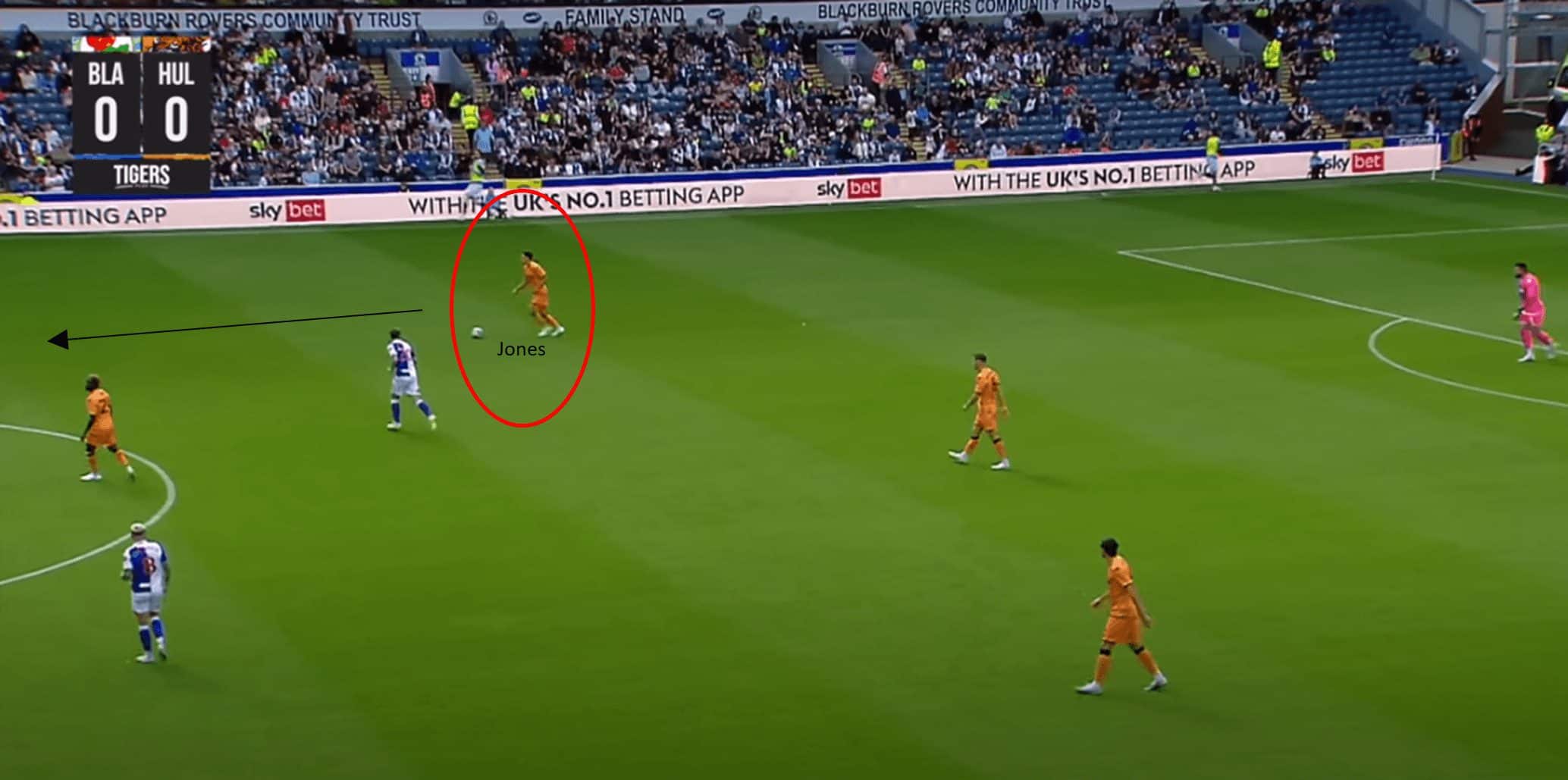
Jones is progressive in his play, immediately looking to play the ball forward.
By carrying the ball forward, Jones plays a pass to Delap, who has positioned himself in a deeper role, as seen below.
Such positioning is indicative of Delap’s intelligence, as he anticipated the ball from Jones; the movement and passing play by Hull ensured the ball passed through the opposition midfield.
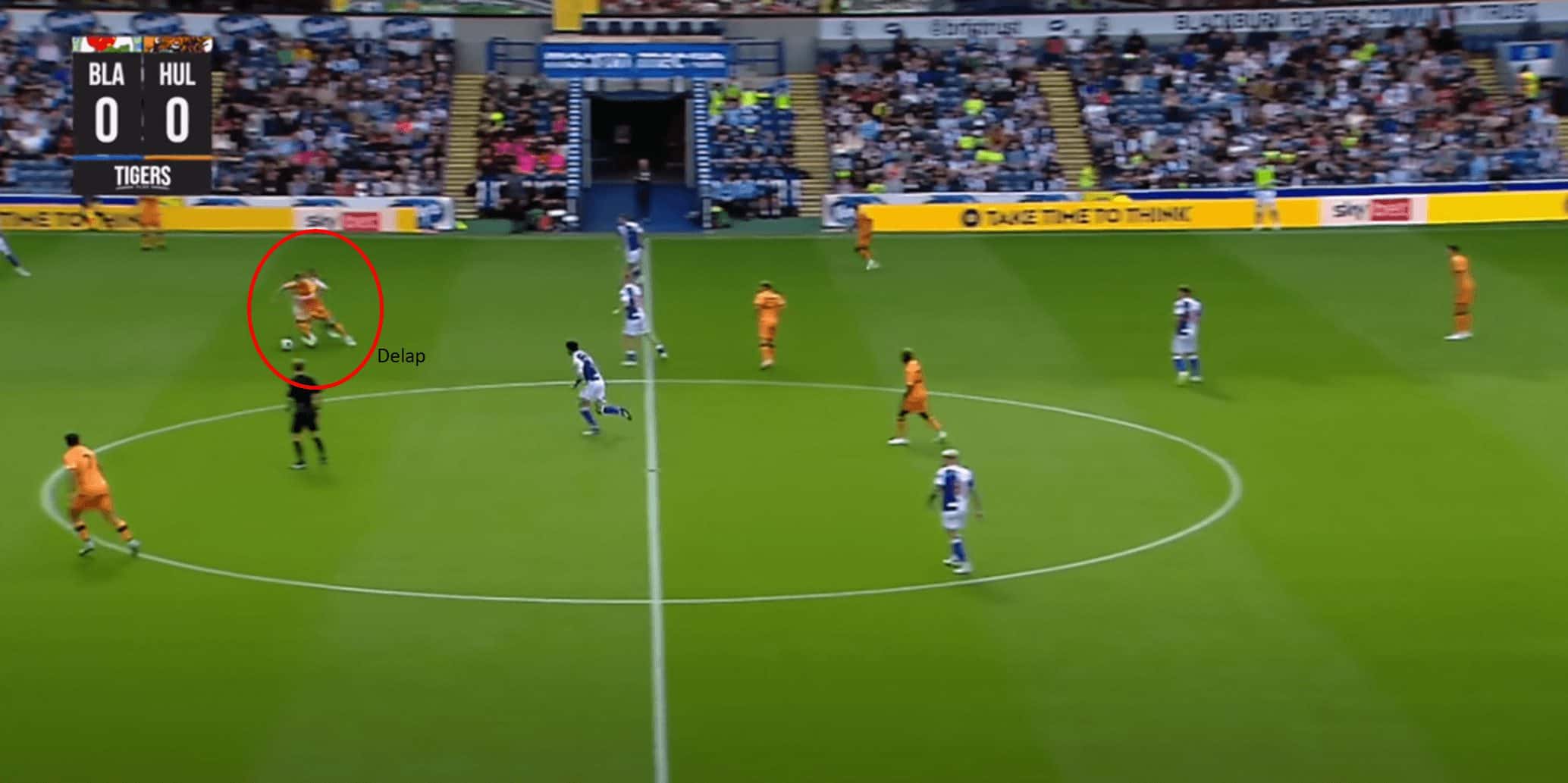
Delap is then able to use his speed and strength to turn and carry the ball forward at pace toward the opposition’s goal.
Delap’s quality in carrying the ball ranks him high at present for chance-creating carries in the league, as his carries forward have ended in four shots, one goal, four key passes, and one assist thus far.
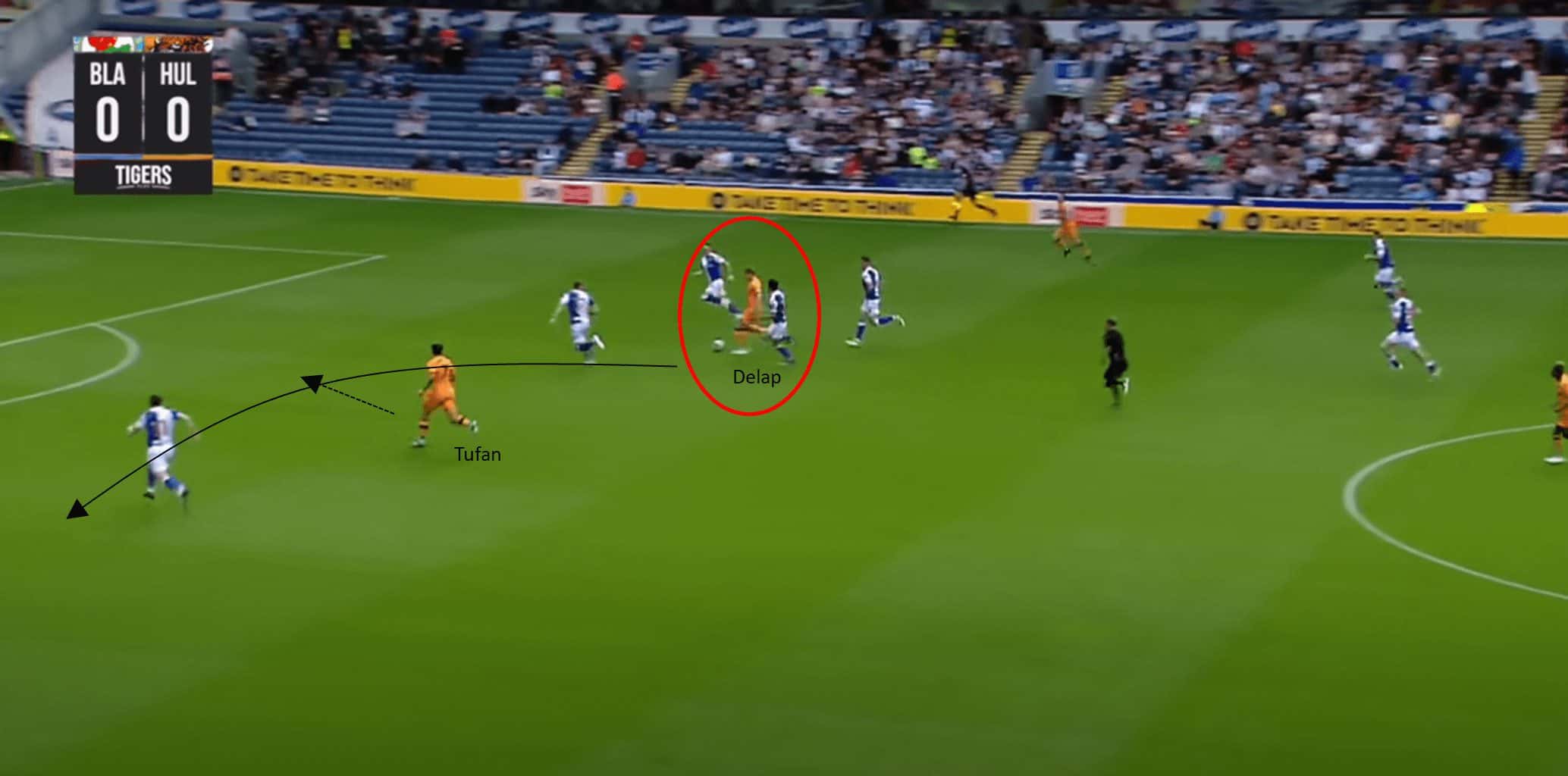
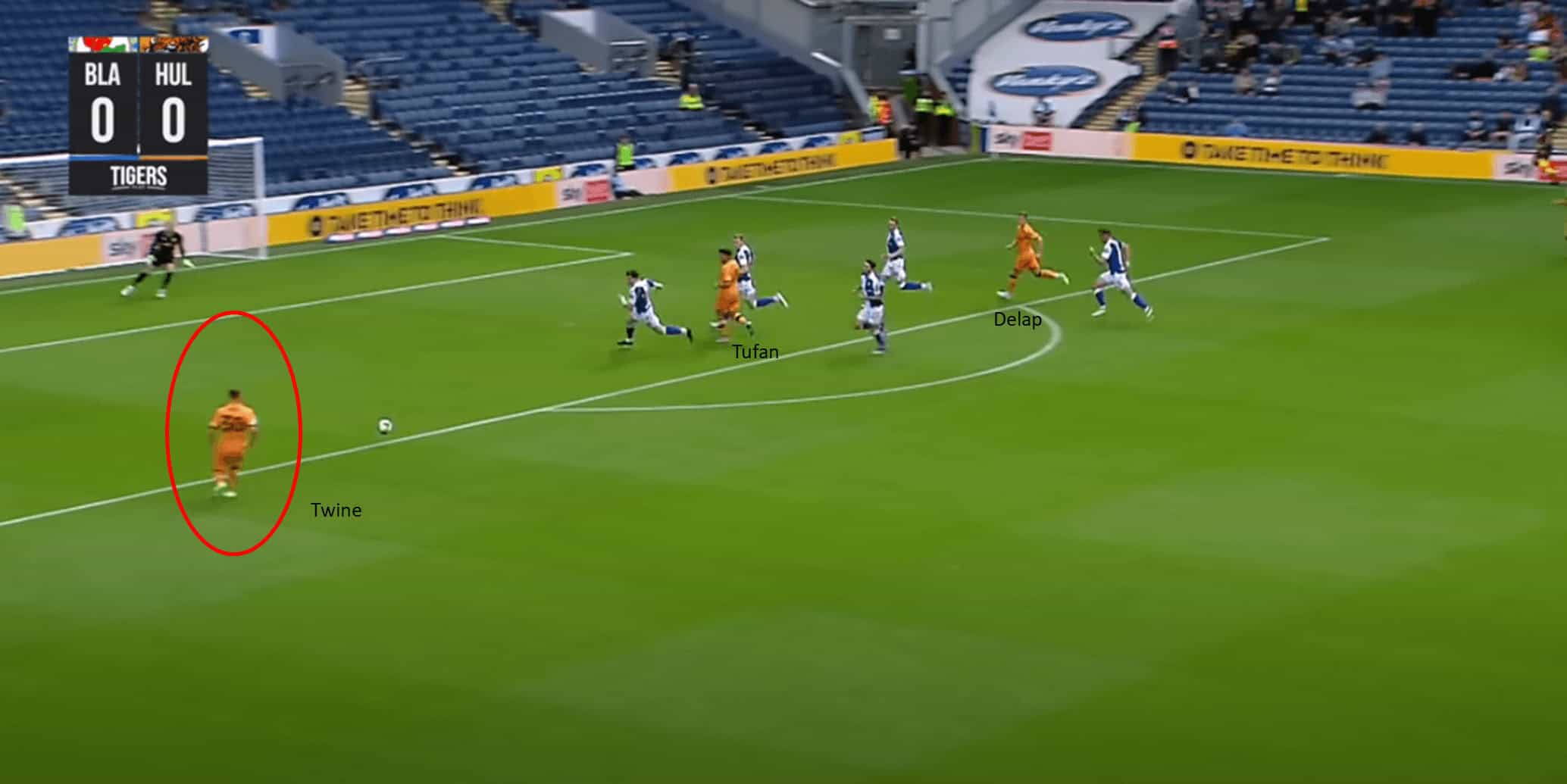
Tufan’s movement in the above graphics ensures that the ball from Delap bypasses the opposition defence, leaving Twine unmarked on the left to get a shot away.
However, on this occasion, his effort hits the side netting.
With Delap’s speed and the intelligent runs that Delap, Twine, and Connolly look to make behind defences, Hull appears to pose much more of an attacking threat than they did last season.
Furthermore, the versatile Twine will likely expand the Tigers’ set-piece options.
Although Hull have conceded a few more goals than they would have hoped this season, injuries have restricted them from being able to play a consistent back four.
Nevertheless, Hull currently find themselves in 6th place on goal difference, two points behind the automatic places.
Conclusion
In this tactical analysis, we discussed how Liam Rosenior’s tactics and formations have transformed Hull City’s performances.
We have seen how personnel changes to adapt to Rosenior’s possession-based football, playing out from the back, have improved the team’s defensive record.
Moreover, this analysis has shown how impressive Hull have been defensively since Rosenior’s appointment, compared to their opponents.
We have also examined some of Hull’s recent signings in the transfer window to improve their attacking credentials and assessed how these acquisitions have improved their goal return.
On the basis that Rosenior was able to solidify the defence, ensuring they had one of the best defences in the division last time round, and if the current goal return continues an upward trajectory, Hull City may very well be in the promotion mix this season.
A return to Wembley 10 years after that FA Cup final may be on the cards.