
It has been quite a summer at Tottenham Hotspur.
The departure of Ange Postecoglou after winning the Europa League Final has brought mixed emotions.
Optimism returned when Thomas Frank and his staff arrived with a renewed optimism and a different playing style.
The results on the pitch have been encouraging, but the summer transfer window has been less straightforward.
Expectations of a busy transfer market after the arrival of Mohammed Kudus soon gave way to frustration.
Morgan Gibbs-White has chosen to stay at Nottingham Forest, signing a new contract.
Eberechi Eze, who at one stage appeared close to joining Spurs, made a late U-turn that allowed Arsenal to move in.
The pattern of Spurs‘ targets suggests the club has been searching for another central ball carrier.
Thomas Frank wants a player who can work in tight spaces, drive forward and hurt opponents through direct runs, but this raises questions of balance.
Spurs already have several strong carriers in Kudus, Dejan Kulusevski, the injured James Maddison and Pape Matar Sarr.
What Tottenham lack is a pass-first profile in midfield (further forward).
They need someone to connect the phases of play, but ideally in the final third.
This tactical analysis and scouting report proposes two alternative player profiles, Sebastian Nanasi and Bilal El Khannouss, who can carry the ball when required but prefer to pass.
The recruitment analysis will assess their ability to play in central midfield, particularly on the right side, or as a ten.
It will also weigh the wider pros and cons of building around ball carriers compared with pass-first players.
Eberechi Eze Player Profile
First, we’ll take a quick glance at Eberechi Eze’s player profile to see what traits Tottenham were trying to gain in signing Eze.
The left-winger/left-sided attacking midfielder accumulated a ton of minutes for Crystal Palace last season, playing a key role in their FA Cup-winning season.
Eberechi Eze Stats

Focusing mainly on Eze’s attacking (yellow) and possession (pink) metrics, we can see that he primarily offers his team chance creation and threat.
For Eze’s attacking metrics, he ranks very highly in shot volume, goal contribution and xG contribution, while also sitting above average in dribbles per 90.
Meanwhile, he gets involved in his team’s possession to a decent extent while mainly standing out for his ability to make ‘dangerous passes’, an indication of his ability to offer value inside the final third.
However, he can also provide ball progression to the final third.
Ball Carriers Vs Pass‑First Players In Central Areas
In modern midfield construction, clubs often weigh the value of ball carriers against pass‑first players.
Both profiles bring tactical benefits and drawbacks; the right balance between them can determine whether a team can progress the ball while staying secure in transition.
Ball Carriers
Ball carriers pose an immediate threat through their ability to resist pressure and break through the line.
By driving into central corridors or half‑spaces, they manipulate defensive structures directly.
A single dribble forces opponents to step out, compromising compactness and the lanes behind.
As shown in a league fixture against Bournemouth last season, Eze’s ball-carrying causes problems for Bournemouth, which is currently recovering and out of shape.
Eze dribbles with purpose and is fouled to prevent a dangerous attacking situation.
In congested areas where vertical passes are blocked, a progressive carry acts as a “physical pass,” moving play forward when no lane is available.
Carriers also influence tempo through temporal manipulation.
The delay in their release means they drag opponents and create time advantages for runners arriving on the blind side.
Against mid‑blocks, or in transition moments when defences are less structured, one successful carry can collapse multiple lines at once.
However, there are some drawbacks.
Central turnovers from failed carries can be dangerous for the in-possession team because they occur with the carrier already committed forward, leaving little cover.
Unlike a misplaced pass, a failed dribble exposes the ball to multiple angles of pressure.
Carrying has a physical and cognitive load on players.
It demands constant scanning to avoid pressing traps.
Against low blocks, defenders may channel carriers into wide or less hazardous areas, making carries more predictable.
Pass‑First Players
Pass-first profiles offer a distinct set of advantages.
They do well in circulating play and rhythm control.
They can move the ball quickly, forcing opponents into constant adjustments.
This probing through circulation wears down blocks and creates exploitable gaps.
In the UEFA Nations League Final against Spain, Pedri shows his vision with a clever slip pass to Mikel Oyarzabal for the goal.
Pedri tends to be a pass‑first player, but also shows the ability to carry the ball and blend both aspects of his game, similar to Maddison, though the latter is currently sidelined with an ACL injury.
These types of players embody “third‑man principles”: instead of relying on 1v1 superiority, they exploit relational superiority by playing and moving at speed.
Their style also distributes risk.
Rather than relying on one player to advance under pressure, responsibility is shared across the team, which protects the structure from counter-pressing traps.
Because the ball is released quickly, teammates can maintain optimal positions, making it easier to carry out automatisms like triangles and rotations.
However, pass‑first players also face limitations.
When opponents collapse space between the lines, they may become redundant and circulate the ball laterally without penetration.
This becomes predictable against compact mid-blocks unless teammates provide movement to achieve superiority.
Tottenham Hotspur Transfer Recommendations
A wide range of names have already been linked with Tottenham’s search for midfield reinforcements.
Morgan Rogers, Xavi Simons, and, most recently, Nico Paz (who was the subject of a rejected Spurs bid) have all been reported as targets.
Each represents a slightly different interpretation of the creative midfield profile Spurs are pursuing.
However, two players stand out from that wider pool as particularly well‑suited to the balance this squad requires; these are the players I would put forward.
Bilal El Khannouss Scout Report
One of the most pressing needs in Tottenham’s current squad under Thomas Frank is a midfielder who can dictate rhythm while still contributing to progression in advanced areas.
They lack a midfielder who can probe patiently, circulate possession, and link together phases of play.
Bilal El Khannouss of Leicester City fits this requirement.
El Khannouss is a pass‑first midfielder, capable of operating either as a deep‑lying eight or in more advanced zones.
El Khannouss stands out strongly in possession metrics despite playing for a relegated Leicester side.
His received passes, at 72.45, progressive passes, at 59.5, and dangerous passes, at 44.2, all sit around or above the league median of 50, which represents the average for attacking midfielders in the top five leagues.
Considering the team’s struggles, he could still progress play and create value in difficult circumstances.
Bilal El Khannouss Stats
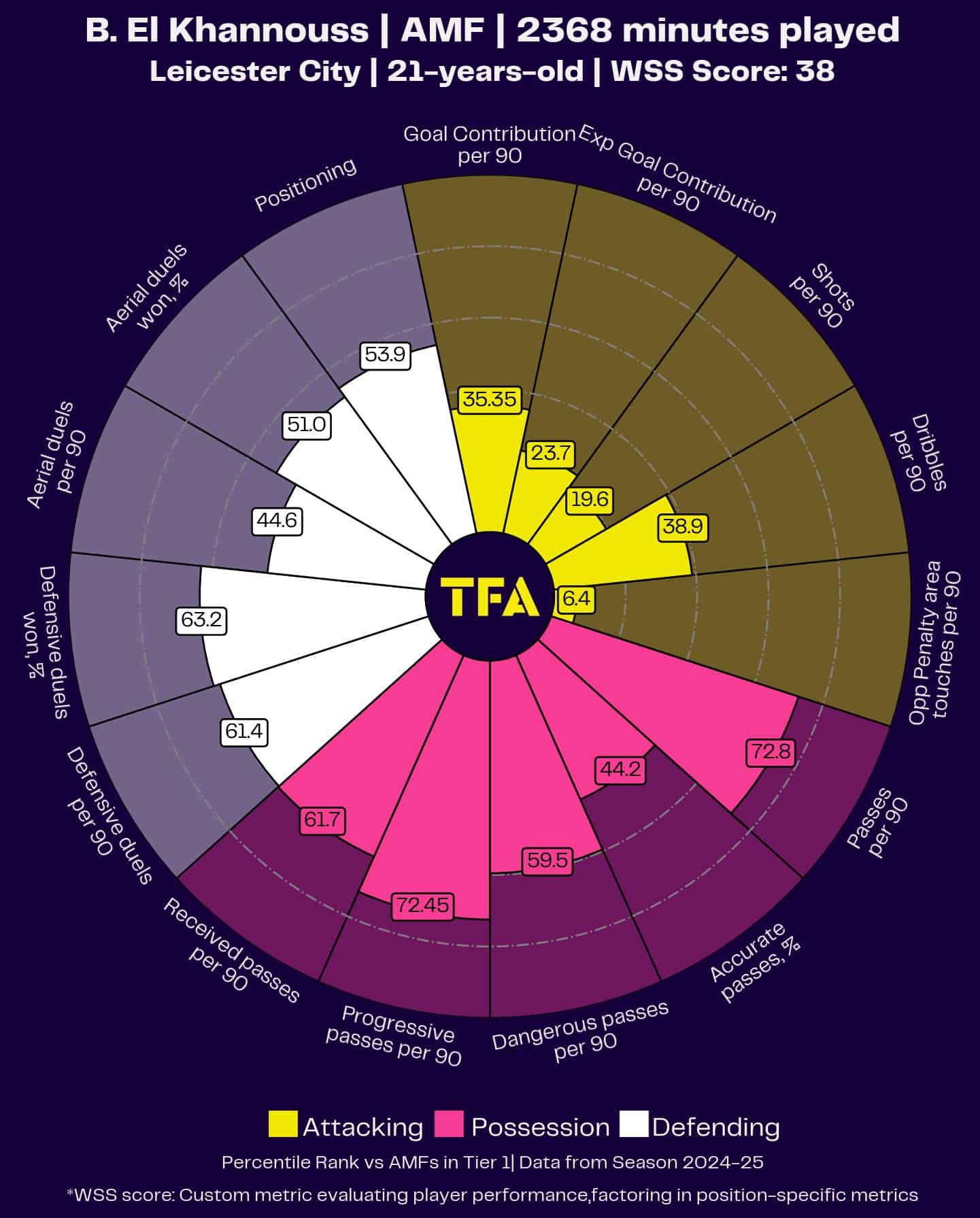
His orientation is always toward receiving under pressure, opening his body, and using quick combinations to progress play.
Unlike a pure ball carrier, he manipulates the opposition by scanning early and releasing the ball at the right moment.
In a pre‑season fixture against Karpaty, El Khannouss shows his flair craft by lifting the ball over an opponent.
He drives into space and then delivers a perfectly weighted pass to Patson Daka, who finishes the move.
His numbers reinforce this profile.
He averages 3.67 passes into the final third per 90 minutes (83rd percentile), based on a comparison with similar players in his position.
At the same time, his defensive contribution is notable, with 2.06 tackles per 90 (92nd percentile), demonstrating that he consistently brings intensity and work rate without the ball.
From a tactical perspective, Thomas Frank’s system at Brentford (now Spurs) is built around midfield fluidity and staggered roles.
In possession, one pivot drops to form a back three, while the other stays higher to connect play.
El Khannouss could do well in the latter role, receiving between opposition lines and linking with Kudus or Kulusevski in the half‑spaces.
His pass‑first tendencies would complement Spurs’ existing ball carriers, as they balance between chaos and control.
For a coach like Frank, who values both compactness and structured possession, Bilal El Khannouss provides qualities in both phases: press resistance through circulation and discipline when the block shifts across.
Whereas Spurs’ current midfield can sometimes feel tilted toward direct runners, El Khannouss would bring a calmer rhythm and probing quality.
He would allow Spurs to recycle, build patiently, and add progression through short and medium passes.
His statistical profile and stylistic tendencies align with the creative midfielder role Spurs need.
Under Thomas Frank, he could be the connector in central midfield, the player who turns possession into structure and structure into chances.
Sebastian Nanasi Scout Report
Sebastian Nanasi, currently impressing at Strasbourg under BlueCo ownership, could represent a well‑rounded solution.
He combines passing progression with chance creation in the final third.
Although listed as a left winger, Nanasi has often played as one of the 10s in a 3‑4‑2‑1, taking on greater responsibility in the central‑to‑left zones.
His radar is measured against LW peers.
Compared to the positional median (50), Nanasi excels in received passes (63.9) and dangerous passes (64.97) per 90.
Teammates turn to him to unlock play, and he responds with forward‑looking deliveries.
What makes him valuable is his tendency to drift.
He can start wide but slide into central pockets.
At Strasbourg, this role has given him creative responsibility, which includes injecting tempo and finding runners when the game slows.
Sebastian Nanasi Stats
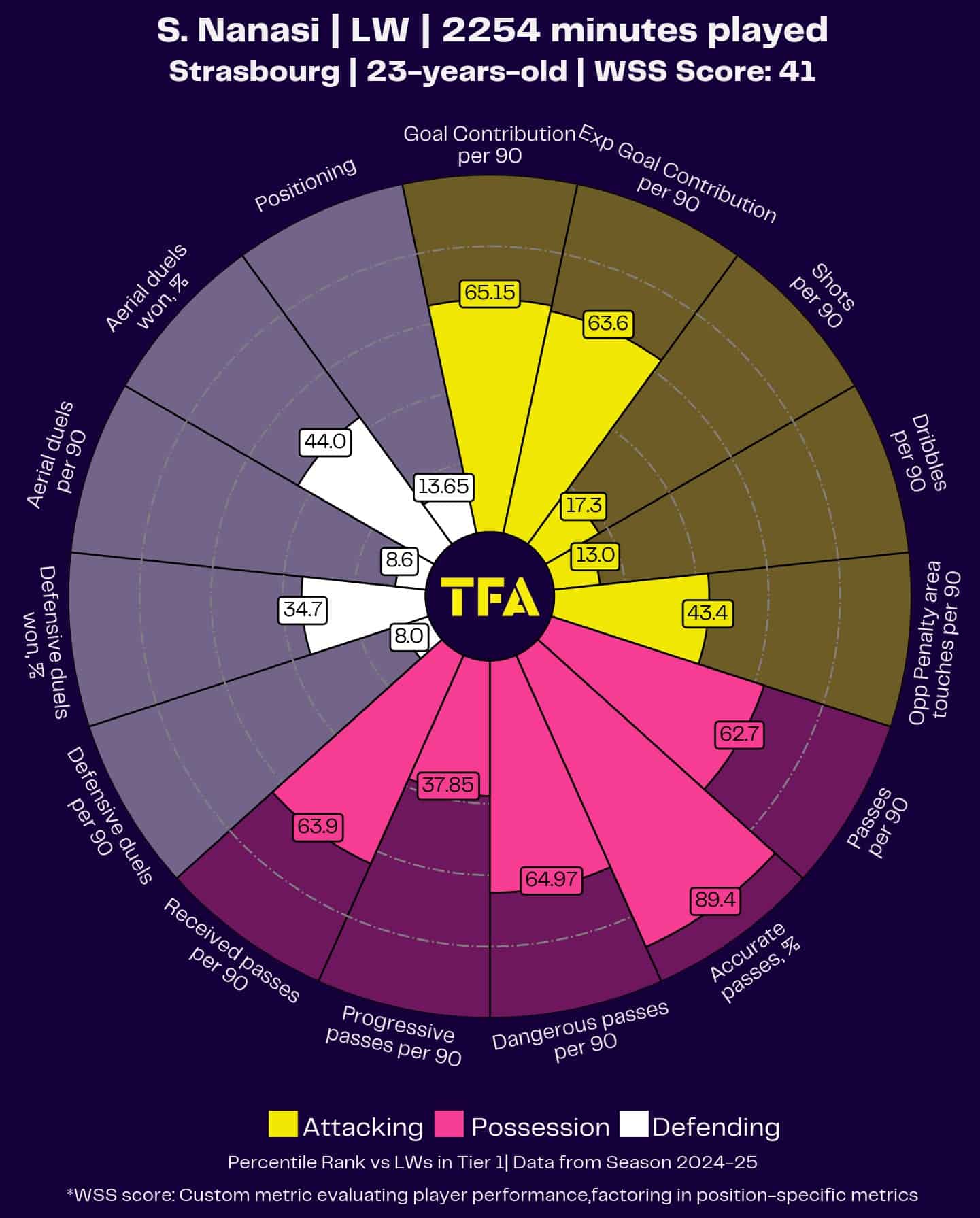
He averages 5.42 progressive passes per 90 (72nd percentile), showing his ability to consistently move the ball upfield.
He also registers 3.25 passes into the final third per 90 and regularly connects the midfield to attack.
In a league fixture against AS Saint‑Étienne, Nanasi links play by driving centrally with the ball before disguising a pass into space on the left for Emanuel Emegha, who was able to take a shot on goal.
Perhaps most eye‑catching is his 0.71 goal‑creating actions per 90.
This mix of progression and end product makes him a different type of creative midfielder from those already in the Spurs’ squad.
In terms of profile, Nanasi is comfortable operating between the lines but is more attack‑minded than a pure rhythm setter.
He likes to be in advanced central areas, where he can receive on the half‑turn, combine quickly, and exploit movement ahead of him.
His game is built on smart passes and decisive involvement in the final third, rather than long spells of recycling possession.
As shown below against Le Havre, Nanasi is able to receive on the back foot in the half space.
He is able to force the issue by using his ball control to skip past two opposition defenders.
Instead of shooting from a tight angle, he looks up and plays a pass to Abdoul Ouattara, who misses the chance.
This makes him particularly well‑suited to Frank’s 4‑2‑3‑1 setup, where the attacking midfielder must be a connector and creator (like Mikkel Daamsgard at Brentford).
Tactically, Frank’s Spurs lean on midfield fluidity and half‑space occupation, as seen in his Brentford sides with Damsgaard.
Nanasi could slot into that attacking‑midfield role, linking with Dominic Solanke’s hold‑up play or releasing wide runners like Brennan Johnson and Kudus.
His ability to receive under pressure would allow Spurs to sustain possession higher up the pitch, while his eye for goal‑creating passes would be a danger.
His willingness to progress play through passing rather than over‑carrying makes him a stabilising presence when Spurs face compact mid‑blocks.
Compared to someone like Bilal El Khannouss, Nanasi represents a more direct creative force.
He is less of a tempo‑dictator, more of a final‑third instigator.
In summary, Sebastian Nanasi has a mix of progression and creativity that Tottenham lack in certain game states.
His ability to progress play, feed runners, and generate goal‑creating moments makes him a profile worth serious consideration.
Conclusion
Tottenham’s midfield under Thomas Frank will require both balance and variety.
Bilal El Khannouss offers the pass‑first control that complements Spurs’ existing ball carriers, while Sebastian Nanasi provides the drifting, final‑third magic to turn structure into chances.
Together, they represent two profiles that could elevate Spurs’ midfield identity by blending control with creativity and giving Frank the tools to restore stability and an attacking edge in North London.
