
Now that the UEFA Champions League semi-final first-leg matches have finished, it’s time for the UEFA Europa League semi-finals to take centre stage.
One of today’s clashes takes place in North London, where Tottenham Hotspur host Bodø/Glimt.
Our focus turns to Bilbao, however, where Ernesto Valverde’s Athletic Club, a team commonly referred to as Athletic Bilbao around the world, are set to host Manchester United.
In addition to being in the Europa League semis, the Basque club currently sit fourth in La Liga.
Los Leones have the joint-fifth-best goalscoring record in the league, with 50.
However, they boast the best defensive record, having conceded just 26 in 33 games, as well as the lowest xGA (31.9).
Evidently, Valverde’s Athletic Club have been incredibly solid when out of possession this term.
Their league position, which currently places them comfortably in the UEFA Champions League qualification spots, can primarily be attributed to their defensive exploits, as can their progress to the UEL semi-finals.
Ahead of their semi-final first-leg clash with Man United at Estadio San Mamés, our Ernesto Valverde tactical analysis aims to outline the 61-year-old coach’s out-of-possession tactics.
Our Athletic Club tactical analysis explains the Athletic Bilbao style of play in all defensive phases.
Ernesto Valverde Preferred Formation
To start, let’s talk about Athletic Club’s shape in 2024/2025.
Valverde has primarily set his team up in a 4-2-3-1 formation, though this has shifted to a 4-4-2 depending on the opponent, game state, and the phase of defence Los Leones find themselves in at a particular time.
Within that structure, expect Athletic Club’s holding midfielders and wingers, in particular, to make a significant contribution to the team’s defensive efforts.
Ernesto Valverde High Press Tactics
Let’s start off our Athletic Club analysis with a focus on Valverde’s high-pressing tactics.
This phase of play has grown enormously in popularity in recent years and typically lends itself to an exciting, attractive style of play.
Valverde’s Athletic Club are not the most high-pressing side in Spain or the world.
Their La Liga PPDA for the 2024/2025 season currently sits at 11.52—the seventh-lowest PPDA in Spain’s top flight at present.
A low PPDA typically indicates a high level of pressing intensity.
Therefore, we can say that Athletic Bilbao’s press falls just above average in terms of intensity among their league rivals.
Nevertheless, it’s an essential phase of play that any team worth their salt in out-of-possession phases will want to be comfortable in.
Athletic Club will mainly utilise their high press in matches where they feel the need or feel they can take the game to the opposition.
We’re using examples from a league game against CD Leganés earlier this year, as well as their Europa League quarter-final second-leg home fixture versus Rangers.

Versus Leganés, one of La Liga’s weaker sides this season, Valverde’s side were comfortable pressing high and trying to force mistakes from their opponents.
They aimed to try and force high turnovers and get on the ball to put their qualitative advantage over the opposition to good use in this contest.
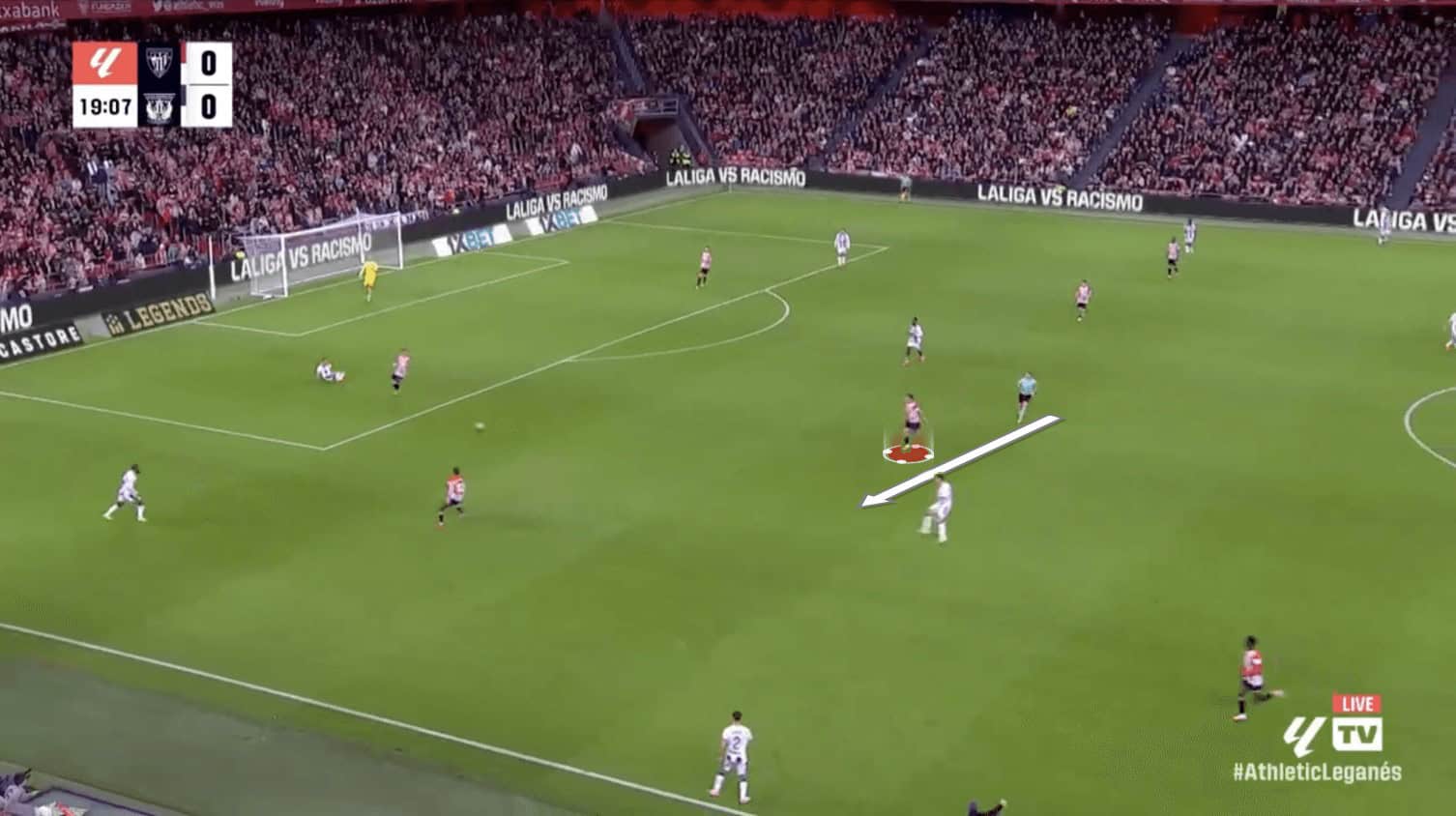
Figure 1 shows Athletic Club pressing high in their 4-2-3-1 shape.
The centre-forward, Gorka Guruzeta, curves his run to close down the ball carrier from the side.
By doing so, he blocks off the passing option to Leganés’ left centre-back, thus penning the opposition into a more congested space on their right-hand side.
While the centre-forward presses the ball carrier, Athletic Club’s midfielders advance to retain access to the central passing options.
Meanwhile, the wingers retain access to wide passing options, while the ball-near winger also stays close to the right centre-back—the ball carrier’s most likely passing option here.
As play moves on, the ball carrier ultimately gets forced into a rushed pass while off-balance.
This opens the door for the left-sided holding midfielder, Mikel Vesga, in this case, to burst into action, get ahead of the intended receiver and win possession back for Los Leones inside the final third.
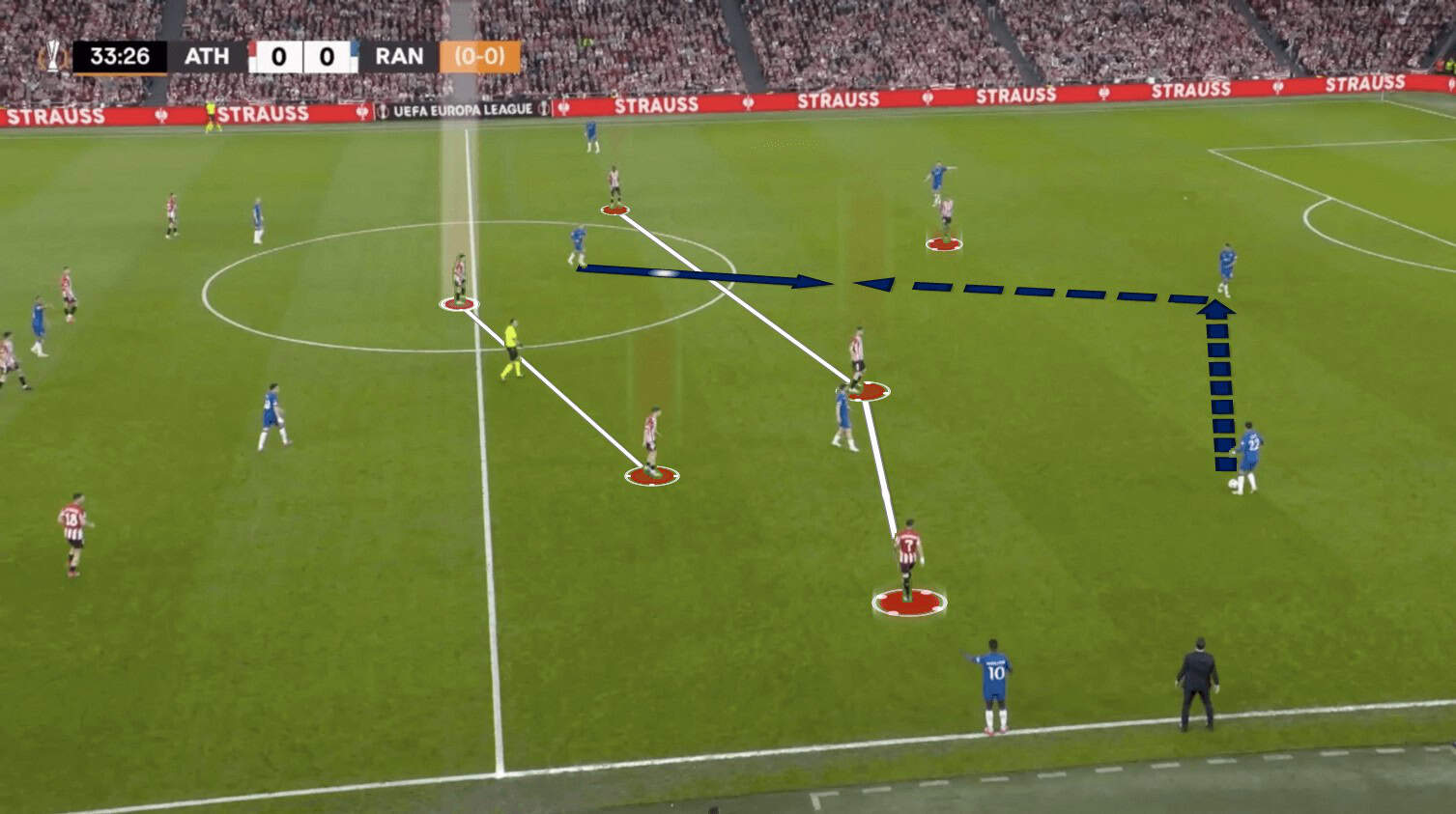
We have a similar example of Athletic Bilbao’s press involving the aggressive holding midfielders versus Rangers at home.
Initially, we find Rangers penned in on their left-hand side, almost like a mirror image of what we saw versus Leganés above.
A route was open for Rangers to move into midfield with the ball via the central centre-back, who had a clear passing lane open to the right central midfielder at this moment in Figure 3.
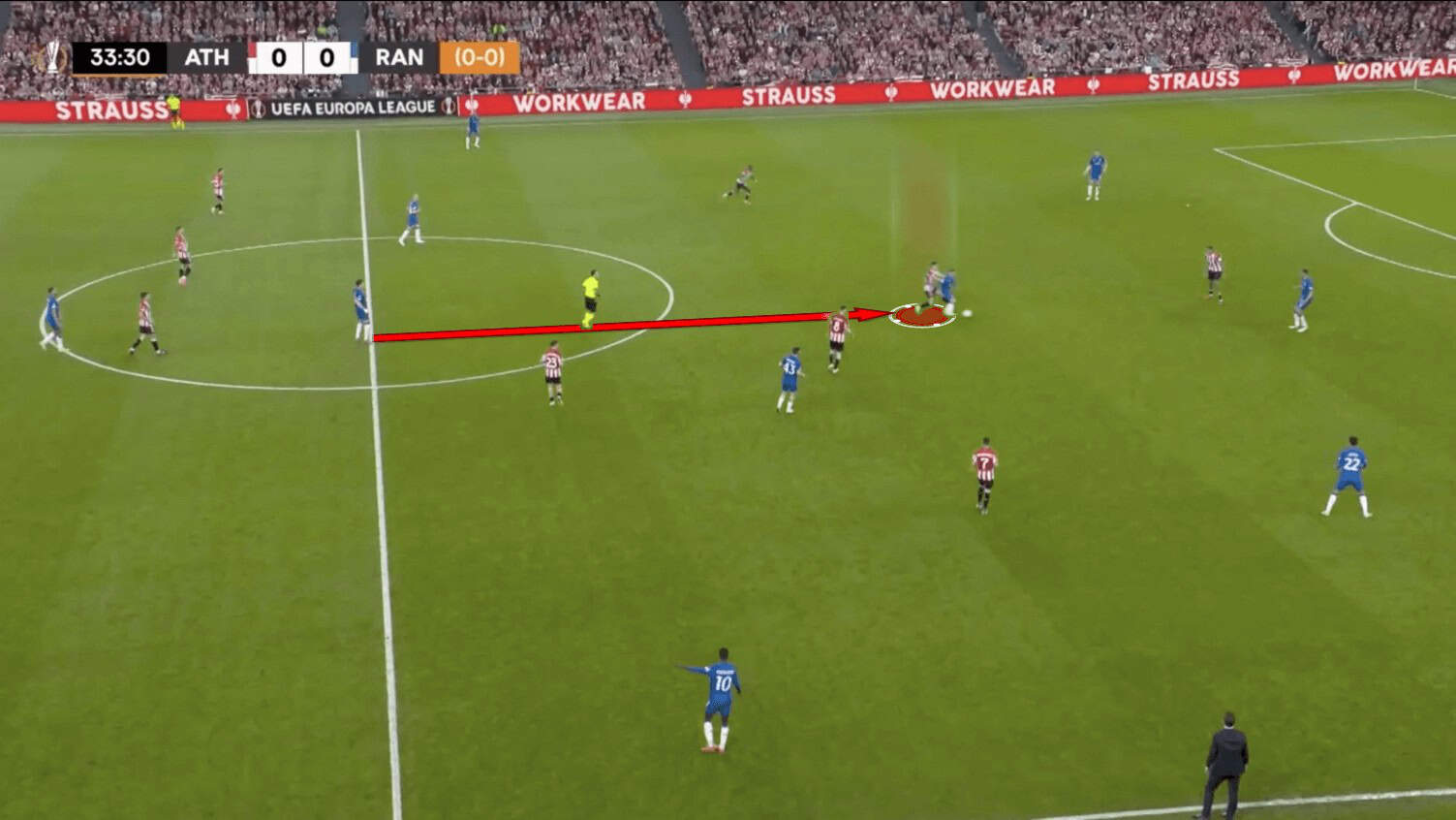
However, as the ball entered central midfield, left-sided holding midfielder Íñigo Ruiz de Galarreta jumped on the receiver, denying him space to turn and forcing him to play the ball hurriedly backwards.
A backwards pass acts as a ‘pressing trigger’ for many teams in the high-block phase, and Athletic Club are no different in that regard.
This means that when the opponent plays a backwards pass, it acts as a sort of ‘alarm’ for Athletic Club’s players, prompting them to increase their pressing intensity significantly.
An increase in pressing intensity occurs precisely as the ball is played to the right centre-back, who comes under immediate pressure from left-winger Nico Williams, as seen in Figure 4, who is already closing his man down.
Mikel Jauregizar Radar Chart 2024/2025
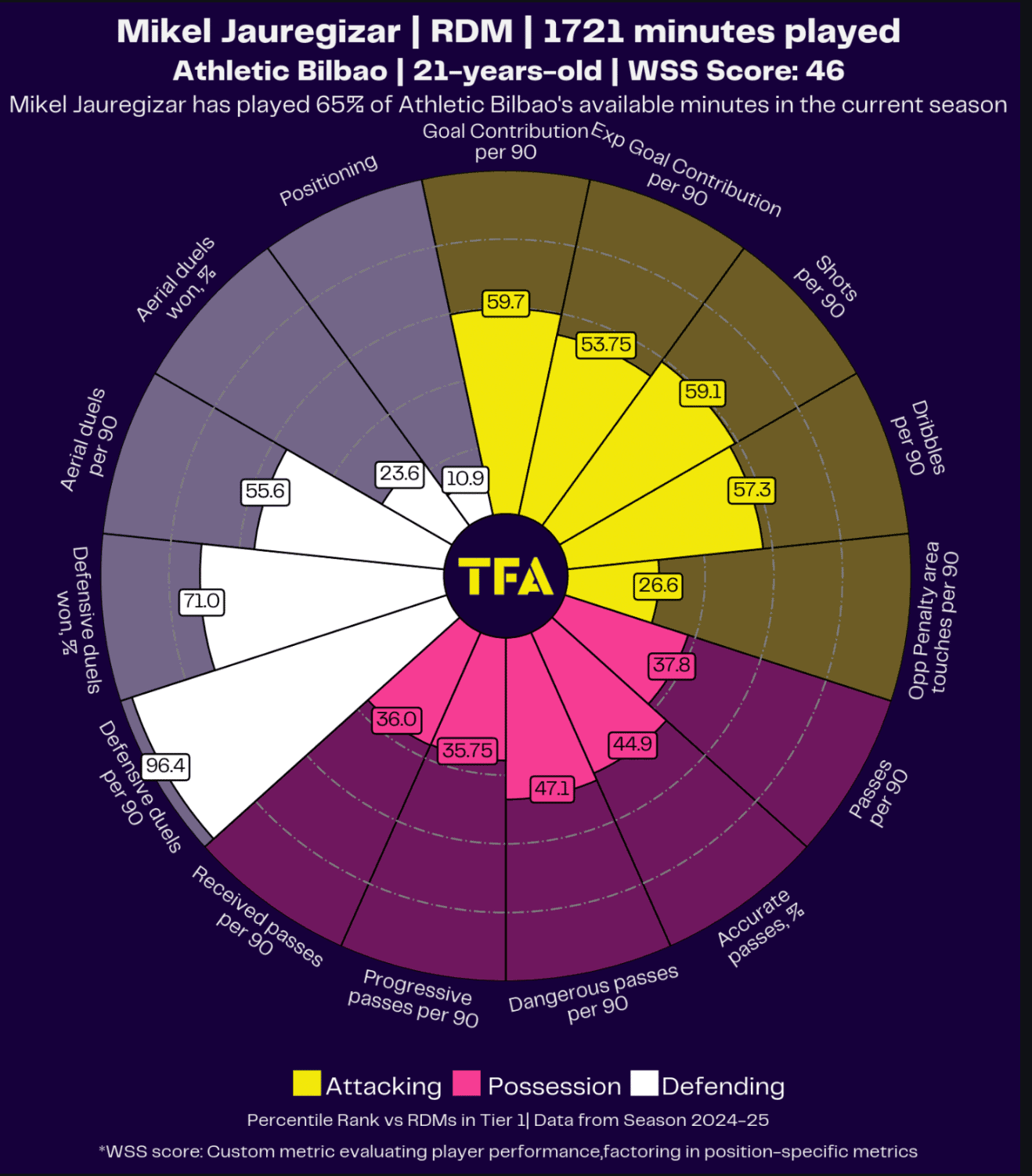
Mikel Jauregizar has been Athletic Club’s most-capped central midfielder this season.
The 21-year-old has accumulated 2821 minutes across all competitions for the Basque side in 2024/2025.
He particularly stands out through his defensive contribution this term, evident on Mikel Jauregizar pizza chart, which shows a 96.4 percentile rank among right-sided holding midfielders in Europe’s top-five leagues in relation to defensive duels per 90.
Jauregizar has been one of Europe’s most actively involved defensive midfielders this term.
He has been an excellent fit for Valverde’s defensive tactics, which require a heavily involved holding midfielder from a pressing standpoint.
Ernesto Valverde Mid-To-Low Block Tactics
Valverde’s Athletic Club tactics in the mid/low block phases are all about protecting the central areas of the pitch.
The Basque side will be found in these phases more frequently against stronger opposition or teams they want to show greater respect to and spend more time playing without the ball.
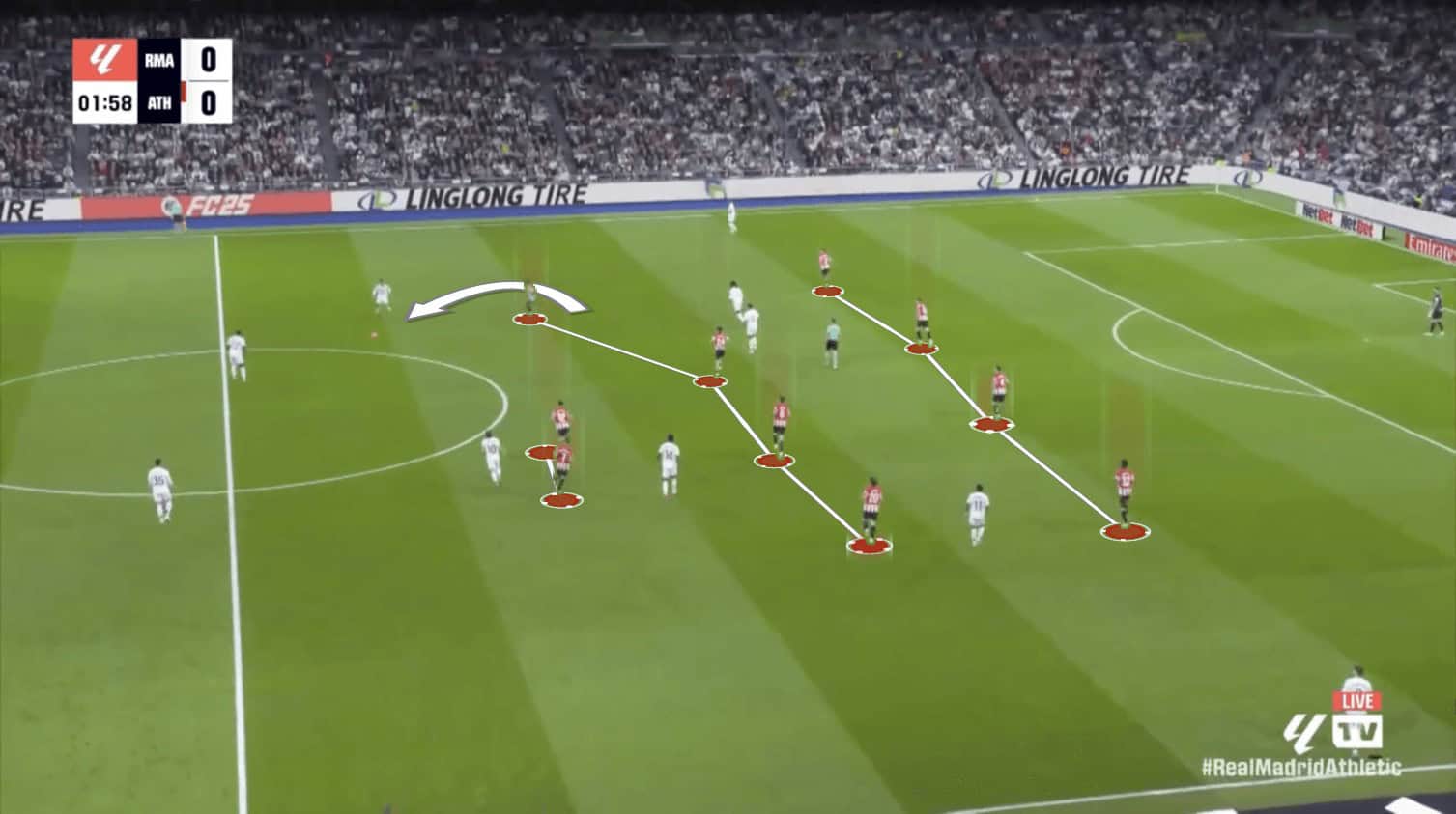
The image above, taken from Athletic Club’s 1-0 loss to Real Madrid, displays how Valverde’s side set up in the mid-to-low block phase in this game.
A few key principles of the team’s tactics are evident from this image.
Firstly, the team’s two banks of four are very horizontally compact.
The wingers are situated quite close to the centre of the pitch, demonstrating how Los Leones are comfortable giving up some space out wide to bolster those valuable central positions even more.
Additionally, Athletic Bilbao want to control the space between their midfield line and backline.
Therefore, the space between those lines remains very tight and narrow.
Should the ball find its way into the half-space here with Jude Bellingham, for instance, the Real Madrid midfielder would come under immediate pressure from behind as an Athletic Bilbao defender pushes up as well as from the front as a midfielder comes back to close him down.
Valverde’s side constantly keep the space between the lines tight so that if the ball is played into that space, multiple players are close by to try and shut down the attack.
Isolating an attacker 1v1 with an Athletic Bilbao defender—like an early progressive pass into a strong striker backing into an Athletic Bilbao centre-back—can be one way to get at Athletic Club and create something against their solid defence.
However, with that said, opportunities to do so are typically few and far between against Los Leones, which is a testament to Valverde’s tactics and training, as well as the players’ application of the coach’s strategy.
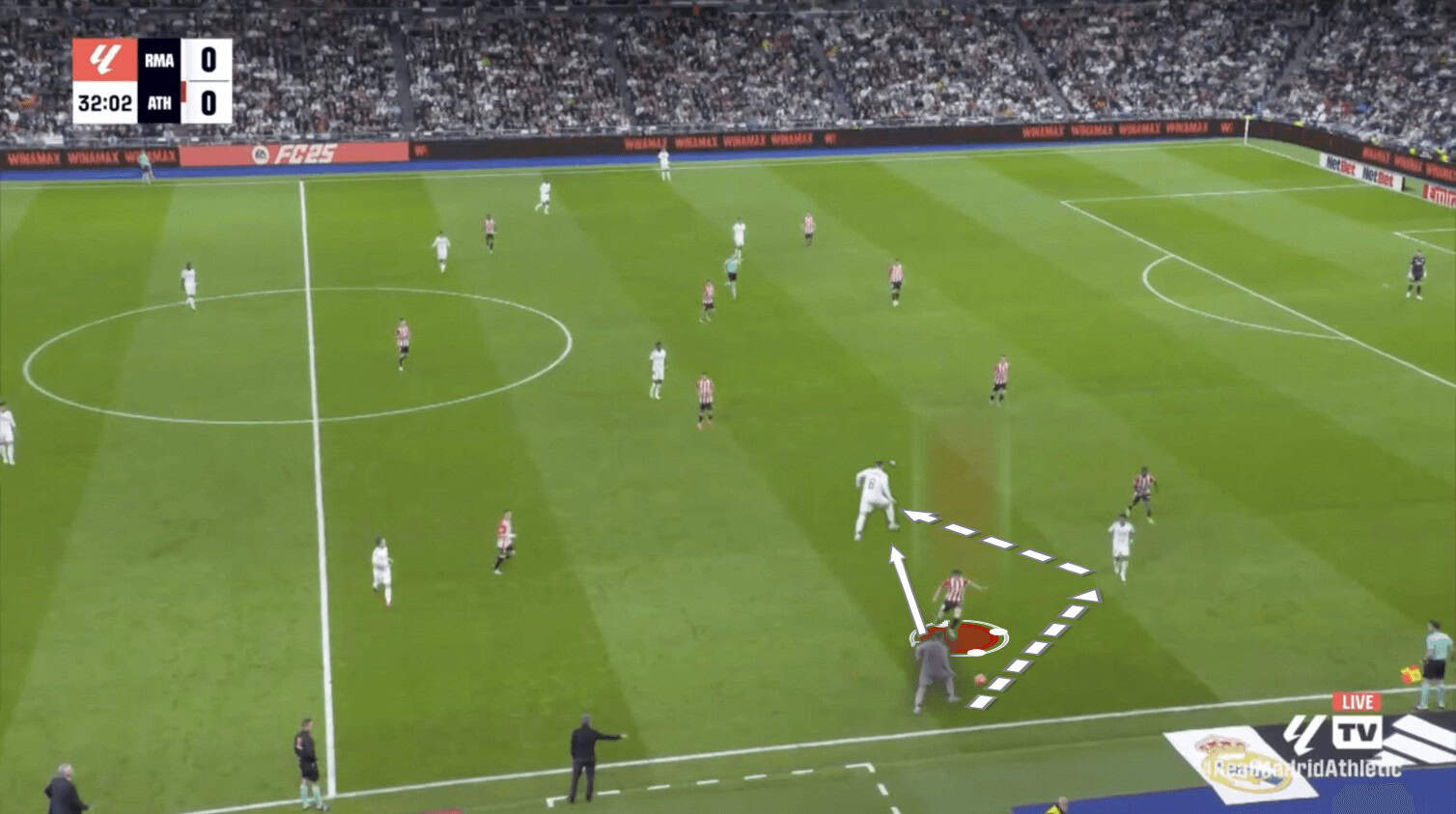
Here, we see Real Madrid attacking via Federico Valverde on the right wing.
Athletic Bilbao’s left-winger has been dragged out from the centre to try and address the growing threat of the Real attack.
As the winger comes out, Valverde plays a one-two with Rodrygo to get around the pressing player, setting him up to run at Athletic Club through the centre of the pitch.
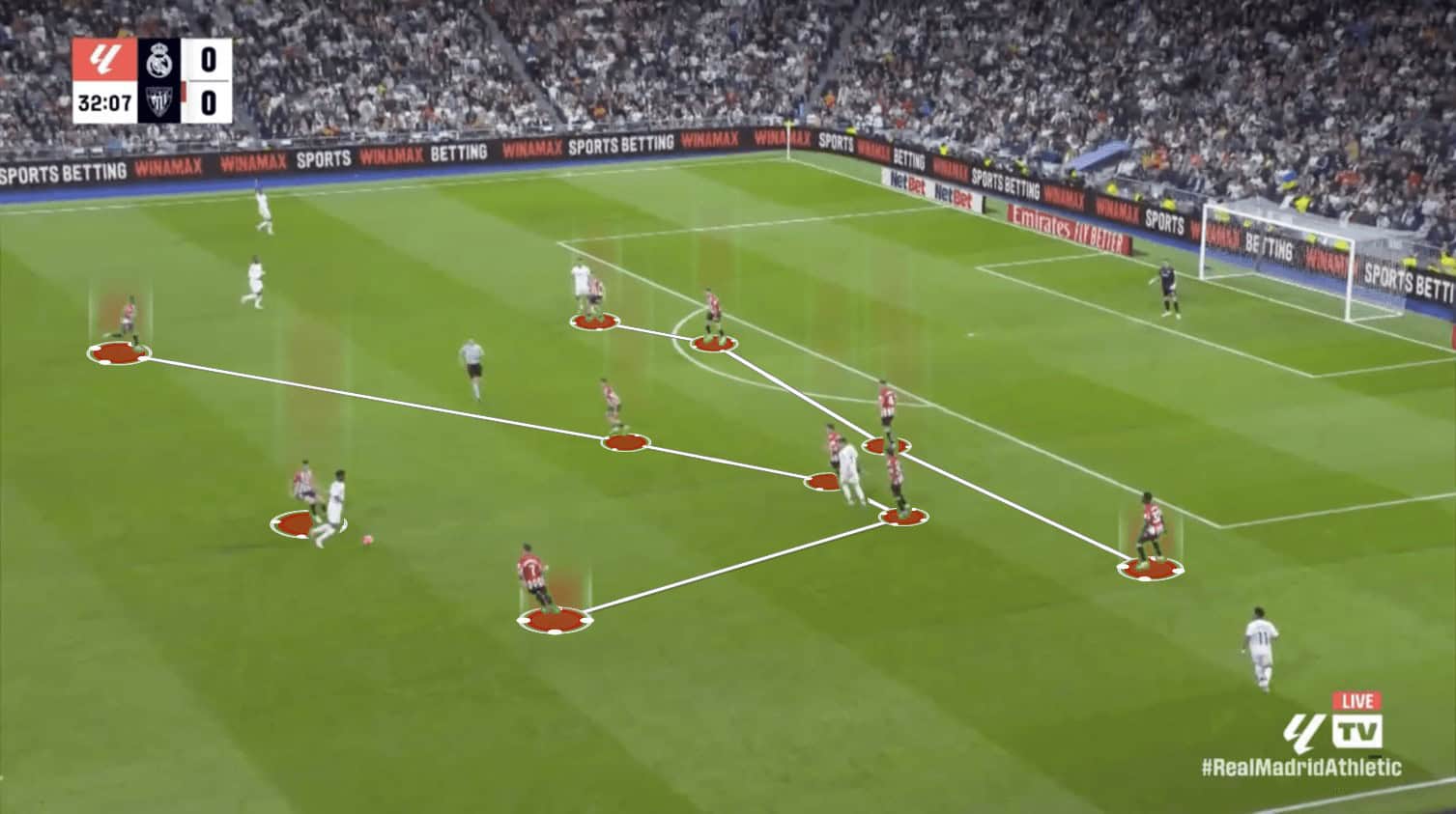
As play moves on, the ball finds its way to Vinícius Júnior in the centre of the pitch.
However, while the talented Brazilian is in a good position in terms of location, the picture has changed entirely in just five seconds, as Athletic Club have now got pretty much all their players back behind the ball, with the centre-forward pressing Vinícius aggressively on the edge of Bilbao’s third.
This move quickly changed from a half-chance for Valverde to run at Athletic Bilbao through a seemingly weakened centre into a very difficult challenge for Vinícius Júnior, with Athletic Bilbao’s whole team set up in a low-block standing between the dribbler and the goal.
Here, we have another example of a few key principles of Athletic Club’s game.
Firstly, all players are expected to contribute to the defensive phases.
Secondly, they are expected to get back behind the ball and recover quickly when under threat—both in settled out-of-possession phases and defensive transitions.
Lastly, to round out this section, we can see how well Athletic Club managed to protect those valuable central areas of the pitch even as their opponents attacked and made some ground down the wing.
This further reinforces our initial statement: the ultimate key to Athletic Bilbao’s defensive tactics in the mid-to-low block phases is central security.
Ernesto Valverde Transition Defence Tactics
Our final section of analysis in this article centres on Athletic Club’s transitional defence.
This is another strength in Los Leones’ game.
Although teams are typically at their most vulnerable in transition, Athletic Club fares better than most in this phase at the moment.
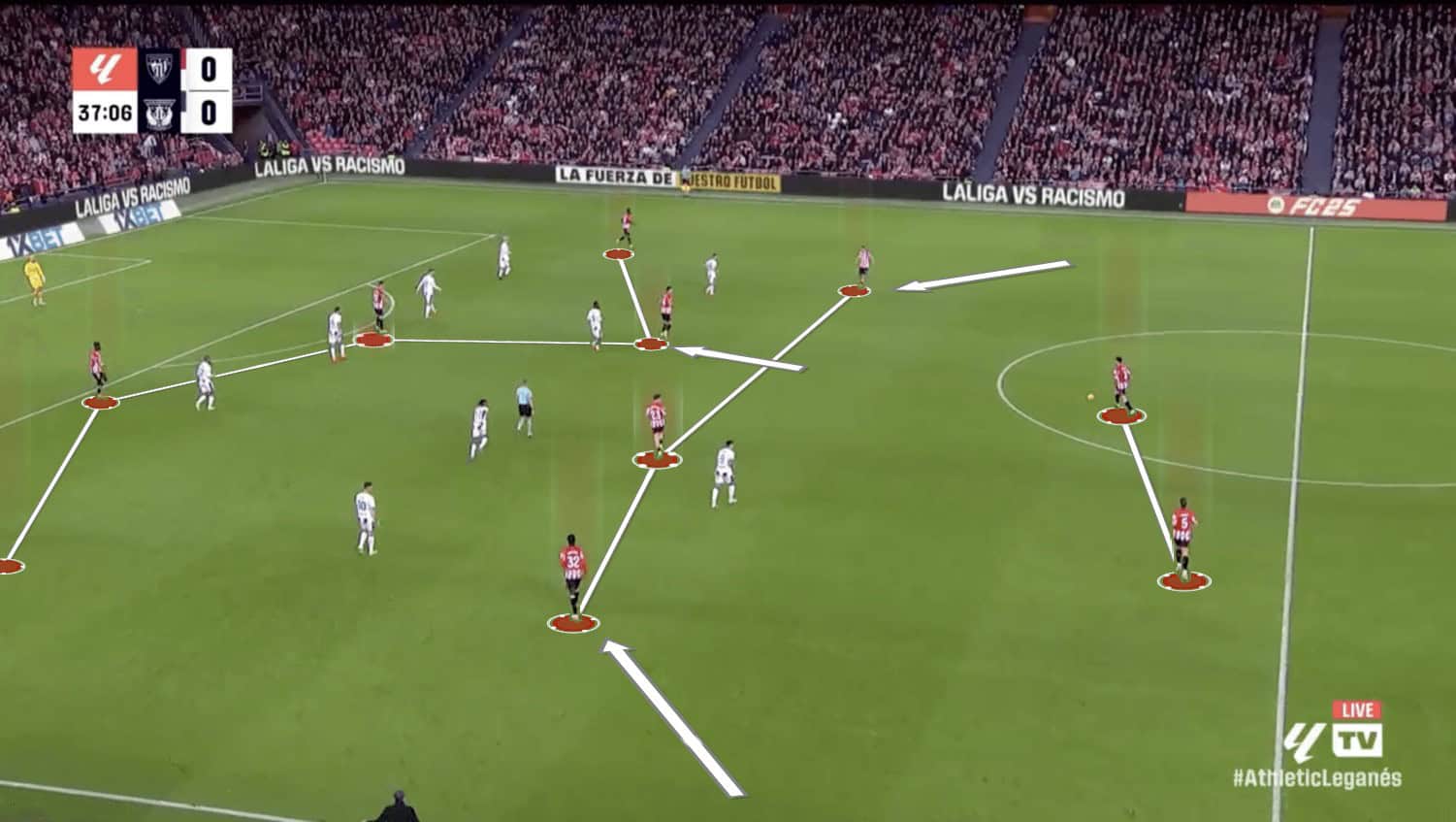
In order to examine Athletic Club’s transition defence tactics, we must first take a look at their shape in settled possession, particularly when camped inside the opposition’s half in the chance creation phase.
Athletic Club normally go with a 2-3-5 shape in this phase of play.
Their two centre-backs form the base of the shape.
Meanwhile, their full-backs tuck in centrally alongside one holding midfielder.
In contrast, the other holding midfielder advances into a position somewhere between the midfield line and the forward line—wherever they can find space to occupy, which may make them an attractive option for forward passing and chance creation.
Los Leones’ wingers stay wide, the striker stays central, and the ‘10’ will either act as another centre-forward and occupy an opposition centre-back or, like the advanced holding midfielder, try to find space to exploit between the lines.
That’s essentially how we see them shape up in the image above, but what if Athletic Club lose possession in the chance creation phase?
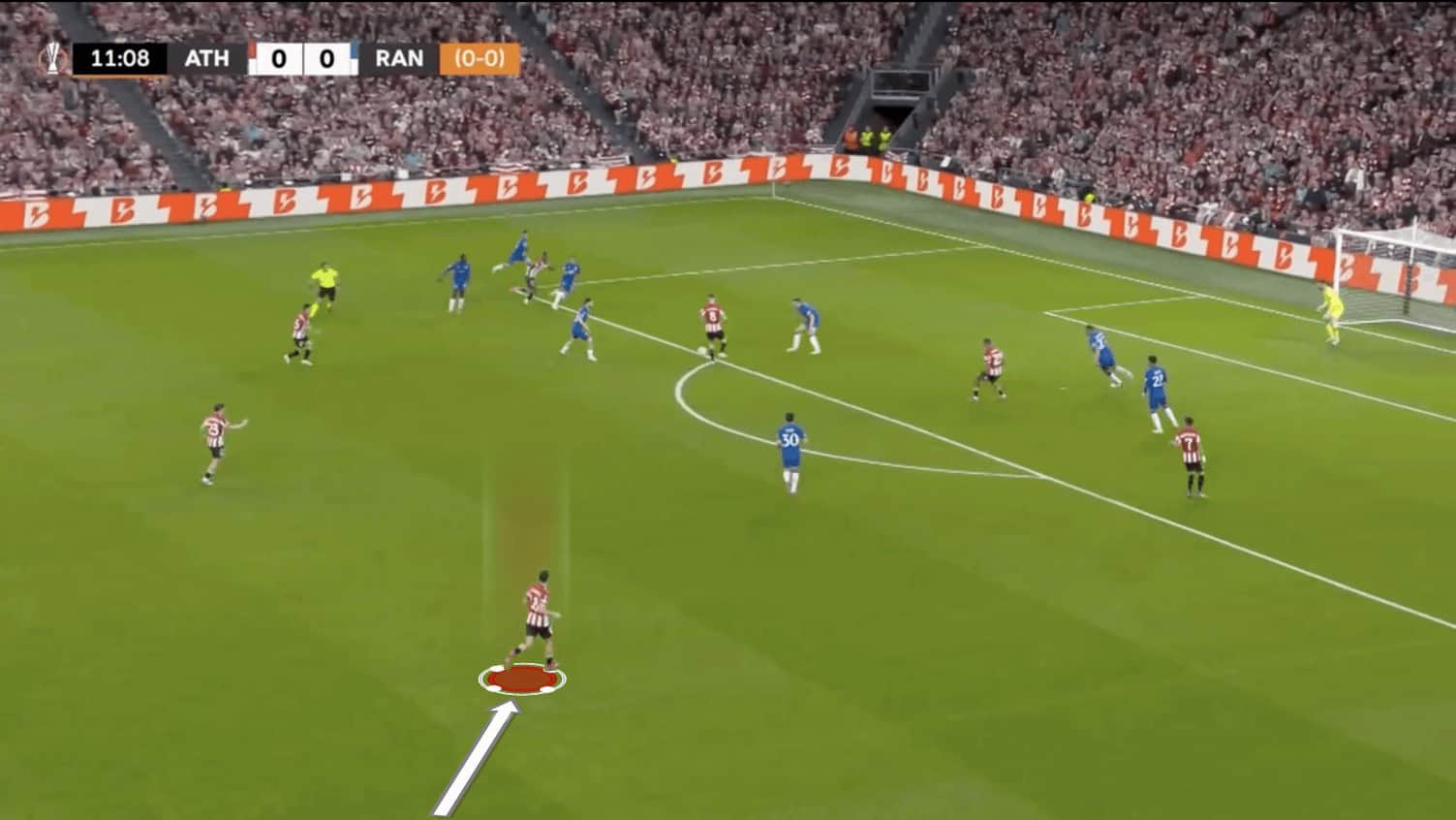
The line of three in the middle of the park during this phase are crucial for Athletic Club’s transitional defence.
Firstly, note the position of veteran right-back Óscar de Marcos in Figure 10.
The 36-year-old is positioned centrally, providing a potential passing option should the ball return to midfield, while also preparing himself to counter-press if needed.
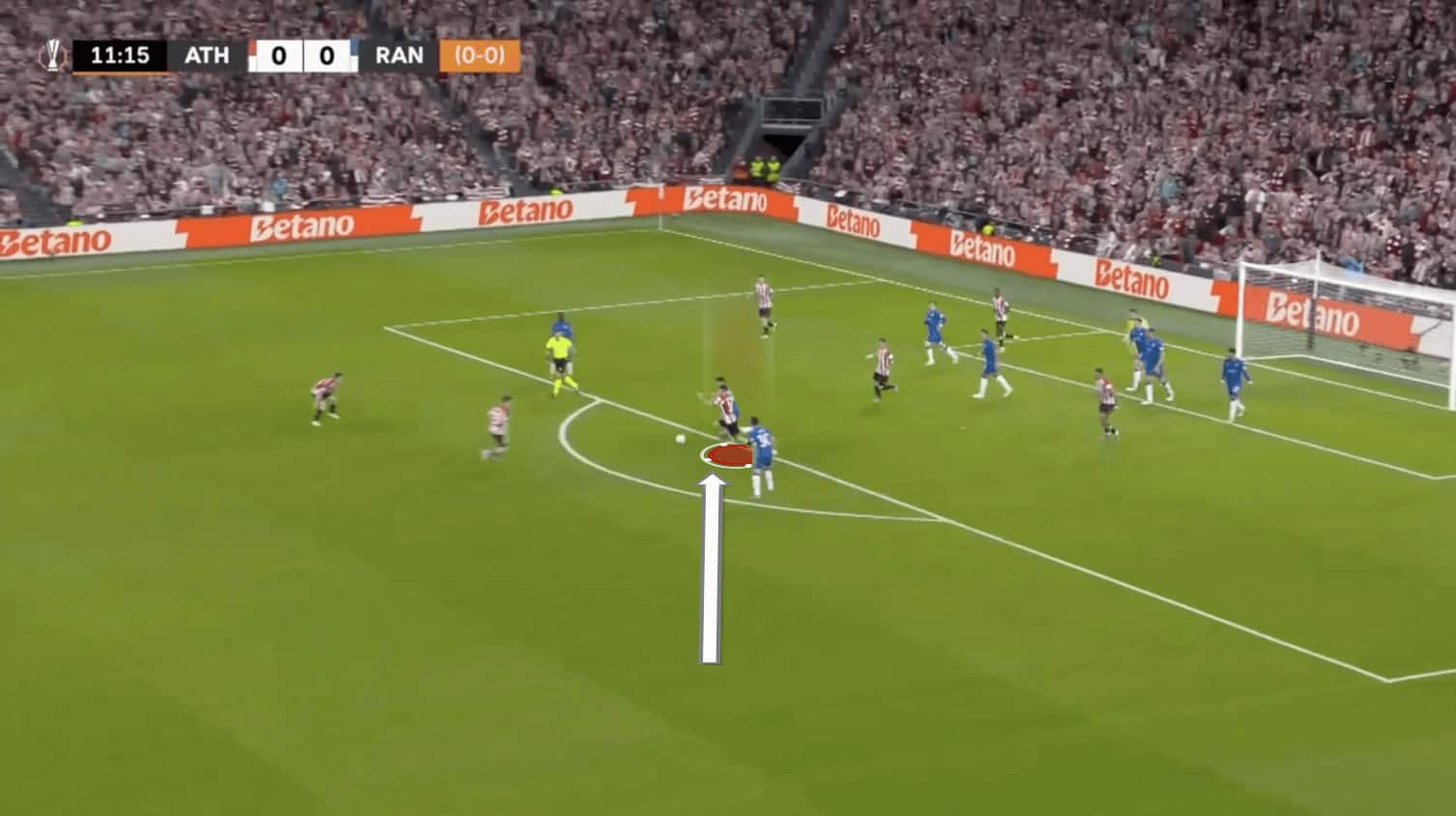
Athletic Club subsequently lose the ball on the edge of the box, and De Marcos’ counterpressing skills are, indeed, required.
De Marcos jumps on the opportunity to press the Rangers receiver on the edge of the Gers’ own box, immediately shutting down the Scottish giants’ prospective counterattack before it even gets started, winning possession back for Athletic Bilbao in a perilous, high-value position.
This provides an excellent example of how Athletic Club’s counterpress/transition defence works.
This passage of play clearly demonstrates the value of the inverted full-backs in the rest defence structure.
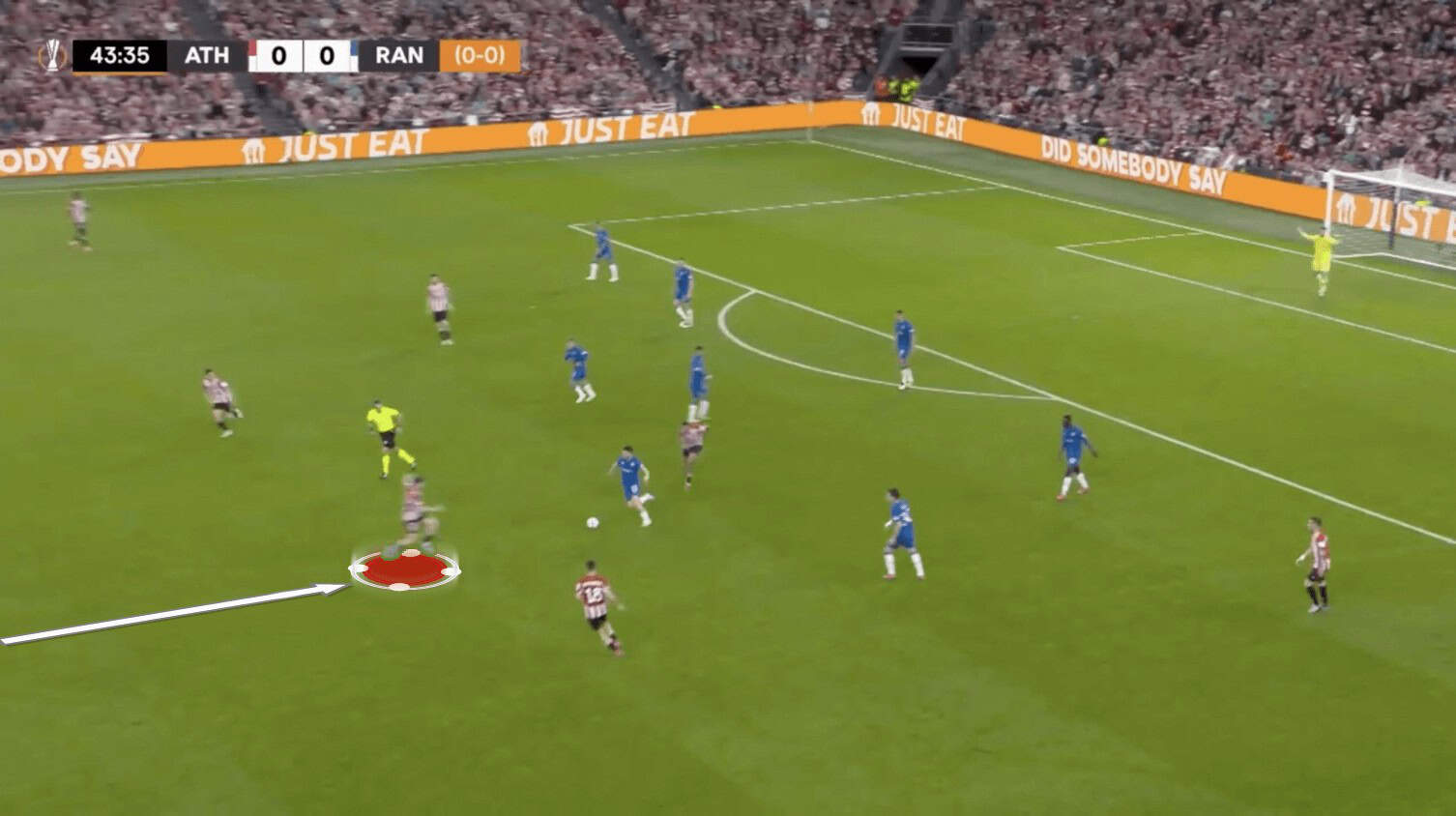
Later in the same contest, as seen in Figure 10-11, the holding midfielder is called into action to shut down the budding Rangers’ transition.
In all phases of defensive play, a lot is demanded from Athletic Club’s holding midfielders.
This is especially true for the remaining holding midfielder in the central three during the transition to defence phase.
As Rangers begin moving out of their own third, the holding midfielder closes him down aggressively.
This, along with the inverted full-backs’ positioning, forces a rushed pass towards the centre, which is intercepted, thus allowing Athletic Club to restart their own attack from an advanced, central position—a highly valuable area from which to attack.
Conclusion
To conclude our tactical analysis, Athletic Club boast the best defensive record in Spain’s top flight due to their proficiency in all phases of their out-of-possession game.
They can press well in the high block, with particular emphasis on their holding midfielders’ roles.
They can control the middle of the park in deeper defensive phases (the mid/low-block phases) and quickly shut down opposition counterattacks through their transitional defence tactics.
They occupy the UEFA Champions League qualification places domestically, as well as the UEFA Europa League semi-finals, largely thanks to Valverde’s defensive strategies and principles outlined in this article.
