
The decision to dismiss Ange Postecoglou as Tottenham Hotspur manager over the summer, following the club’s UEFA Europa League triumph, was certainly a controversial one.
Despite an unprecedented 22 Premier League defeats, Postecoglou had ultimately ended Spurs’ 17-year trophy drought.
That would undoubtedly lead to Postecoglou being the man to lead Tottenham into the UEFA Champions League, right?
Daniel Levy had other ideas and landed first-choice managerial target Thomas Frank from Brentford in June.
This appointment is intriguing, given that it is the Danish coach’s first ‘top’ job after previously managing Brentford, Brøndby, and Denmark’s youth sides.
Frank has enjoyed a very promising start at the helm in North London.
Spurs applied themselves very well in the UEFA Super Cup defeat to Paris Saint-Germain before thrashing Burnley 3-0.
One of the clearest tactical changes in this new-look Tottenham is the much more considered approach to set-pieces, with Frank reaping the rewards when his side scored from two of them in the PSG defeat.
This tactical analysis will examine Tottenham Hotspur’s attacking corner tactics under Thomas Frank style of play, as implemented in recent competitive fixtures.
This Tottenham Hotspur set-piece analysis will highlight common issues exploited against zonal marking and man-marking defensive systems.
Thomas Frank Set-Piece Tactics & Principles
No side in the Premier League scored more headed goals than Thomas Frank’s Brentford last season, with the West London side also recording the highest average shot quality from corners in the division.
So, how exactly does Thomas Frank make his sides so effective from corners, and how has this already been translated to Tottenham?
Frank frequently urges numerous players to flood the penalty area, assigning his most physical players to make varied movements aimed at unsettling zonal marking systems.
From as far back as his Brøndby days, his teams have crowded the box on every corner, with their movement and shielding tactics typically enabling his attackers to register the first contact on the ball.
A major contributing factor to his Brentford side’s scoring so many goals from corners was his ability to continually change over time to avoid being too predictable.
One interesting setup from last season involved Brentford overloading the back post before sharply attacking the front, creating confusion in the defence.
The ball would be crossed to the front post, where the Brentford players often were first and scored.
Frank is, by all accounts, a percentages man who severely disapproves of his players shooting from distance in open play, so it’s unsurprising that his players are placed in high-probability scoring zones (like the near post or penalty spot), forcing defenders into reactive marking and increasing chances of first contact.
Frank’s corner routines also often feature a blocking system, in which his players deliberately impede defenders to free up space for key runners.
These blocks disrupt man-marking and create clean lanes for attackers to meet the delivery with momentum.
Generally, the runners follow tightly coordinated movements; some arc their runs to pull defenders out of position, while others time late bursts into open zones.
These rehearsed patterns are designed to carve open the opposition structure and exploit mismatches in the box.
Thomas Frank Set-Pieces At Tottenham Hotspur
Thomas Frank’s attacking corner routines at Spurs already reflect his Brentford blueprint.
Frank has brought his data-driven set-piece philosophy to North London, emphasising strict positioning, coordinated movement, and the desire to win the vast majority of second-ball scenarios.
Early signs suggest Tottenham are adopting similar principles: using blockers to disrupt man-marking, flooding key zones, and choreographing runners to disrupt the defensive line.
If the aim is to create separation and disrupt defensive structure, giving his attackers a clean run at the ball, then his side have certainly achieved that overall in Frank’s opening months at the helm.
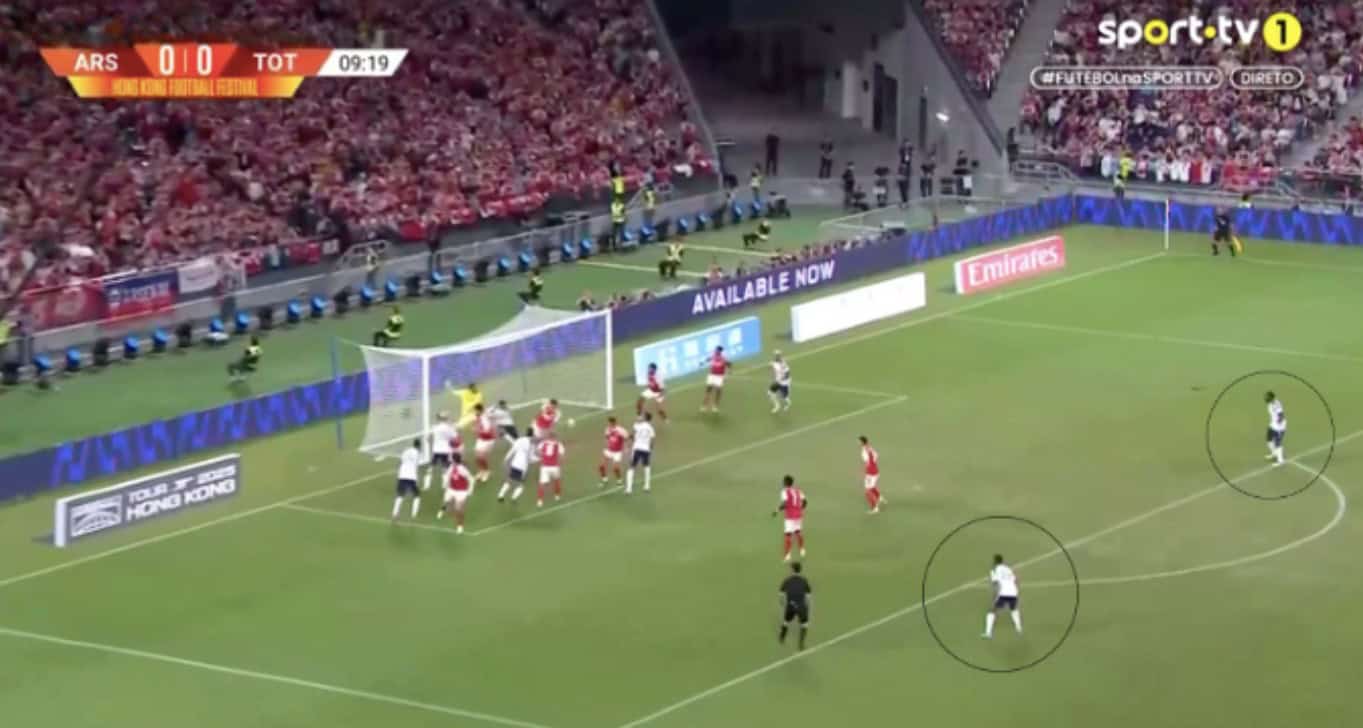
During this pre-season win over Arsenal, in which Pedro Porro almost scored a sensational Olimpico, Tottenham had six to seven men inside the box, with two more deployed on the edge to pick up loose balls from clearances.
It would be both lazy and insincere to suggest that this structure is merely flooding the box; Frank’s method is a calculated way to control both the initial delivery and the aftermath.
Tottenham hugely maximised their chances of connecting with the ball, whether through headers or rebounds.
Frank has demonstrated a preference for swinging corners, which, of course, means a right-footed specialist from the left wing and a left-footed one from the right wing.
This enables the ball to be whipped in toward goal, allowing his players to drive defenders backwards, attack the delivery with intent, and create havoc in the penalty area.
For Spurs, this leaves Pedro Porro swinging them in from the left and Mohammed Kudus being handed the responsibility out on the right.
Porro registered nine assists for Spurs across all competitions in the 2024/2025 season, and his pinpoint crossing is a key reason he remains trusted with corner duties.
Kudus, meanwhile, racked up 13 assists in 80 appearances for West Ham with that venomous delivery of his, boasting the potential to carve out high-quality chances from set pieces.
Factor in Cristian Romero‘s threat from dead balls as well: the Argentine defender scored five set-piece goals in the 2023/2024 season, and Spurs have the potential to be a set-play danger this season.
Blocking The Goalkeeper
Interestingly, Micky van de Ven recorded an xG figure of 0.59 from headed corner efforts in Tottenham’s 3-0 victory over Burnley last weekend.
The central defender enjoyed a lot of success in registering the first contact throughout the entire afternoon last Saturday.
This was a result of an intriguing tactic from Frank designed to unsettle the debuting opposition goalkeeper Martin Dúbravka.
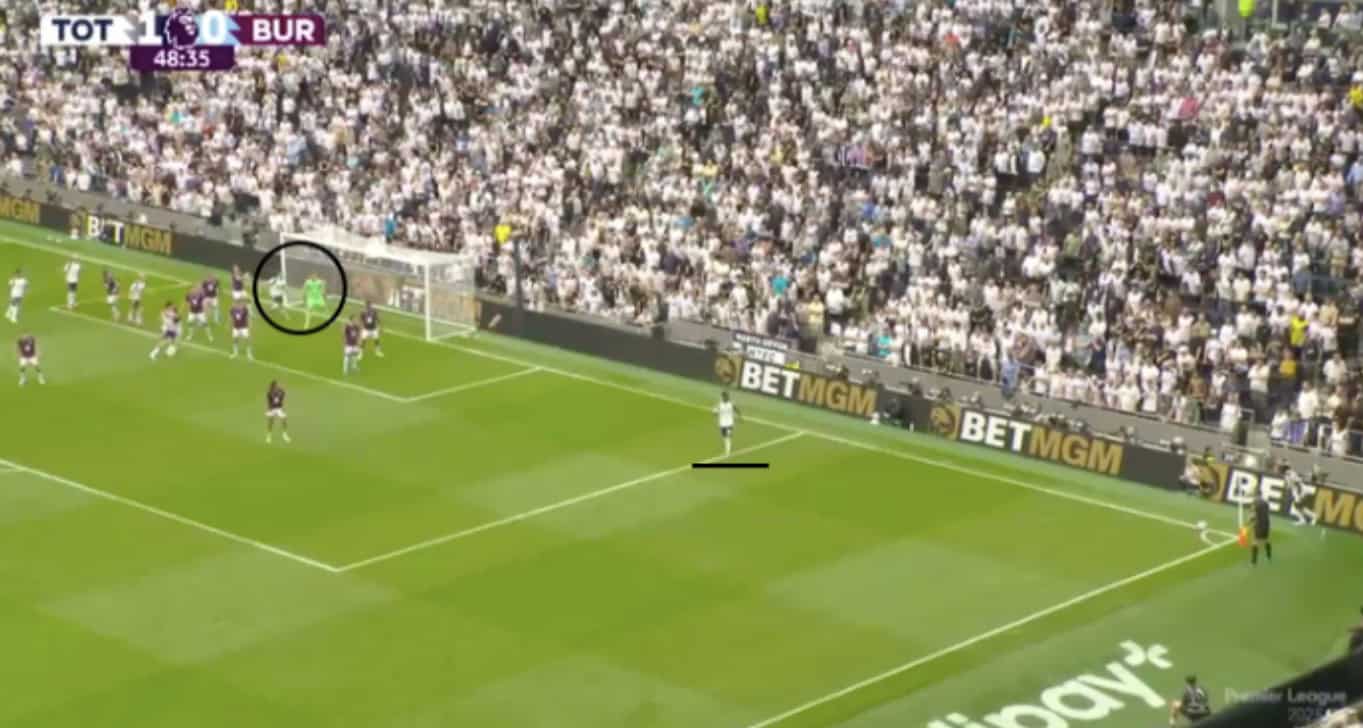
In this example, as Mohammed Kudus swings in the corner, Spurs have a clear short-option decoy, with Pape Matar Sarr positioned on the edge of the box parallel to the taker.
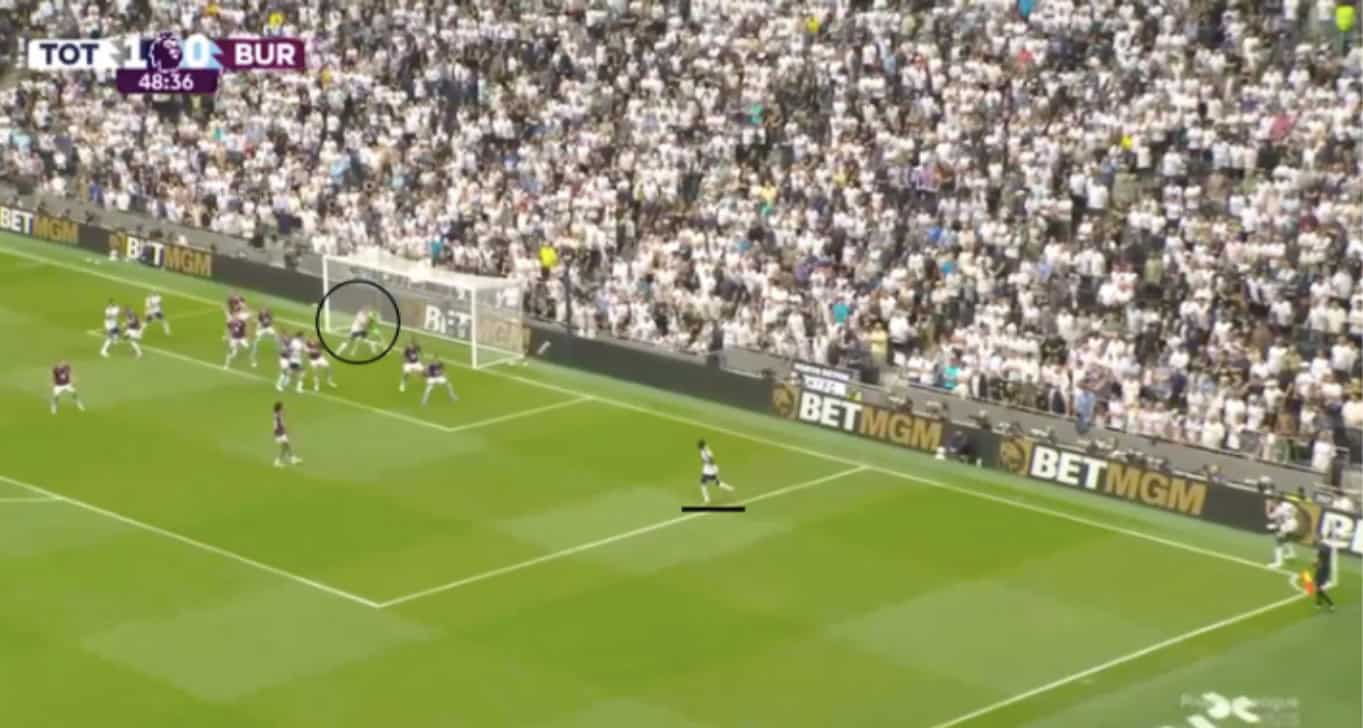
Van de Ven and Richarlison both crowd the goalkeeper’s space as Kudus prepares to deliver, effectively engaging in a physical duel right on the goal line.
Their presence isn’t incidental; it’s disruptive, designed to block the keeper’s movement, obscure his sightline, and force hesitation.
Of course, Arsenal’s Nicolas Jover adopts a similar corner approach.
In this approach, Ben White initiates contact with the keeper before being joined, after the corner has been delivered by Gabriel Magalhães, who screens zonal defenders or subtly impedes the keeper’s movement from a different angle.
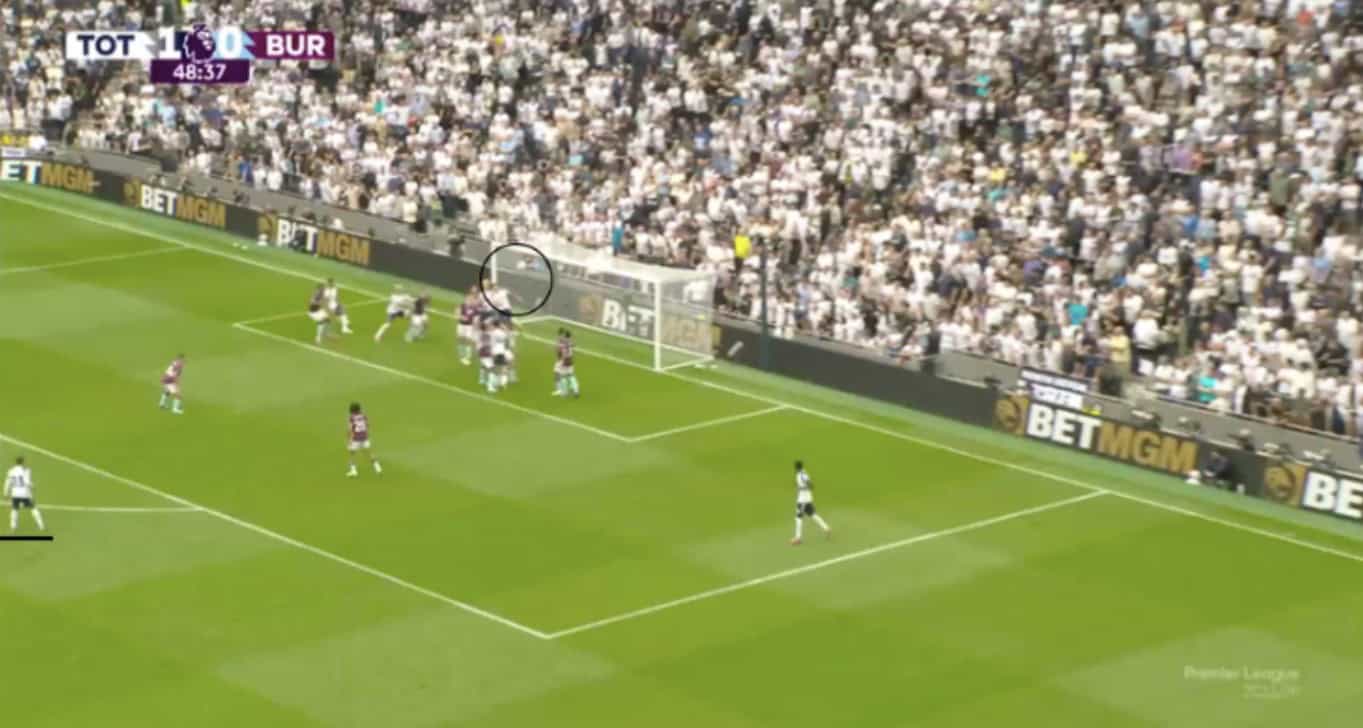
As the corner is delivered under the bar, Van de Ven is already entrenched in the keeper’s zone, disrupting Dúbravka’s balance and positioning.
Dúbravka’s ability to claim or punch is compromised, and Van de Ven, still tangled with him, breaks free at the last moment to meet the ball with a clean header from point-blank range, which he should do much better with.
This is a very calculated disruption on Tottenham’s part.
By engaging the keeper early, Van de Ven ensures the delivery arrives in a contested space where Spurs have the physical advantage.
Playing It Short
Against Burnley, as well as in pre-season, Spurs also evidenced the ability to mix it up with short corners, pulling defenders out of their set positions and forcing a reset of the defensive shape.
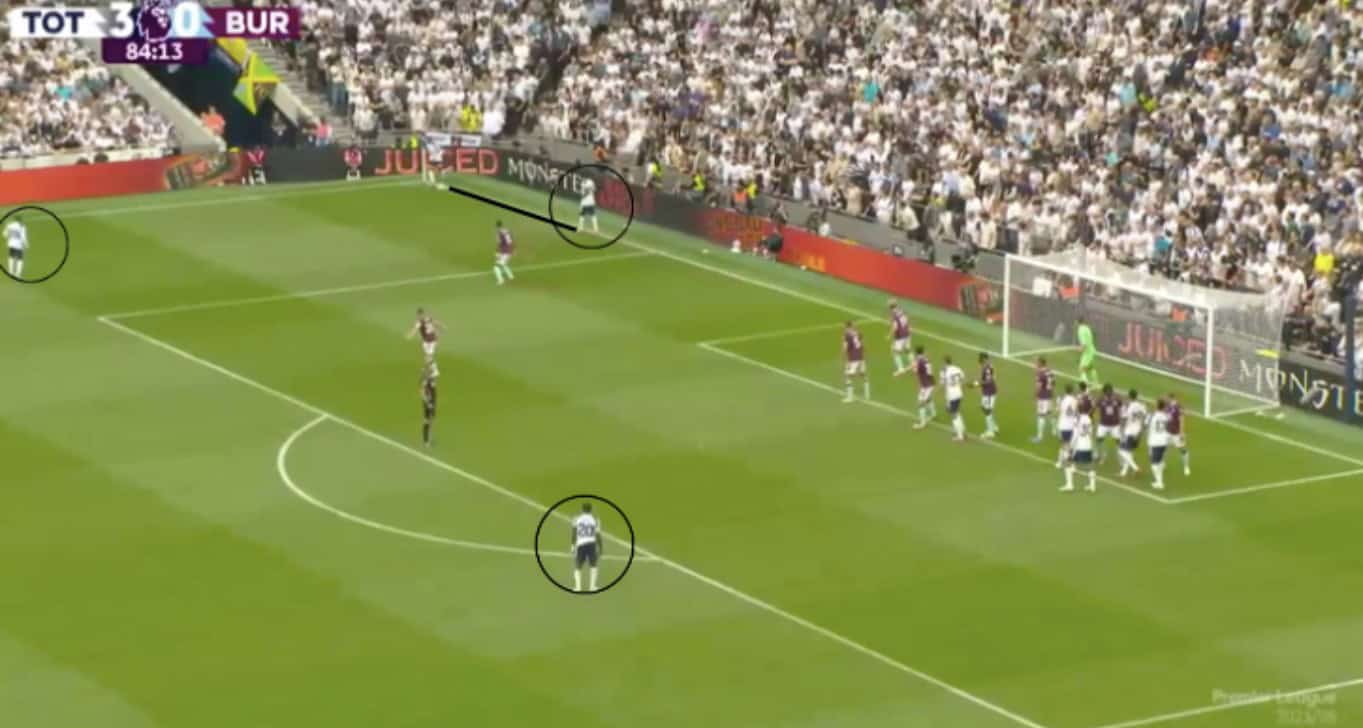
Frank’s sides often create numerical superiority near the corner flag, for example, using as many as four players against two defenders to overload the short-corner zone.
This setup allows them to manipulate defensive lines, drag zonal markers out of position, and create shooting opportunities from unexpected angles.
As we can see above, Tottenham essentially created a 3-v-1 by the corner flag, with all three players being heavily involved in that specific area, and, more generally, a 4-v-2 formation with Kudus positioned on the edge of the defensive area.
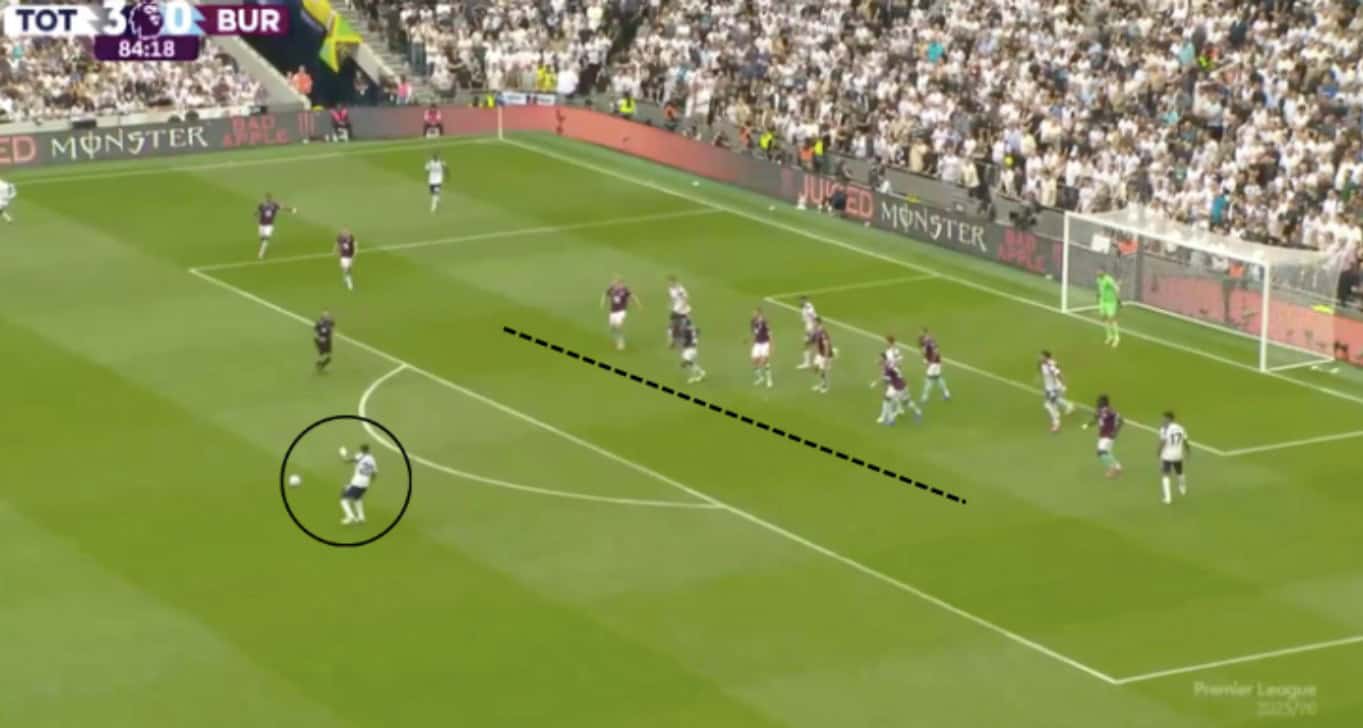
After some neat interplay between Porro, Sarr and Wilson Odobert, Kudus receives the ball 25 yards or so from goal with ample time to fire off an uncontested shot on his stronger left foot.
Although it’s undoubtedly a low-percentage shot that was created, we see another example of Tottenham displaying the ability to discombobulate a defensive set-up on a corner and manipulate both the box markers and defenders who are challenging for the ball elsewhere.
Conclusion
Tottenham Hotspur’s new corner routines represent a tactical evolution in Premier League set-piece strategy built around choreographed chaos inside the six-yard box.
Their standout routines, particularly the near-post flick-ons and blindside runs, show an impressive understanding of space and timing.
They work together to unlock tight defences and catch teams off guard when their marking slips.
While the delivery quality from players like Kudus and Porro is already elite, the next phase of Spurs’ set-piece development will depend on their ability to vary the approach: mixing short corners, overloads, and deceptive movement to maintain unpredictability across 90 minutes.
Suppose they continue to refine the timing of runs and embrace the physicality of the six-yard duels. In that case, they have every attribute needed to become the Premier League’s benchmark for attacking set pieces, and perhaps even redefine how corners are approached at the elite level.
One thing is for certain: this is a remarkably different approach to Postecoglou’s view on set-pieces:
“Eventually, I will create a team that has success, and it won’t be because of working on set-pieces!”
