
Le Havre have not been in Ligue 1 since 2009, meaning that Les Ciel et Marine have not seen the top flight of French football in 14 years.
This club has been busy during that period, making a name for themselves for producing some excellent players such as Riyad Mahrez who has dominated the Premier League, and Paul Pogba who has shown world-class talent at both Manchester United and Juventus.
So far this season, Le Havre has been impenetrable, with their strong defensive record a key reason why Les Ciel et Marine are comfortably top of the league halfway into the season.
Luka Elsner struggled in the past few seasons in Belgian football, but since taking charge of the team this season, they have only conceded seven goals in 19 games.
This club sits nine points clear at the top of the league, although six of their 12 wins this season have only been by one goal.
Whilst this is not a problem, the team does lack goals, and so they will need to stay secure defensively to keep their place at the top of the league come June.
This article will contain a tactical analysis in the form of a scout report to show exactly how Luka Elsner tactics have transformed Le Havre into league leaders.
We will examine the tactics used by this side, which have only conceded seven goals, and conduct an in-depth analysis of the reasons why they have won so many games by a small margin.
Luka Elsner Formation
Le Havre have utilised a 4-3-3 system for the entirety of this season.
Their team has largely remained the same throughout the campaign, and the continuity in the selection has helped the team become familiar with each other.
Le Havre’s promising spine consists of four u21 players, following their recent high-profile academy starts leaving for various clubs around Europe.
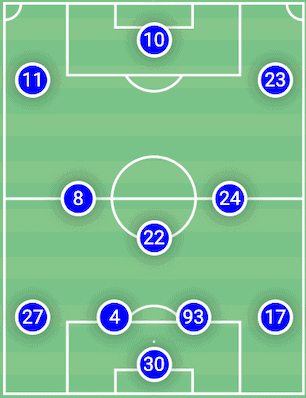
20-year-olds Arouna Sangate, Amir Richardson and Yassine Kechta are part of their strong core, which has helped to keep the team performing consistently week in and week out.
At the same time, 21-year-old Josue Casimir brings creativity and directness to the front line.
These players are important figures in a settled team, and as they gain experience, they have the potential to become important figures at this club or any other they may join in the future.
Progressing the ball up the pitch
Le Havre are a side which average a majority of the share of possession each game, although depending on game state, are no stranger to forfeiting possession of the ball to their opponents.
This side doesn’t have the most technical players in the squad, so they will not attempt to play it out from the back under pressure.
They will opt to go long rather than risk a loss of possession in their own third.
However, they do look to progress play through the opposition if they are allowed the time and space to do so, which has been the case for a lot of their games in Ligue 2 this season.
On certain occasions, Le Havre have successfully bypassed opposition pressure, with this being most effective when coming up against weaker pressing structures where it is possible to bypass the press with one easy action, whether that is a pass or a dribble.
When a press is aggressive and adequately prepared, the league leaders don’t have the technical quality or composure in their ranks to cope with the pressure.
However, they have been set up in a way that should a free player be left open, there are massive spaces to exploit.
Whenever there is a free player, Le Havre’s central defenders are comfortable enough on the ball to find the player left open and lift a ball aerially towards them.
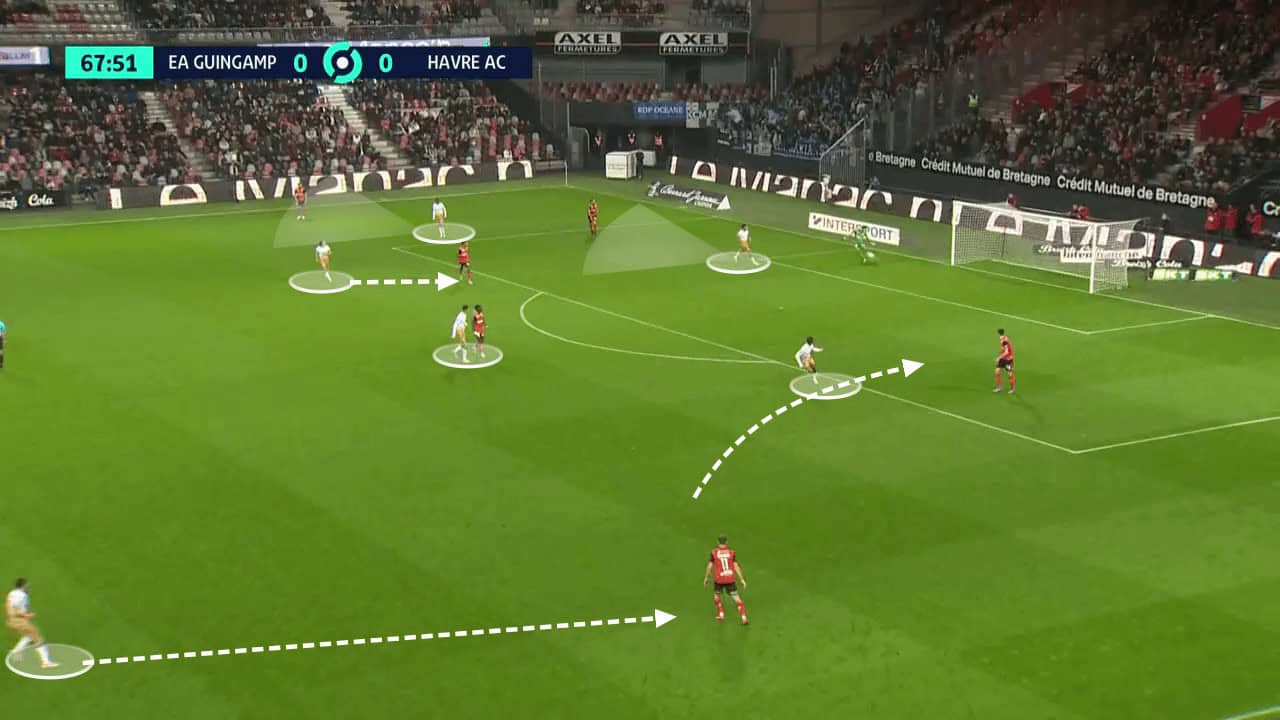
In other instances, those where every passing option is marked, Le Havre use decoy runs from the midfield line to create spaces which can be penetrated.
For example, the image below shows Lekhal the holding midfielder moving into a crowded area of the pitch, in order to give his centre-back an escape, as there is no passing option available to him.
After dribbling into the open space, Le Havre successfully beat the first line of pressure and can directly play the pass into one of their front three, where they have the ball in the opposition’s third.
Le Havre’s limited technical capacity means that they can struggle in tight spaces when opposition defenders stay deep and compact.
Rather than being overly creative, they use patterns of play to move the ball through the thirds.
This means that rather than always looking up and making decisions based on what’s ahead of them, Le Havre make predetermined movements and passes that can become predictable if they are attempted too frequently.
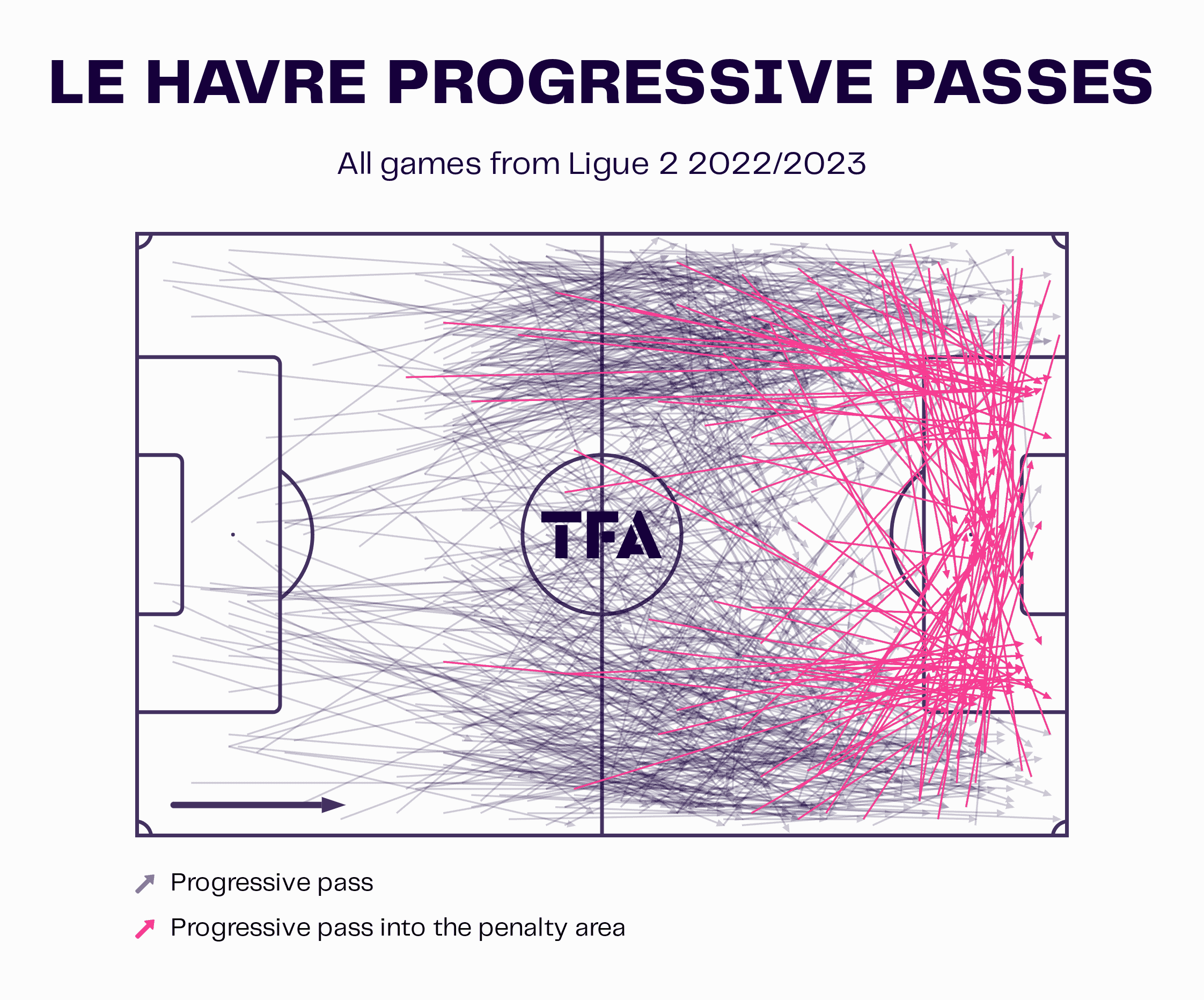
In the progressive passes map below, we can see that Le Havre heavily uses the flanks to move the ball up the pitch, with the middle lane being quite empty and not important to their play.
Arrows are more common in the wings, and we can see their play involves a lot of straight vertical passes down the line from the full-back to the winger, which can become easier to intercept due to their predictability.
Even though Le Havre can be limited to wing play, they have some patterns which are effective in their attempts to get into the final third.
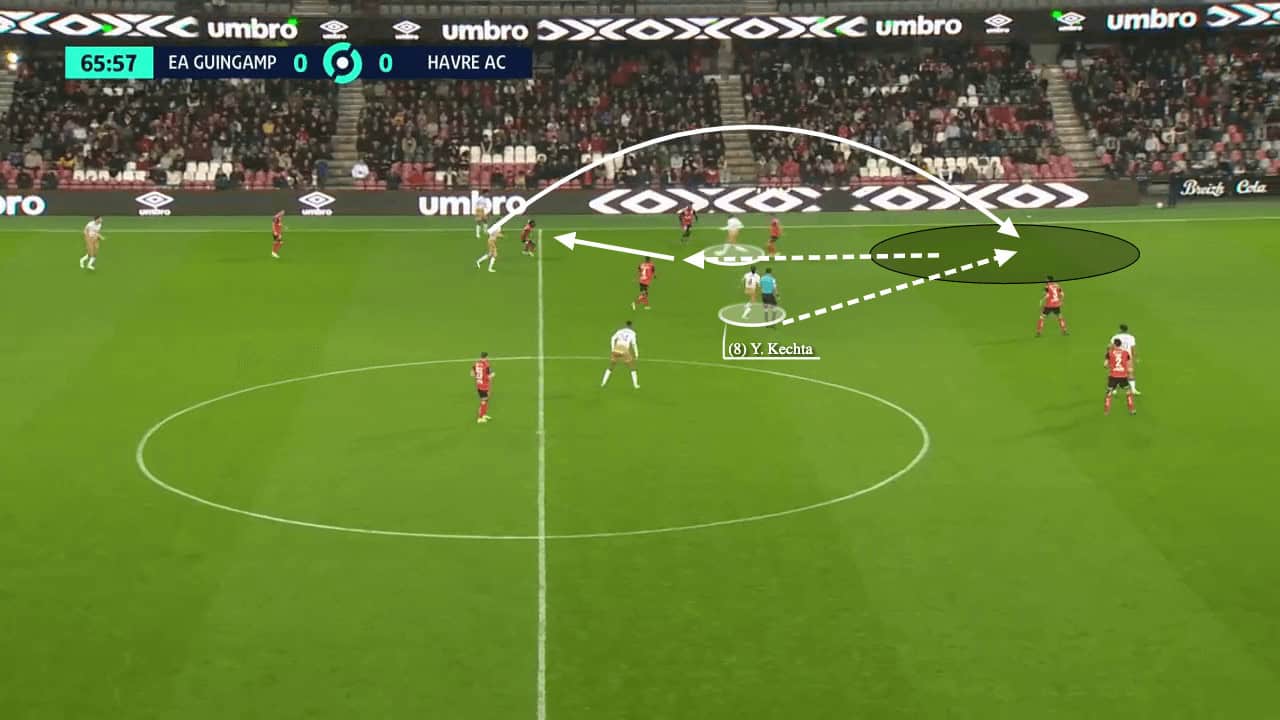
The first of which involves a rotation down the left hand flank between the left-sided full-back, winger and midfielder.
When Lekhal, the holding midfielder, has possession of the ball, it becomes a trigger for the left winger to drop deeper, becoming a passing option.
As the winger comes to the ball, he attracts the defending full-back, which creates space in the left channel for #8 Kechta to run at.
This image below shows the rotation in effect, with Operi the left back receiving the bounce pass from the wide player and playing it into the space that had just been created.
On the right-hand side, the movements differ, with the winger Casimir being used as the outlet rather than a run from deep by Richardson, who is better when receiving the ball to feet.
In the image below, goalkeeper Arthur Desmas displays the ability to loft a pass to his full-back to evade the press before finding the free midfielder instantly while he is still in space.
When the ball is in their own third, Le Havre’s two advanced #8’s stay quite high, so are almost irrelevant during the build up phase.
This means that when the ball is played forward quickly, they often find themselves in space in those more advanced areas, from where they can receive the ball and drive it into the opposition’s half, as in the image below.
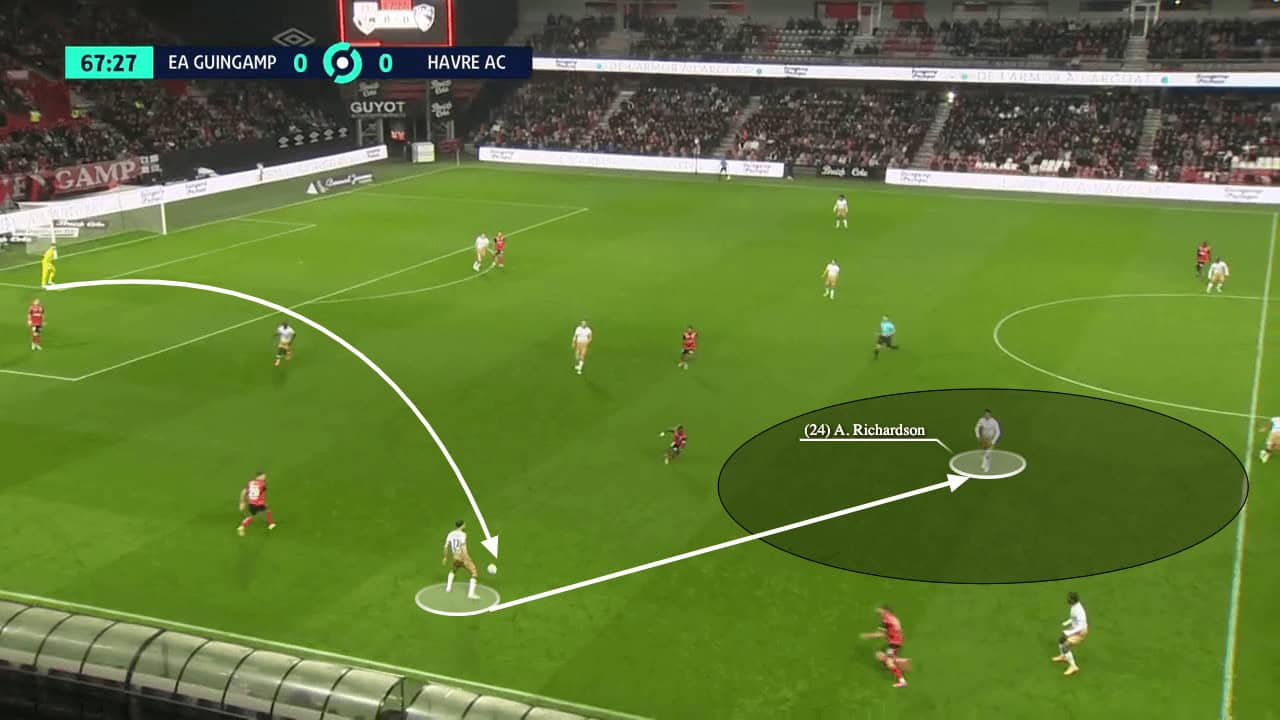
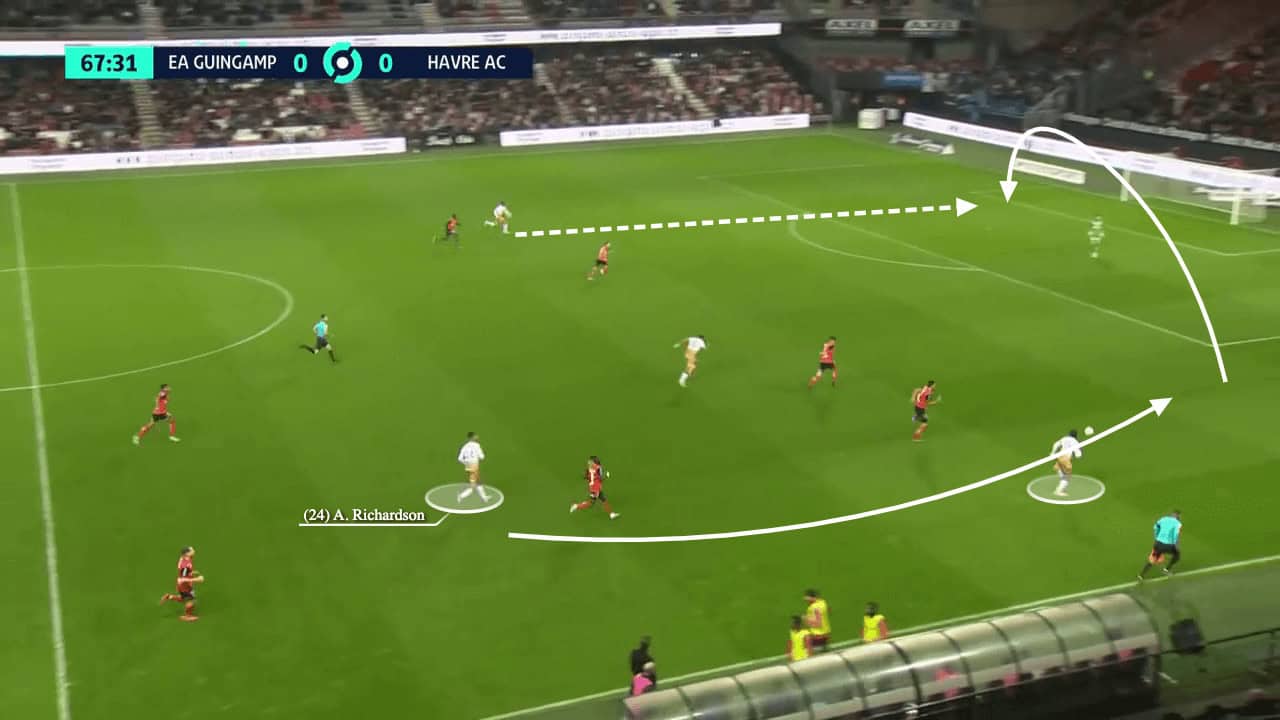
After that long pass escapes the 1st line of pressure, Richardson can drive with the ball while his team have several runners into the space left behind the opposition’s high line.
Richardson plays a delightful pass with the outside of his weak foot, allowing the ball to curve into his teammate’s path.
The latter can cross the ball to the back post.
The lofted pass from the goalkeeper, who has attracted pressure, is vital, as Le Havre can then have safe possession of the ball against a high line which has lots of space in behind to be exploited.
While Le Havre have shown that they are capable of progressing the ball down the flanks, they clearly lack both bravery and ability to do the same in central areas.
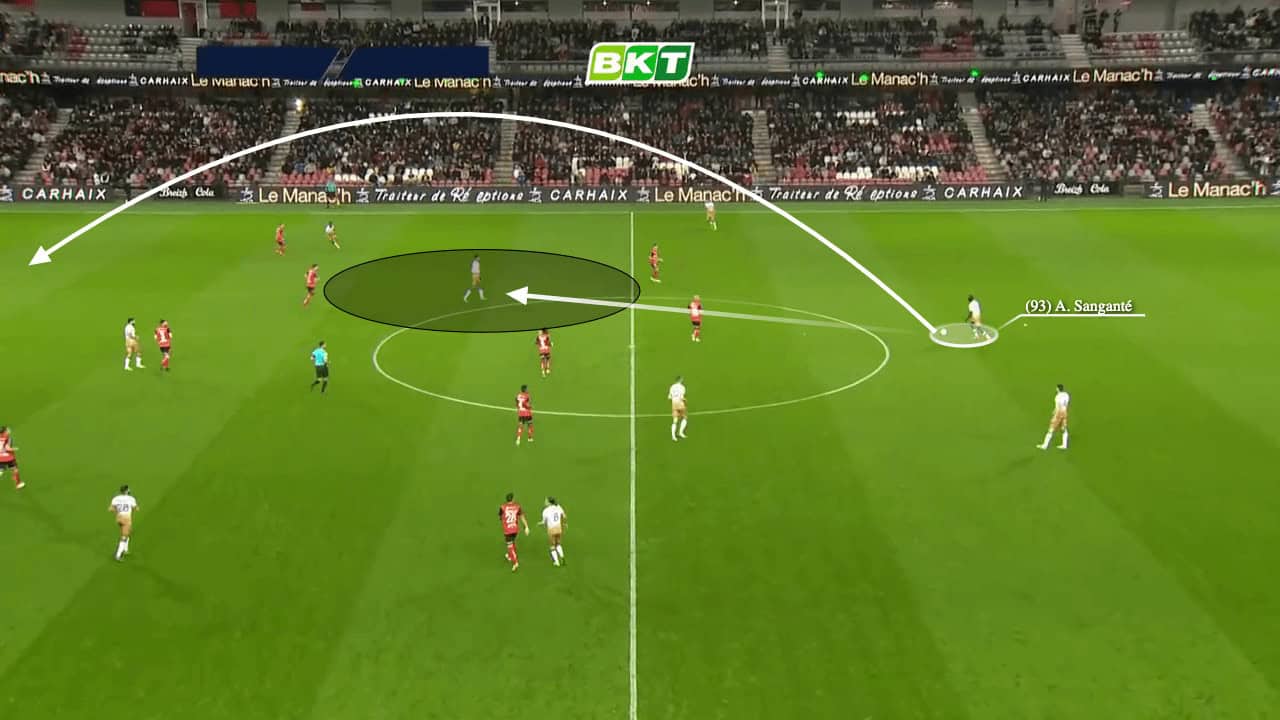
When the central defenders have the ball, they frequently attempt ambitious long ball over the back line for the wide players to run onto the end of.
Whilst this kind of pass can be deadly, the Le Havre players lack the technical quality in their weight of pass to consistently make these passes accurate.
As a result, Le Havre often gives away possession when trying these sorts of passes, even though other options are available.
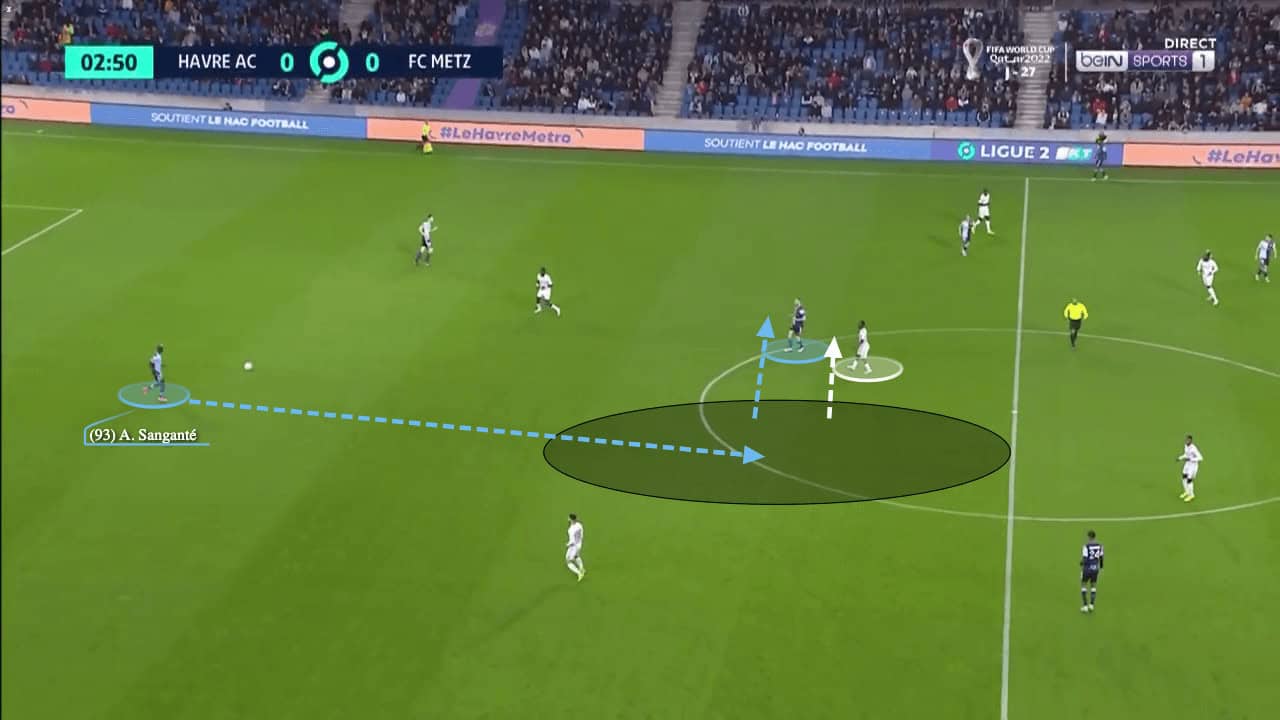
This image below shows Sangante attempting the pass, although Richardson has lots of space between the midfield and defensive lines.
The pass to Richardson inside the black circle is on, but he lacks the quality required to be comfortable in such situations, so the team prefers to be direct and concede possession as far away from their own goal as they can.
The lack of technical ability means that Le Havre don’t have a reliable way of entering the final third.
They often rely on getting into those dangerous areas through patterns of play, winning second balls, and counter-pressing after losing the ball.
Attacking Threat
We have mentioned above the ways in which Le Havre attempts to get into the final third, albeit without a reliable method for consistently doing so.
However, once they do enter the final third, their structure allows them to be extremely threatening due to the number of players that move up the pitch.
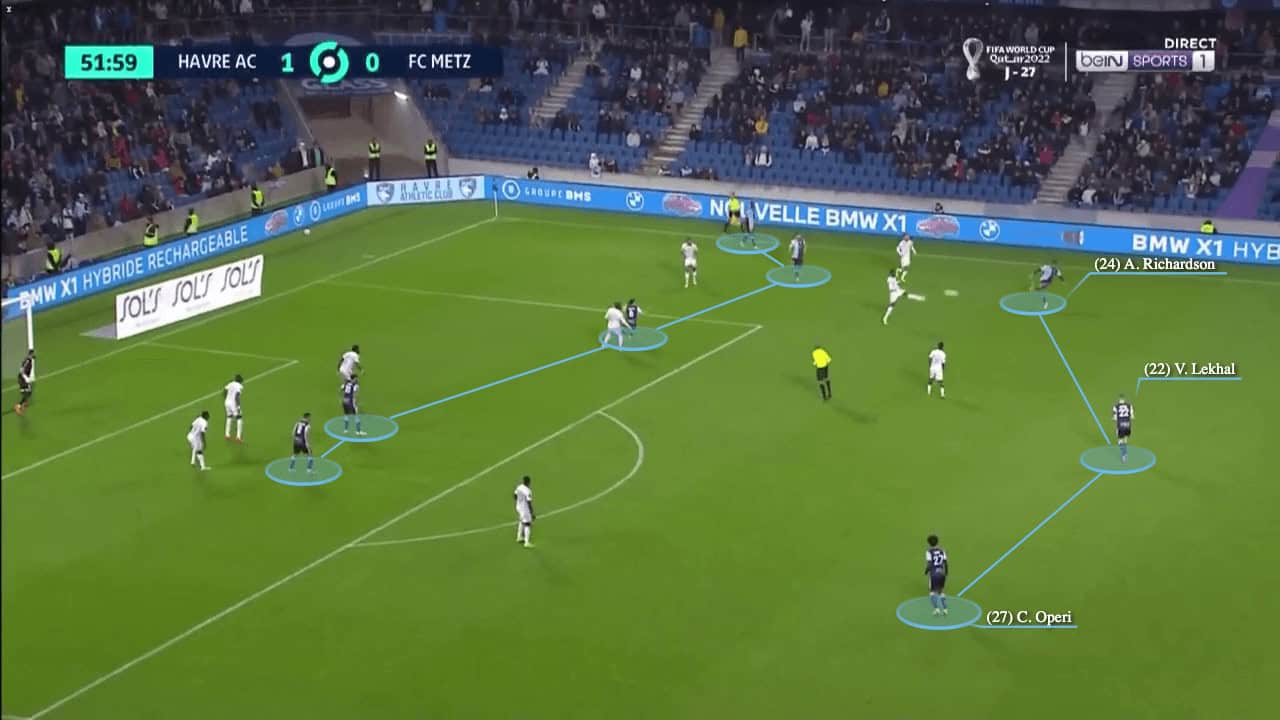
The image below shows their structure on the ball: 2-3-5, although the two central defenders are off the screen.
The left-back, Operi, comes into the middle of the pitch alongside the holding midfielder Lekhal and right-sided midfielder Richardson.
This is a very athletic trio, which allows Le Havre to counterpress effectively due to the recovery ability and strong defensive duels that these players possess.
In the front line, the right-back El Hajjam provides overlaps for the right-winger Casimir, while Cornette is wide left accompanied by Kechta, who joins from deep.
The striker Alioui is their frontman and attempts to link play and attack the space in behind.
Because the team consistently has five players attacking the box, they can cause overloads against a back four, allowing them to have an extra free man in the box when the ball is in wide areas.
As we can see in the image below, Kechta’s late arrival causes a problem for the opposition’s back line. Each defensive player is already marking someone, and the extra runner distracts one of the central defenders.
As the defender takes his eye off his marker, the player on the end of the cross can move further from the defender, into more space, and have an easy chance on goal.
The cross finds him perfectly, although the headed attempt goes wide.
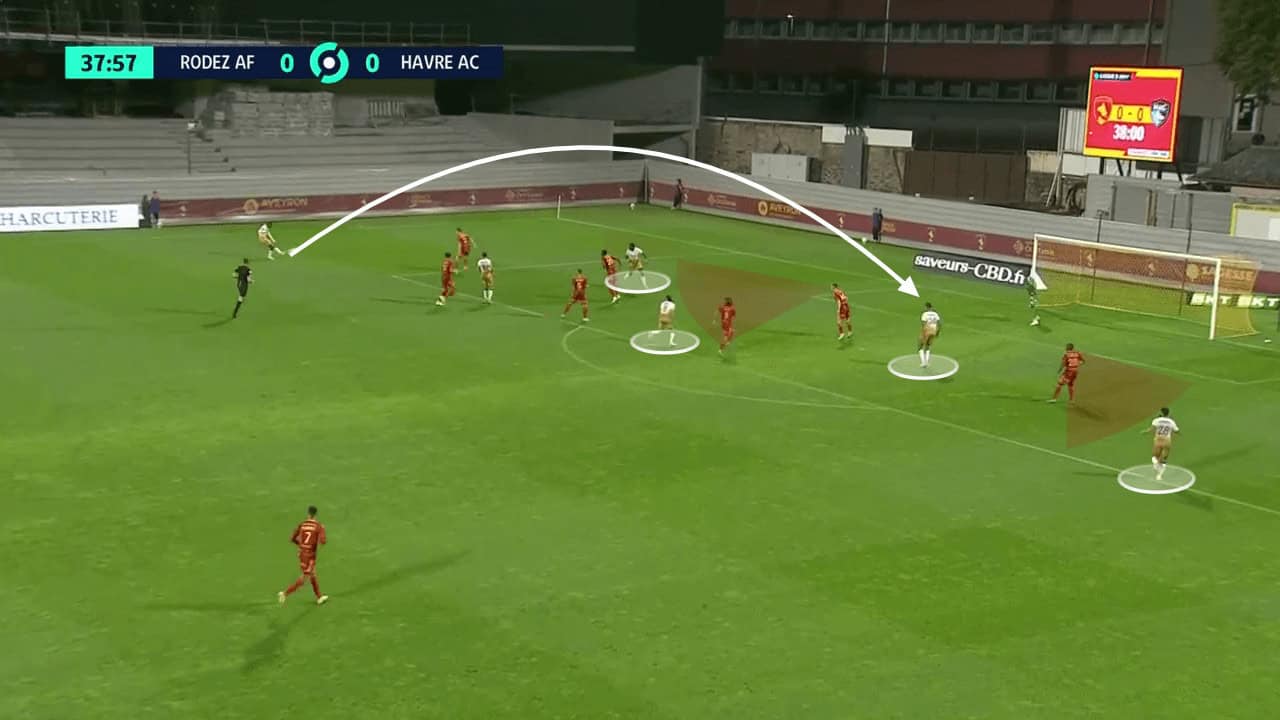
Le Havre’s most reliable chance creation when with the ball is through crosses from wide areas, but the team largely lacks the creativity and technical ability to play through the defensive blocks to create other kinds of chances.
Defensive Solidity
Le Havre’s standout positive as a team is its ability to limit the number of chances the opposition receives through its strong shape off the ball.
Le Havre have only conceded 7 goals in 19 league games so far, meaning they roughly concede 0.37 goals per game.
While they have shown strong performances without the ball, they also have had a slight element of luck on their side, with them being expected to concede around 0.6 goals per game.
One of the strongest parts of their game is their ability to counter press when they lose the ball, preventing their opponents from being able to spring any counterattacks on them.
In the screenshot below, we can see Richardson close down the ball, forcing him inside, while Lekhal closes down the passing option.
The players in the front line sprint back to close down the ball from the opposition’s blind side, which helps Le Havre immediately win the ball back, leading to a goal.
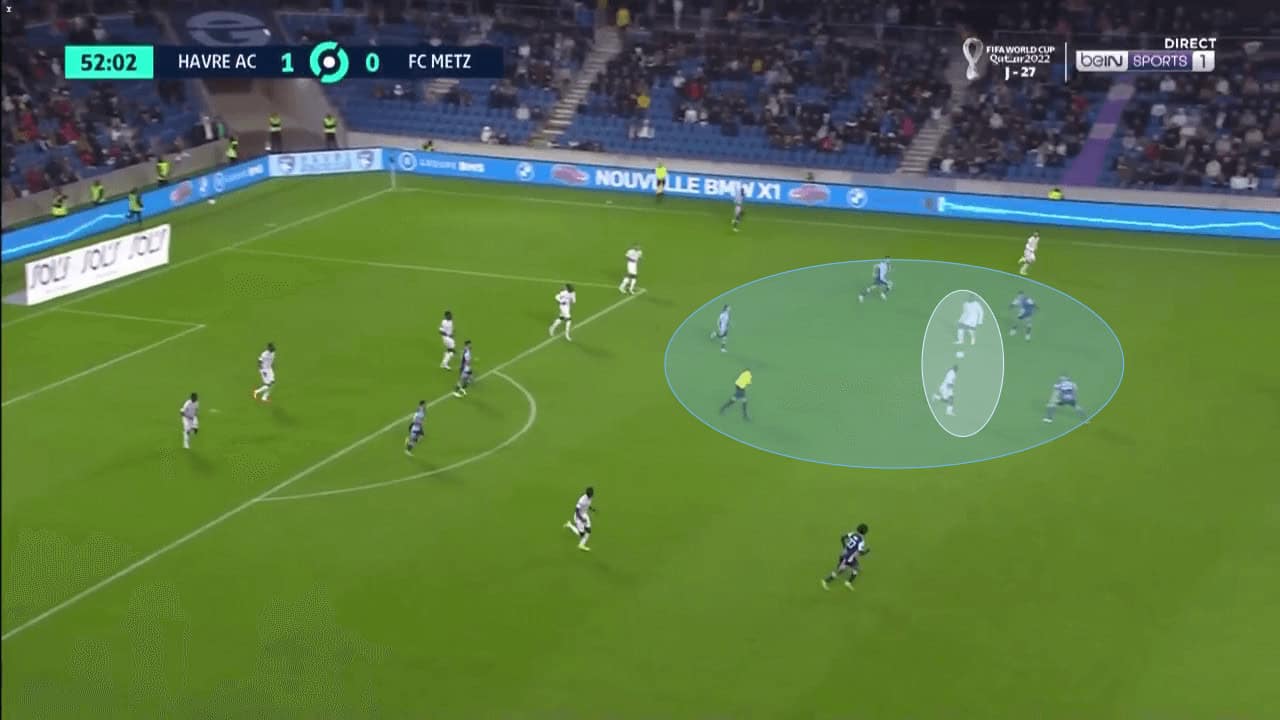
Part of what makes Le Havre so good at winning the ball back high up the pitch, both through pressing and counter-pressing, is their aggressive front-foot defending.
20-year-old Senegalese defender Sangante always looks to win the ball back early by stepping up to intercept long balls played into the strikers.
Sangante is quick off the mark, which allows him to frequently get ahead of the forwards, but he sometimes lacks the ball control to help his team retain possession of the ball.
Le Havre is often able to quickly snuff out any direct pass like the one pictured below, forcing opposition teams to play down the flanks or adopt a more patient, slow approach to the ball.
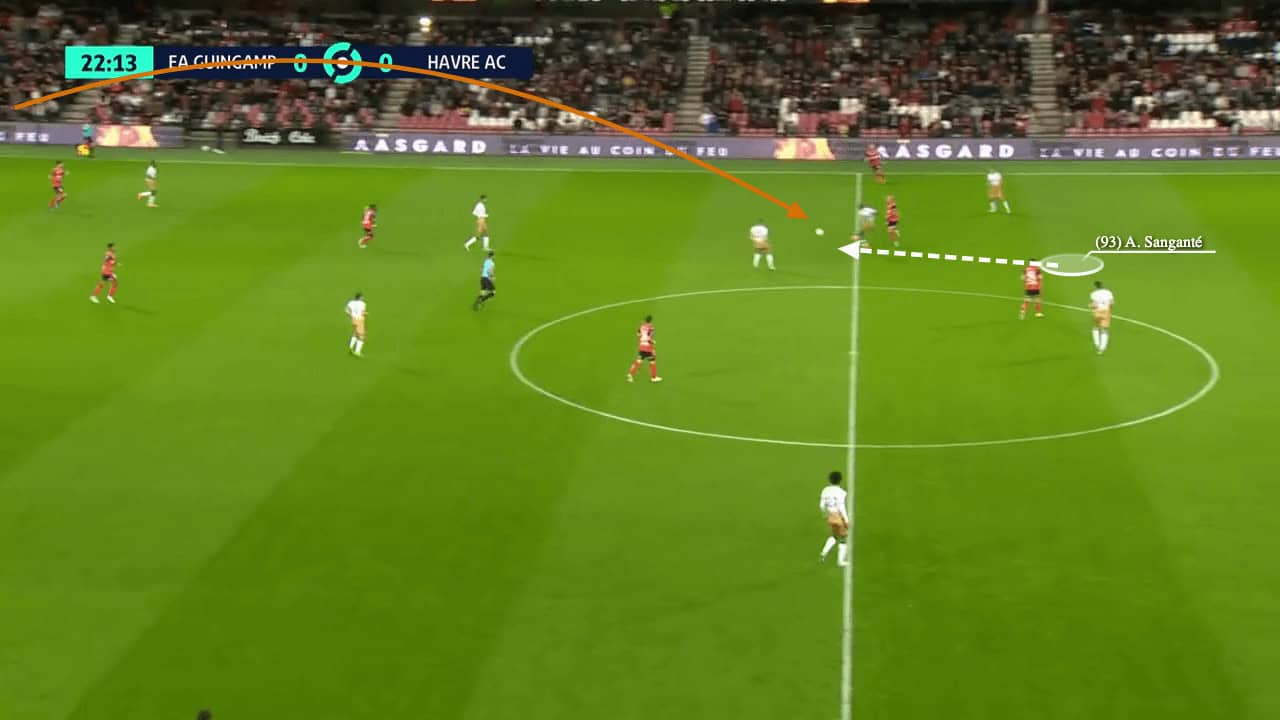
Le Havre frequently attempts to press their opposition, setting up a 4-1-4-1 system which looks to press opponents on backwards passes or during goal kicks.
The league leaders stay compact off the ball. The midfielders cut off any potential central passes, while the wide players force them to come inside and play into the crowded central areas.
The centre forward also comes back to mark the holding midfielder, overloading the central areas and forcing the opponents to play in wide areas.
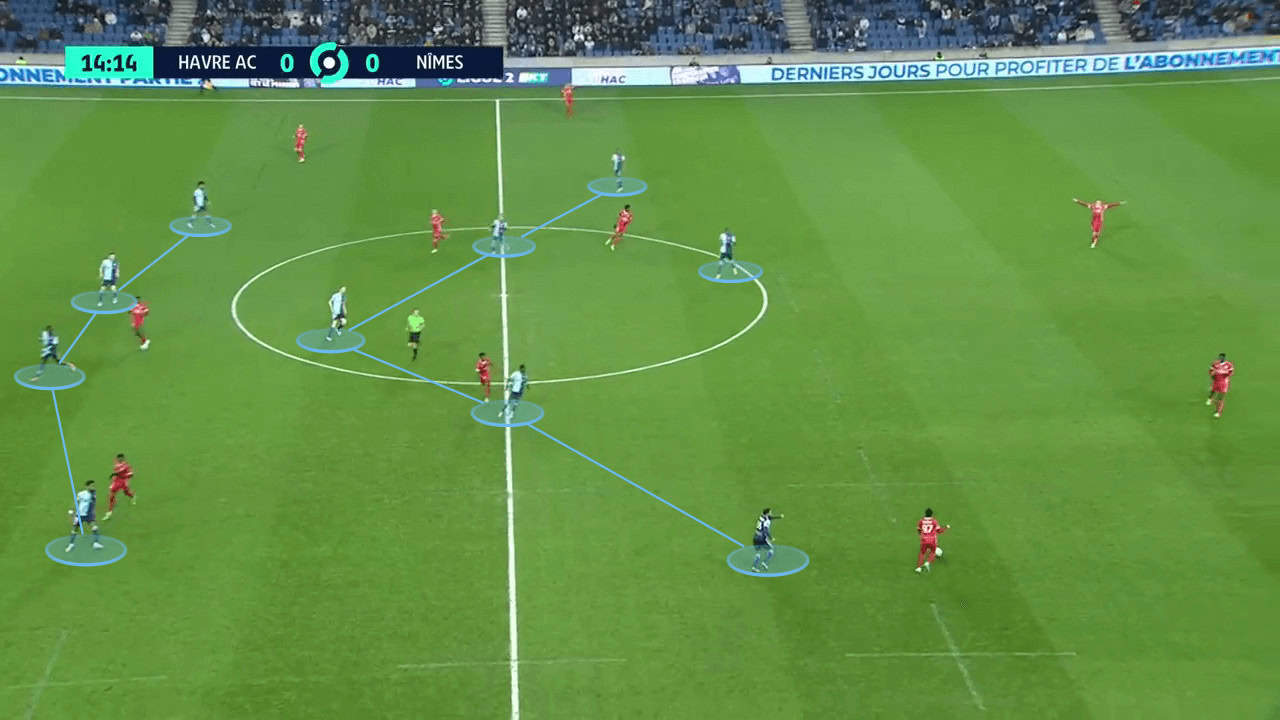
When Le Havre manages to force the opposition back to their own goal, they intensify their press by becoming more aggressive.
The wide players come inside to prevent the goalkeeper from making any easy passes.
As we can see in the image below, the right winger comes inside to mark the centre-back, while the right back steps up to prevent the goalkeeper from clipping a pass into the full-back who is left spare for a moment.
The two advanced #8s stay tight to prevent the ball from progressing centrally, and the striker and left winger cover the passing lanes to the other defenders in the build-up.
As a result, opposition teams are forced to go long, where Sangante can use their strengths to win the ball back ahead of the centre forward.
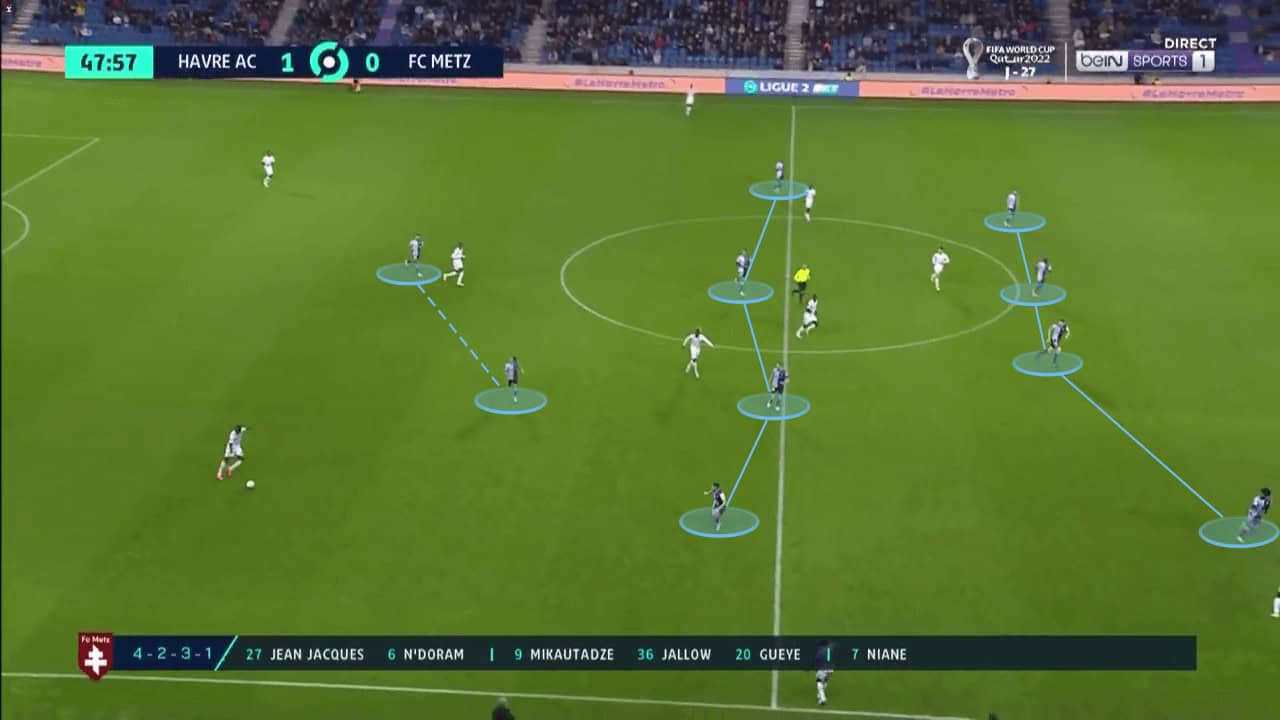
When teams manage to retain possession of the ball, Le Havre shift into a 4-4-2 mid-block, with the two forward players swapping roles between pressuring the ball, and marking the pivot.
The two players swap roles as the ball is shifted from side to side to prevent any short passing options from becoming available.
The rest of the team have similar roles, with the midfield players still being responsible for cutting off any central passes.
The team maintains a high line, and the defensive players have the athleticism to recover any passes played over the top of the defence.
Conclusion
This tactical analysis has displayed the different ways in which Le Havre have been able to control games, progressing the ball in wide areas to enter the final third.
While Le Havre hasn’t been special on the ball, they have been excellent off the ball.
Their ability to limit the number of chances their opponents created has been the key to helping them win games, even if it’s by a singular goal.
Le Havre has shown that they can keep this up for the campaign’s second half as long as they maintain their excellent off-the-ball shape and energy.
