
Following the sacking of Ange Postecoglou and the appointment of Thomas Frank from Brentford, Tottenham Hotspur are undergoing a series of summer transfers ahead of the upcoming 2025/2026 English Premier League season.
The latest Spurs transfer to North London is the exciting West Ham United attacker Mohammed Kudus, who came up through the Right To Dream Academy in Ghana.
Although the UEFA Europa League champions have decent squad depth, Tottenham will aim for the best in this summer transfer window to ensure their return to the top half of the Premier League table.
Despite their European success, Spurs were dissatisfied with their domestic campaign, where they finished 17th in the EPL, just one position above relegation.
To get back to a Top 6 finish where they once belonged, Thomas Frank tactics will need to overhaul the team’s incisiveness, versatility, and dynamism in attack.
On paper, Mohammed Kudus is the perfect candidate to fulfil those requirements.
In this scout report and player analysis, we will dive into how Mohammed Kudus style of play will fit in at Tottenham Hotspur tactics and the different roles he can play under Thomas Frank management.
Mohammed Kudus At Spurs 2025/2026
Mohammed Kudus is a dynamic left-footed attacker who can play as a left-winger, right-winger, attacking midfielder, and false nine.
His time at Ajax is a key factor in his versatility.
The Ghana International spent three seasons in the Eredivisie before making the switch to the Hammers in 2023.
He has been an exciting figure in attack ever since.
For Spurs, he will likely play a similar role to Dejan Kulusevski on the right side.
However, he might also be deployed at times as an attacking midfielder in place of James Maddison.
Similarly, he can also play as a striker when Dominic Solanke is rested or unavailable.
This will add a new dimension to Thomas Frank’s side as Kudus will play relatively deeper when operating there.
Looking at the style of play and referring to player profiles, Kudus can be compared to Kulusevski.
Mohammed Kudus Vs Dejan Kulusevski Stats

Both are at par in terms of dribbles per 90 minutes.
However, Kudus ranks significantly higher in touches in the opponent’s penalty box and receiving passes in progressive positions.
Although the Swede has greater numbers for incisive passes per 90, the Ghanaian has more progressive passes and defensive duels to his name.
We examine how Mohammed Kudus plays and identify moments where he bears a resemblance to Dejan Kulusevski.
Mohammed Kudus Style Of Play
Kudus is fairly explosive, which is evident when he dribbles and takes on defenders.
However, in terms of ball action, the wide channel is not the only area he frequents.
The Ghanaian has a large radius of action and can influence play from multiple areas of the pitch.
It is quite common to see explosive players operate in a wide area most of the time.
This allows them to isolate their direct opponent (full-back or wing-back) and get the most out of these situations.
This is called qualitative superiority, where a quick winger goes up against a relatively slower full-back or wing-back.
In these situations, the winger contributes to a good number of crosses, cutting inside, and shooting actions.
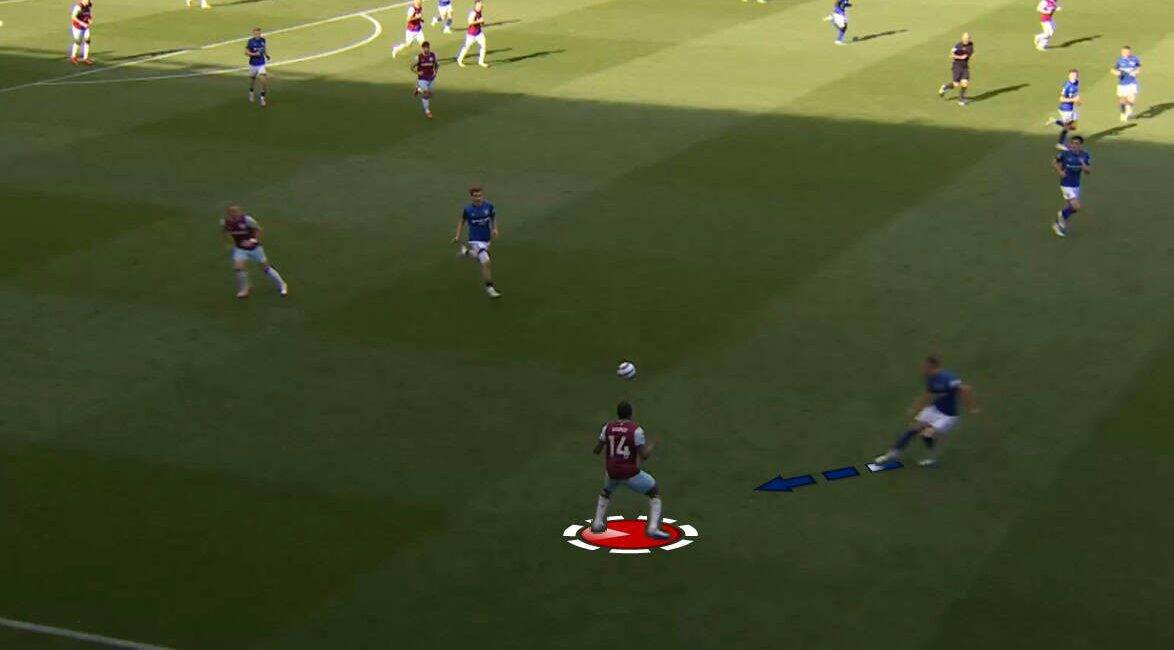
Kudus can often be seen receiving in the wide channel, where he can isolate an opponent and take him on.
In the above image, the Ghanaian is seen receiving wide, where an opponent is pressing him.
The winger looks to exploit the space behind the defender.
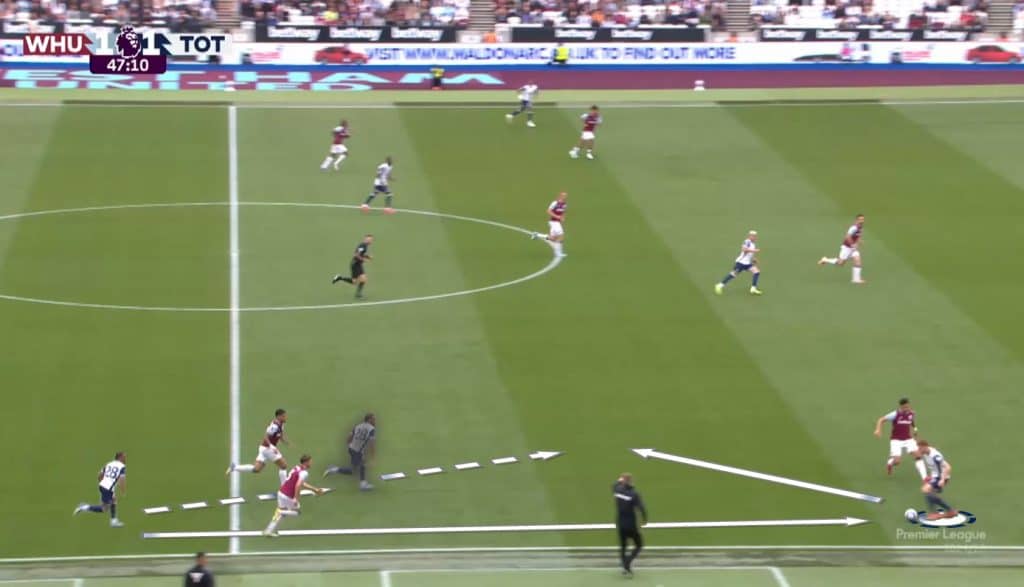
Here, we can see Kulusevski receive in a similar zone.
He can either attempt a take-on or a combination play with the arriving teammate in the half-space.
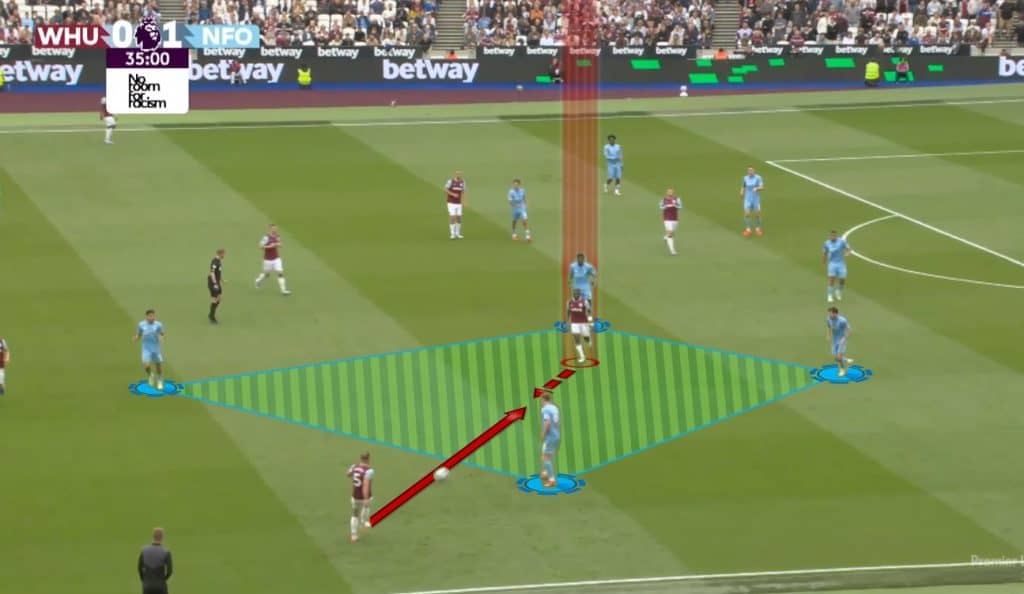
Apart from the wide areas, Kudus can also be seen receiving in the half-spaces.
He usually operates in these areas when the full-back provides width.
Quite often, it is the full-back who plays the pass to Kudus into the half-space.
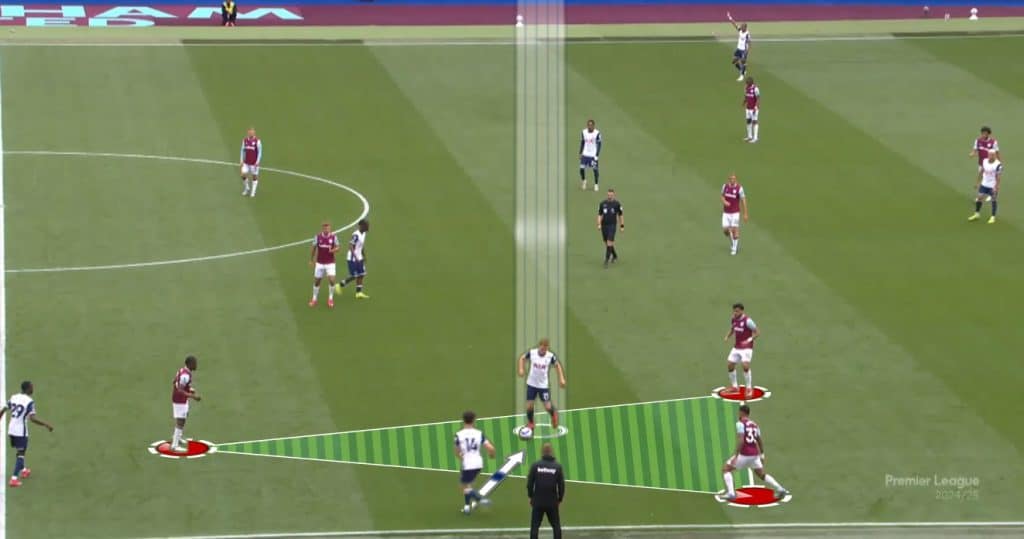
Here, we can see Kulusevski receiving in a very similar situation and area from his full-back.
Mohammed Kudus In Tight Spaces
Kudus had impressive numbers for dribbles and progressive carries per 90 in the 2024/2025 season, with 92 in total and 3.45, respectively.
A large chunk of those came from the Ghanaian receiving in tight spaces, small pockets in different parts of the pitch.
Although multiple opponents surrounded him, he was adept at performing exit dribbles, driving into a bigger space, and progressing the ball.
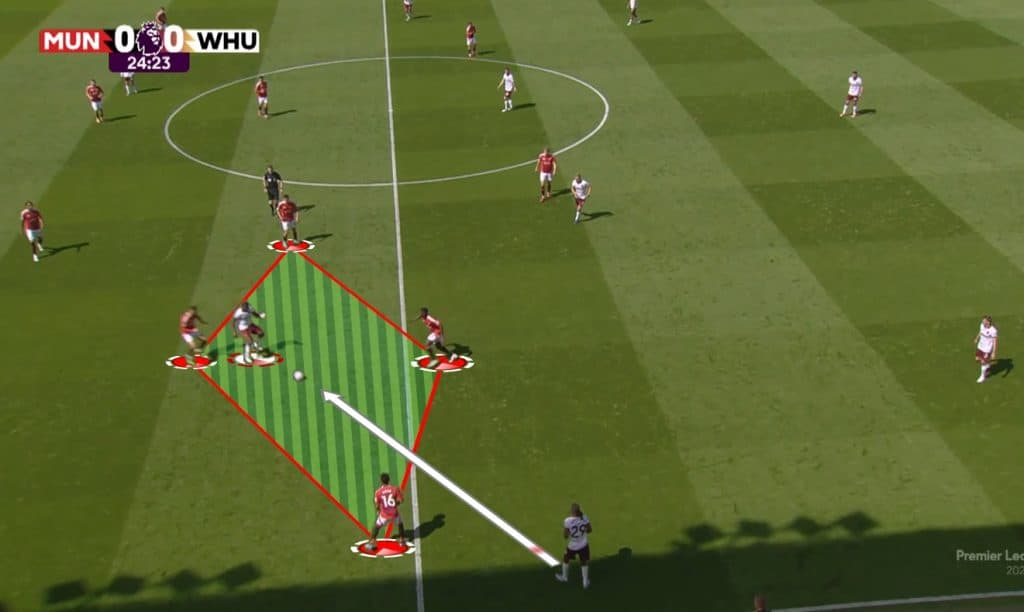
In this image, Kudus receives in a small pocket, surrounded by four opponents.
He turns away from pressure and swiftly progresses the ball.
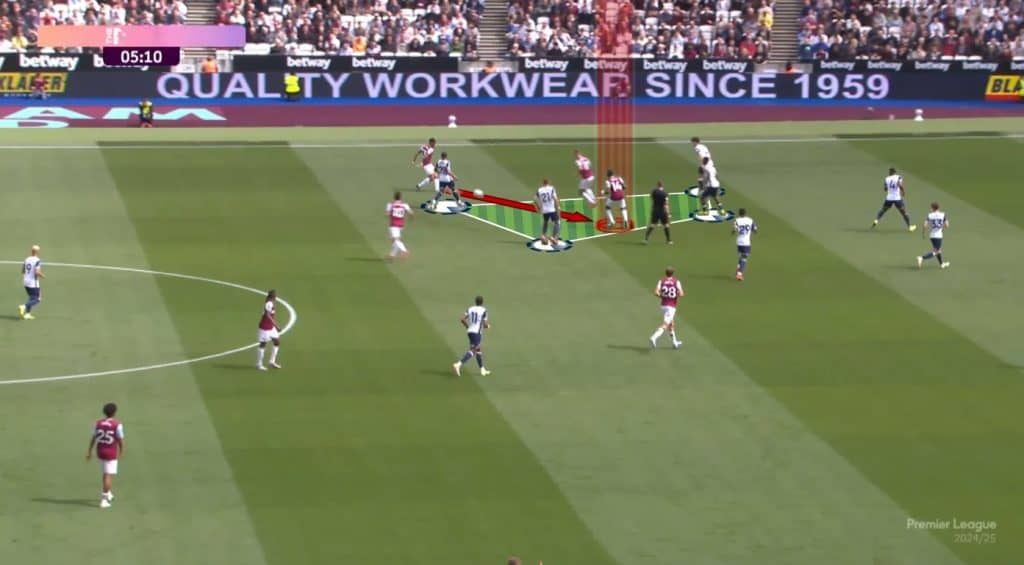
Here is another example of Kudus receiving in a tiny pocket of space.
He invites pressure by getting on the ball in a situation like this.
Once the opponents move close to him, he passes to a teammate who has more space.
This is another way of indirectly playing forward.
Players like him, who are a constant threat through direct dribbling, attract multiple opponents whenever they get on the ball.
Kudus’ decision-making regarding how long he should hold onto the ball will be one of the driving factors in how Spurs find opportunities to penetrate.
Mohammed Kudus Operating As Striker
Apart from playing in the wide areas, Mohammed Kudus can also be deployed as a striker or a central attacking midfielder.
During his time at West Ham, he was often seen operating in those central areas.
In such situations, Kudus dropped deep to create a numerical superiority for smoother progression.
He would either drop to lay it off to a deeper player facing the play, or, in some cases, would turn his man and carry the ball forward himself.
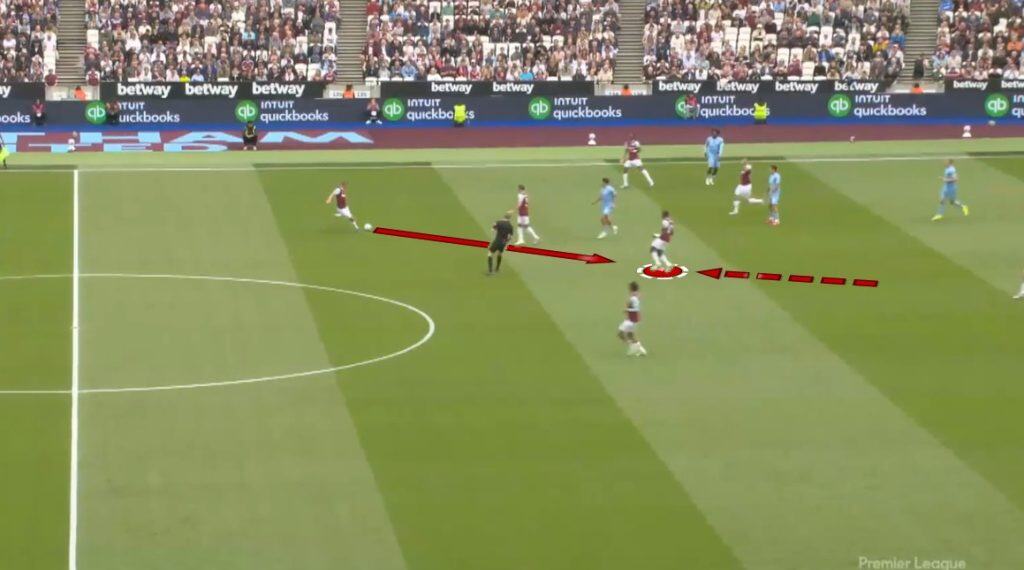
Here is an example of Kudus dropping deep while operating as a striker.
In this situation, he is not closely followed by any of the opponents.
Thus, he ends up receiving it on the turn and driving forward.
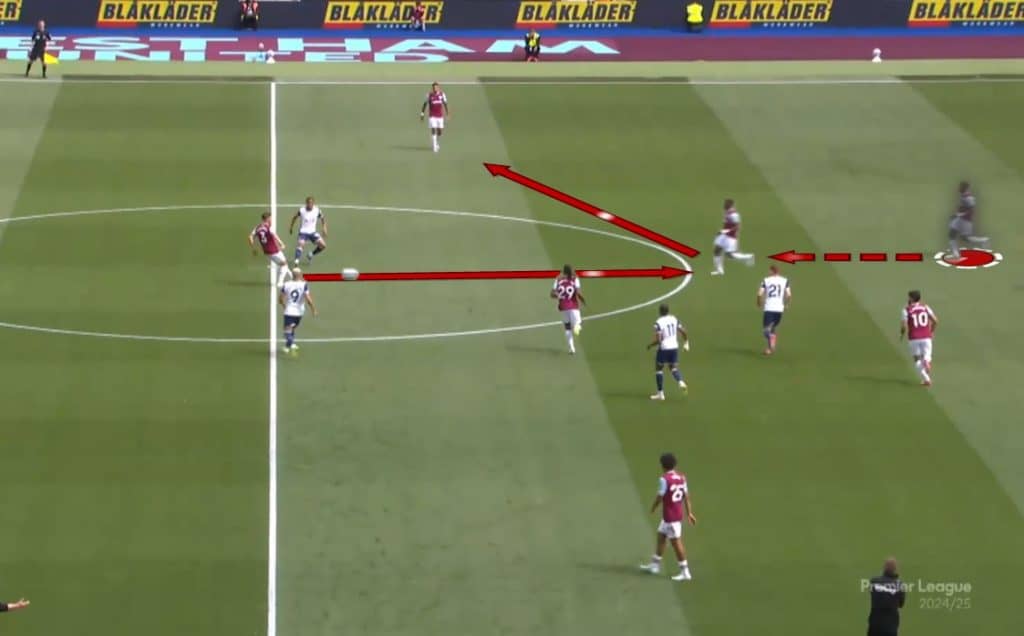
In this situation, the Ghanaian International drops deep to lay it off to a teammate with more space.
Moreover, the teammate is directly facing the play, which helps with verticality.
When he is deployed as a striker or an attacking midfielder, he can drop deep and help out in progression.
However, he can also operate between the opponent lines of midfield and defence when other players drop deeper.
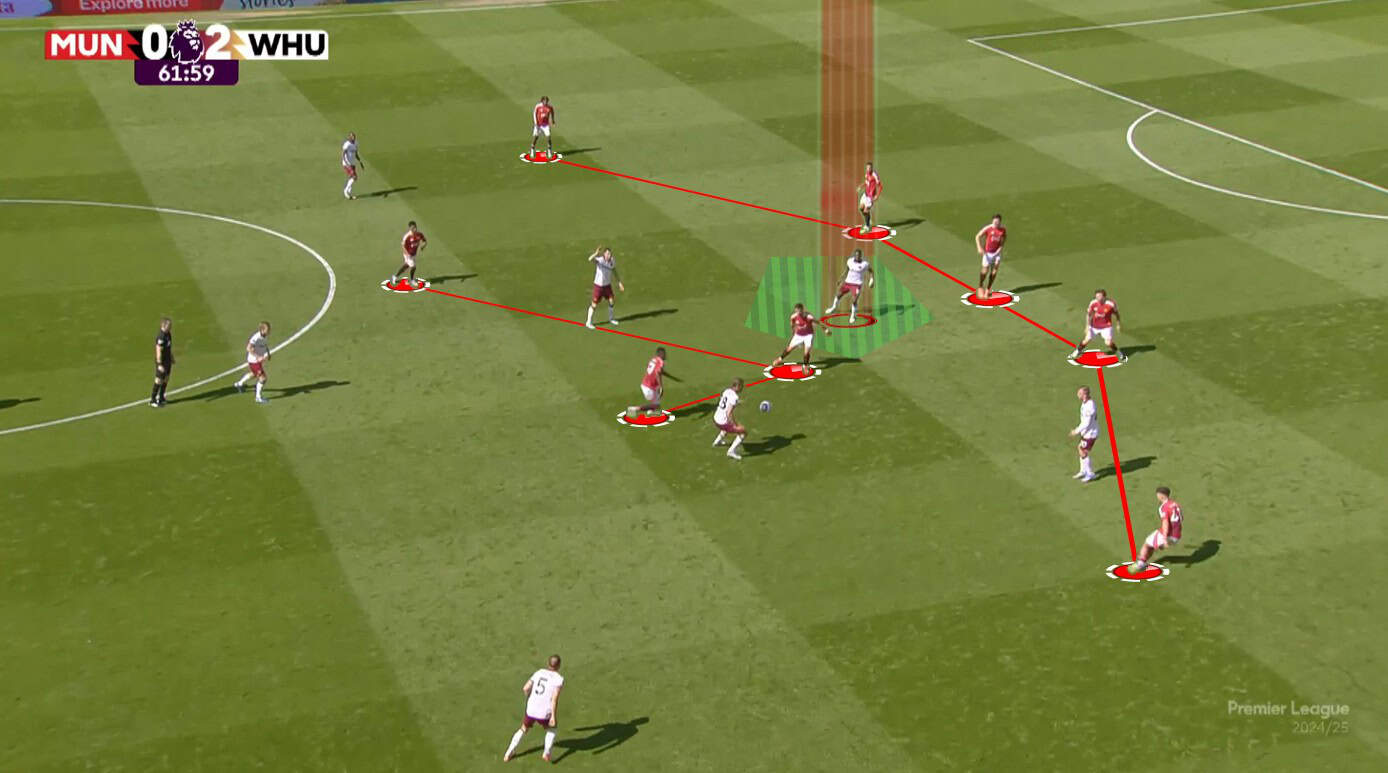
In this image, Mohammed Kudus operates as a striker between the lines.
If a speedster like him plays on the shoulder of the last defender, opponents may double-team him at times, opening space for teammates in other areas of the pitch.
Mohammed Kudus Explosive Dribbling
One of Mohammed Kudus’ invaluable traits is his high-intensity dribbling.
The new Spurs signing has often showcased his technical prowess by taking on defenders and carrying the ball into space.
A quality that sets his dribbling apart is his tendency to be direct.
In isolated one-on-one situations, his dribbling makes a lot of difference in creating an extra yard of space to get a cross in.
Here is an example of the Ghanaian dribbling past multiple opponents to swing in a dangerous cross.
The initial bit highlights his dribbling IQ as he immediately cuts across to avoid a challenge from the first opponent.
He avoids an outstretched tackle by bringing his body between the ball and the defender.
Before beating the second defender, he slows down, killing the momentum of the defender.
As soon as the defender is flat-footed, Kudus explodes away from him.
Here, we can see him carrying the ball from his defensive third during a positive transition.
He very artfully uses each defender’s momentum against themselves to beat them.
It is noteworthy that, in addition to understanding a change of pace and direction within a split second, Kudus is also adept at playing through contact.
This highlights his physical dominance in these situations.
When there is no space available to dribble, he adjusts by playing quick one-twos with his teammates to receive the ball in his path.
This helps him not break his stride and maintain the pace of the counter-attack.
Mohammed Kudus Assistance With Shifting Play
One of the advantages of Kudus dropping deep is his contribution to connecting play.
This helped his West Ham side in moving the ball out of tight areas and shifting the play.
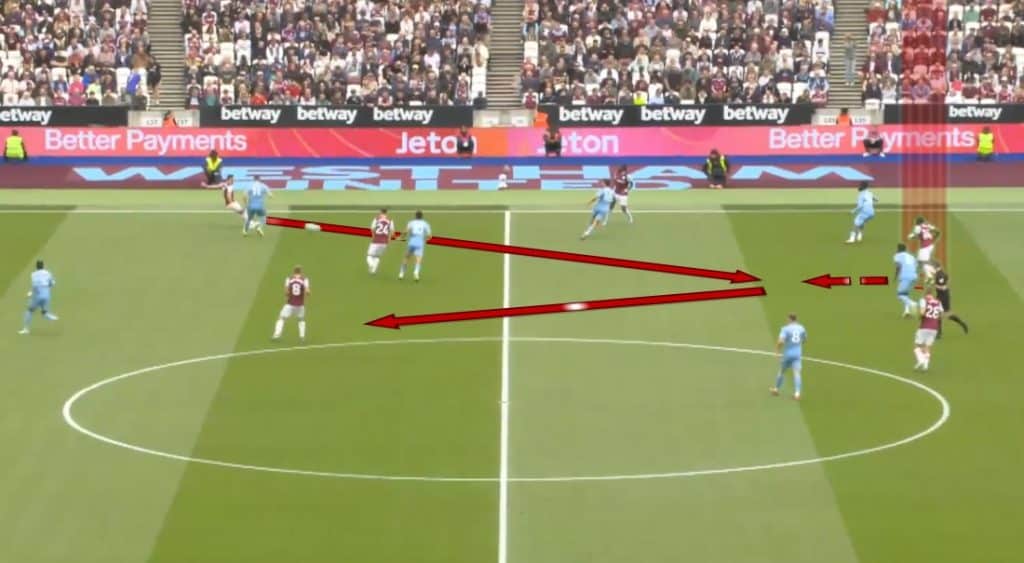
Here is an example: Three opponents are pressing high on West Ham’s left side, marking all the short options.
Kudus drops from a central position and passes to a deeper midfielder positioned in the central zone.
Subsequently, the midfielder shifts the play to the other side.
Mohammed Kudus Offensive Actions In Attacking Third
The new Spurs recruit displayed a range of actions in the attacking third, making him a multidimensional player for West Ham United.
In this video, Kudus makes a double movement in the box to score from a cutback.
His initial movement creates space by dragging the defender into another area before he finally moves towards the ball for a first-time finish.
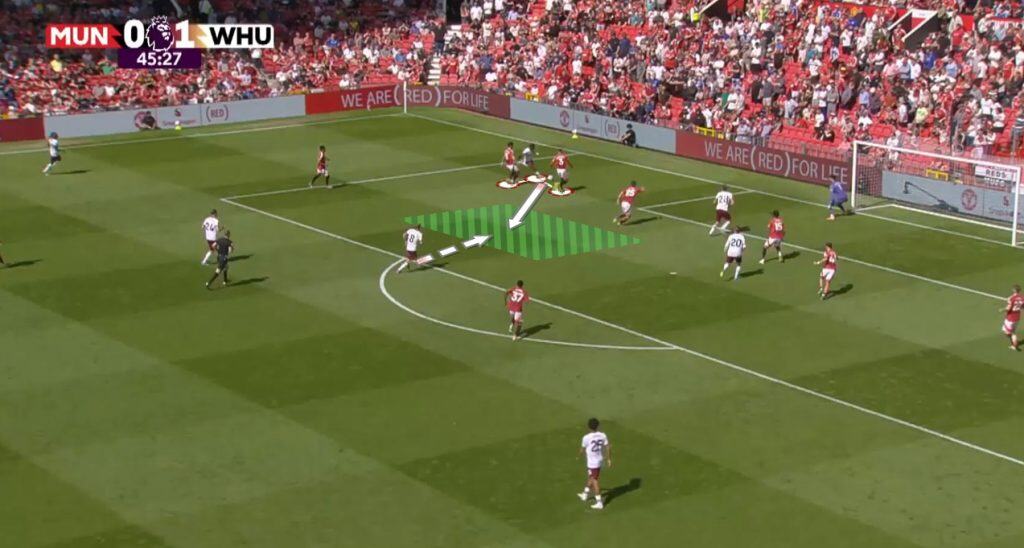
Here, we can see the Ghanaian attacker dragging two opponents to open space for a midfielder who is arriving late into the box.
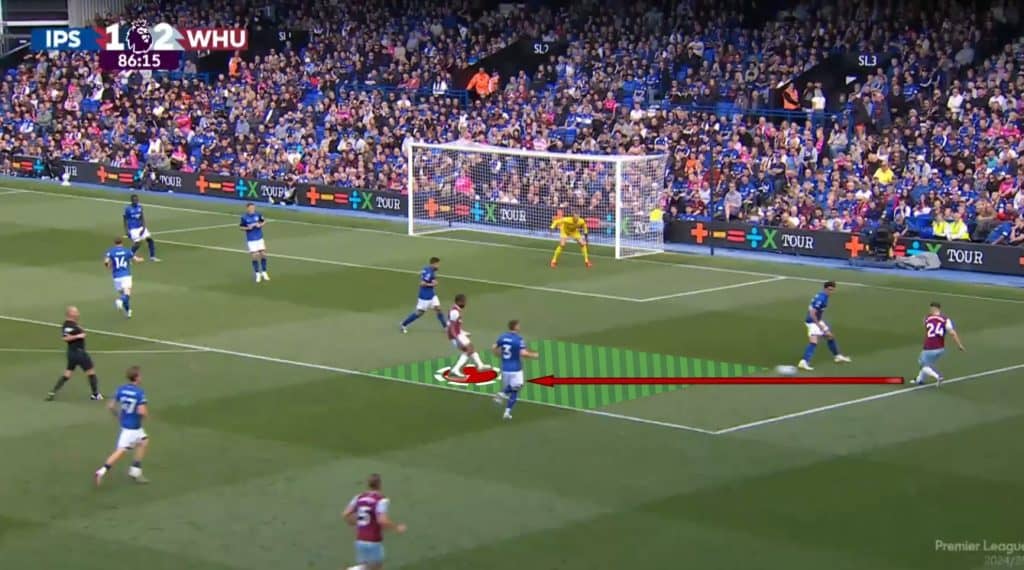
Kudus can be seen receiving a cutback inside the penalty area.
Since he has no blindside pressure, he receives it on the back foot and slots it into the far corner.
Mohammed Kudus Runs In Behind
A speedster like Mohammed Kudus is expected to make incisive runs behind the last line of defence.
Apart from the Ghanaian being comfortable receiving to his feet, his ability to make runs in behind to receive in his stride adds an element of unpredictability to his game.
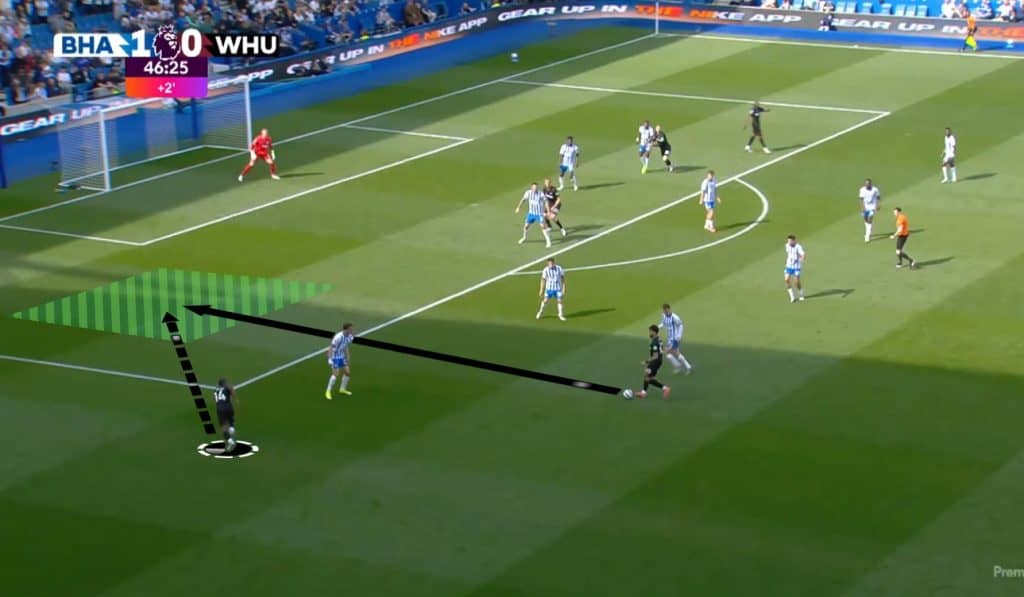
Here is an example of the Ghanaian making a run in behind.
He shuffles wide to drag the defender out and stretch the gap before making the timed run into the space behind the defenders.
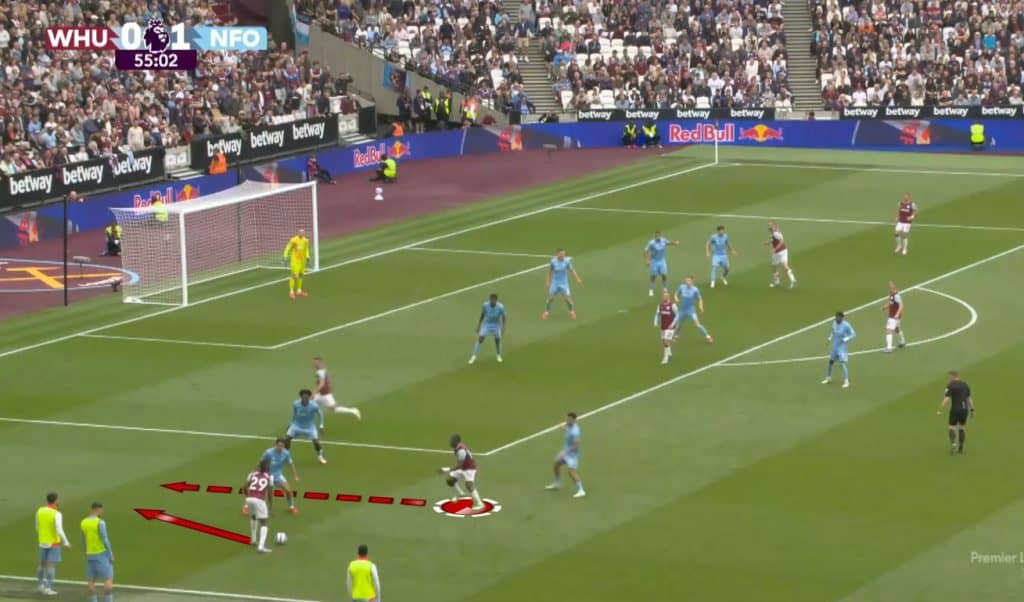
Kudus was also seen making plenty of these underlapping runs when the full-back had the ball.
In this situation, he identifies the space behind the opponent’s full-back.
He meets the ball in behind to quickly swing a cross into the box.
These examples showcase his ability to make a variety of attacking movements, especially in the final third.
It also shows his eagerness to demand the ball and get involved in the play in different areas of the pitch.
Mohammed Kudus Defensive Actions
A dynamic player like Kudus makes a huge contribution to the attack.
Fortunately for Spurs, their latest signing is also a workhorse in the defensive phase.
Whether he is aggressive in high press to force the opposition to play long or pressing to cut space to force a backwards pass, Kudus has displayed that he is capable of doing it all.
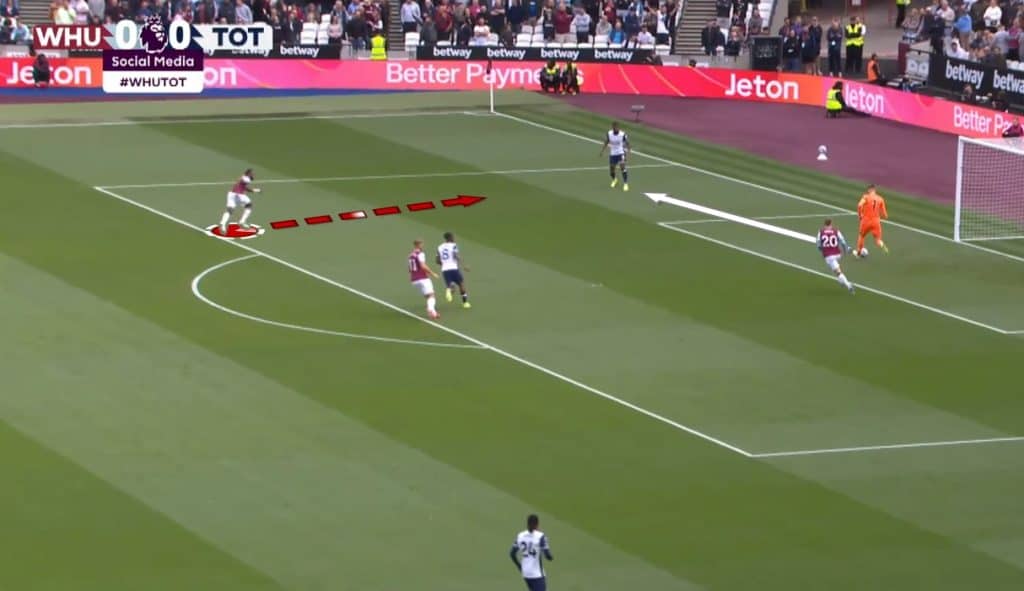
Here, Kudus is playing as a left-winger.
He anticipates the opponent goalkeeper’s pass to his centre-back and immediately cuts down space.
The defender is eventually forced to play long.
The opponents shift play by making a horizontal pass to the right side.
The defender receiving the ball has ample space to open up initially.
However, Kudus’ aggressive pressing ensures the space is cut out, and the defender plays it backwards.
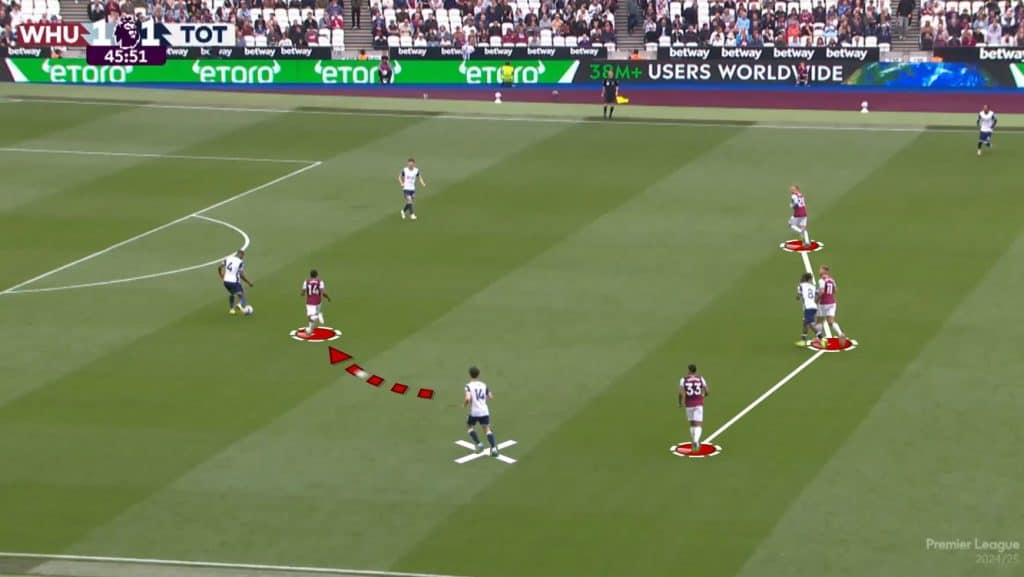
In this situation, Kudus operates as a striker.
He presses the opponent’s centre-back, making a curved run.
This helps him keep the opponent full-back in his cover shadow, which in turn forces a backwards pass.
It is nothing less than a treat to have a versatile attacking player who is willing to contribute with intensity during the defensive phase.
The Ghanaian will inject a lot of energy into Tottenham’s pressing, which will only push them further to dominate more games.
Conclusion
Mohammed Kudus is a versatile attacker who can play across all positions in the front four.
He has a large radius of action and is comfortable operating in multiple areas of the pitch.
He also offers a commendable work rate in defensive moments.
At Spurs, he can match the profile of Dejan Kulusevski as a right-winger, play as a central attacking midfielder in place of James Maddison, play on the left, or as a striker in the absence of Dominic Solanke, with a slight variation in terms of how he operates.
Thomas Frank has got his hands on a player who could very well end up becoming a talismanic figure for the North London side over the next few seasons.
