
Christopher Nkunku is joining AC Milan from Chelsea for an estimated €42 million fee.
I Rossoneri’s main need from the summer transfer window has been the main striker profile, as the team has been relying solely on Santiago Giménez.
Although the signing of Nkunku can be considered a striker, it does not fully meet the team’s attacking requirements, as Nkunku has a more versatile profile, similar to that of a second striker, playmaker, winger, or false nine.
Still, he was indeed used as a striker on numerous occasions with Chelsea.
That said, Nkunku will be very valuable in Milan’s attack as he offers high quality in all aspects, regardless of which position he is used in by Massimiliano Allegri.
In this Christopher Nkunku player analysis and scout report, we will explore Massimiliano Allegri’s possible options for reorganising the team following the addition of Nkunku.
The analysis will also shed light on Nkunku’s possible addition to AC Milan and what he can add to Milan’s attack.
Christopher Nkunku Position In Massimiliano Allegri Lineup
Allegri’s Milan struggled to get a positive result in their opening game of this season’s Serie A.
And with the arrival of a player like Nkunku, it is possible that Allegri would lean towards a change in formation to suit the abilities of his available players and work on limiting the defensive issues that were relatively created due to the lack of experience in terms of marking and positioning in the 3-5-2 formation.
Allegri might continue working according to that formation, as he had built his entire pre-season preparation around it.
However, he is also expected to favour a change of formation to get the most out of his players.
It is true that such a rapid change in formation might be risky for everyone, as it could create a sense of doubt in Allegri’s management of the team, especially among the media.
However, this could be a worthwhile risk to improve the team.
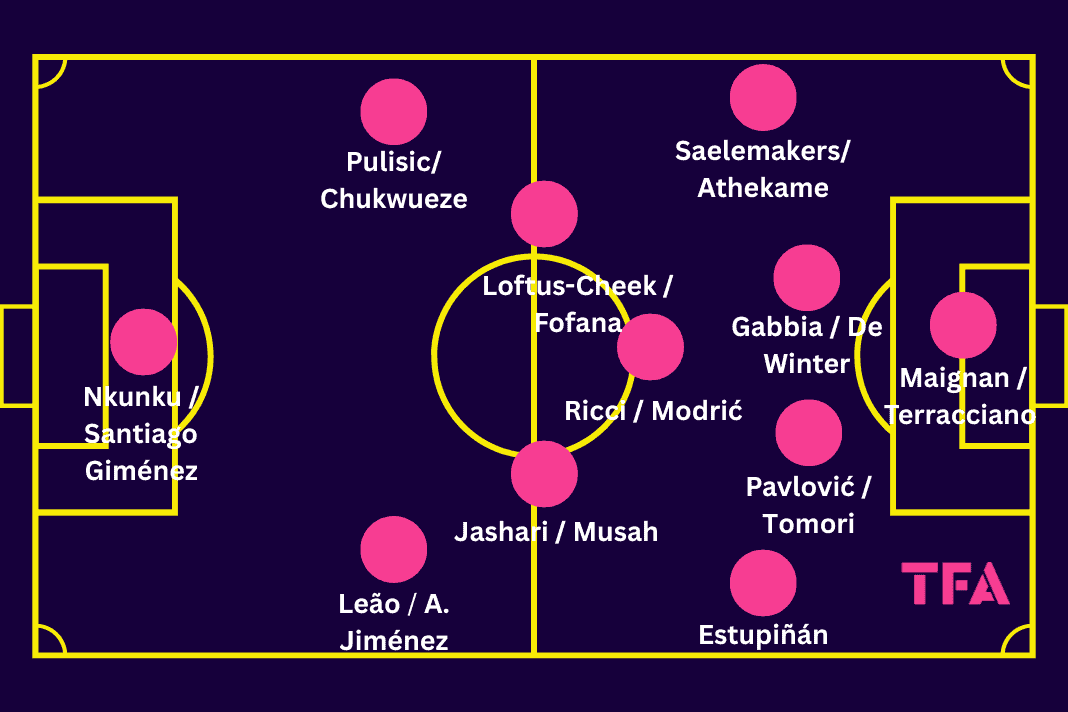
AC Milan Possible Switch To 4-2-3-1 Formation
In this regard, Allegri might consider changing his formation to a 4-2-3-1, as shown in the following graphic.
This formation is based on the fact that using a 3-5-2 formation would result in Milan losing some of their excellent attacking players, at the expense of midfielders and wing-backs.
The 4-2-3-1 formation allows Allegri to use all four of Christian Pulisic, Nkunku, Rafael Leão, and striker Giménez in one formation, exploiting the talent and attacking ability of the four players simultaneously, something that would not be possible with the 3-5-2 formation.

AC Milan Possible Change To 4-3-3 Formation
Allegri can also switch to the 4-3-3 formation and rely on Nkunku as the central striker, making him start instead of Giménez and building competition between the two for the starting role, with Nkunku obviously receiving more playing time given the significant investment in bringing him to Milan.
This formation would also be more suitable defensively than the 4-2-3-1 formation, as the midfield line would be more solid defensively.
Using three midfielders instead of a midfield duo would be more appropriate, given that Allegri has typically preferred a midfield trio.
For Nkunku, playing as a central striker in this formation might be effective, especially if Allegri assigns him different roles than Giménez.
Nkunku can be very useful and dangerous if used as a false nine.
He moves a lot without the ball on the wings and in midfield, and Milan can also benefit from his penetrations and dribbling abilities.
However, he will not be able to fully interpret the role of Giménez, mainly because his height and characteristics do not allow him to play the role of a stationary striker with 100% success.
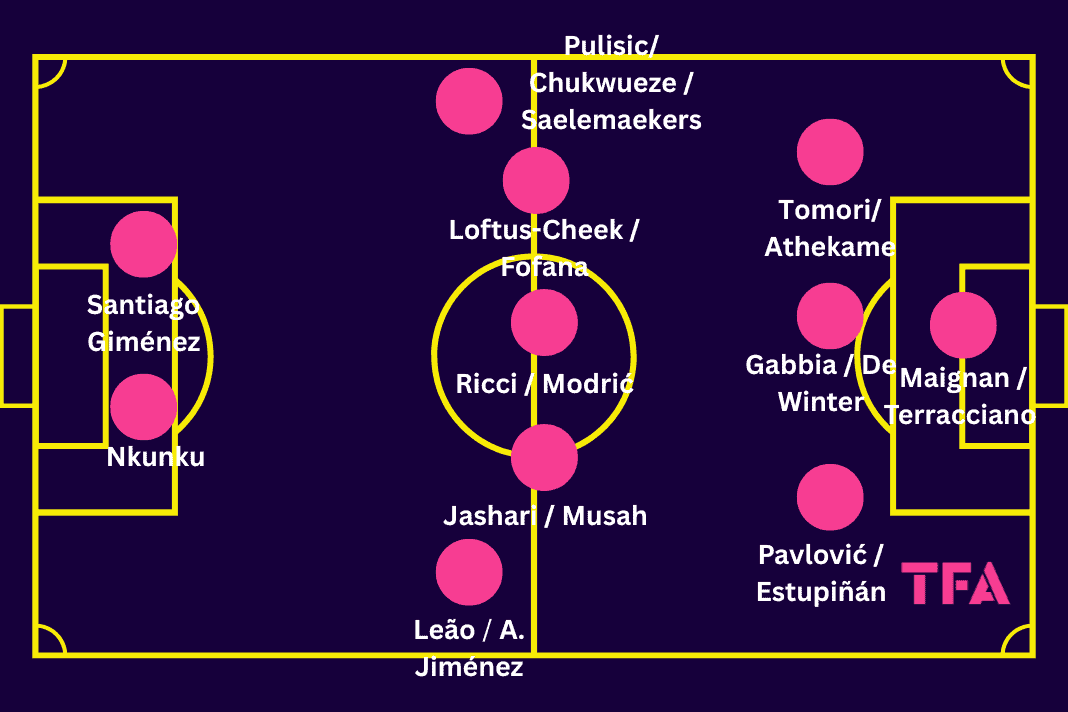
Exploiting Giménez-Nkunku Duo In 3-5-2 Formation
This leads us to another possible alternative for using Nkunku: an attacking duo combining both Giménez and Nkunku, respectively, as a central striker and a second striker.
In this case, Milan will most probably make use of a powerful attacking duo but will lose some of their reliable assets.
In other words, Milan will have to sacrifice either Leão and Pulisic or Alexis Saelemaekers and Pervis Estupiñán if they continue playing according to the 3-5-2 formation with the Giménez-Nkunku duo.
And since both Leão and Pulisic are crucial elements within the team, Allegri will likely sacrifice both Saelemaekers and Estupiñán if he plans to continue using the 3-5-2 formation, relying on the Giménez-Nkunku duo.
That said, the formation will become weaker defensively as neither Leão nor Pulisic can be considered 100% efficient in the defensive phase as wing-backs.
Using Christopher Nkunku As Striker In 3-5-2 Formation
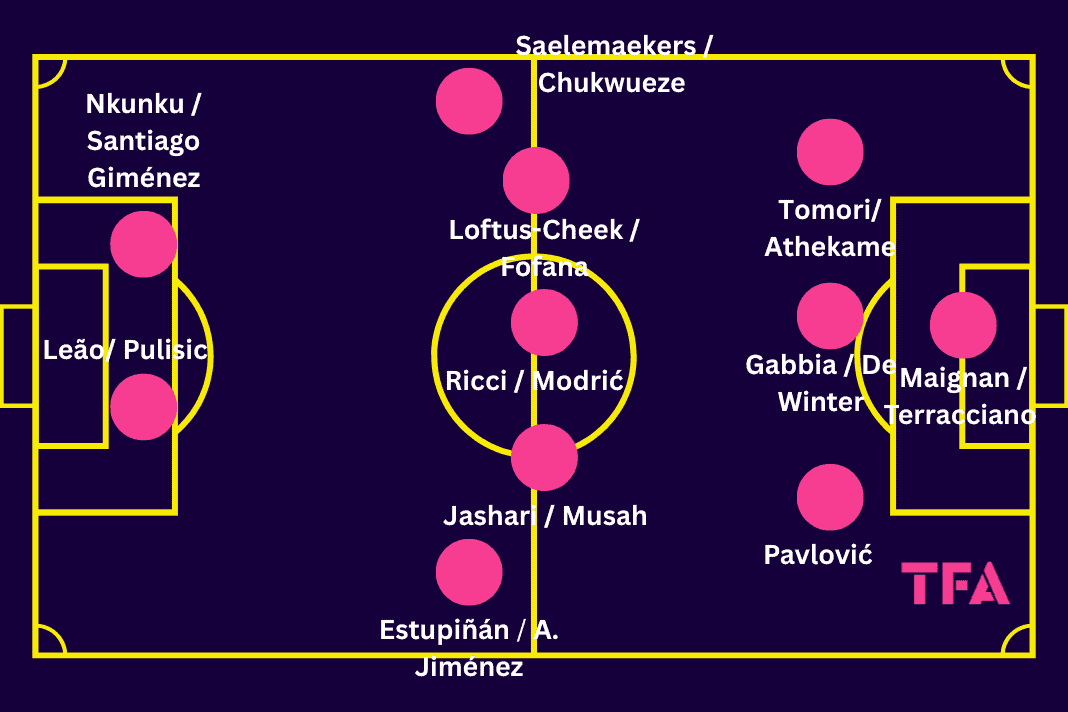
A more rational choice would be to maintain the 3-5-2 formation, but without opting for a Giménez-Nkunku duo and playing one of the two as the team’s striker, thereby guaranteeing more stability and balance in terms of tactical ideas and positioning, and avoiding confusion early in the season.
This solution will be very suitable at the moment, mainly because Giménez is not really putting on convincing performances.
That’s why using Nkunku as a striker for the upcoming games with Leão alongside him would be one of the best solutions for Nkunku’s integration into the team without creating a drastic tactical change that might impact the team’s performances, at least in the short term.
Christopher Nkunku: Possible Addition As A Striker
In the event that Allegri opts to use Nkunku as his central striker with Giménez as a secondary option, it is essential to examine what Nkunku can bring to Milan’s attack and how he can benefit the team.
First, it will be essential to understand quickly that Nkunku cannot be relied upon to receive long passes, battle with defenders in aerial duels, or act as a target man.
He is a striker who likes to move between the lines, retreat to receive the ball at the edge of the final third, and make explosive penetrations thanks to his pace, dribbling skills, and ability to protect the ball while running.
This allows him to be very dangerous when the ball is in that area, making him a real threat to opponents.
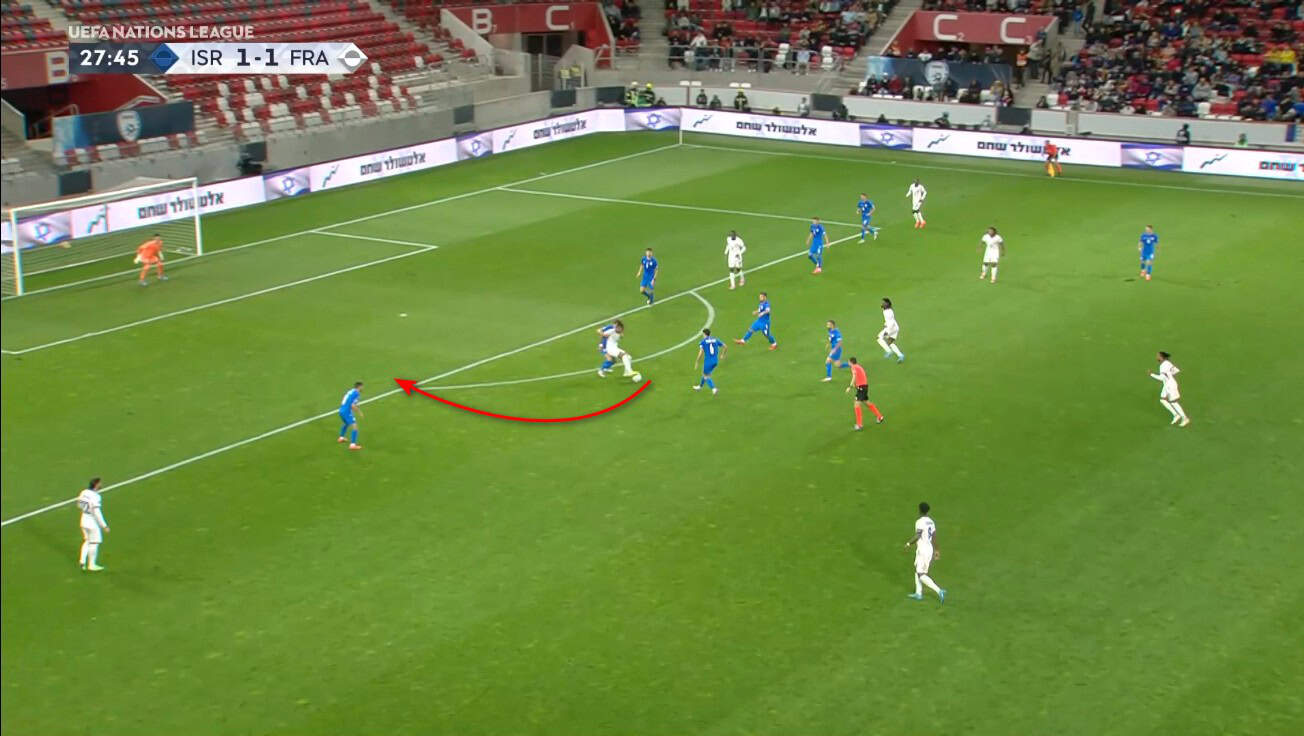
Christopher Nkunku Penetration Abilities
The following goal action also highlights Nkunku’s ability to turn and make progressive runs while resisting the opposing disturbance and succeeding in dribbling past them before finishing with success.
This shows his high level of concentration in front of goal despite the risky angle of shooting.
In this regard, Nkunku can also offer intelligent attacking plans to Allegri, as he allows him to diversify the attacking actions further.
Since he possesses exceptional dribbling and penetration abilities, along with good finishing skills, Allegri will be able to create a continuous alternation of roles among him, Pulisic, and Leão.
The three players possess the ability to be dangerous both when positioned inside the box and when initiating their penetrations from the edge of the final third or from the wings.
This in-game alternation of positions can be highly beneficial to Milan and potentially dangerous to their opponents, as it can easily confuse their defensive systems if executed flawlessly.
Christopher Nkunku Ball Protection Inside The Box
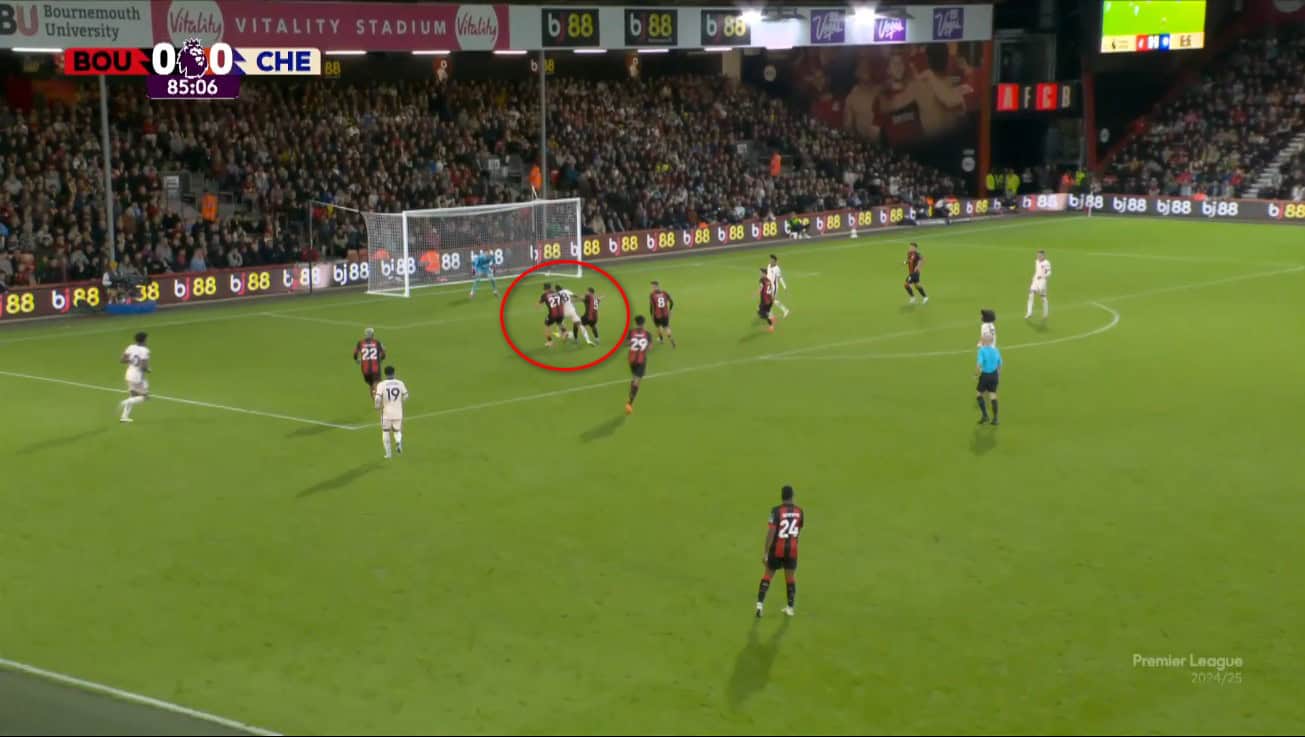
And despite Nkunku’s lack of reliability in the air, he has proven on many occasions that he can be very tough to beat when he has the ball inside the box and needs to score goals.
His remarkable solo action against Bournemouth in this goal example highlights his ability to extricate himself from difficult situations while avoiding the disturbance of two opponents.
Nkunku’s balance and physical strength, especially in ball protection when put under pressure, help him get out of such situations.
Allegri at Milan can exploit these goalscoring and dribbling traits, as well as his ability to avoid and resist defensive disturbance, by relying on him to receive passes in such conditions and deal well with these situations, knowing that Giménez has been failing to do so with efficiency so far.
Christopher Nkunku Penetrations From The Wings
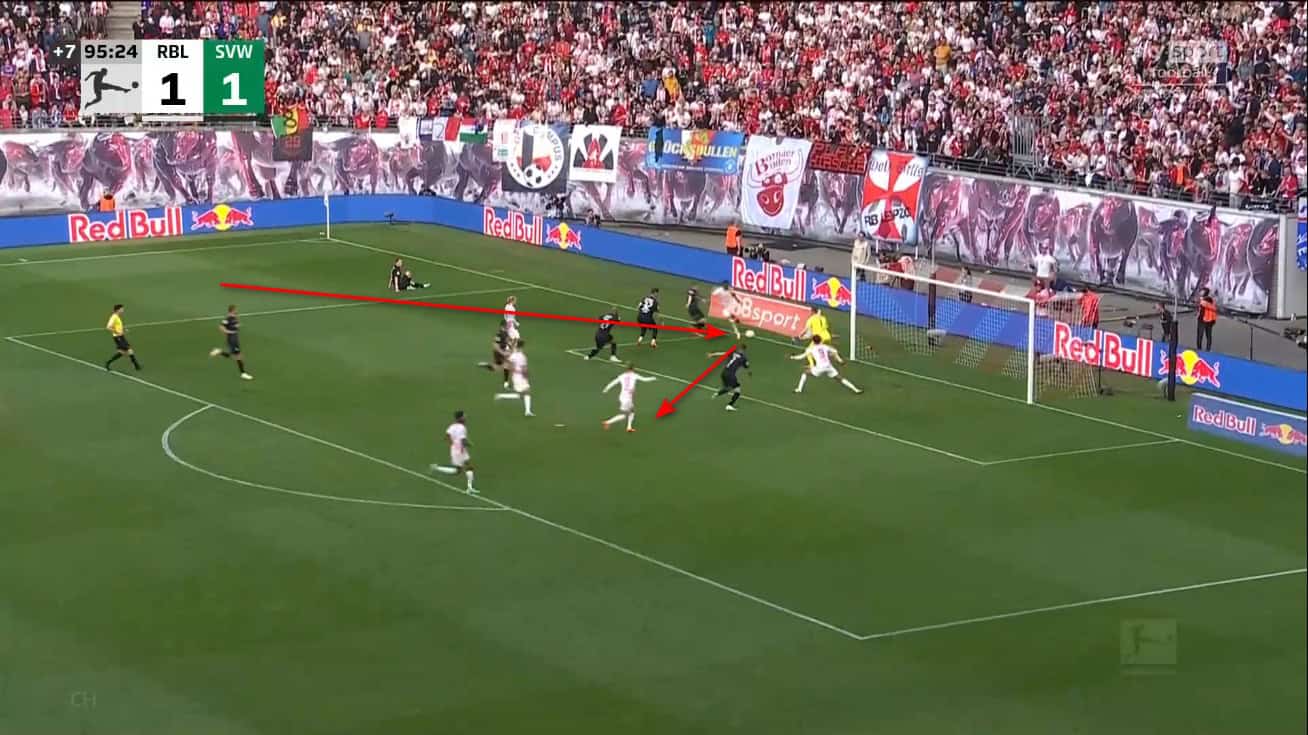
Furthermore, Nkunku offers Allegri the chance to play games with the opponents as he can be extremely dangerous from the wings, thanks to his penetrations from both sides and his excellent and quick decision-making in terms of final passes.
As mentioned above, this paves the way for Allegri to experiment with the in-game changes of his players’ attacking positions, as Nkunku can shift towards the left wing and attempt his dangerous penetrations, with Leão moving into the box to receive the pass.
Nkunku has shown numerous dangerous actions from the wings throughout his career.
He has an outstanding ability to surpass his opponents and accelerate without losing the ball.
He also selects the optimal timing and destination of his final passes, which has contributed to his high number of assists during many seasons.
Succeeding in having his best run of form with Milan in this regard would make him a crucial assist-maker for the team, even if he is used solely as a striker.
Nkunku brings a lot of diversity, dynamism, and quality to a team that currently lacks efficient attacking players and needs talented ones like Nkunku.
The challenge will be to know how to utilise his abilities best and avoid letting him go through a negative period, so that he does not fall into the trap of signing a player whose performances do not reflect their true value.
Conclusion
Overall, the signing of Christopher Nkunku can be considered very positive, especially given the available options in the market.
That said, Allegri must choose the most suitable tactics and formations in the fixtures to come to integrate Christopher Nkunku as effectively as possible while avoiding confusion in terms of positioning and roles on the pitch.
