
On Saturday, August 30, 2025, Werder Bremen faced off against Bayer Leverkusen at the Weserstadion, for Matchday 2 of the new Bundesliga season.
Both teams had hired new managers in the offseason: Horst Steffen for Werder and Erik ten Hag for Bayer 04 Leverkusen.
Yet both teams had started the season with defeats and were looking to change momentum and avoid a miserable start to the league.
Bayer Leverkusen were coming off the two most successful years in their history.
Under head coach Xabi Alonso, the team won their first Bundesliga title and the DFB-Pokal, made the UEFA Europa League Final, and finished second to Bayern Munich last season.
Unfortunately for them, Real Madrid called Alonso, and he answered, leaving the club.
This prompted a chain reaction, which ultimately led to many top players leaving the club, most notably Piero Hincapié, Jonathan Tah, Granit Xhaka, and Florian Wirtz.
There were 12 departures and 17 new signings at the club, a complete turnover.
Erik ten Hag, former manager of Ajax and Manchester United, was supposed to manage the new Bayer Leverkusen team.
With a big name, expectations were high for Leverkusen coming into the season, but with the completely overhauled team, the start to the season went rather rough.
They struggled against a fourth-tier team in the DFB-Pokal and lost their first game at home against Hoffenheim.
Werder Bremen scored the equaliser in stoppage time, despite having been a man down and trailing 3-1 with 15 minutes to go.
Leverkusen captain Robert Andrich talked to the media, heavily criticising his teammates.
Just minutes later, Simon Rolfes (Bayer Leverkusen Sporting Director) and Fernando Carro (Bayer Leverkusen CEO) declined to comment on Ten Hag’s future.
The decision had already been made, and Erik ten Hag was ultimately sacked after just three games in charge.
In this Bayer Leverkusen tactical analysis, we will examine how things derailed so quickly for Erik ten Hag style of play, why Ten Hag was sacked, what tactics the Dutch coach used, where Bayer Leverkusen need to improve, and give a little context to a decision that came as a shock to most people.
Lacking Cohesive Ideas
Robert Andrich was very blunt after the game against Werder.
The German international told reporters that in this game, Bayer Leverkusen had not been playing as a team; everyone was just playing for themselves.
Watching the game back, it becomes very obvious that the team lacked coherent patterns of play in pretty much all phases of the game.
Therefore, no collective decision-making was taking place on the field; it was just 11 men working on their own.
The second goal for Werder makes it a bit clearer.
At this point, Leverkusen were leading 3-1 and were one man up compared to Werder.

Leverkusen often managed to play through the Werder midfield, which is not a surprise given the circumstances, but when reaching the final third, the team lacked a clear plan to finish the game off for good.
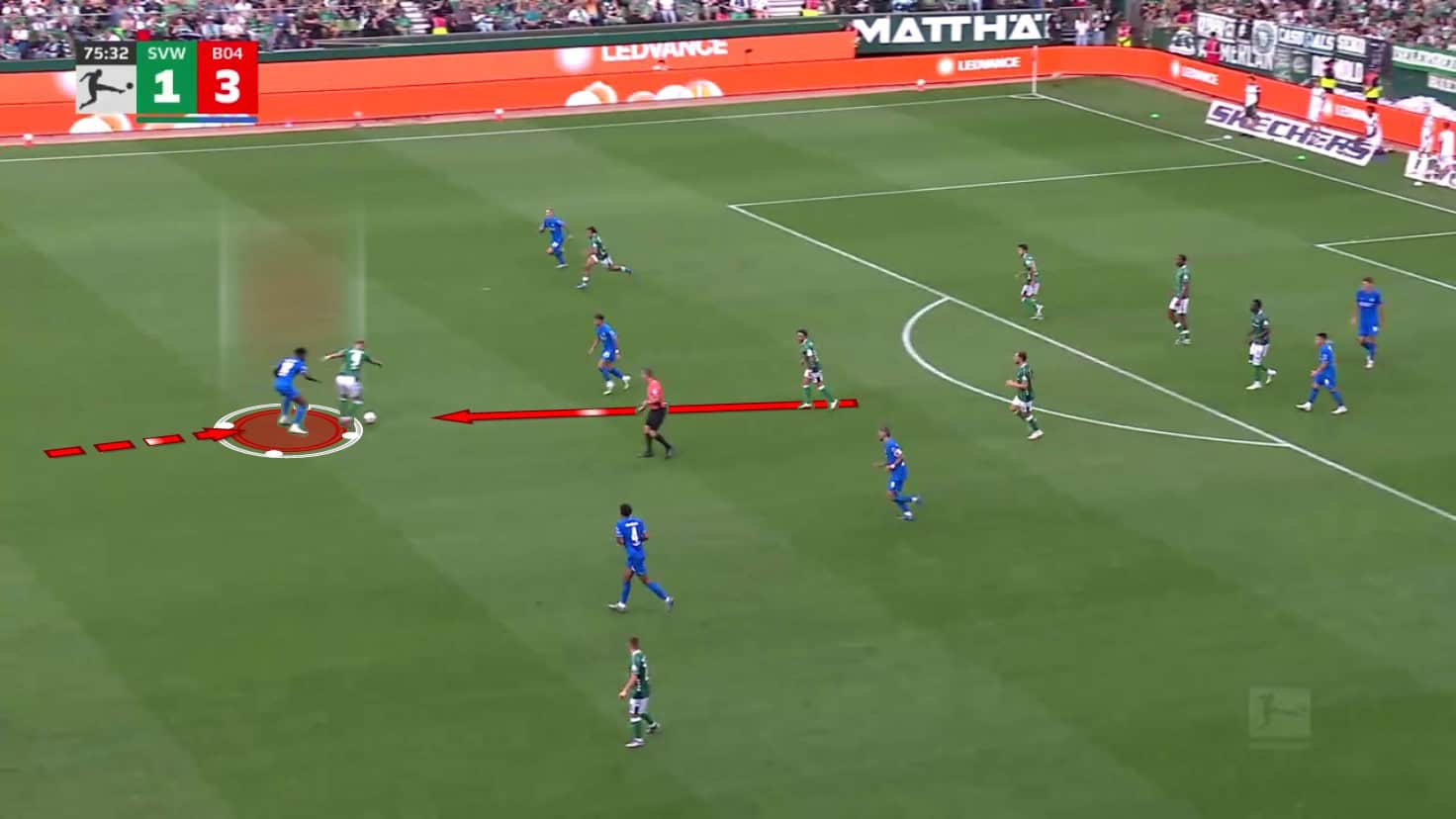
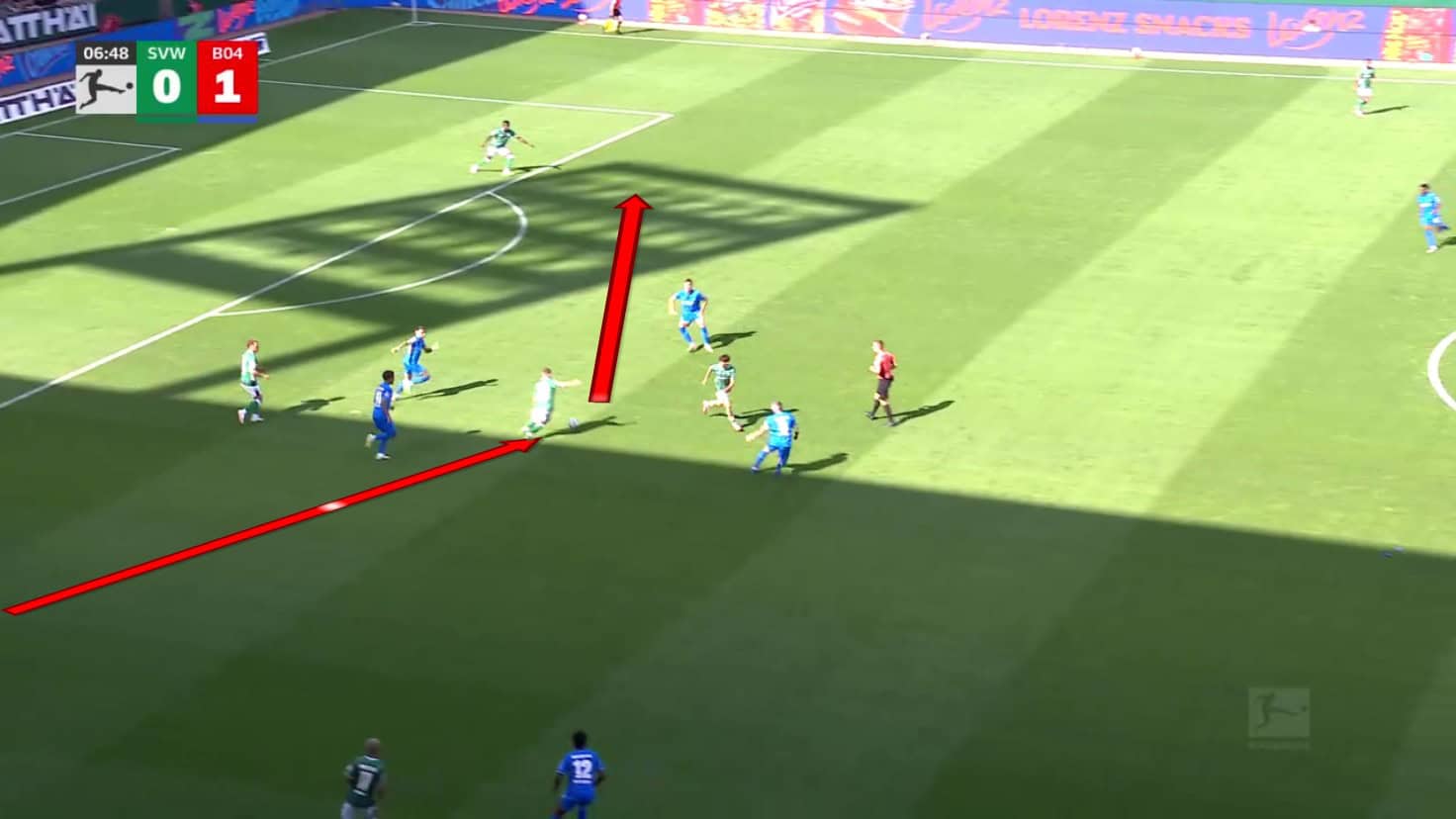
Ten Hag’s men were often able to get the ball to the winger at the edge of the box, who was facing off against a full-back.
Ten Hag and his team had only one idea to beat down the defence in this situation: a straight run behind the full-back by one of the attacking midfielders.
However, Werder used one of the players in their double pivot to cover off these runs, as seen in the picture above.
This dragged one midfielder into the backline, however, and, in theory, now opens up space for Nathan Tella to cut inside.
However, Leverkusen wanted to play through the wings, and this led to their winger often hesitating and making poor decisions when forced to cut inside.
The presence in the box was also pretty bad throughout the entire game.
When Werder was falling back into a deep block, Leverkusen didn’t commit many players into the box, allowing Werder the numerical advantage there.
Werder got away with a lot of bad crosses while also not being pinned back by Leverkusen.
Instead, Ten Hag positioned three players at the edge of the box, in addition to the winger with the ball and the running attacking midfielder.
This, in theory, should have helped the team switch play through the centre, but in the end, it just forced the wingers to play a lot of square passes that functioned as triggers for Werder’s press in their own third.
In this situation, Tella tries to square the ball, misses the pass, and Werder are able to jump onto the ball and intercept it.
From there on, we can see the next problem, which is that Ten Hag’s men were clueless about what they would do after losing the ball like that.
Werder plays the pass to their striker, Keke Topp, who drops back about 30 meters towards his own goal, so Werder are still in a very deep position here.
The centre-back, Edmond Tapsoba, now realises that and wants to engage in a counterpressing attempt.
He defends forward and presses Topp with his back turned towards the goal, deep in Werder’s half.
The problem is that he is the only one playing this aggressively; the rest of the team is not closing the space behind him, and the players in front of him are merely trotting backwards, lacking the intensity to get into a duel.
This allows Topp to hold up the ball in the 1-v-1 duel against Tapsoba and secure possession for Werder despite being surrounded by five Leverkusen players in his own half.
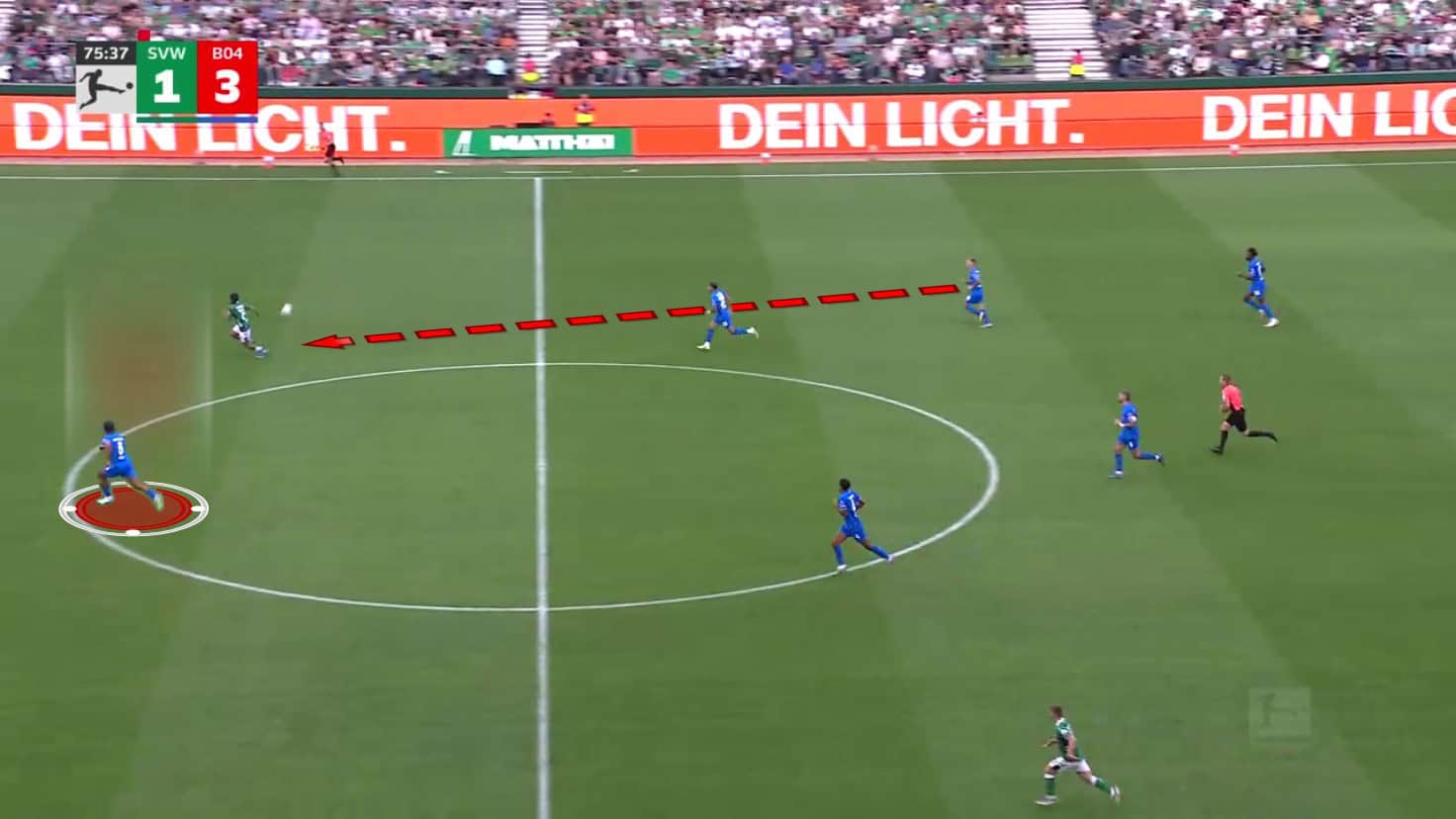
Topp can hold off Tapsoba and even turn around and play a long ball down the channel in the right half-space.
Isaac Schmidt was starting a vertical run behind Tapsoba earlier.
As seen in the picture above, the rest of Leverkusen’s defence was not able to secure the space behind the forward-moving centre-back simply because the team was not on the same page for about five seconds on what to do.
The only player who recognised the danger was goalkeeper Mark Flekken, who moved, trying to reach the ball before Schmidt did, but the pacey full-back managed to lob him and score into the vacated goal, getting Werder back into the game.
From start to finish, Ten Hag never established a coherent idea, and the individual players looked lost.
They could not come to a collective decision about what to do, and that is more than problematic.
Struggling With Attacking Press
Erik ten Hag is a coach who can be summed up as “traditionally Dutch“ because he follows tactical principles established by coaches like Johan Cruyff and Louis van Gaal.
Ten Hag is a fan of “total football“.
He wants to dominate through good positional play and possession and does not want to let his opponent breathe, which made him incredibly successful at FC Utrecht and Ajax.
A key part of playing football this way is possessing the ball.
To possess the ball, you need to win it somewhere on the pitch, and with the way Ten Hag wants his men to play, they want to win it as soon as possible.
During his short tenure with Bayer Leverkusen, his team failed to do that more often than not, and it cost them.
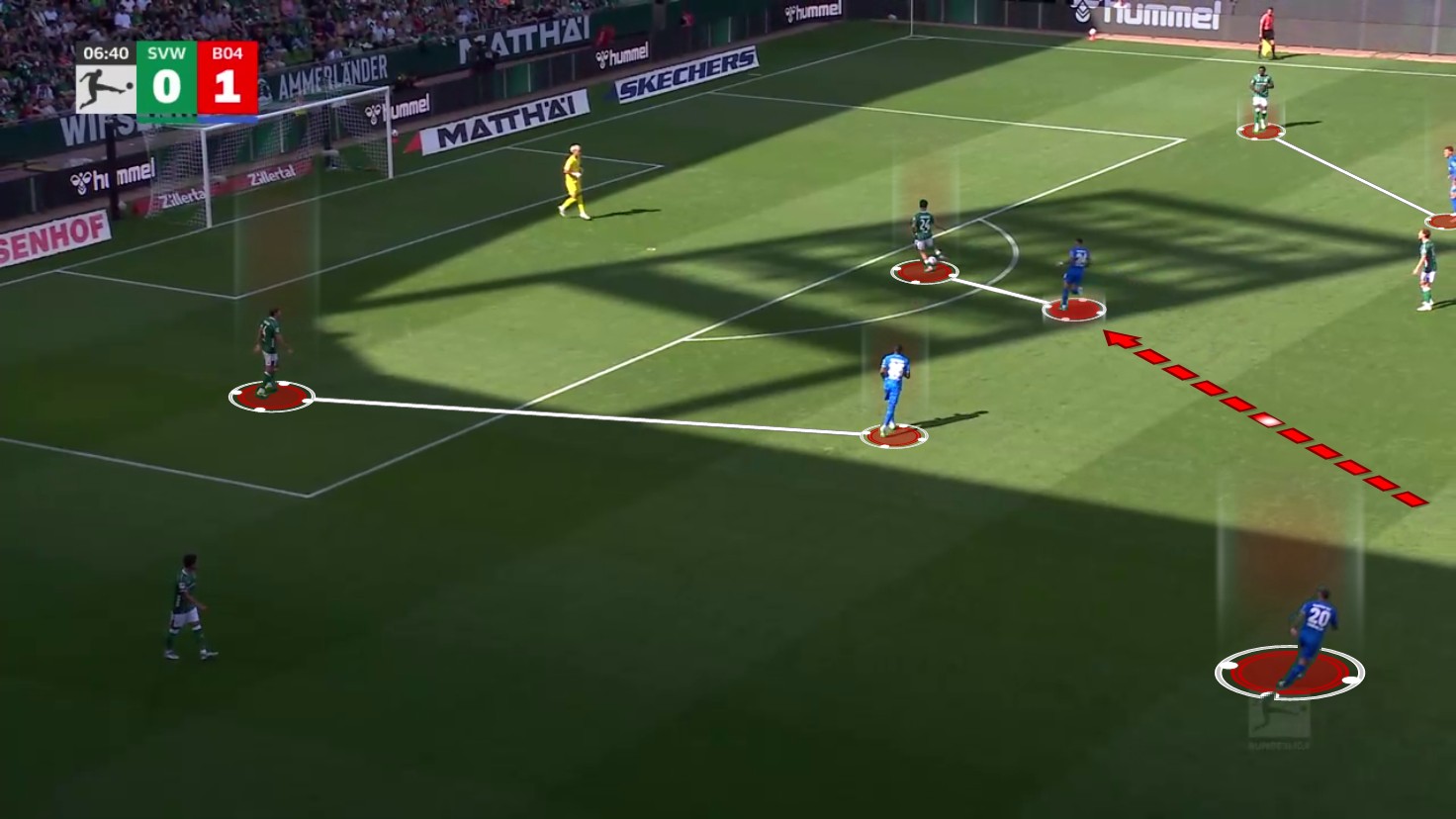
Looking at the start of their attacking press, Leverkusen had a clear plan.
Even though the Dutchman favours a 4-3-3 formation, but decided to continue Alonso’s idea of playing with a 3-4-3 formation, but after their rough start, decided to mirror the 4-2-3-1 formation of Werder.
Werder played the game in Horst Steffen’s typical 4-2-3-1 formation, keeping their full-backs rather flat and heavily involving their goalkeeper in the build-up.
Ten Hag gave his men a clear plan in this phase of play, so unlike earlier, his team knew what they had to do to execute the plan, but the plan just wasn’t working.
As seen in the picture above, Leverkusen played a man-oriented marking system in their attacking press, with left winger Christian Kofane and striker Patrick Schick controlling the two centre-backs.
Malick Tillman and Exequiel Palacios marked Werder’s double pivot, and Robert Andrich played as a holding midfielder, covering Werder’s attacking midfielder.
Tella was assigned to mark the left-back, while Alejandro Grimaldo was supposed to move high up the pitch and mark the right-back.
This caused a lot of problems for Ten Hag’s men.
While the idea is rather simple, and with their advantage in terms of individual quality, Leverkusen should have been able to control the game that way and win most of the 1-v-1 situations created that way.
Werder always dropped back their right-back, Yuki Sugawara, and one midfielder, which forced Grimaldo and Palacios to cover considerable distances to get to their assignments and dragged them out of position completely.
Looking at the picture, Grimaldo quickly realises the gaping space behind the forward-defending Palacios and realises he needs to cover it.
However, he also needs to move forward himself to get to Sugawara, a dilemma for the left-back.
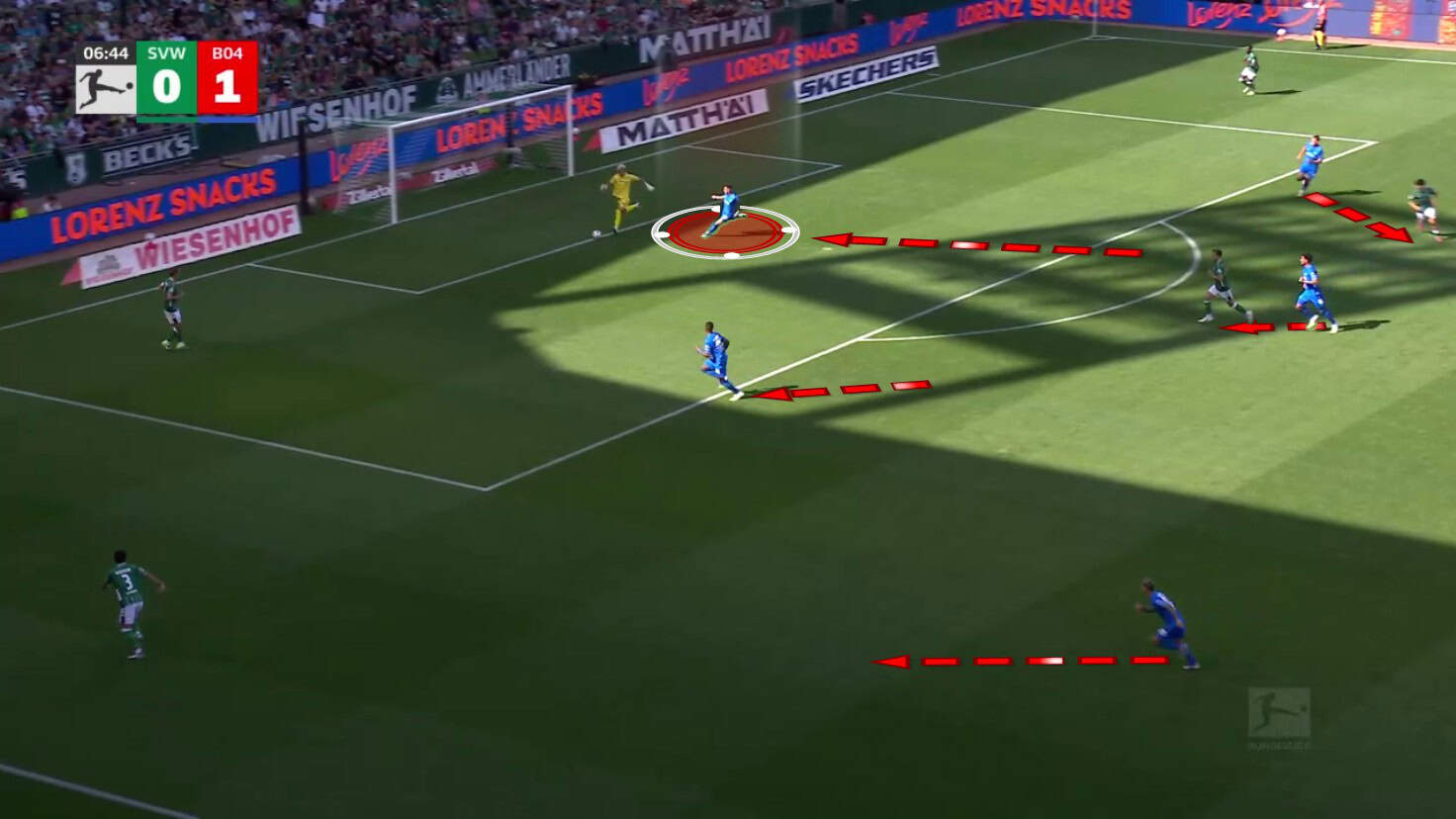
Werder now play to their midfielder, binding Palacios high up the field at the edge of the box.
With the lay-off to their keeper, they even get Leverkusen to shift through completely.
Palacios now presses the keeper, but because of the enormous distances, Werder can just play through their right side quickly and get away from the pressure.
Ten Hag wanted his men to cut off one side of the field here, so the entire team moved towards the near sideline now.
Unfortunately, Grimaldo is not able to close the distance to Sugawara fast enough, giving the Japanese international the chance to scan the field.
Werder now create dynamics by moving into the spaces that are opened up, most prominently the space behind Palacios, who completely left his position and his assignment to press the goalkeeper and was not quick enough to recover in time.
Sugawara is now able to play a diagonal pass against the direction of the Leverkusen team’s collective movement, finding a midfielder right in the centre of the field.
From there on, it’s too late for Ten Hag’s men.
Werder are able to switch play to the side that was supposed to be cut off and just progress the ball by dribbling past Leverkusen’s first line of pressure, forcing them to drop backwards.
Ten Hag had a plan and committed a lot of players forward to win the ball in a good position, but they were never able to get pressure on the ball.
High Risk In Possession
As stated before, Ten Hag is a fan of “total football”; his Ajax team was one of the most entertaining teams to watch in recent years thanks to their great possession play.
If you hire Ten Hag, you do it because you want him to develop a great passing and attacking game for your team, just as he did back then.
At Leverkusen, the team struggled immensely in possession, especially for a team coached by Ten Hag.
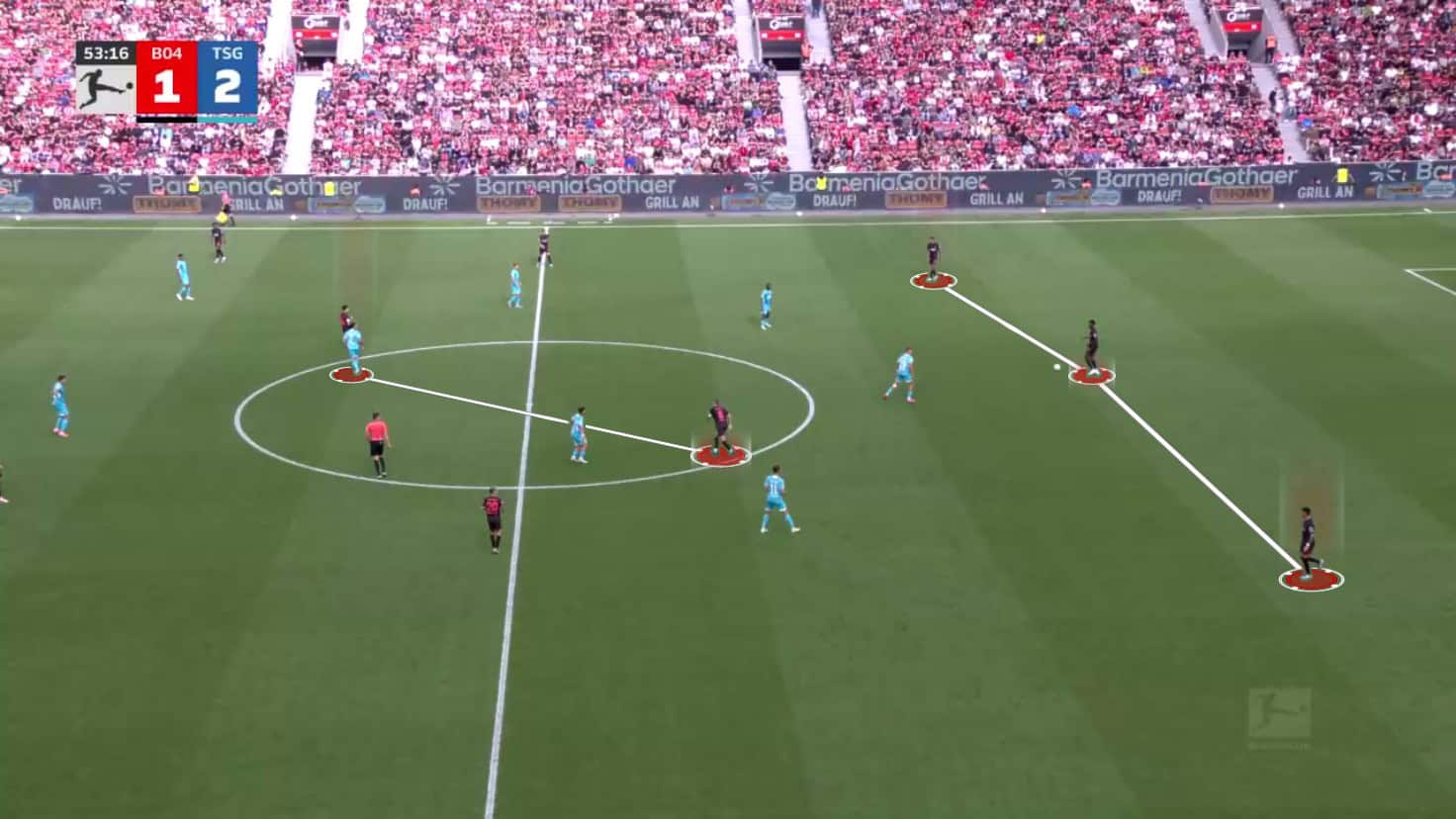
Looking at their basic shape in possession, they kept their back three as their base, with one midfielder pushing up the pitch and the other staying in front of the defenders.
The two full-backs pushed inside rather than staying wide and were positioned at the right height between the two midfielders.
The attackers were pushed up really high up the pitch and were positioned very wide, trying to stretch out the opposing team’s defence.
In theory, this is a very solid plan, but it only really works when the opposing team plays with a deep block.
Given the way the summer went for Leverkusen, their opponents employed significantly more aggressive tactics when playing against them.
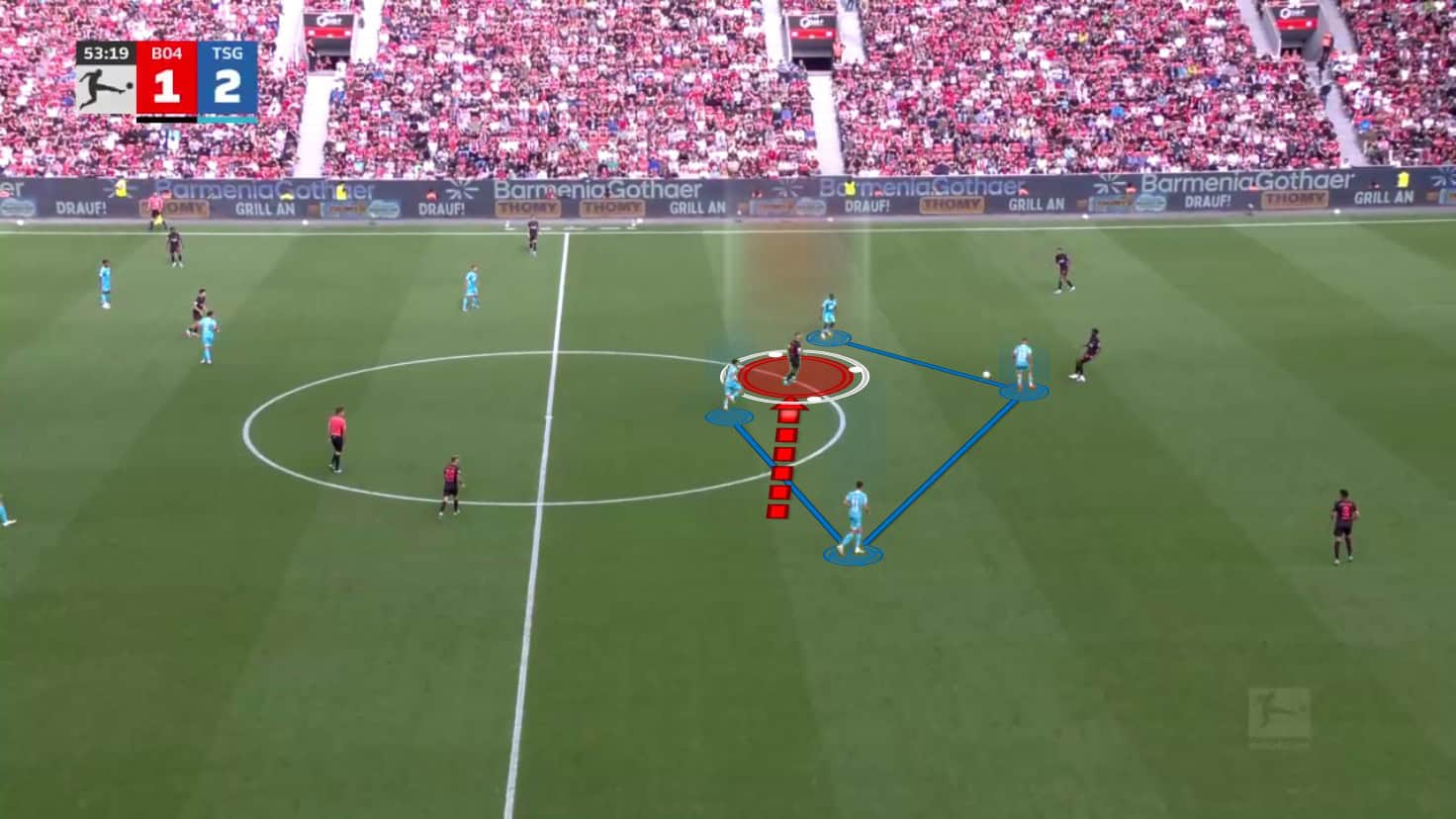
Hoffenheim had a simple plan against that type of build-up; they matched the numbers in the first line of play, closed off the centre and then controlled the three centre-backs with their striker and the two wingers.
Instead of trying to play around it, Ten Hag had his men play right through it.
Andrich constantly moved into the space between the four Hoffenheim players in the centre, and his centre-backs often played the ball there, which put him under a lot of pressure.
The Dutchman wanted his players to prove they were great on the ball, playing out these 1-v-1 situations without needing a numerical advantage to progress the ball.
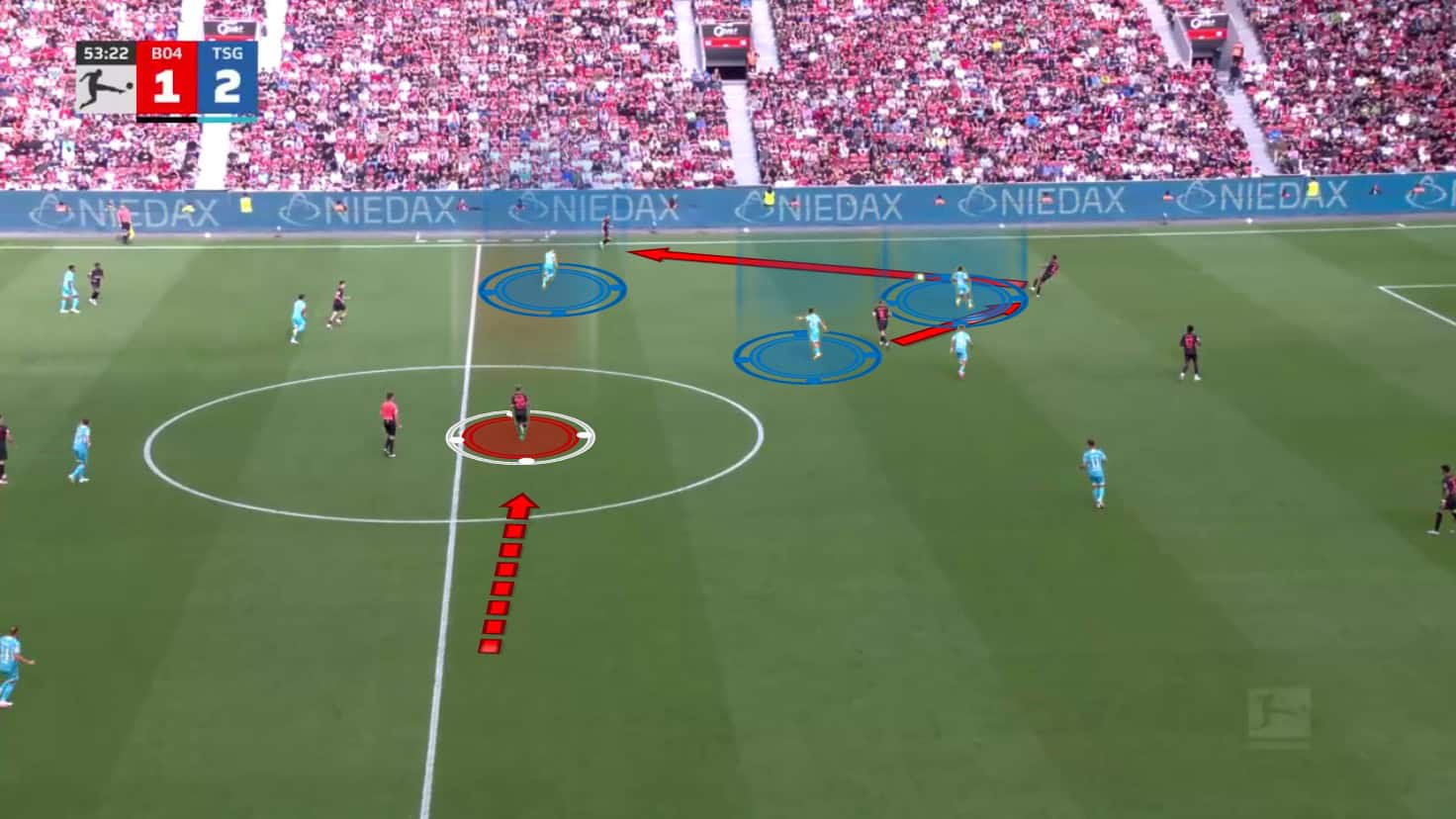
In the end, it didn’t work out.
The risk rarely paid off, and the team struggled under pressure.
Andrich often could not find a good solution and could only lay the ball off back to a centre-back, which triggered Hoffenheim.
They still closed off the centre with three players and moved forward now, pressing the centre-back and the wing-back without giving up much.
The only space they gave up was behind their line of press to Grimaldo, who made the individual decision to move inside in this situation.
Even then, the wing-back or the centre-back had to chip a ball over multiple players, which was hard and only worked out once for Leverkusen.
This high-risk approach ultimately cost them, as Hoffenheim were able to win the ball back in good positions multiple times in this game and ultimately scored from these situations.
While the idea was decent, because it allowed Ten Hag to have more presence and space in the attacking line, his team often struggled to even get there and had to play low-chance passes way too often to actually be successful.
Conclusion
With the way the transfer window went for Bayer Leverkusen, with the players they lost, the many new signings, and the late activity, it would be crazy to expect a coach to be as successful as his predecessor straight away, so I can understand the argument that many people are making that Leverkusen should have given Erik ten Hag more time to develop his system.
On the other hand, I don’t think the Bayer Leverkusen board expected great results from the get-go, even though they probably wanted more than what they got.
If you want to build a house and you make a mistake in the first row of laying bricks, you can just keep on going to save time, but in the end, it will still come back to bite you at some point, and your walls will collapse.
It’s the same as building a new team from scratch, like Bayer Leverkusen had to do; if you make an early mistake, you need to fix it, not work around it.
Looking at the information that came out over the last couple of days (and I don’t mean those hit pieces put out by some of the yellow press), it becomes rather apparent that Erik ten Hag and Bayer Leverkusen were just a mismatch at a personal level.
The team never warmed to the coach; the way the club worked and how Ten Hag wanted to work didn’t align, and in the end, what happened on the pitch was just a reflection of the fact that things did not work out how everyone wanted them to.
The Bayer Leverkusen board quickly realised that hiring Erik ten Hag was a mistake in the first place.
He is not the type of coach who can moderate such a transfer window, and while his idea of playing football is intriguing, it was never realistic to actually get it to work this season in Leverkusen.
This does not mean that Erik ten Hag is a bad coach or that Leverkusen were dumb to hire him; it just didn’t work out as a combination in the current situation.
If that’s the case, letting him go is a decision you have to make, even if it comes as a surprise.
Now, with Kasper Hjulmand as the new manager of Bayer Leverkusen, it will be interesting to see if the Dane can work under these harsh conditions and quickly form a team to compete in the Bundesliga.
