
While everything seemed to be going well on the pitch, there was turmoil off it at Nottingham Forest.
After a historic season that saw Forest spend a lot of time in a UEFA Champions League place but eventually finish seventh, Nuno Espírito Santo’s job was in question.
Tension was building in the back rooms between him and owner Evangelos Marinakis over summer transfers, eventually leading to Marinakis sacking him three matches into the season.
Marinakis has brought in a fellow Greek and an old friend of the Premier League, Ange Postecoglou, to replace him.
Postecoglou delivered Tottenham Hotspur their first trophy since 2008, beating Manchester United in the UEFA Europa League Final, but a 17th-place finish in the Premier League ultimately cost him his job.
The move is surprising, considering that Nuno Espírito Santo and Ange Postecoglou’s tactical philosophies last season could not have been more different.
On the surface, it looks like a decision that will put NFFC back in the bottom half of the table or, worse, close to the relegation fight.
However, when we dig beneath the surface, Nottingham Forest were starting to change their tactical identity in the first three matches compared to how they played last season.
In this tactical analysis article, we’ll explore how Nottingham Forest set up tactically during the 2024/2025 season, the changes they’ve made three matches into the season, Ange Postecoglou tactics at Spurs, and how his tactics fit at Nottingham Forest.
Nottingham Forest Tactics 2024/2025
Nuno Espírito Santo’s Nottingham Forest last season was a team straight out of the 1980s & ’90s.
It was old-school football built on routinely going long from goal-kicks, transition attacks, and compact mid-block defending.
Nottingham Forest rarely tried to build out of the back and almost always tried to send it long, consistently targeting Chris Wood and then trying to win second balls to play through balls in behind.
Nottingham Forest launched the ball from goal-kicks 65% of the time (the highest rate in the Premier League), averaged only 41.2% possession (third-lowest), and 17.4% of their pass attempts went long.
|
Team |
% of Passes Short | % of Passes Medium | % of Passes Long |
|
Everton |
41.02% |
38.49% |
20.49% |
|
Bournemouth |
40.70% |
41.68% |
17.62% |
|
Nottingham Forest |
45.33% |
37.27% |
17.40% |
|
Crystal Palace |
40.68% |
42.29% |
17.04% |
|
Brentford |
41.20% |
42.04% |
16.76% |
|
Ipswich Town |
41.66% |
42.75% |
15.59% |
|
Wolves |
45.24% |
39.89% |
14.87% |
|
West Ham |
44.59% |
40.73% |
14.69% |
|
Leicester City |
45.30% |
40.35% |
14.35% |
|
Fulham |
42.35% |
43.36% |
14.30% |
|
Brighton |
46.11% |
40.80% |
13.09% |
|
Newcastle Utd |
46.10% |
41.03% |
12.87% |
|
Southampton |
45.12% |
42.07% |
12.81% |
|
Manchester Utd |
47.20% |
40.18% |
12.61% |
|
Chelsea |
43.00% |
44.56% |
12.44% |
|
Liverpool |
45.03% |
42.74% |
12.24% |
|
Aston Villa |
44.28% |
43.55% |
12.17% |
|
Tottenham |
44.86% |
44.06% |
11.08% |
|
Arsenal |
48.30% |
41.27% |
10.43% |
| Manchester City | 50.37% | 41.02% |
8.62% |
Defensively, Nottingham Forest very rarely pressed high and sat in a mid-block at the highest rate of any Premier League side.
Everyone is pressing relentlessly in modern-day football, but Nottingham Forest were different.
Instead of pressuring the ball, Nottingham Forest would sit off and take away every possible pass centrally to either force the opponent to go out wide or to pass it backwards.
In this example against Brighton, the only option for the centre-back is to play it backwards and start over.

It was incredibly difficult for any team to play through the middle of Nottingham Forest, and oftentimes, when the ball was funnelled out wide, they would try to beat them with crosses.
Still, Murillo and Nikola Milenković were two of the best aerial duel winners in the Premier League.
Nottingham Forest ran incredibly hot playing this way for a majority of the season, but the underlying numbers eventually caught up with them.
When they beat Tottenham 2-1 in matchweek 33, Nottingham Forest were still sitting in third place.
After matchweek 33, Nottingham Forest were sitting with 60 points and a +14 goal differential.
When you look at their underlying numbers, they only had 43.8 expected points and a -2.7 expected goal differential at that point in the season.
The reality set in: playing extremely direct football could only keep Nottingham Forest competing in the top end of the table for so long.
Eventually, Nuno Espírito Santo had to add another element to Nottingham Forest.
That is precisely what he did for the first three matches of the season.
Nottingham Forest Tactics 2025/2026
Nottingham Forest played Brentford, Crystal Palace, and West Ham United out of the gates, which gave Santo a good opportunity to implement their new identity.
For those three matches, instead of going long from goal kicks 65% of the time, Nottingham Forest only went long 19% of the time.
Per Opta, Nottingham Forest had 14 build-up attacks in those three matches, more than any other team in the Premier League.
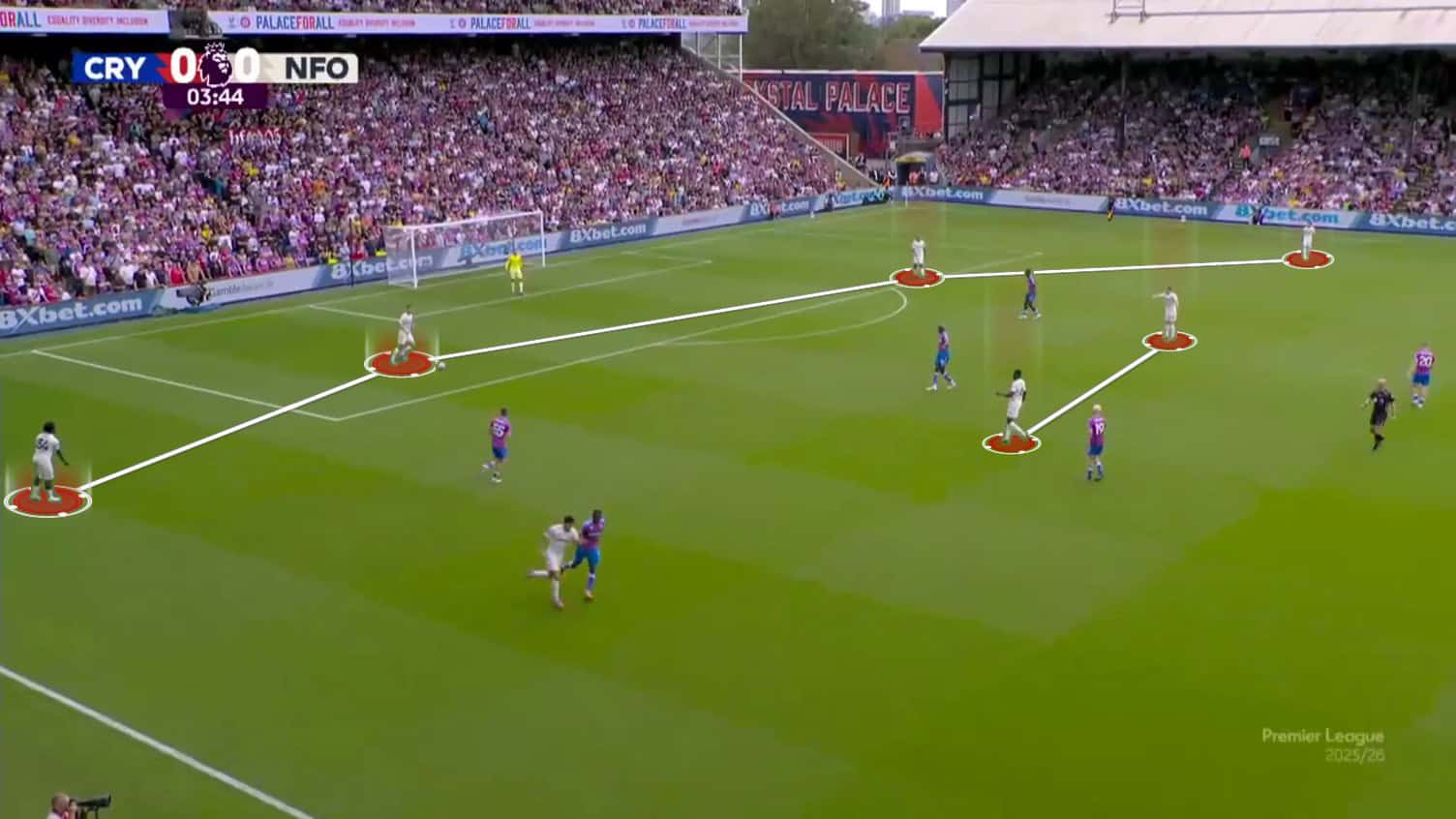
Their build-up is a 4-2 base, with Morgan Gibbs-White constantly dropping deep to find pockets of space.
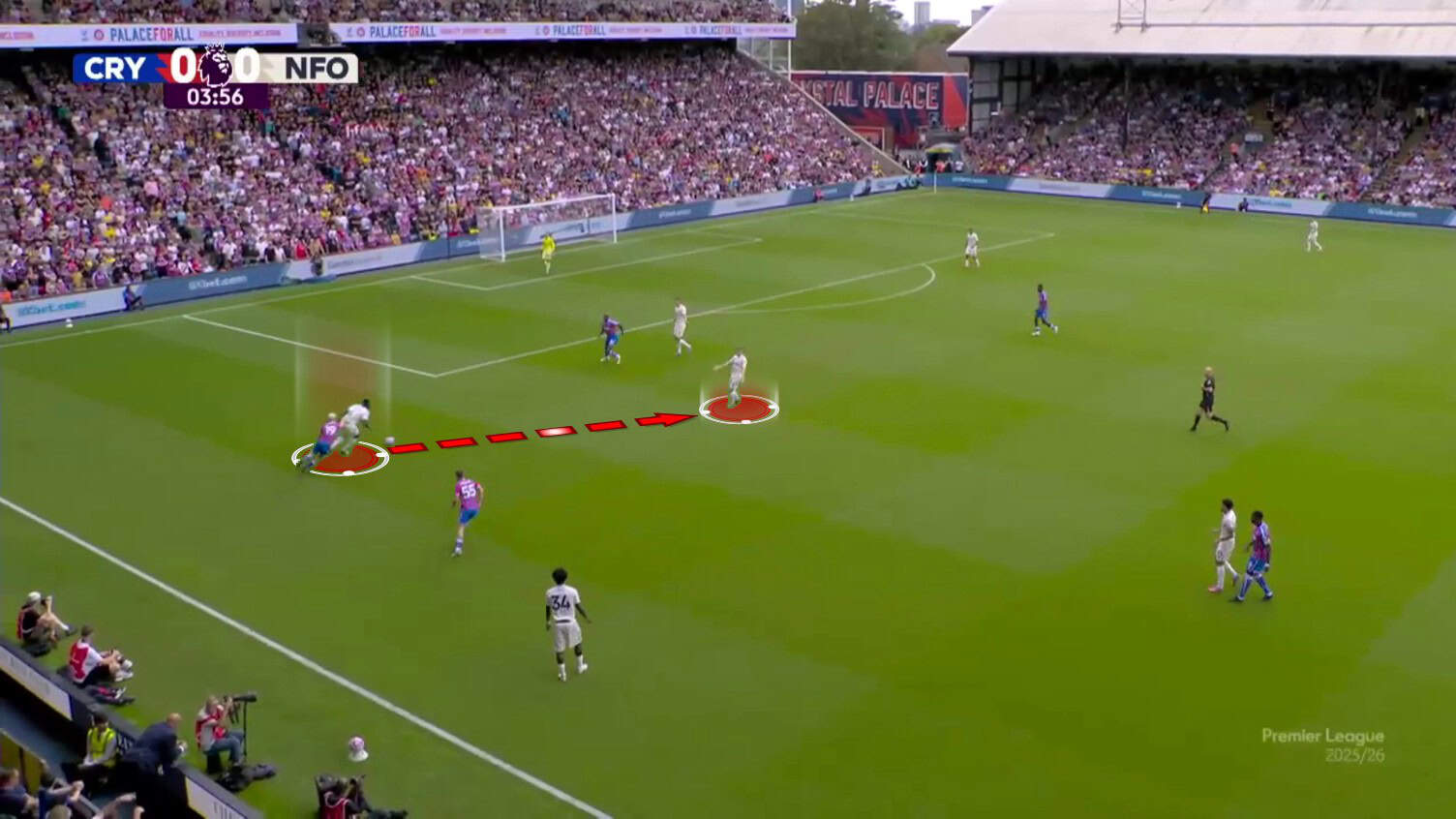
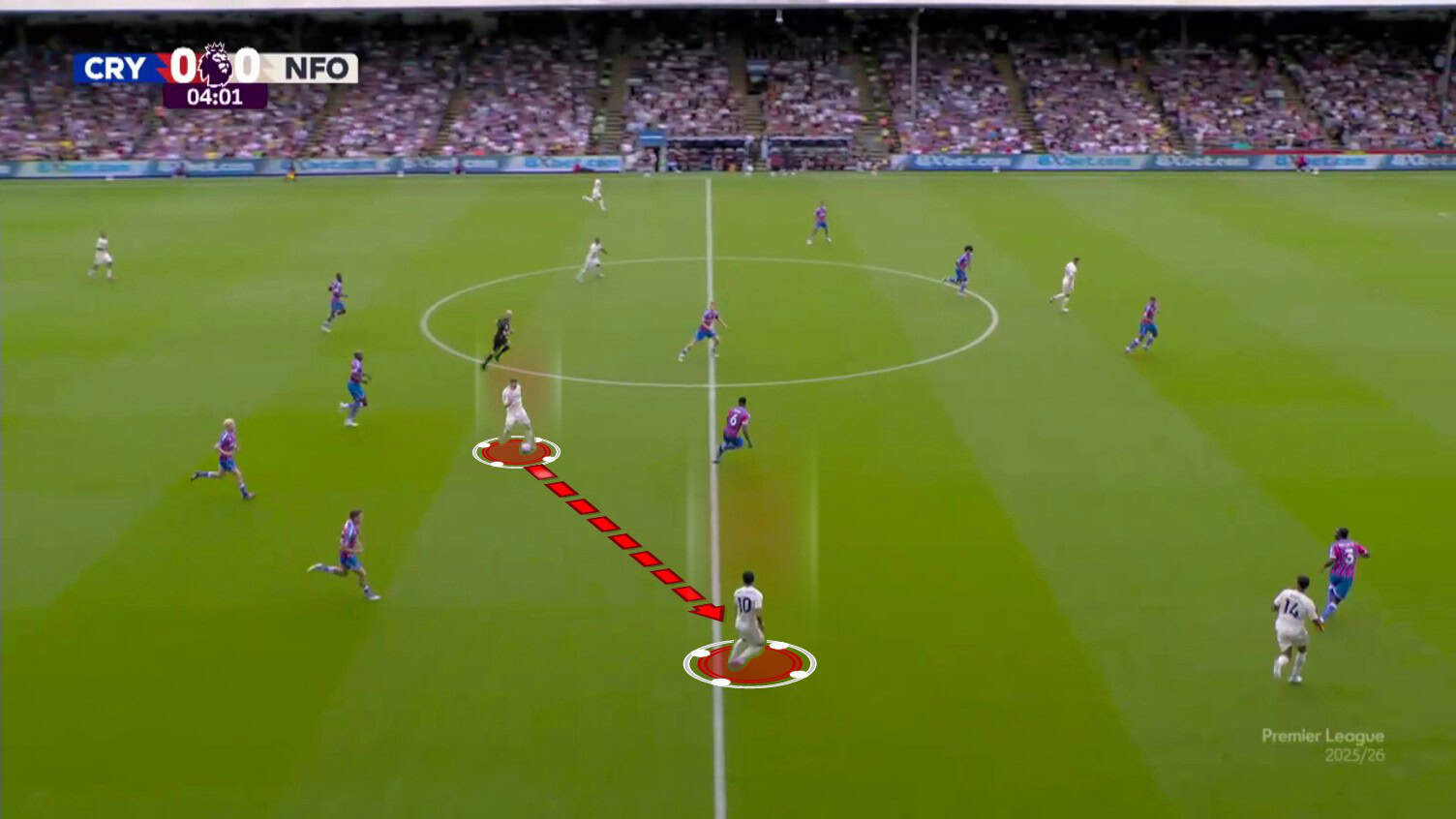
In this scenario against Crystal Palace, Nottingham Forest is able to rotate the ball from side to side a couple of times, which opens up space for Elliot Anderson to receive the ball.
He can then drive right at the Crystal Palace defence before playing a pass to Gibbs-White to give Nottingham Forest a 2-v-1 on the outside against the full-back.
Defensively, Nottingham Forest have started to press more often.
It’s a really small sample size of three matches, but their PPDA this season is 11.5, which is much lower than the 14.2 they averaged last term.
Per Opta, Nottingham Forest already have 21 high turnovers, which is the second most in the Premier League behind only Brighton.
We have only seen them play this new style against three teams that finished 10th or worse in the table last season.
We’ll never know if Nuno Espírito Santo would have continued to play this way against Arsenal or any of the other elite teams in England.
What he did, though, was establish that foundation last season so that when they played better teams, they could revert back to it and be effective.
Ange Postecoglou Tactics At Tottenham
The tactical identity of Tottenham in possession under Ange Postecoglou was rigid and predictable.
Tottenham went long from goal kicks only 7.7% of the time, which was the lowest rate in the Premier League.
They were always setting up in a 4-2 base using Guglielmo Vicario as the extra man, but teams would often pin them into the corner and force them to go long or turn them over.
Per markstats.club, Tottenham averaged 26.7 danger zone losses during the 2024/2025 season (fourth most).
They would try a couple of different patterns over and over again, so teams would just take it away by pressing man-to-man.
They would initially play the ball to the centre-back, then play it out wide to the full-back.
The full-back would drop in and play a “bounce” pass to one of the double pivot midfielders to create a transition break.
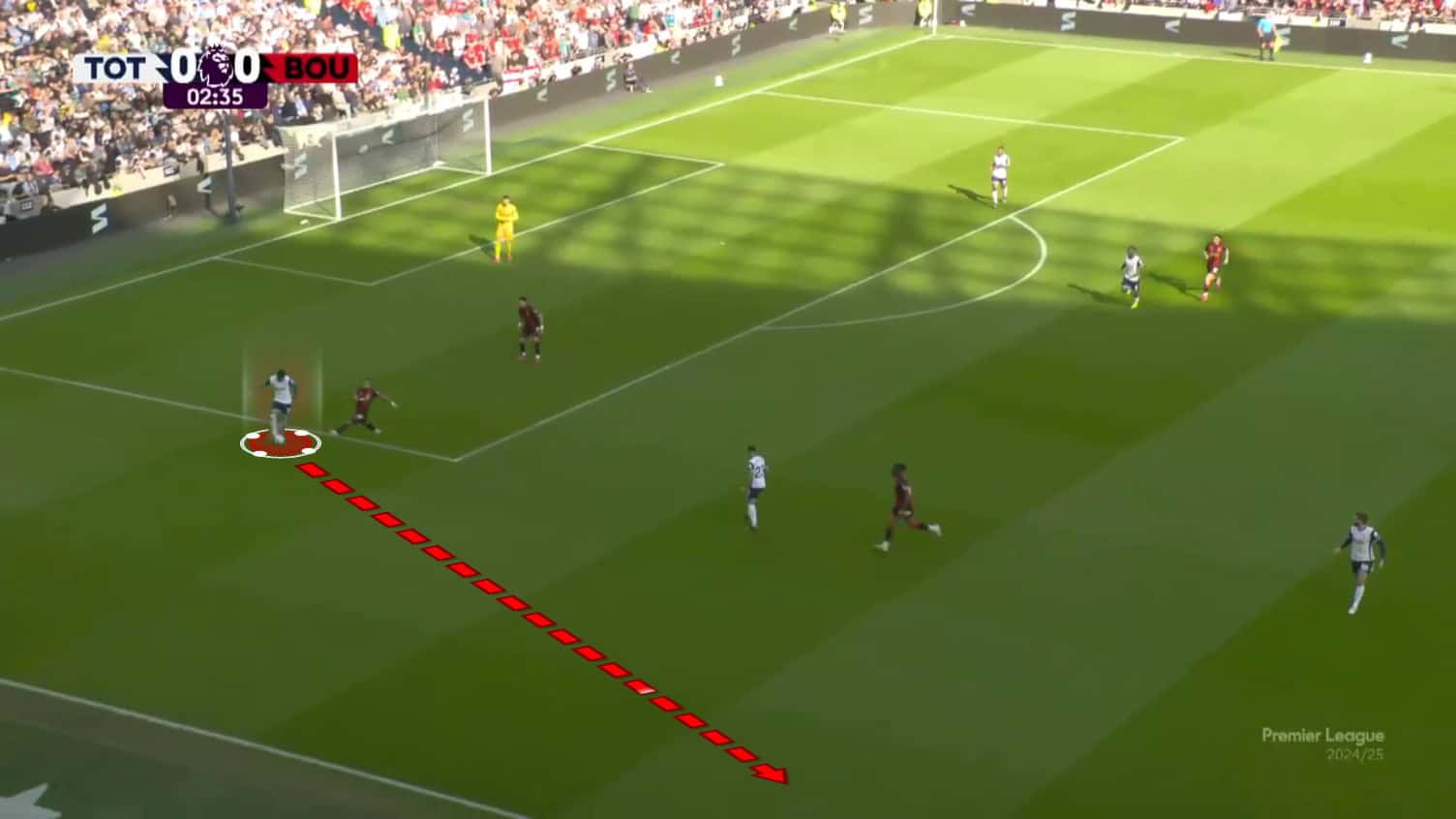
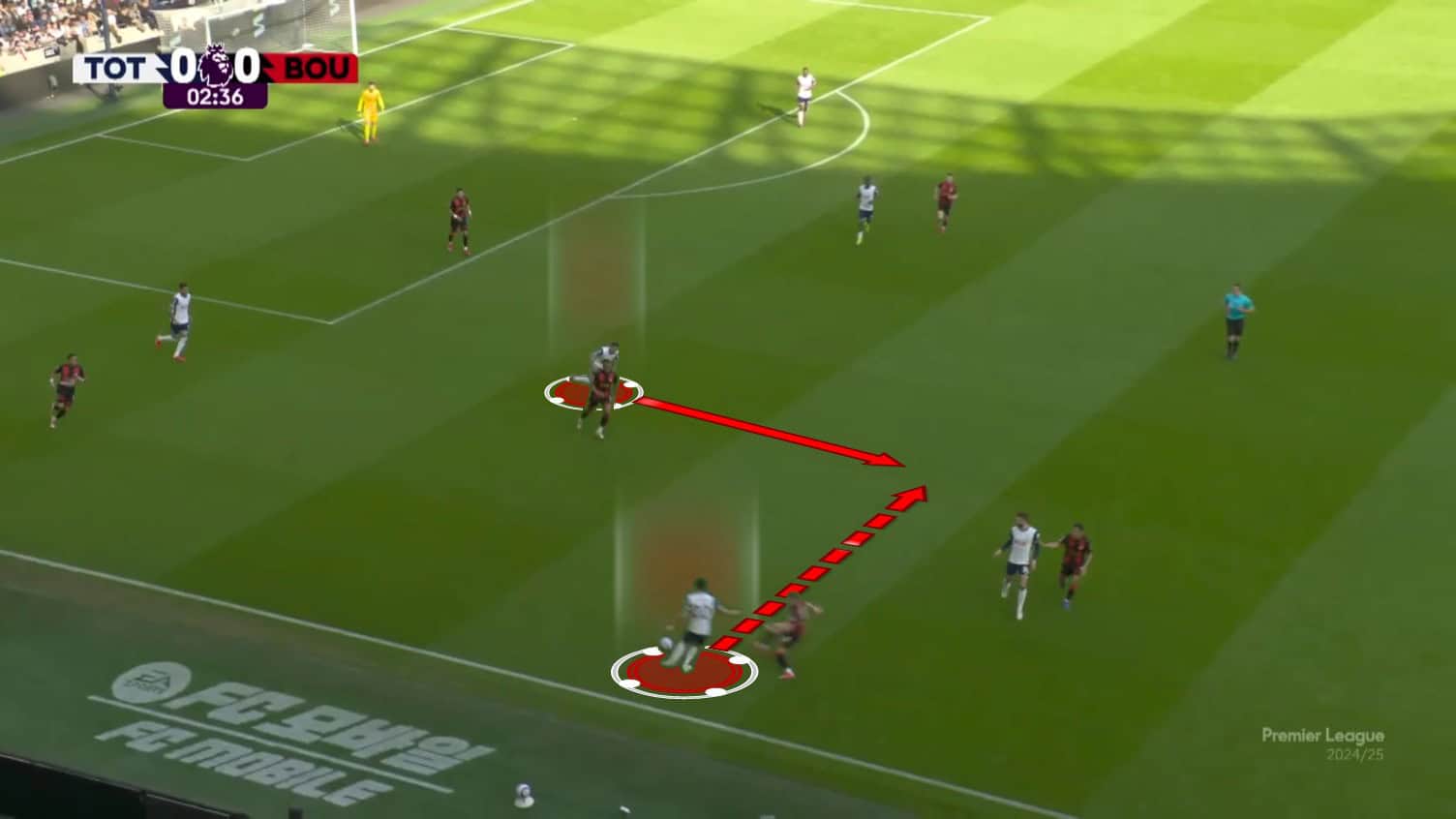
Against good pressing teams like Bournemouth, Tottenham would often find themselves stuck in their own end of the pitch.
The problem with playing this way is that almost every single time, you have to get these passing patterns perfect.
If you don’t, you run the risk of turning it over in really dangerous areas, which is what happened more often than not for Tottenham.
When Tottenham entered the final third, Postecoglou would transition them to a 2-3-5 formation with both fullbacks inverting into the centre of the pitch.
The problem with that type of setup was that when teams won the ball, they would easily counterattack Tottenham, forcing Cristian Romero and Micky van de Ven to cover a large amount of space.
Playing this style left Tottenham very open, as Spurs allowed the third most fastbreak shots last season.
A large part of that was also the ineffectiveness of their press, but Ange was insistent that they keep on pressing.
Tottenham finished the season fourth in PPDA, but only 11th in the amount of danger zone losses forced.
In the end, Ange Postecoglou was too entrenched in his ways to adopt any other type of system.
It’s what caused Tottenham to plummet all the way to 17th place and ultimately led to his departure.
Conclusion
I think the narrative around the hire of Ange Postecoglou is that this doesn’t make much sense.
From an out-of-possession perspective, it doesn’t make much sense to me.
I don’t think taking a team that spent the least amount of time sprinting out of possession and then asking them to press relentlessly is going to work.
In possession, I think it does make sense given the way Nottingham Forest have started off the season.
Establishing themselves as a solid build-up team that already has the solid foundation of playing direct will make them very difficult to prepare for if Postecoglou is adaptable.
In the short term, I don’t think you will see Nottingham Forest completely subscribe to Angeball, but he will subtly, over the coming weeks, start to transform them into what his Tottenham teams were.
The biggest risks associated with playing Angeball are injuries and fatigue.
The last two seasons for Tottenham fell apart because of injuries to key players.
Asking his players to press and run as much as he did at Tottenham is not sustainable in modern football, where teams often play three matches in a seven-day period.
With Nottingham Forest participating in the Europa League, it will be interesting to see if Ange Postecoglou sticks to his tactical identity or builds on the foundation that Nuno Espírito Santo has built over the past year.
If he is going to be successful at Nottingham Forest, he must learn from his mistakes and become more adaptable.
If he doesn’t, Nottingham Forest could plummet towards the bottom of the table.
