
I’m back again with the second part of this series for Total Football Analysis, looking at using specific profiles and data scouting in order to surface and identify some interesting players.
Last week, I looked at the dominant defender profile, one of my own personal favourites.
This time around, however, the focus will be on the other side of the coin regarding central defenders, as we concentrate instead on ball-playing defenders.
As I have progressed through different roles within football and recruitment, I have become more aware of my own biases—we all have them!
In the early part of my time within the game, I was obsessed with ball-playing defenders and central defenders who were comfortable on the ball and could break lines with their passing.
Being aware of your bias when scouting is important as it gives you an opportunity to self-correct or even just check yourself in terms of your evaluations.
On reflection, I think my bias has shifted towards dominant defenders who can win duels consistently.
That said, however, the holy grail is to find a player who can perform well in his duels and retain the ability to step in and break lines in the build-up phase.
Ball-playing defenders are still incredibly valuable in modern football, but their importance is perhaps more dependent on the coach’s desired style of play.
There has been a clear and obvious shift within football, with teams wanting to play short in their defensive third and to be able to come out through the initial press, either through line-breaking passes or preset passing patterns, to move the ball into the middle third.
In this article, I am going to look more closely at some interesting players who fit the profile of a ball-playing defender.
As with the first article in this series, I will start by identifying a strong profile of this type in a top-five league.
I will then look to identify two interesting players in the tier below the top-five leagues and one player from a lower-level league who has the potential to move up and develop.
All of this work is done through data analysis, with models built and weighted to surface players who fit my profile preferences.
Let’s start by looking at the ideal profile in a top-five league.
Piero Hincapié As The Ball-Playing Defender Prototype
When it came to selecting my ‘control profile’ for the dominant defender profile, I went to the Bundesliga with Bayern Munich‘s French international central defender Dayot Upamecano.
For the ball-playing defender profile, I will again visit the German top flight, this time to Bayer Leverkusen, where the Ecuadorian international central defender, Piero Hincapié, is currently impressing.
This is not the first time that I have written about Hincapié on this platform.
Back in 2021, I wrote this article, including the Ecuadorian as one of five young central defenders to watch.
Good talent ID, right? At least my data analysis skills have improved since then.
Hincapié has thrived at Leverkusen under their Spanish coach, Xabi Alonso.
Their style of play perfectly suits his strengths.
Piero Hincapié Radar Chart

Figure One
As you can see from his pizza chart, the first thing to note is the volume of his passes.
He is in the 81st percentile for passes per 90 amongst players in his position in the top-five leagues.
The key to ball-playing defenders or ball progressors from midfield positions is that you do not expect them to retain a high pass percentage.
This is because they are often more aggressive in their passing approach, attempting more difficult passes.
Hincapié is in the 50th percentile for pass completion percentage.
He is also in the 74th percentile for dangerous passes, which combines passes to the final third and penalty area, and the 81st percentile for progressive passes.
Piero Hincapié Progressive Passes Chart
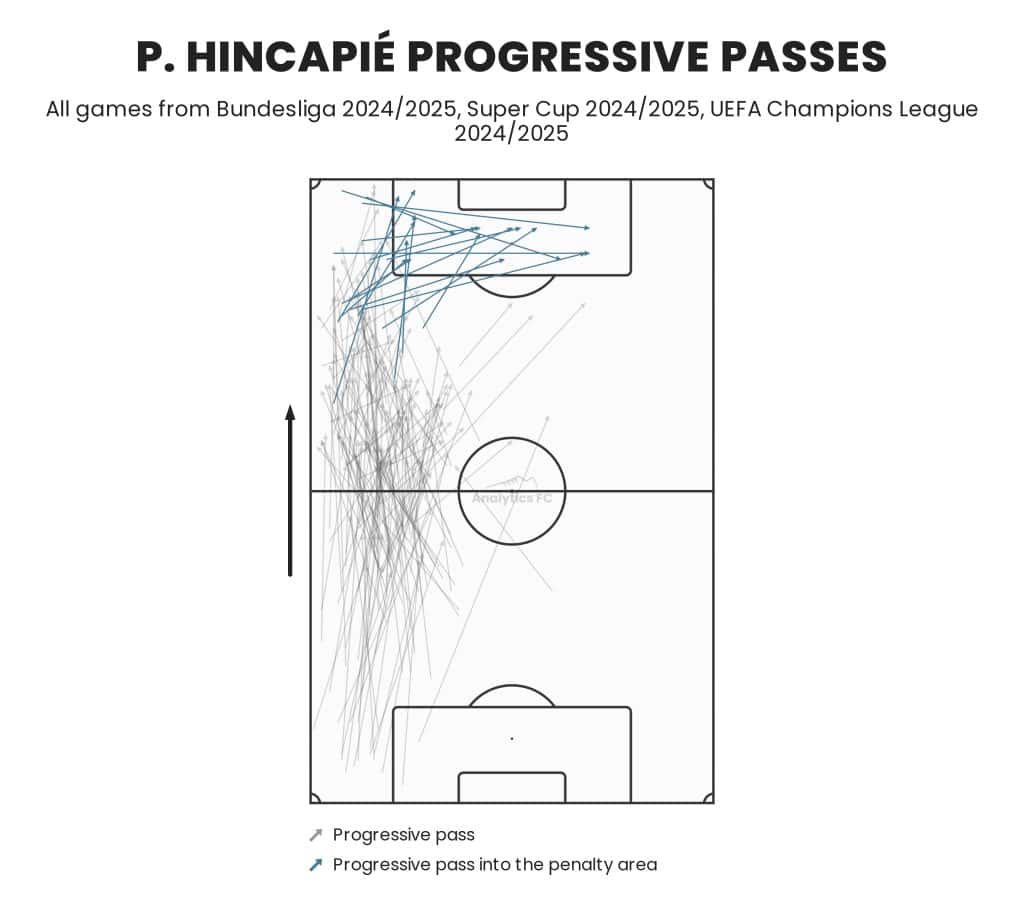
Figure Two
It is interesting to look further at Hincapié’s ball progression data.
He is a naturally left-sided player who typically plays as the LCB for Leverkusen under Xabi Alonso tactics.
As you can see from this pass map, which shows the passes that he has played that are considered to be progressive, his ability to play passes through the left-sided half-space is a strong trait of his.
So, this gives us an idea of the kind of player and profile we are interested in.
Let’s look at the first three players we identified in the model.
Callum Doyle Scouting Report At Norwich City – The Man City Academy Graduate
The first player I picked out is currently playing his football in the English Championship with Norwich City on loan from Manchester City.
Callum Doyle is a 21-year-old English U21 international defender listed at 6’3” / 190cm.
Interestingly, he is left-footed like Hincapié, and his size and frame, along with his mobility, suggest that once he is fully developed, he may become one of those rare profiles that combine playing as a dominant defender with the ability to progress the ball like a ball-playing defender.
Callum Doyle Radar Chart
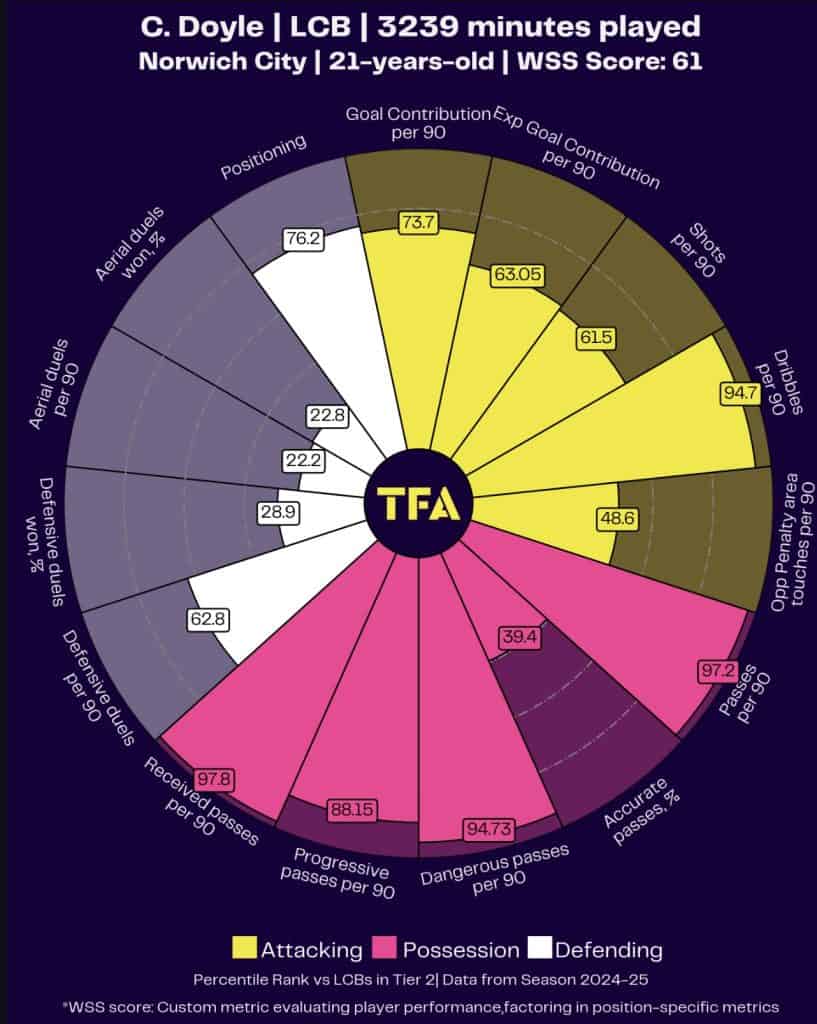
Figure Three
It’s not a bad start in terms of a comparison to our control profile, Piero Hincapié.
From a data perspective, Callum Doyle’s style of play ticks many of the same boxes as that of the Ecuadorian international defender.
At the time of writing, Doyle is in the 97th percentile in terms of passing volume but only the 39th percentile for accurate pass %.
Again, there are clear similarities between Doyle and Hincapié.
He is in the 95th percentile for dangerous passes and the 88th percentile for progressive passes, a promising data comparison between the two.
Callum Doyle Progressive Passes Chart
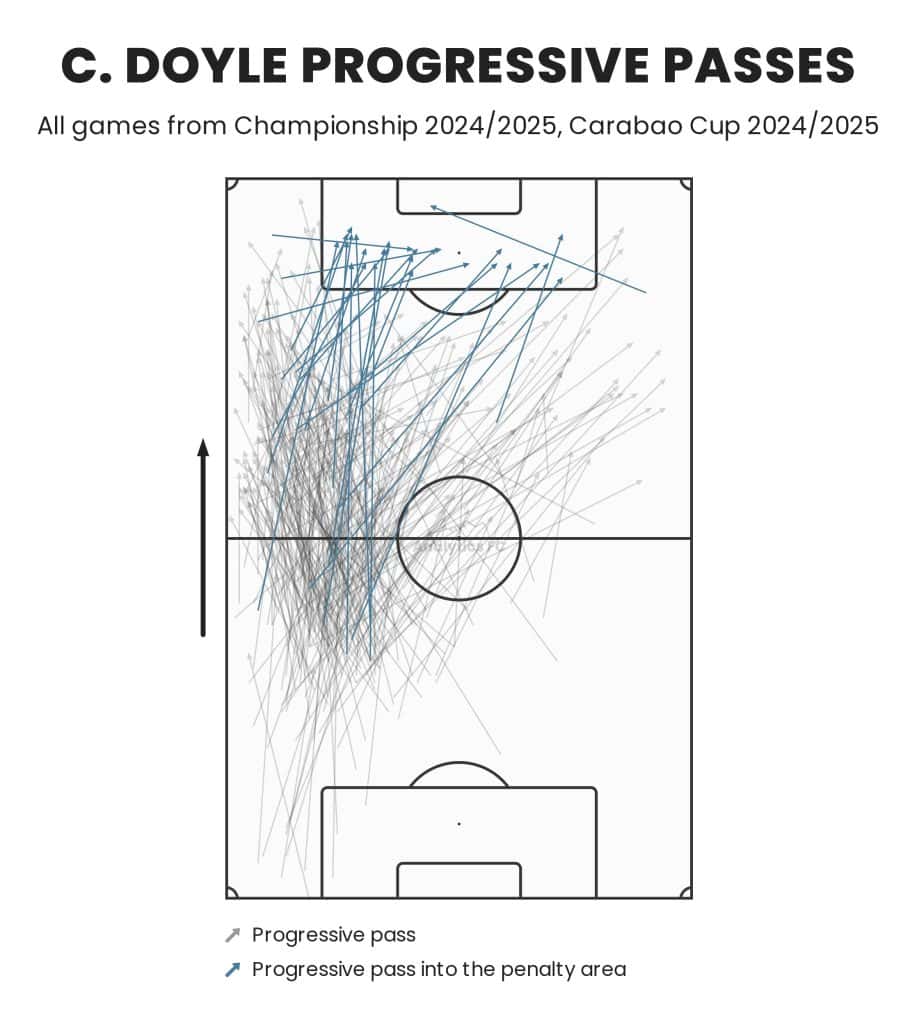
Figure Four
Again, when we look at Doyle’s progressive pass map this season, it is fascinating to see that he progresses the ball aggressively and at a high volume through the left half-space.
He is an extremely aggressive ball-passer who creates a lot of volume and danger for Norwich down the left-hand side.
While Doyle may not make the breakthrough at Man City, he will undoubtedly be on the radar of Premier League clubs.
José Marsà Scout Report At K.V. Mechelen – An Intriguing Pathway
The next player to surface in the model has had an extremely interesting career path to this point.
José Marsà started his career in the Barcelona academy before moving across the border to join Sporting CP in Portugal.
From there, Marsà moved back to Spain to join FC Andorra in the lower leagues, where he was a standout in data for ball progression as a central defender.
Last summer saw him move again to Belgium, where he joined K.V. Mechelen for a reported 160k.
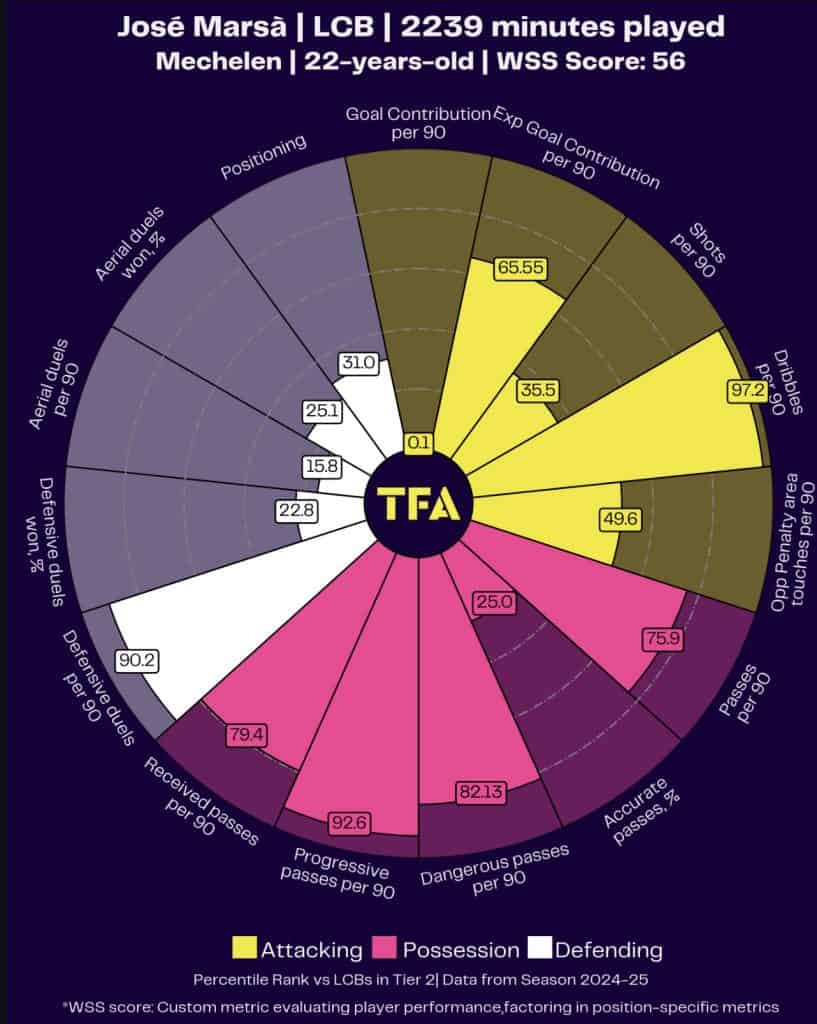
Figure Five
Again, when we look closely at the 22-year-old Spaniard’s data profile, we can see immediate comparisons between him and Hincapié.
At the time of writing, José Marsà is in the 76th percentile for the volume of his passes.
Once again, we can see that there is no focus on ball retention, as he is in the 25th percentile for the percentage of completed passes.
He is perhaps an even more extreme version of the ball-playing defender profile than Hicapie in that regard.
Again, we can see that he is aggressive in his passing approach.
He is in the 82nd percentile for dangerous passes and the 93rd percentile for progressive passes.
José Marsà Progressive Passes Chart
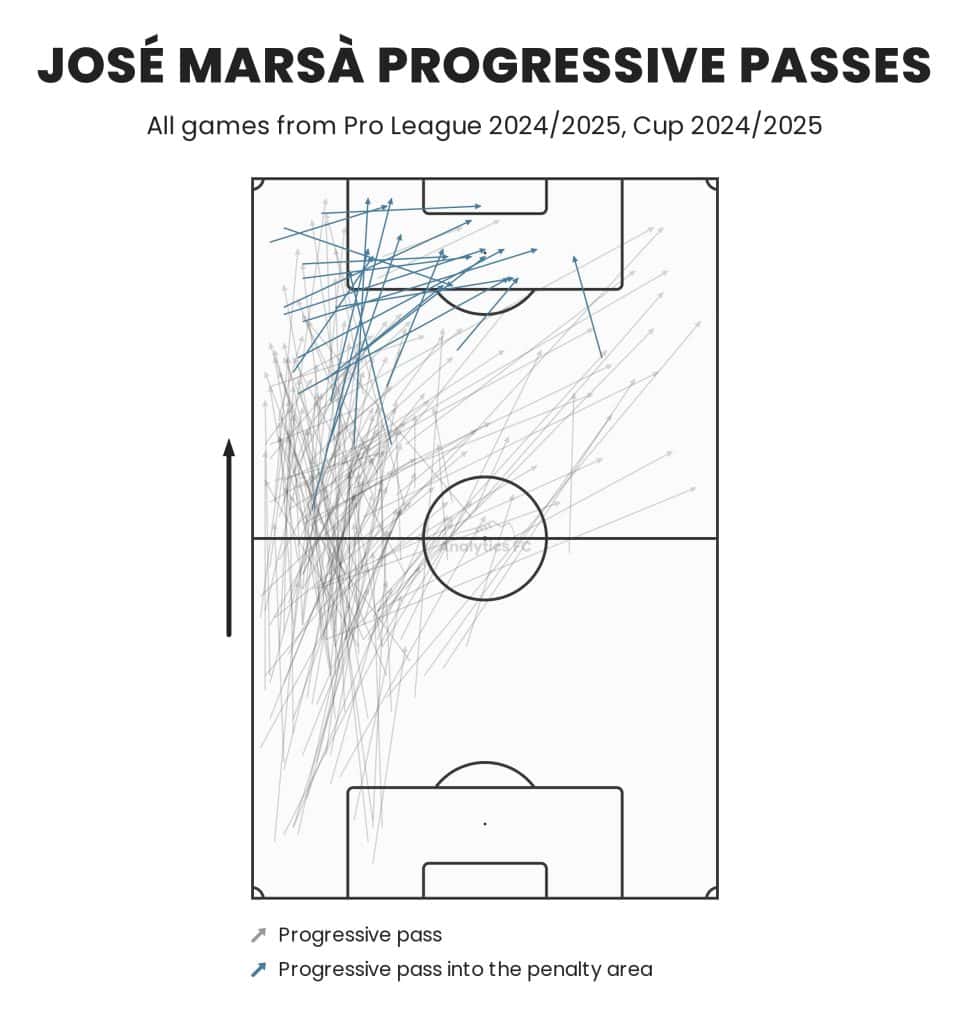
Figure Six
Marsa is yet another left-sided player who fits this profile.
Maybe all left-footed defenders are ball progressors? This obviously is not true, but the idea is a fun one.
As you can see from comparing their pass maps, his volume of passes is lower than that of Hincapié and Doyle.
However, this has more to do with the change of style, with Mechelen being a less possession-dominant side than either Leverkusen or Norwich.
Jose Marsà’s profile is much harder to project to the next level.
Maybe a move back to the Spanish top-flight would be the correct pathway for him.
Sean Roughan Scout Report At Lincoln City FC – A Rough Gem
The final player featured in this article is contracted to Lincoln City FC in League One.
Sean Roughan (A rough gem, get it?) is a 21-year-old Irish central defender who started his career in Ireland with Phoenix FC before moving to Lincoln City.
He is slightly undersized, but his performances for Lincoln do not reflect that.
Sean Roughan Radar Chart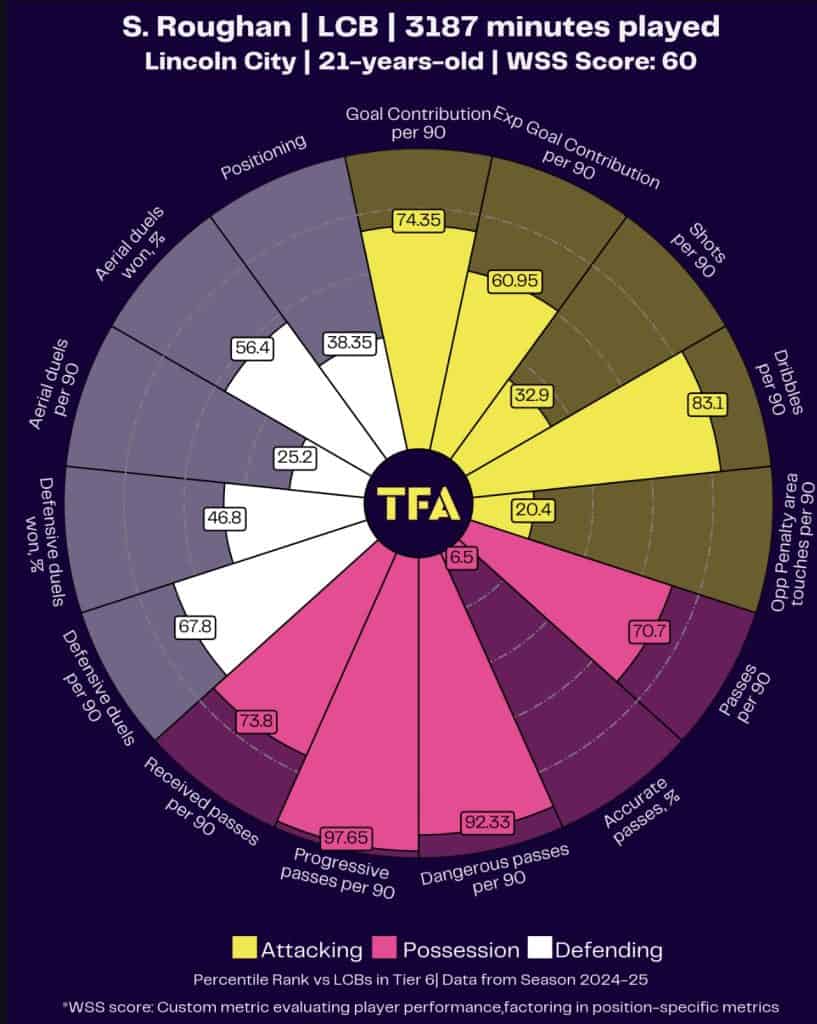
Figure Seven
Once again, the data profile closely matches what we are looking for, although arguably, Roughan’s profile has even more extreme elements than Marsà’s.
He is in the 70th percentile for passes per 90, but only the 7th percentile for the % of his passes that are accurate.
This is obviously an extreme.
Otherwise, however, Roughan continues to fit what we are looking for, as he is in the 92nd percentile for dangerous passes and the 98th percentile for progressive passes.
Sean Roughan Progressive Passes Chart
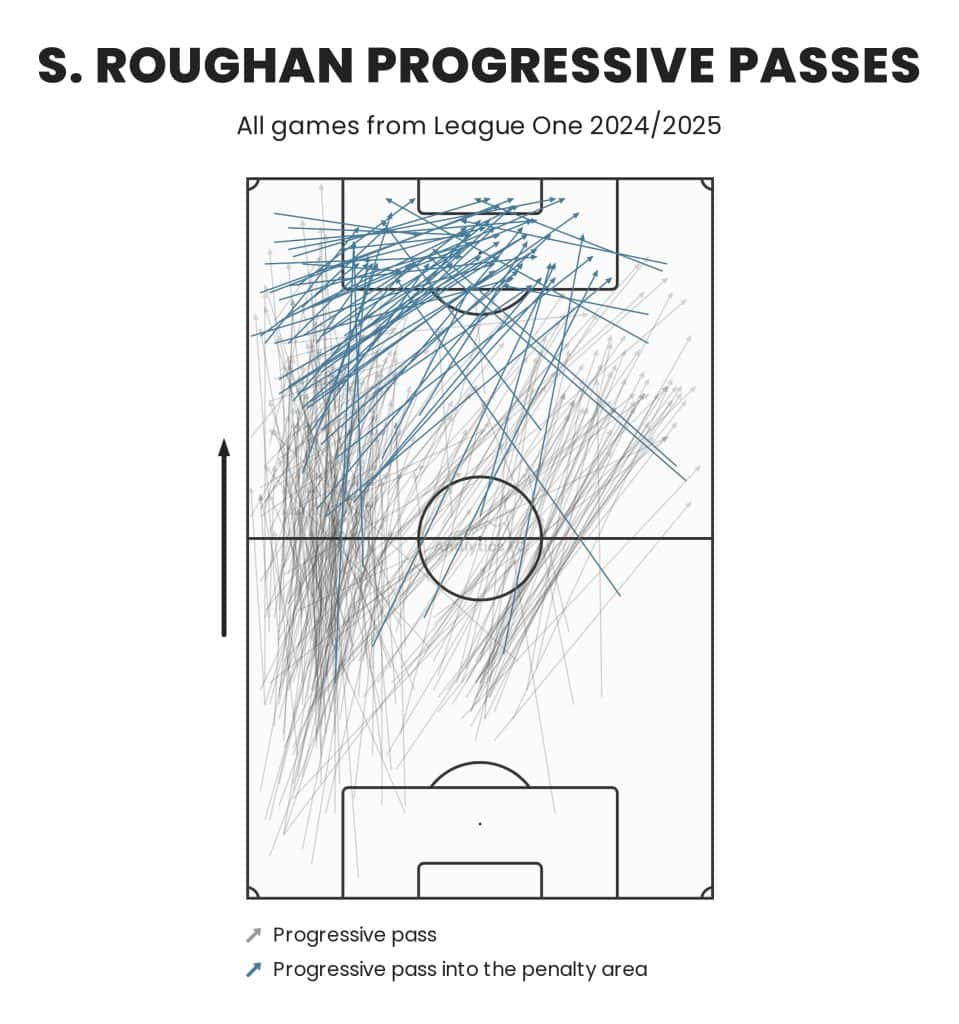
Figure Eight
It’s interesting to note that Roughan’s progressive pass map shows more variety than the players who have come before him in this article.
Roughan has more progressive passes in the central areas and even across and towards the right-hand side; he is yet another left-footed player in this profile.
Roughan’s progression from this point is harder to predict because he is an outlier in terms of his size for a central defender and a unique case with an extremely aggressive passing style that leads to a lower-than-expected pass completion percentage.
He is a very fun example of a ball-playing central defender, though.
Conclusion
Ball-playing defenders are still a profile that I find interesting.
There is something special about seeing an elegant defensive player in possession and breaking lines with driven-through balls to move the ball into the middle third.
