
KV Mechelen have been a respectable side in the Belgian Pro League for quite a long time.
Having spent all but one of the last 18 seasons in the top flight, as well as finishing in the top half of the table on several occasions, it’s fair to say they’ve earned their reputation as a club that punches above its weight year in year out.
Last season, they placed eighth in the league, only missing out on a European competition playoff at the hands of Gent, who finished nine points higher.
It was their fourth time in five seasons, since their promotion after a solitary season out of the Belgian elite in 2019, that they finished in the top 8 — quite a feat for a club not traditionally considered one of the big boys in the country.
This season, they’ve started fairly well again, indicating that they can push for another high ranking in the standings this year.
After six rounds, they are currently 9th in the table, but perhaps more surprisingly, they are the third highest scoring outfit in the league with 10 goals: only bettered by shock leaders Dender (13) and the other surprise package, Westerlo (12), who are sitting in fourth.
What makes their goalscoring record even more surprising is that their expected goals (xG) average is pretty low at just 1.09 per game, meaning they’ve almost doubled the numbers they normally should be getting at this point, with nearly two goals a game on average six games in.
This tactical analysis and scout report will explore in depth the keys behind their offensive success under head coach Besnik Hasi so far this season and whether their numbers are sustainable or if there are underlying issues in their team and/or tactics that are being papered over by some great finishing.
KV Mechelen Spacing Issues
One of the most noticeable things about the way Mechelen attack when you watch them play is just how spread out the players are on the pitch.
Besnik Hasi’s side mainly line up in a 3-4-3 shape, with a heavy focus on wing play and a direct approach offensively.
The biggest protagonists in this system are their wing-backs, normally the adventurous German Patrick Pflücke on the right, who is a winger by trade, and the domestic Daam Foulon on the left.
Their aim is to get them as wide and high up the pitch as possible, with the deeper players on the ball being tasked with finding them in spaces through long balls and quick switches of play.
While this has paid dividends on many occasions this season, when you look beneath the surface, it’s clear that there are some structural issues in the way they set up when in possession.
Let’s take a look at some of those issues via some in-game illustrations below.

The above example is early on in the game against Anderlecht.
As mentioned before, you can see the wing-backs taking up a position high up the field early on in the build-up phase.
However, we can also see one of the central midfielders (captain Rob Schoofs in this case) moving wide to take up the wing-back spot so Foulon can go up and act as a left winger.
The actual wingers, Kerim Mrabti (RW) and Nikola Storm (LW) move in between the lines to form a more narrow attack, dragging out their markers and opening up spaces for the wing-backs to exploit.
We can also see the outside centre-backs, Jules Van Cleemput (RCB) and José Marsá (LCB), moving wider, which allows them to become outlets for the central defender of the trio, in this case, Toon Raemaekers, to circulate the ball to a wider area.
This would allow them to link up with the underlapping wing-back on their near side or switch to the overlapping far side opposite.
This is a normal setup for a team that relies heavily on wing play as its main attacking strategy.
What it costs them is the loss of control in the central areas, making it more difficult to access due to a lack of numbers in the middle of the park.
This means they’ll have to constantly shift from side to side or go long in order to progress their plays.

Another example of that above is from the same game, with Van Cleemput on the ball but only having Pflücke as a forward passing option, with no one else available to him besides going backwards.
The front three are on the other side of the field waiting for a switch, which is a common tactic for this team but one that does not help them establish control of possession for very long in games.

Here’s another example from the following game against Antwerp.
Here, we can see both Van Cleemput and Pflücke signalling to Raemaekers to switch the play to the opposite left side, where they have more of a numerical advantage and can overload that flank with the right ball.
Other than shifting the ball from side to side, there’s nowhere else to go, again due to the spacing of the midfield, which is set up to play through the wide channels.

In this graphic, we can see the role that the wingers play once the ball is ready to be launched into an attacking area from the back; Mrabti notices the space behind the Antwerp left-back, who’s trying to pick up Pflücke’s run and moves into the space behind him.
Again, this is another case of Mechelen having few options but to either go long or side-to-side because of both their positional structure and Antwerp creating numerical superiority by pushing higher up to cut down passing options.

Here, we can see a common example of the switch of play that Mechelen relies heavily on to get their wingbacks on the ball in advanced positions.
Van Cleemput spots Foulon in empty space on the underloaded side and plays it early with the Antwerp full-back tucked inside trying to cover Storm.
This is a good example of how the wingers forming a narrow attack opens up room for the wingbacks to attack on the outside by taking away markers from them.

Here, we see another example of their poor spacing from the game against Charleroi.
The right wing-back (Rafik Belghali here) is on the ball and has few options to pass it to as he looks around, with each player several feet away from him.
All he can really do is try to switch it long or force a play with either a risky pass or a dribble attempt.

One last example of their use of getting the ball from back to front as directly and efficiently as they can is Belghali making the overlapping run in behind the Charleroi full-back.
This is spotted by Raemaekers, who attempts the long ball over the top into that space.
Mechelen are outnumbered 2v5 in this situation in midfield, with the wingers staying further up this time and the double pivot of Schoofs and Aziz Ouattara dropping deeper to support.
Large gaps in Mechelen’s positional structure have been a common problem for establishing control of the key central areas on the field, although it’s clear that their intent is to sacrifice that for success through their wing play.
KV Mechelen Shooting From Distance & Low Goal Probability
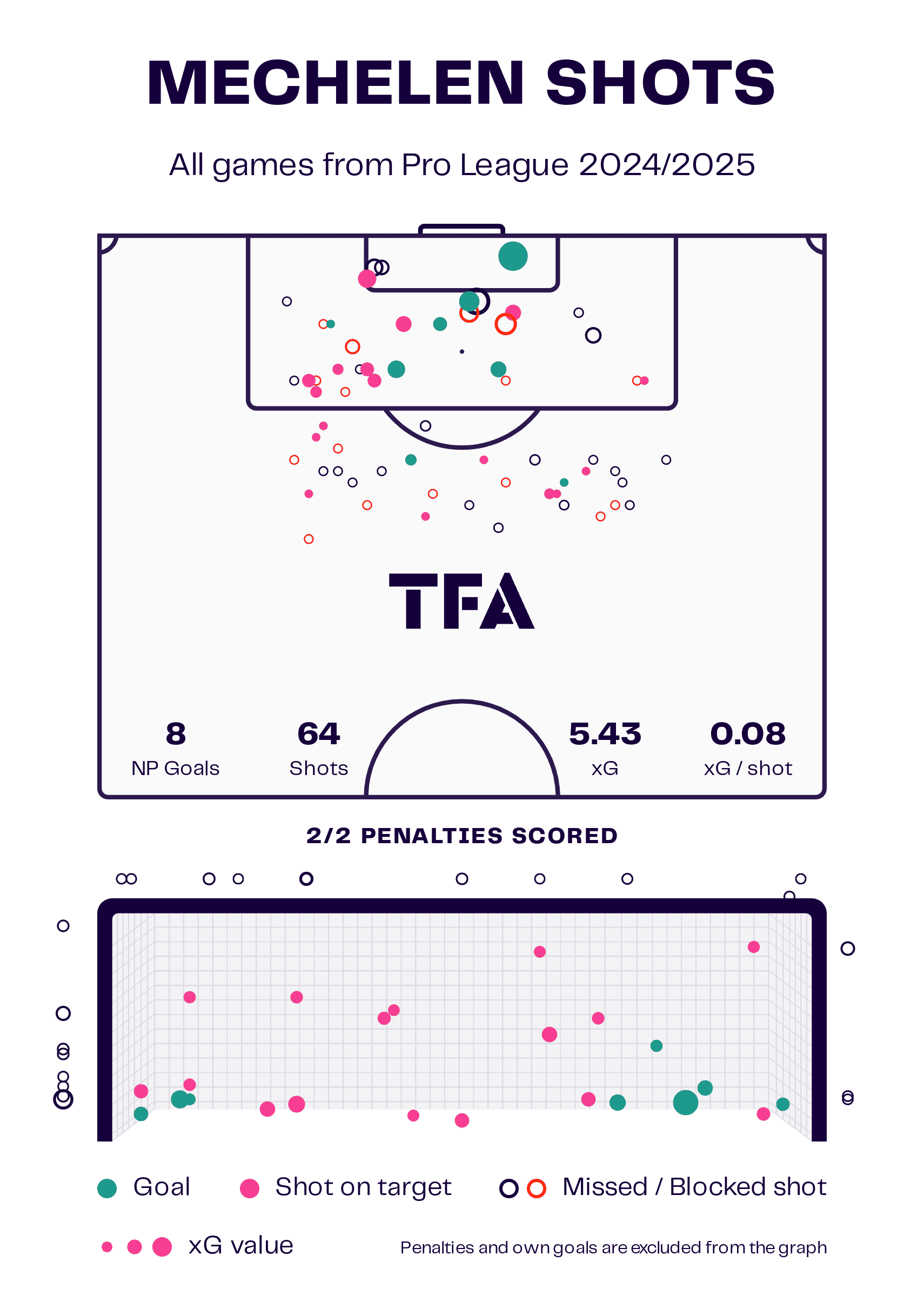
The main reason Mechelen’s expected goals (xG) average is so low is simply shot selection.
As the data viz above shows, out of the 64 shots they have attempted this season, 32 of them have come from outside the 18-yard box — that’s 50% of their total efforts!
Several others come from a wider angle inside the box and are normally not given a high xG value.
With a 0.08 xG shot value, they have one of the lowest averages in the league but have still outperformed that by scoring twice as many goals as their xG indicates.
This all comes down to some excellent finishing from difficult angles, particularly in the Charleroi game, which we’ll examine later.

Here is a bad example of their poor shot selection from the game against Anderlecht.
Storm picks up the ball in a wider area, comes inside, and unleashes a shot that’s tame but comes nowhere near troubling the goalkeeper.
This is a minor detail in the game itself, but it is an example of their desire to shoot from distance, even if there are better options available (like playing it out wide for the overlapping Foulon here).

Here’s another example from the same game just moments later: they got a chance to hit Anderlecht on the break.
Centre-forward Lion Lauberbach receives the ball wide of goal and tries to attempt an early shot into the far corner but falls short of the mark and is easily saved by the Anderlecht keeper.
Again, a low probability of scoring, to begin with, but it doesn’t stop Mechelen from trying anyway, as they do so often.

Here’s an example of where shooting on sight works out well for them.
Storm picks up the ball in a central area before firing a low, hard shoot into the bottom corner to the Charleroi keeper’s right.
There is not a high probability of scoring here, but it comes off to restore their lead just before the interval.

They repeated the trick in the same game early in the second half, with Schoofs firing low back across the keeper and the ball finding its way in the bottom corner again.
Not often do you see teams score two such goals from long range, which is almost always of a lower xG value, but that’s what happened for Mechelen here, and that’s why their numbers are higher than expected so far this season.

Another poor example of their shooting but willingness to try, with Pflücke cutting in and blazing his shot way over the bar.
Mechelen attempts to shoot a lot from distance.
Often, it doesn’t come off as you’d expect for most sides, but it’s paid dividends on a few occasions this campaign, thus leading to the numbers they have to date.
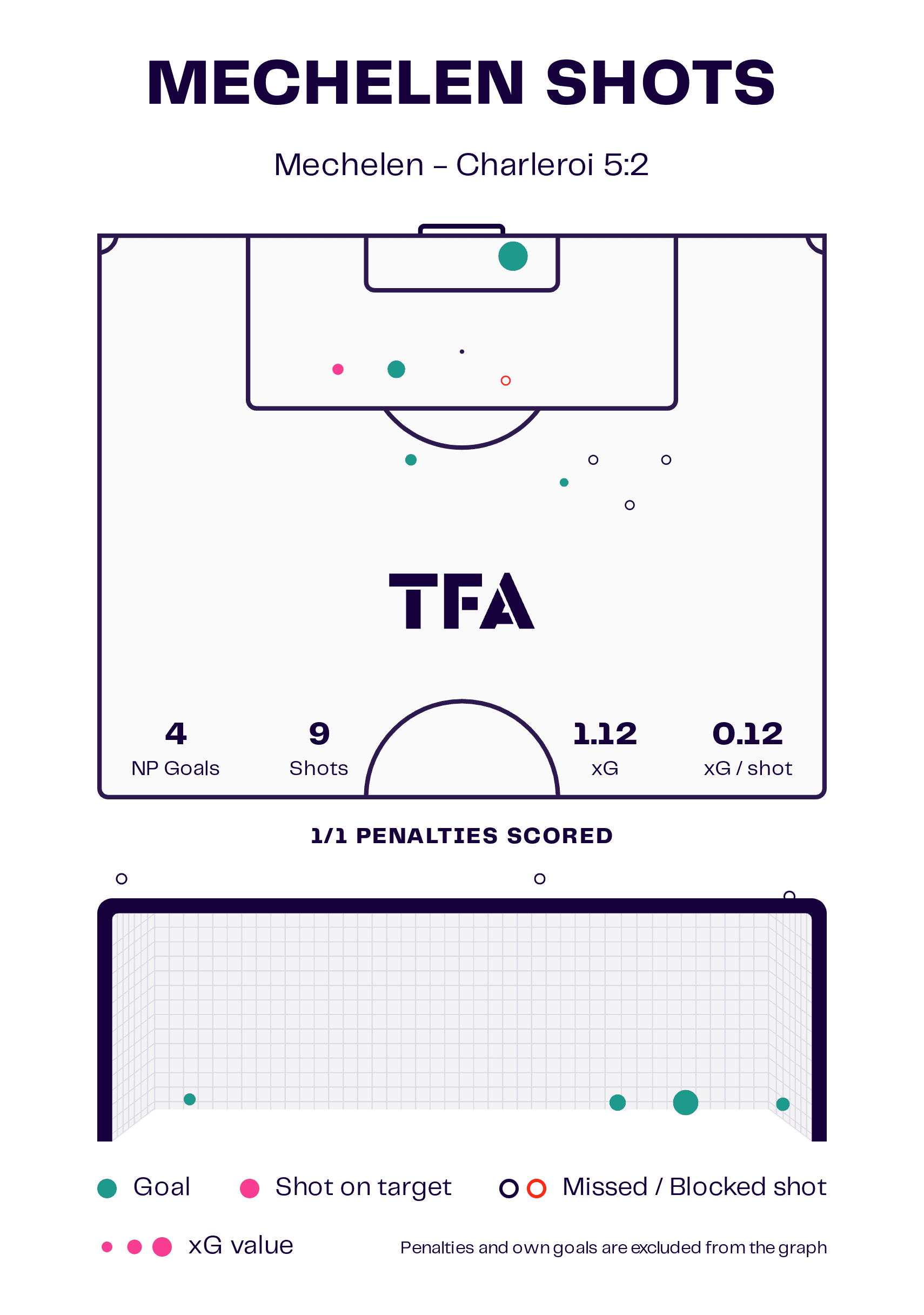
The data above illustrates their shot map in their last game against Charleroi, which is where they really beat their xG average for the season and skewed their numbers.
Nine shots in total (not including the penalty kick goal that made it 2-1), with five coming from outside of the penalty area, two of which nestled into the back of the net.
In fact, you could argue they only had one high-value xG attempt in the whole game, with the finish from close range from Benito Raman that made it 5-2, yet they still managed to score five goals despite a low xG of just 1.12 throughout the 90 minutes.
Conclusion
It’s very unlikely that Mechelen will be able to sustain the numbers they’ve put up so far, particularly from their most recent outing against Charleroi.
In this analysis, we were able to examine how they’ve outperformed their xG so far and why this may be unsustainable in the long run.
They will continue to find success through their direct and vertical wing play and willingness to take shots from all angles; it just may not be at this level for the course of the season.
There are still cracks that need to be addressed, but it’s been a fun start to the year for the club, which has been pushing for a European berth for the first time since 1993.
It will be interesting to see how Besnik Hasi tactics fare as they progress through their fixture list.
