
Scouting promising young centre-backs in Ligue 1 has been a joy in recent years.
From the pairing of William Saliba and Wesley Fofana at Saint-Étienne to Axel Disasi and Benoît Badiashile at AS Monaco, just to name a few, the French top-flight has been a highly productive breeding ground for top-class defenders.
Jérémy Jacquet (188cm/6’2”, 79kg/174lbs) at Stade Rennais is one of the most interesting centre-backs currently looking to join that illustrious list and make a name for himself in Ligue 1.
After spending 2024 out on loan at Clermont Foot, Jacquet returned from that spell away from the Brittany club in February, immediately slotting into then-new manager Habib Beye’s starting XI.
From that point on, Jacquet hasn’t looked back, and the 20-year-old Rennes academy product has repaid Beye’s trust, becoming a standout for Les Rouge et Noirs in 2025/2026, offering his team quality with and without the ball.
This Jérémy Jacquet scout report outlines the centre-back’s key strengths and weaknesses, detailing what potential suitors should know about the young Frenchman and why he’s definitely one to keep on your radar if you want to stay up-to-date on your young French centre-backs.
Jérémy Jacquet Stats
Firstly, we’ll use a pizza chart (Figure 1), which visualises Jérémy Jacquet’s performance for Rennes in 2025/2026 by providing his percentile ranks in several key metrics.
These percentile ranks compare Jacquet’s performance in the corresponding metrics with that of other right-sided centre-backs from Europe’s top-five leagues this term.
Upon examining the visual in Figure 1, we immediately see that Jacquet stands out in aerial duel success, defensive positioning (a combination of tackles and interceptions), as well as defensive duel volume.
The relatively high rank in ‘Dribbles per 90’ indicates Jacquet’s tendency to carry the ball out from the back and into midfield.
At the same time, he’s also quite heavily involved in his team’s possession play, making Jérémy Jacquet’s profile that of quite a well-rounded centre-back.
Jérémy Jacquet Pizza Chart 2025/2026

This doesn’t surprise, though I would say I’ve been far more impressed by Jérémy Jacquet’s reliability in defensive duels than the above data would suggest, as well.
We’ll delve into Jacquet’s qualities with and without the ball in greater detail as we progress through this scout report, but to summarise, I’d say his main strengths lie in his strength, positioning, anticipation, and aggressive style of play.
Physically and technically, I’ve largely been impressed by Jacquet’s quality, though there are some clear areas for improvement technically and mentally.
Jérémy Jacquet Out-Of-Possession
Let’s start the Jérémy Jacquet video analysis with his out-of-possession game, where I’ve seen a lot of strengths this term.
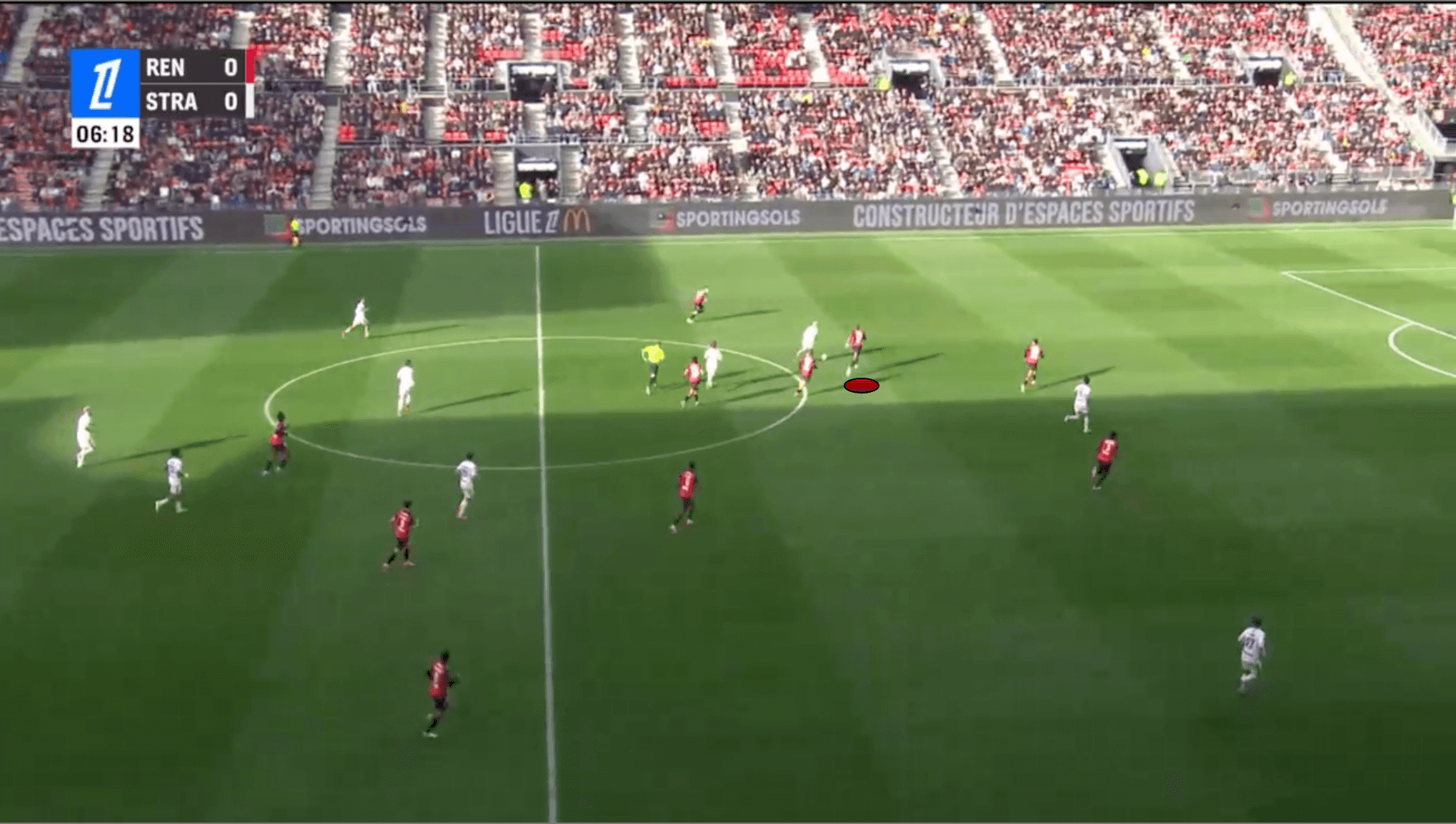
Firstly, the 188cm defender has very long limbs, which have proven extremely valuable for winning the ball back through his tackles, undoubtedly to the annoyance of his opponents.
Figure 2 shows Jacquet protecting the valuable central areas by showing the ball-carrying opponent away from the middle of the park, forcing him to dribble wider.
Initially, the ball carrier sees an opportunity to go past Jacquet on the outside here, where we can see the Rennes defender has left a lot of space.
Rather than making an oversight here, however, Jacquet has intelligently set a trap that his opponent falls into.
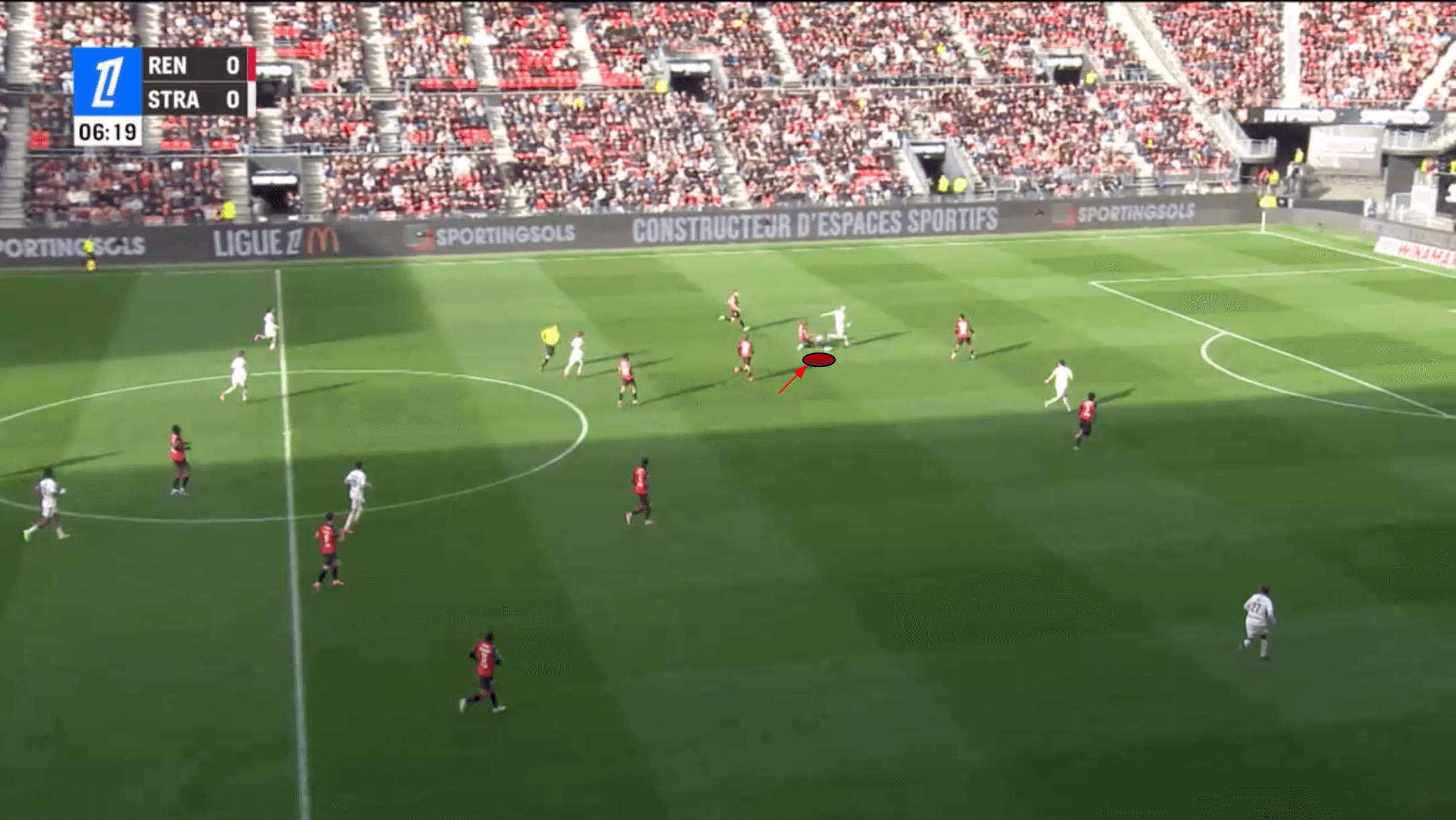
It appears that the opponent has succeeded in dribbling past Jérémy Jacquet by exploiting the space on his outside.
However, just as the dribbler goes past the defender, the ball is unceremoniously hooked away by Jacquet’s innovative use of his long legs, which have no trouble reaching in front of the dribbler, snatching back possession for Rennes.
This is a skill that makes defenders very annoying for opponents.
Just when attackers think they’ve got away and start to look up towards goal, they’re stopped in their tracks.
Jacquet’s timing has to be on point in order to pull this off, as it was on this occasion.
This is one method of defence that the Rennes centre-back has demonstrated himself as being extremely comfortable with under Habib Beye this term.
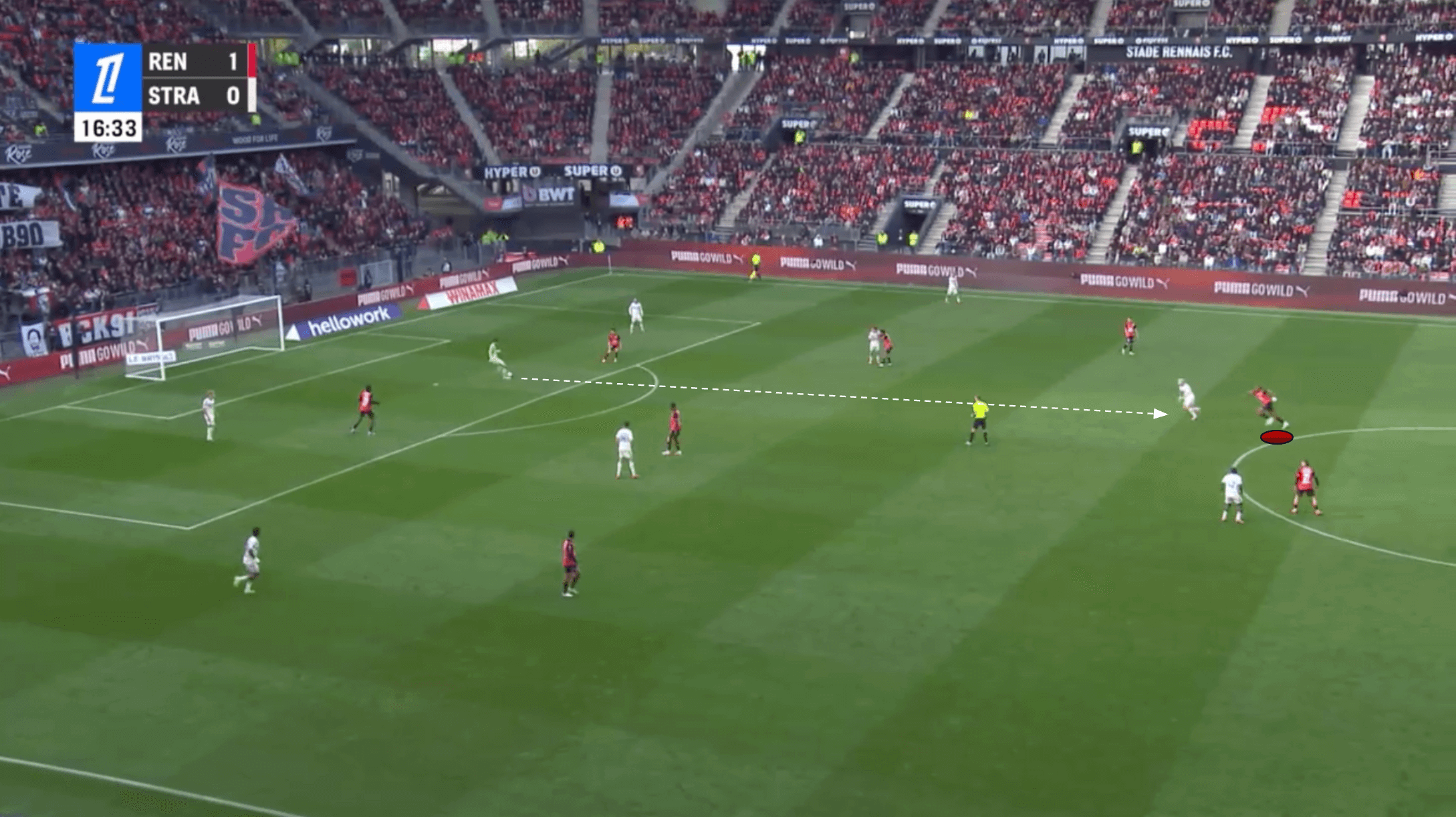
One of the clear standout traits you see when you watch Jérémy Jacquet is his comfort with stepping out of the backline and defending high.
His high-risk, high-intensity, physical and aggressive style of play means he very much fits the ‘stopper’ defensive archetype.
Here, he quickly spots the incoming pass from the RC Strasbourg goalkeeper to the attacker who’s dropping off into midfield just in front of him.
Jacquet reacts, following the attacker into midfield.
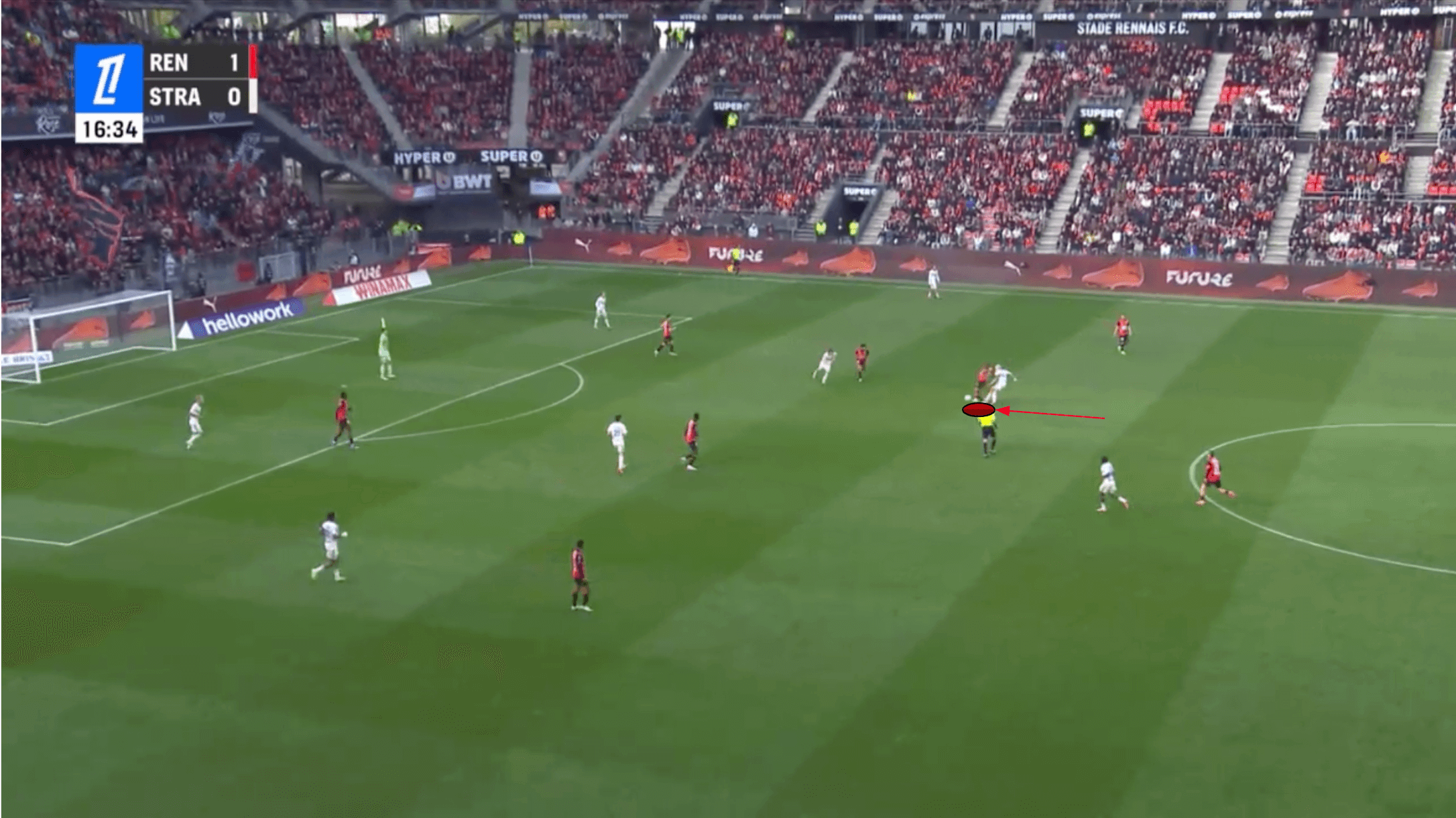
Thanks to his anticipation and reactions, Jacquet is able to get in front of the intended receiver before the ball arrives, regaining possession for Rennes well inside the opposing half, setting up a great chance to attack the Strasbourg goal with the backline spread wide and unsettled.
This is an excellent example of Jacquet’s front-footed defensive nature and how his team can benefit from it.
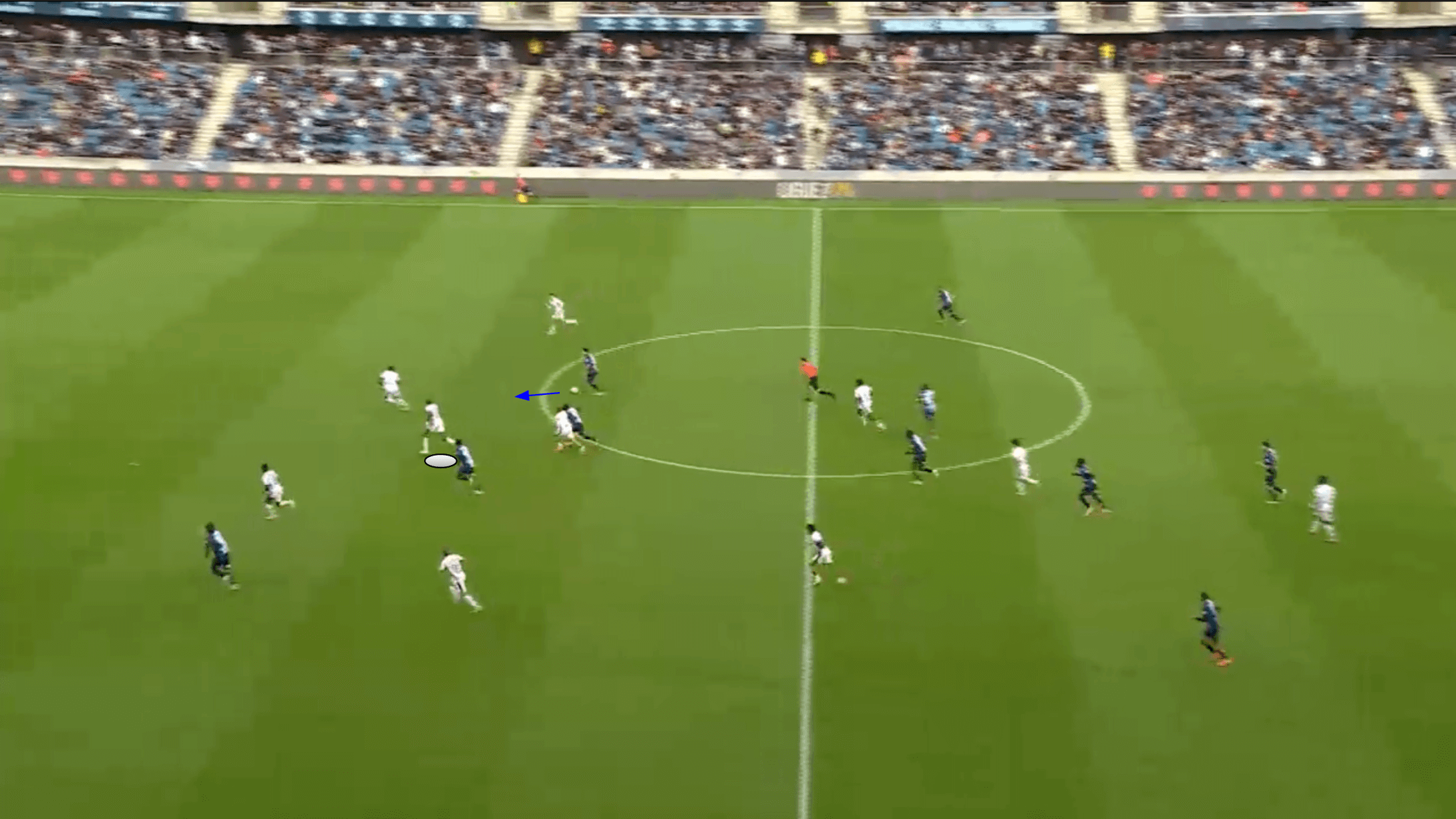
Jacquet will act as the aggressor in the backline in pretty much all phases of play.
Here, we see him step out as his team prepares to defend against an opposition counterattack.
His role is to step out, close down the ball carrier, and either stop the counterattack or at least buy his team a bit more time to recover and get more bodies behind the ball.
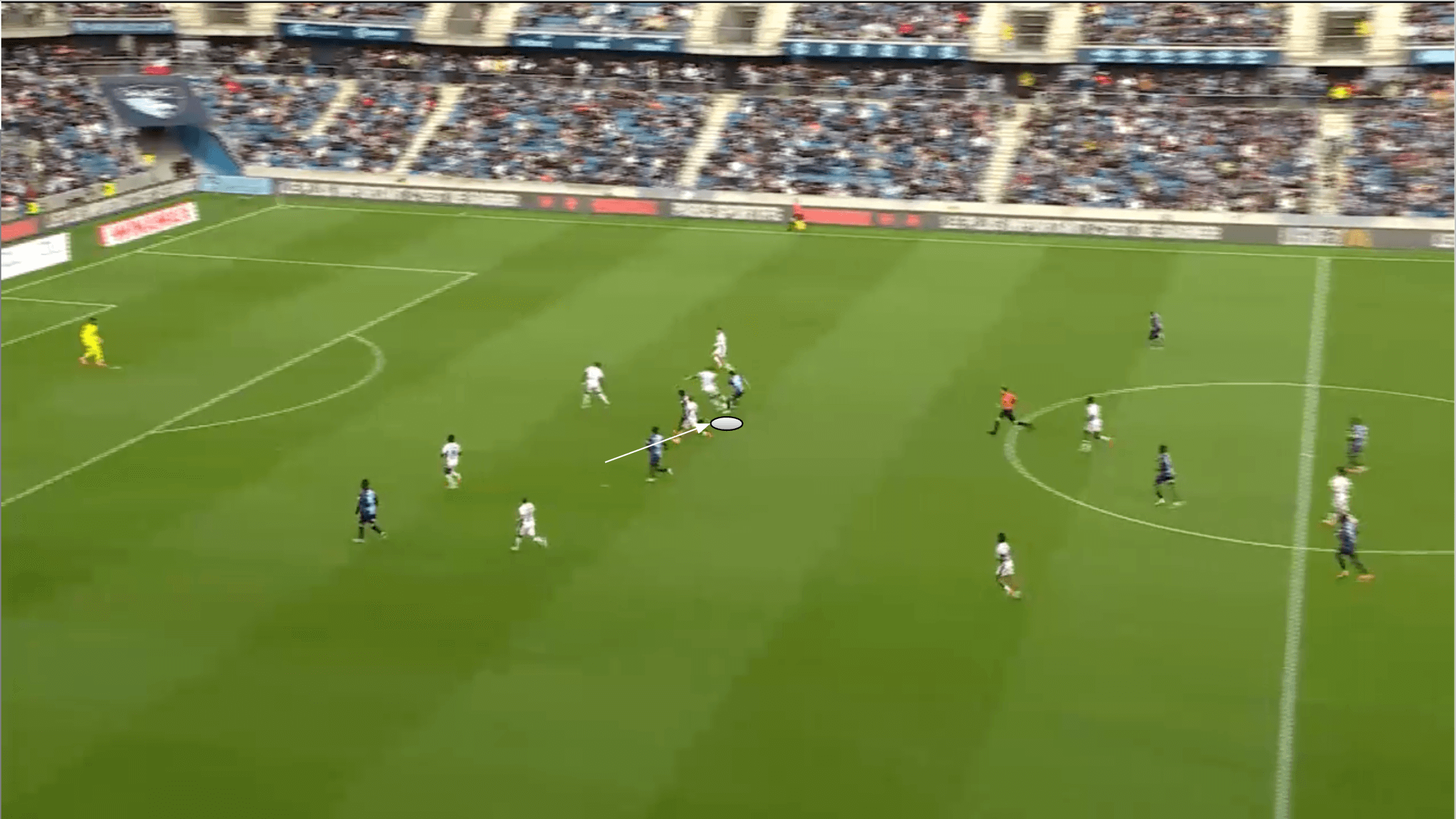
Crucially, the timing and execution of Jacquet’s tackle are excellent, meaning he steals the ball away just as the opponent enters Rennes’ third of the pitch, allowing his side to rebuild from the back against a Le Havre side that now needs to recover fast themselves.
In addition to the aggression, anticipation, and timing observed in the previous examples, Jérémy Jacquet is very strong, making him extremely difficult for any striker to deal with in physical duels.
As far as defensive weaknesses go, Jacquet can be required to step out and defend wider areas at times, especially if the right-back is caught out of position on the counter.
He doesn’t look extremely comfortable in those situations.
Fast wingers will have the upper hand on Jacquet in terms of pace.
However, the main issue is agility.
Jacquet can get turned inside-out or simply wrong-footed in 1-v-1 duels, especially when exposed out wide, and he’ll find it tough to recover if sent the wrong way, meaning he needs to be protected in those situations.
Jérémy Jacquet In-Possession
Jérémy Jacquet’s in-possession game has significant strengths and weaknesses.
Starting with the positives, as mentioned earlier, Jacquet is comfortable carrying the ball out from the back and breaking the first line of pressure this way, getting up into a better passing position.
Jacquet is generally quite confident on the ball and not afraid to take somewhat risky passing options if the potential upside, should it work out, is high enough.
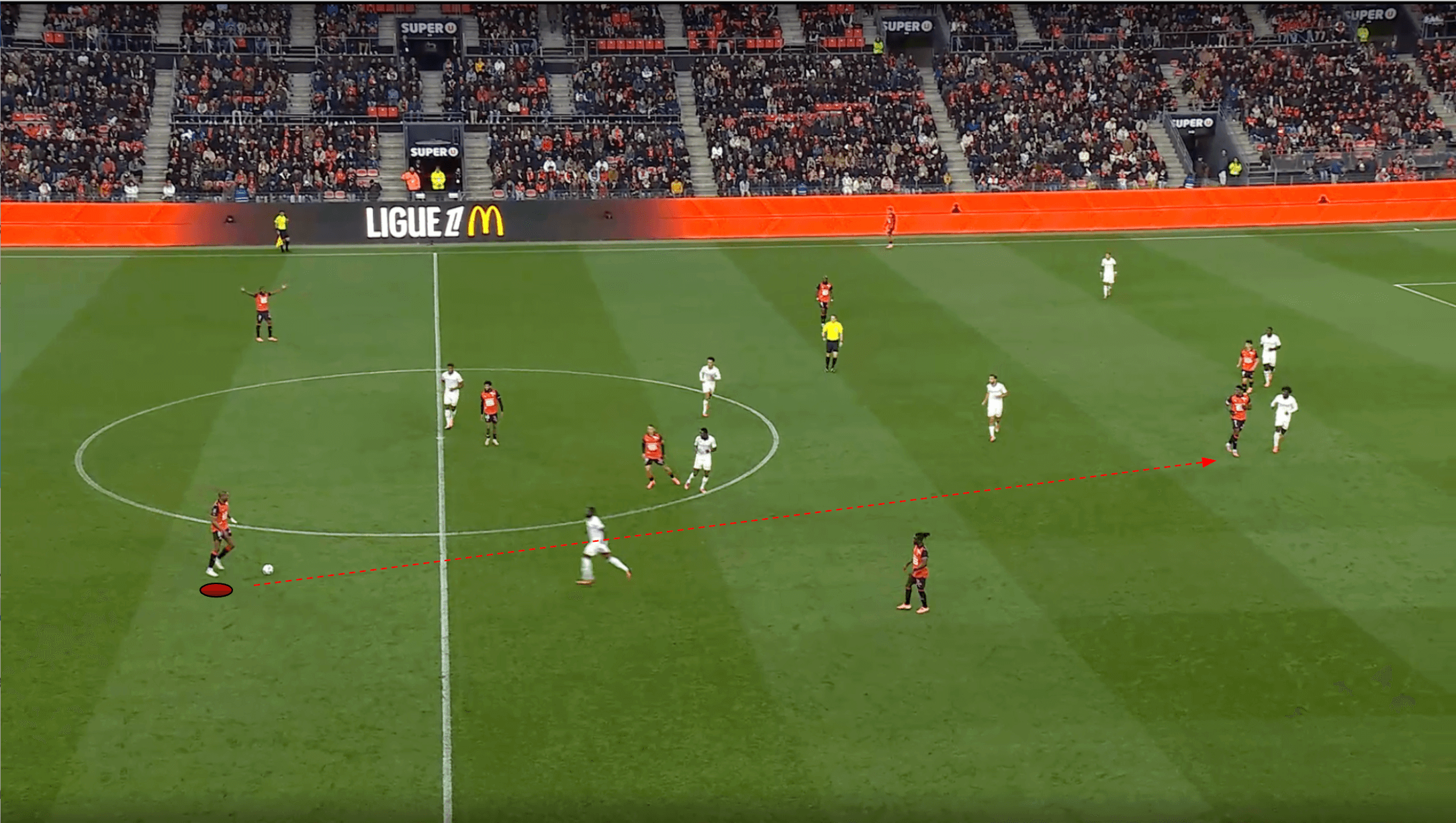
Take the above example.
Here, Jacquet is lining up what will soon be a line-breaking progressive pass through a tight space to get Rennes into the final third.
After receiving the ball, he gets his head up, sees the opportunity, and backs himself to take that pass on.
The vision to see the opportunity in the first place, coupled with the bravery to take it on, are highly desirable qualities in a modern centre-back.
Along with line-breaking progressive passes like this, Jacquet frequently takes on long crossfield balls designed to exploit space out wide when there’s a Rennes attacker in position to take advantage of it.
There are a couple of issues with Jacquet’s passing game, however.
He’s prone to mistakes and poor decision-making when put under pressure, and he will sometimes take on a passing option that’s somewhat beyond his current capabilities.
Both of these issues can lead to losses of possession in dangerous areas.
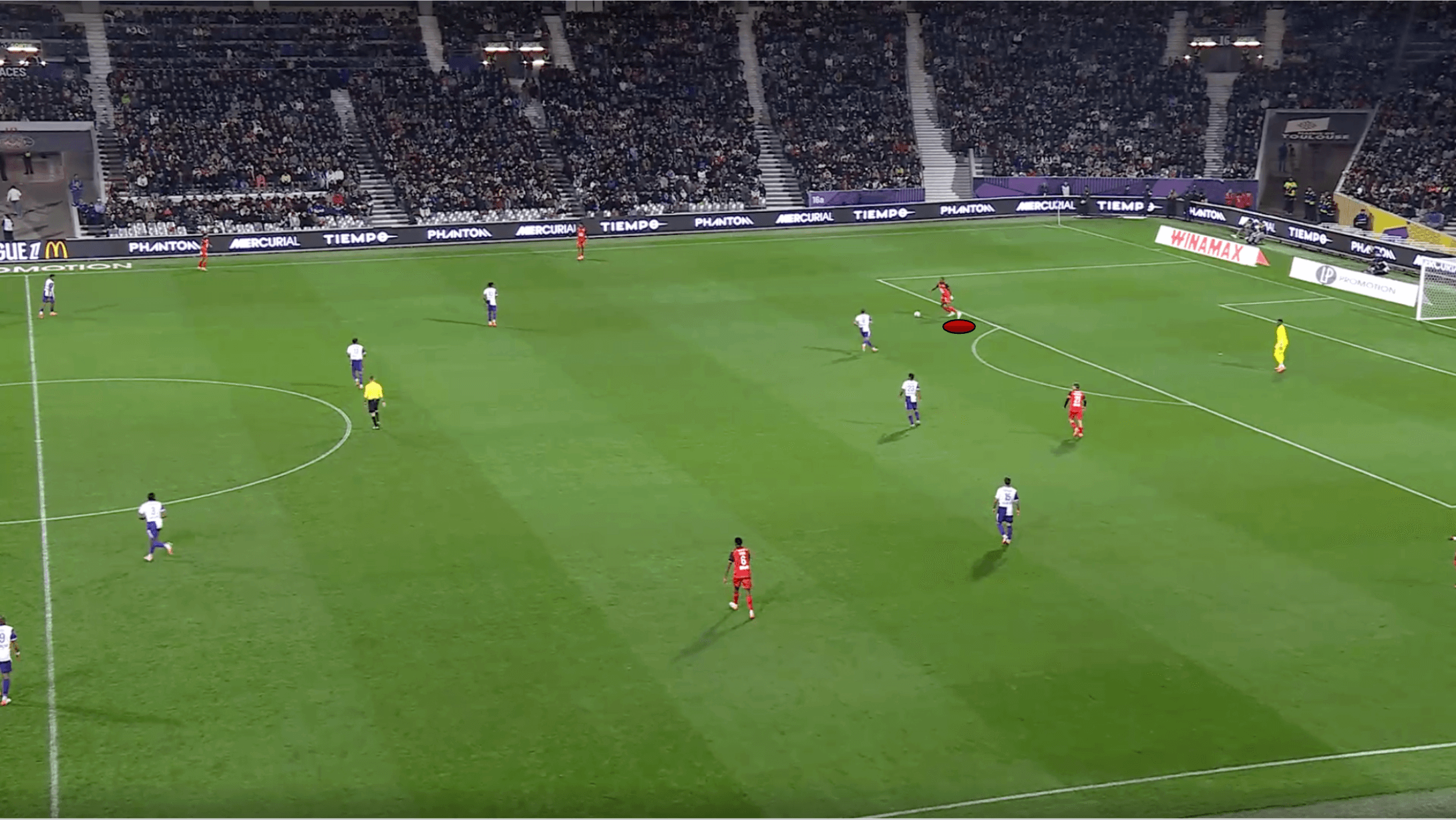
To illustrate, let’s turn our attention to Figures 9-10.
Above, Jacquet has been assigned to the right centre-back position, and now he is under pressure from the opposing striker.
Crucially, Rennes lack a holding midfielder to give Jacquet a short central option, which he’d probably take in this situation.
Rather than opting to pass out wide, likely determined to keep his team playing through those high-value central areas, Jacquet backs himself with a riskier long pass towards the attacking midfielder.
The decision was rushed due to the striker’s pressing, and the pass was a difficult one for anyone to take on.
The result is that Rennes give up possession in the middle of the park, handing the opponents a great opportunity.
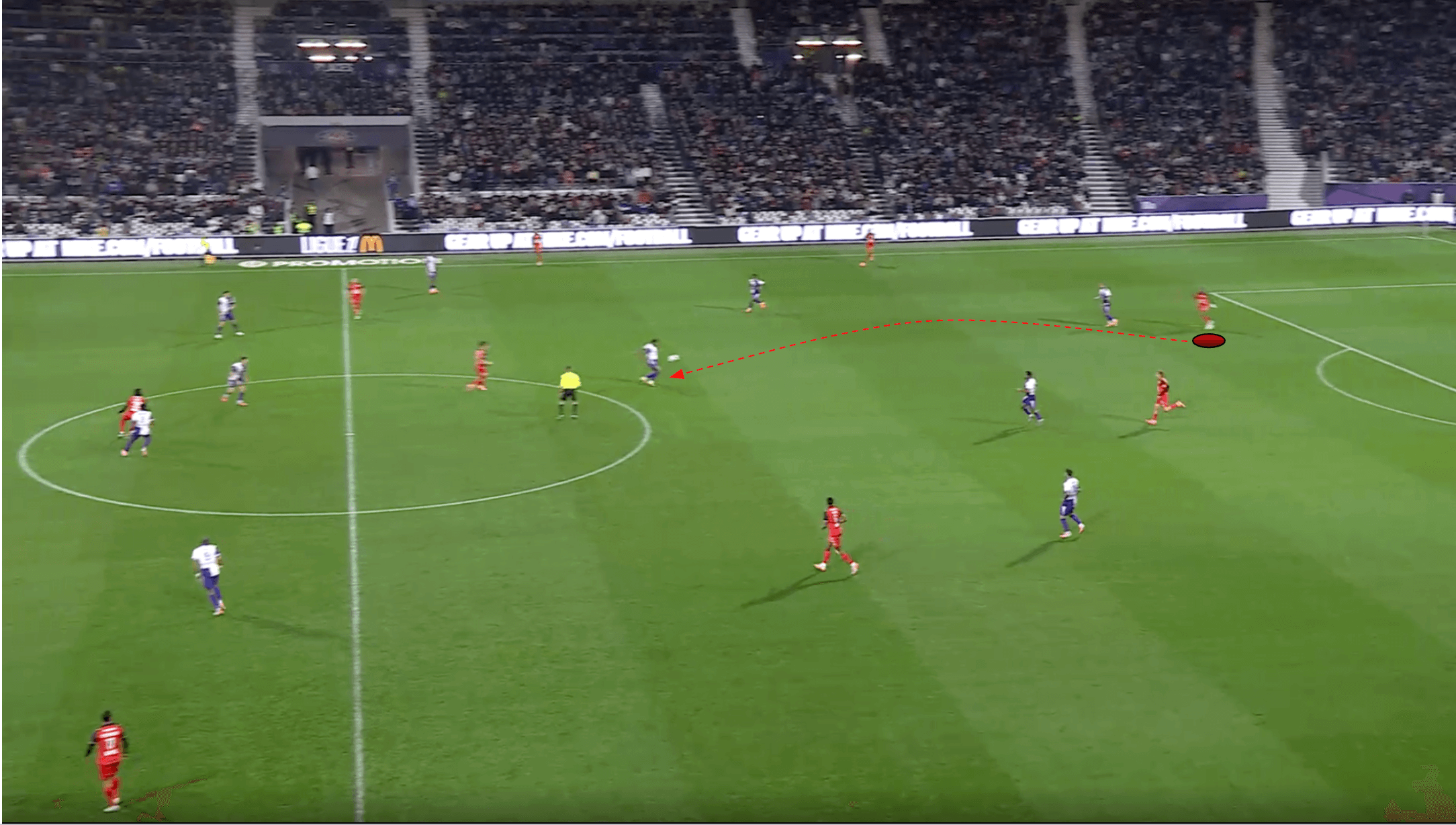
So, while Jacquet is confident on the ball and can pull off some great passes, his team must bear his in-possession limitations in mind and provide easier options to avoid situations like what we observed in Figures 9-10, which have been a little too common this season.
Conclusion
To conclude our Jérémy Jacquet scout report and player analysis, I’m a big fan of this centre-back, especially for his well-rounded out-of-possession game.
He’s difficult for many different types of attackers to beat.
If used in the right system, which adequately masks his weaknesses (namely, 1-v-1 defending out wide), he represents a potentially fantastic option for a team in need of an aggressive ‘stopper’ in the backline.
In possession, Jérémy Jacquet has plenty of room for improvement mentally and technically.
He needs to take the time to practice staying calm under pressure in order to improve his decision-making in such situations.
Jacquet can be an asset on the ball but can also be a liability.
I think his limitations in possession must be expressed clearly to him in order to help his decision-making processes, especially when passing from deep.
Still, you don’t want to discourage the bravery and confidence on display in Figure 8, which helps Jacquet further differentiate himself from the pack.
With time, Jacquet can learn when to take on riskier passes and when to opt for safer options.
Some work on the training ground can also help him improve his areas of weakness in the passing game to further round out his profile.
