
There’s no single statistic that can explain why Borussia Mönchengladbach currently sit seventh in the Bundesliga.
Yes, after finishing 14th last season, Gladbach have a chance of qualifying for European competition this term.
That would be massive.
But if you look at the statistics, there’s nothing special about them.
Their underlying numbers aren’t anything extraordinary.
Yes, their xG is the sixth highest in the league, but their xGA is the second worst.
If you were to calculate by xG difference, Gladbach would be 13th.
They also don’t press the opposition very hard, as their PPDA (passes allowed per defensive action) is among the highest (which means one of the least intense).
Under Gerardo Seoane, Gladbach are not really one of the best attacking or defensive teams.
Frankly, they are not good in either category.
They are just… well, efficient.
Efficiency comes in several categories: maximising their attack, maximising their set-pieces, maximising the strength of their players, and, most importantly, maximising their space—which covers all the things I mentioned before.
Direct Attack Makes Borussia Mönchengladbach Efficient & Dangerous
As mentioned above, Gladbach are not a team that like to press their opponents high and intensely.
Instead, they prefer to wait for their opponents to enter the attacking third.
Why? Because Gladbach like to push their opponents up the defensive line.
In the Bundesliga this season, Gladbach are the third-best team in terms of pushing their opponents’ defensive line higher, with an average of 48.13 metres.
For some teams, facing a team with a high defensive line might be bad because their opponents’ structure in possession is compact—the gap between the lines and the players is always small, making it easy for them to keep possession.
For Gladbach, however, this is an advantage.
And yes, it relates to some of the efficiency aspects mentioned above: It can help them maximise their attack and the space.
By raising their opponent‘s defensive line, Gladbach are able to create a lot of space behind it—space that they can exploit.
If Gladbach can win the ball from their opponents, they can then attack directly or counterattack into the space behind their defensive line.
They have often created chances or even goals from this situation.
There are many goals that can be cited as examples, but take this one against Heidenheim.
Within moments of winning the ball back, Gladbach were on the attack.
Julian Weigl played a through ball from his own half into the space behind Heidenheim‘s defensive line.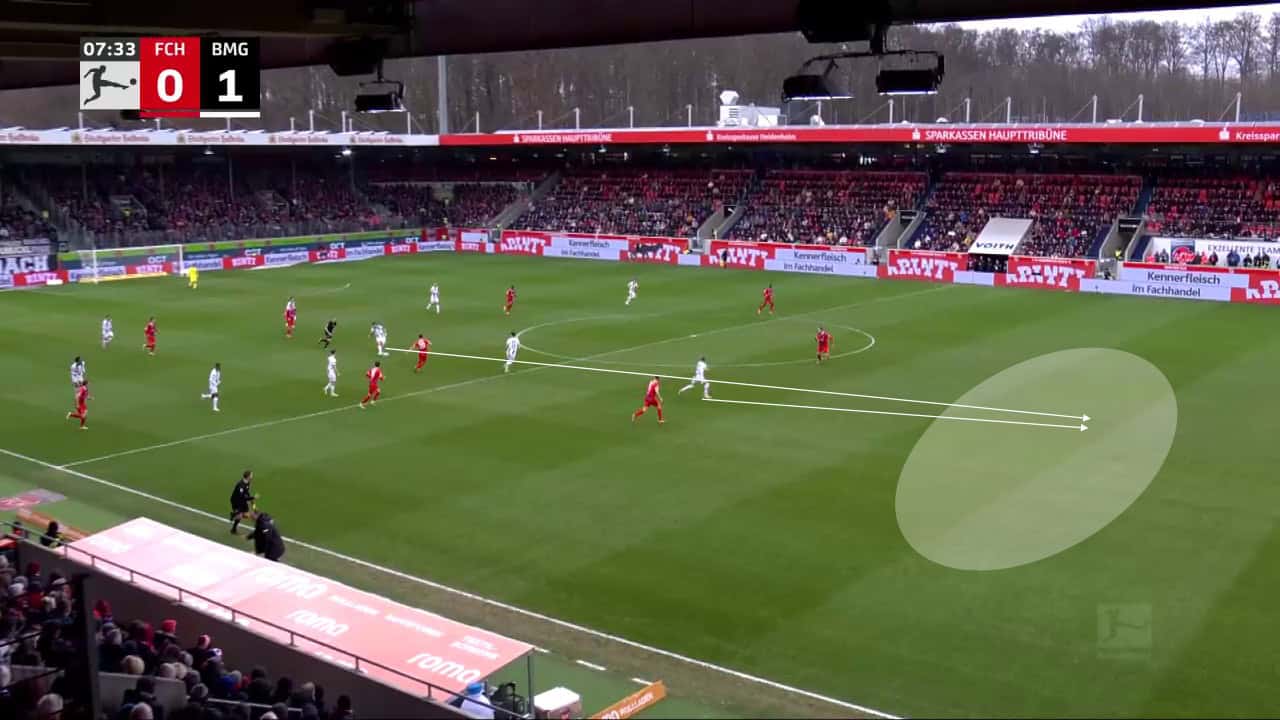
Robin Hack ran into the space, collected the ball and scored comfortably—only one-on-one with the goalkeeper.
Alassane Plea’s goal against Hoffenheim was a similar story.
The process started when Gladbach won the ball and played a quick, direct ball into space.
Plea ran into it, and then he was able to score in a one-on-one situation against the goalkeeper.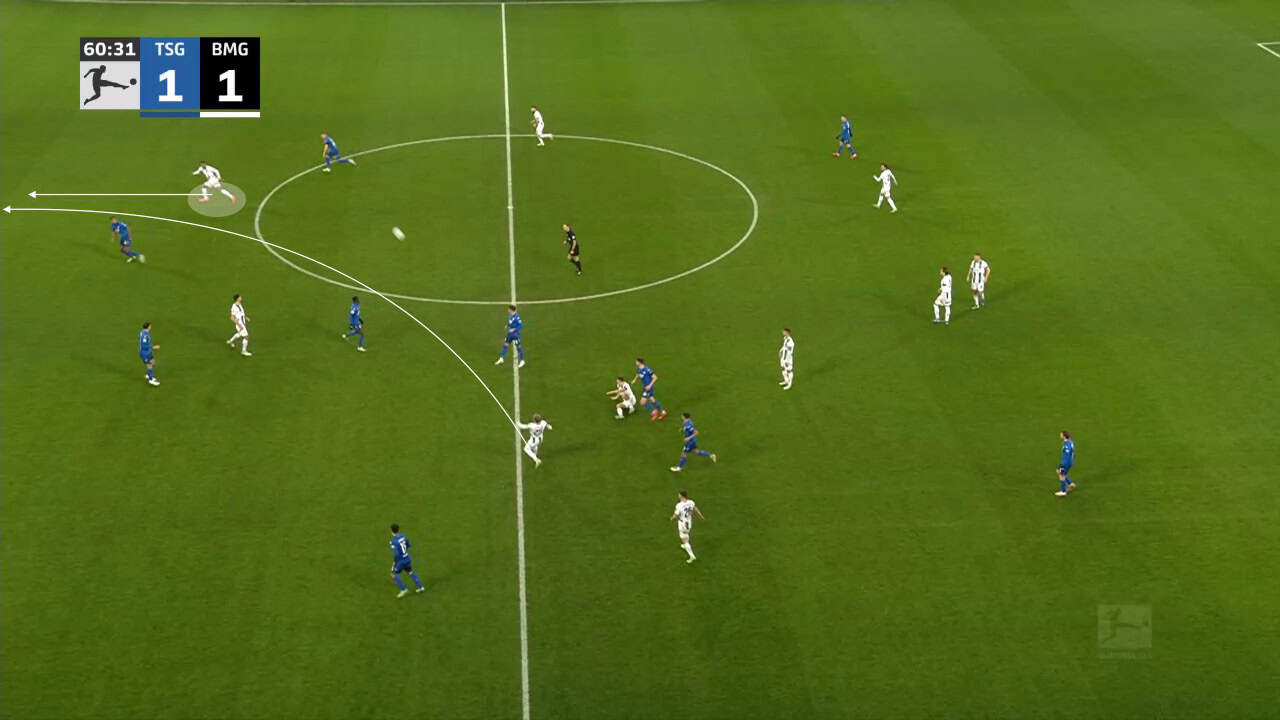
This type of goal captured the efficiency I mentioned earlier.
Gladbach can attack with just one direct pass and one run off the ball because they are very efficient at maximising space.
They have created the space by inviting or triggering the opposition to enter the final third.
Julian Weigl Direct Play
This style also shows how efficient Gladbach are at maximising the strength of their players.
They often attack the space behind their opponents’ defensive line because they have a speedy player like Plea or Hack.
Not only that, but it often works because they have Julian Weigl in midfield.
Indeed, the current captain has been instrumental in making Gladbach more direct.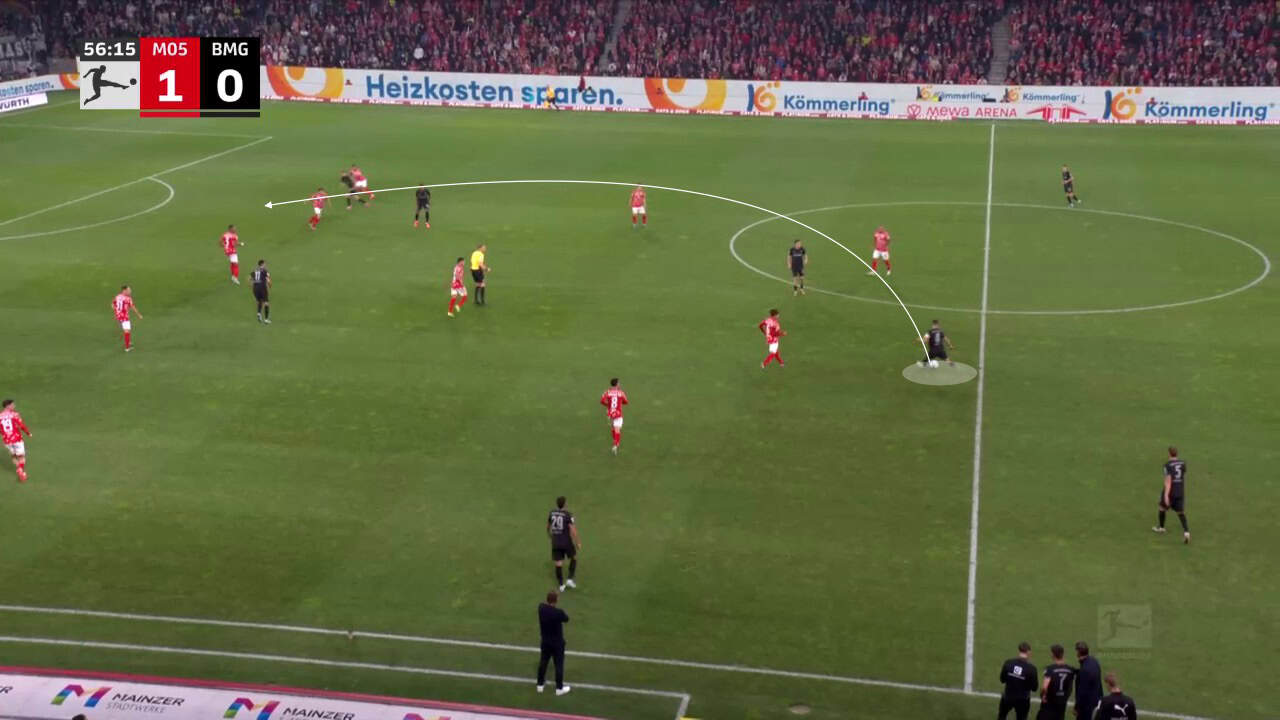
This is because Weigl has the ability to deliver a precise long ball.
His accuracy rate from long balls is 80.5%—that’s a massive figure.
And of the players who have played at least 100 long balls, only Bayern Munich‘s Dayot Upamecano is more accurate than Weigl.
Then, if you have a player who is capable of delivering accurate long balls most of the time, why not make him an integral part of your team’s style of play?
And that’s exactly what Seoane is doing.
Maximising Tim Kleindienst
Another example of just how efficient Gladbach have been under Seoane tactics in maximising the strength of their squad is Tim Kleindienst.
He can be considered one of the most successful transfers in the Bundesliga this season.
In fact, after Gladbach bought Kleindienst from Heidenheim, the striker adapted quickly and hit the ground running.
So far this season, he has scored 15 goals.
And this figure shows just how clever Gladbach have been in maximising the 29-year-old’s potential.
It is no secret that Kleindienst is good in the air.
He has scored six headers so far this season.
Yes, at 1.94 metres, he’s a big striker.
But his height is not the only thing that makes him special.
It is his ability to position himself in a defender’s blind spot.
Even when there are one or two players around him, he usually knows how to get on the end of a cross or long ball.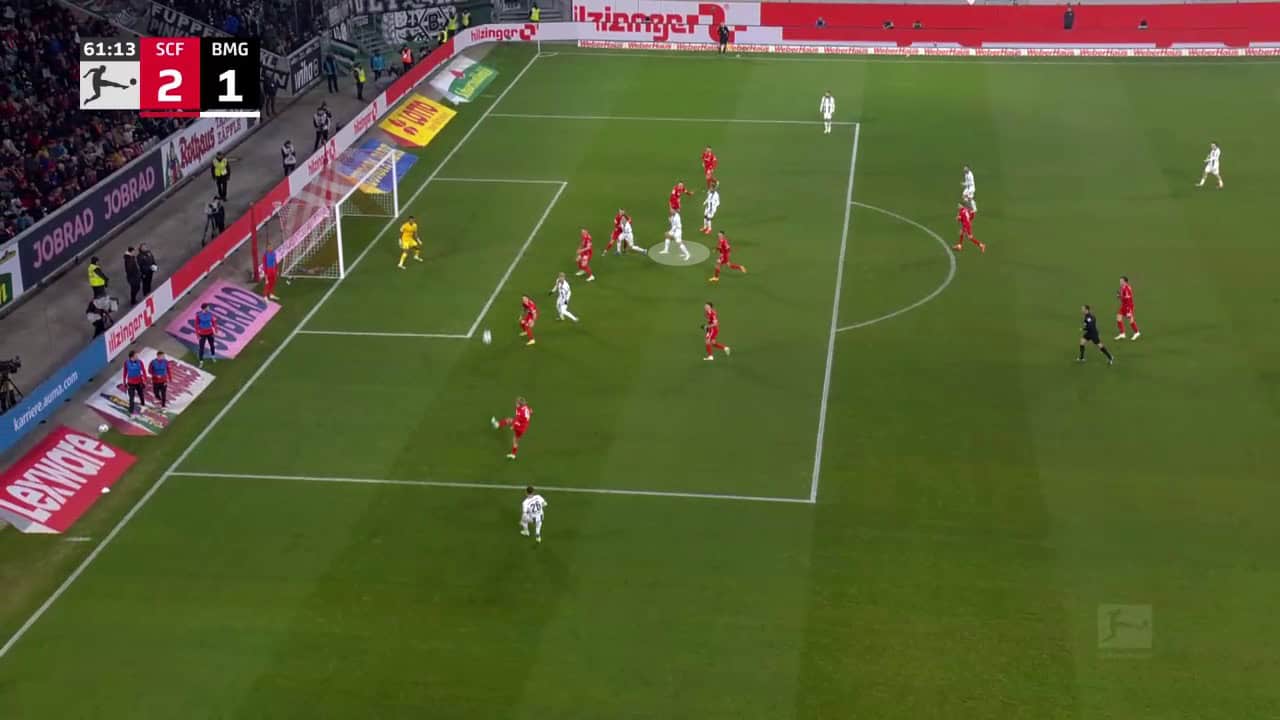
Then Gladbach often play the cross into the box to Kleindienst.
Hopefully, the striker will be able to catch it—and most of the time, he does.
Kleindienst has often won the duels because he’s in a comfortable position to head the ball—the marker has already failed to catch it.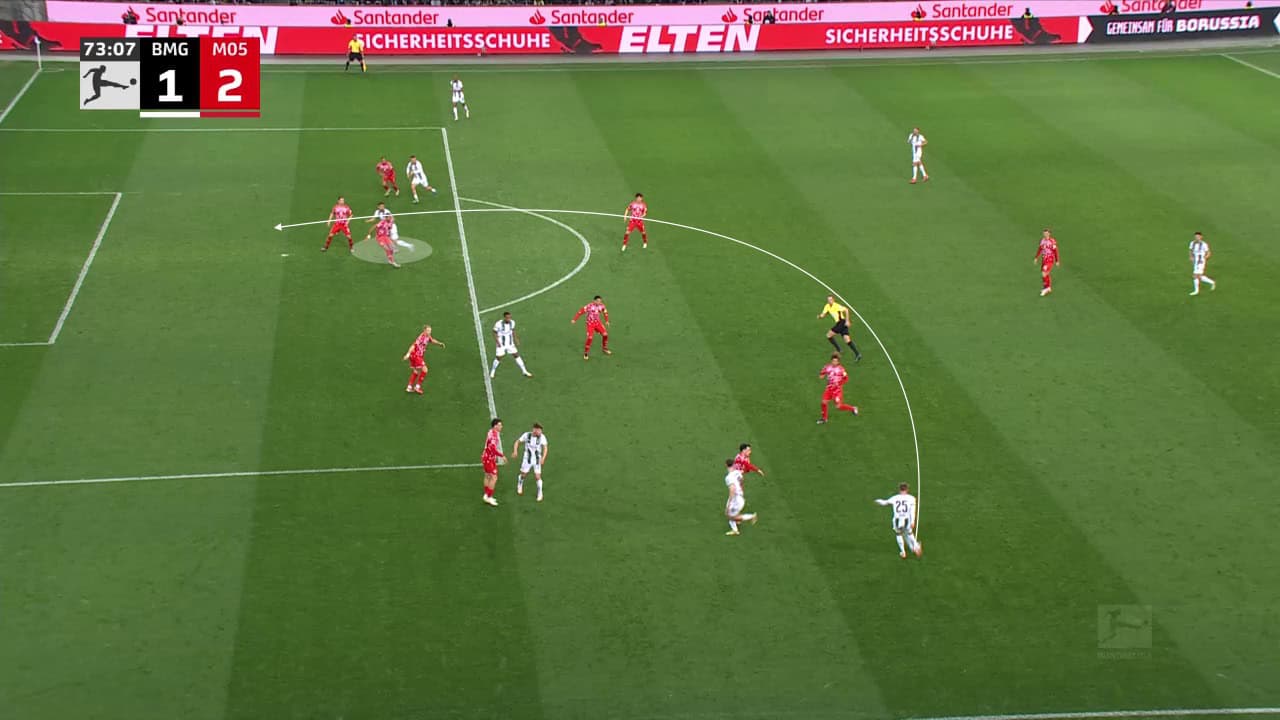
He is clever at finding space.
Even though he’s not the fastest, his intelligence helps him run efficiently into space behind the opposition’s defensive line.
In most cases, as with headers, he will have gained momentum by turning half his body towards the opposition goal, making it easier for him to turn and run.
Gerardo Seoane Use Of Underlapping Full-Backs
When we talk about how efficient Gladbach are at maximising space, we have to talk about their full-backs.
Seoane usually uses a 4-2-3-1 formation, which can be translated as a 4-2-4 in or out of possession.
They can also switch to a back five during the game.
This is usually because one of the midfielders (usually Julian Weigl) has dropped off to help the team move the ball forward during the build-up.
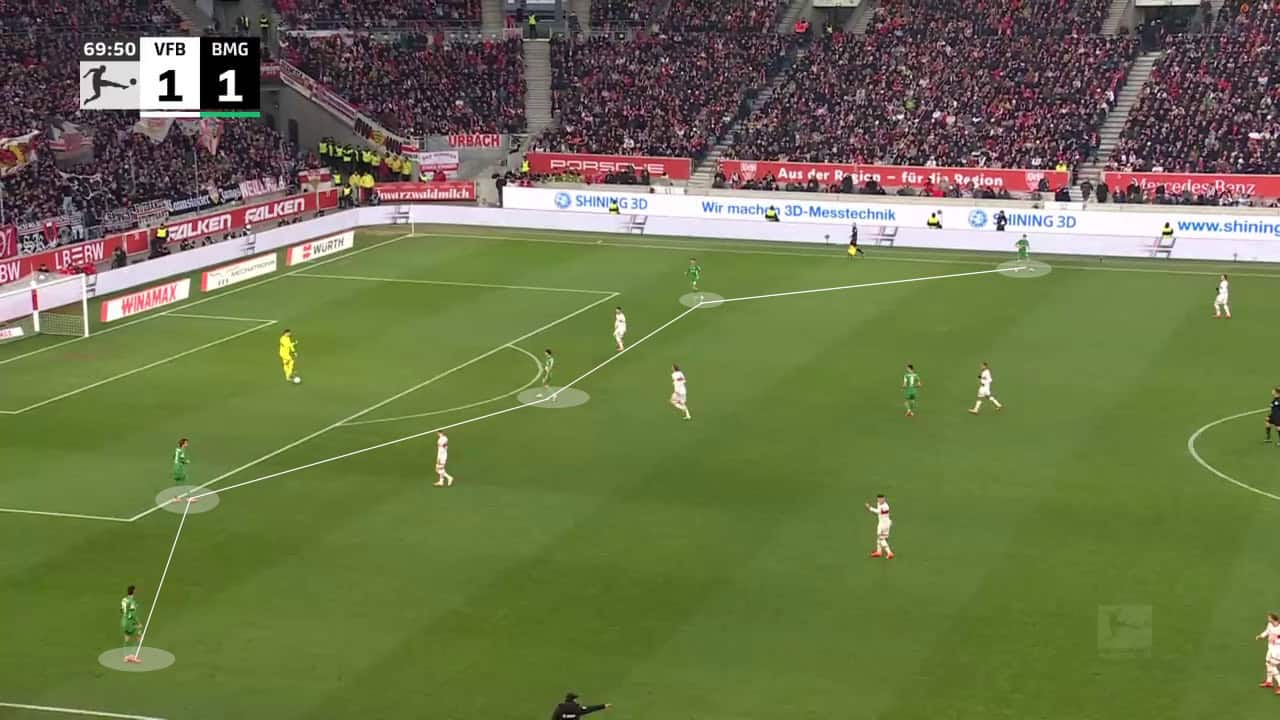 Alternatively, one of the midfielders or wingers can be dropped during the defensive phase to form a back-five.
By forming a 4-2-4 and often dropping one of the midfielders, Gladbach can run the risk of being outnumbered in the centre of the field.
On the other hand, the midfielder’s drop can cause the opponent to press, creating a lot of space in the middle of the field.
And that is something their full-backs can maximise.
Lukas Ullrich and Joe Scally often play as underlapping full-backs.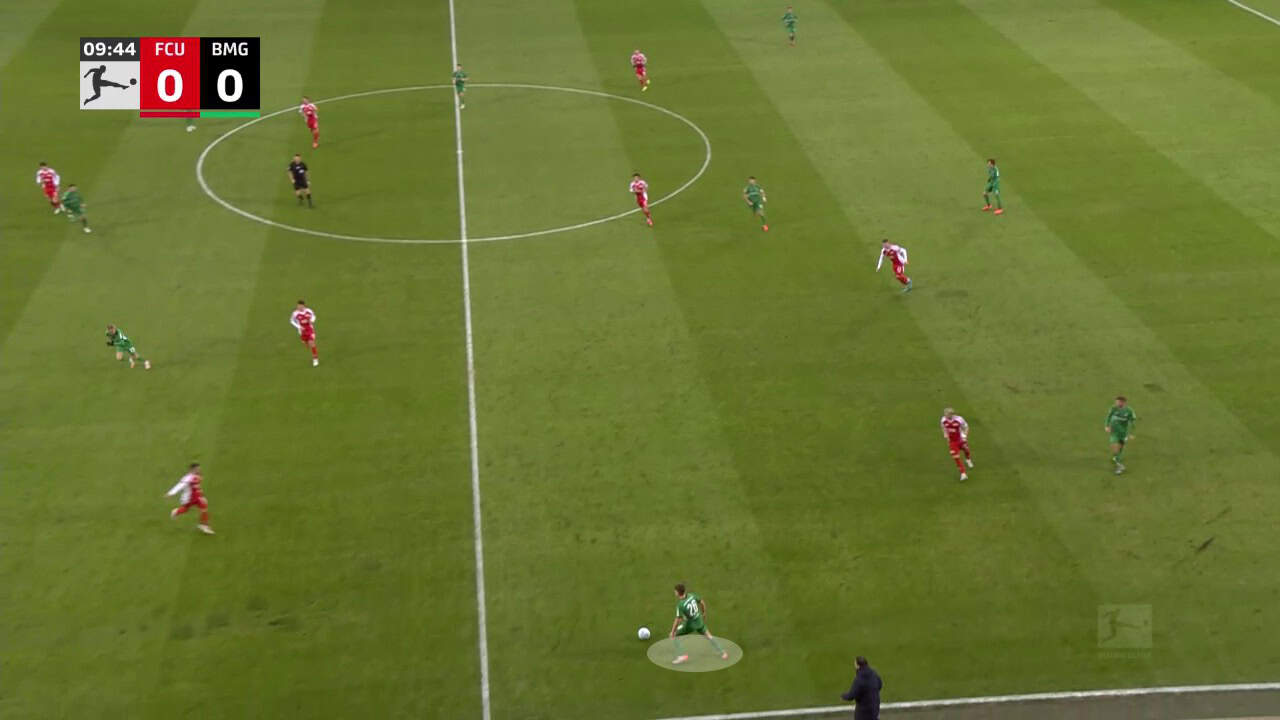
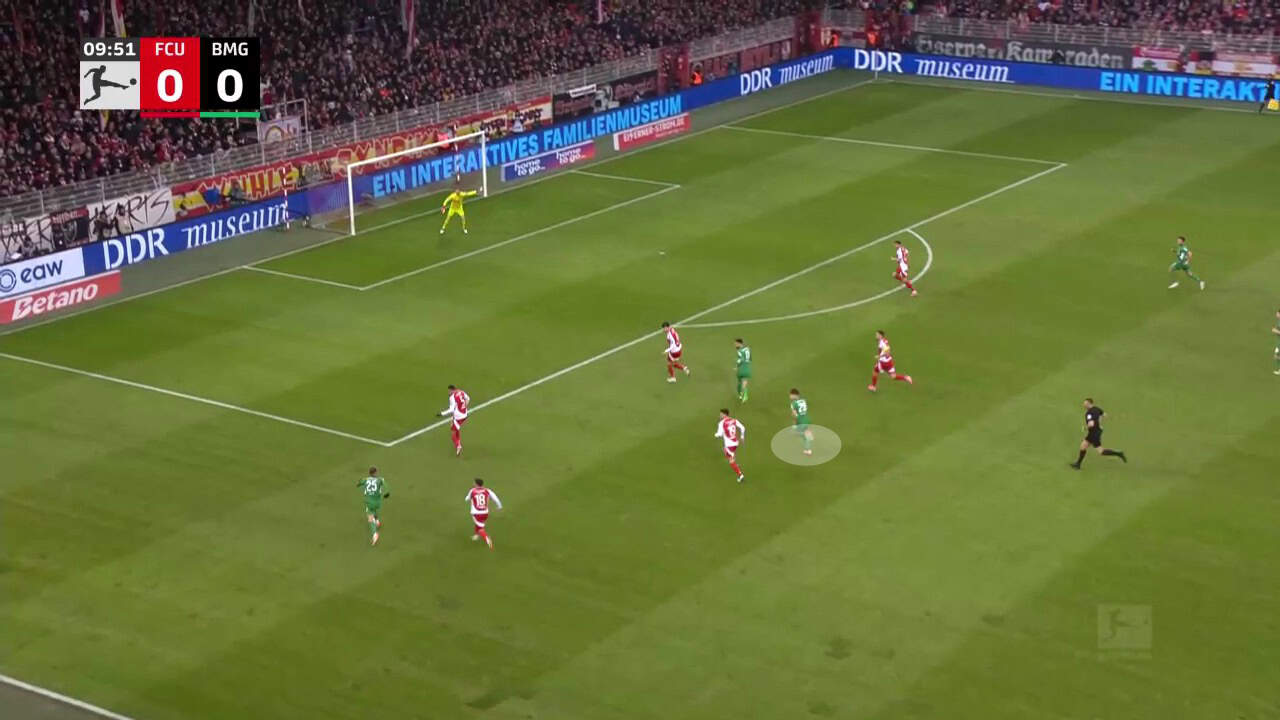 When they realise there’s space in the middle, they’ll make an underlap run into the middle rather than a vertical run to stay in the wide area.
And by making this kind of run, Gladbach are able to fill all the corridors of the pitch (centre, half spaces, flanks) while in possession.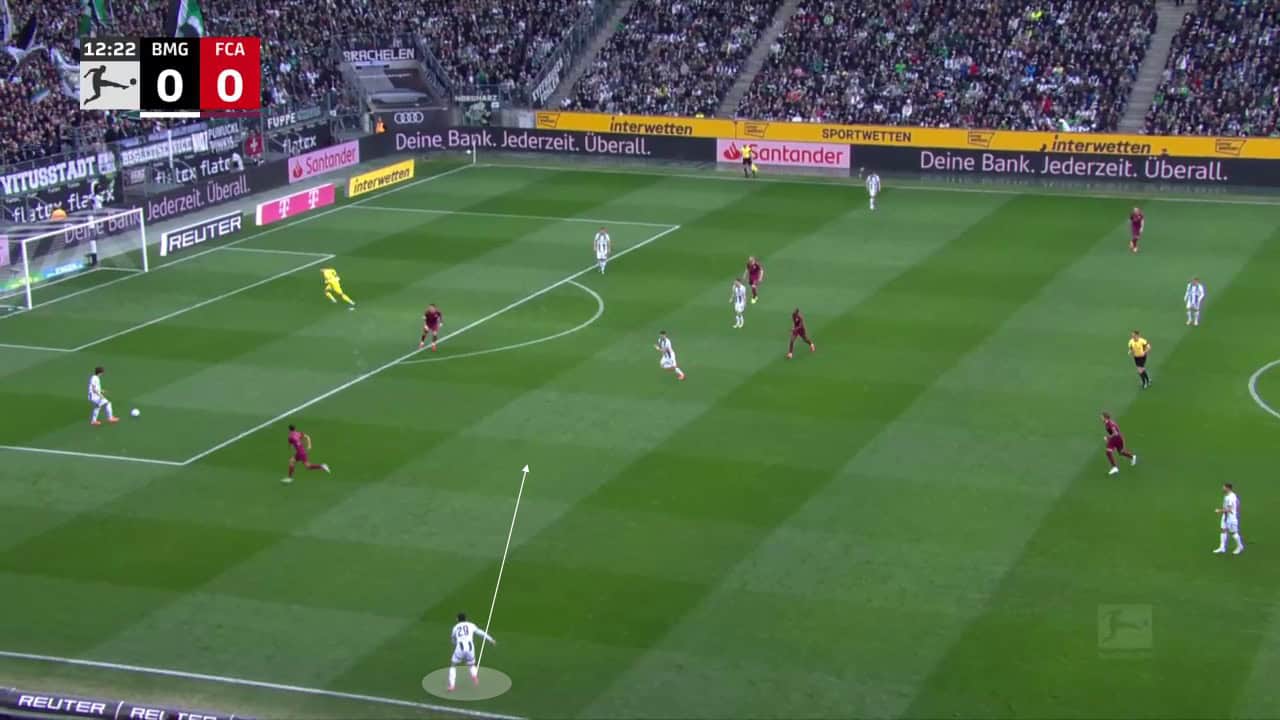
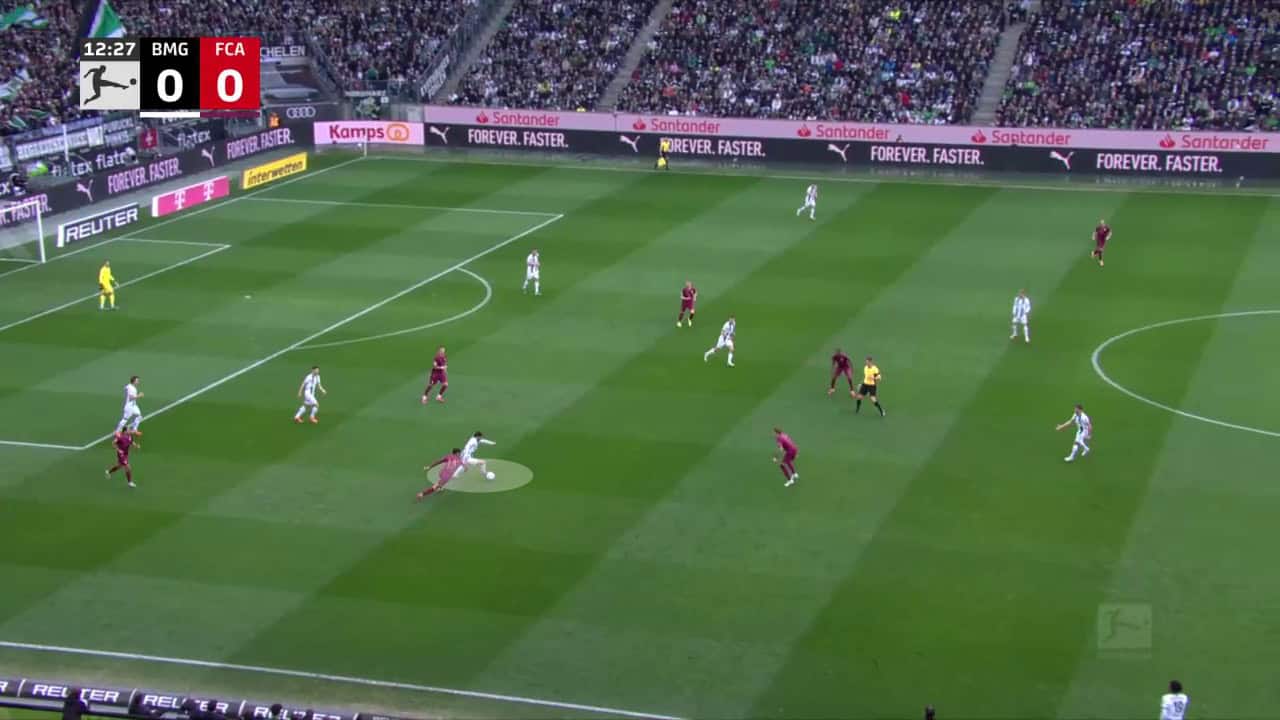 So there’s no redundancy, because they wanted to attack quickly and directly, rather than complicating their attack with a lot of combinations in some areas.
Progressiveness is the key.
Set-Piece Mastery: Ko Itakura Is Key
One thing that has stood out about Gladbach this season is how efficient they have been from set-pieces.
To put this in context, in their last two games against RB Leipzig and St. Pauli, all of Gladbach’s two goals came from set-pieces.
And they took four points from both games.
In total, Gladbach have scored 12 goals from set-pieces this season.
Only three teams have scored more than that, so it is also an impressive tally.
And the recipe for this success lies in the strategy behind the set pieces, particularly the corners.
First, they’ll have four or five players at the front or near post, and then only one player (usually Ko Itakura) at the far post.
Gladbach wanted to achieve a couple of things with this set-up.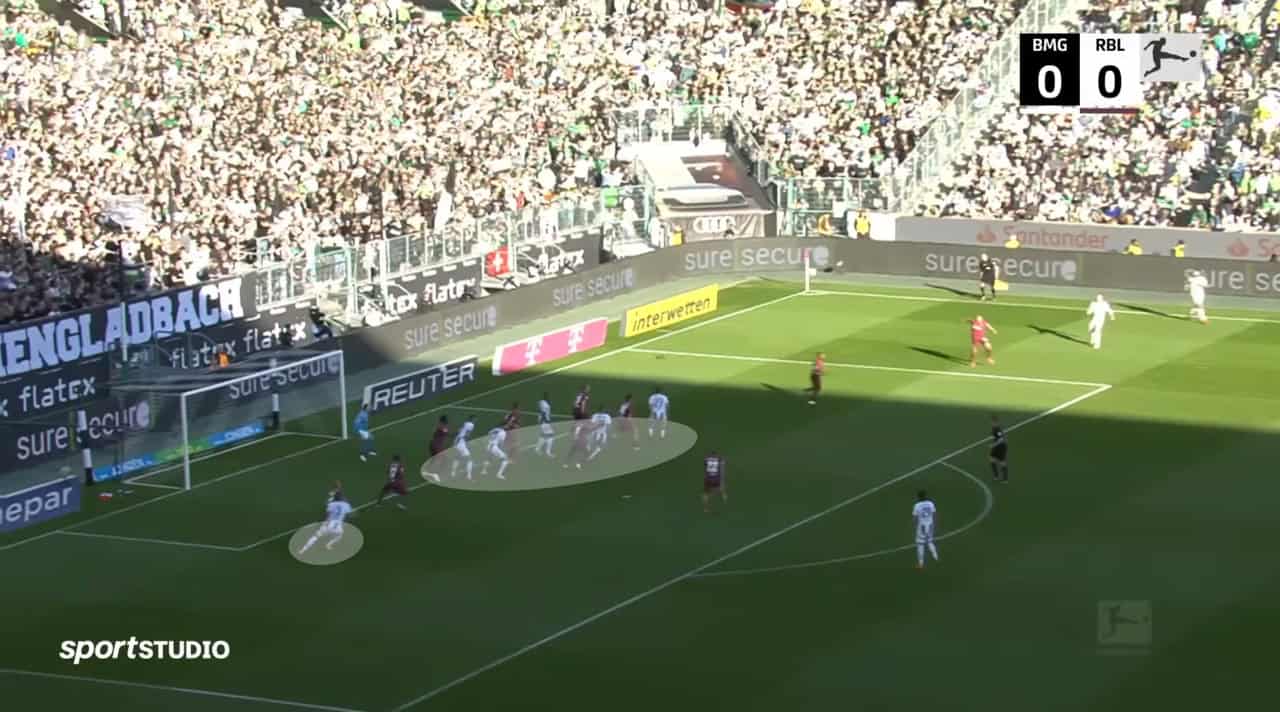
Firstly, they wanted to have enough players close to the near post so they’d have a better chance of winning the corner quickly—if the ball failed to reach the far post.
Secondly, by having a lot of players close to the near post, they hoped that Itakura would only have to deal with one player, which would also make it more likely that he’d win the challenge—Itakura has won over 64% of his aerial challenges this season.
It’s no surprise, then, that Itakura was involved in both goals against Leipzig and St. Pauli.
Against Leipzig, it was his shot that the Leipzig goalkeeper failed to parry, and Plea successfully converted the rebound.
And against St. Pauli, it was Itakura himself who scored the goal with a superb header inside the far post.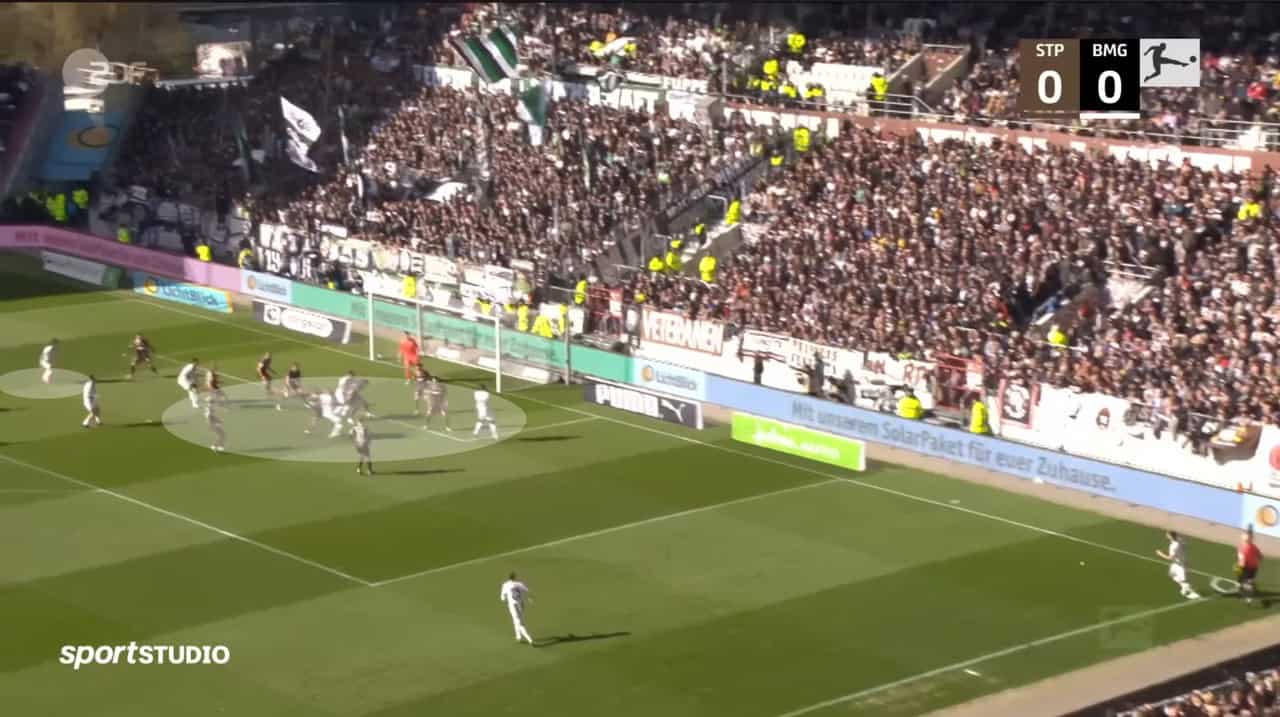
Conclusion
Gladbach may not be particularly special in attack or defence this season.
Their underlying numbers suggest that they are not a team of European competition calibre.
However, the reality is different.
Currently sitting in seventh place in the Bundesliga, Gladbach have a chance of playing in Europe next season.
And they are doing well simply by being efficient.
They are efficient in the way they set up and play.
They are efficient in releasing direct attacks, maximising players—Tim Kleindienst in particular—maximising set-pieces and maximising space.
That efficiency helps them a lot to get that three or one point that keeps them from losing.
If they’re not efficient at set-pieces, for example, they won’t get four points from the last two games; they’ll get one.
Of course, there are things they can improve on, such as their tendency to play in a wait-and-see style when their opponents are in possession, which makes them vulnerable to attack at times—hence their xGA being one of the worst.
However, Seoane seems to know that his team can cope with the opposition’s attacks—especially the bottom half.
So, he believes in and relies on his attack to produce goals.
And that belief can be kept in hand so far and perhaps makes the Borussia Arena host European nights once again next season.
