
Manchester United hosted Aston Villa in Gameweek 30 of the 2025/2026 Premier League.
The Red Devils came away with a 3-1 victory.
The result saw Manchester United maintain their third spot in the league table.
Meanwhile, Villa also managed to stay fourth as Liverpool dropped points against Tottenham Hotspur.
In the early stages of the game, the visitors dominated ball possession, but the hosts took control in the second half.
Both sides had the same number of big chances (3-3); however, United had almost twice as many shots (16-9) and fouls (10-5).
Although Villa had more touches in opponent box (31-21), United had more shots on target (6-2).
Through this tactical analysis, we aim to highlight the positive factors of Manchester United’s play, areas they struggled in, and possible solutions.
Manchester United Vs Aston Villa Lineups & Formations
Let us look at how Michael Carrick and Unai Emery fielded their squads.
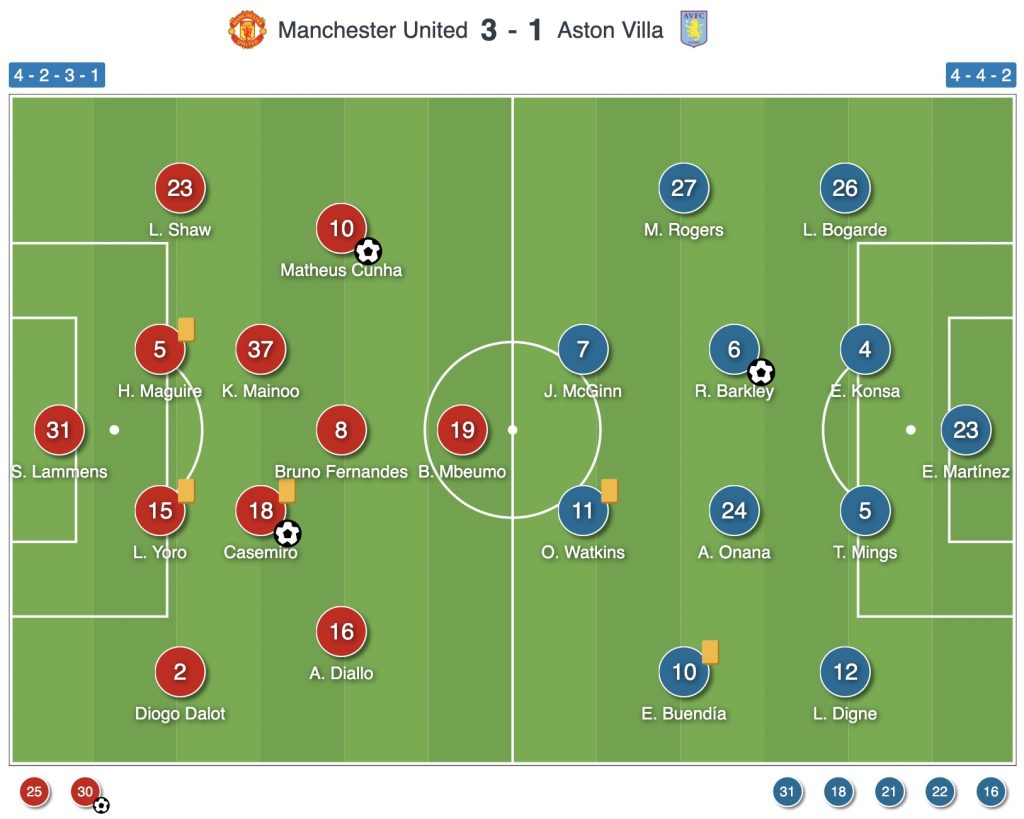
The hosts, Man United, played in a 4-2-3-1 formation.
Senne Lammens started between the sticks.
The back four were Diogo Dalot (right-back), Leny Yoro (right centre-back), Harry Maguire (left centre-back), and Luke Shaw (left-back).
Casemiro and Kobbie Mainoo played as the double pivot; the former made way for Manuel Ugarte (90’ +1).
Amad Diallo (right) and Matheus Cunha (left) were the wingers; skipper Bruno Fernandes operated as the centre attacking midfielder.
Bryan Mbeumo played as the lone striker. Benjamin Šeško replaced Mbeumo at the 75th minute.
The visitors, Aston Villa, played in a 4-4-2 formation.
Emiliano Martínez started in goal.
The back four were Lamare Bogarde (right-back), Ezri Konsa (right centre-back), Tyrone Mings (left centre-back), and Lucas Digne (left-back).
The latter made way for Ian Maatsen (82’).
Amadou Onana and Ross Barkley played as the two centre-midfielders.
The latter was replaced by Douglas Luiz (82’).
Morgan Rogers (right) and Emiliano Buendía (left) played as the wingers.
The latter made way for Andrés García (86’).
Skipper John McGinn and Ollie Watkins operated as the front two.
They were substituted by Leon Bailey (61’) and Tammy Abraham (60’), respectively.
Manchester United Areas Of Struggle
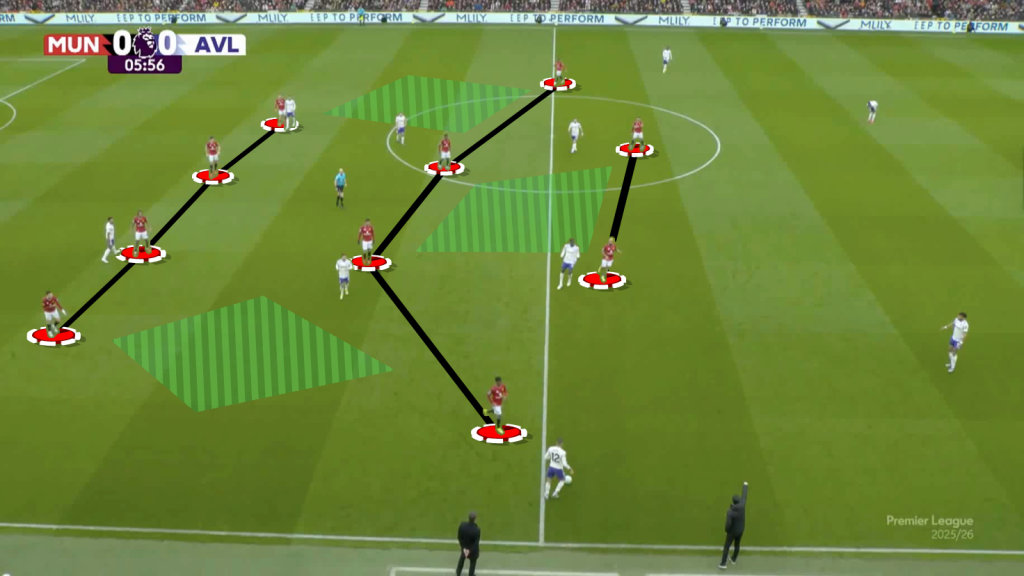
Manchester United set up in a 4-4-2 shape off the ball.
However, for the first 15 minutes or so, their shape was compact neither horizontally nor vertically.
Villa were offered spaces inside United’s structure in the half-spaces and between the lines centrally.
Consequently, they were seen playing vertical passes.
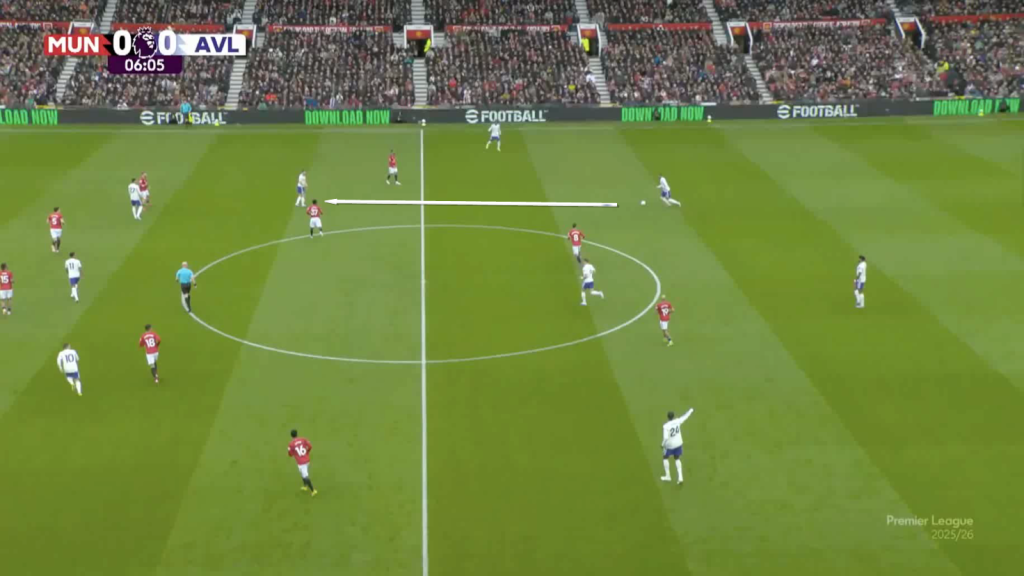
Since the midfield four and the front two were not compact horizontally, the Villa defenders found enough pockets to find their advanced players in the half-spaces.
On occasions when Manchester United pressed as a unit in the midfield third, some of the actions were disconnected in terms of spacing.
The front six stepped up to put pressure, but were not covered by their backline.
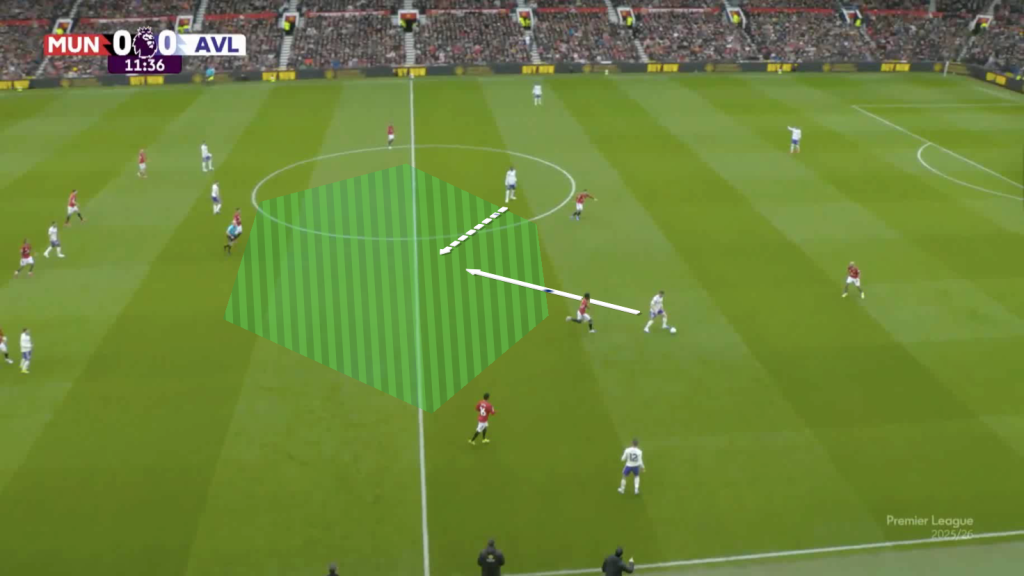
Manchester United attempt to put pressure on the ball in the wide channel.
As the ball moves infield, a United midfielder steps up to press the Villa midfielder on the ball.
Meanwhile, the other midfielder moves into the space behind the wave of pressure.
Since the United backline did not step up in time, the Villa midfielder got space to carry the ball forward.
This plight continued even in the defensive third for the hosts.
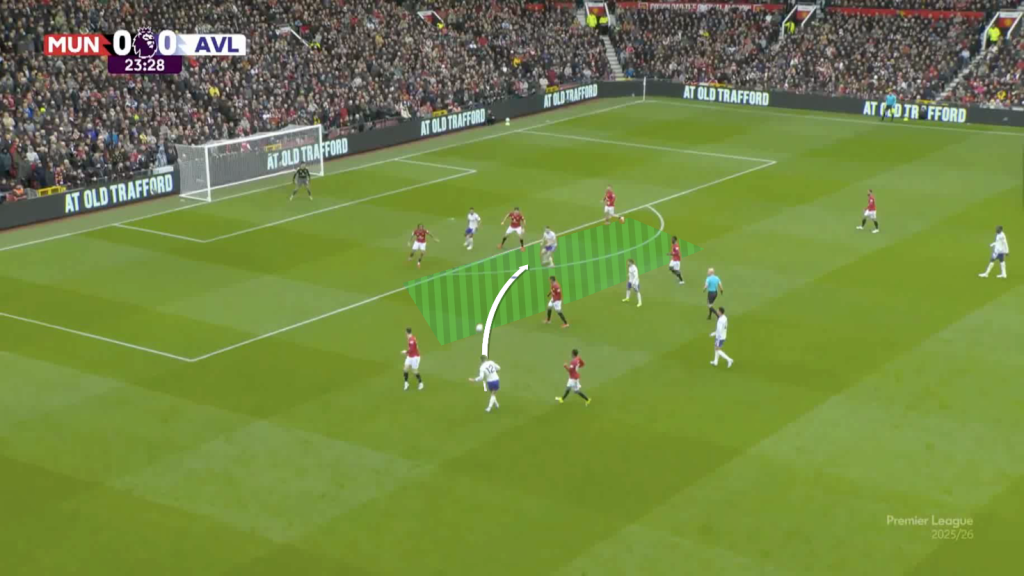
Villa’s left-back drives up with the ball; meanwhile, the passing lane to the second striker in zone-14 is open.
He receives on the turn and gets an unopposed attempt.
Manchester United were not the only ones allowing space to their opponents.
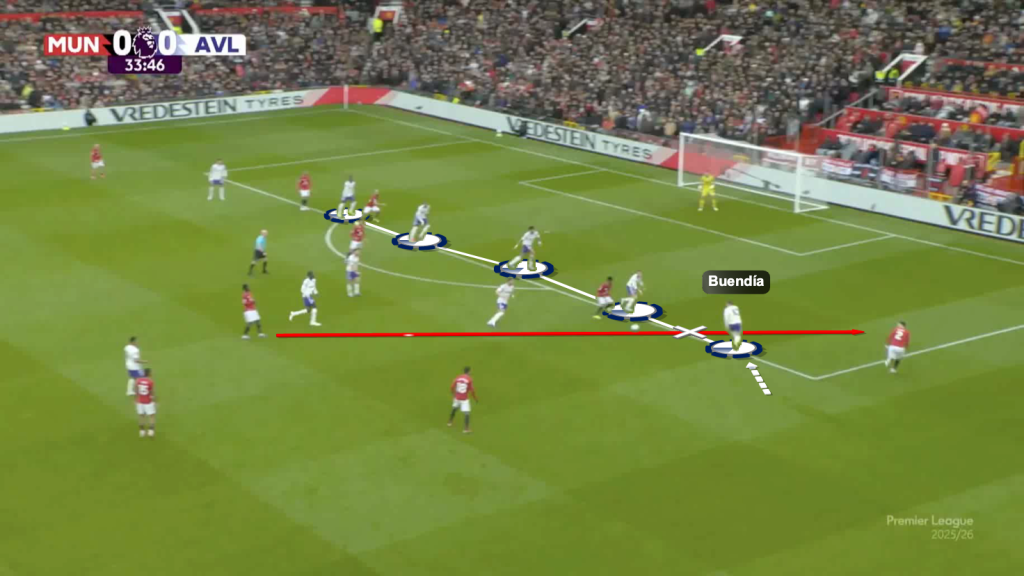
There were multiple occasions, especially in the first half, when United got the ball behind Villa’s backline.
However, their wingers covered for the full-backs and made a back five whenever necessary.
In this situation, Buendía drops to intercept a through pass, which helps them start a counterattack of their own.
There was also space behind the Villa centre-backs to deliver crosses; however, United took some time to exploit that.
There were situations where Manchester United managed to get the ball to the wide area for crosses aimed between the defenders and the goalkeeper.
Dalot whips in a cross at the back post.
With Fernandes and Mbeumo in the vicinity, there was a chance to attack the cross.
However, it dropped inside the six-yard box and was cleared away for a corner-kick.
The space offered by Villa in multiple situations allowed their opponents to exploit more than they did.
The goal scored by Aston Villa highlights the lapse in concentration by the United players.
Barkley is available in the half-space when the ball is on the right flank.
Once it goes in for a cross, all the United players turn their attention to the ball.
As Digne whips it in from the left side, none of the United players tracks Barkley; thus, he gets enough space and time to finish unopposed.
Manchester United Positive Impact
Manchester United Defensive Phase
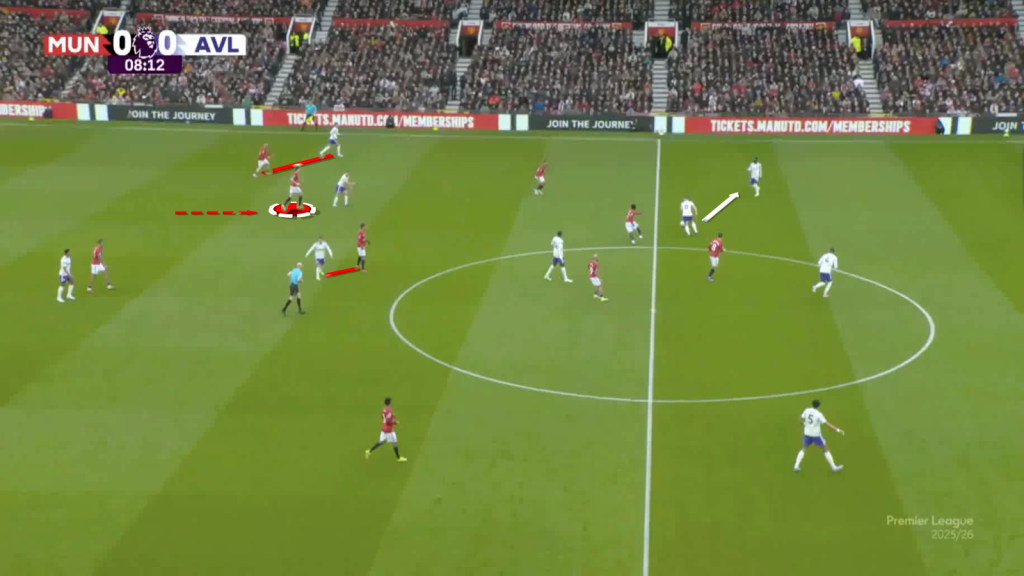 The issue of Villa finding vertical passes inside the Red Devils’ structure was addressed by the defenders stepping up in midfield.
Maguire steps to mark an opponent in the half-space.
As a result, the player on the ball cannot play forward.
He is forced to play sideways, which slows Villa’s attack.
Man United’s shape was relatively more compact once the game progressed.
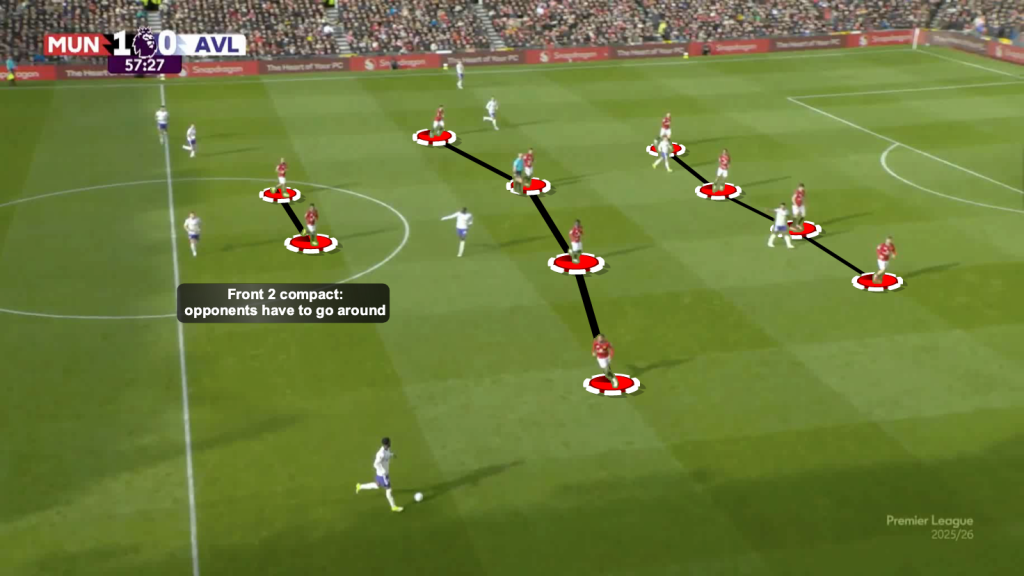
The front two stay more compact.
This forces the opponent to go around the block.
The midfield four are also slightly closer; when the ball travels to the wide channel, they slide across to engage in the wide area.
This was a contributor to slowing down the opposition’s central progression.
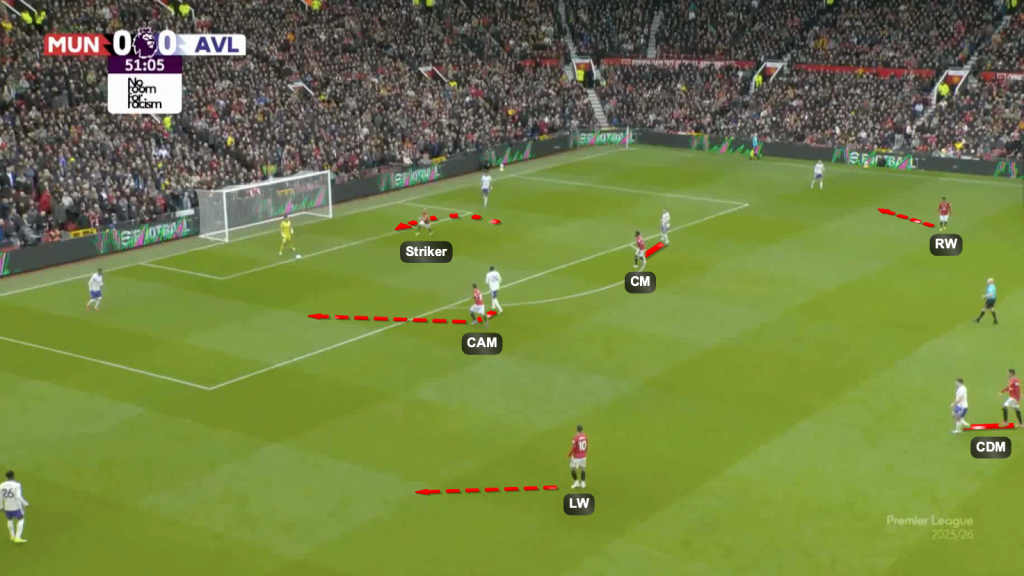
During static build-up moments from the opponent, Manchester United pressed high in a compact shape.
The majority of the players covered the central zone, with the wingers in the half-space.
The press was initiated by the striker, who forced play to one side.
Since all the short options were cut out, the goalkeeper had to play long.
In dynamic build-up moments from the opponent, the pivots stepped up to stay close to the opposition pivots.
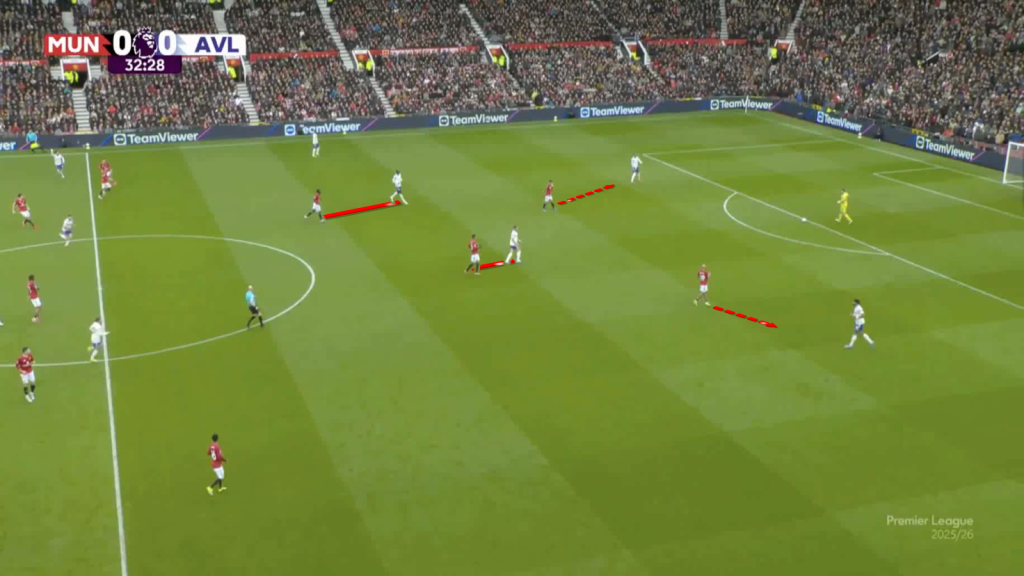
This granted freedom to the front two to press the centre-backs.
Meanwhile, the wingers stayed slightly deeper in the wide area, in case the ball reached the full-backs.
In a situation like this, the opponent will be forced to play long unless they are adept at positional rotations, especially in the midfield.
Despite having a high line like their opponents, Man United reacted well in transition.
The defensive players were quick to get back in shape inside the defensive third.
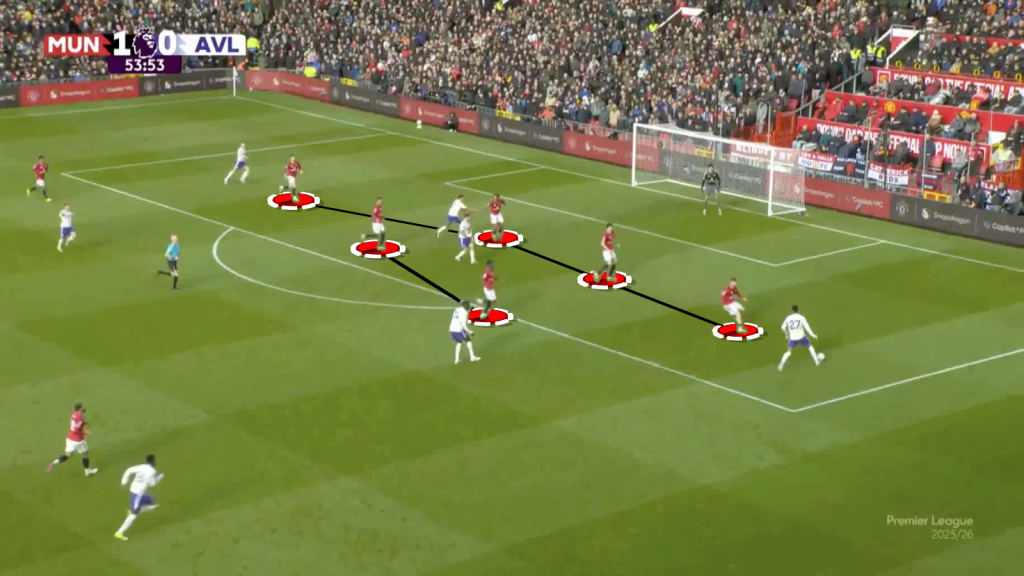
Villa are on an attack while United get back in their 4-2 structure inside the box.
This significantly reduces their chances of conceding a shot on target.
Manchester United Attacking Phase
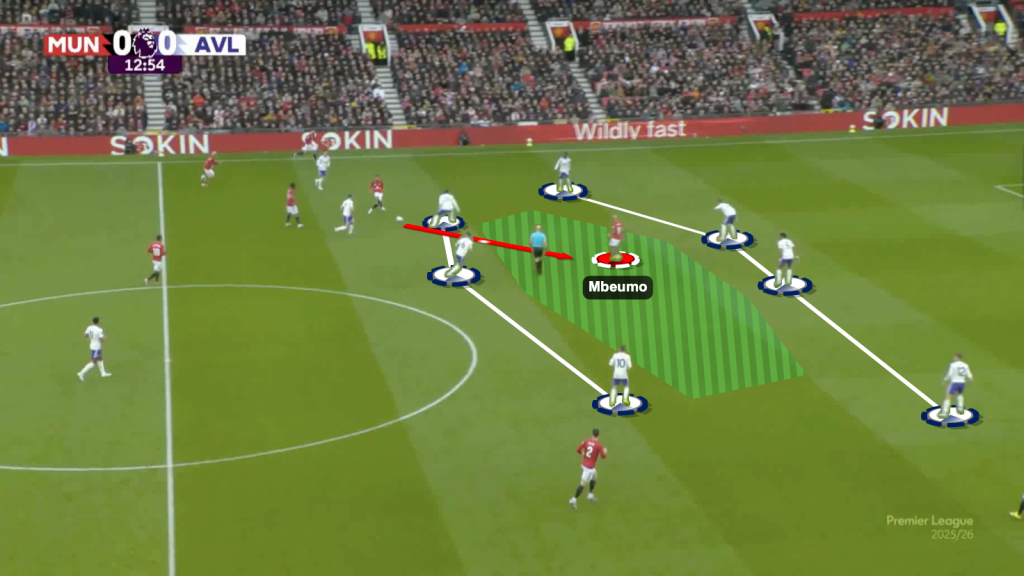
Villa were not vigilant in maintaining compactness, either horizontally or vertically.
Man United’s attacking players, like Mbeumo, were often seen exploiting this by receiving between the lines.
He often shifted the ball wide within two touches, which completed in-to-out passes.
By receiving the ball, he drew the players around him; thus, offloading the ball created more space for his teammates.
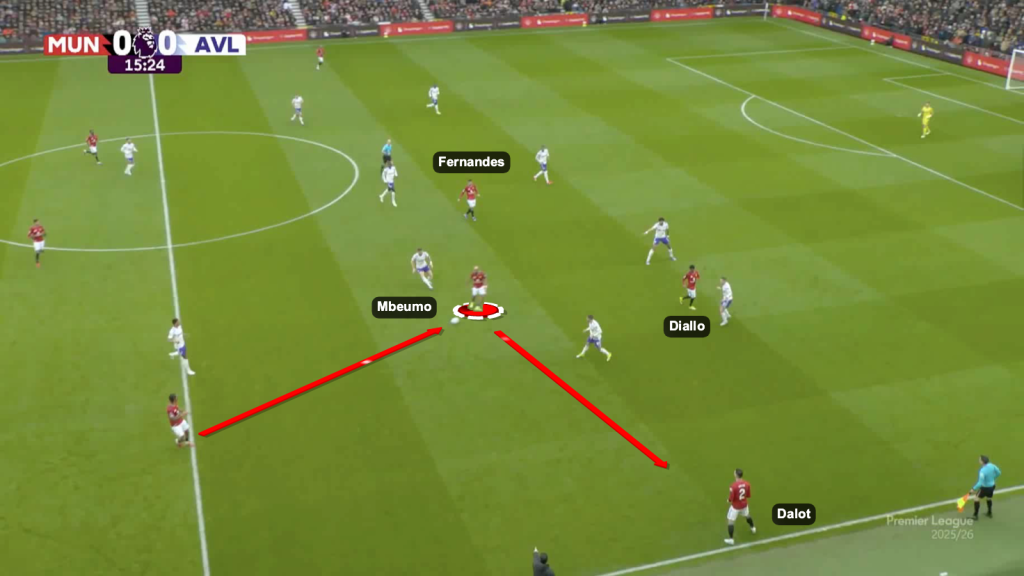
He was also seen dropping in the half-space.
Meanwhile, either Fernandes, Diallo, or Cunha occupied the void left by him.
Villa also played with a high line, which Man United recognised in the second half.
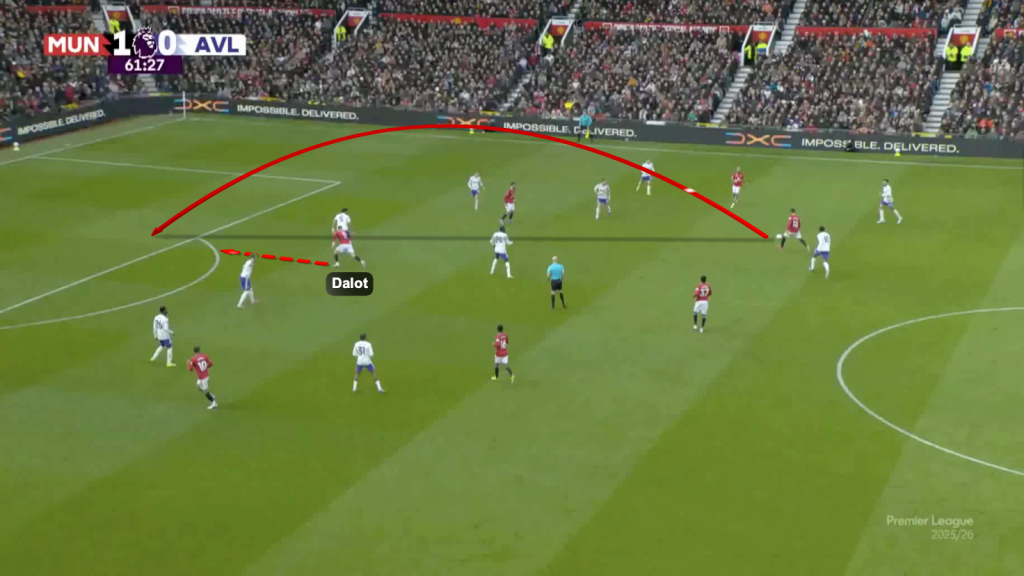 This move works out because of the quickness of execution.
Mbeumo cuts inside and plays it to Casemiro, who plays the through pass on one touch.
Dalot’s blind-side run is well-timed, which keeps him onside.
This is similar to how Cunha’s goal came.
Apart from keeping a high line, Villa’s backline is not compact enough in the given situation.
The through pass from Fernandes and the run from Cunha are well timed; the attack ends up as a perfect set-up for a far-corner finish.
The variable to track for Villa was that Cunha, Mbeumo, and Dalot took turns making runs in behind.
These movements spelled danger anytime Villa held a high line.
The through passes came in the form of over-the-top balls, diagonal switches, and line-breaking ground passes.
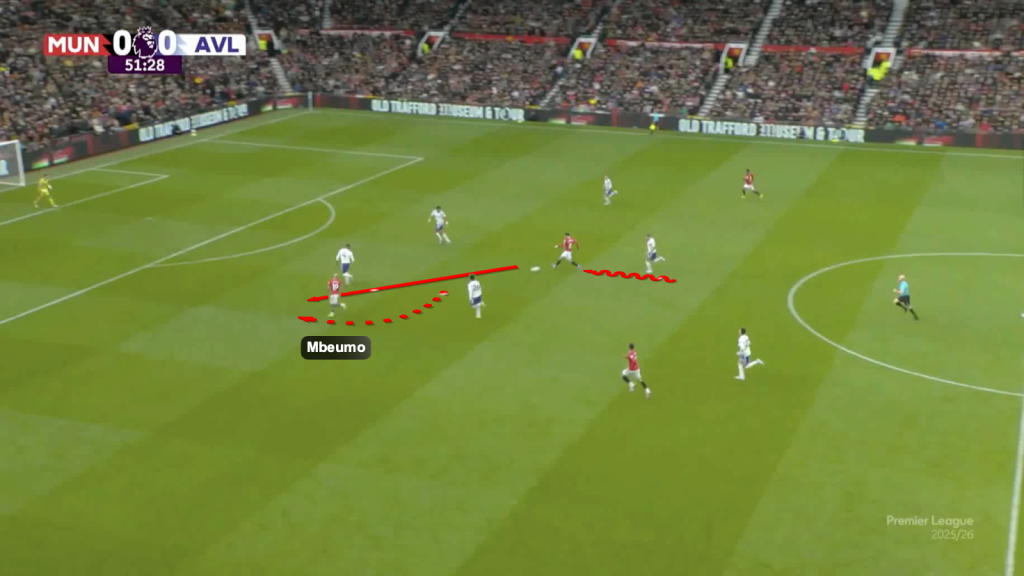
During transition moments, Carrick’s side were often up against two or three Villa defenders, delaying the attack.
Running at them with intensity fetched the hosts some degree of penetration.
Fernandes carries the ball down the central zone till the time Mbeumo peels wide to create a bit of space for himself.
Upon receiving from the Portuguese, the Cameroonian needs just a touch to set himself up for a shot, which is parried away for a corner.
Man United eventually opened the scoring from this particular set-piece.
Casemiro starts his curved movement at the correct time to lose his marker.
He reaches the near post by the time the ball arrives, and gets a free header by virtue of being positioned at the near post defender’s blind side.
United had a variety of ways to create shot actions.
It also included making quick third-man combinations to create space inside the opponent’s structure.
The wingers (Cunha and Diallo) frequenting the half-spaces helped their case as they received inside passes from the full-backs to lay it off to the third man moving infield.
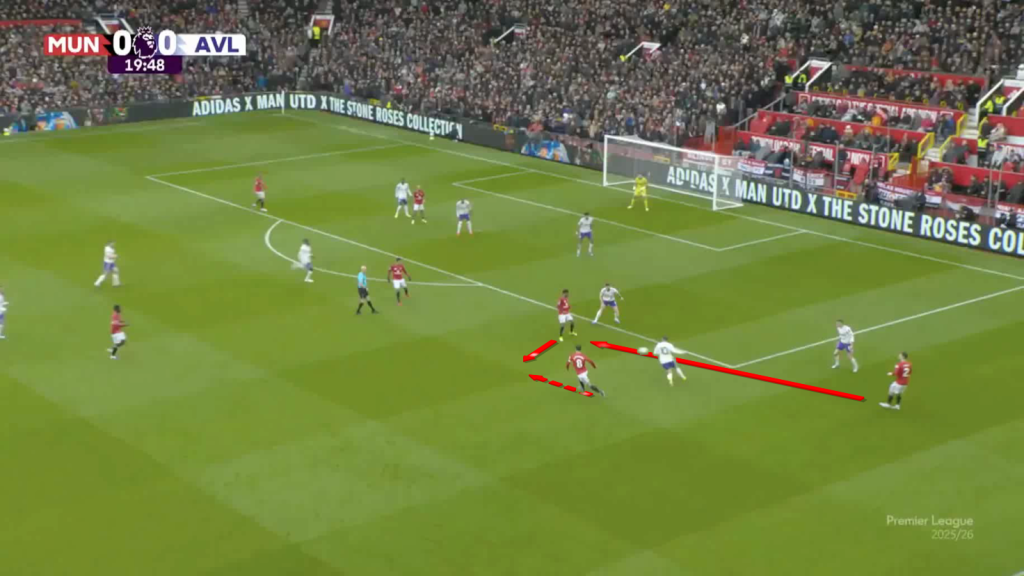
Dalot finds Diallo, who sets it to Fernandes moving inside.
Diallo does not have enough space to turn himself, as he is under pressure upon taking a touch.
A third man moving at a convenient angle makes a difference, as it can create a shooting angle or, at the very least, help keep possession by moving the ball into space.
Šeško’s goal was the nail in the coffin for Emery’s side.
It was an apt representation of how the game was going for the Villans.
The visitors were lethargic in reacting to second balls, which was to the Red Devils’ advantage as they pounced on any loose balls.
This is what happened in the build-up to their third goal.
Cunha’s attempted low cross was initially blocked; however, the ball was not cleared.
Šeško was the first to react to the second ball; the Slovenian, who was starved of service, took no time to find the back of the net.
Manchester United Solutions
The three points were fortunate, but there were some moments of concern for Carrick’s side, which need to be addressed.
After clearing the first ball, United were inconsistent in shutting down all the gaps to keep their opponents out.
Villa squeezed a few passes in-behind every once in a while.
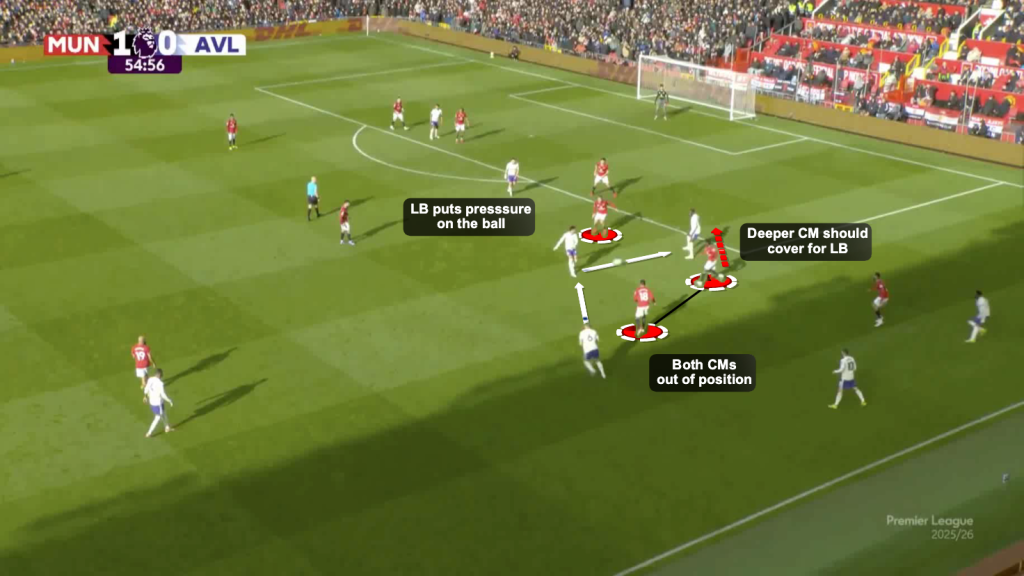
Manchester United are in the process of moving their back line up to engage with the opponent.
However, the left-back and both the pivots are out of position.
The pass goes through them on this occasion, which gives the opposition a box entry.
As the left-back puts pressure on the ball, essentially covering for a midfielder, the solution would be for the nearest midfielder to drop into the full-back’s position to provide mutual cover.
This way, they can delay the attack and reorganise without being exposed.
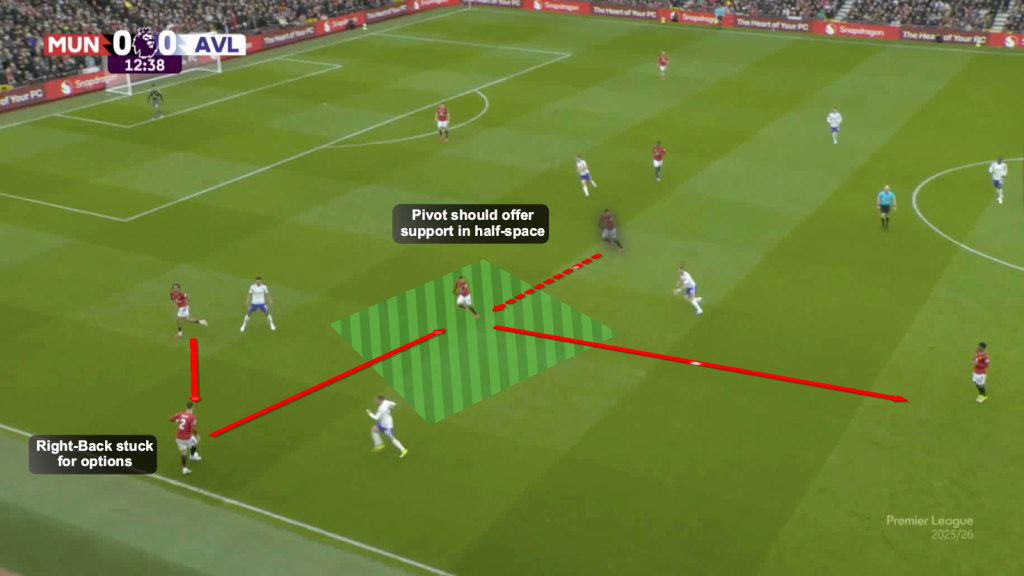
The centre-back plays to the full-back, who lacks short options to go forward.
The passing lane to the near-side winger is narrow and risky.
This is where the near-side pivot can step in.
He can offer support in the half-space and be the link player to move the ball forward.
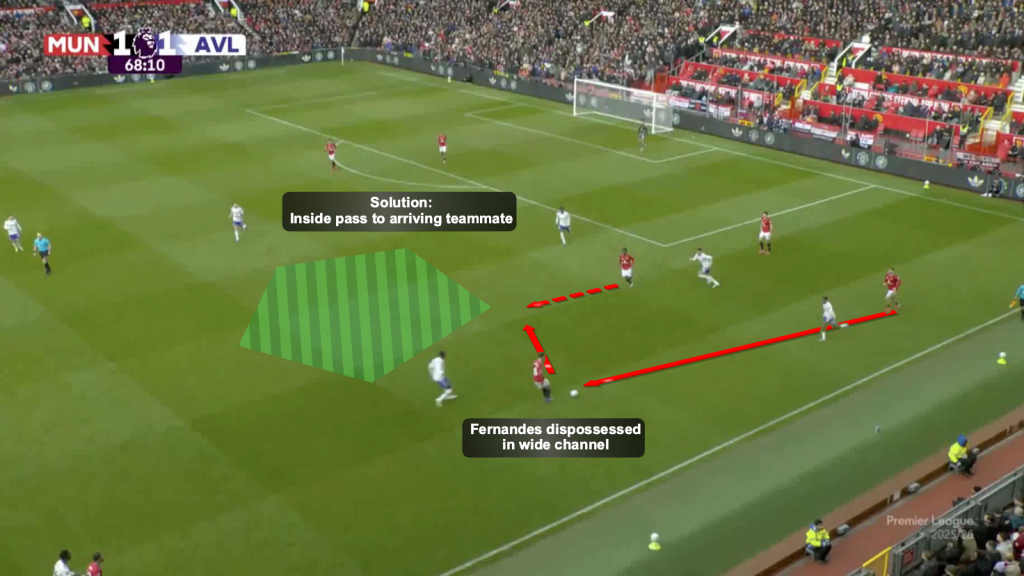
Another build-up moment of struggle.
The full-back plays to the attacking midfielder, who gets stuck with pressure on his back.
The solution is for the near-side pivot to move up and receive the set pass inside.
With enough space in the half-space, United can progress the ball forward.
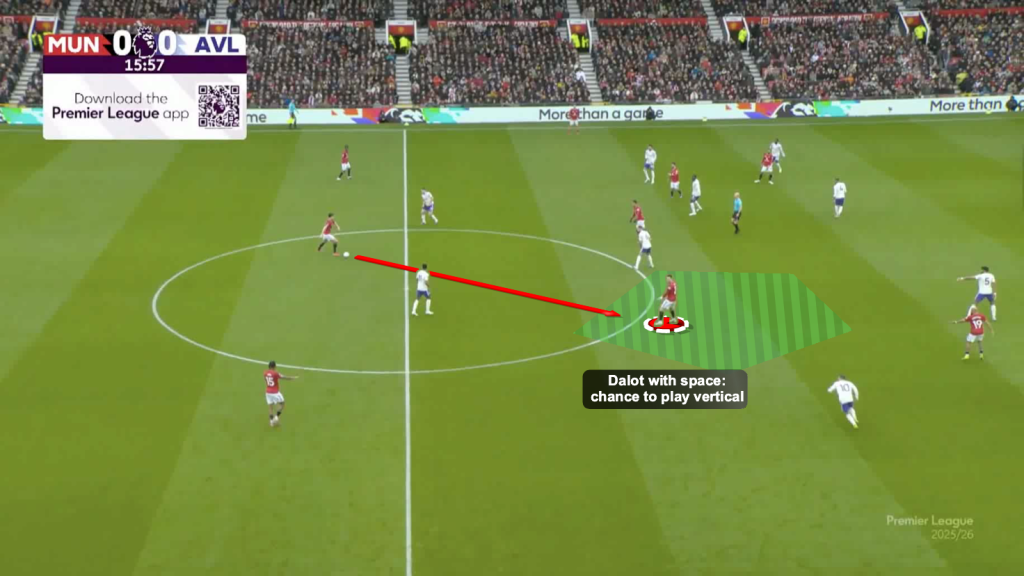
Manchester United did not showcase a lot of moments of penetration down the central channel.
There were situations where Dalot inverted and added a number in midfield.
Villa were inadequate in tracking this; however, United did not use these opportunities to their full extent.
Conclusion
Manchester United initially struggled in terms of keeping their 4-4-2 shape horizontally and vertically compact.
Aston Villa enjoyed some penetration before the Red Devils fixed it, with the centre-backs stepping up.
Man United also struggled with penetration during the first half, especially with nobody attacking the crosses between the opposition defenders and the goalkeeper.
After the initial phase of uncertainty ended, they looked more comfortable in their more compact defensive shape.
Their high press forced Villa to play long, as most central options were cut out.
Mbeumo, Cunha, and Dalot making runs in-behind, along with the former popping up to receive between the lines and the half-spaces, helped United achieve more progression into the final third.
