Total Football Analysis
Once.Sport
  • Football Analysis
    • Data Analysis
    • Formations
      • 2-2-4 Formation
      • 2-3-5 Formation
      • 3-1-4-2 Formation
      • 3-2-2-3 Formation
      • 3-2-4-1 Formation
      • 3-1-6 Formation
      • 3-3-4 Formation
      • 3-4-1-2 Formation
      • 3-4-2-1 Formation
      • 3-4-3 Formation
      • 3-5-1-1 Formation
      • 3-5-2 Formation
      • 4-1-4-1 Formation
      • 4-2-2-2 Formation
      • 4-2-3-1 Formation
      • 4-2-4 Formation
      • 4-3-1-2 Formation
      • 4-3-3 Formation
      • 4-4-2 Formation
      • 4-5-1 Formation
      • 5-3-2 Formation
      • 5-4-1 Formation
      • 6-3-1 Formation
    • Head Coach Analysis
    • Match Analysis
    • Player Analysis
    • Recruitment Analysis
    • Set Piece Analysis
    • Tactical Theory
    • Tactical Preview
    • Team Analysis
    • Training Analysis
    • Tactical Analysis
    • Scouting Report
  • Competition
    • ALL Competitions
    • English Premier League
    • Champions League
    • La Liga
    • Bundesliga
    • Serie A
    • Ligue 1
    • Eredivisie
    • EFL Championship
    • FIFA World Cup 2022
    • WEURO 2022
    • Women’s Super League
    • NWSL
    • Belgian First Division A
    • A-League
    • Liga Profesional de Argentina
    • Austrian Bundesliga
    • Campeonato Brasileiro Série A
    • DFB Pokal
    • 1. HNL
    • Danish Superliga
    • EFL League One
    • EFL League Two
    • FA Cup
    • EFL Cup
    • Indian Super League
    • K-League
    • J1 League
    • Liga MX
    • Copa América 2021
    • Copa del Rey
    • MLS
    • Eliteserien
    • Euro 2020
    • Primeira Liga
    • Scottish Premiership
    • Allsvenskan
    • Europa League
    • UEFA Nations League
    • Liga AUF Uruguaya
  • Coaches
    • All Coaches
    • Alfred Schreuder
    • Ange Postecoglou
    • Antonio Conte
    • Arne Slot
    • Bo Svensson
    • Brendan Rodgers
    • Bruno Lage
    • Carlo Ancelotti
    • Christophe Galtier
    • Claude Puel
    • Claudio Ranieri
    • David Moyes
    • Dean Smith
    • Diego Simeone
    • Domenico Tedesco
    • Frank Lampard
    • Eddie Howe
    • Edin Terzić
    • Emma Hayes
    • Erik ten Hag
    • Ernesto Valverde
    • Gennaro Gattuso
    • Gerardo Seoane
    • Gian Piero Gasperini
    • Giovanni van Bronckhorst
    • Graham Potter
    • Igor Tudor
    • Imanol Alguacil
    • Jesse Marsch
    • Jonas Eidevall
    • Jorge Sampaoli
    • José Bordalás
    • José Mourinho
    • Julen Lopetegui
    • Julian Nagelsmann
    • Julien Stéphan
    • Jürgen Klopp
    • Luciano Spalletti
    • Lucien Favre
    • Manuel Pellegrini
    • Marcelo Bielsa
    • Marco Rose
    • Marco Silva
    • Massimiliano Allegri
    • Mauricio Pochettino
    • Maurizio Sarri
    • Mikel Arteta
    • Niko Kovač
    • Nuno Espírito Santo
    • Oliver Glasner
    • Patrick Vieira
    • Paulo Fonseca
    • Pep Guardiola
    • Peter Bosz
    • Rafa Benítez
    • Ralf Rangnick
    • Ralph Hasenhüttl
    • Roger Schmidt
    • Roy Hodgson
    • Sean Dyche
    • Sérgio Conceição
    • Simone Inzaghi
    • Sonia Bompastor
    • Stefano Pioli
    • Steffen Baumgart
    • Steven Gerrard
    • Thiago Motta
    • Thomas Frank
    • Thomas Tuchel
    • Unai Emery
    • Vincenzo Italiano
    • Xavi
  • Teams
    • ALL Teams
    • AC Milan
    • Ajax Amsterdam
    • Arsenal
    • AS Monaco FC
    • Atalanta
    • Atlético Madrid
    • FC Barcelona
    • FC Bayern Munich
    • Borussia Dortmund
    • Celtic FC
    • Chelsea FC
    • Everton F.C.
    • Inter Milan
    • Juventus F.C.
    • Leeds United F.C.
    • Liverpool FC
    • Manchester City
    • Manchester United FC
    • Paris Saint-Germain
    • Rangers FC
    • RB Leipzig
    • Real Madrid CF
    • Tottenham Hotspur
    • West Ham United
  • Players
    • ALL Players
    • Alisson Becker
    • Bukayo Saka
    • Erling Haaland
    • Harry Kane
    • Jack Grealish
    • John Stones
    • Julián Alvarez
    • Kalvin Phillips
    • Kevin De Bruyne
    • Kyle Walker
    • Kylian Mbappé
    • Lamine Yamal
    • Lionel Messi
    • Luis Díaz
    • Mohamed Salah
    • Phil Foden
    • Virgil Van Dijk
  • Contact
  • Write For TFA
No Result
View All Result
No Result
View All Result
Total Football Analysis
No Result
View All Result
Home Match Analysis

Liverpool Vs Manchester City [1–2] – Premier League 2025/2026: Pep Guardiola’s Kloppian Tactics – Tactical Analysis

Juan Lauz by Juan Lauz
February 10, 2026
in Match Analysis, 4-3-1-2 Formation, 4-4-2 Formation, Analysis, Arne Slot, Bernardo Silva, Liverpool FC, Manchester City, Pep Guardiola, Premier League, Tactical Analysis
0
Liverpool Vs Man City 20252026

Anfield is often a setting in which the most elaborate game plans must be simplified.

The tempo, atmosphere, and territorial aggressiveness of Liverpool make every visit a test of emotional and tactical endurance.

In that context, Pep Guardiola’s Manchester City competed through a specific adjustment that stood out even within the Catalan coach’s long history of tactical adaptations.

Rather than insisting on prolonged control through midfield circulation, City presented a surprisingly direct, vertical and reactive version of themselves.

At times, this approach seemed to dialogue more closely with the historical principles of Jürgen Klopp’s Liverpool than with the Guardiola who dominated English football through possession, pause, and the rational occupation of interior spaces.

It would not be far-fetched to think that the presence of Pep Lijnders, now part of City’s coaching staff, played a role in shaping this plan, not as an ideological rupture but as a contextual reinterpretation of certain principles.

Two main ideas structured City’s approach at Anfield, especially during the first half.

On the one hand, an offensive proposition with limited midfield circulation, wide full-backs, three dynamic midfielders and three narrow forwards.

On the other hand, counterpressing was used as the primary strategy, supported by interior traps, ball recoveries in advanced areas, and immediate attacks after regaining possession.

From there, City managed to unsettle Liverpool in phases where they have historically been dominant.

This tactical analysis article aims to break down those ideas.

Liverpool Vs Manchester City Lineups & Formations

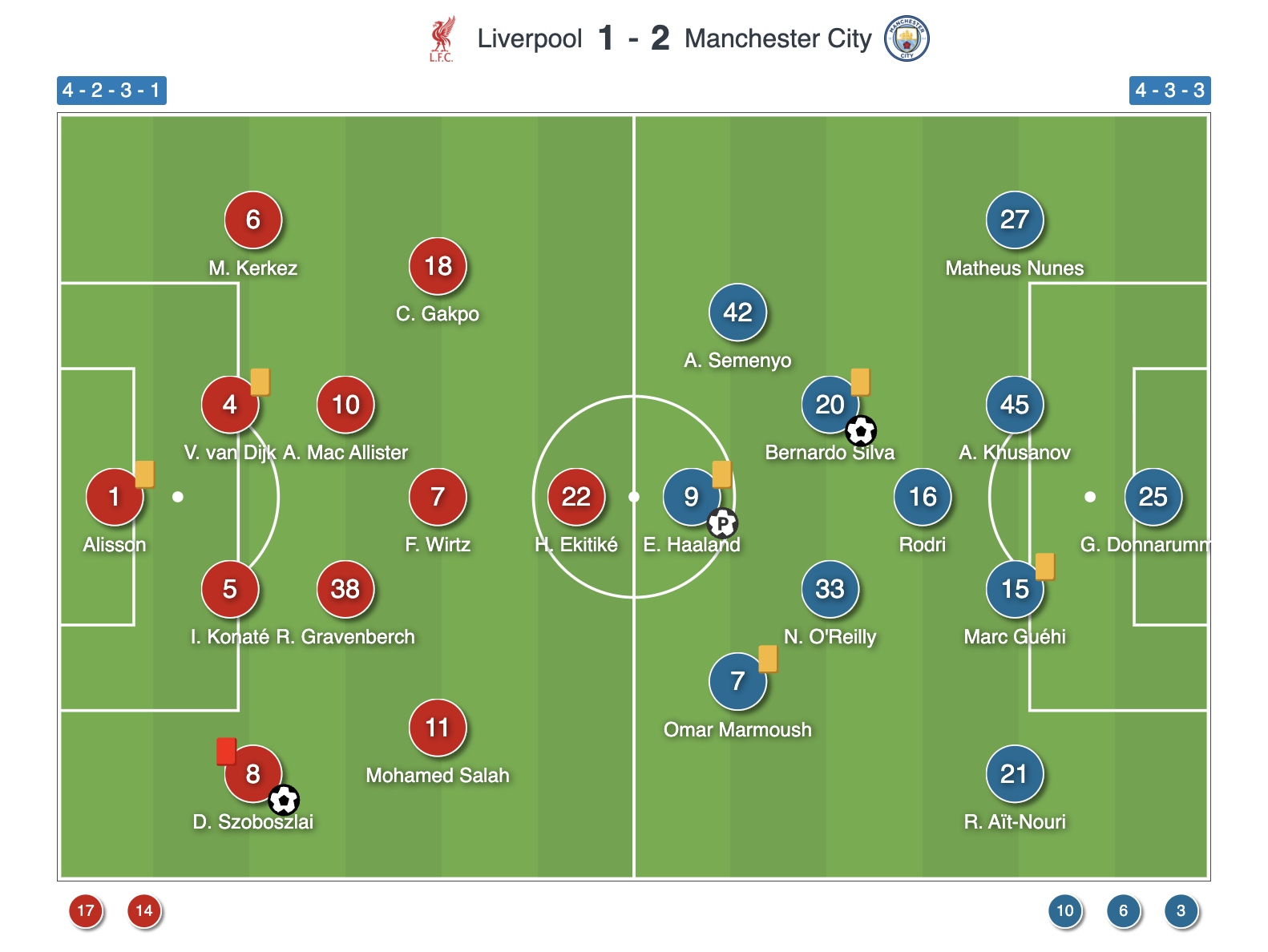
The hosts set up in a 4-2-3-1 with Alisson Becker in goal behind a back four of Dominik Szoboszlai, Ibrahim Konaté, Virgil van Dijk and Milos Kerkez.

Ryan Gravenberch and Alexis Mac Allister played deep midfield roles behind Florian Wirtz, with Mohamed Salah and Cody Gakpo on the wings and Hugo Ekitiké up front.

The visitors are listed below in a 4-3-3 formation, but were more of a narrow 4-3-1-2 in reality.

Gianluigi Donnarumma played in goal behind Matheus Nunes, Abdukodir Khusanov, Marc Guéhi and Rayan Aït-Nouri.

Rodri was at the base of midfield behind Bernardo Silva, Nico O’Reilly and Antoine Semenyo with Omar Marmoush partnering Erling Haaland up front.
Screenshot 2026 02 10 at 09.30.12


Manchester City’s Out-Of-Possession Structure

The first major adjustment appeared without the ball.

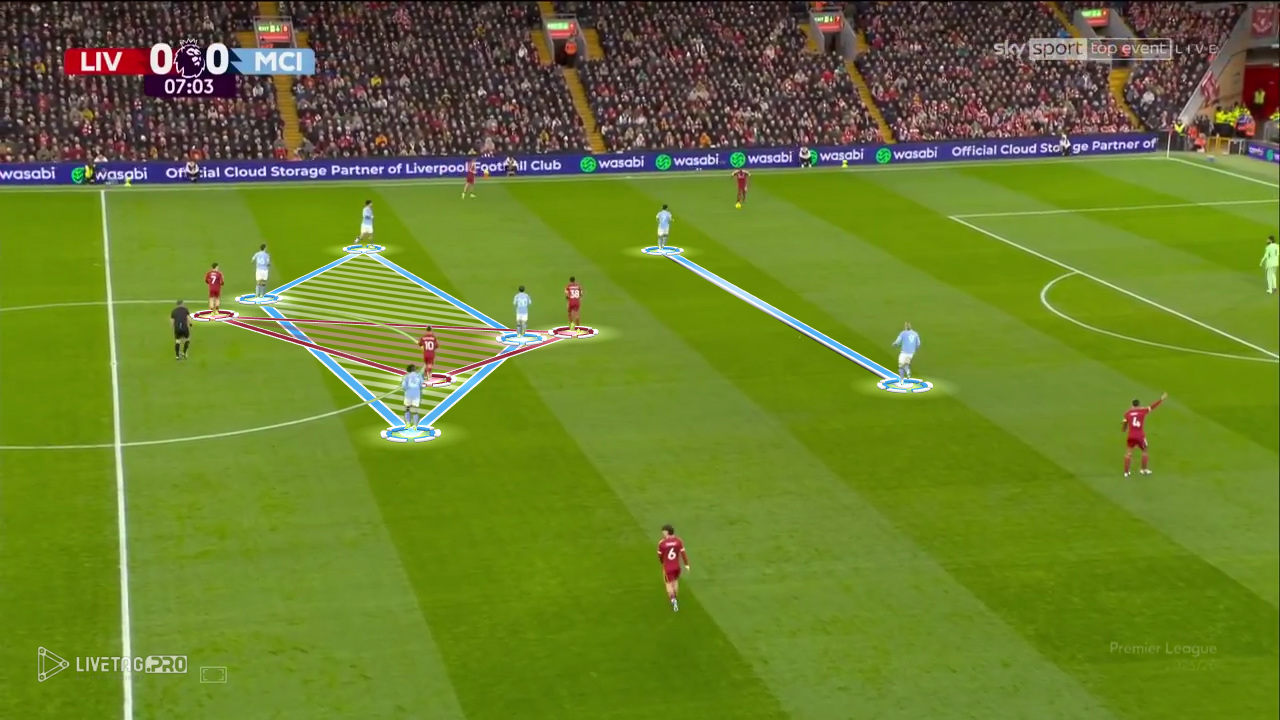
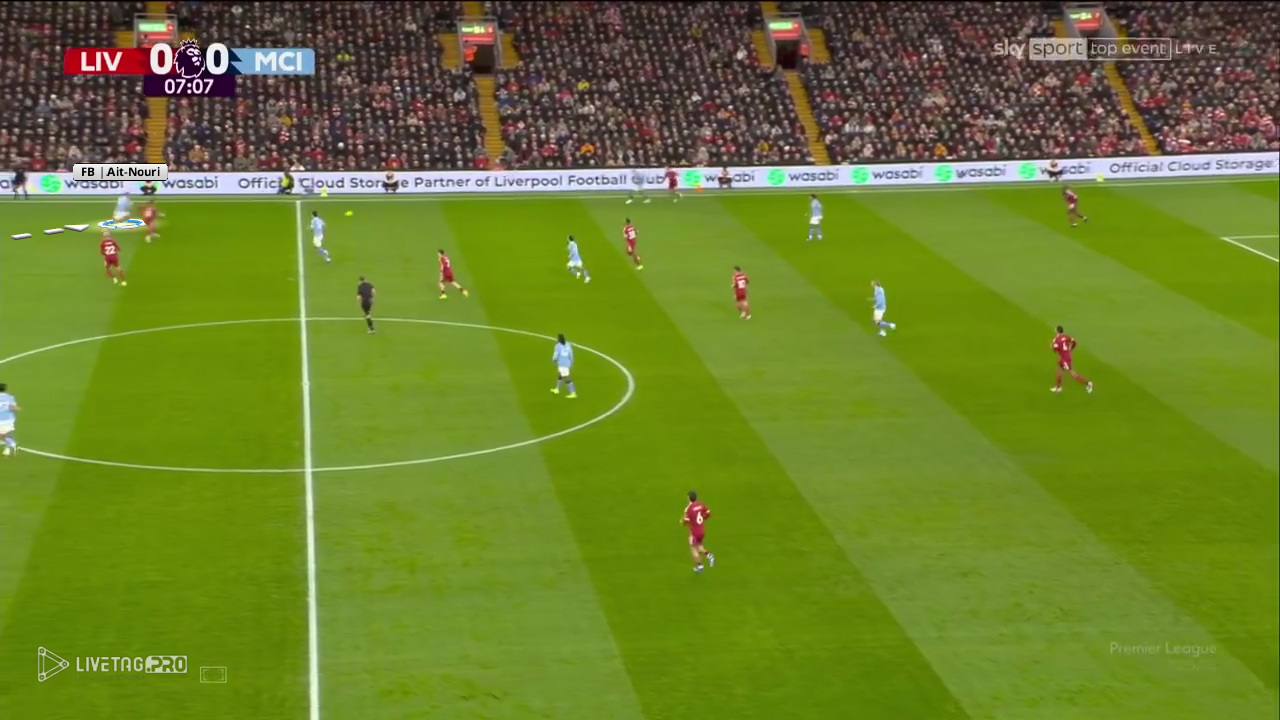
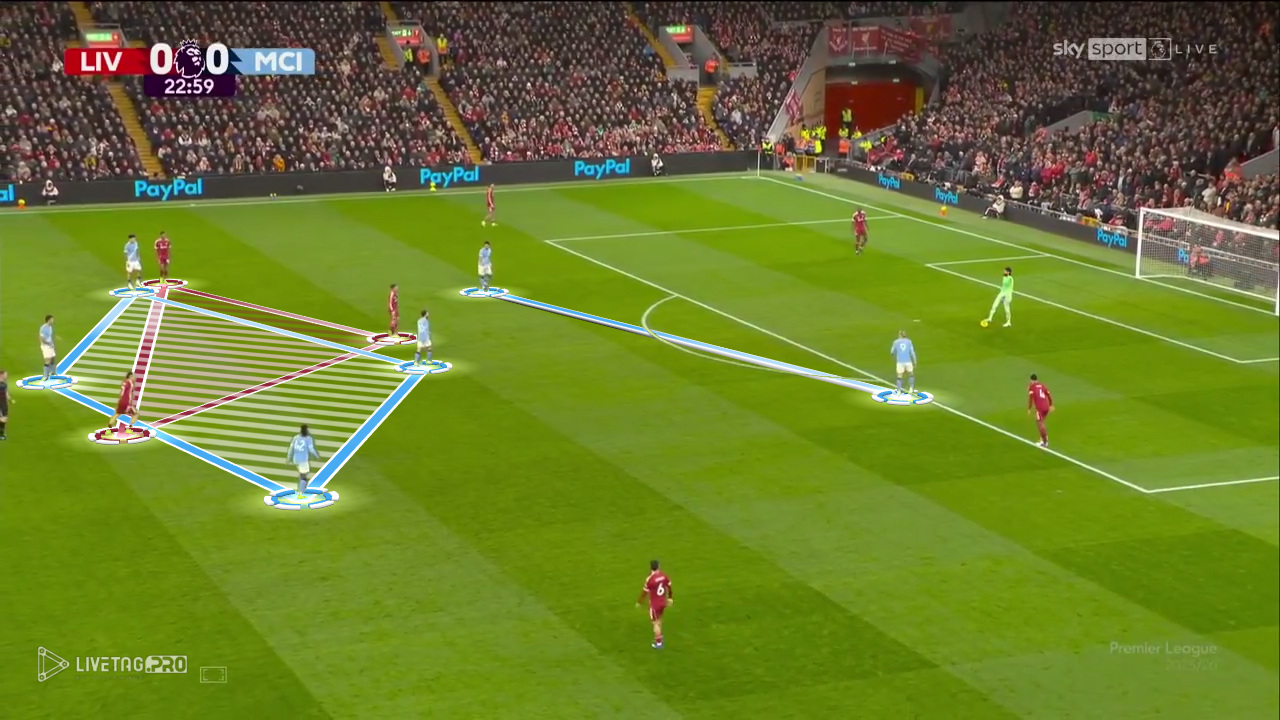
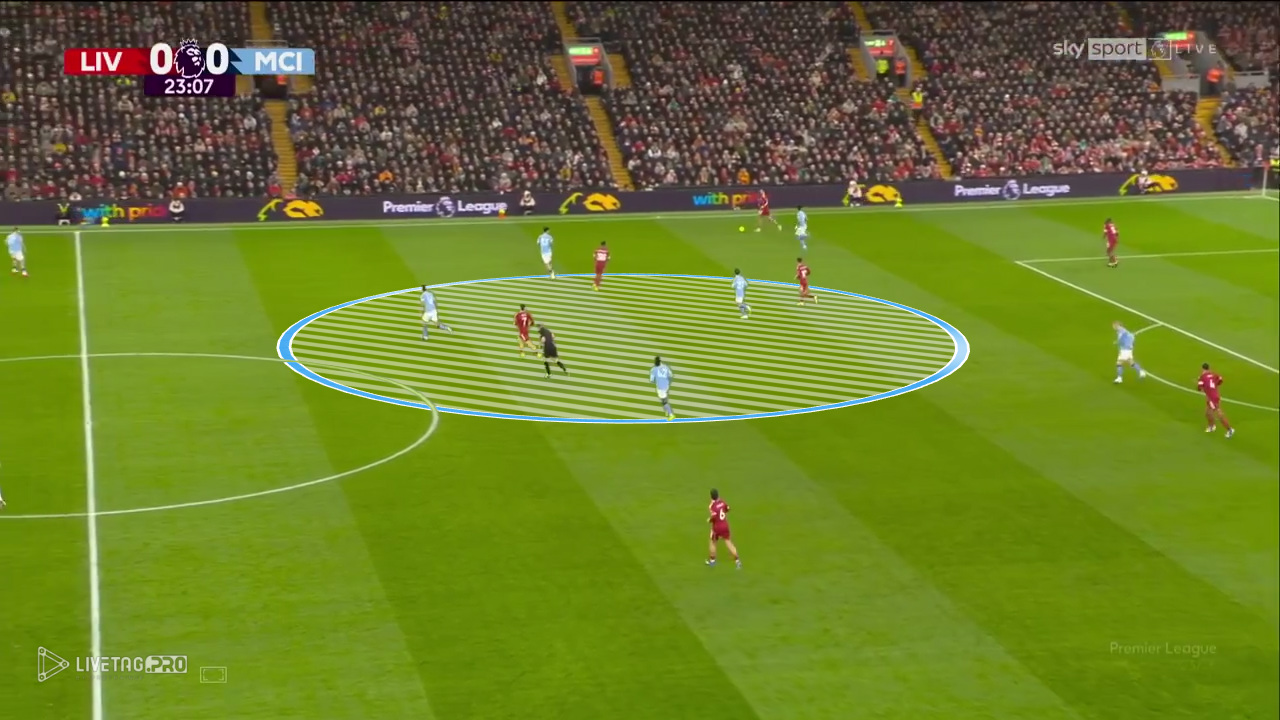
During Liverpool’s build-up phase, City abandoned any attempt at a classic positional press based on guiding, delaying, and progressively closing passing lanes in favour of a 4-3-1-2 structure, numerically matching Liverpool’s midfield and funnelling circulation towards uncomfortable zones.

City’s three midfielders were dynamic and aggressive in their references, while the attacking midfielder, Bernardo Silva, played a key role by closing direct access to Liverpool’s pivot.
City Without Ball I

City Without Ball II

Rather than operating through fixed marking, his function was that of a passing-lane interceptor, constantly adjusting his positioning so that any interior progression would already be under pressure.

The objective was not to win the ball immediately in high zones, but to guide Liverpool’s build-up into congested interior corridors, where density and short inter-line distances increased the likelihood of recoveries or at least technical errors.
City Without Ball III

City Without Ball IV

Guardiola appeared to accept that Anfield is not a setting for long, clean pressing sequences, but rather for short, intense and repeated actions.

This behaviour was reinforced by two very clear mechanisms.

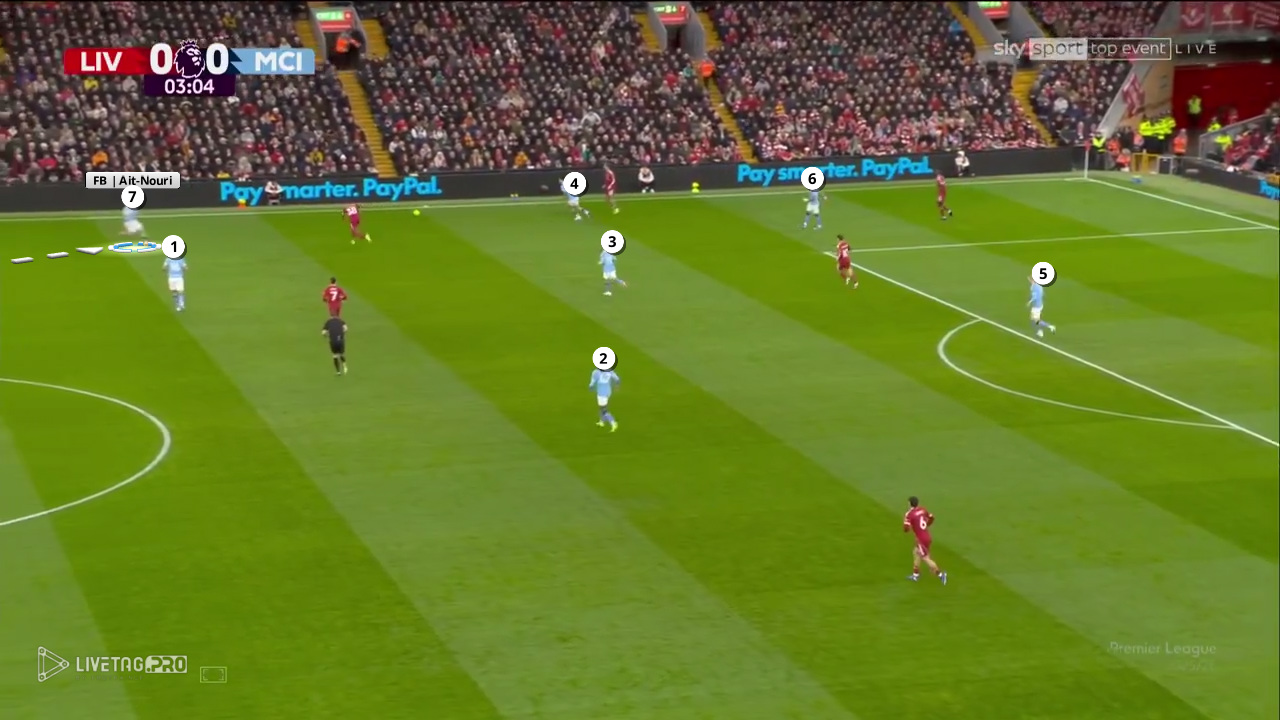
First, long pressing jumps from the full-backs, especially when Liverpool attempted to progress down the flanks.

These jumps were not primarily aimed at direct ball recoveries, but at forcing inward-oriented first touches or uncomfortable return passes, reducing the receiver’s decision-making time.

Second, active man-oriented tracking from the outer midfielders against the lateral movements of Liverpool’s double pivot.

Any attempt by Liverpool to “escape” through the wide zones was met with intense individual pressure, even at the risk of temporarily breaking City’s collective structure.

The result was a Liverpool side constantly forced into decisions: outside-to-inside passes without a body-orientation advantage, first touches facing their own goal, or long balls without a clear structure to secure the second ball precisely where City wanted the game to be played.

Interior Traps: The Heart Of The Plan

If one concept defines City’s proposal at Anfield, it is the interior trap.

Guardiola accepted that the game would not be won by denying Liverpool’s rhythm, but by using it against them.

Every Liverpool interior progression became an invitation to accelerate the game, but under conditions imposed by City.

Whenever Liverpool found an interior progression, either through a vertical pass or a ball-carry, City activated an immediate collapse around the receiver.

The compactness between the lines, a direct consequence of the 4-3-1-2 structure, facilitated clean recoveries or, at the very least, deflections and second balls that triggered the next phase of the plan: attacking immediately after regaining possession.City Without Ball V
Here we find one of the most “Kloppian” ideas Guardiola has displayed in recent memory.

The recovery was not the end of the defensive sequence, but the beginning of a brief, direct and aggressive attack, often executed with very few touches and without the need to pass through an organised midfield.

City were not looking to organise after recovering the ball; they were looking to punish Liverpool’s disorganisation.

Manchester City’s In-Possession Structure

The other major departure from City’s usual identity came in possession.

Guardiola consciously accepted a reduced role for the midfield as a zone of elaboration.

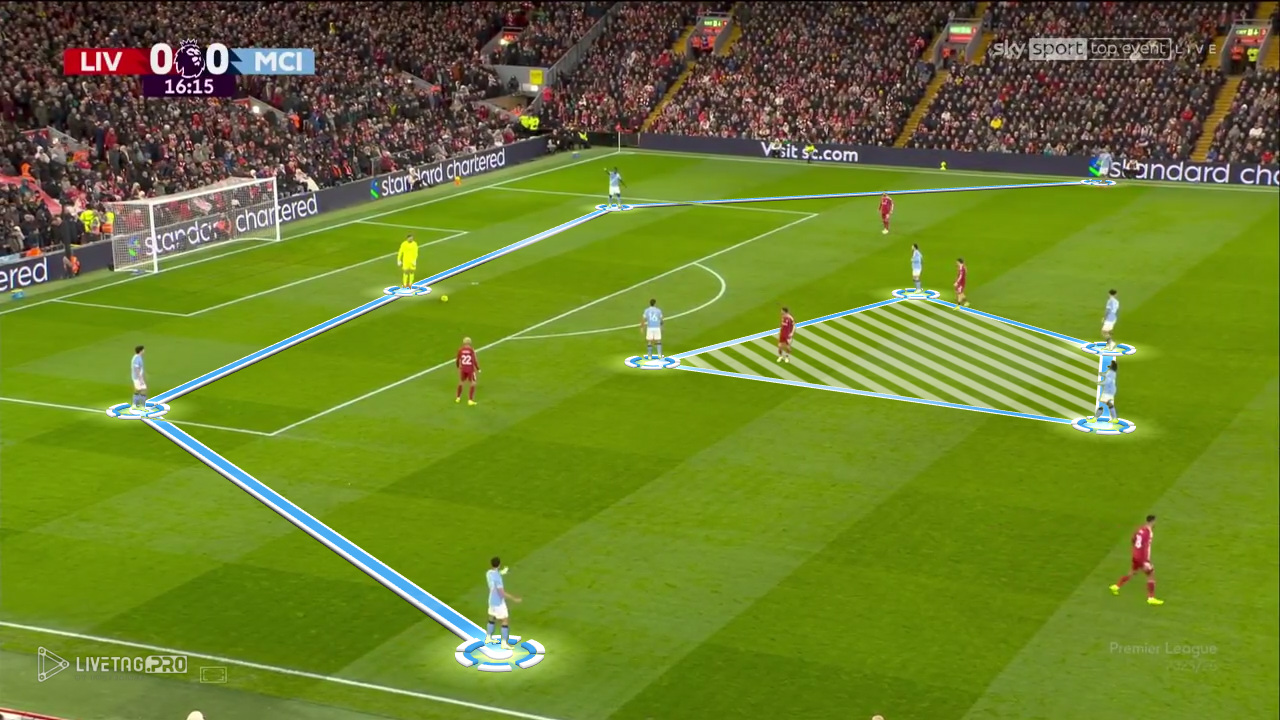
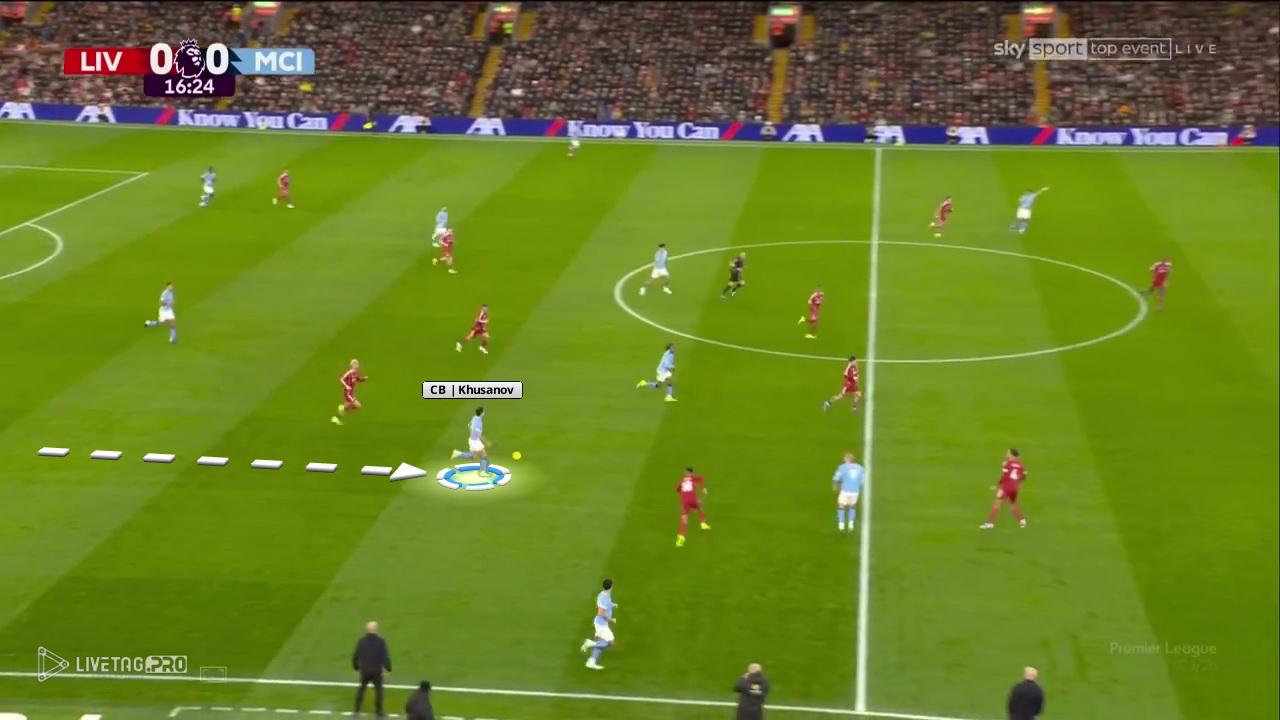
Instead of insisting on supported progressions and long spells of possession, City prioritised three very clear attacking behaviours.

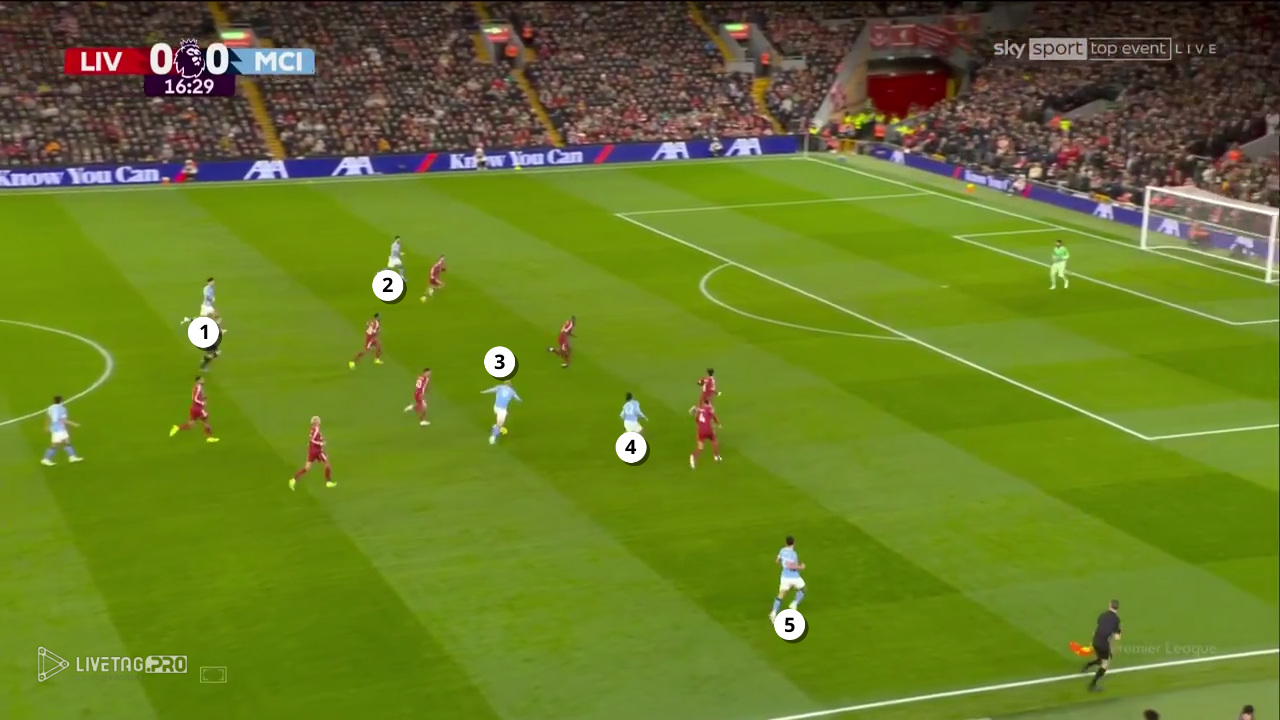
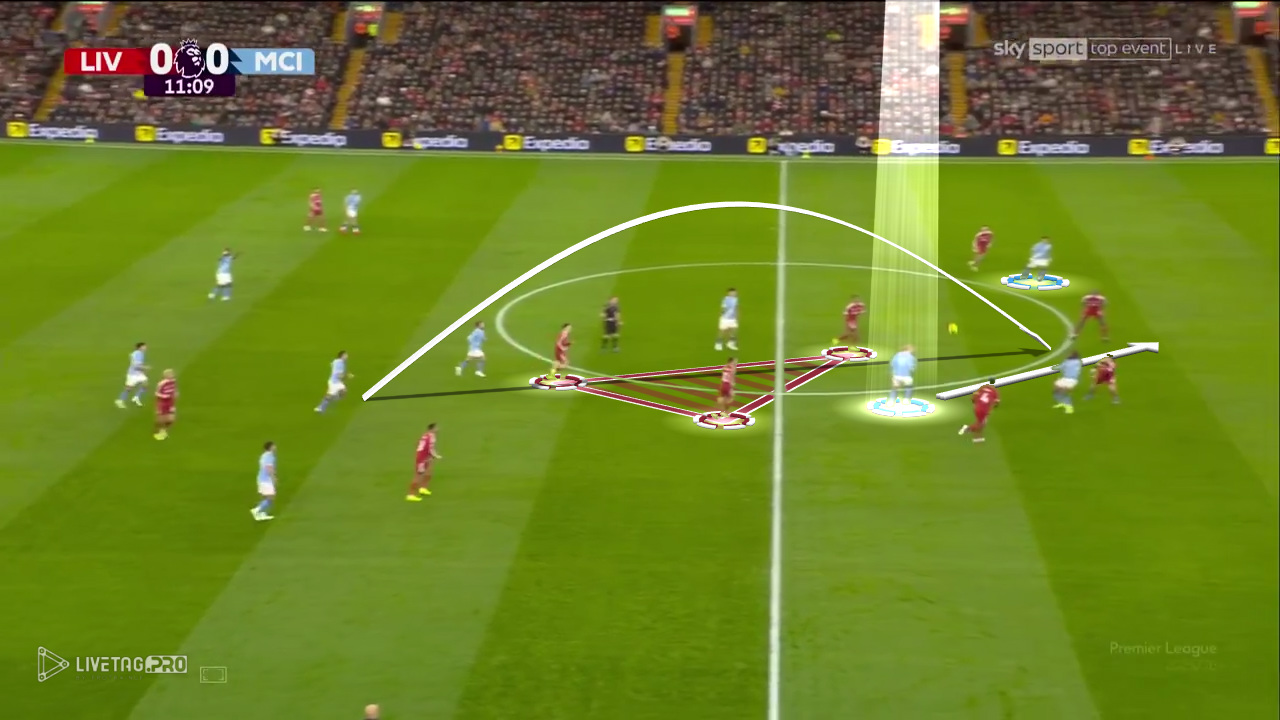
First, quickly activating the three narrow forwards, seeking direct receptions between the lines or on the last line, often without intermediate passes.
City With Ball I

The intention was not to generate prolonged positional advantages, but to attack before Liverpool could reorganise, either by drawing their pressure or during transitional moments.
image

image 1

City With Ball IV

Second, using the full-backs wide, not as interior players nor as creators of central overloads, but as fixers and recipients of switches of play.

Their width stretched Liverpool’s last line and prepared the conditions for potential second balls.

Third, provoking second balls through direct passes or clearances forced from Liverpool’s backline.

This aspect was crucial.

Every contested ball, every defensive clearance, became an opportunity for City to employ their primary tactic: counterpressing.

City’s compact structure and short inter-line distances allowed them to sustain attacks even without clean possession, something relatively unusual for Guardiola’s teams.

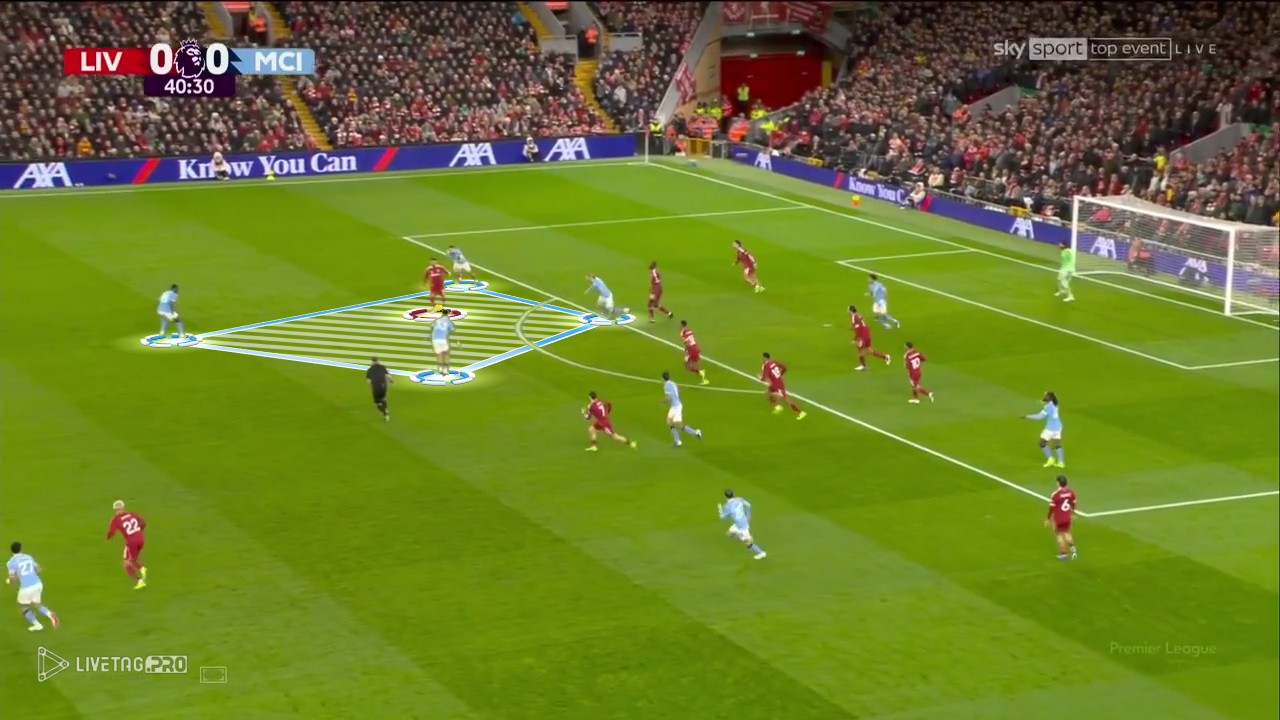
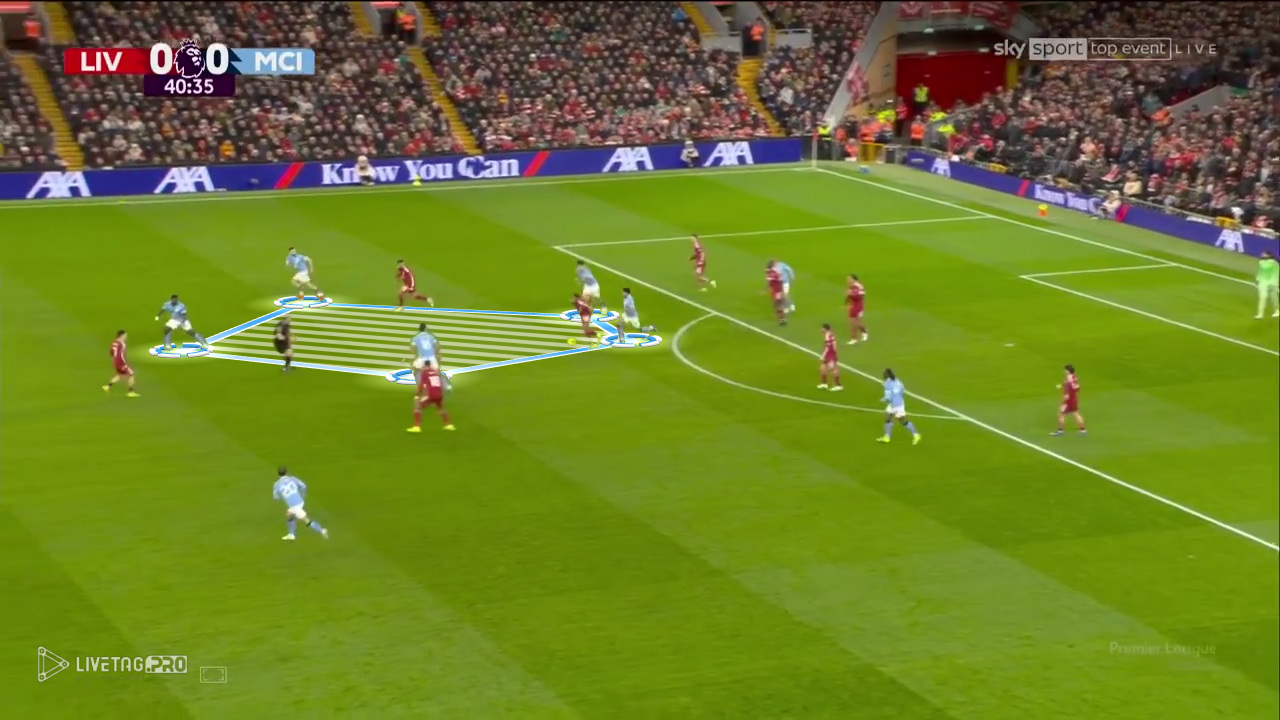
Counterpressing As The Main Strategy

This was not a situational resource, but the central strategy of the match.

City were less concerned with defending backwards than with defending forwards, reducing Liverpool’s time and space immediately after regaining possession.
City With Ball V

City With Ball VI

Every City loss triggered an almost automatic mechanism: the closest player jumped to press, the second closed the most obvious passing lane, and the third adjusted behind to sustain the block’s height.

This coordination ensured that many Liverpool attacks died before they could properly develop, even when the first line of pressure was bypassed.

The key lay in the fact that this counter-pressing was not merely reactive, but pre-structured from City’s attacking shape.

By attacking with few players inside and maintaining wide full-backs, City always had clear reference points to jump after losing the ball, reducing the need for long defensive readjustments.

The Limit Of The Plan: Without The Final Pass

However, this plan also revealed a clear limitation.

The absence of elite final passers and the lack of clarity in the final action prevented City from translating their contextual dominance into decisive advantages.

The team repeatedly reached promising zones, but lacked a player capable of slowing the chaos in the final third and selecting the optimal option.

In that sense, City remained on the brink of achieving their objectives.

They generated high recoveries, second balls and attacks with relative advantage, but lacked the final pause to convert those moments into clear chances.

The plan succeeded in allowing them to compete, unsettle and condition Liverpool, but not in finishing the job.

This absence does not invalidate the proposal; it contextualises it.

Guardiola designed a plan to survive and dominate certain moments at Anfield, but the price was a partial renunciation of the mechanisms that usually provide continuity and depth to his attacking play.

Conclusion

The inevitable question is whether this “Kloppian” City was a one-off adjustment for Anfield or a glimpse into a broader evolution of Guardiola’s model.

Context, such as opponent, stadium, and timing, explains much of the decision, but it also reveals a degree of conceptual flexibility rarely seen in coaches so strongly associated with a single idea.

City competed without monopolising possession, defended by attacking, and embraced chaos as a strategic tool. In that sense, Anfield was not an exception, but a laboratory.

And perhaps that is the true value of this match: showing that even the coach most closely associated with absolute control can find, in the opponent’s territory, an alternative and functional version of himself.

Tags: Liverpool Vs Manchester City FormationLiverpool Vs Manchester City LineupLiverpool Vs Manchester City Tactical AnalysisPep GuardiolaPep Guardiola Coaching StylePep Guardiola FormationPep Guardiola Manager StylePep Guardiola NewsPep Guardiola Style Of PlayPep Guardiola Tactical AnalysisPep Guardiola TacticsPremier LeaguePremier League News Liverpool Vs Manchester City TacticsPremier League Tactical AnalysisPremier League Tactics
Previous Post

Sassuolo Vs Inter Milan [0–5] – Serie A 2025/2026: Missed Counters, Heavy Punishment – Tactical Analysis

Next Post

Marcos Llorente Scout Report At Atlético Madrid 2025/2026: The Engine Of Diego Simeone’s Transitions – Player Analysis

Next Post
Marcos Llorente Atlético Madrid 20252026

Marcos Llorente Scout Report At Atlético Madrid 2025/2026: The Engine Of Diego Simeone's Transitions – Player Analysis

  • About Total Football Analysis
  • Contact Total Football Analysis
  • Write For Total Football Analysis
  • Advertise
  • Privacy Policy
  • Cancellation / Refund Policy
  • Resources
  • Terms Of Service

© 2026 Total Football Analysis

No Result
View All Result
  • Football Analysis
    • Data Analysis
    • Formations
      • 2-2-4 Formation
      • 2-3-5 Formation
      • 3-1-4-2 Formation
      • 3-2-2-3 Formation
      • 3-2-4-1 Formation
      • 3-1-6 Formation
      • 3-3-4 Formation
      • 3-4-1-2 Formation
      • 3-4-2-1 Formation
      • 3-4-3 Formation
      • 3-5-1-1 Formation
      • 3-5-2 Formation
      • 4-1-4-1 Formation
      • 4-2-2-2 Formation
      • 4-2-3-1 Formation
      • 4-2-4 Formation
      • 4-3-1-2 Formation
      • 4-3-3 Formation
      • 4-4-2 Formation
      • 4-5-1 Formation
      • 5-3-2 Formation
      • 5-4-1 Formation
      • 6-3-1 Formation
    • Head Coach Analysis
    • Match Analysis
    • Player Analysis
    • Recruitment Analysis
    • Set Piece Analysis
    • Tactical Theory
    • Tactical Preview
    • Team Analysis
    • Training Analysis
    • Tactical Analysis
    • Scouting Report
  • Competition
    • ALL Competitions
    • English Premier League
    • Champions League
    • La Liga
    • Bundesliga
    • Serie A
    • Ligue 1
    • Eredivisie
    • EFL Championship
    • FIFA World Cup 2022
    • WEURO 2022
    • Women’s Super League
    • NWSL
    • Belgian First Division A
    • A-League
    • Liga Profesional de Argentina
    • Austrian Bundesliga
    • Campeonato Brasileiro Série A
    • DFB Pokal
    • 1. HNL
    • Danish Superliga
    • EFL League One
    • EFL League Two
    • FA Cup
    • EFL Cup
    • Indian Super League
    • K-League
    • J1 League
    • Liga MX
    • Copa América 2021
    • Copa del Rey
    • MLS
    • Eliteserien
    • Euro 2020
    • Primeira Liga
    • Scottish Premiership
    • Allsvenskan
    • Europa League
    • UEFA Nations League
    • Liga AUF Uruguaya
  • Coaches
    • All Coaches
    • Alfred Schreuder
    • Ange Postecoglou
    • Antonio Conte
    • Arne Slot
    • Bo Svensson
    • Brendan Rodgers
    • Bruno Lage
    • Carlo Ancelotti
    • Christophe Galtier
    • Claude Puel
    • Claudio Ranieri
    • David Moyes
    • Dean Smith
    • Diego Simeone
    • Domenico Tedesco
    • Frank Lampard
    • Eddie Howe
    • Edin Terzić
    • Emma Hayes
    • Erik ten Hag
    • Ernesto Valverde
    • Gennaro Gattuso
    • Gerardo Seoane
    • Gian Piero Gasperini
    • Giovanni van Bronckhorst
    • Graham Potter
    • Igor Tudor
    • Imanol Alguacil
    • Jesse Marsch
    • Jonas Eidevall
    • Jorge Sampaoli
    • José Bordalás
    • José Mourinho
    • Julen Lopetegui
    • Julian Nagelsmann
    • Julien Stéphan
    • Jürgen Klopp
    • Luciano Spalletti
    • Lucien Favre
    • Manuel Pellegrini
    • Marcelo Bielsa
    • Marco Rose
    • Marco Silva
    • Massimiliano Allegri
    • Mauricio Pochettino
    • Maurizio Sarri
    • Mikel Arteta
    • Niko Kovač
    • Nuno Espírito Santo
    • Oliver Glasner
    • Patrick Vieira
    • Paulo Fonseca
    • Pep Guardiola
    • Peter Bosz
    • Rafa Benítez
    • Ralf Rangnick
    • Ralph Hasenhüttl
    • Roger Schmidt
    • Roy Hodgson
    • Sean Dyche
    • Sérgio Conceição
    • Simone Inzaghi
    • Sonia Bompastor
    • Stefano Pioli
    • Steffen Baumgart
    • Steven Gerrard
    • Thiago Motta
    • Thomas Frank
    • Thomas Tuchel
    • Unai Emery
    • Vincenzo Italiano
    • Xavi
  • Teams
    • ALL Teams
    • AC Milan
    • Ajax Amsterdam
    • Arsenal
    • AS Monaco FC
    • Atalanta
    • Atlético Madrid
    • FC Barcelona
    • FC Bayern Munich
    • Borussia Dortmund
    • Celtic FC
    • Chelsea FC
    • Everton F.C.
    • Inter Milan
    • Juventus F.C.
    • Leeds United F.C.
    • Liverpool FC
    • Manchester City
    • Manchester United FC
    • Paris Saint-Germain
    • Rangers FC
    • RB Leipzig
    • Real Madrid CF
    • Tottenham Hotspur
    • West Ham United
  • Players
    • ALL Players
    • Alisson Becker
    • Bukayo Saka
    • Erling Haaland
    • Harry Kane
    • Jack Grealish
    • John Stones
    • Julián Alvarez
    • Kalvin Phillips
    • Kevin De Bruyne
    • Kyle Walker
    • Kylian Mbappé
    • Lamine Yamal
    • Lionel Messi
    • Luis Díaz
    • Mohamed Salah
    • Phil Foden
    • Virgil Van Dijk
  • Contact
  • Write For TFA
  • Login

© 2026 Total Football Analysis