
Newcastle United hosted Brentford in Gameweek 25 of the 2025/2026 Premier League.
The Magpies ended up losing 2-3 against the Bees, owing to a late goal from Dango Ouattara.
With this win, the visitors increased their lead over the hosts to six points.
This was Newcastle’s fifth consecutive game without a win; meanwhile, their opponents recorded a third win out of the last five games.
Both sides were not far apart in major statistics, including ball possession (54%-46%), total shots (16-11), big chances (4-4), and final third entries (65-64).
Through this tactical analysis, we aim to understand Brentford’s strengths and weaknesses in both the attacking and defensive phases, which led to their securing the three points.
Newcastle United Vs Brentford Lineups & Formations
Let’s look at how Eddie Howe and Keith Andrews fielded their squads.
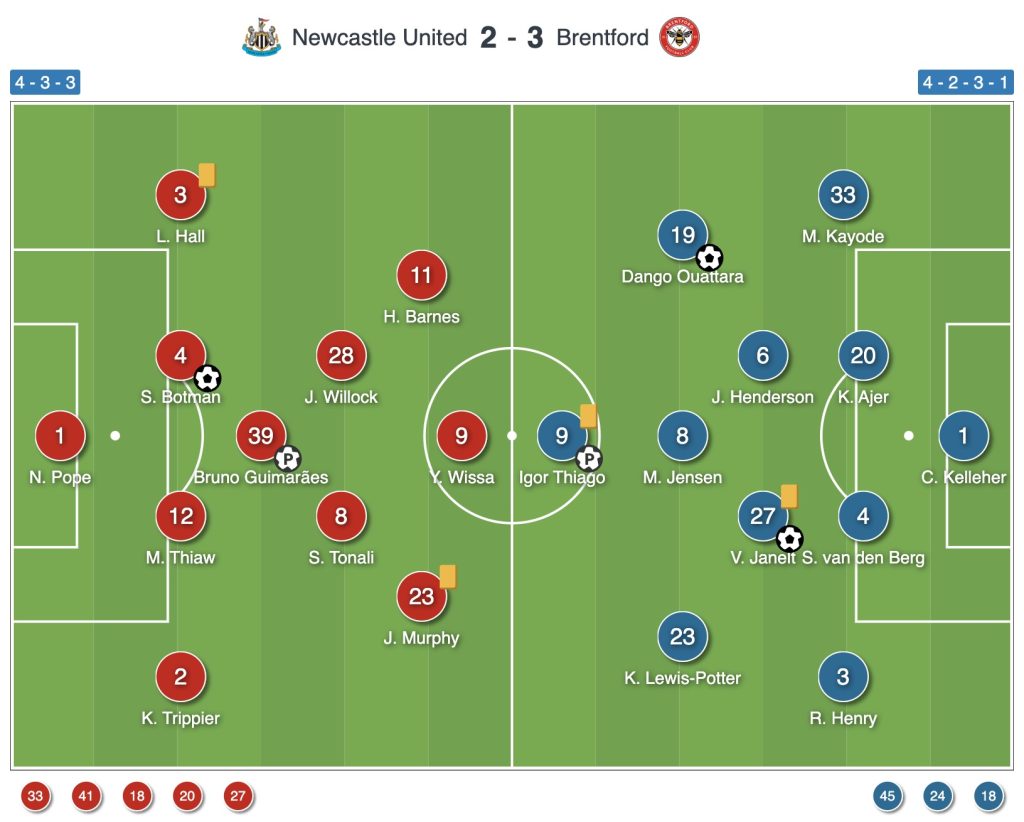
The hosts, Newcastle, played in a 4-3-3 formation.
In goal was Nick Pope, with a back four of Kieran Trippier (right-back), Malick Thiaw (right centre-back), Sven Botman (left centre-back), and Lewis Hall (left-back).
Dan Burn came on for Trippier at the 87th minute.
The midfield comprised skipper Bruno Guimarâes, Sandro Tonali, and Joe Willock.
Tonali and Willock were replaced by Jacob Ramsey (87’) and Anthony Elanga (46’).
Jacob Murphy (right) and Harvey Barnes (left) played as the wingers with Yoane Wissa as the striker.
Murphy and Wissa were replaced by Nick Woltemade (46’) and William Osula (65’).
The visitors, Brentford, played in a 4-2-3-1 formation.
Caoimhin Kelleher started between the sticks.
The back four were Michael Kayode (right-back), Kristoffer Ajer (right centre-back), Sepp van den Berg (left centre-back), and Rico Henry (left-back).
Jordan Henderson and Vitaly Janelt operated as the double pivot.
The former was replaced by Yehor Yarmolyuk (56’).
Dango Ouattara (right) and Keane Lewis-Potter (left) were the wingers with skipper Mathias Jensen as the central attacking midfielder.
Igor Thiago played as the lone striker. Romelle Donovan came on for the left-winger (80’) and Mikkel Damsgaard for the attacking midfielder spot (87’).
Brentford Attacking Tactics
Brentford Progression
The Bees were aware that they would not have access to a comfortable build-up pathway consistently.
Hence, they did not shy away from pursuing the long option to advance from their defensive third.
The simplest route was moving the ball around Newcastle’s structure, which saw them progress from the wide areas.
The right-back plays a lobbed pass into the midfield third, which is shielded by the right-winger, before being laid off to a centre-midfielder making an overlap.
They found a decent amount of success in getting to the attacking third in a few passes.
There were moments when the opponents attempted to stop Brentford’s wide channel progression by cutting off the outside pass.
This gave the visitors more space to come inside and find passes within the structure.
Newcastle press to cut the outside pass; however, the inside space opens up for a one-touch sequence for the visitors to find progression.
Subsequently, they reach the attacking third in the next four passes.
Although they showcased some impressive moments of progression, they could not deliver the same consistently.
The ability to find regular progression would help them control the game more effectively, as it would force opponents to pause their press and sit deep in a compact shape.
However, if opponents believe they can win the ball frequently by pressing high, there is an advantage to this approach: they will leave space either behind or between the lines.
Brentford did well to exploit these spaces at times.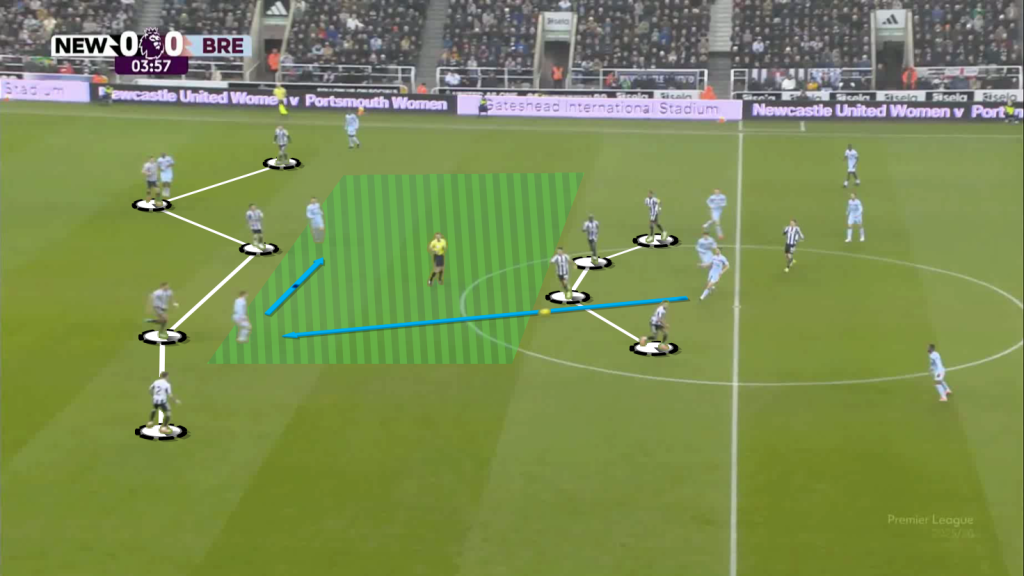
Newcastle are in a 5-4-1 pressing shape, leaving ample space between the lines.
Brentford utilised this by finding a vertical pass to play a third-man combination.
Apart from Newcastle’s disconnected press, there were lapses in the Brentford players’ understanding of space behind the first line of press.
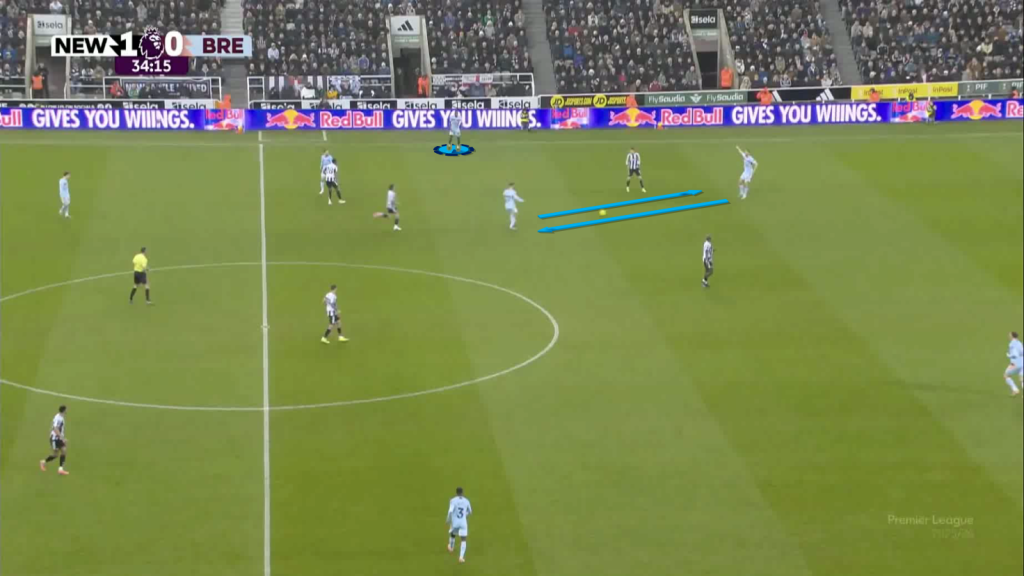
The centre-back finds the centre-midfielder with the right-back wide open.
By using the available third-man combination to find the exit pass, Brentford can progress down the right wide channel.
However, the midfielder bounces it back to the centre-back, which forces Brentford to start a dynamic build-up all over again.
In these situations, the centre-back had to play it either sideways or backwards.
There were situations where the midfielder utilised this combination.
However, it was not the best possible choice in the given circumstances in terms of space available.
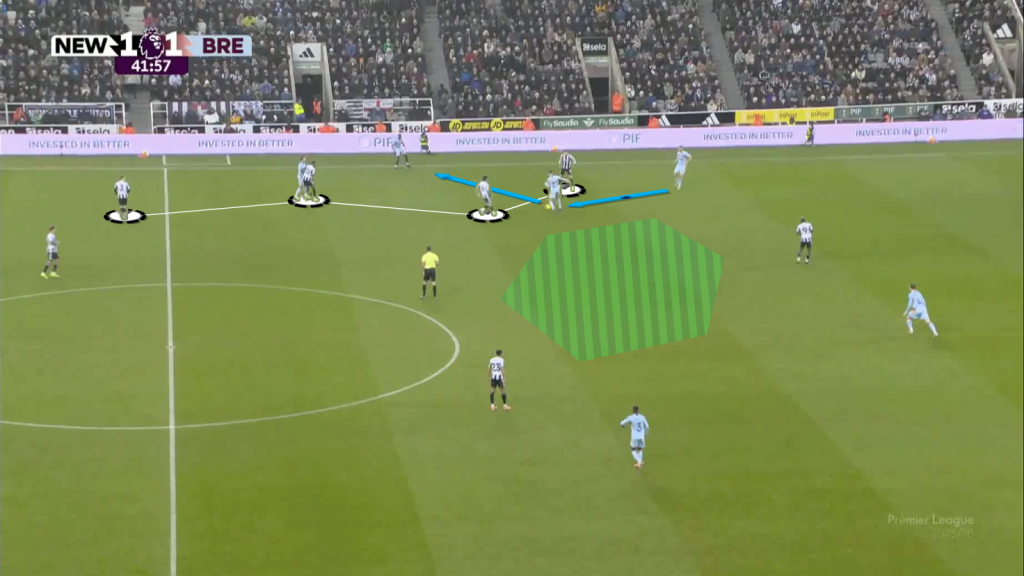
The centre-midfielder uses the third-man combination by playing it to the right-back.
However, in this situation, the right-back is not an exit option, as four Newcastle players may crowd him, and he must play back to retain possession.
Instead, there is enough space available on the midfielder’s right shoulder to find progression.
Brentford Transition & Chance Creation
A simpler way for Brentford to reach the final third was to be prompt in attacking transition.
Igor Thiago was instrumental in these moments, as he dropped to provide the missing link, ensuring the Bees found the release pass.
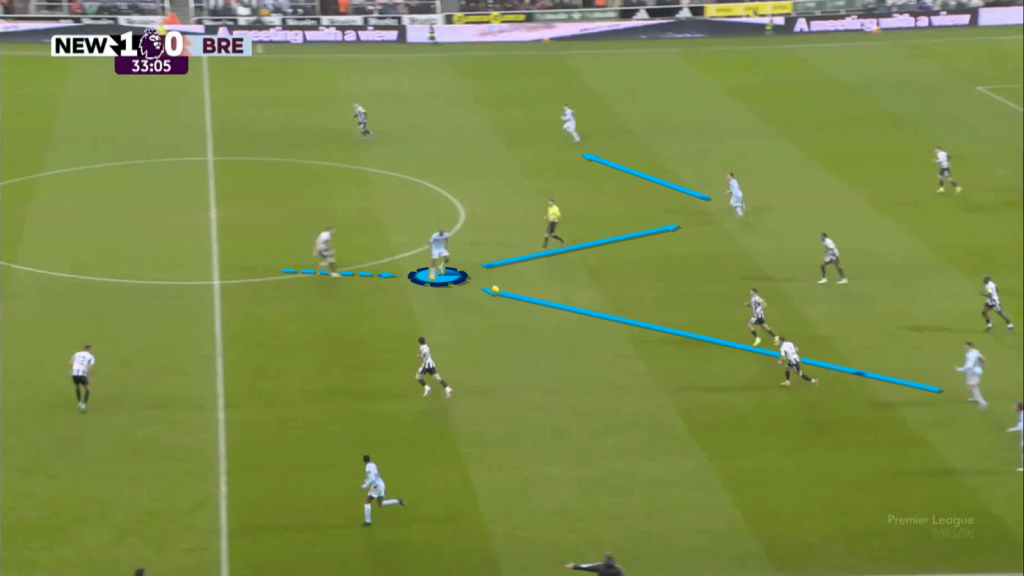
Brentford wins the ball at the edge of their defensive third; the Brazilian drops at the right moment to create a third-man combination, shifting play.
Brentford ended up finding the release pass on the other side.
There were multiple scenarios in the game when Brentford, after finding the release pass, were in an isolated counterattacking situation.
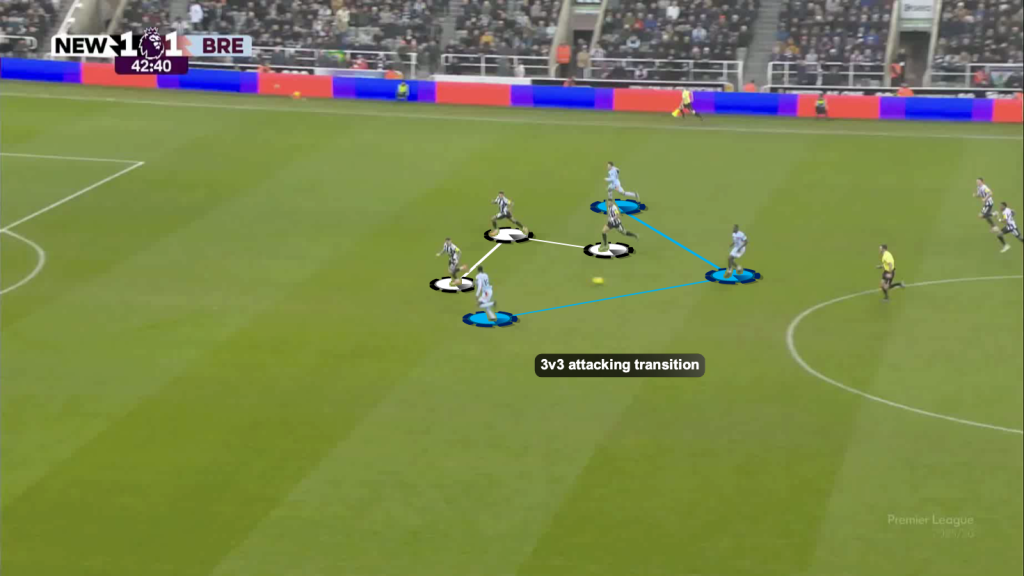
The positive transition right before Brentford won the penalty.
The ball-carrier plays a through pass in the path of his teammate, who does well to enter the penalty area and square it to his teammate on the other side, whose shot wins the penalty through a handball.
It was either transition or chance-creation from wide areas that brought some success for Keith Andrews’ side.
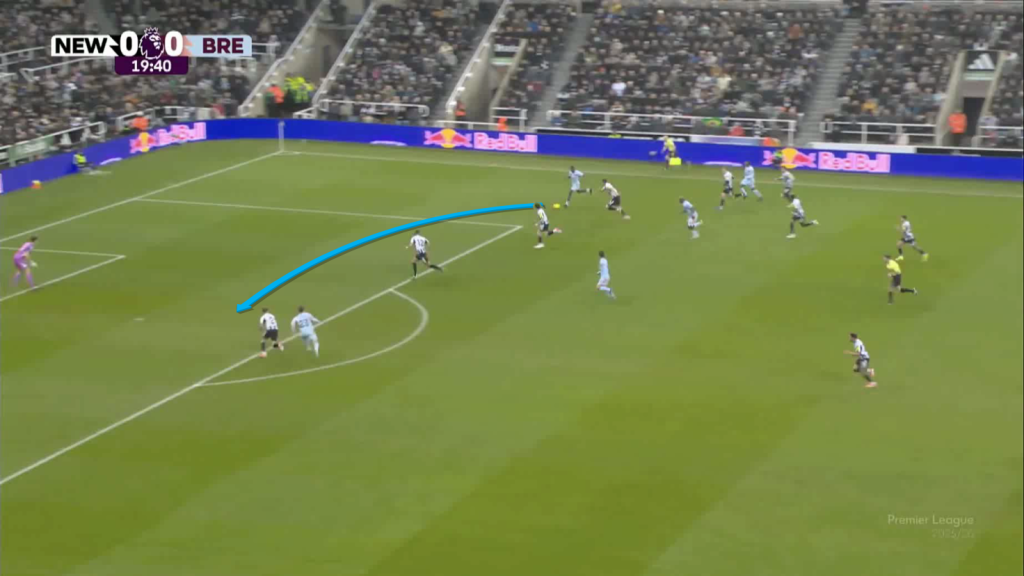
The Bees played quick combinations in the wide channel to get the ball in-behind for crosses.
They ended up scoring a goal through a similar action.
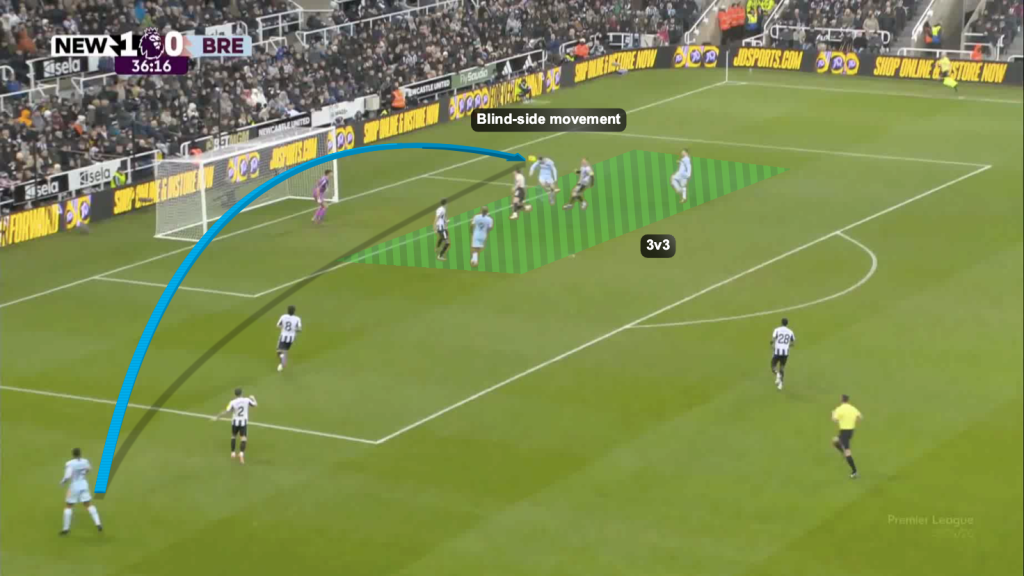
Ouattara receives the ball in the left wide channel before carrying it into the final third.
Upon his cross, Brentford has a 3v3 situation in the delivery zone.
Matching the number of defenders with attackers for crossing situations usually results in an advantage for the attacking team.
Janelt meets the cross by making a blind-side run to the edge of the six-yard box.
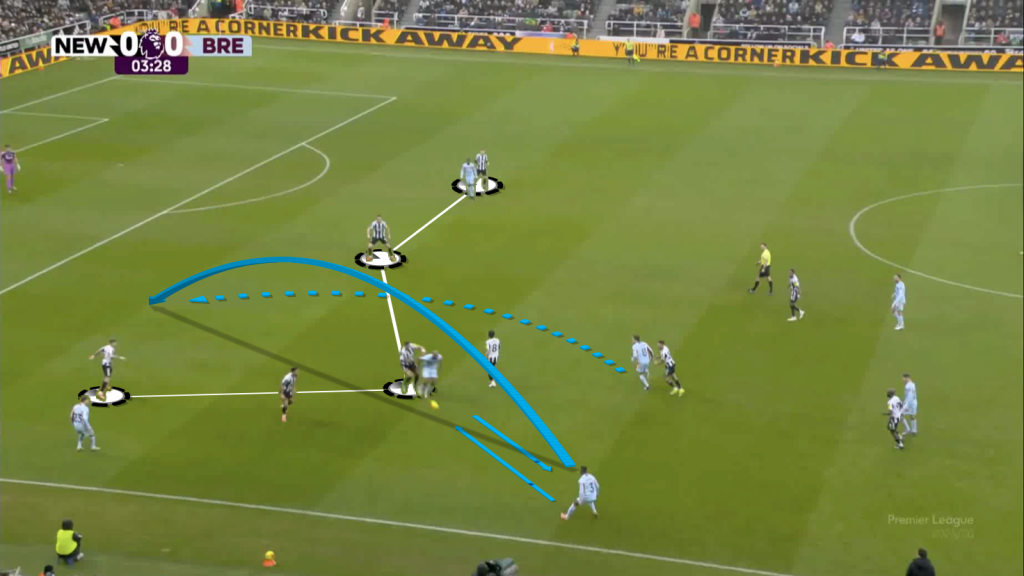
Igor Thiago dropping not only helped with an additional number in the mid-third, but also dragged an opposition defender out of position.
At times, the Brentford midfielders exploited this, making runs in behind.
The winner, scored by Brentford, indirectly came from the space between the lines left unattended by the Magpies.
Newcastle makes the first contact with Brentford’s long pass; however, it is Brentford who wins the second ball through Jensen between the lines.
The Dane plays a first-time through pass to Ouattara running in-behind, who makes sure to slot it past Nick Pope.
Brentford Defending Tactics
Brentford In Opponent Half & Midfield Third
Brentford were seen pressing high, forcing the opponents to one side.
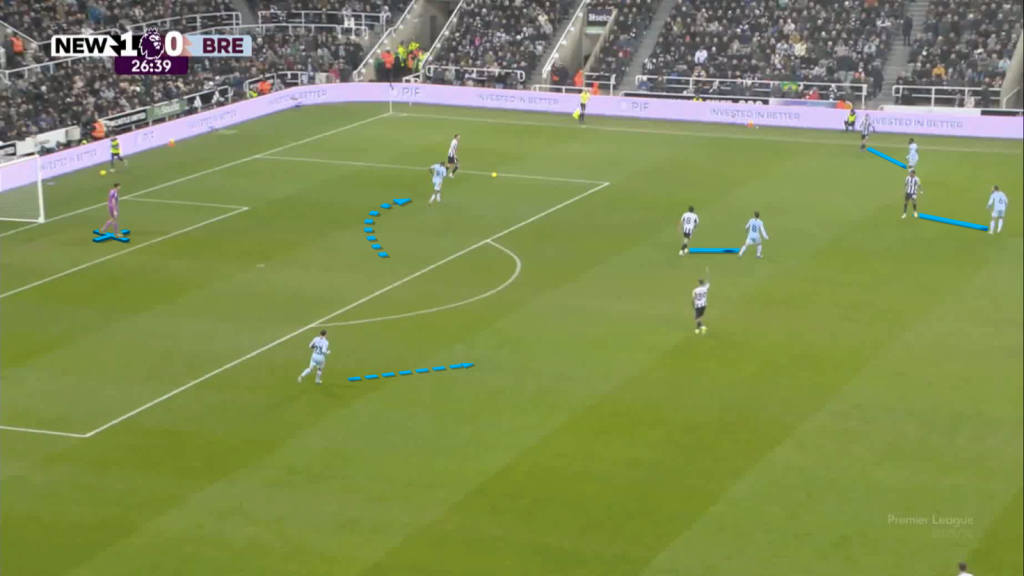
The idea was to squeeze the wide area so that the opponents play long.
As shown in the image, the striker curves his run to cut into the passing lane to the goalkeeper.
The only way the opposition centre-back can dribble is towards the wide area.
However, their press was not the most efficient.
It was reflected by the frequency of Newcastle playing through the press.
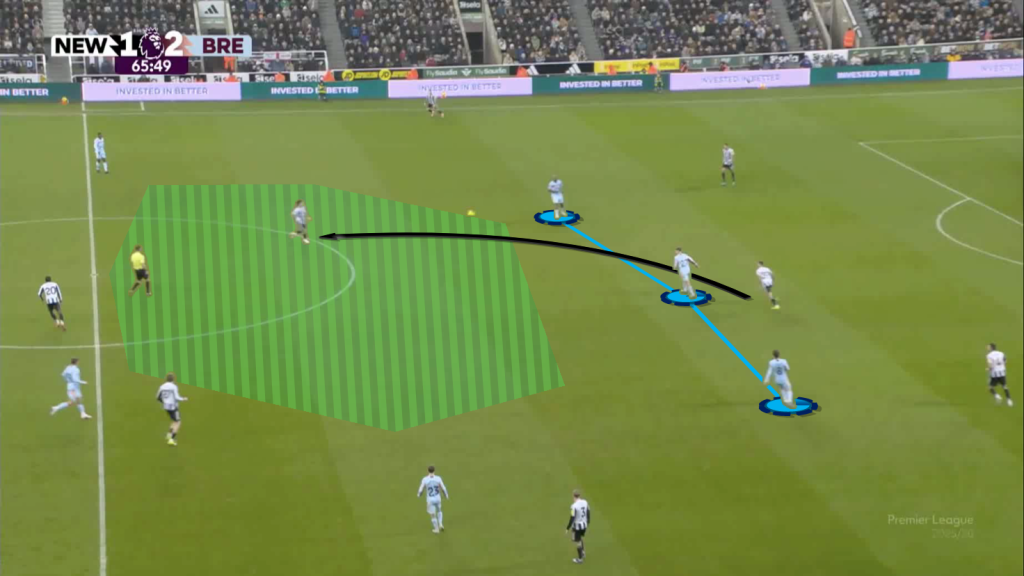
Their lines were often disrupted, with Eddie Howe’s midfielders receiving behind the first line of press.
Both sides found progression through the middle, which contributed to the game being end-to-end.
This happened with Brentford in the wide areas as well.
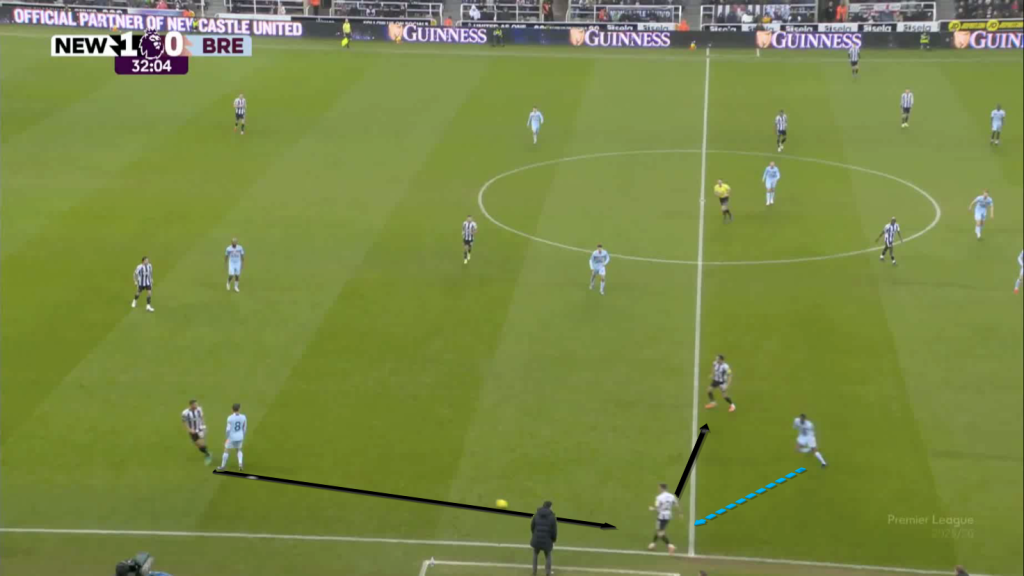
Newcastle’s vertical pass down the line helps them find progression, as the winger has an inside pass available in a 2v1 situation.
Brentford defended in a 4-4-2 shape; Jensen moved up alongside the striker.
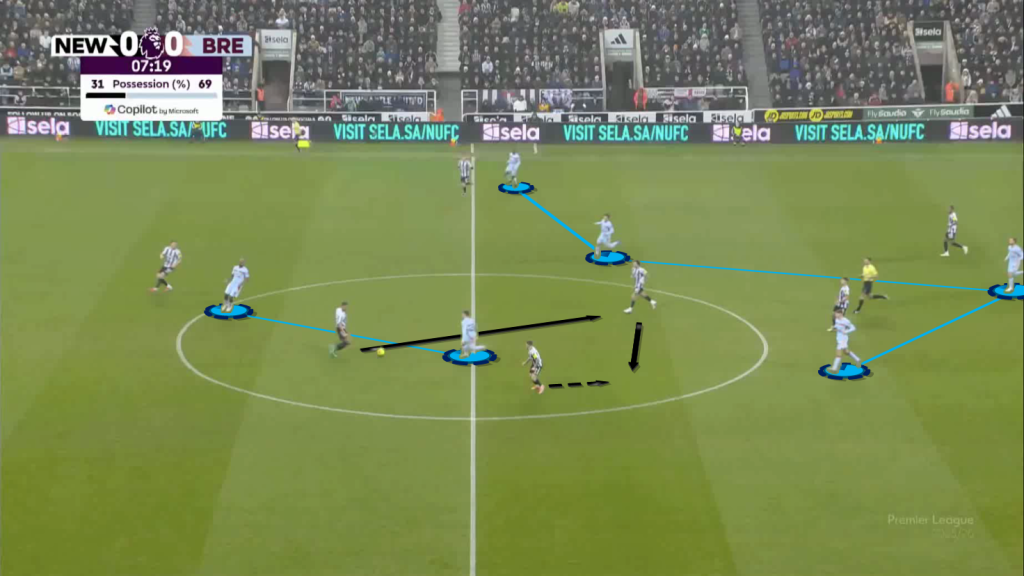
Brentford’s 4-4-2 shape is visible.
However, it is not organised well to prevent inside passes.
Newcastle finds a simple third-man pass to bypass the pressure.
Brentford Defending In Own Half
Brentford did well in terms of covering each other’s positions in the defensive phase.
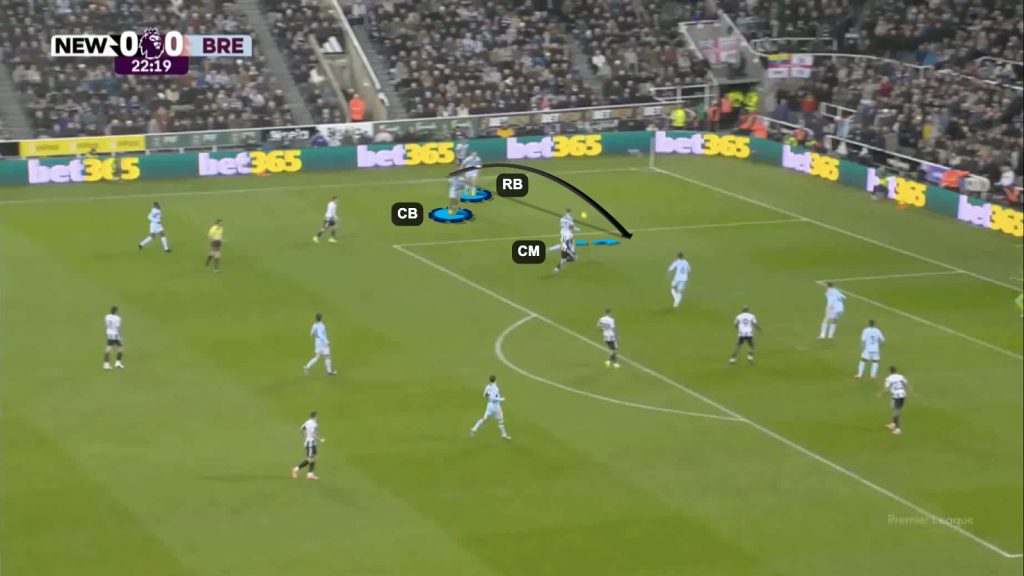
The right centre-back and the right-back are engaged in the wide channel as the cross comes in.
The centre-midfielder tracks back to cover for them as he intercepts the cross.
This was one of the ways Brentford kept Newcastle out.
However, they also showed weaknesses in leaving opponents unmarked during crucial moments, and were fortunate not to concede from those situations.
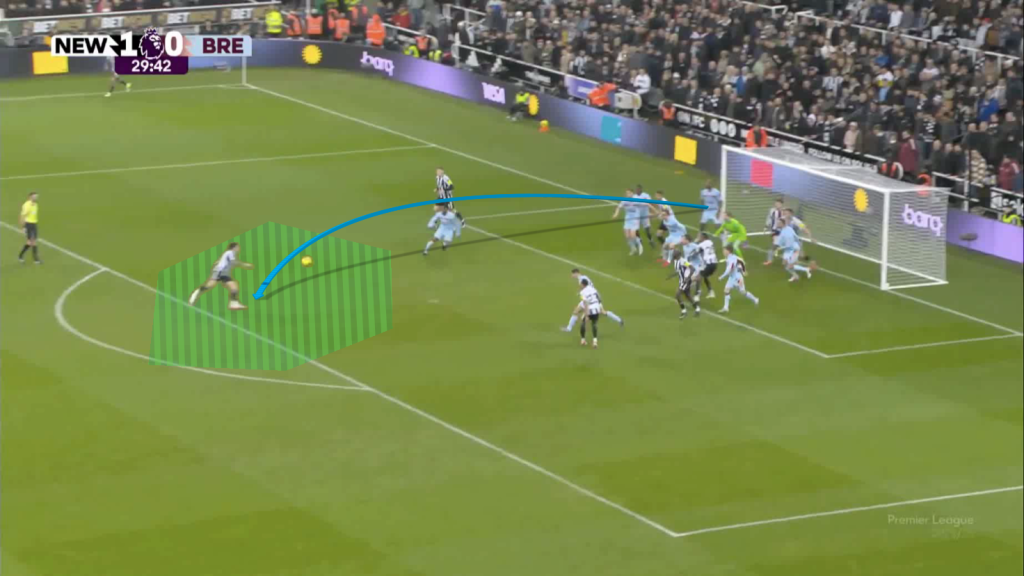
Sandro Tonali receives a rebound from a corner-kick save.
With no Brentford players in the vicinity, the Italian takes an unopposed shot, with the Bees relieved to see it go over the bar.
They also got caught in some transitional moments.
One of which led to the penalty that gave their opponents the equaliser.
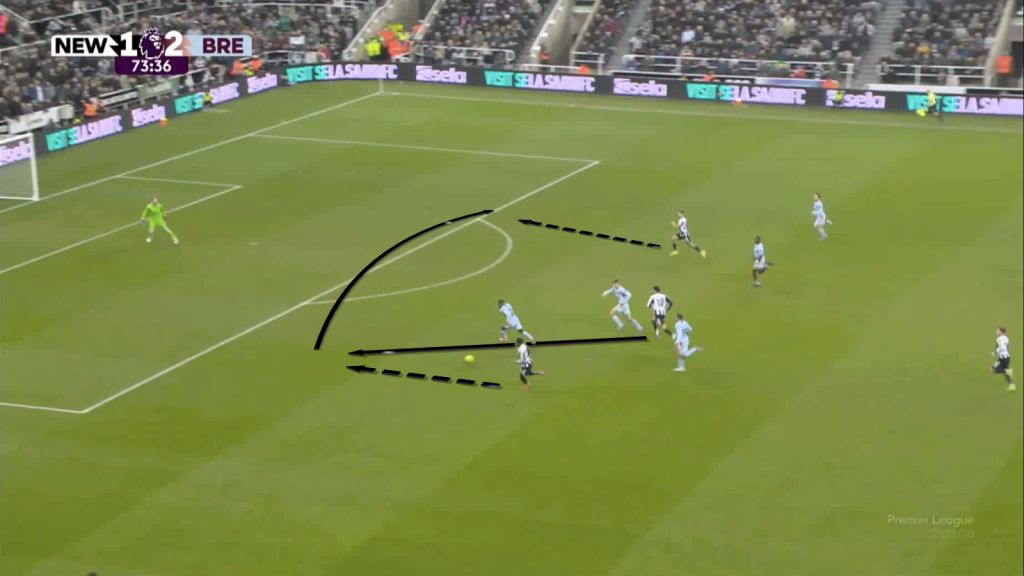
It was a similar situation to the transition through which Brentford won their penalty.
Here, the third man was fouled inside the box, which gave them the penalty.
Conclusion
Brentford used a combination of playing around the press, through the press, and using the space between the lines to attack from static and dynamic build-up moments; however, they were inconsistent in finding the best possible space to move the ball into.
Furthermore, they relied on their counterattacking prowess, where the striker dropping helped with link-up and creating space in-behind by dragging a defender.
Defensively, they set up in a 4-4-2 mid-block, which was time and again penetrated by their opponents.
When Brentford executed a high press, they attempted to force the opponents wide.
However, the opponents were allowed enough space behind the first line of press to create overloads and progress.
Their most reliable bit of defending came when they were defending in a compact shape in the defensive third.
Covering up for each other’s positions helped them keep their opponent out in some crucial moments.
