
As the 2025/2026 Premier League season approaches its decisive phase, attention is increasingly turning towards the battle for qualification to the UEFA Champions League.
After roughly 29 matches, the title race appears largely concentrated between Arsenal and Manchester City, who have established a noticeable gap at the top of the table.
Meanwhile, a tightly contested race for the remaining Champions League places has developed just behind them.
Currently, Manchester United and Aston Villa sit level on 51 points, with Chelsea and Liverpool closely behind on 48 points after 29 matches.
With the Premier League expected to secure five Champions League qualification spots next season, this data analysis will examine the tactical structures, managerial changes, and statistical profiles shaping this four-team battle.
By analysing underlying metrics and stylistic differences, the report aims to identify which side is best positioned to sustain performance levels and ultimately secure a place in Europe’s premier club competition.
All data used in this analysis is accurate as of 14th March 2026.
Expected Vs Actual Points: Aston Villa’s Tactical Edge In The Champions League Race
One of the most revealing angles in this four‑team Champions League battle is the gap between actual points and expected points (xP).
This statistical lens shows which sides are genuinely outperforming their underlying numbers.
Premier League 2025/2026 UCL Race – Performance Vs Expectation – Points & Expected Points
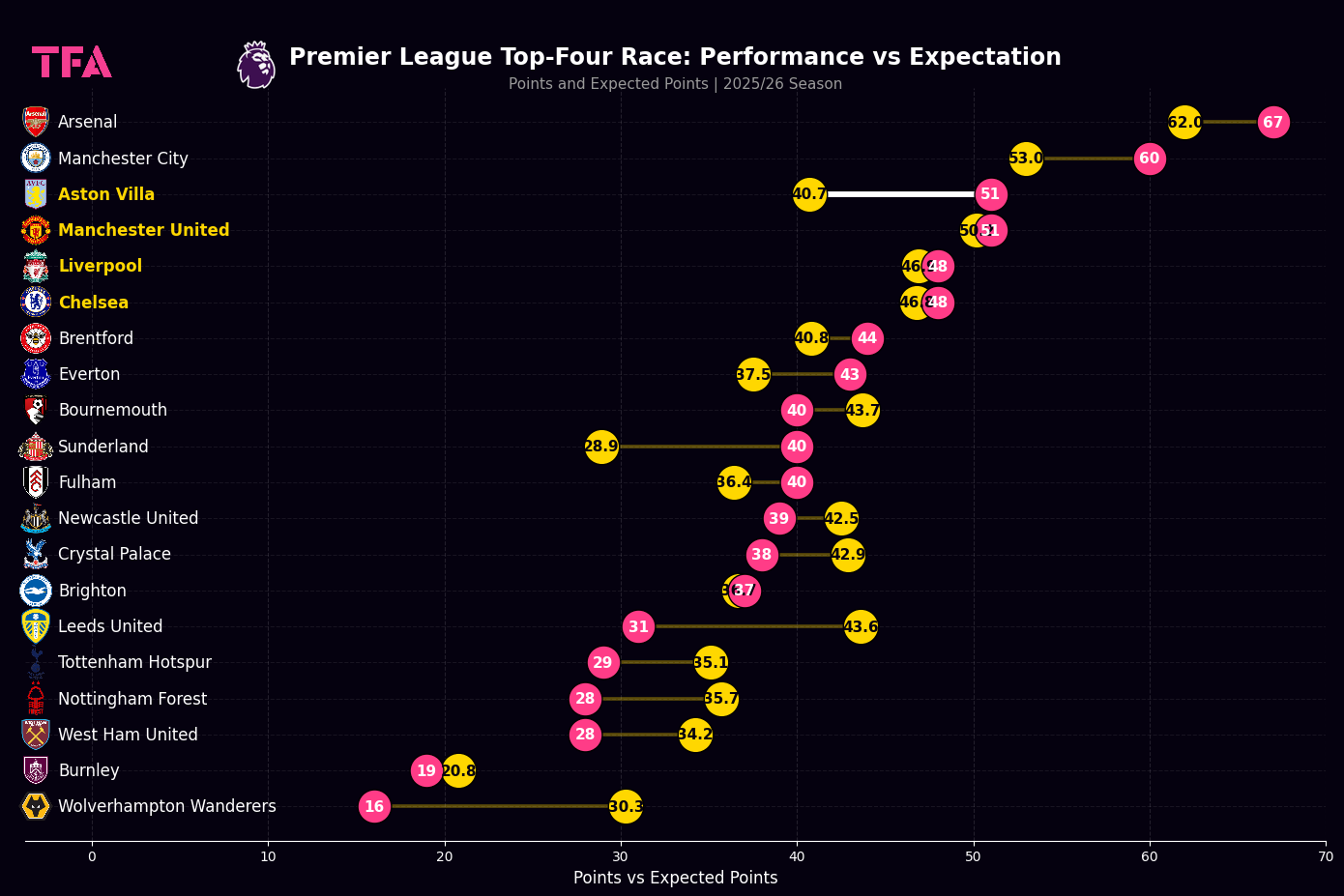
According to current models based on match outcomes and expected-goals data, Aston Villa have accumulated 51 actual points despite an expected-points tally of just 40.7, indicating a substantial over‑performance relative to their underlying metrics.
This contrasts with Manchester United, whose 51 actual points are almost in line with an expected 50.2, highlighting a more “deserved” points haul based on their performances.
Liverpool (48 actual vs 46.9 expected) and Chelsea (48 vs 46.8) also hover close to their statistical benchmarks, with neither side massively overachieving so far.
Villa’s ability to convert tight games into results under boss Unai Emery, a tactician known for structured pressing and transitional play, could be the key to sustaining their advantage.
Aston Villa’s Overperformance: Offensive Efficiency Beyond xG
One of the most striking trends in this four-team Champions League battle is Aston Villa’s ability to consistently outperform their expected goals (xG) metrics, highlighting both efficiency and tactical acumen in attack.
Across 29 Premier League matches, Villa have frequently converted tight opportunities into decisive results, showcasing clinical finishing under Unai Emery.
Premier League 2025/2026 Goals Vs Expected Goals – Aston Villa Lowest xG & Goals Among UCL Qualification Contenders
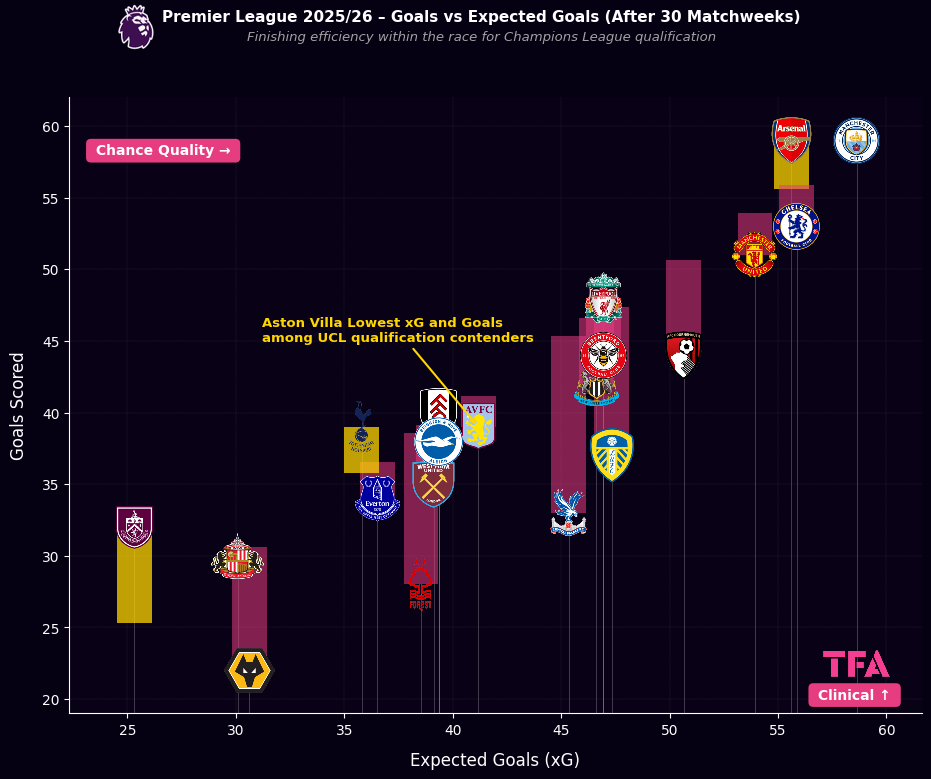
For example, in late December, Villa defeated Chelsea 2-1, outperforming their xG of 1.81.
Their 3-4 victory against Brighton in early December also saw them score more than the 3.11 xG, reflecting effective positioning and creative execution in the final third.
In high-pressure encounters, Villa have exceeded their xG, underlining Emery’s structured offensive patterns and transitional strategies.
Across the season, Villa’s offensive profile, 1.42 average xG per game, 11.66 shots per match with over four on target, and a high number of counterattacking opportunities, illustrates why they are the most efficient of the four teams in converting performance into points.
Their overachievement in xG relative to actual goals scored sets them apart in this Champions League qualification race, giving them a statistical edge in tight contests.
Aston Villa’s High Line & Central Control Under Unai Emery
One of the key tactical principles behind Aston Villa outperforming expectations under Unai Emery is their aggressive defensive structure, particularly the use of a high defensive line combined with a compact central block.
Emery instructs his side to prioritise protecting the middle of the pitch, often compressing the central lanes to deny opponents the ability to receive between the lines.
This forces opposition teams to either circulate possession harmlessly or attempt riskier vertical passes behind the defence.
The backline, typically marshalled in front of Emiliano Martínez, pushes high to maintain territorial pressure while relying on a well-coordinated offside trap to disrupt forward runs.
In front of them, the double pivot, often featuring players such as Onana and Douglas Luiz, helps seal central passing lanes, forcing play wide where Villa are more comfortable defending.
The wingers tuck inside while the full-backs step out only when necessary, creating a compact five-lane defensive shape.
Aston Villa Compress The Centre, Forming A Narrow Mid-Block That Protects Central Lanes & Forces The Opposition To Play Wide
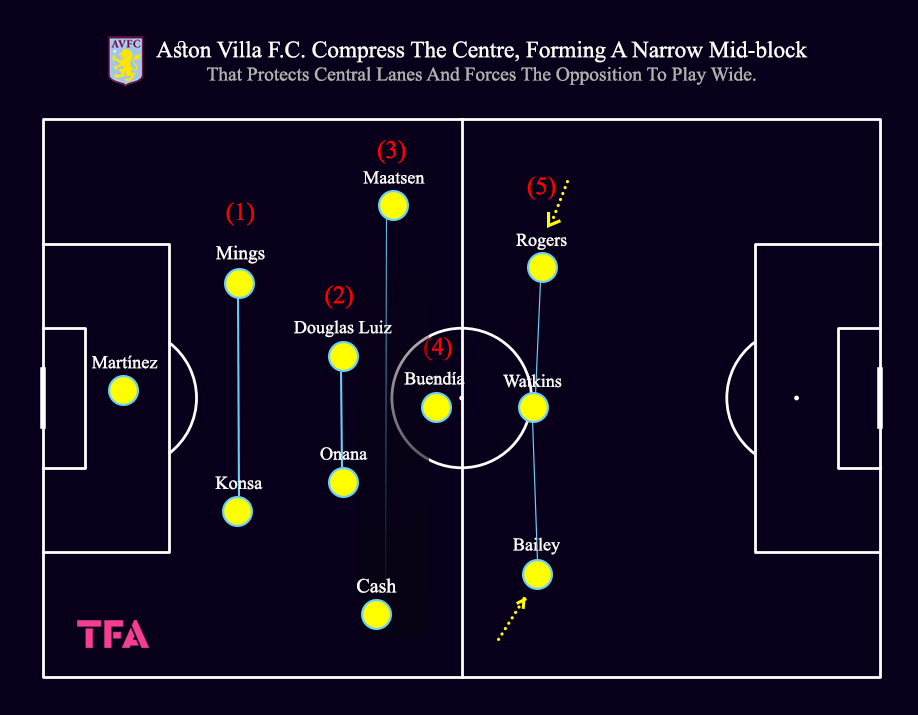
This central congestion frequently frustrates opponents who rely on combinations through midfield, allowing Villa to regain possession and transition quickly.
Against weaker or less tactically organised sides, this approach proves highly effective, as their controlled defensive spacing and disciplined positioning enable them to dictate where the opposition can play, a key factor behind their consistent overperformance under Emery.
Chelsea’s PPDA Against: Fewest Defensive Interventions From Opponents
In the 2025/2026 Premier League, Chelsea registered the highest PPDA against at 15.17, meaning opponents attempt fewer defensive interventions against them than against any other team.
This indicates that when Chelsea has the ball, opposition sides press less aggressively, granting the Blues more time and space to build play safely.
Premier League 2025/2026 PPDA Against – Pressing Pressure Faced
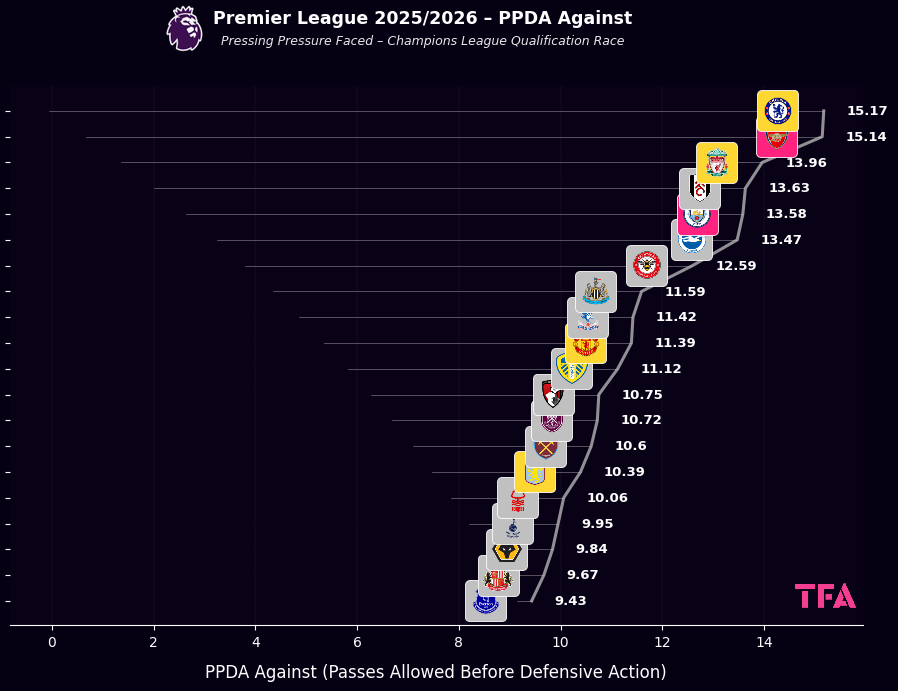
Under Liam Rosenior, Chelsea’s structured positional setup and controlled movements minimise risky situations, reducing the need for opponents to constantly challenge.
Compared to Aston Villa (10.39), Manchester United (11.39), and Liverpool (13.96), Chelsea face significantly less defensive pressure, allowing them to dictate tempo, maintain possession, and transition safely in tight encounters during the Champions League qualification battle.
Chelsea’s Tactical Shift Under Rosenior
Since the arrival of Liam Rosenior, Chelsea have shown subtle but important tactical differences compared with the more conservative possession structure previously associated with Enzo Maresca.
While Maresca often prioritised numerical superiority in central areas, frequently dropping players like Cole Palmer and Enzo Fernández deeper to circulate possession, Rosenior has introduced a more vertical and direct attacking approach.
Rather than patiently building through the middle, Chelsea have increasingly targeted space behind opposition defensive lines, encouraging forwards such as João Pedro and Alejandro Garnacho to make aggressive runs in behind.
This shift places greater emphasis on timing, forward movement, and quick progression once space opens up.
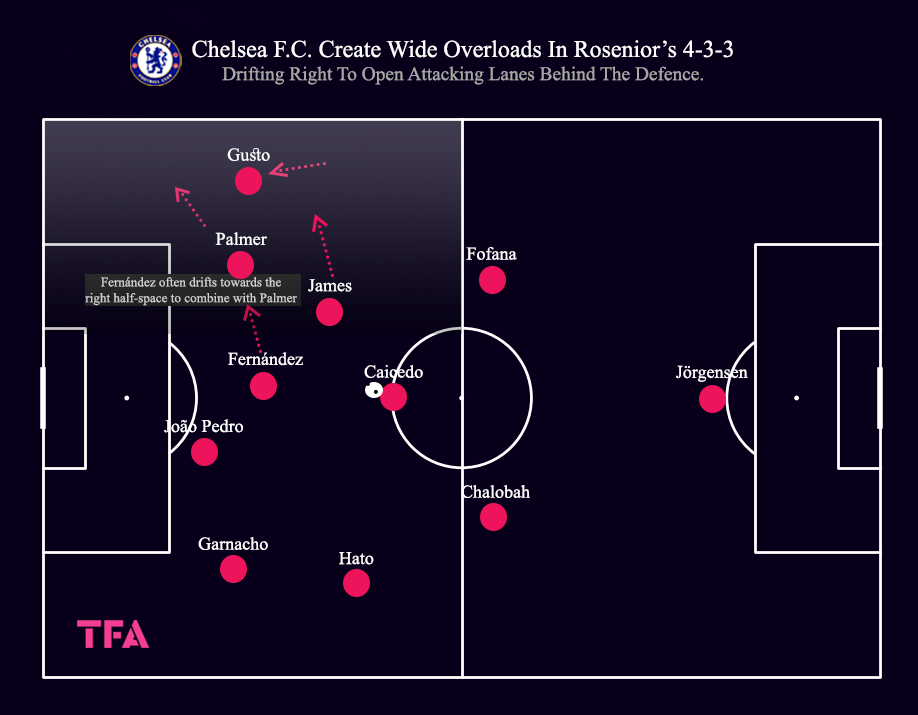
Another notable adjustment is the use of wide overloads within a 4-3-3 structure, where Fernández often drifts towards the right half-space to combine with Palmer, creating numerical advantages on the flank before delivering into the box.
Chelsea Create Wide Overloads, With Enzo Drifting Right To Combine With Palmer & Open Attacking Lanes Behind The Defence
However, such structural changes inevitably require time to develop full cohesion; synchronisation of runs, balance between vertical play and controlled possession, and spacing between lines are all elements that will improve with repetition.
If these patterns continue to develop, Rosenior’s more dynamic interpretation of Chelsea’s attacking play could gradually provide a clearer tactical identity.
For example, in the Aston Villa vs Chelsea match that ended 4-1 to Chelsea, shot maps illustrate how the Blues created and converted chances.
Aston Villa Vs Chelsea Shot Locations & xG Distribution 2025/2026
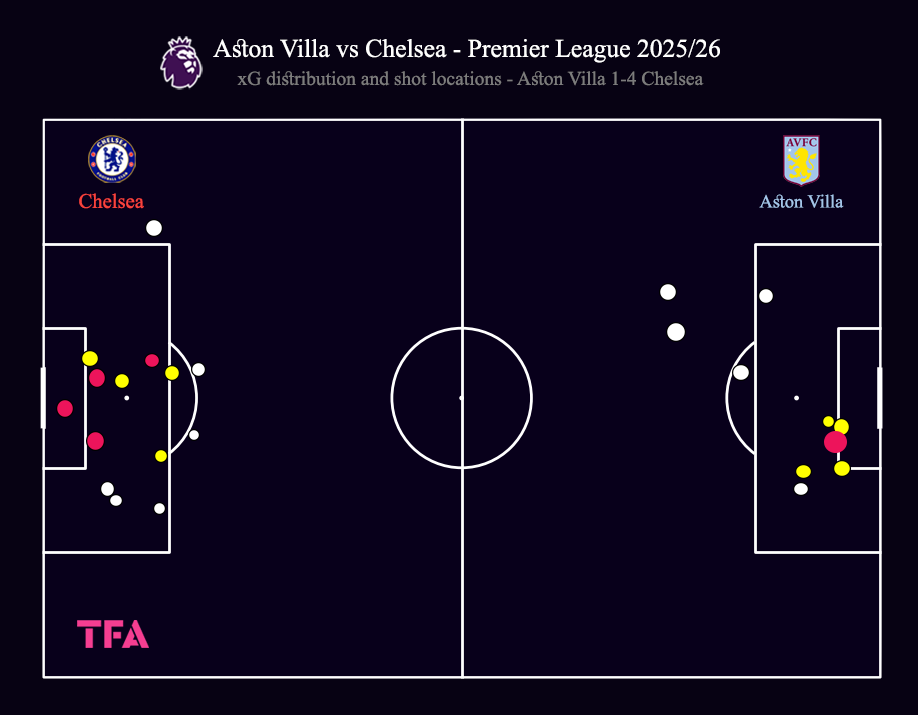
After building play through controlled possession and wide overloads on the right flank, Chelsea frequently switched the ball to the left half-space, opening central channels for finishing.
In this match, Chelsea registered 15 shots, converting four into goals.
Many of these opportunities arose from precise passes behind defenders or from overloading one side before switching play, demonstrating Rosenior’s emphasis on dynamic positional rotation and on exploiting central channels once space is created from wide movements.
Manchester United’s Resurgence Under Carrick: Shot Volume Driving Their Champions League Push
Following the dismissal of Ruben Amorim in January, Michael Carrick was appointed interim manager of Manchester United.
This move has significantly reshaped the club’s trajectory in the race for Champions League qualification.
Amorim’s tenure had been marked by inconsistent results and tactical rigidity, averaging only around 1.23 points per game in the league before his departure.
Since Carrick’s arrival, however, United have stabilised both tactically and psychologically, climbing to 51 points after 29 matches, level with Aston Villa and firmly embedded in the battle for the top five.
Carrick’s approach has prioritised clarity in structure and more aggressive attacking sequences, encouraging quicker progression into the final third and greater shooting frequency.
Statistically, United’s attacking output highlights this transformation; the club currently leads the Premier League in total shots with 439, significantly ahead of rivals such as Arsenal (398) and Manchester City (397).
Premier League 2025/2026 – Manchester United Lead The Shot Volume In The Race For Champions League Qualification
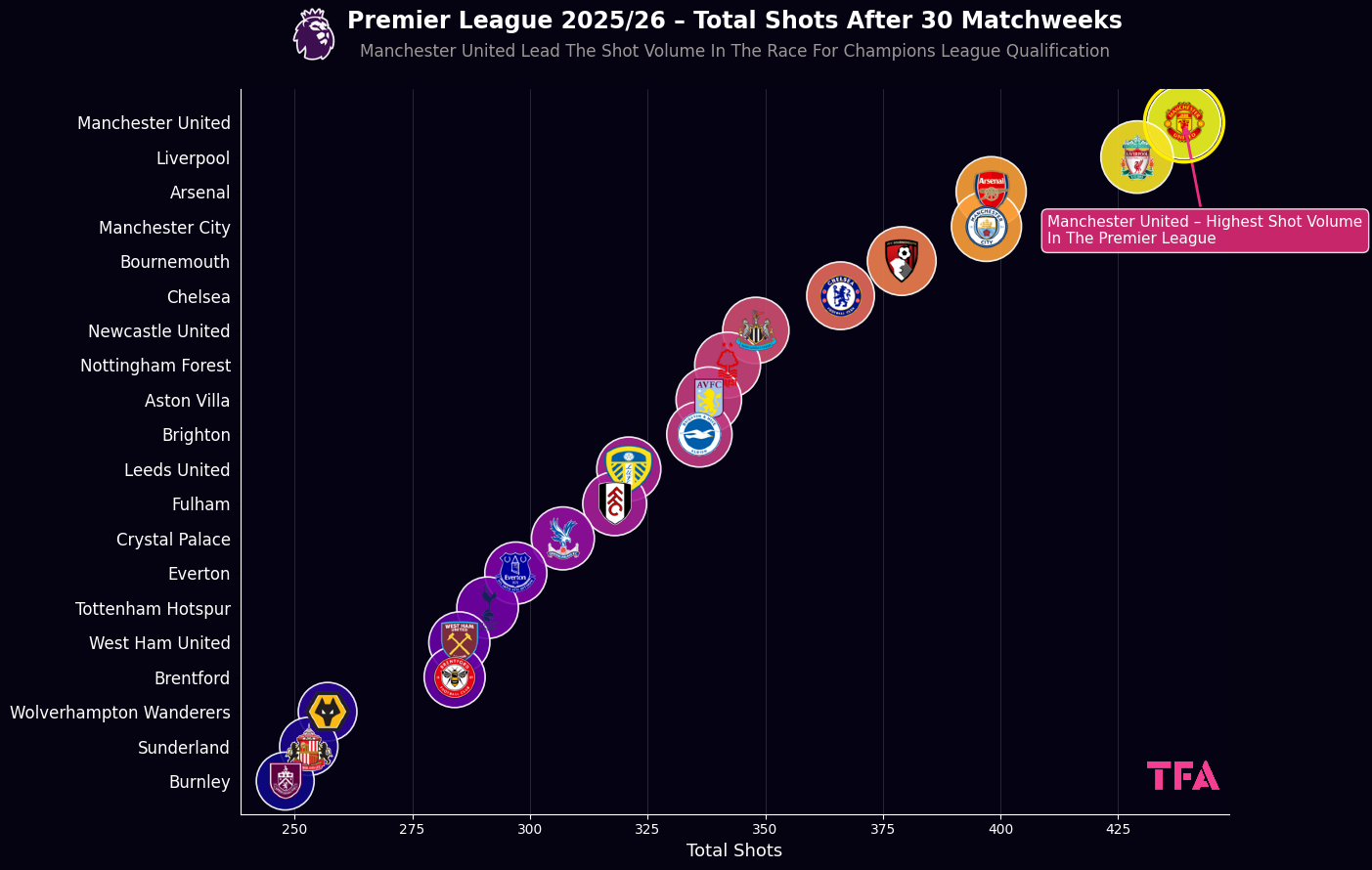
Of these attempts, 427 have come from open play, underlining United’s ability to generate chances through structured attacking phases rather than relying heavily on set pieces.
Although their 37.6% shot-on-target rate suggests room for improvement in finishing efficiency, the sheer volume of attempts reflects a proactive attacking philosophy.
This high shot production, combined with Carrick’s tactical simplification and improved momentum, has re-established Manchester United as one of the most dangerous attacking sides in the Premier League during the decisive phase of the Champions League qualification race.
Liverpool’s Finishing Struggles Under Slot: High Shot Requirement To Score
While Liverpool remain firmly involved in the race for Champions League qualification with 48 points after 29 matches, their 2025/2026 campaign under Arne Slot has often been characterised by attacking inefficiency rather than a lack of chance creation.
The Reds frequently require a high volume of attempts to convert opportunities into goals, highlighting a recurring issue with finishing efficiency during key moments of the season.
A clear example came in their recent 2–1 defeat to Wolverhampton Wanderers, where Liverpool dominated possession and attacking output but struggled to translate that pressure into goals.
In that match, they produced 15 shots, seven on target, and scored only once despite accumulating 1.93 expected goals (xG).
Liverpool Shot Locations & xG Distribution Vs Wolverhampton Wanderers
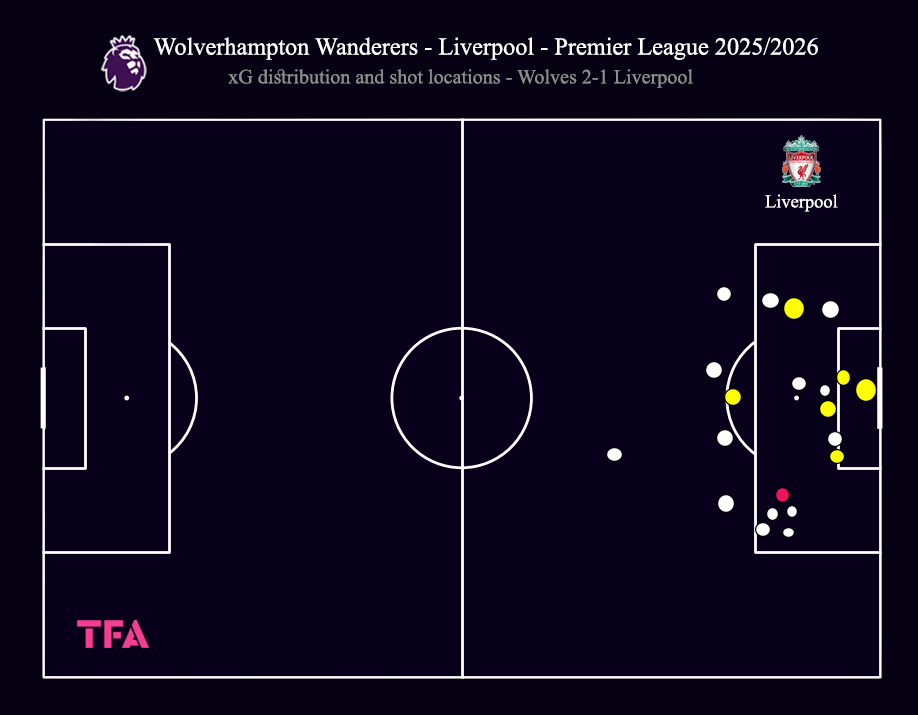
This pattern has appeared repeatedly throughout the campaign, with Liverpool generating respectable chance volumes but often lacking the clinical edge required to capitalise on them consistently.
While their underlying attacking numbers remain competitive with those of rivals such as Chelsea and Manchester United, converting territorial dominance into goals remains the decisive factor in determining whether Liverpool ultimately secures a place in next season’s Champions League.
Conclusion
As the Premier League season approaches its final stretch, the battle for Champions League qualification remains finely balanced between Aston Villa, Chelsea, Manchester United, and Liverpool.
Each side presents a distinct tactical identity and statistical profile.
Aston Villa have demonstrated remarkable efficiency under Unai Emery, consistently converting limited chances into crucial points.
Manchester United, revitalised by Michael Carrick, relies on high shot volume and attacking momentum to sustain their push.
Chelsea, meanwhile, appears to be tactically evolving under Liam Rosenior, with improved positional structure and reduced pressure from opponents.
Liverpool remains competitive in chance creation but must address recurring inefficiencies in front of goal.
Ultimately, the race may be decided not only by tactical organisation but also by which team can maintain consistency and maximise key moments during the closing weeks of the campaign.
