
Sunderland successfully secured a league double over their Tyne-Wear rivals Newcastle United, putting the icing on the cake of what will go down as a successful first season back in the top flight after almost a decade away.
With seven games remaining in the 2025/2026 campaign, the Black Cats sit a point ahead of the Magpies; they’ll now be aiming to finish the season that way.
Newcastle, meanwhile, are stuttering, having been unceremoniously knocked out of the UEFA Champions League by Barcelona in mid-week, heading into Sunday’s losing derby effort.
It was a well-deserved win for Sunderland, characterised by Newcastle’s failure to fully capitalise when they had early momentum and Sunderland punishing them effectively.
This tactical analysis details both sides’ strengths and weaknesses in and out of possession, examining how this clash could’ve gone either way and why the Black Cats ultimately came away with three points.
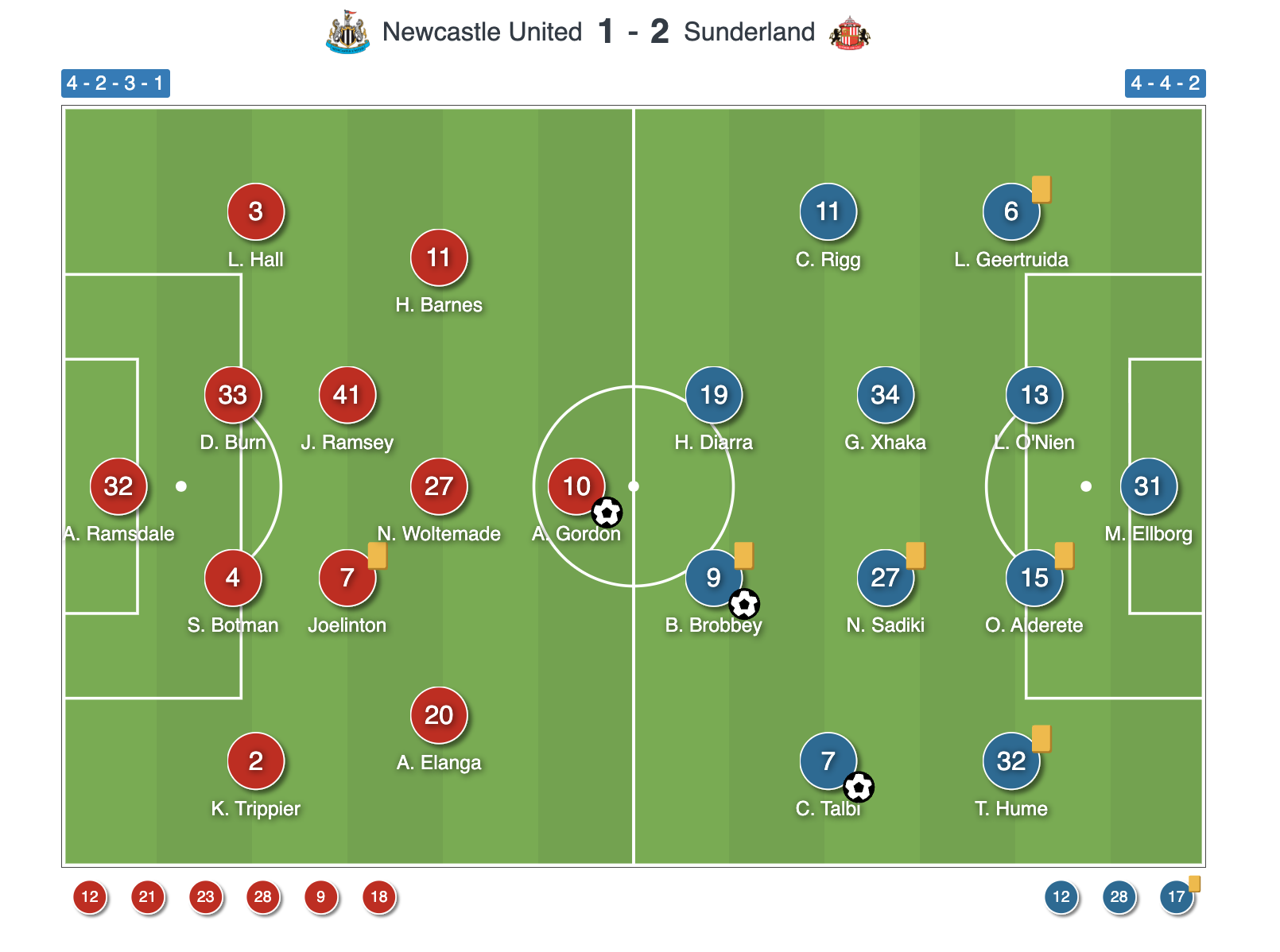
Newcastle United Vs Sunderland Lineups & Formations
Eddie Howe set the home side up in a 4-2-3-1 shape.
Aaron Ramsdale started in goal behind a back four of Kieran Trippier, Sven Botman, Dan Burn and Lewis Hall (right to left).
Joelinton and Jacob Ramsey played behind Nick Woltemade in an attacking central trio, with Anthony Elanga and Harvey Barnes on the right and left wing, respectively.
Anthony Gordon led the Toon attack as the centre-forward until he was replaced by Yoane Wissa in the 89th minute.
Alongside Wissa, Howe made five other substitutions over the course of the match.
Botman was replaced by Malick Thiaw due to injury in the 54th minute, just before Sunderland scored the equaliser.
This preceded a triple change just after the hour mark, as Elanga, Woltemade and Trippier made way for Jacob Murphy, Joe Willock and Tino Livramento, respectively.
William Osula was also brought on for Barnes as Howe looked for a winner in the 76th minute.
As for the visitors, Régis Le Bris lined his side up in a 4-4-2 shape with Melker Ellborg in net behind a backline of Lutsharel Geertruida, Luke O’Nien, Omar Alderete and Trai Hume (right to left).
The midfield four, from right to left, were Chris Rigg, Granit Xhaka, Noah Sadiki and the first goalscorer Chemsdine Talbi.
Habib Diarra played as a second striker with Brian Brobbey at centre-forward.
Le Bris made just three late changes to his starting XI.
First, Enzo Le Fée replaced Diarra in the 85th minute, before Eliezer Mayenda came on for the scorer of the winner Brobbey in the 92nd minute, and Reinildo Mandava replaced Talbi to see out the game.
Newcastle United Early Momentum Vs Sunderland
Though Howe had been rotating to the extent he thought possible, Sunday’s derby match came at the end of a busy two-and-a-half-week period in which the Toon played six big games.
Nine of Newcastle’s starters on Sunday also started their heavy mid-week loss in Camp Nou.
Likely spurred on by the electric St. James’ Park atmosphere for Sunday’s derby, the hosts came sprinting out of the blocks.
They took three shots, scoring from one and generating 0.43 xG in the first 10 minutes of the match, while the opening 15 minutes saw Newcastle generate their lowest PPDA (3.2, compared to 8.32 for the match) and most possession (67%, compared to 56.85% for the match) of any 15-minute period in Sunday’s fixture.
It wasn’t until after they’d gone level again in the second half and substitutes were introduced that Newcastle managed to generate a similar period of productivity in terms of chance creation, while they never reached the same level of pressing intensity and control again in the game after that opening quarter-of-an-hour.
They took advantage of their early momentum by getting into the lead and forcing Sunderland to come out and press more aggressively than they would’ve liked at St. James’ Park.
Progressing through their back four, they were able to draw Sunderland’s midfield high and exploit space between the lines via their attacking midfield trio, as shown above.
Anthony Gordon was comfortable dropping in between the lines and linking up with the midfield to support progression via the space Newcastle were able to create between the lines, as the second clip shows.
Despite the vast amount of space Newcastle were able to create, they ultimately failed to turn that into a respectable amount of clear-cut goalscoring opportunities.
Only 15% of Newcastle’s passes were defined as progressive passes, per Wyscout, compared to just under 25% of Sunderland’s passes, reflecting a more passive, risk-averse style of play than would ultimately have been optimal if the Toon were to proactively and successfully take advantage of the dynamic they created in the first half and really put Sunderland to the sword early on.
This phase provided the conditions for Newcastle to generate more high-quality chances, with Sunderland stretched in an uncharacteristically aggressive defensive shape, and seize the opportunity to put the game beyond their rivals, while energy was high, the stadium was buzzing and Sunderland were getting forced into an awkward out-of-possession strategy that afforded Newcastle’s creators exactly the space they wanted and needed between the lines.
A mix of poor support runs in the final third, a lack of movement and intelligent runs in behind the Sunderland defence and an apparent preference to try and control the game once ahead rather than continuing to attack with the same pace and intensity of the first 15 minutes as the first half progressed allowed Sunderland a glimmer of hope which they grasped in the second half.
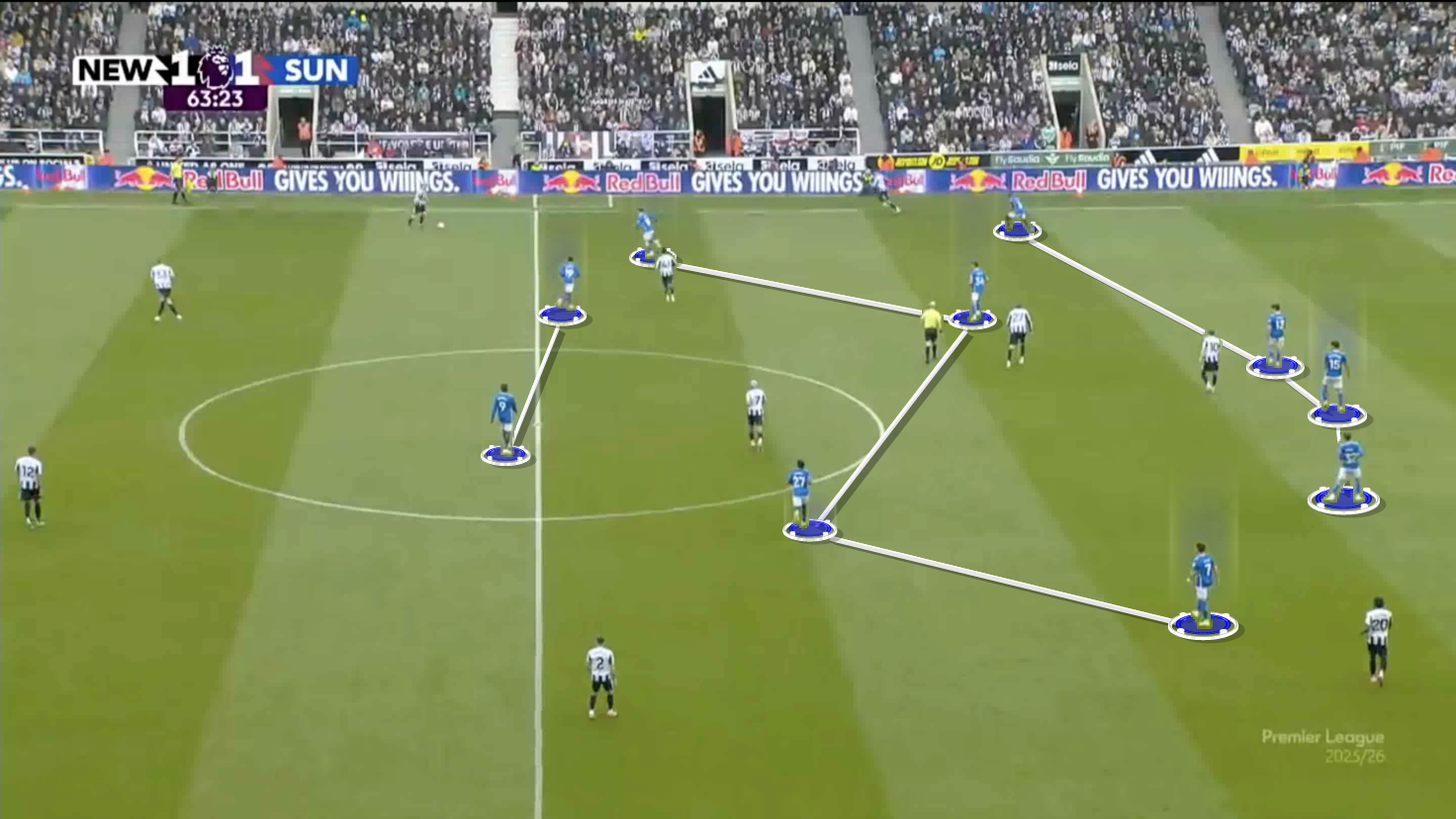
Once Sunderland had equalised in the second half, they were able to sit off into a mid-block, which closed the space between the lines and minimised the creative capacity of Newcastle’s attacking midfielders.
Newcastle’s chances mostly came from set-pieces after that; their open-play avenues were shut off, so it was a missed opportunity when so much space had been afforded to them between the lines.
Sunderland Rest Defence & Pressure On Second Balls
During periods of possession inside the opposition’s half, Sunderland’s full-backs would come inside while the wingers primarily held the width in the final third.
We see a rather extreme example of how narrow they’d come in Figure 3 below, in this case, the two linking up in zone 14.
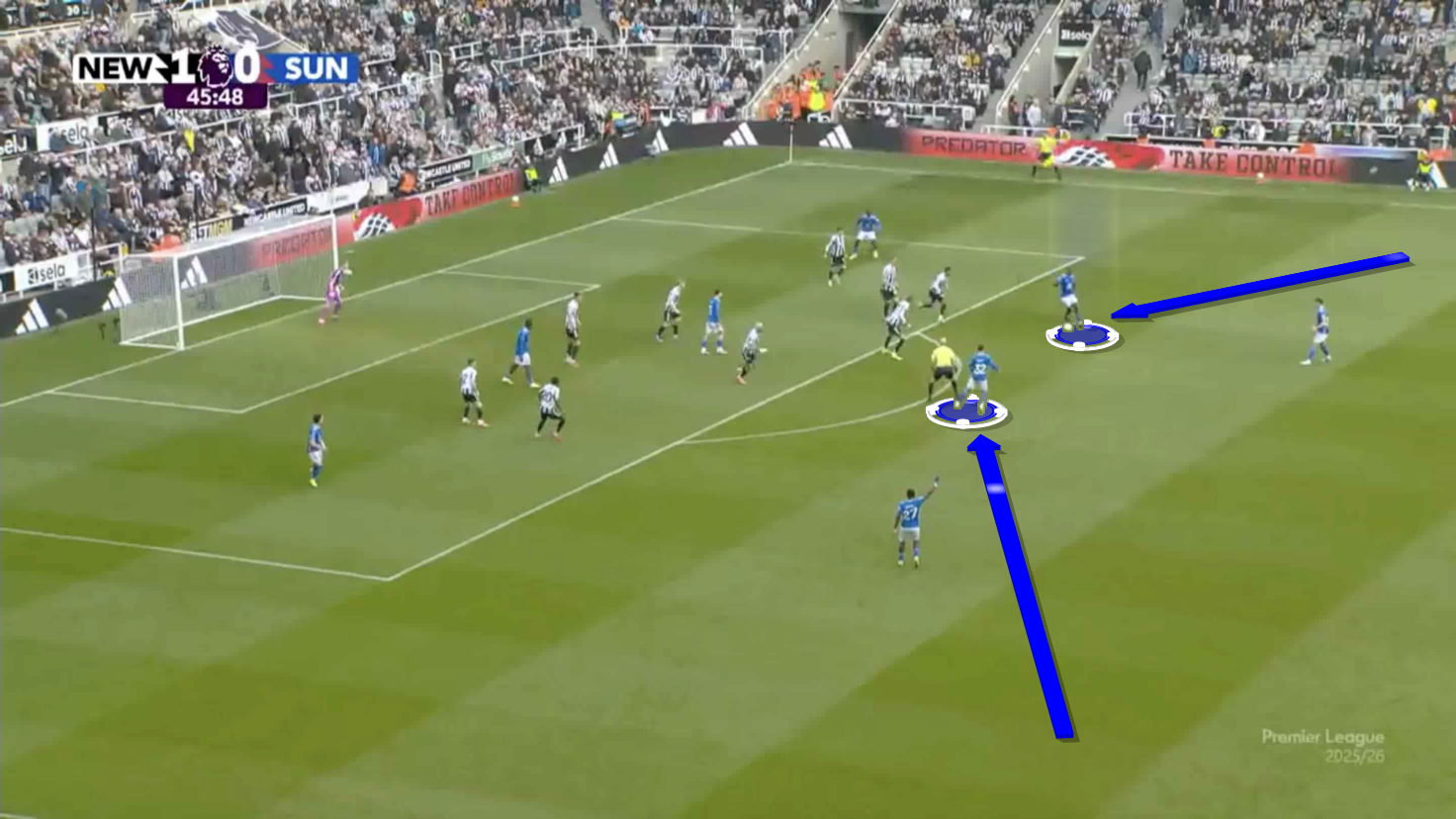
Inverting full-backs like this serves two main purposes: it helps the team control the midfield battle and progress play through tight central spaces, and it improves the team’s rest defence by positioning players close together, enabling them to counterpress quickly on a loss of possession.
When Sunderland settled into periods of possession inside the final third, they were able to sustain pressure on Newcastle with the help of their rest defence structure, poor Newcastle clearances and a lack of pressure on the second ball from the defending side.
The clip below illustrates this point, which plagued Newcastle’s box defence throughout the match, forcing them to collapse and soak up pressure rather than counterattack; all 11 players were defending the box, and nobody was upfield to put pressure on the second ball after a clearance or to be a target for the counterattack.
This afforded Sunderland more chances than Newcastle could ultimately take, hence the Black Cats got back into the game.
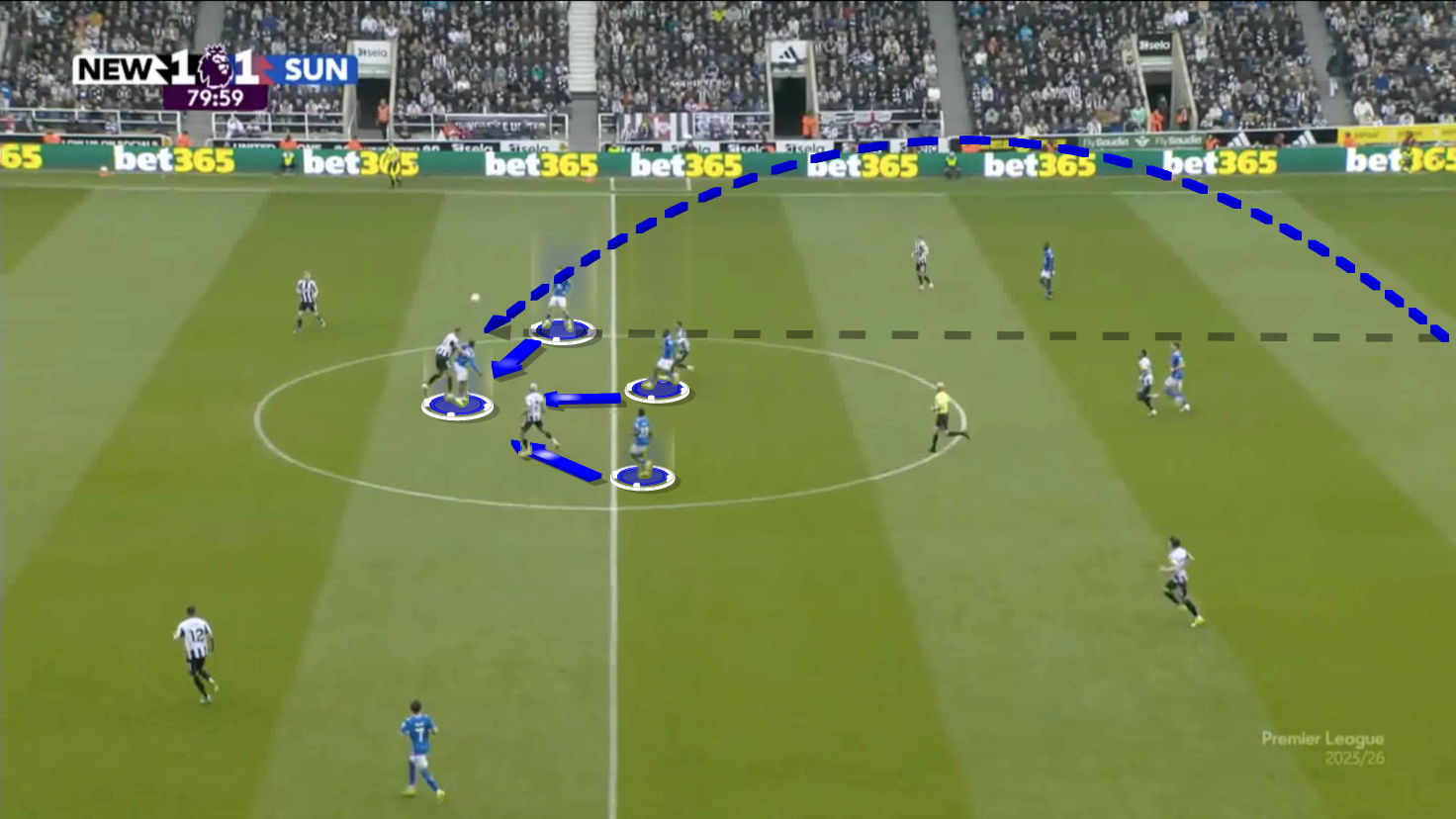
Sunderland used Brian Brobbey as a target man throughout the game; his physical battles with Newcastle’s centre-backs were entertaining to watch and a key part of Sunderland’s attacking efforts.
It was imperative for Diarra and Sunderland’s midfield to provide support to Brobbey to pressure the second ball and provide runs in behind, just like it would’ve been important for Newcastle to provide more support and movement in behind when they did exploit space between the lines in the first half.
Sunderland’s equalising goal came from a corner kick, which ultimately resulted from a long ball knocked on by Brobbey, while the winning goal was scored by the striker, highlighting his key role in the derby win.
Conclusion
Sunderland’s win reflected their ability to leverage their preferred game state and phases of play better than Newcastle through chance creation.
If Newcastle had been more proactive and aggressive in translating their early territorial dominance, intensity, and access between the lines into more penetrative attacking sequences, they could’ve put the game beyond Sunderland.
They seemed to take their lead for granted, failed to exploit the space available to them between the lines enough, and provided limited support around the forward line when they did access that space.
This let the Black Cats recover and impose their own game-state preferences, with Sunderland’s rest defence and control of second balls becoming increasingly influential, allowing them to sustain pressure and ultimately capitalise.
In the end, Sunderland executed their plan well, but the match was equally defined by a missed window in which Newcastle could’ve dictated an alternate ending.
