
Last week in the UEFA Champions League quarter-final first leg, Total Football Analysis called Arsenal‘s away performance blunt, amongst other things.
Fast forward a week later, and they have cruised into the quarter-finals of the Champions League with what looks to be a favourable draw, though the past week has been far from straightforward for them.
In a similar vein to how Max Dowman was the outlier who lifted Arsenal’s creative spirits against Everton on Saturday, their press and style of play at home did so against Bayer Leverkusen.
In this tactical analysis, we will talk about how Mikel Arteta‘s men powered to victory by using intense pressing and capitalising on Leverkusen’s errors, with the two going hand in hand.
Arsenal Vs Bayer Leverkusen Lineups & Formations
Let’s have a quick look at how both teams set themselves up for the match in London.
For Arsenal, David Raya started in goal behind the trusted centre-back pairing of Gabriel and William Saliba, alongside Piero Hincapie on the left and Ben White on the right as full-backs.
In a midfield three, Declan Rice, Eberechi Eze and Martin Zubimendi played in the middle with Viktor Gyökeres ahead of them up front, flanked by Bukayo Saka and Leandro Trossard.
Meanwhile, Leverkusen lined up with Janis Blaswich in nets behind a 3-4-2-1 system.
The three centre-backs were Jarrell Quansah, Robert Andrich and Edmond Tapsoba.
As the wing-backs, Alejandro Grimaldo was on the left and Ernest Poku on the right.
Making up the central midfield pairing were Aleix Garcia and Ezequiel Palacios.
The forward line included Ibrahim Maza and Martin Terrier supporting Christian Kofane up front.

Arsenal Out-Of-Possession Tactics
Arsenal’s press wasn’t as intense as usual in this match, but it was effective enough to cause the German side to make a lot of unforced errors.
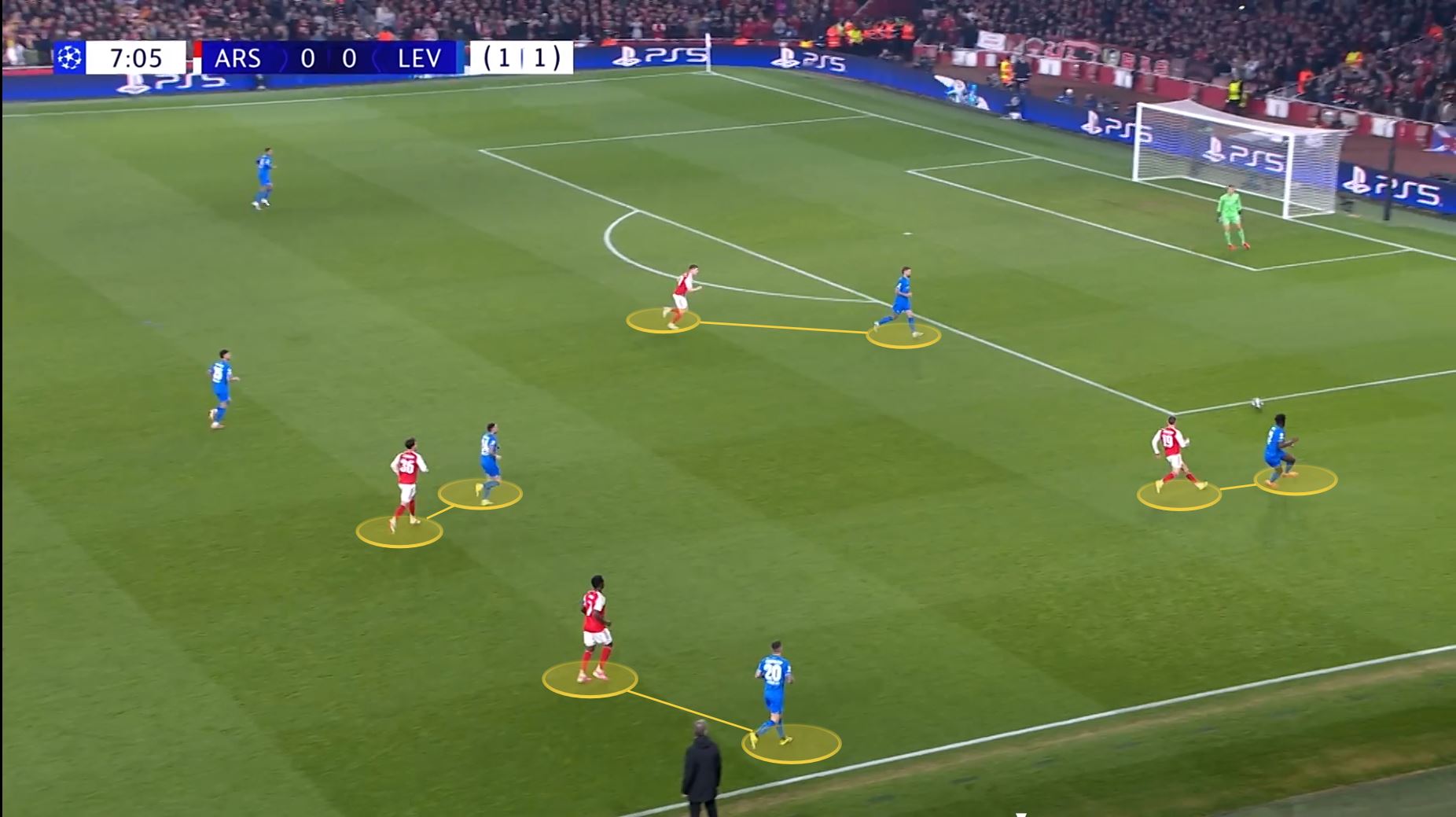 It’s difficult to press high up against a back five because gaps often appear, particularly between the wing-backs and centre-backs, where, if players are not tracked or covered, defenders can emerge with the ball.
As there are five defenders in the backline, they are spread quite wide across the pitch, so you need a lot of men to cover them, but Arsenal had no problem committing to the press in moments, especially when the opposing backline was scattered.
When they pressed, Arteta encouraged the winger on the opposing wing to push up and help, as Trossard and Saka had hybrid roles.
With Saka pushing back to mark the full-back on the left, Trossard hunting down a centre-back joined by Gyökeres and Zubimendi on whichever side the ball was on, there was no one to pass to.
It’s the fact that on whichever side the ball was on, Arsenal shut down and trapped the Bundesliga side.
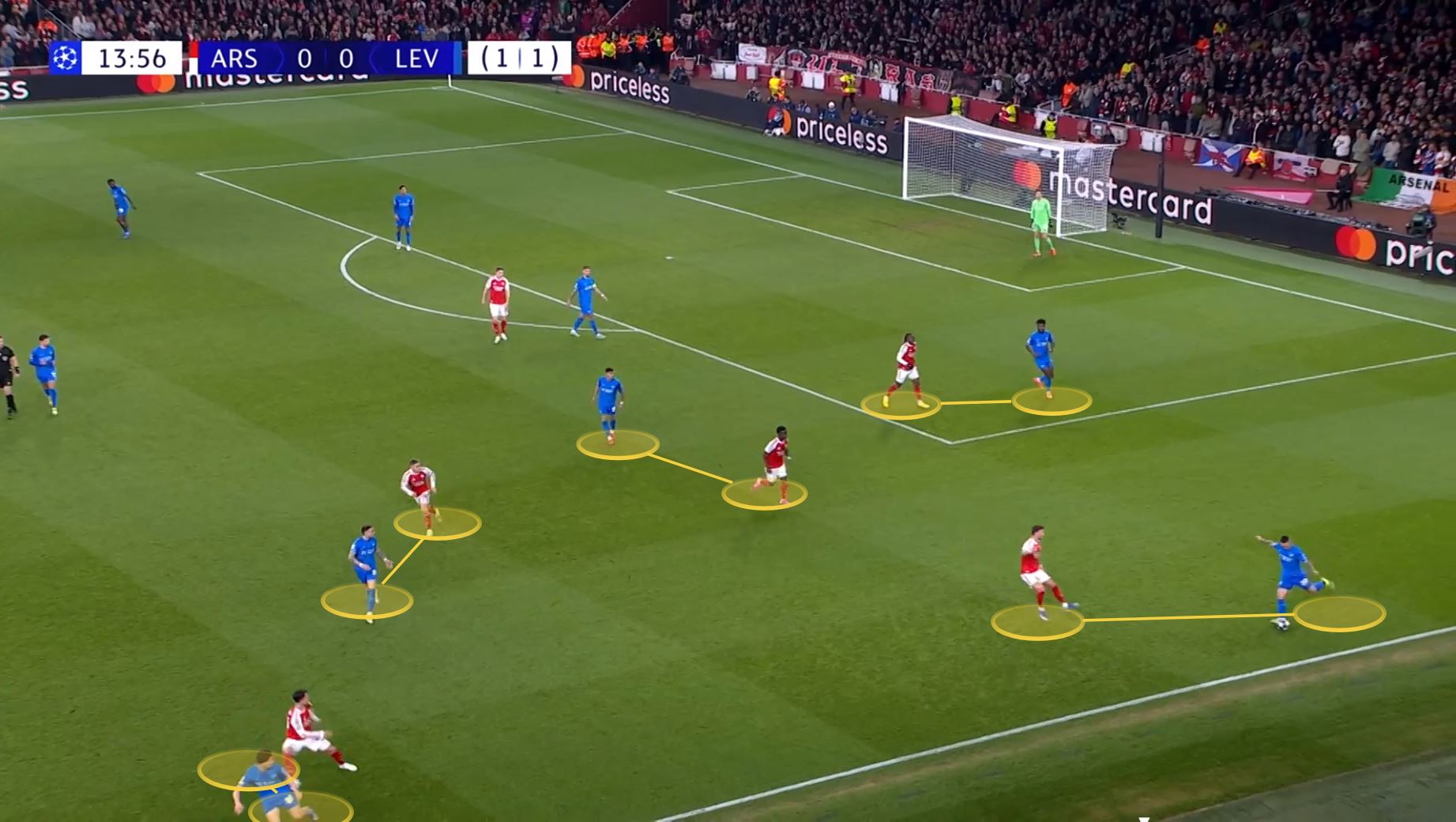 The shot above is interesting because once again, it’s when Leverkusen’s back five is scattered.
Because Arsenal attack for most of the game, they like to push their full-backs up.
Instead of retreating, White, Saka, Eze and Trossard press with Zubimendi bravely following a forward on the same wing across.
Think of the times you’ve watched Arsenal this season.
How many times have you seen the shot above, with two midfielders, two wingers, and a full-back all on one wing?
It was because Arsenal were attacking, but instead of quickly retreating into a mid-block, they kept the pressure on in order to quickly retrieve the ball.
As a result, turnovers came.
Though Leverkusen’s mistakes played a role in this match, it was a response to the intensity and pressure applied.
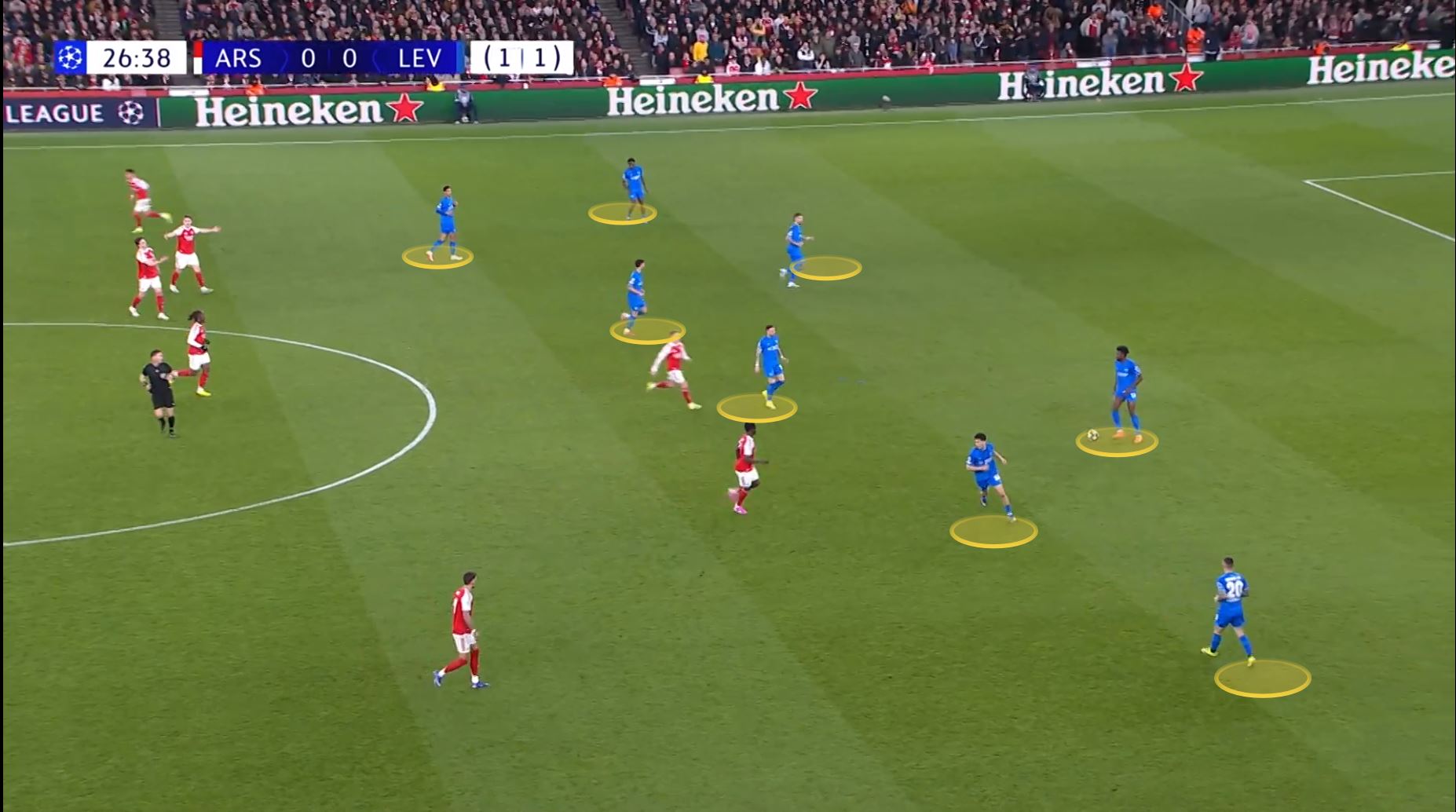
The screenshot above is eye-opening.
This is in the first half, as Leverkusen were eventually ushered further and further back with eight players in their own box, not past the halfway line.
If you can mark off, look to press and track the defence whilst they attempt to build up and progress the ball, you will start to create pressure.
It was really hard for Leverkusen to get a foothold in the game after the first fifteen minutes or so.
Instead of Kasper Hjulmand‘s side getting a foothold in the game on the ball and playing their way into it, they have been coached to get it up to one of the wingers or Kofane, favouring a more direct approach to totting the ball forward.
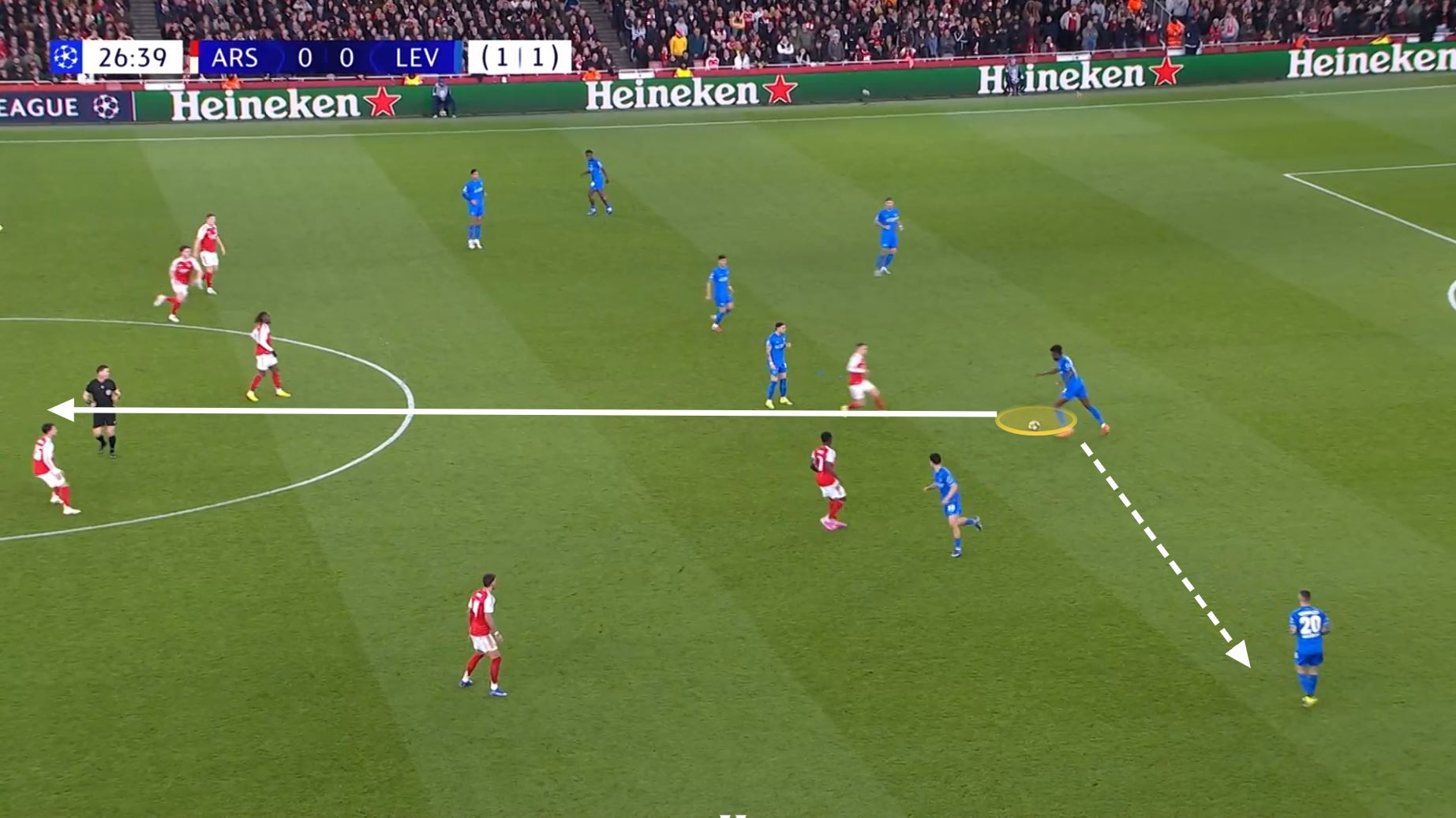
The long ball up to the striker doesn’t work, and Arsenal turn the ball over.
In the sequence above, there is a clear pass to the left, where Leverkusen should’ve taken better care of the ball even without high pressure.
There have been many times when visitors to the Emirates have successfully taken the sting out of the game.
For instance, the 0-0 draw against Liverpool typified Arsenal’s problems.
Liverpool controlled the ball, took the sting out of the game and let Arsenal’s own problems showcase their difficulties in front of their own supporters.
But Leverkusen’s direct play had the opposing effect.
This is also the problem with playing on the counter and relying on fast forwards to make something out of nothing.
There were too many periods in the game when Arsenal were rampant or comfortable.
Arsenal Turnovers & Commitment Of Players
It was no surprise that Eze’s opening goal, a brilliant strike from outside of the box, involved seven Arsenal players inside Leverkusen’s half.
It exhibits the change from the first leg, Arteta encouraging his players to commit to the attack.
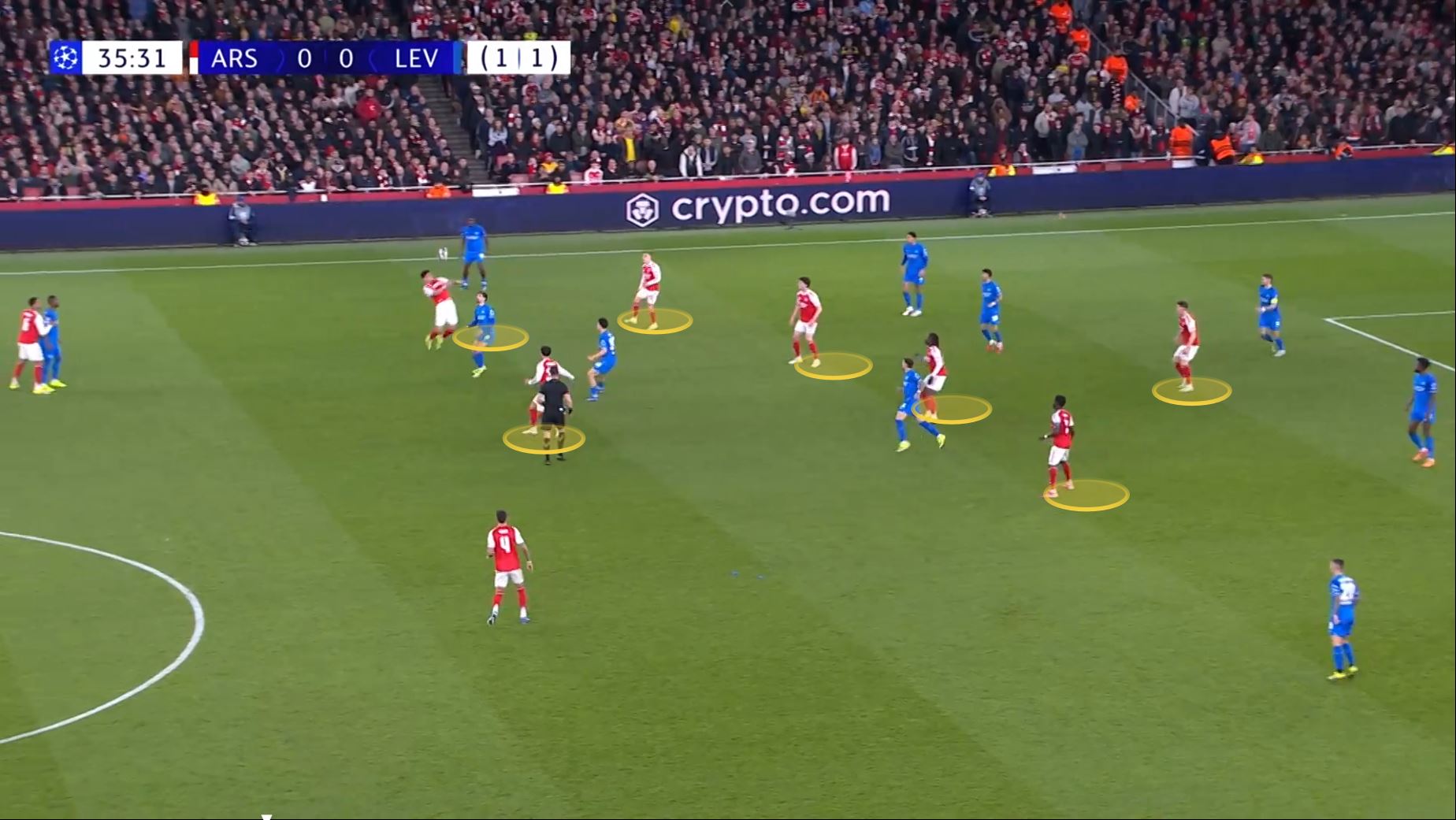
It’s risky to commit so many players to attack, but because of their physicality, height and organisation, whenever Bayer Leverkusen’s midfield or defence tried to clear the ball in the lead-up to the goal, a player would quickly head it back into a dangerous area, as above.
Quick turnovers ensured that the rest defence Arsenal set up throughout the match kept the pressure on Leverkusen.
If an attack broke down, the volume of players in attack meant they could keep Leverkusen under the cosh by using the players they had up the pitch to win physical duels.
Keeping a number of players in attack and then using their defensive capabilities to put the onus on the other team means the attack never dies.
Though Eze’s strike was the genius of the goal, it shows that, if needed, Arsenal have another gear to tap into.
Bayer Leverkusen Unforced Errors
Arsenal definitely took advantage of a Leverkusen team that simply gave the ball away far too many times in their own half.
In the first leg, before they scored the opener, maybe because they were playing at home, they had a route to the goal.
They kept bypassing Arsenal’s press and deploying dropping strikers to get into Arsenal’s half.
In the second leg, they didn’t have this, and because they had no way to get the ball down and build a spell of possession, they would often give the ball away, shooting themselves in the foot.
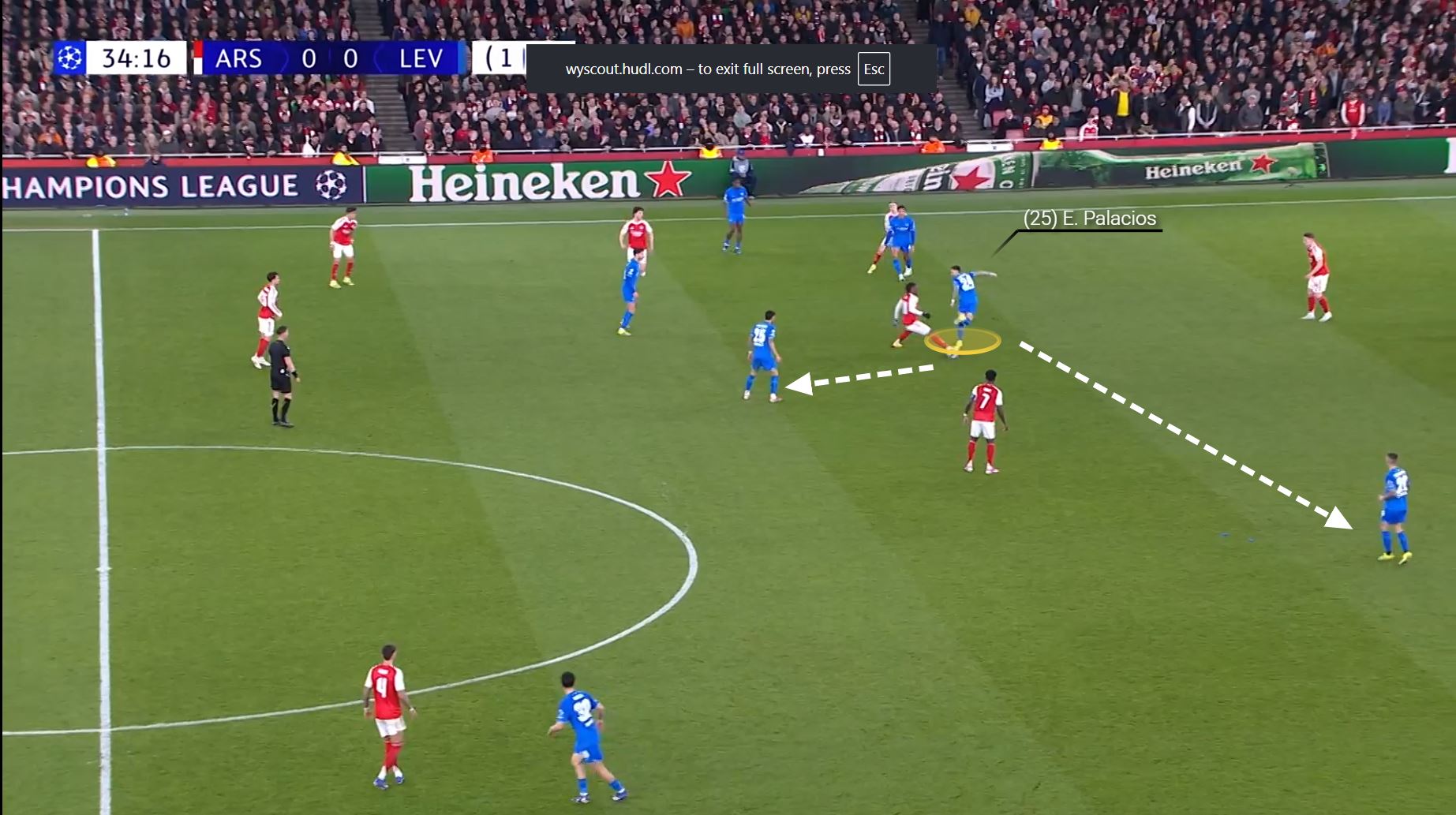
It contributed to their loss, as above: Palacios gets on the ball and, instead of holding it for a second, turning and switching, he attempts a backheel in his own half that doesn’t reach his own player, allowing Arsenal to intercept.
It goes back to the point I made earlier: if you are looking to counterattack quickly as a team, holding the ball for too long can be detrimental.
With the number of Arsenal players around him, it wasn’t the easiest option, but holding onto the ball and even going backwards would’ve been better than losing it in that area.
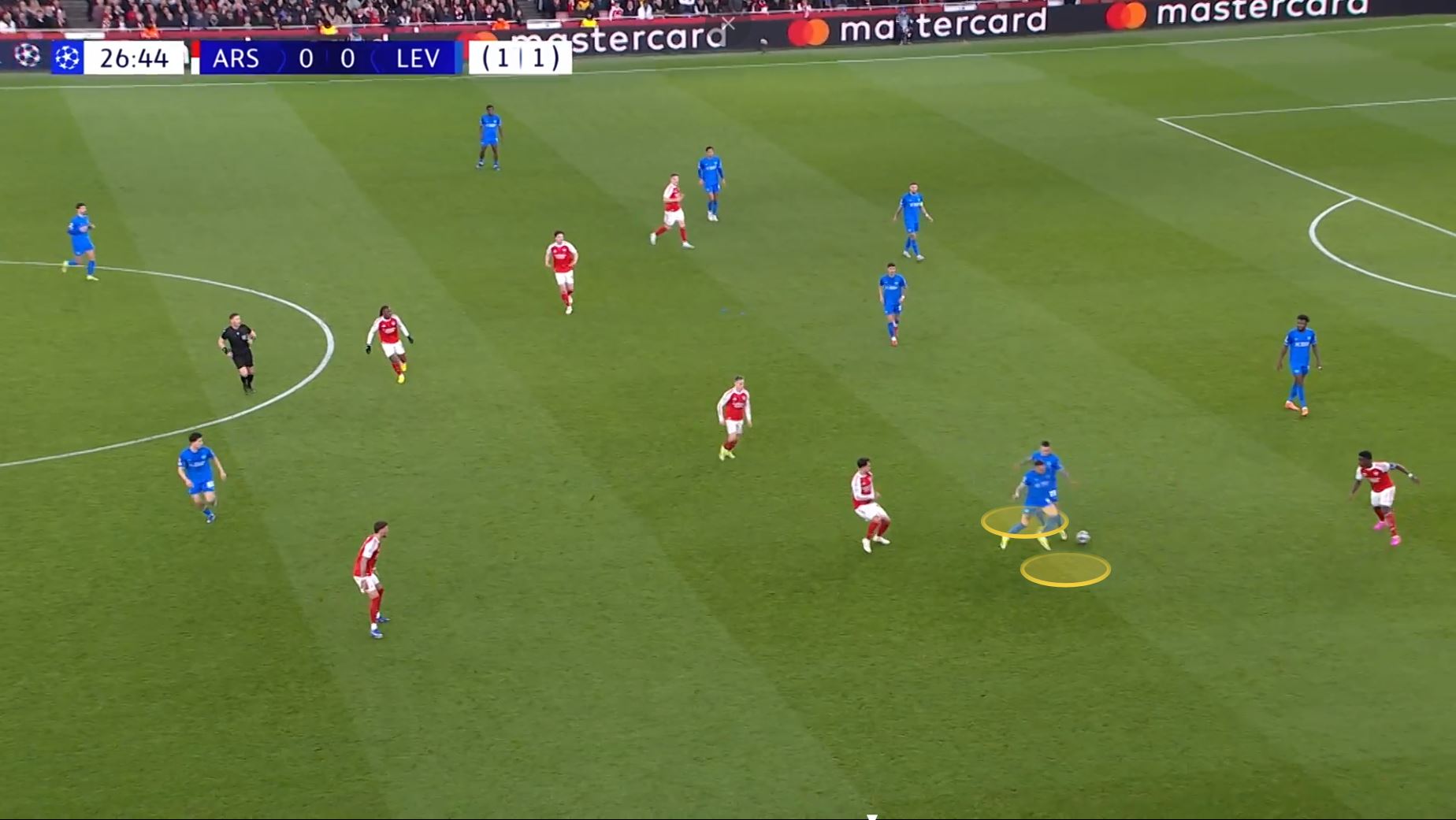
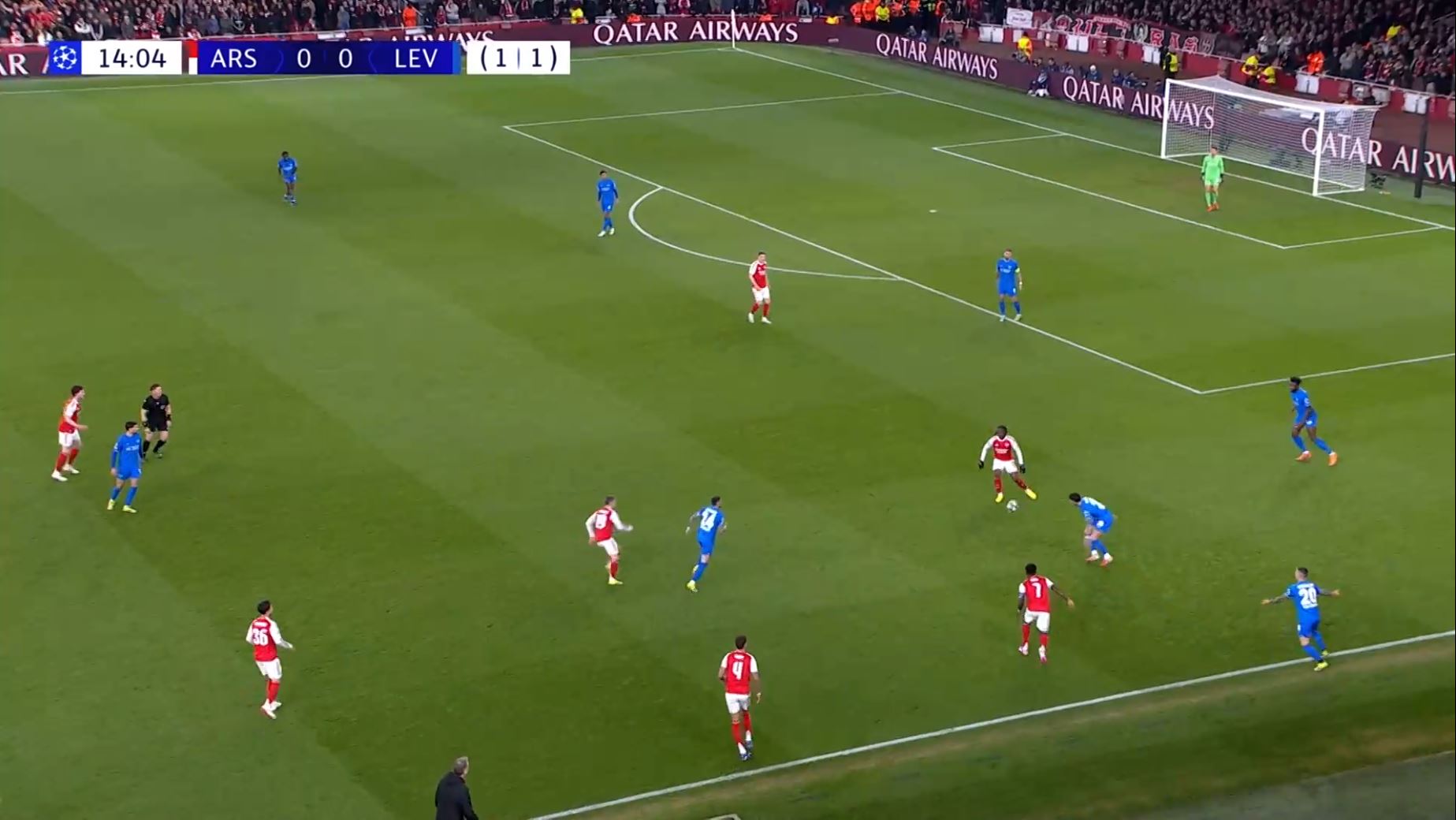
In the 26th minute, the ball was loose as two players looked to clear it.
They both miscommunicate, and an easy attempt to clear the ball is lost.
They were simply getting in each other’s way.
Earlier in the match, Grimaldo had a throw-in in his own half, which he gave away to Eze.
It was sloppiness throughout and contributed to their downfall.
Arsenal risking more players was bad enough for them to deal with, but they kept giving the ball back to the opposition, encouraging them to attack.
Conclusion
Though Arsenal have come under fire for playing ‘boring’ football this season (including from me), ultimately, they lose few games and if it turns out that the season results in silverware, Arteta can say that his shift to pragmatism has massively worked.
In seasons gone by, the Basque manager at first heralded an Arsenal side that was explosive in attack, then switched to ‘settled’ attacks, and now, finally, to a full embrace of a possibly best defence in Europe.
They don’t score many goals, but they have the ability to change the game and get a result.
Ahead of the game vs Sporting CP, it must be noted that they have a somewhat ‘favourable’ draw, with the second leg at home.
Even if they were to concede away from home, you feel as though, off the back of the match against Leverkusen, they have enough not to concede much and put too much pressure on an opponent out of possession and rely on their flexibility.
It may not be pretty, but it is certainly effective.