
Total Football Analysis
Once.Sport
  • Football Analysis
    • Data Analysis
    • Formations
      • 2-2-4 Formation
      • 2-3-5 Formation
      • 3-1-4-2 Formation
      • 3-2-2-3 Formation
      • 3-2-4-1 Formation
      • 3-1-6 Formation
      • 3-3-4 Formation
      • 3-4-1-2 Formation
      • 3-4-2-1 Formation
      • 3-4-3 Formation
      • 3-5-1-1 Formation
      • 3-5-2 Formation
      • 4-1-4-1 Formation
      • 4-2-2-2 Formation
      • 4-2-3-1 Formation
      • 4-2-4 Formation
      • 4-3-1-2 Formation
      • 4-3-3 Formation
      • 4-4-2 Formation
      • 4-5-1 Formation
      • 5-3-2 Formation
      • 5-4-1 Formation
      • 6-3-1 Formation
    • Head Coach Analysis
    • Match Analysis
    • Player Analysis
    • Recruitment Analysis
    • Set Piece Analysis
    • Tactical Theory
    • Tactical Preview
    • Team Analysis
    • Training Analysis
    • Tactical Analysis
    • Scouting Report
  • Competition
    • ALL Competitions
    • English Premier League
    • Champions League
    • La Liga
    • Bundesliga
    • Serie A
    • Ligue 1
    • Eredivisie
    • EFL Championship
    • FIFA World Cup 2022
    • WEURO 2022
    • Women’s Super League
    • NWSL
    • Belgian First Division A
    • A-League
    • Liga Profesional de Argentina
    • Austrian Bundesliga
    • Campeonato Brasileiro Série A
    • DFB Pokal
    • 1. HNL
    • Danish Superliga
    • EFL League One
    • EFL League Two
    • FA Cup
    • EFL Cup
    • Indian Super League
    • K-League
    • J1 League
    • Liga MX
    • Copa América 2021
    • Copa del Rey
    • MLS
    • Eliteserien
    • Euro 2020
    • Primeira Liga
    • Scottish Premiership
    • Allsvenskan
    • Europa League
    • UEFA Nations League
    • Liga AUF Uruguaya
  • Coaches
    • All Coaches
    • Alfred Schreuder
    • Ange Postecoglou
    • Antonio Conte
    • Arne Slot
    • Bo Svensson
    • Brendan Rodgers
    • Bruno Lage
    • Carlo Ancelotti
    • Christophe Galtier
    • Claude Puel
    • Claudio Ranieri
    • David Moyes
    • Dean Smith
    • Diego Simeone
    • Domenico Tedesco
    • Frank Lampard
    • Eddie Howe
    • Edin Terzić
    • Emma Hayes
    • Erik ten Hag
    • Ernesto Valverde
    • Gennaro Gattuso
    • Gerardo Seoane
    • Gian Piero Gasperini
    • Giovanni van Bronckhorst
    • Graham Potter
    • Igor Tudor
    • Imanol Alguacil
    • Jesse Marsch
    • Jonas Eidevall
    • Jorge Sampaoli
    • José Bordalás
    • José Mourinho
    • Julen Lopetegui
    • Julian Nagelsmann
    • Julien Stéphan
    • Jürgen Klopp
    • Luciano Spalletti
    • Lucien Favre
    • Manuel Pellegrini
    • Marcelo Bielsa
    • Marco Rose
    • Marco Silva
    • Massimiliano Allegri
    • Mauricio Pochettino
    • Maurizio Sarri
    • Mikel Arteta
    • Niko Kovač
    • Nuno Espírito Santo
    • Oliver Glasner
    • Patrick Vieira
    • Paulo Fonseca
    • Pep Guardiola
    • Peter Bosz
    • Rafa Benítez
    • Ralf Rangnick
    • Ralph Hasenhüttl
    • Roger Schmidt
    • Roy Hodgson
    • Sean Dyche
    • Sérgio Conceição
    • Simone Inzaghi
    • Sonia Bompastor
    • Stefano Pioli
    • Steffen Baumgart
    • Steven Gerrard
    • Thiago Motta
    • Thomas Frank
    • Thomas Tuchel
    • Unai Emery
    • Vincenzo Italiano
    • Xavi
  • Teams
    • ALL Teams
    • AC Milan
    • Ajax Amsterdam
    • Arsenal
    • AS Monaco FC
    • Atalanta
    • Atlético Madrid
    • FC Barcelona
    • FC Bayern Munich
    • Borussia Dortmund
    • Celtic FC
    • Chelsea FC
    • Everton F.C.
    • Inter Milan
    • Juventus F.C.
    • Leeds United F.C.
    • Liverpool FC
    • Manchester City
    • Manchester United FC
    • Paris Saint-Germain
    • Rangers FC
    • RB Leipzig
    • Real Madrid CF
    • Tottenham Hotspur
    • West Ham United
  • Players
    • ALL Players
    • Alisson Becker
    • Bukayo Saka
    • Erling Haaland
    • Harry Kane
    • Jack Grealish
    • John Stones
    • Julián Alvarez
    • Kalvin Phillips
    • Kevin De Bruyne
    • Kyle Walker
    • Kylian Mbappé
    • Lamine Yamal
    • Lionel Messi
    • Luis Díaz
    • Mohamed Salah
    • Phil Foden
    • Virgil Van Dijk
  • Contact
  • Write For TFA
No Result
View All Result
No Result
View All Result
Total Football Analysis
No Result
View All Result
Home Match Analysis Tactical Preview

Arsenal Vs Bayer Leverkusen – Champions League 2025/2026: How Set-Pieces Could Decide The Second Leg – Tactical Preview

Karim El-Shesheiny by Karim El-Shesheiny
March 16, 2026
in Tactical Preview, Analysis, Arsenal, Bayer Leverkusen, Champions League, Gabriel Magalhães, Kasper Hjulmand, Mikel Arteta, Nicolas Jover, Set Piece Analysis, Tactical Analysis
0
Arsenal Vs Bayer 04 20252026 - set-piece analysis

Bayer Leverkusen hosted Arsenal in the first leg of the UEFA Champions League Round of 16 at BayArena, in an important game that ended in a 1-1 draw.

It was predicted that the game would be easier for Mikel Arteta‘s side, who entered the game in good form, leading the Premier League with a six-point difference above Man City.

On the other hand, Kasper Hjulmand‘s side isn’t in a good position in the Bundesliga table, where they sit in sixth position with 45 points, with a 22-point difference between them and the first,  Bayern Munich.

It was also a surprise for some fans that Bayer Leverkusen scored a goal from a set-piece, a corner kick, while Arsenal couldn’t do so.

On the other hand, Arsenal were threatening from set-pieces, as usual, but Bayer Leverkusen had a good defensive plan that reduced their threat.

In this set-piece analysis, we will explain both teams’ attacking tactics at corners and how the other reacted in the first leg, and then try to see how both may react in the second leg, based on their previous reactions in similar situations.

Bayer Leverkusen Attacking Corners Vs Arsenal

Starting with the side that scored from a set-piece, Bayer Leverkusen had two corners; they scored from one of them and showed a good idea on the other, indicating a good performance in this important aspect of the game.

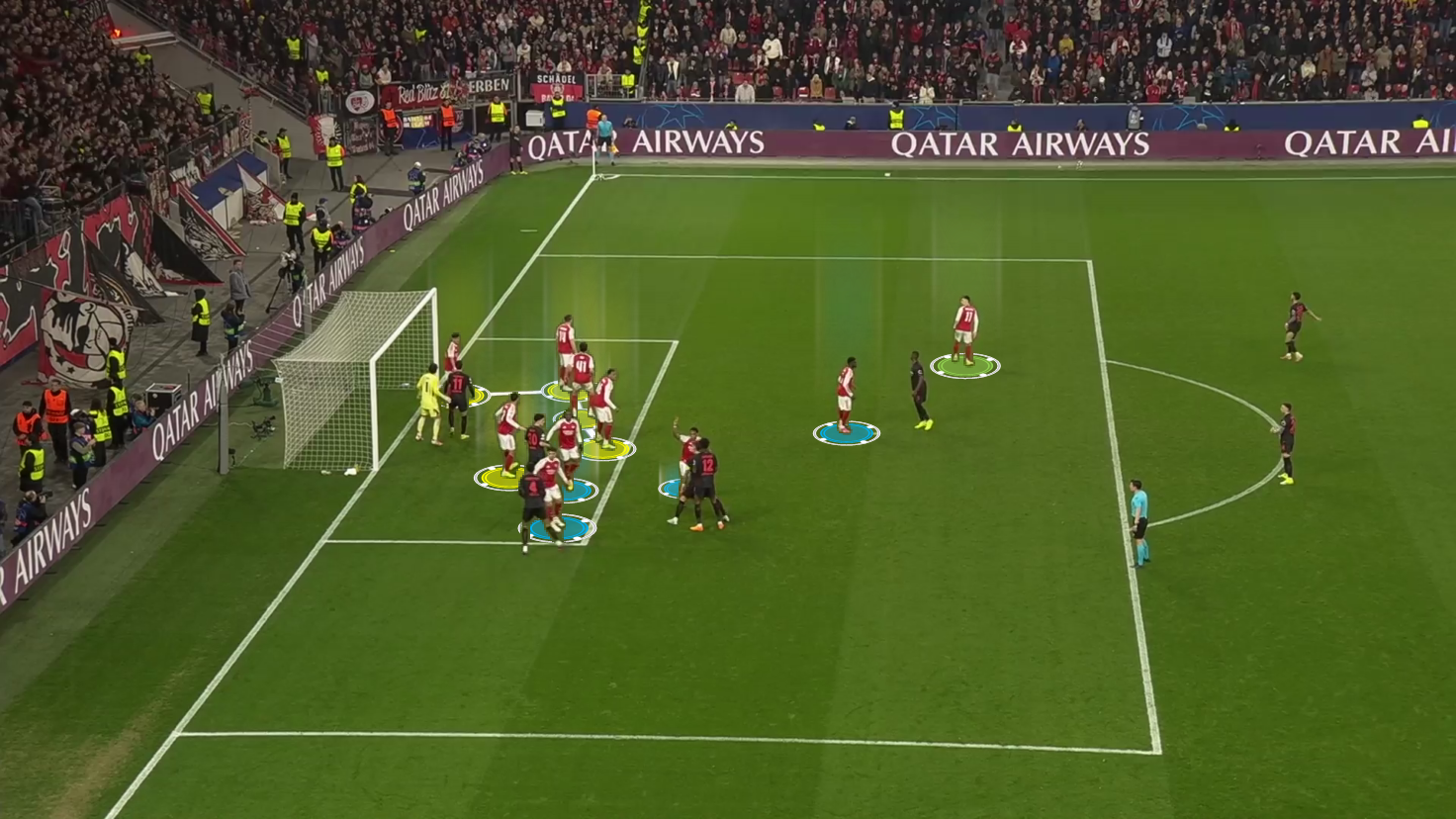
Figure 1 below shows how Arsenal defended corner kicks against Bayer Leverkusen, with the corner that led to the hosts’ goal.

They defended with a hybrid defending system, having five zonal defenders (yellow), four man markers (blue), and a player (green) to defend the rebound, ready to defend short corners.
arsenal-vs-bayer-leverkusen-ucl-2025-26-set-piece-analysis-tactics
Figure 1

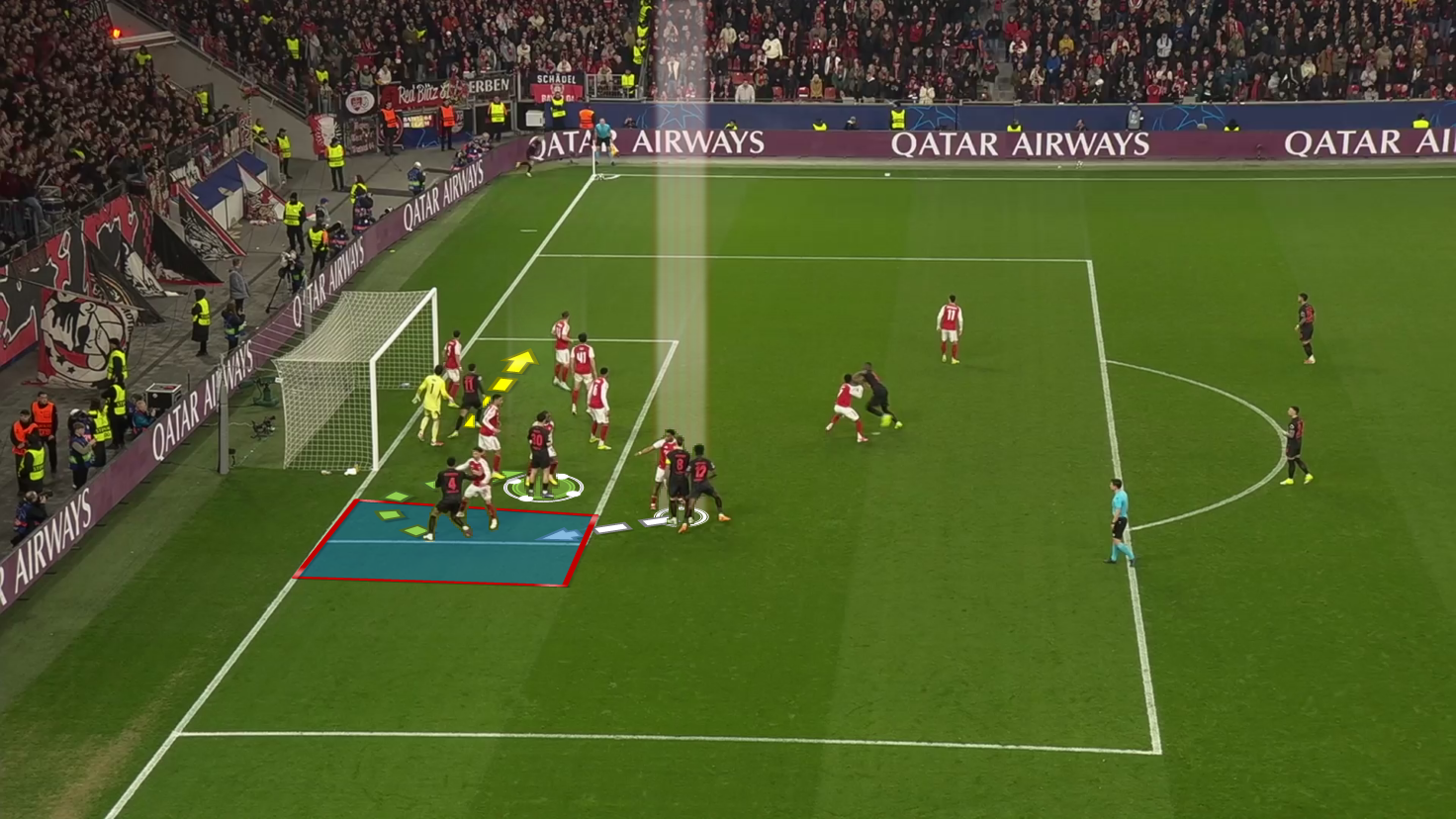
Figure 2 below shows that the German side targeted the far post with the player in white, who had many options in this area: the goalkeeper, the last zonal defender, and the man marker who marks the targeted player.

Bayer Leverkusen dealt with these obstacles carefully, so they asked the yellow-arrowed player to start near the goalkeeper and go on a decoy run to drag David Raya a little bit forward, making it hard for him to step back and claim the ball before reaching the far post.

The green-arrowed player had an important role in blocking the last zonal defender.
arsenal-vs-bayer-leverkusen-ucl-2025-26-set-piece-analysis-tactics
Figure 2

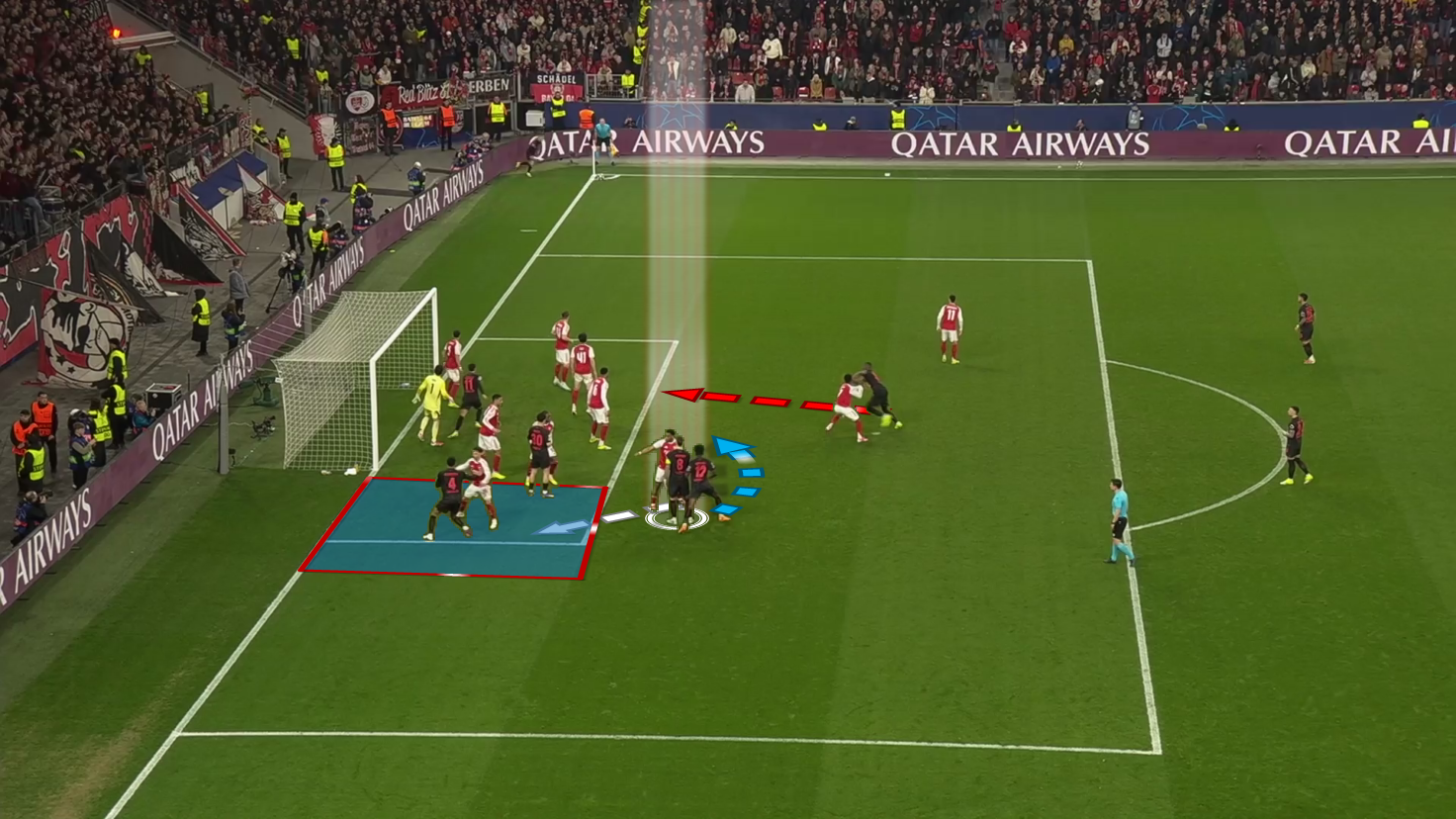
Figure 3 shows how the targeted player (white) dealt with the last obstacle, his man marker.

The player in blue runs first toward the near post to drag the targeted player’s man marker and free him, while the red player also makes a run toward the near post to drag his man marker away from the far post and also to be ready in case the targeted player nods the ball back to the near post.
arsenal-vs-bayer-leverkusen-ucl-2025-26-set-piece-analysis-tactics
Figure 3

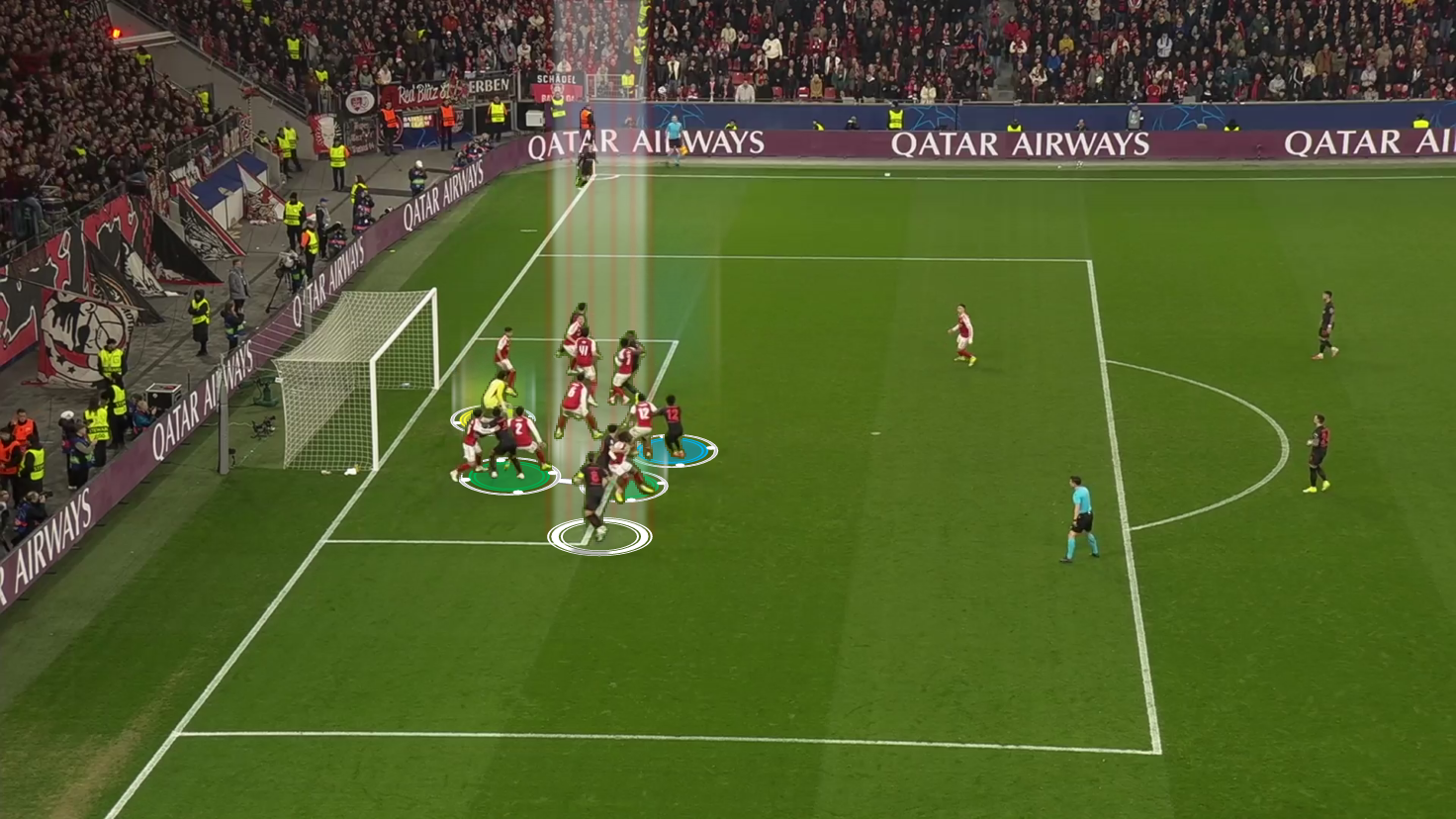
Figure 4 below shows the final moment when all is set, so you can see Raya (yellow) step toward the near post, which made it difficult for him to claim this floated cross to the far post.

You can also see two green blocks: one for the last zonal defender and the other for the last man marker on the far post.

You can also see that the targeted player is free now because the blue runner drags the man marker with him.
arsenal-vs-bayer-leverkusen-ucl-2025-26-set-piece-analysis-tactics
Figure 4

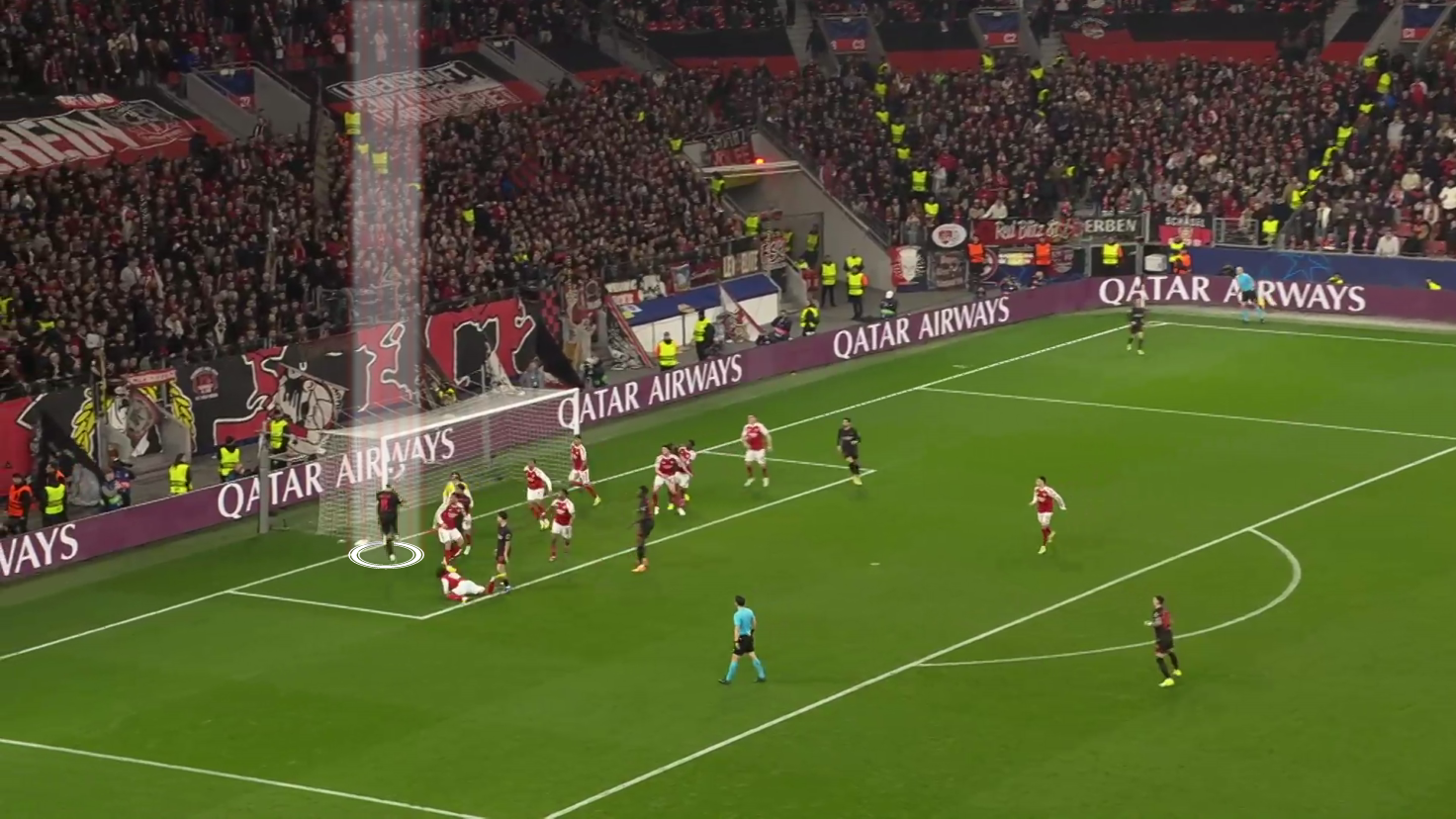
In the end, all is set, and it ended with a goal, as shown in Figure 5.
arsenal-vs-bayer-leverkusen-ucl-2025-26-set-piece-analysis-tactics
Figure 5

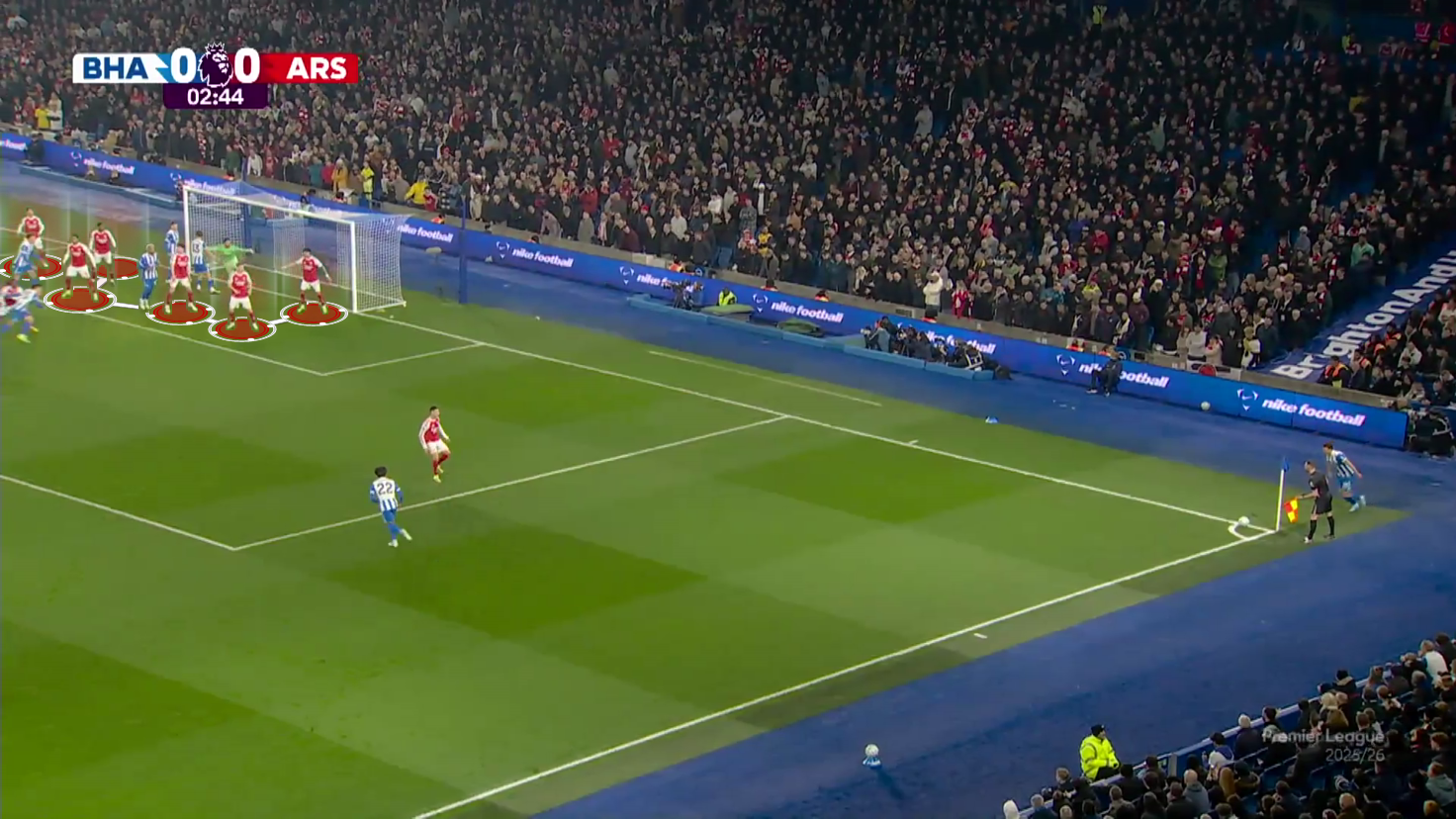
Depending on Arsenal’s previous reaction to teams that are good at attacking the area beyond the far post, we can see how Arsenal defended corners against Brighton, as shown in Figure 6 below.

Arsenal defended with six zonal defenders (red) in that game, and you can notice that the sixth one is beyond the far post.
arsenal-vs-bayer-leverkusen-ucl-2025-26-set-piece-analysis-tactics
Figure 6

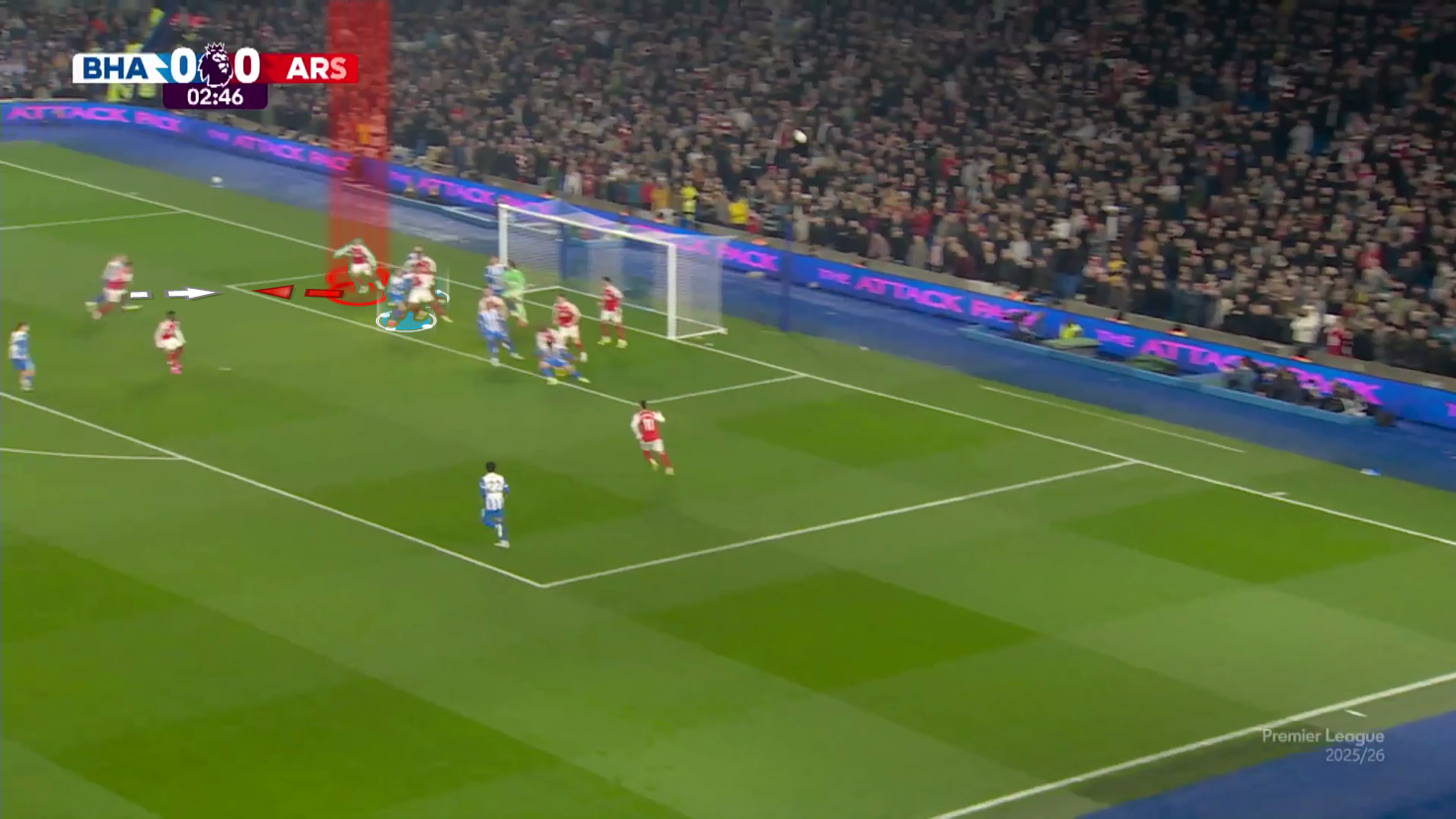
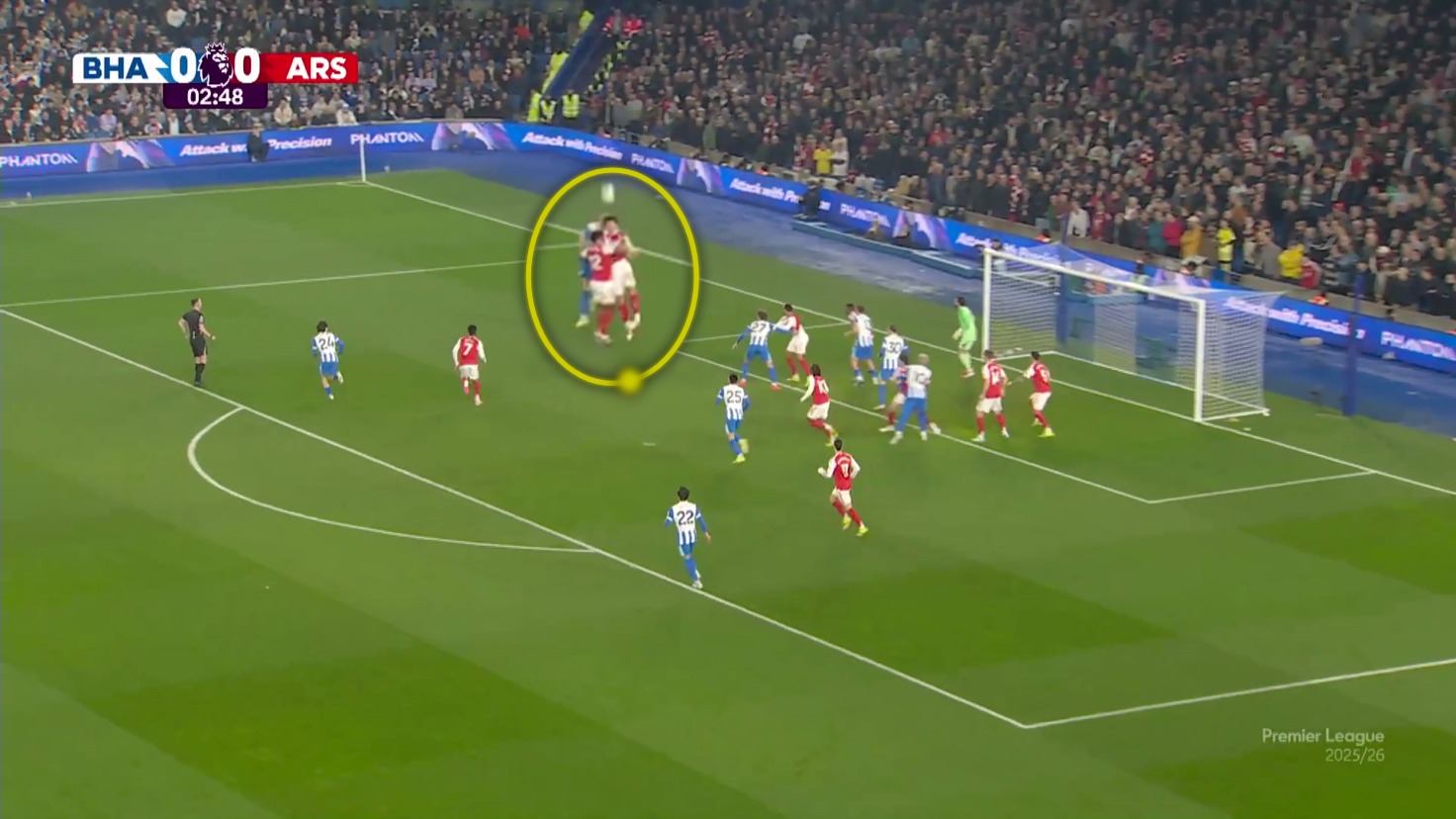
Hence, there are nearly three zonal defenders ready to defend the far post, so if the opponent blocks the two zonal defenders (blue), the last defender (red) can go out to defend the cross against the threat coming from the white-arrowed attacker to help the man marker, as shown in figures 7 and 8.
arsenal-vs-bayer-leverkusen-ucl-2025-26-set-piece-analysis-tactics
Figure 7
arsenal-vs-bayer-leverkusen-ucl-2025-26-set-piece-analysis-tactics
Figure 8

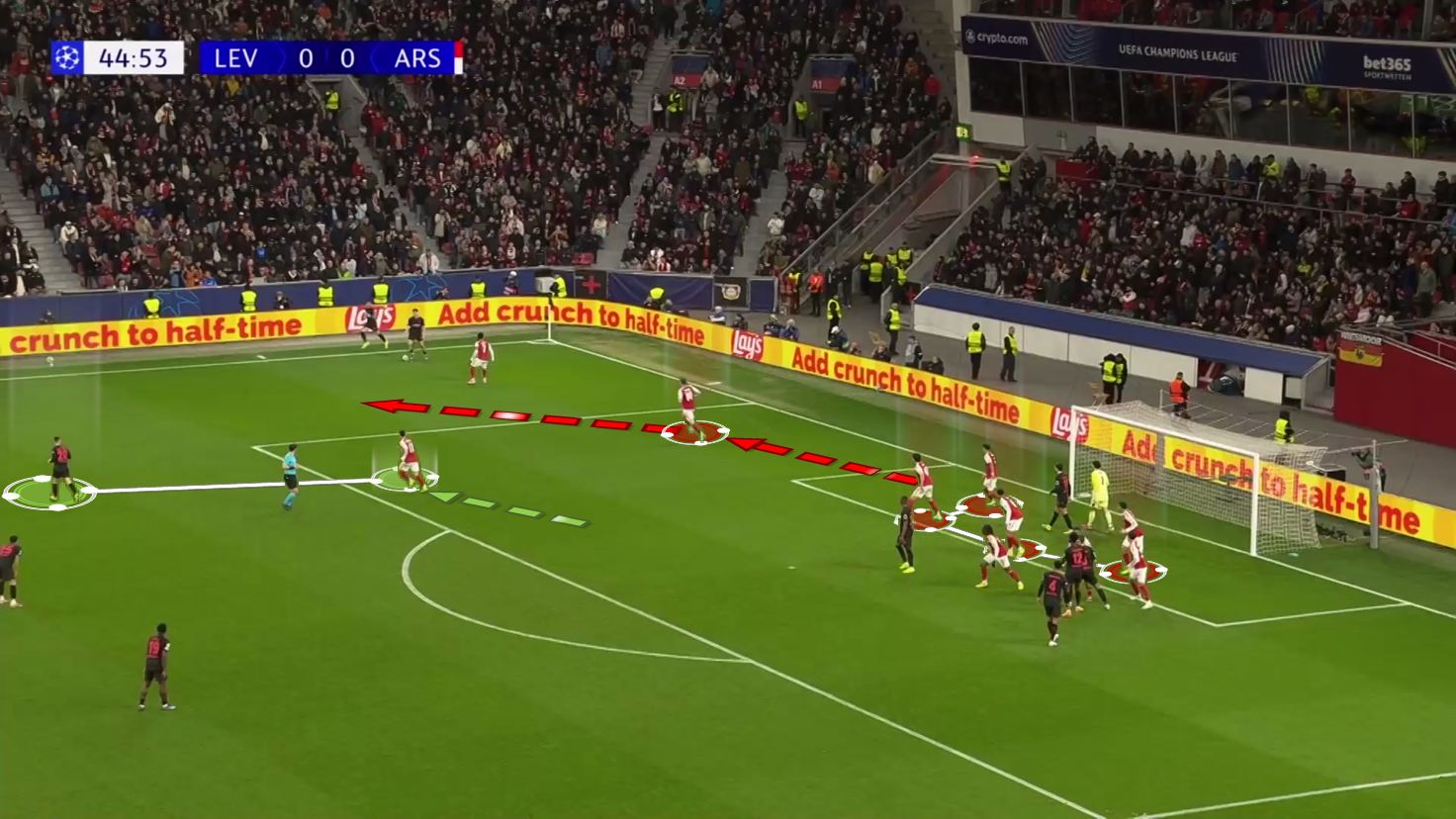
In the other corner (the first one), they tried a short-corner routine with a short-option attacker close to the taker who passes the ball and overlaps while a player moves from the edge of the box toward the ball to drag the rebound defender (green), as shown below.

That forces the first zonal defender (red) to help in this 2v1, but he has to travel some distance, which allows the taker to receive the pass and cross from a better position.
arsenal-vs-bayer-leverkusen-ucl-2025-26-set-piece-analysis-tactics
Figure 9

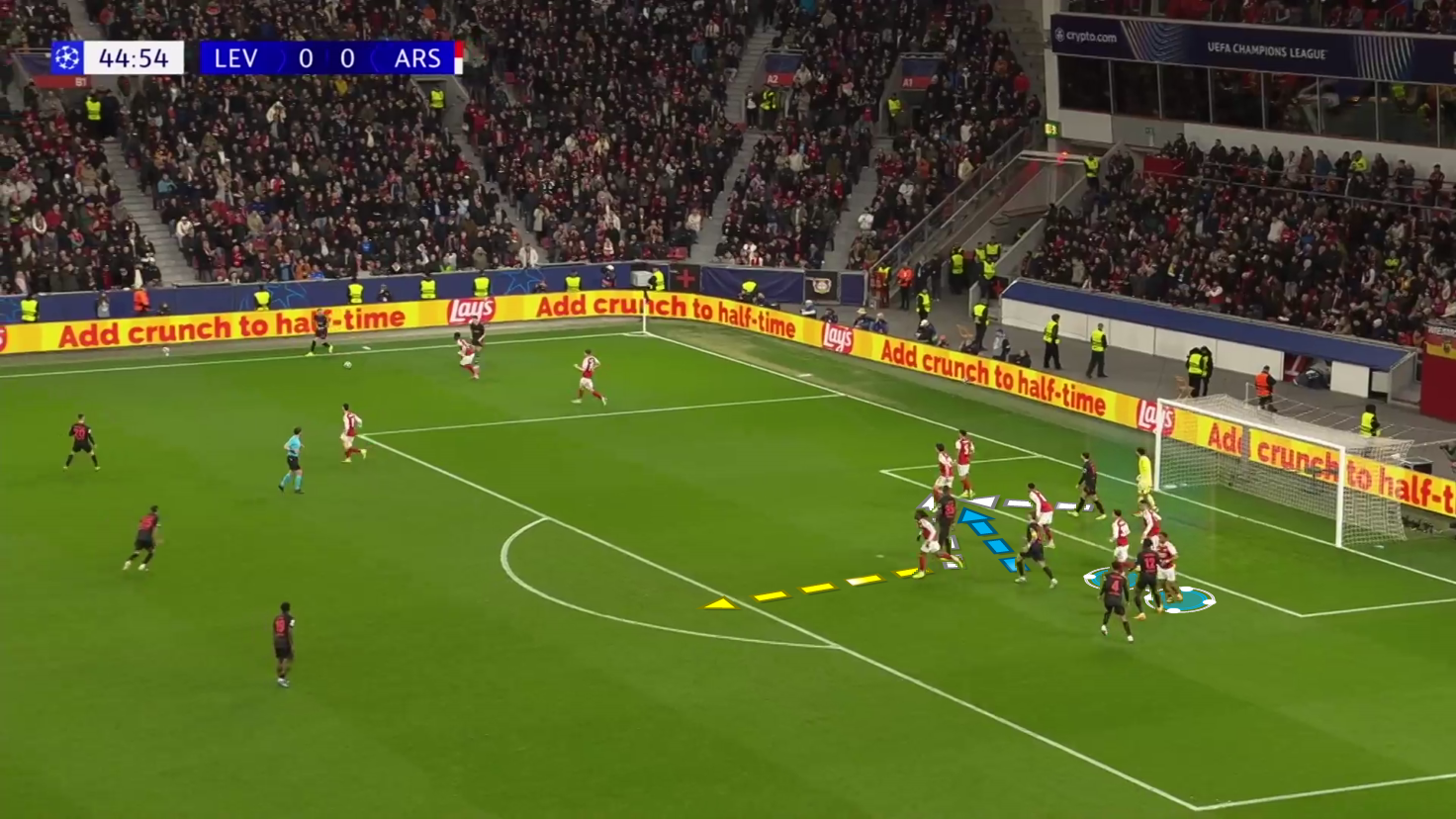
Figure 10 below shows the battle inside the box.

A man marker (yellow) is forced to close down the rebound option on the edge of the box, which leaves just two man markers inside the box (blue).

One of them will be dragged to the near post, leaving just one man marking against two attackers at the far post.

This can also tell us that Bayer Leverkusen may target the edge of the box directly in the second leg by blocking all the man-markers from getting out to defend it, or, let’s say, it is an option.
arsenal-vs-bayer-leverkusen-ucl-2025-26-set-piece-analysis-tactics
Figure 10

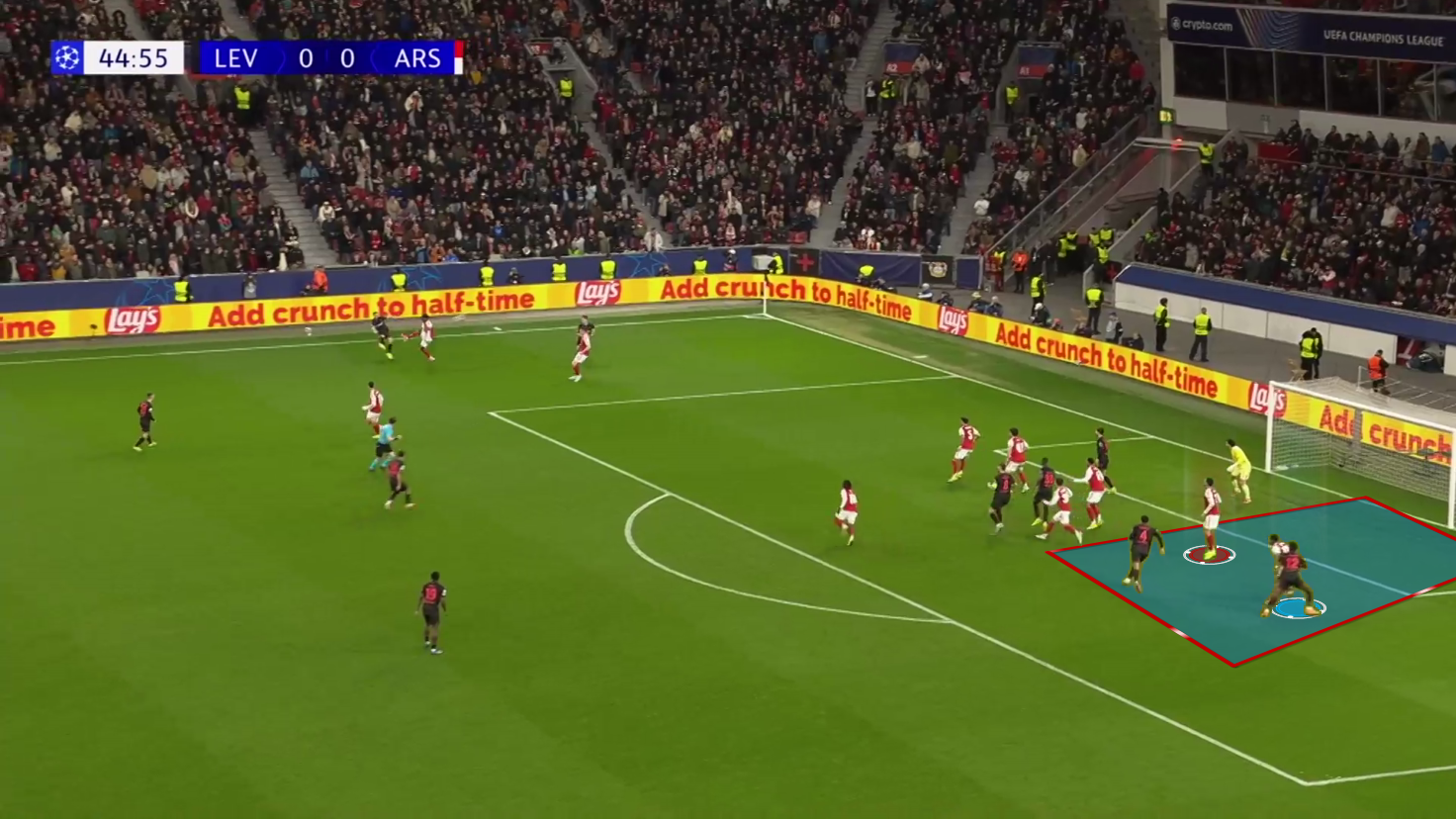
In the end (figure 11), it was a dangerous situation with two attackers against one man marker and the last zonal defender on the far post, but Raya claimed the cross.
arsenal-vs-bayer-leverkusen-ucl-2025-26-set-piece-analysis-tactics
Figure 11

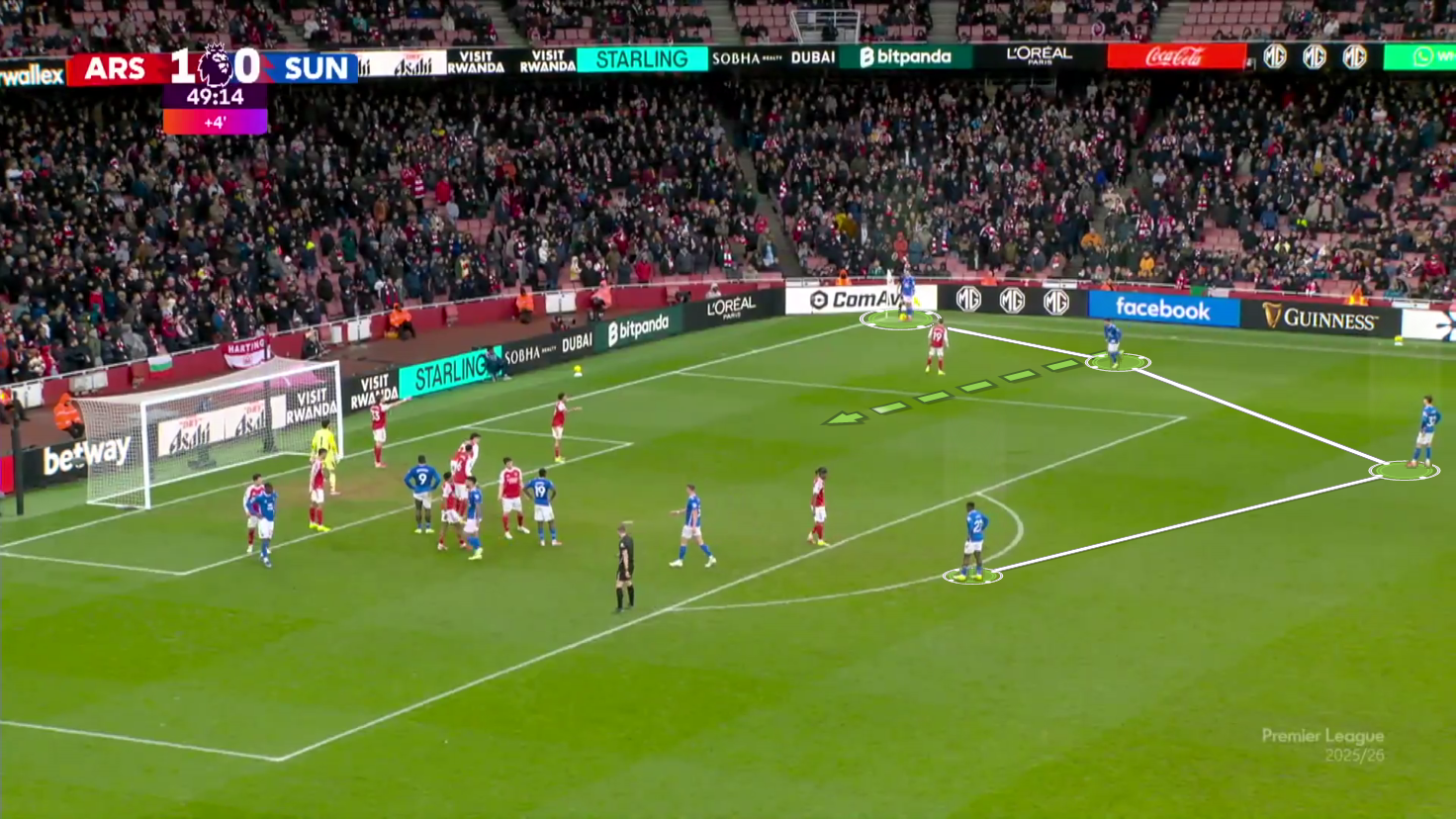
Bayer Leverkusen also have an opportunity to learn from Sunderland.

They asked the first short-option attacker to run diagonally to the box to drag the short-option defender with him.
arsenal-vs-bayer-leverkusen-ucl-2025-26-set-piece-analysis-tactics
Figure 12

Figure 13 shows that the far short-option attacker is now free to receive the ball and send a cross, while the first zonal defender (green) has a long way to chase him, and there is an attacker fixing the edge-of-the-box defender.

Inside the box, the far late runner (white) targets the far post and starts free because the three-man markers (blue) are busy with three attackers.

Hence, the white free attacker targets the far post.
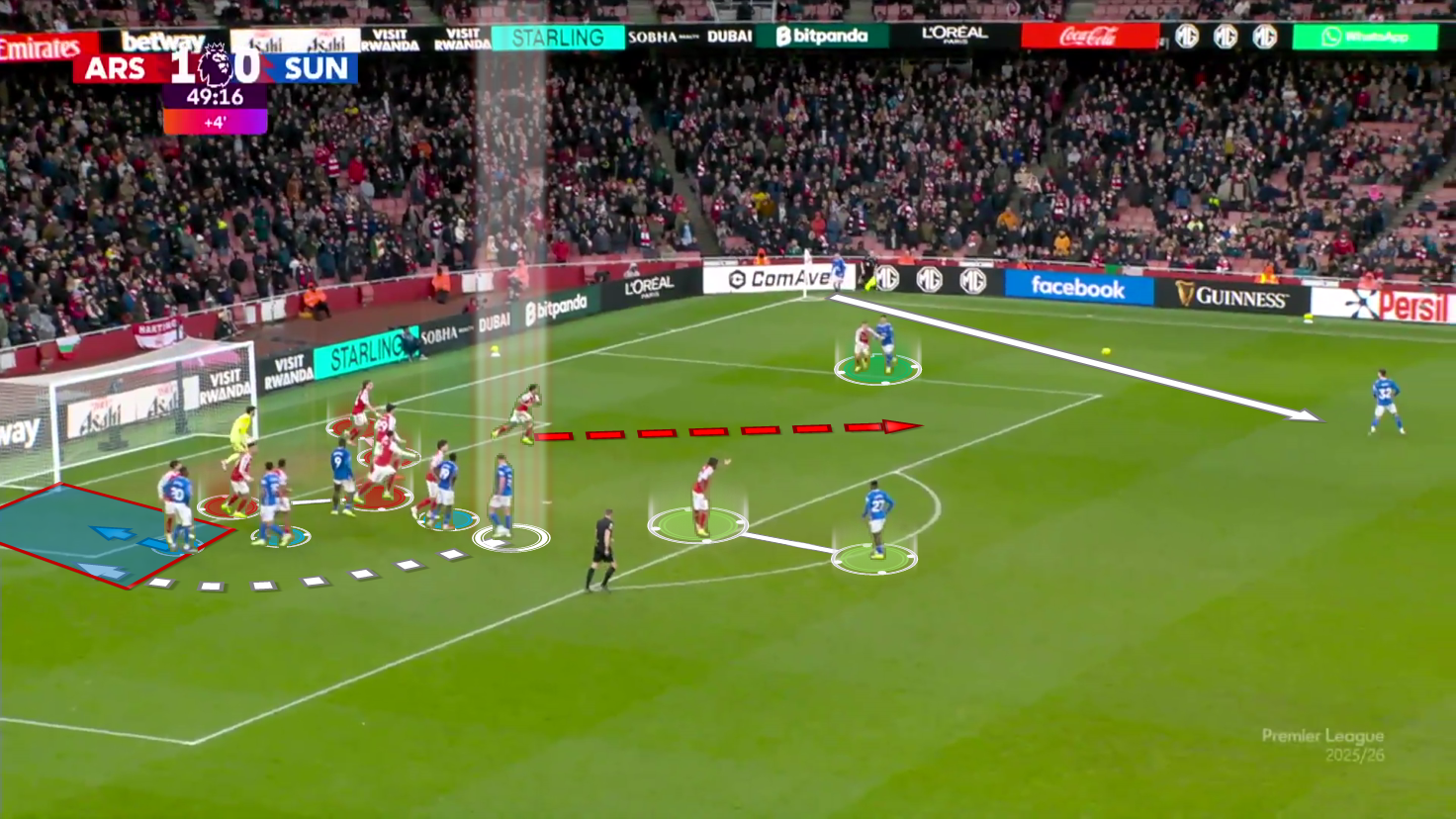
arsenal-vs-bayer-leverkusen-ucl-2025-26-set-piece-analysis-tactics
Figure 13

A man marker realised that and went to mark him; he fell to the ground, but the other attacker was close to scoring a goal, as shown in Figure 14 below.
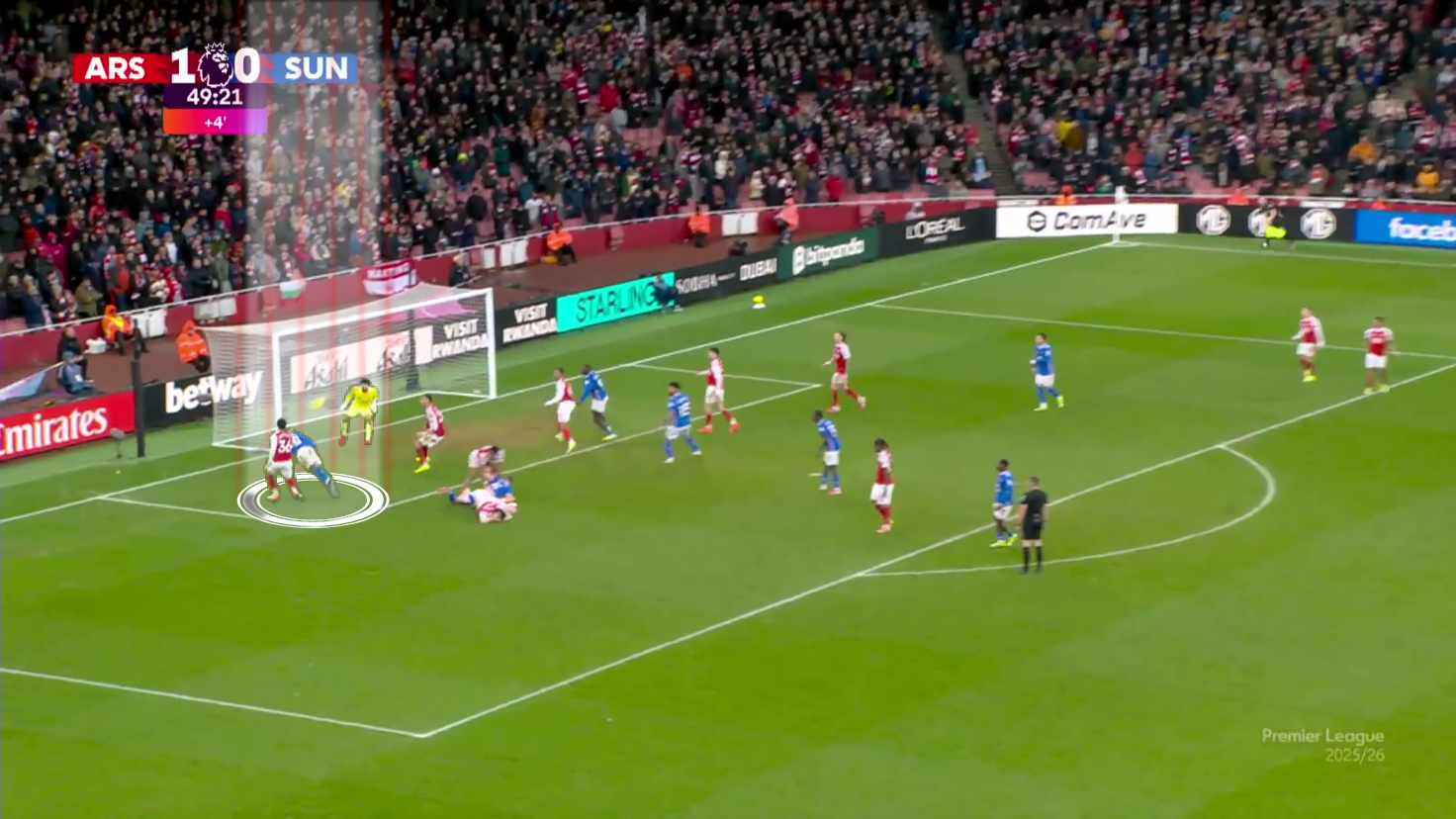
arsenal-vs-bayer-leverkusen-ucl-2025-26-set-piece-analysis-tactics
Figure 14

Arsenal Attacking Corners Vs Bayer Leverkusen

Bayer Leverkusen defended with four zonal defenders (red), a player (green) to defend rebounds and short corners, and the other five as man markers, as in Figure 15.

The first important tip is that they had two man markers for Gabriel Magalhães: one close to him, while the other stood behind him, ready in case Gabriel escaped the first.
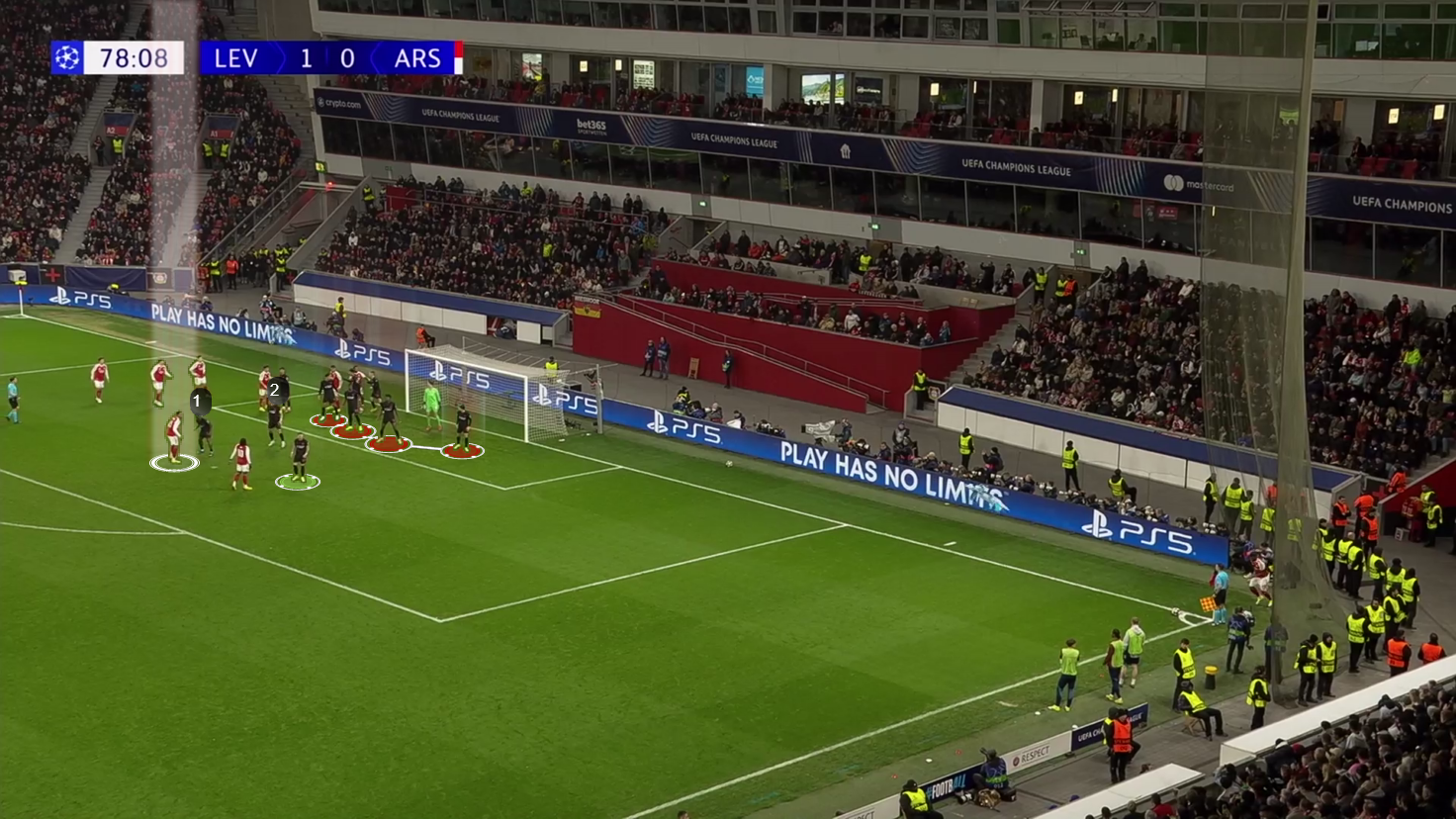
arsenal-vs-bayer-leverkusen-ucl-2025-26-set-piece-analysis-tactics
Figure 15

Hence, we should mention why they utilised this approach, and we will explain how Gabriel usually gets rid of his man marker.

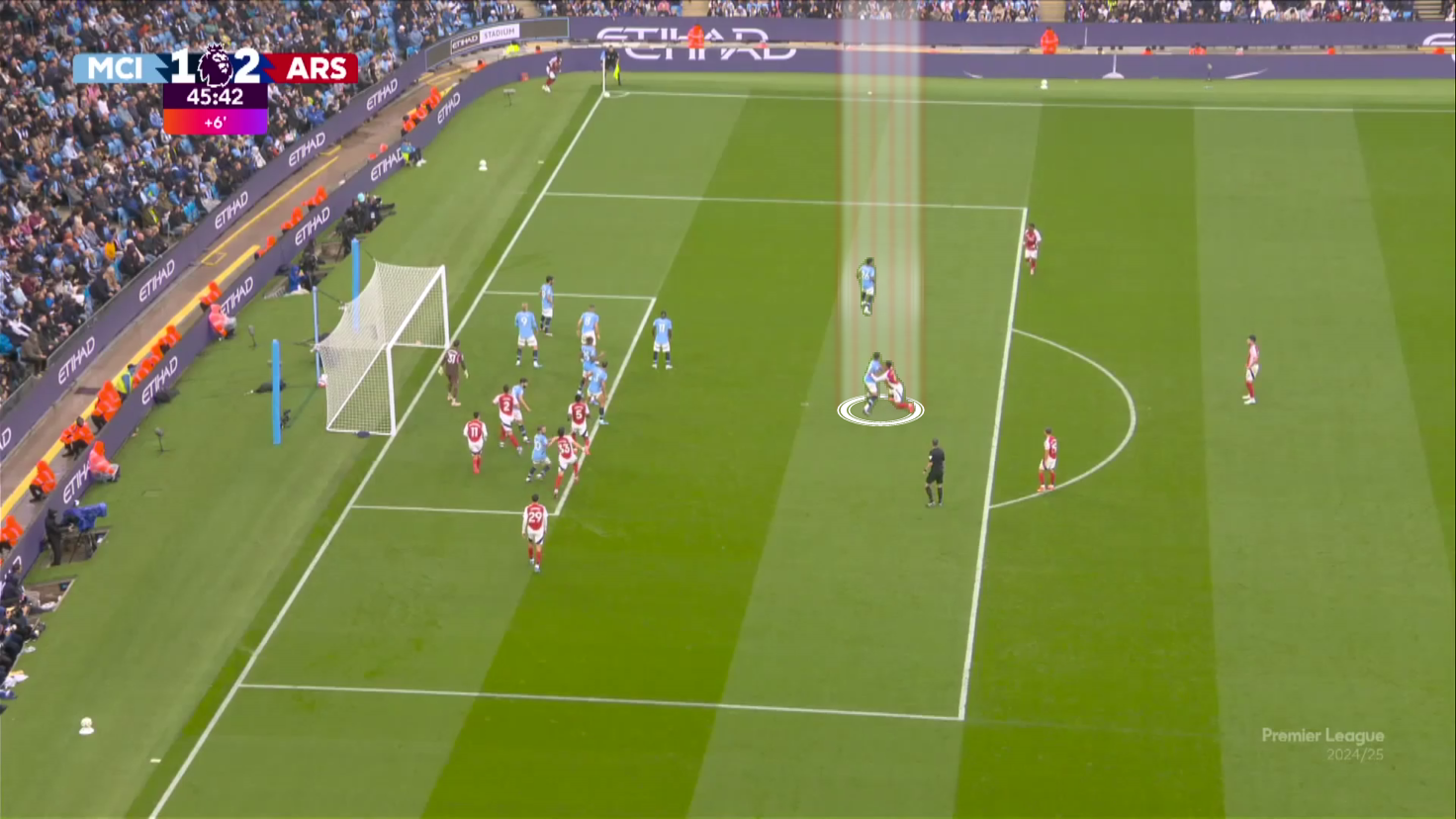
As shown below, Gabriel starts near the penalty spot and quickly feints to the front, then to the back of his marker.
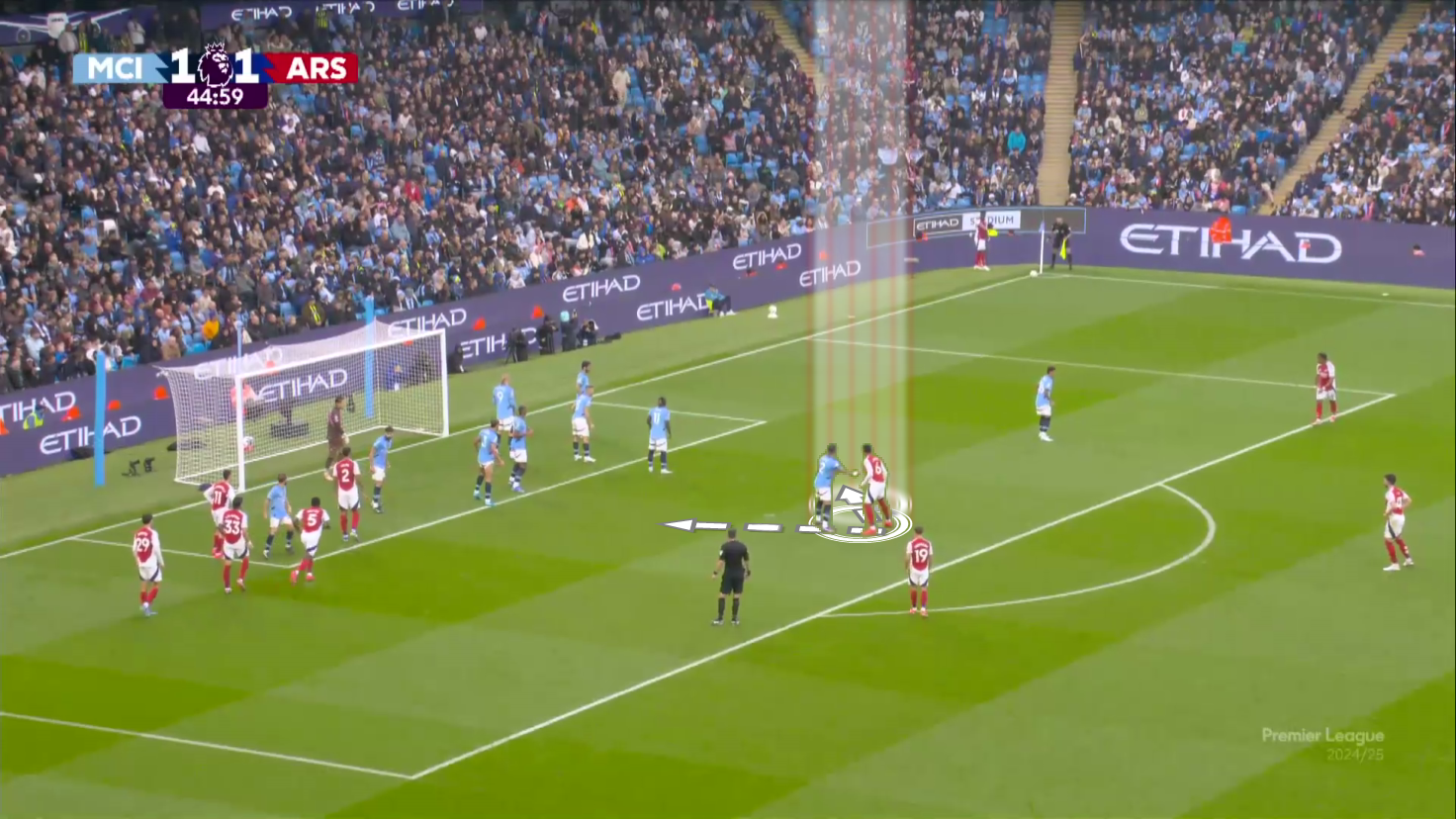
arsenal-vs-bayer-leverkusen-ucl-2025-26-set-piece-analysis-tactics
Figure 16

The marker should make a decision in this critical moment when the taker starts to move: Either watch the ball or watch Gabriel.
arsenal-vs-bayer-leverkusen-ucl-2025-26-set-piece-analysis-tactics
Figure 17

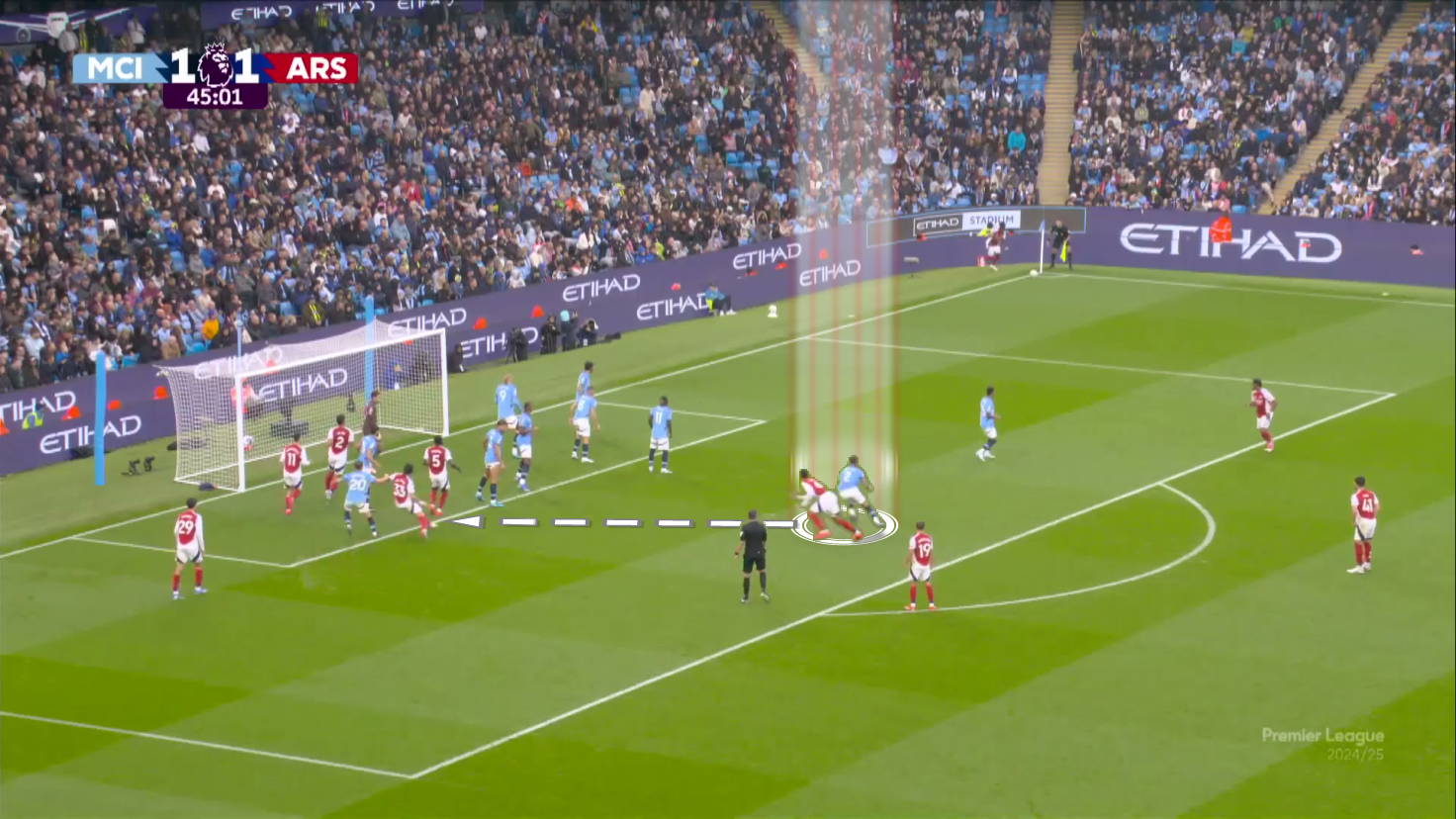
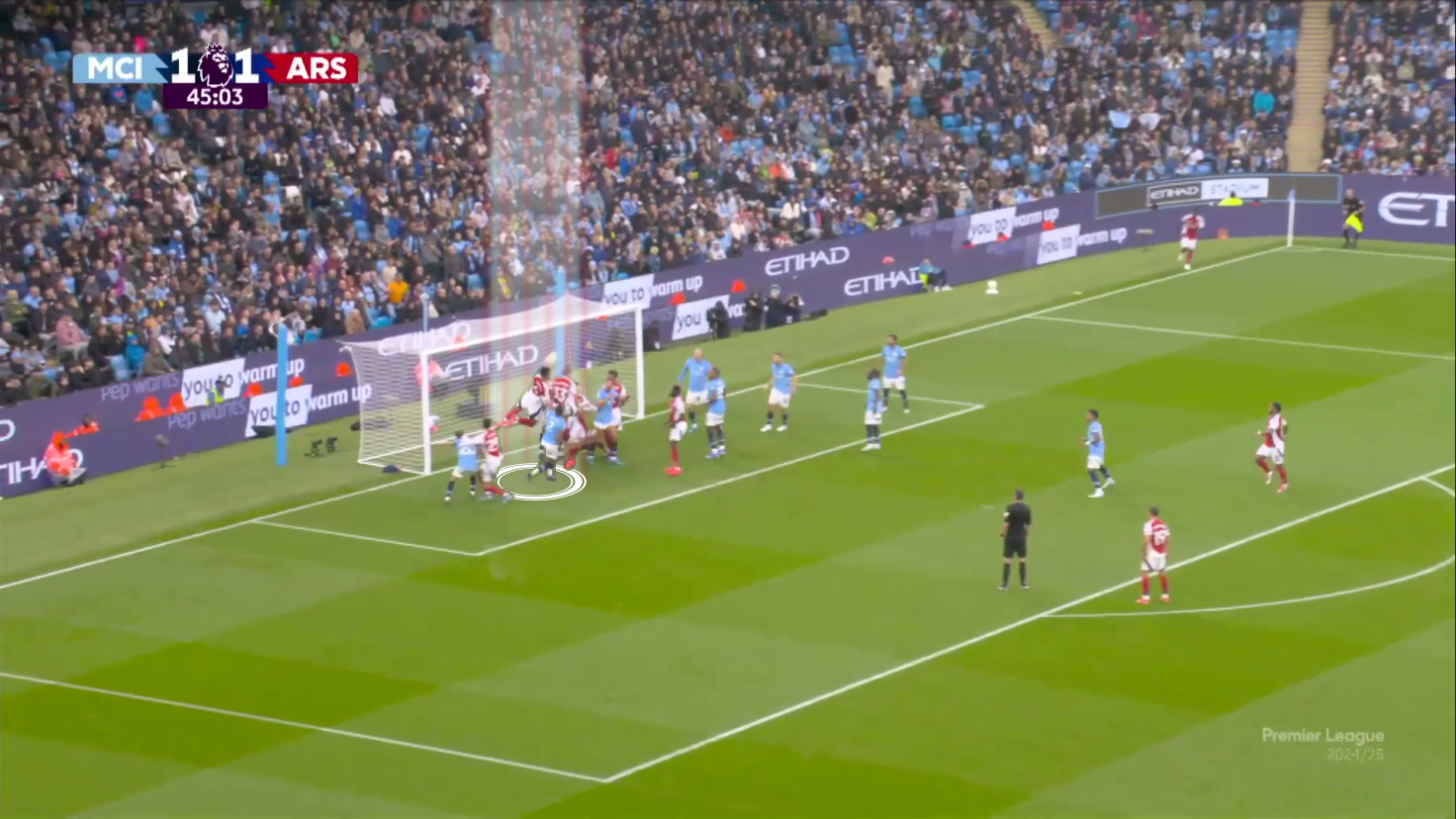
In Figure 18 below, the marker chooses to keep watching the ball, so he loses contact with Gabriel, who is free now and can run all the way to the six-yard line before jumping, which allows him to jump very high because of the dynamic mismatch over the stationary zonal defenders, as in Figures 18 and 19.
arsenal-vs-bayer-leverkusen-ucl-2025-26-set-piece-analysis-tactics
Figure 18
arsenal-vs-bayer-leverkusen-ucl-2025-26-set-piece-analysis-tactics
Figure 19

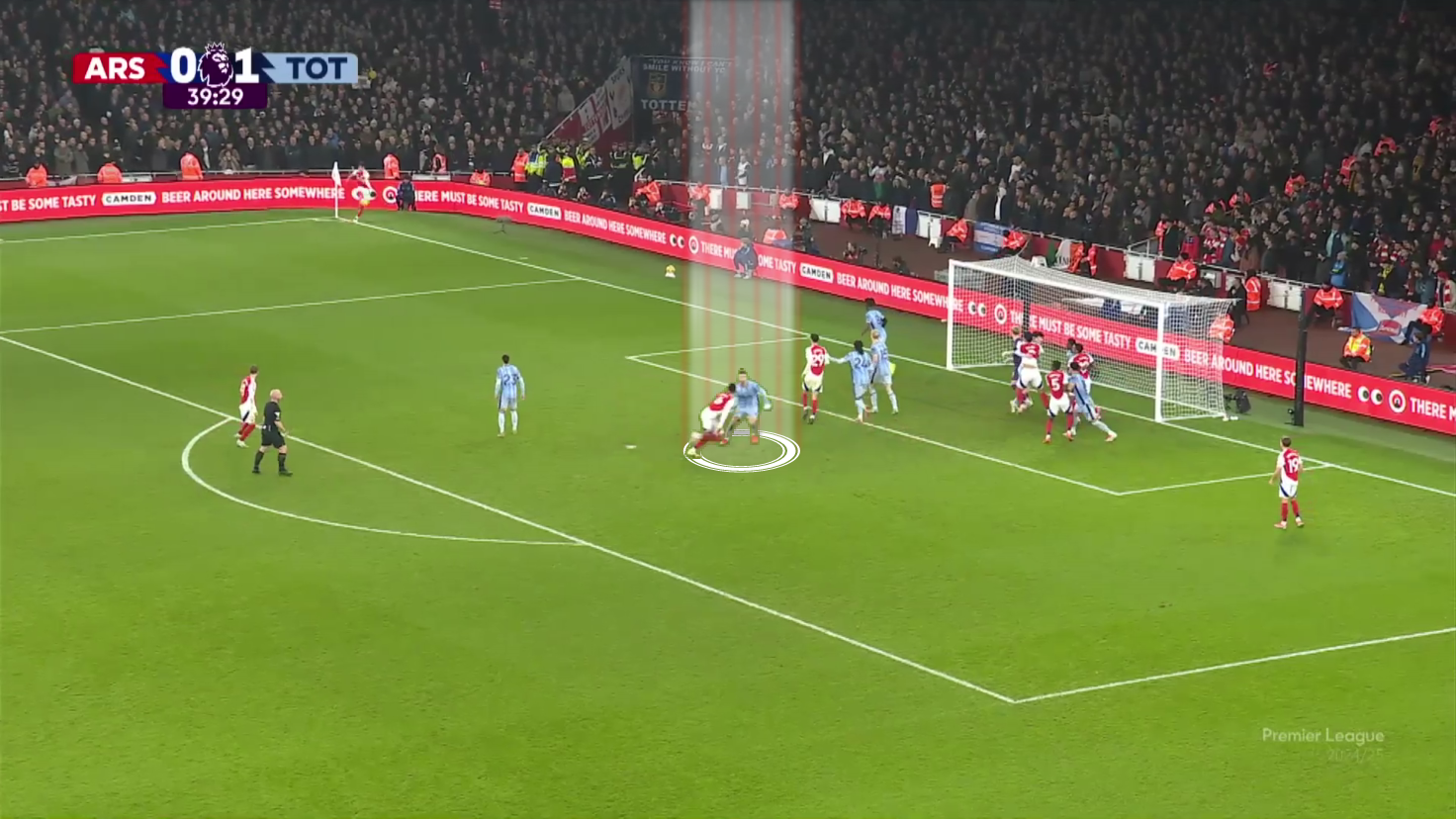
If the man marker decides to follow him, he will lose contact with the ball, as in Figure 20 below.
arsenal-vs-bayer-leverkusen-ucl-2025-26-set-piece-analysis-tactics
Figure 20

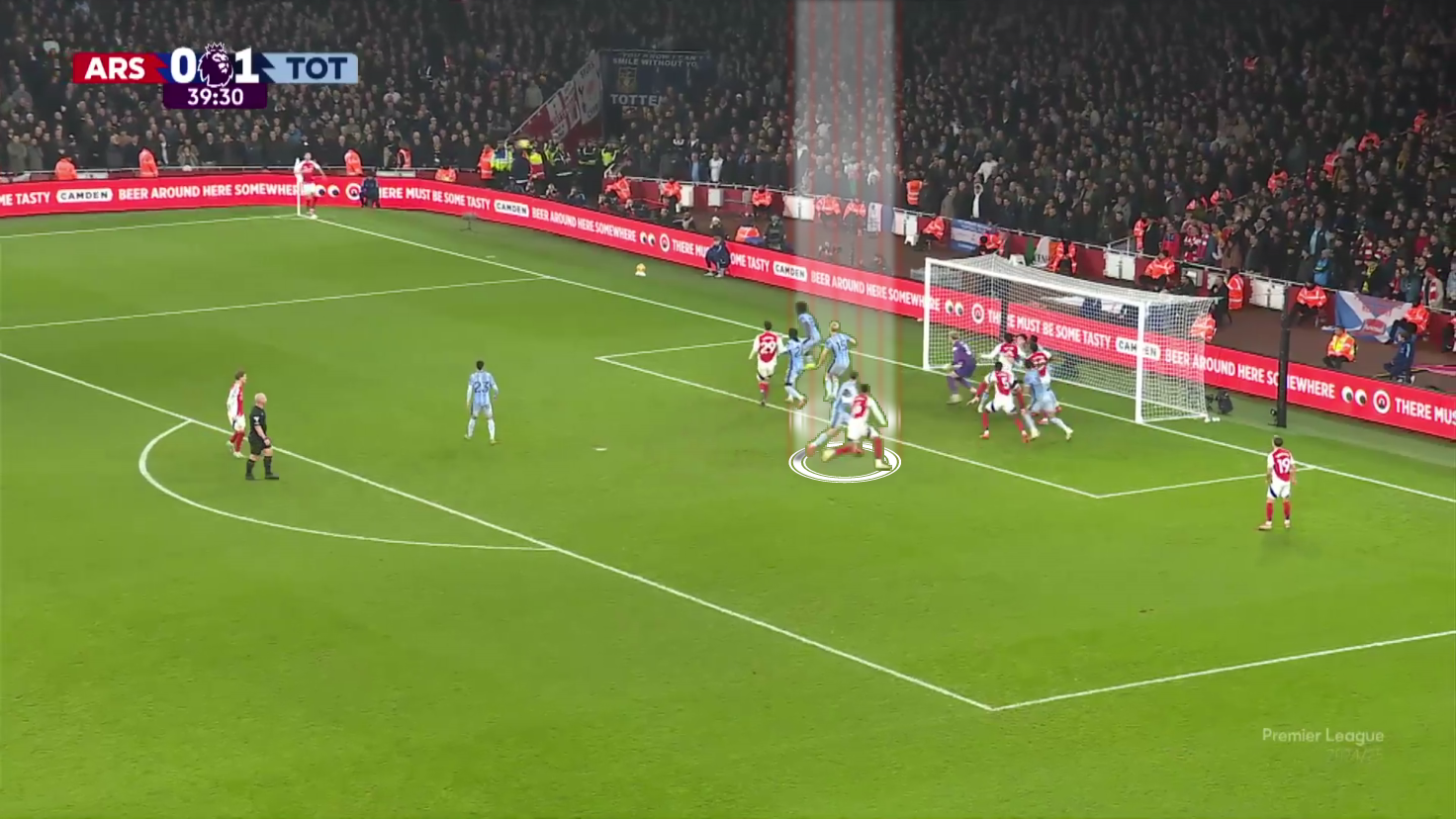
At some point, the defender may want to take a look at the ball, which causes him to lose Gabriel as well, as shown in Figure 21 below.

Hence, we can see Gabriel’s dilemma due to his feint and central starting position; of course, he is also a monster in aerial duels, even if the opponent does everything optimally.
arsenal-vs-bayer-leverkusen-ucl-2025-26-set-piece-analysis-tactics
Figure 21

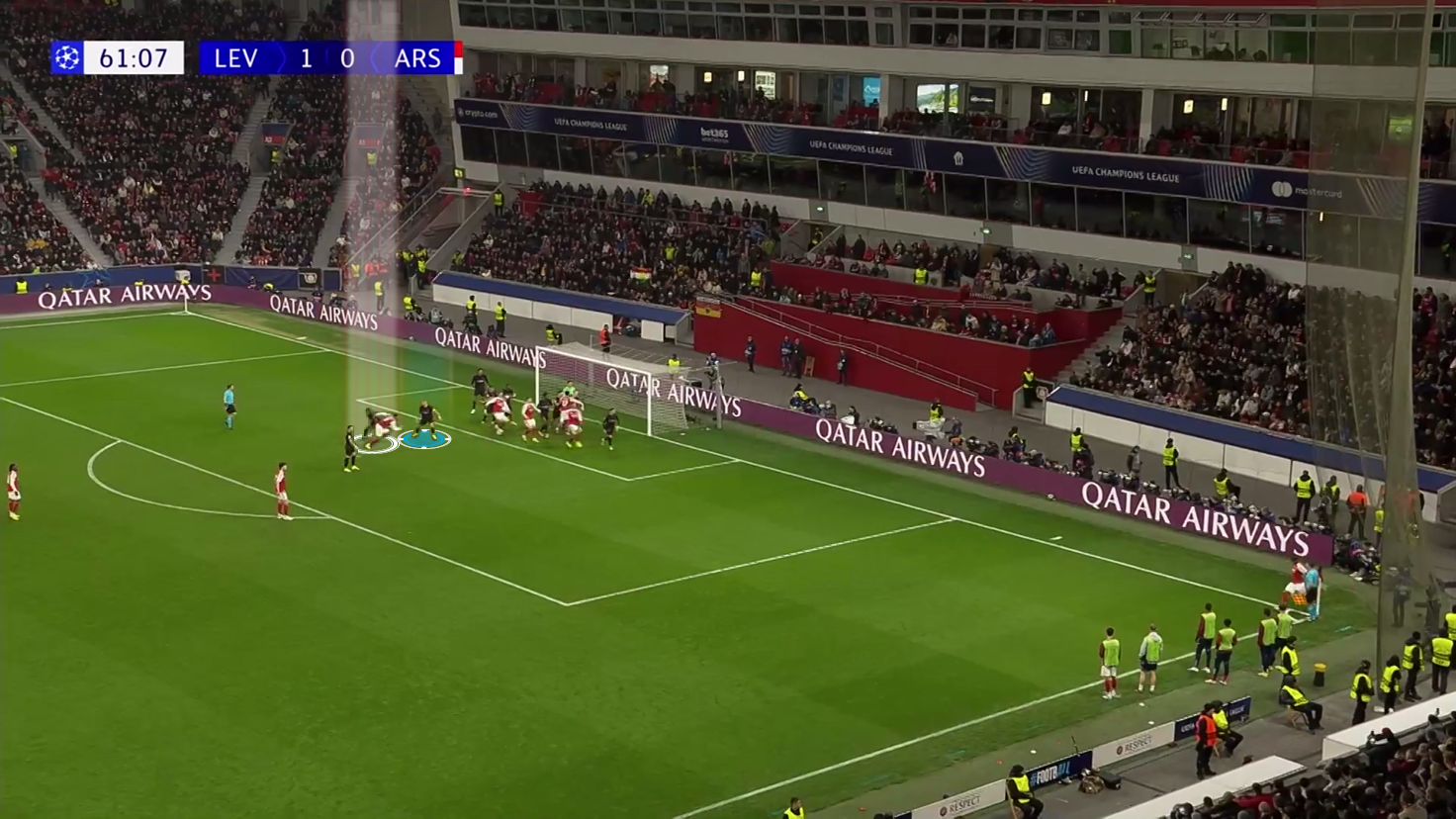
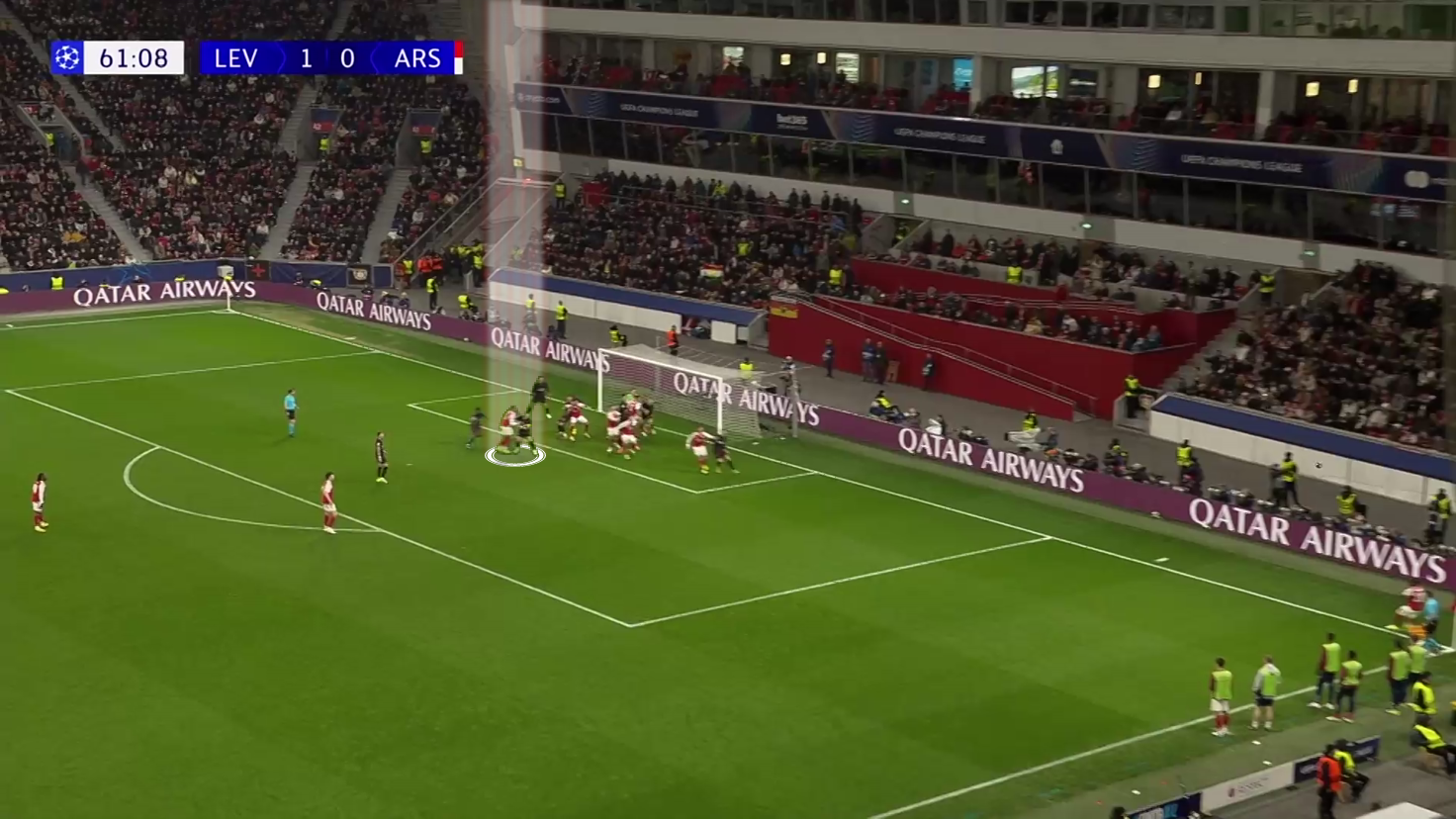
Going back to our match, Gabriel succeeded in escaping from the first man marker as usual, but the second man marker was awaiting and ready to stop him from achieving a dynamic mismatch over the zonal line, as in Figures 22 and 23 below.
arsenal-vs-bayer-leverkusen-ucl-2025-26-set-piece-analysis-tactics
Figure 22
arsenal-vs-bayer-leverkusen-ucl-2025-26-set-piece-analysis-tactics
Figure 23

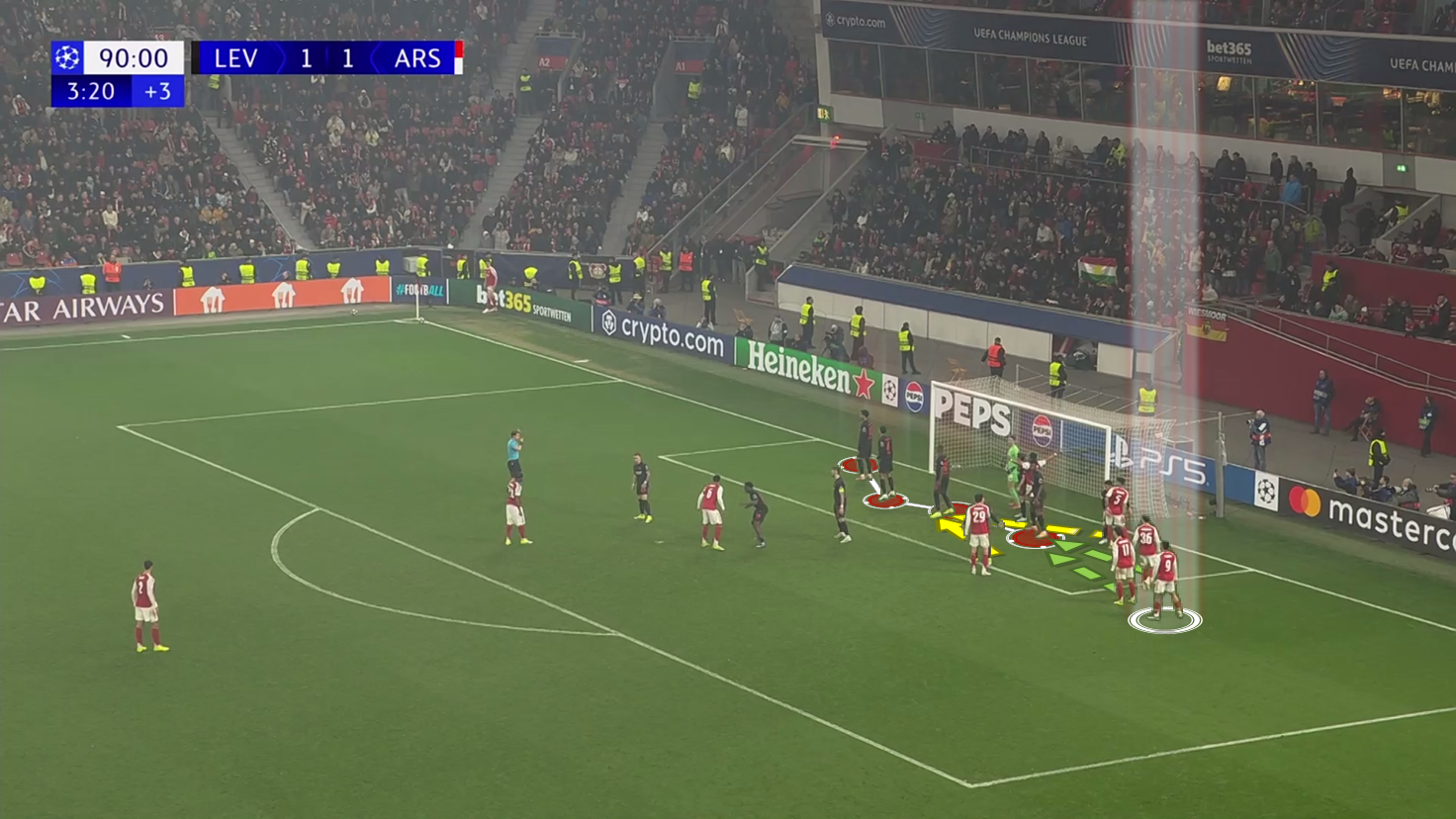
Because we are talking about Arsenal, they are always flexible in their reaction to the opponent, so we may see them targeting the near post more in the second leg or continue doing the same good routine that they did in the last minute of the match.

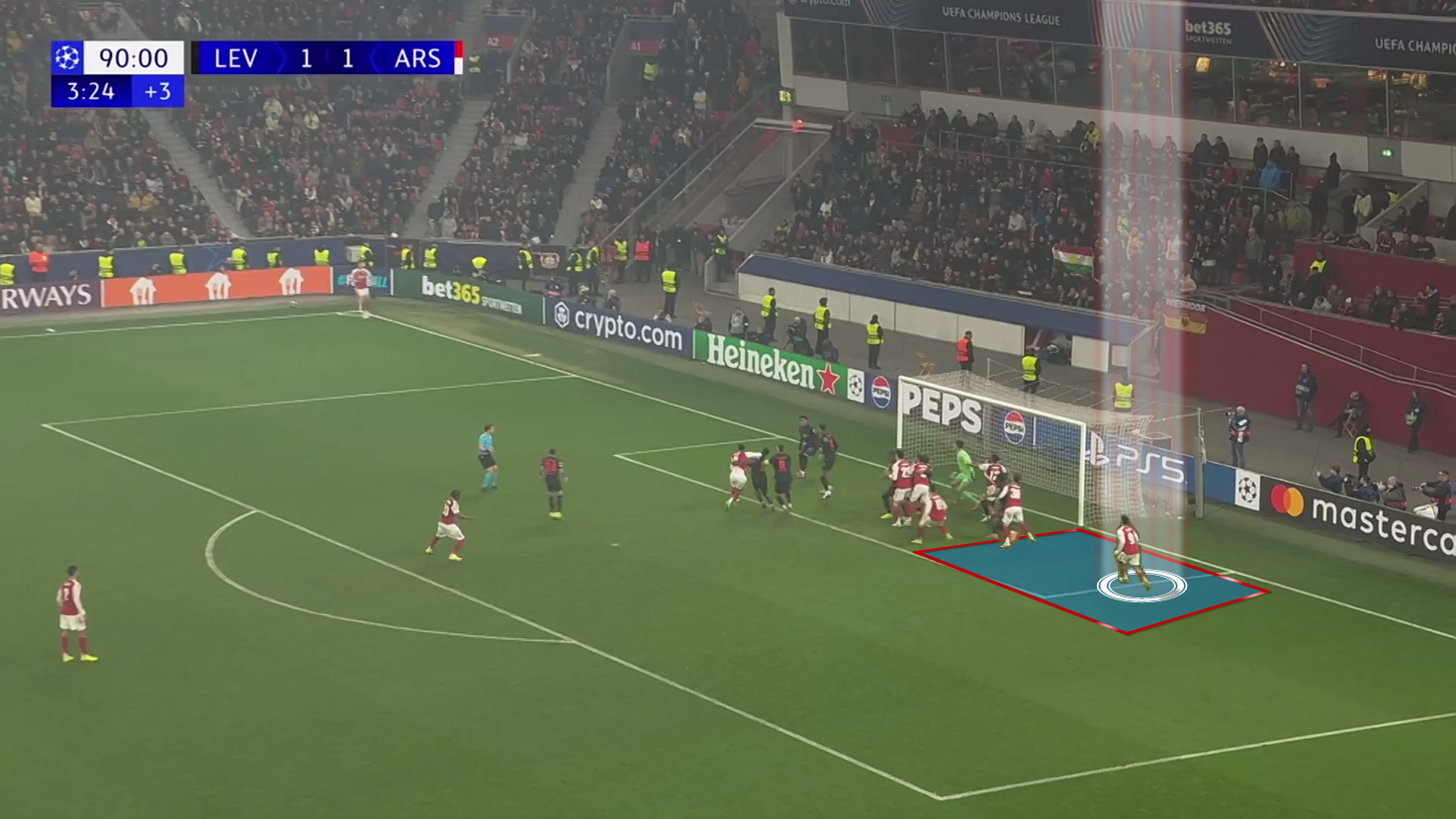
In Figure 24 below, they target the last player (white) in the pack beyond the far post, asking four players to act as blockers (green and yellow), blocking the last two zonal defenders and dragging the man markers with them to make the last player free.
arsenal-vs-bayer-leverkusen-ucl-2025-26-set-piece-analysis-tactics
Figure 24

As shown below, the idea succeeded, leading to a dangerous chance, but we need to mention that Arsenal’s blockers need to be more careful, especially in the UCL, and leave the defender free as quickly as they can, because the referee whistled a foul against the last blocker.
arsenal-vs-bayer-leverkusen-ucl-2025-26-set-piece-analysis-tactics
Figure 25

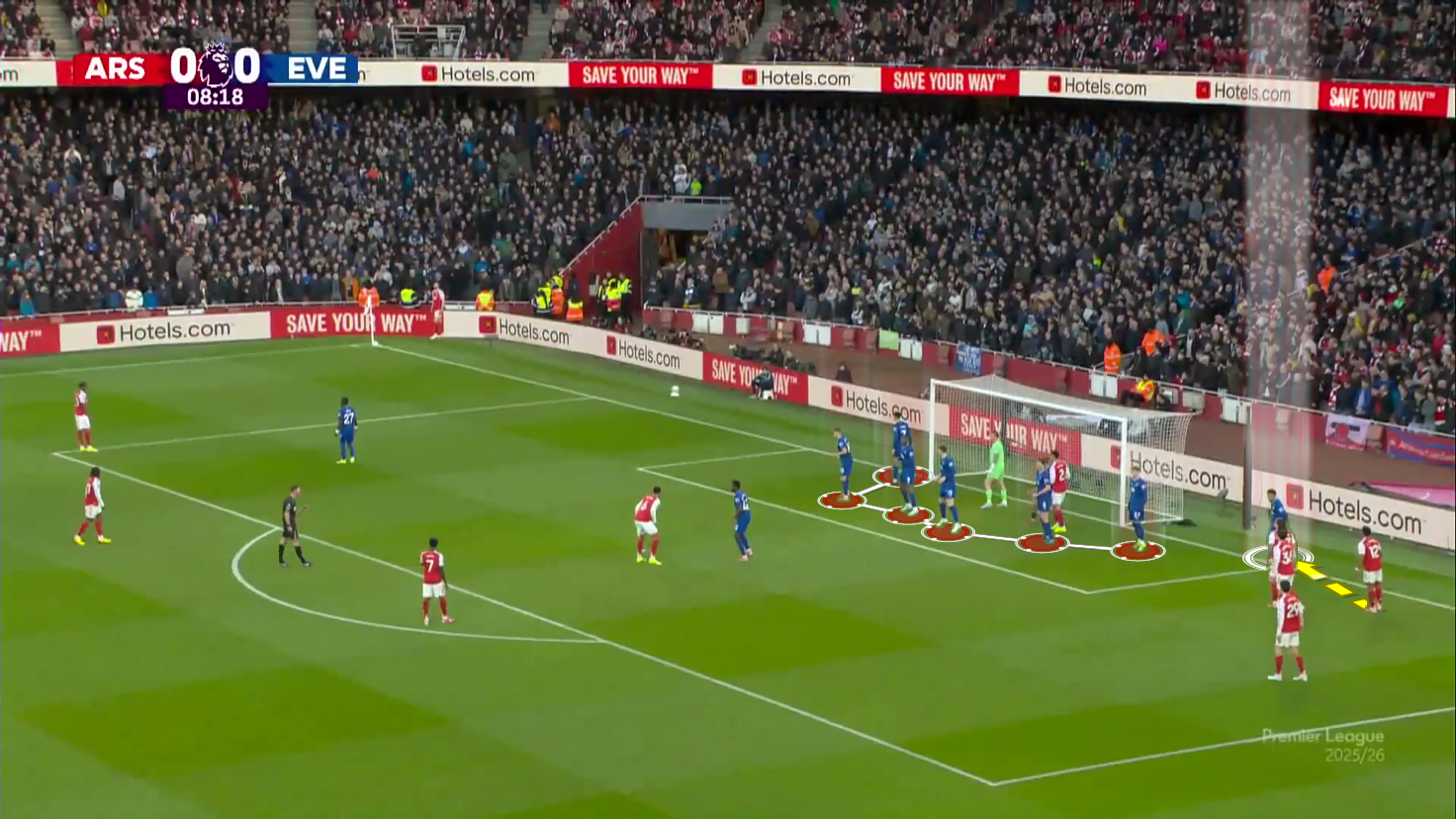
Bayer Leverkusen may use Everton‘s defending trick that they showed in the last Premier League game for Arsenal, which is using six zonal defenders (three of them more toward the far post) and a man marker (white) who stands on the line in an open body shape like a zonal defender in the beginning, as in Figure 26 below.
arsenal-vs-bayer-leverkusen-ucl-2025-26-set-piece-analysis-tactics
Figure 26

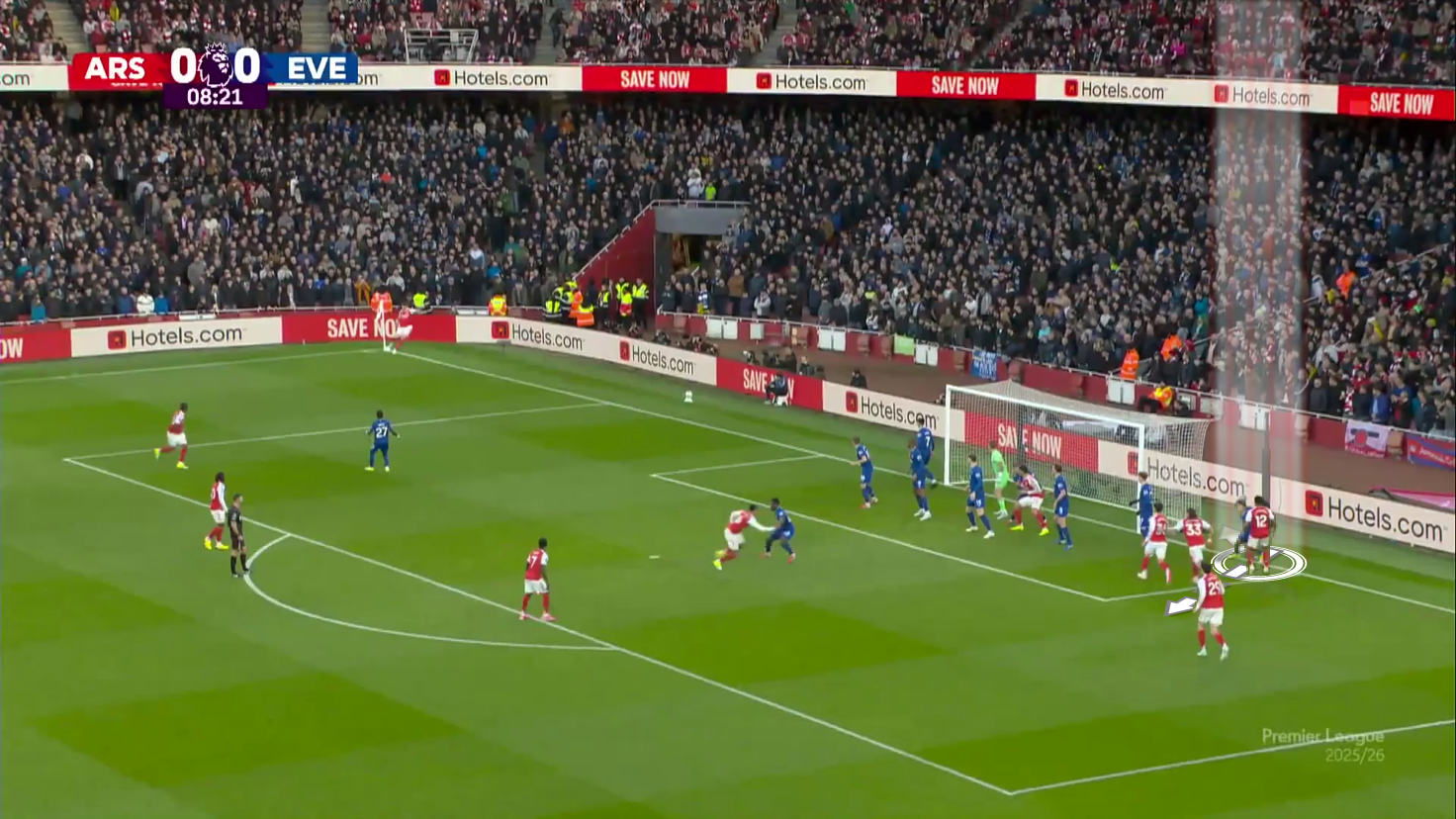
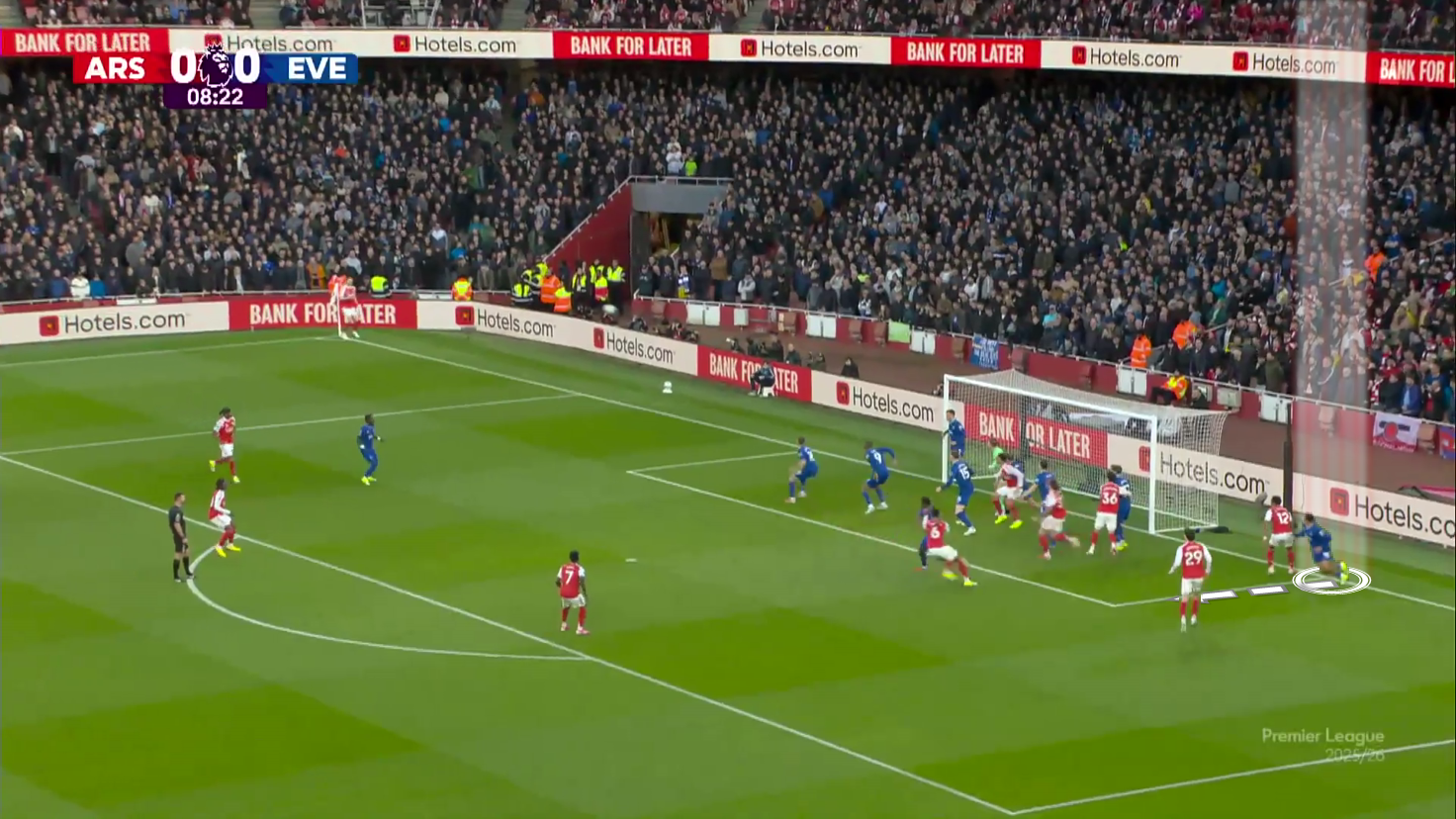
As shown below, Arsenal’s blocker goes to block him, but he surprises him with a body feint and then goes to mark the last late runner, as in Figures 27 and 28.
arsenal-vs-bayer-leverkusen-ucl-2025-26-set-piece-analysis-tactics
Figure 27
arsenal-vs-bayer-leverkusen-ucl-2025-26-set-piece-analysis-tactics
Figure 28

In the same match, we have another example showing how each of the last three zonal defenders (red) is ready to leave their zone diagonally to defend the cross because the other two are blocked (yellow), as in Figure 29 below, where the third-to-last zonal defender goes to defend the area beyond the far post because the last two zonal defenders are blocked.
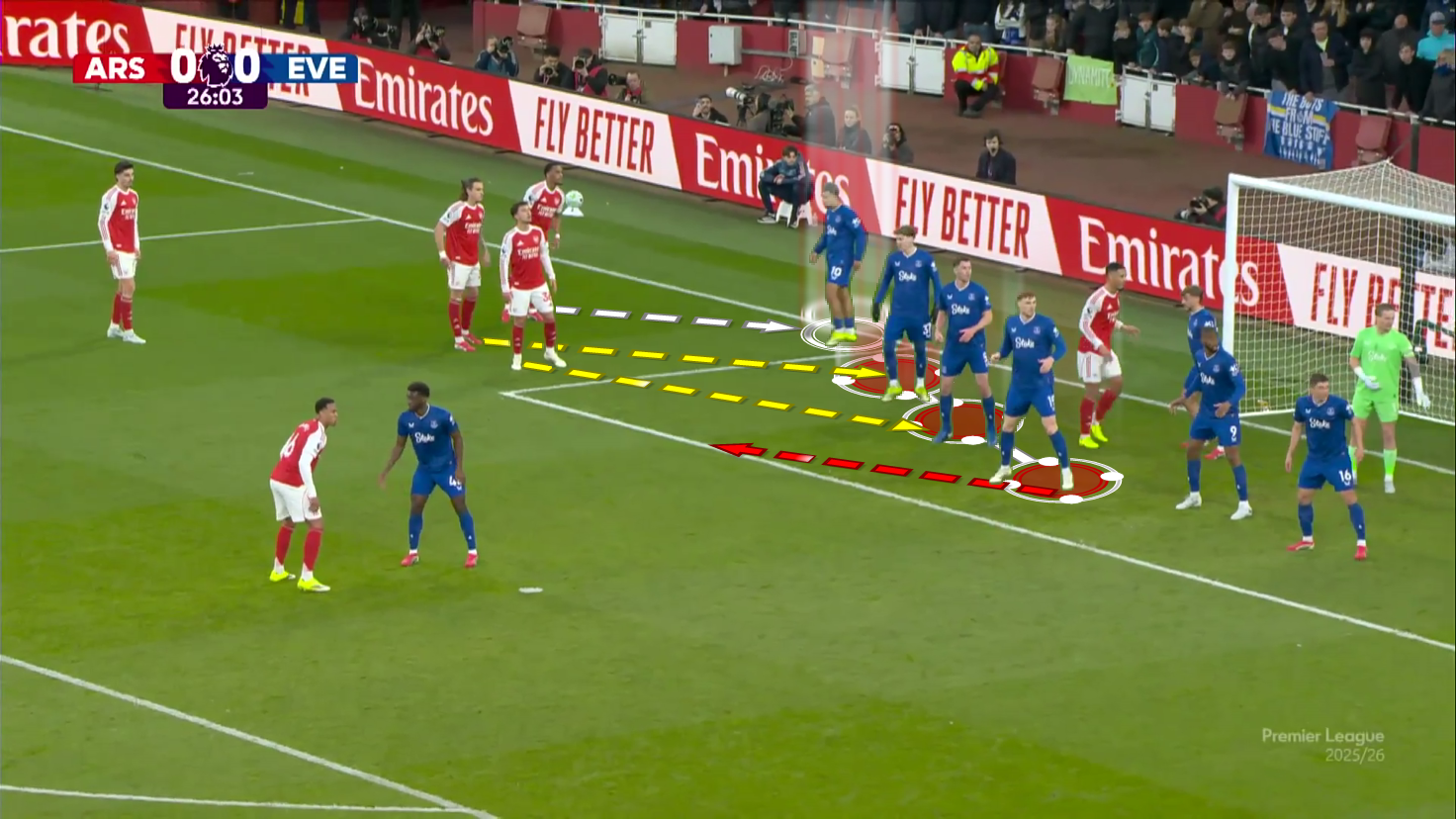
arsenal-vs-bayer-leverkusen-ucl-2025-26-set-piece-analysis-tactics
Figure 29

In the end, the white man marker is ready to defend the last runner (Kai Havertz) while the third-to-last zonal defender is ready to go to the area beyond the far post on behalf of the last two blocked defenders, as shown in Figure 30.
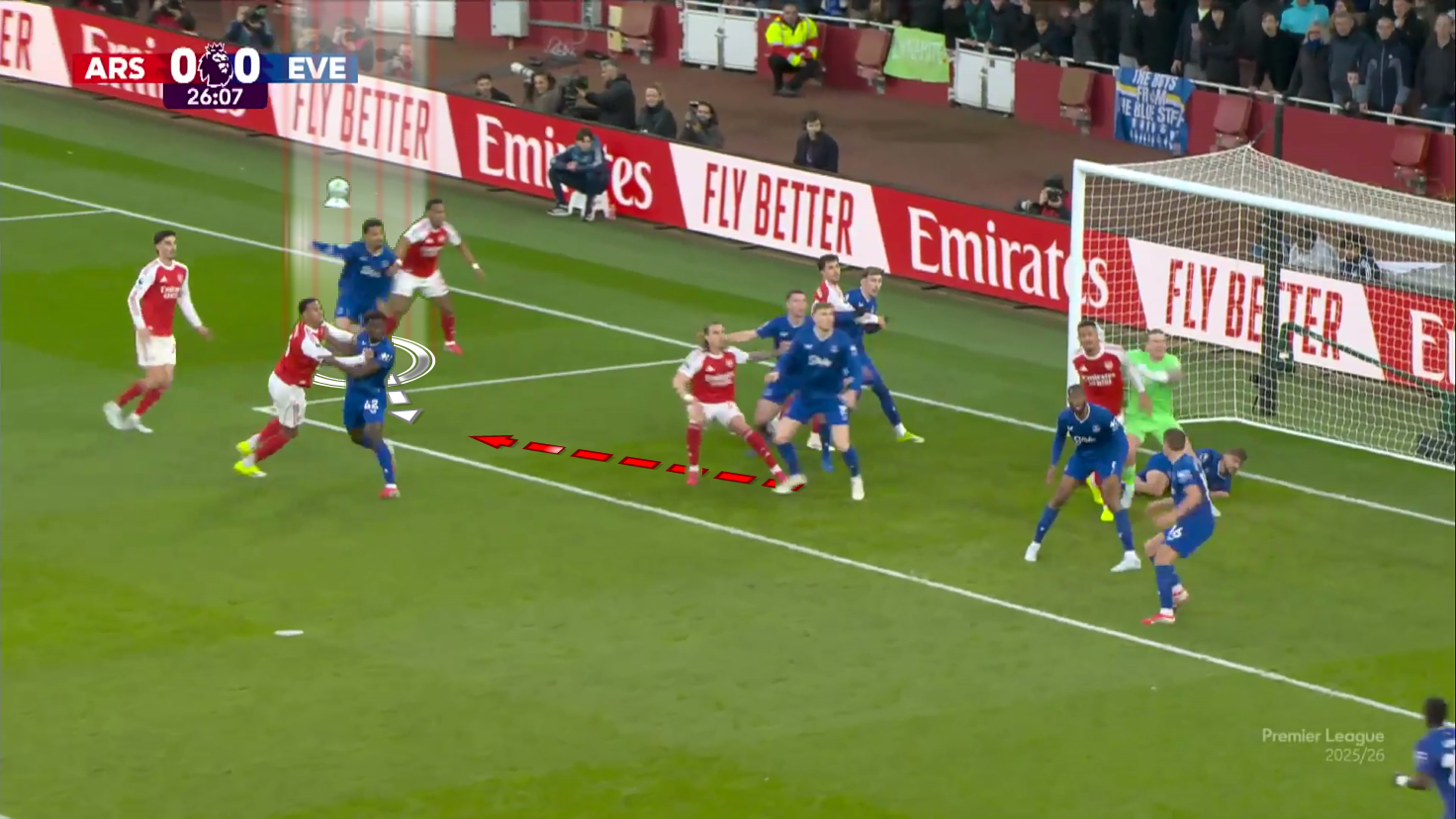
arsenal-vs-bayer-leverkusen-ucl-2025-26-set-piece-analysis-tactics
Figure 30

Conclusion

In this set-piece analysis, we examined the previous set-piece battle between Bayer Leverkusen and Arsenal, showing how both teams tried to exploit the offensive corners in innovative ways.

We have also tried to predict how both teams may react in the second leg to address weaknesses that appeared on their side in the first leg or to exploit the other team’s weaknesses in new, varied ways.

Hence, we can observe the second leg more actively to see how both teams will react.

Tags: Arsenal FormationArsenal LineupArsenal NewsArsenal Style Of PlayArsenal Tactical AnalysisArsenal TacticsArsenal Transfer NewsBayer Leverkusen FormationBayer Leverkusen LineupBayer Leverkusen News Champions LeagueBayer Leverkusen Style Of PlayBayer Leverkusen Tactical AnalysisBayer Leverkusen TacticsBayer Leverkusen Transfer NewsChampions League NewsChampions League Tactical AnalysisChampions League TacticsHow Good Is Kasper HjulmandHow Good Is Mikel ArtetaKasper HjulmandKasper Hjulmand Bayer LeverkusenKasper Hjulmand Bayer Leverkusen Tactics Bayer LeverkusenKasper Hjulmand Coaching StyleKasper Hjulmand FormationKasper Hjulmand Manager StyleKasper Hjulmand NewsKasper Hjulmand Strengths And WeaknessesKasper Hjulmand Style Of PlayKasper Hjulmand Tactical AnalysisKasper Hjulmand TacticsMikel ArtetaMikel Arteta ArsenalMikel Arteta Arsenal Tactics ArsenalMikel Arteta Coaching StyleMikel Arteta FormationMikel Arteta Manager StyleMikel Arteta NewsMikel Arteta Strengths And WeaknessesMikel Arteta Style Of PlayMikel Arteta Tactical AnalysisMikel Arteta Tactics
Previous Post

Premier League 2025/2026: Manchester United, Aston Villa, Liverpool & Chelsea In The UCL Race – Data Analysis

Next Post

Lazio Vs AC Milan [1–0] – Serie A 2025/2026: Maurizio Sarri Wing Play & Pressing – Tactical Analysis

Next Post
Lazio Vs AC Milan [1–0] – Serie A 2025/2026: Wing Dominance Punishes Milan’s Key Passing Flaws – Tactical Analysis

Lazio Vs AC Milan [1–0] – Serie A 2025/2026: Maurizio Sarri Wing Play & Pressing – Tactical Analysis

  • About Total Football Analysis
  • Contact Total Football Analysis
  • Write For Total Football Analysis
  • Advertise
  • Privacy Policy
  • Cancellation / Refund Policy
  • Resources
  • Terms Of Service

© 2026 Total Football Analysis

No Result
View All Result
  • Football Analysis
    • Data Analysis
    • Formations
      • 2-2-4 Formation
      • 2-3-5 Formation
      • 3-1-4-2 Formation
      • 3-2-2-3 Formation
      • 3-2-4-1 Formation
      • 3-1-6 Formation
      • 3-3-4 Formation
      • 3-4-1-2 Formation
      • 3-4-2-1 Formation
      • 3-4-3 Formation
      • 3-5-1-1 Formation
      • 3-5-2 Formation
      • 4-1-4-1 Formation
      • 4-2-2-2 Formation
      • 4-2-3-1 Formation
      • 4-2-4 Formation
      • 4-3-1-2 Formation
      • 4-3-3 Formation
      • 4-4-2 Formation
      • 4-5-1 Formation
      • 5-3-2 Formation
      • 5-4-1 Formation
      • 6-3-1 Formation
    • Head Coach Analysis
    • Match Analysis
    • Player Analysis
    • Recruitment Analysis
    • Set Piece Analysis
    • Tactical Theory
    • Tactical Preview
    • Team Analysis
    • Training Analysis
    • Tactical Analysis
    • Scouting Report
  • Competition
    • ALL Competitions
    • English Premier League
    • Champions League
    • La Liga
    • Bundesliga
    • Serie A
    • Ligue 1
    • Eredivisie
    • EFL Championship
    • FIFA World Cup 2022
    • WEURO 2022
    • Women’s Super League
    • NWSL
    • Belgian First Division A
    • A-League
    • Liga Profesional de Argentina
    • Austrian Bundesliga
    • Campeonato Brasileiro Série A
    • DFB Pokal
    • 1. HNL
    • Danish Superliga
    • EFL League One
    • EFL League Two
    • FA Cup
    • EFL Cup
    • Indian Super League
    • K-League
    • J1 League
    • Liga MX
    • Copa América 2021
    • Copa del Rey
    • MLS
    • Eliteserien
    • Euro 2020
    • Primeira Liga
    • Scottish Premiership
    • Allsvenskan
    • Europa League
    • UEFA Nations League
    • Liga AUF Uruguaya
  • Coaches
    • All Coaches
    • Alfred Schreuder
    • Ange Postecoglou
    • Antonio Conte
    • Arne Slot
    • Bo Svensson
    • Brendan Rodgers
    • Bruno Lage
    • Carlo Ancelotti
    • Christophe Galtier
    • Claude Puel
    • Claudio Ranieri
    • David Moyes
    • Dean Smith
    • Diego Simeone
    • Domenico Tedesco
    • Frank Lampard
    • Eddie Howe
    • Edin Terzić
    • Emma Hayes
    • Erik ten Hag
    • Ernesto Valverde
    • Gennaro Gattuso
    • Gerardo Seoane
    • Gian Piero Gasperini
    • Giovanni van Bronckhorst
    • Graham Potter
    • Igor Tudor
    • Imanol Alguacil
    • Jesse Marsch
    • Jonas Eidevall
    • Jorge Sampaoli
    • José Bordalás
    • José Mourinho
    • Julen Lopetegui
    • Julian Nagelsmann
    • Julien Stéphan
    • Jürgen Klopp
    • Luciano Spalletti
    • Lucien Favre
    • Manuel Pellegrini
    • Marcelo Bielsa
    • Marco Rose
    • Marco Silva
    • Massimiliano Allegri
    • Mauricio Pochettino
    • Maurizio Sarri
    • Mikel Arteta
    • Niko Kovač
    • Nuno Espírito Santo
    • Oliver Glasner
    • Patrick Vieira
    • Paulo Fonseca
    • Pep Guardiola
    • Peter Bosz
    • Rafa Benítez
    • Ralf Rangnick
    • Ralph Hasenhüttl
    • Roger Schmidt
    • Roy Hodgson
    • Sean Dyche
    • Sérgio Conceição
    • Simone Inzaghi
    • Sonia Bompastor
    • Stefano Pioli
    • Steffen Baumgart
    • Steven Gerrard
    • Thiago Motta
    • Thomas Frank
    • Thomas Tuchel
    • Unai Emery
    • Vincenzo Italiano
    • Xavi
  • Teams
    • ALL Teams
    • AC Milan
    • Ajax Amsterdam
    • Arsenal
    • AS Monaco FC
    • Atalanta
    • Atlético Madrid
    • FC Barcelona
    • FC Bayern Munich
    • Borussia Dortmund
    • Celtic FC
    • Chelsea FC
    • Everton F.C.
    • Inter Milan
    • Juventus F.C.
    • Leeds United F.C.
    • Liverpool FC
    • Manchester City
    • Manchester United FC
    • Paris Saint-Germain
    • Rangers FC
    • RB Leipzig
    • Real Madrid CF
    • Tottenham Hotspur
    • West Ham United
  • Players
    • ALL Players
    • Alisson Becker
    • Bukayo Saka
    • Erling Haaland
    • Harry Kane
    • Jack Grealish
    • John Stones
    • Julián Alvarez
    • Kalvin Phillips
    • Kevin De Bruyne
    • Kyle Walker
    • Kylian Mbappé
    • Lamine Yamal
    • Lionel Messi
    • Luis Díaz
    • Mohamed Salah
    • Phil Foden
    • Virgil Van Dijk
  • Contact
  • Write For TFA
  • Login

© 2026 Total Football Analysis