
In modern football, set-pieces are no longer secondary moments in a match; they have become one of the most important sources of creating opportunities and scoring goals.
Many major European teams have begun treating corner kicks and indirect free kicks as essential parts of their attacking systems, rather than haphazard solutions when play is stopped.
During the 2025/2026 La Liga season, Real Madrid emerged as one of the teams that clearly developed this aspect, with corner kicks and set-pieces becoming an effective part of the team’s strategy for creating danger inside the penalty area.
What distinguishes Real Madrid this season is that set pieces are not used simply to send a cross into the box; they are treated as part of a structured attacking phase that begins seconds before the corner kick is taken.
This involves organising the players within the penalty area and assigning roles to them.
In this tactical analysis and set-piece analysis we will describe Real Madrid’s set-piece style.
Numerical Superiority As A Weapon
One of the key elements of Real Madrid’s corner kicks is their reliance on numerical superiority within the penalty area.
The team often pushes a large number of players towards the area before the corner kick is taken, distributing them across various areas between the goalposts, the six-yard box, and the penalty spot.
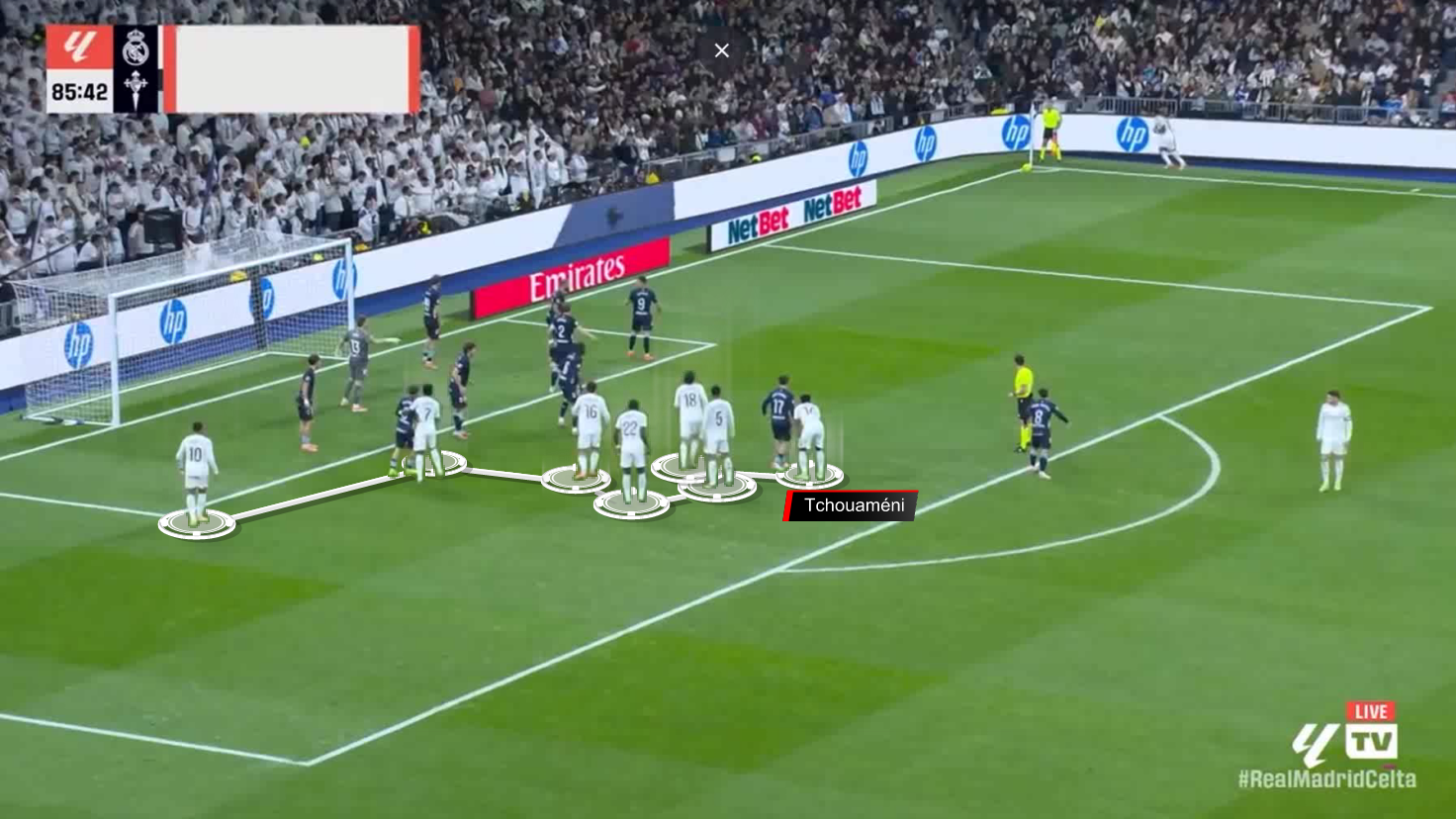
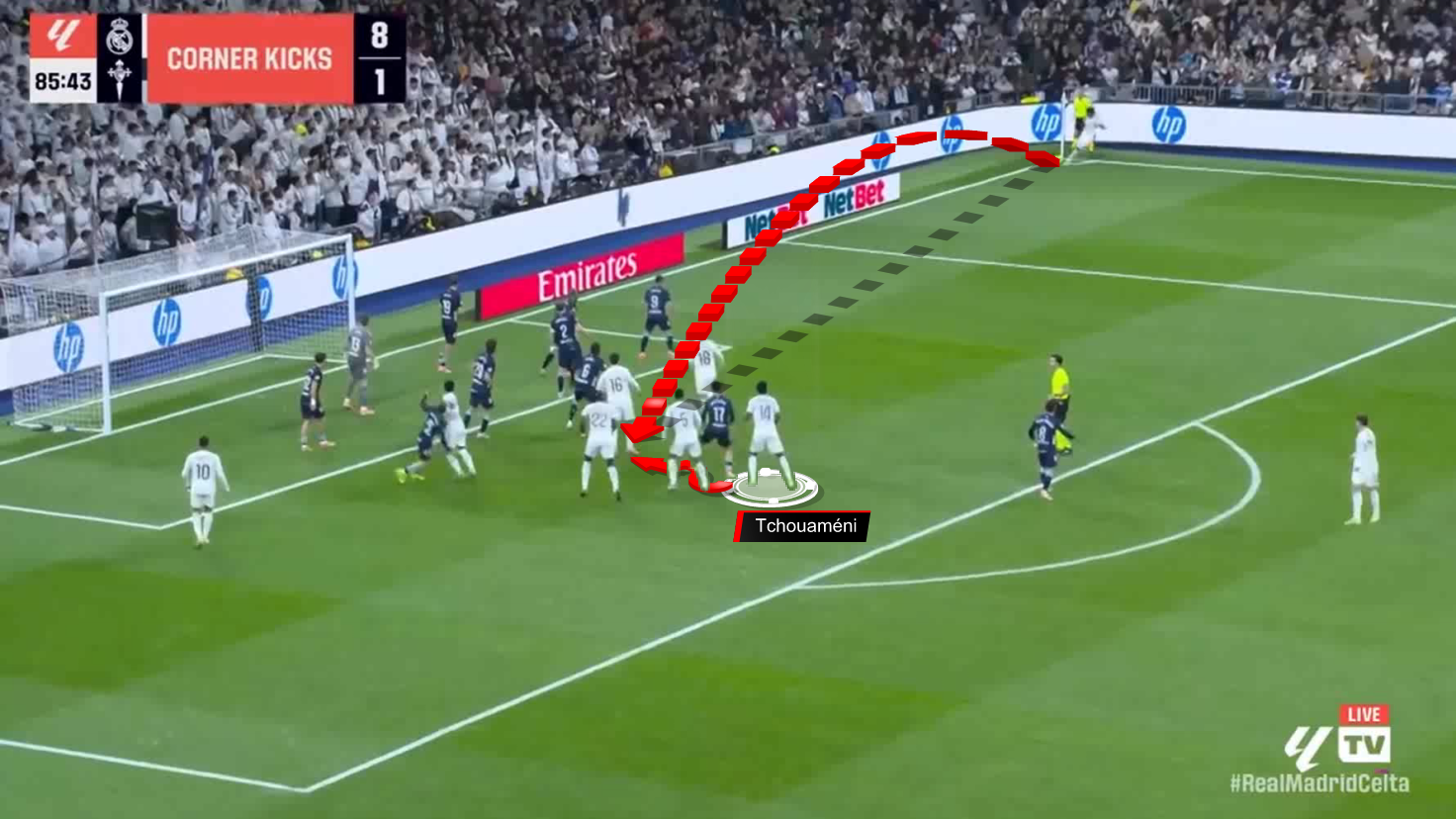
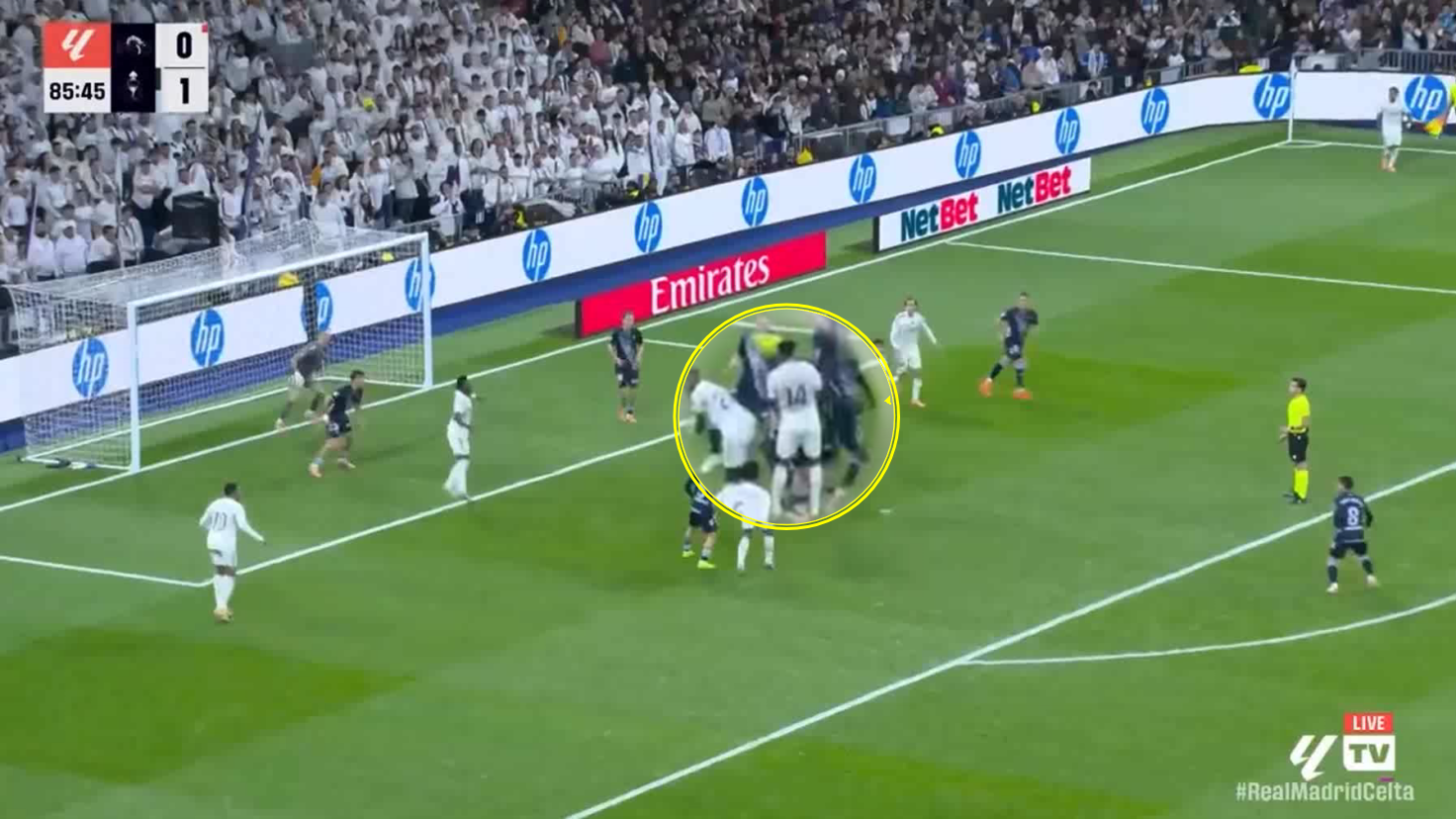 Here, in a match where Real Madrid were trailing, seven players were present during the corner kick, with Aurélien Tchouaméni positioned behind the penalty spot.
He then moved horizontally with a cross to the outside as an outswing cross.
The aim of this distribution is not only to increase the probability of winning the first ball but also to create a state of constant pressure on the opponent’s defensive line.
Having physically imposing players like Antonio Rüdiger, Éder Militão, and Aurélien Tchouaméni gives the team a clear advantage in aerial duels.
However, the tactical approach relies not only on physical strength but also on how these players position themselves before a corner kick is taken.
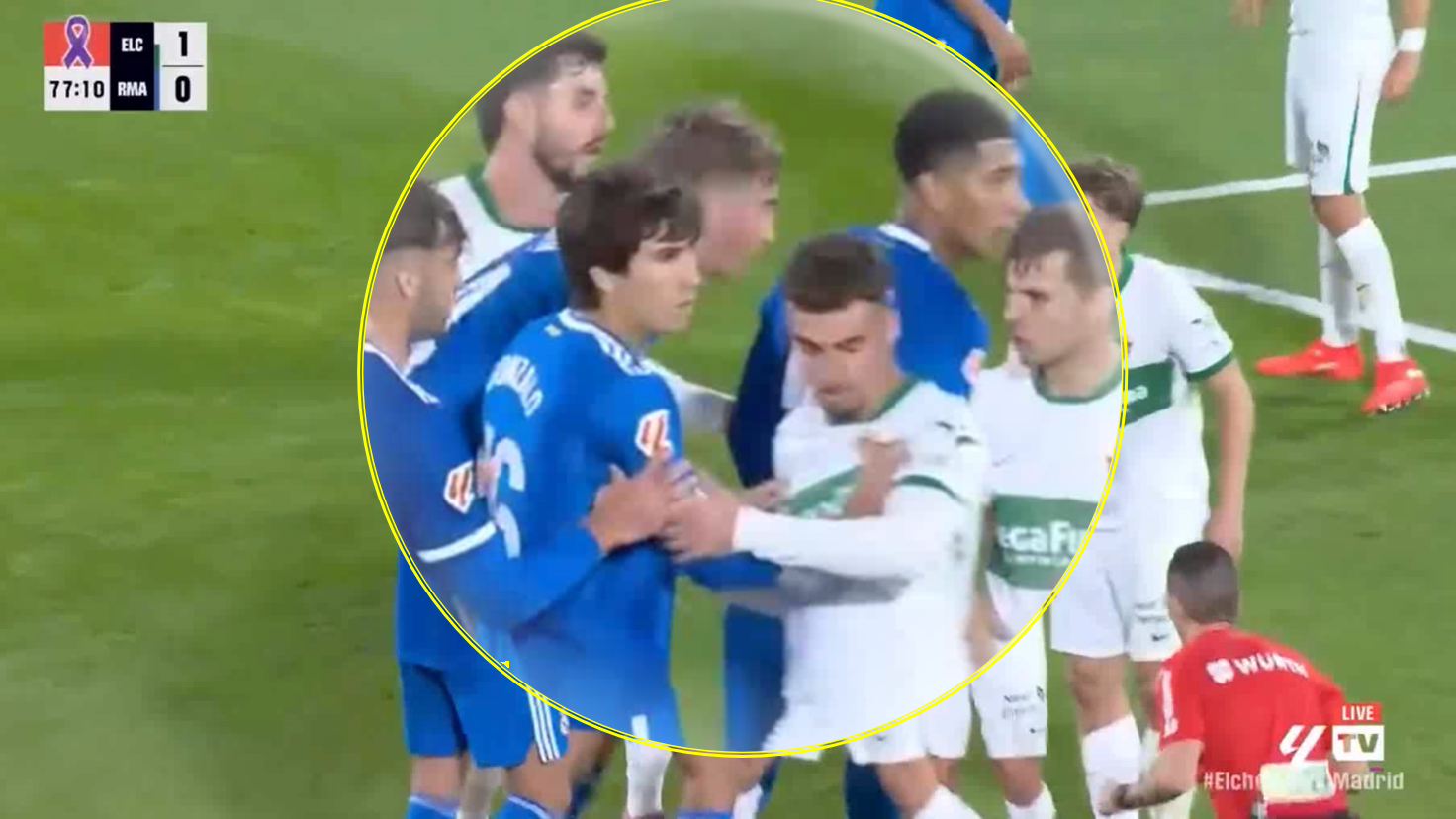
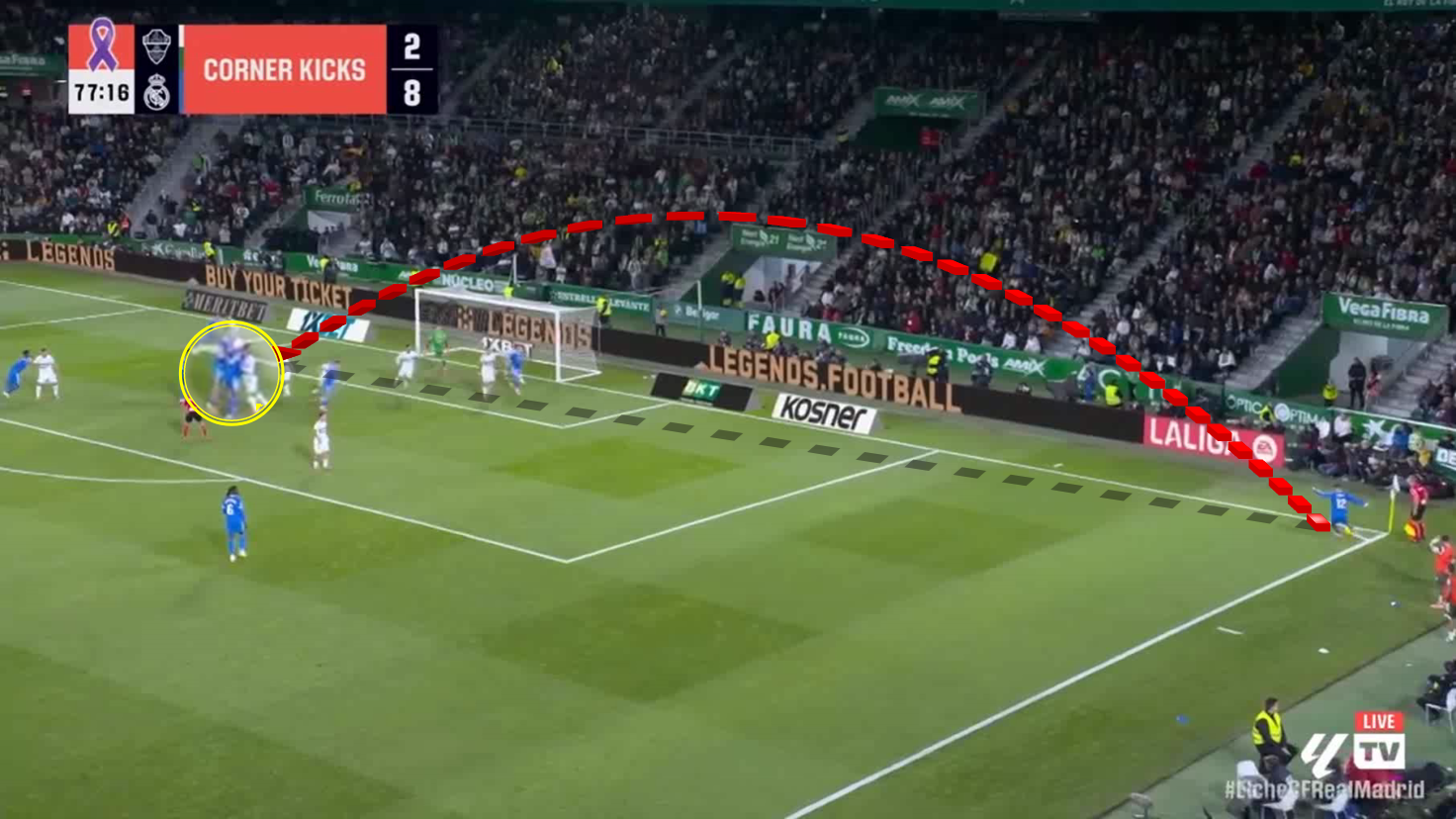
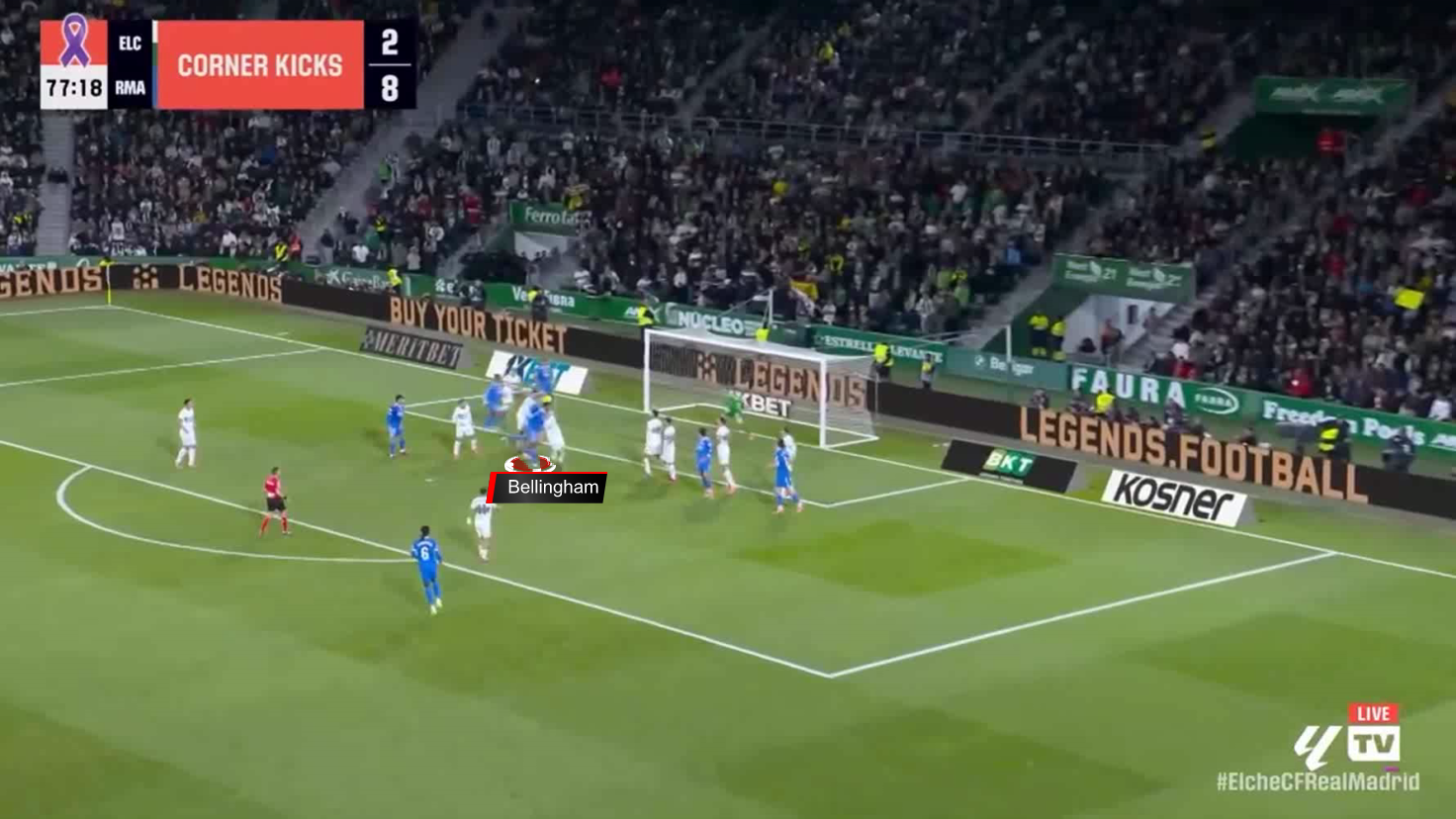
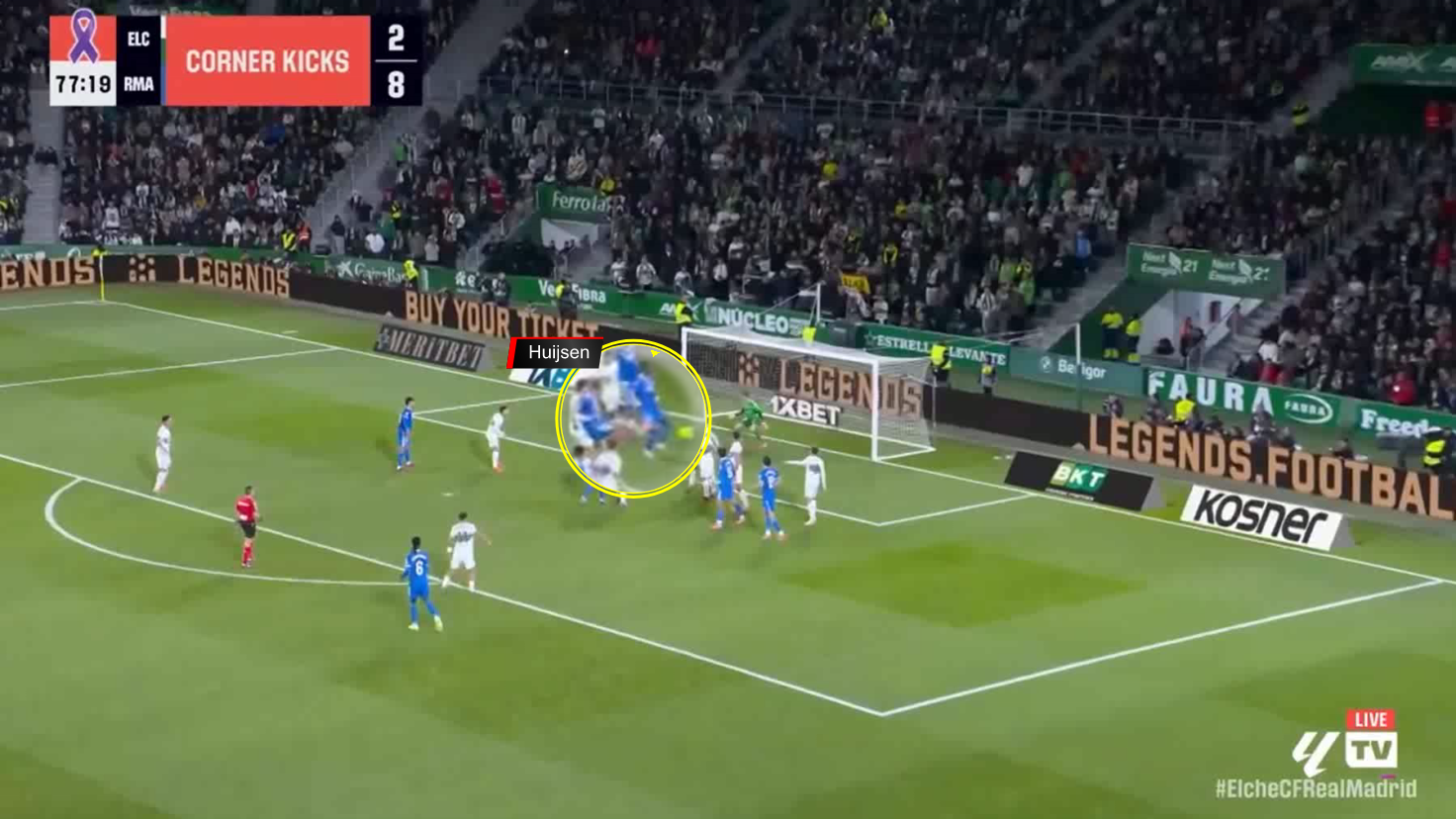
Here, with the score at a disadvantage, there are seven players in the penalty area as Trent Alexander-Arnold takes the kick.
Dean Huijsen is positioned behind Jude Bellingham, with a cross from outswing, just in front of the penalty spot.
Bellingham then heads the ball, and Huijsen taps it in.
In many cases, the players start far from the primary attacking positions and then move towards them at the last moment, which complicates the defensive marking process and creates spaces that can be exploited inside the penalty area.
This type of organisation allows Real Madrid to create multiple attacking options from the same corner kick, as they can target the near post, the penalty spot, or the far post, depending on the defenders’ movement and positioning.
Cut-Cross Movements
Another important element of Real Madrid’s corner kicks is the crossover movement within the penalty area.
Instead of remaining stationary and waiting for the ball, most players begin moving before the kick is taken.
These movements are often synchronised, with one player moving towards the near post while another heads towards the penalty spot or the far post.
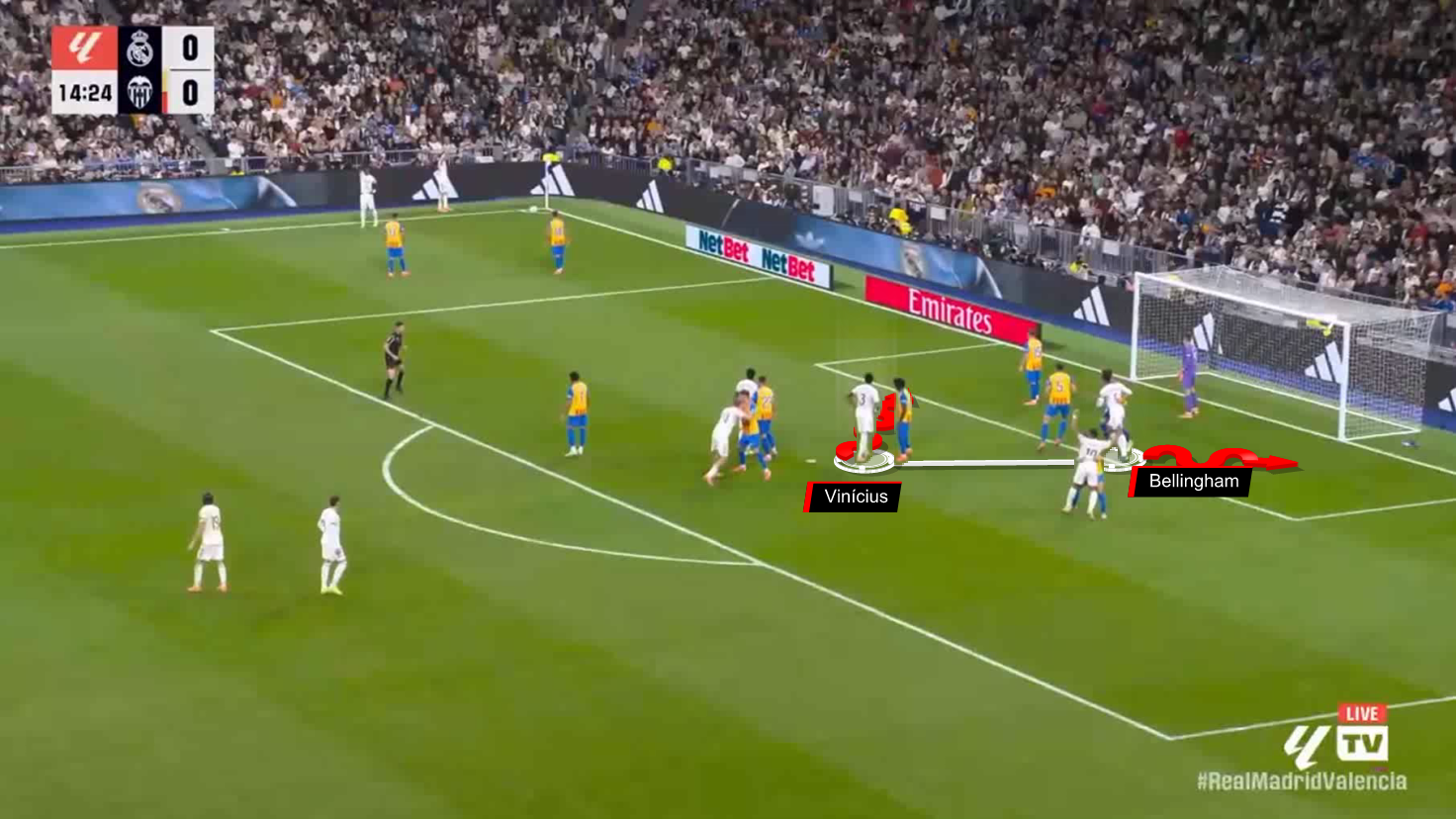
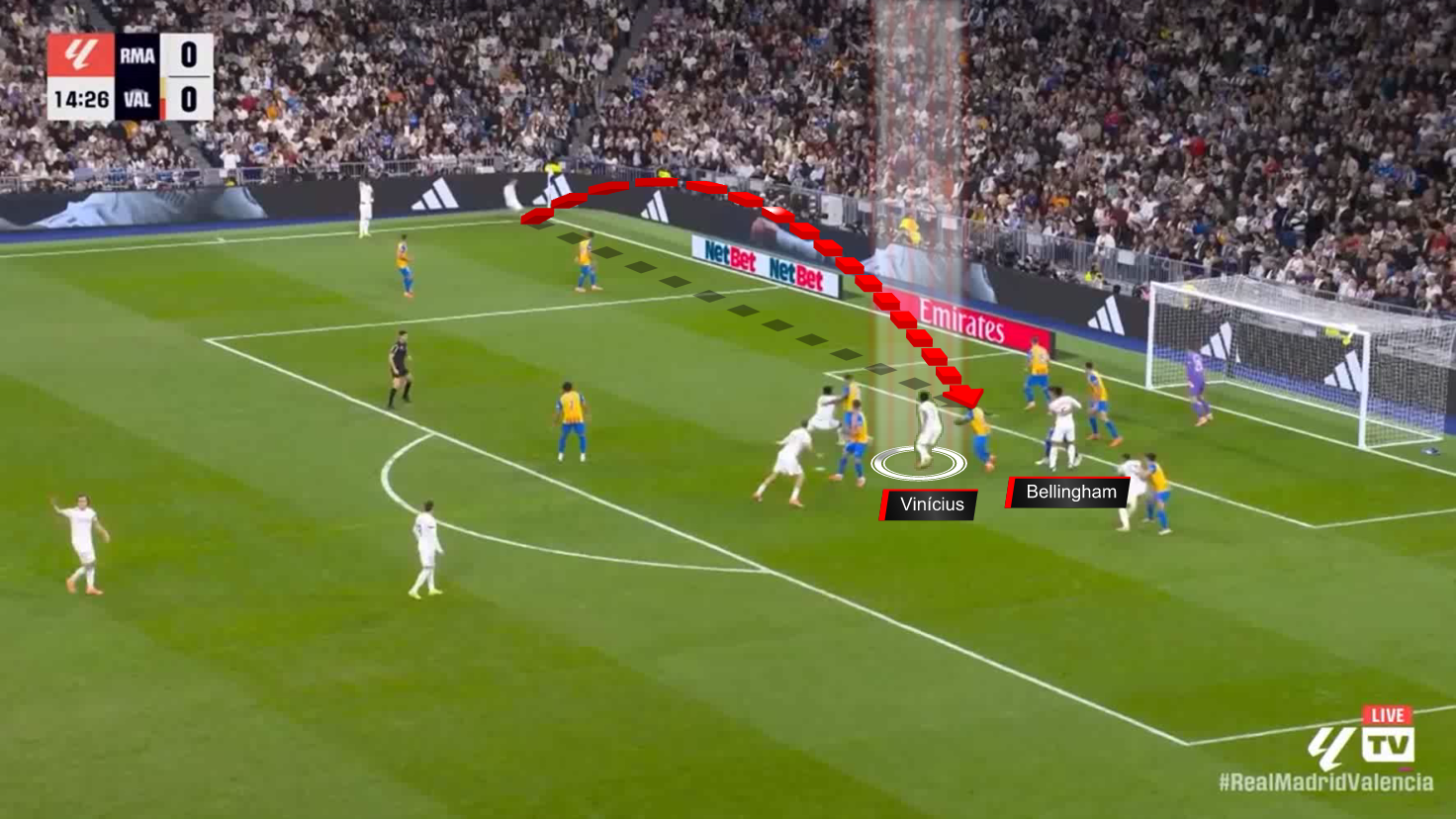
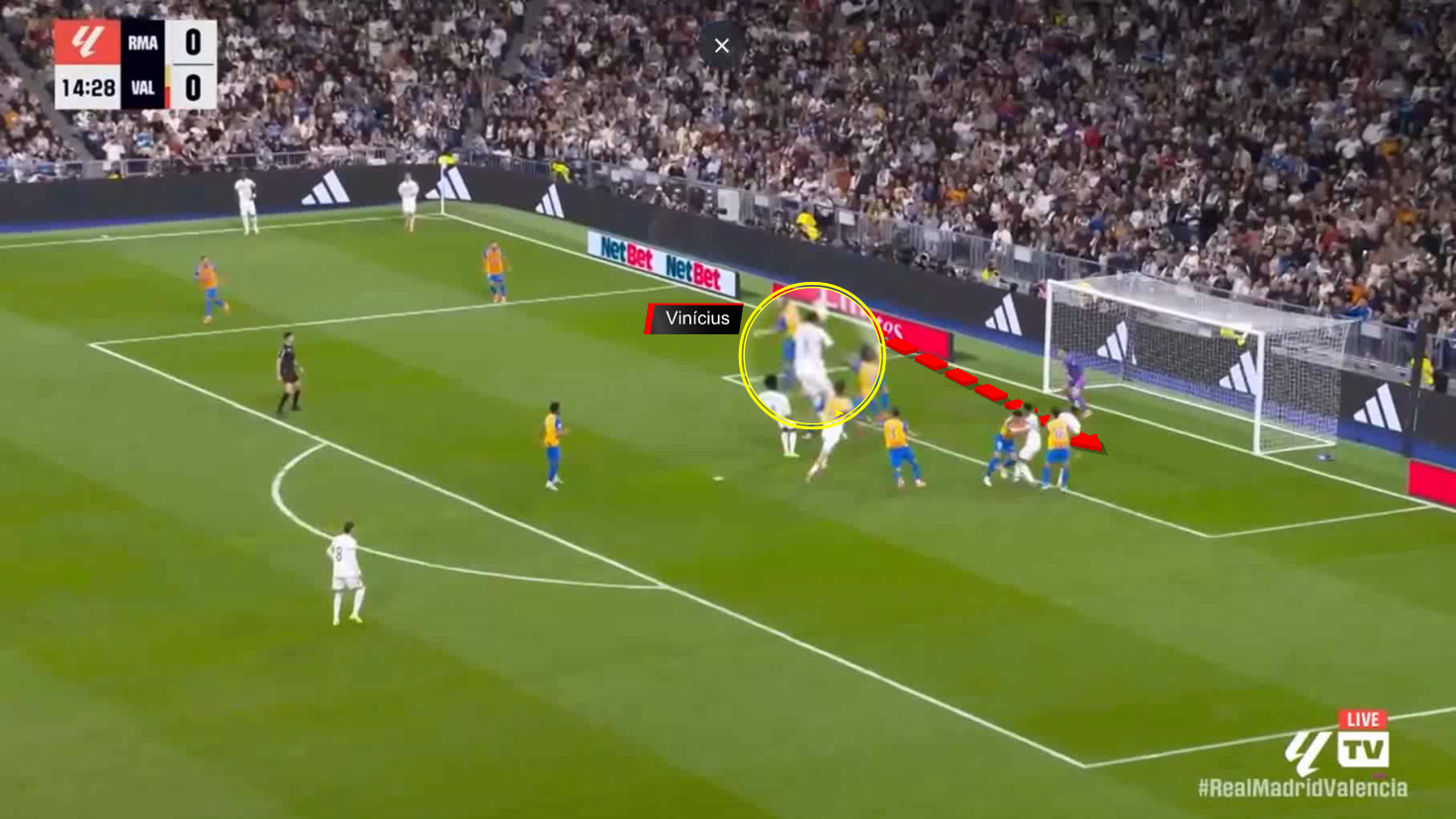 Here we see five Real Madrid players in the penalty area, with Valencia employing a hybrid defensive system combining man-to-man and zonal marking.
We observe Bellingham and Vinícius Júnior moving in a single horizontal line.
The Brazilian is at the near post after a feint, while Bellingham draws the defender to the far post.
This constant movement makes it difficult for defenders to maintain individual marking for extended periods.
In many cases, this type of movement creates a moment of confusion within the defensive line, forcing the defender to choose between following the marked player and retreating towards a more dangerous area within the six-yard box.
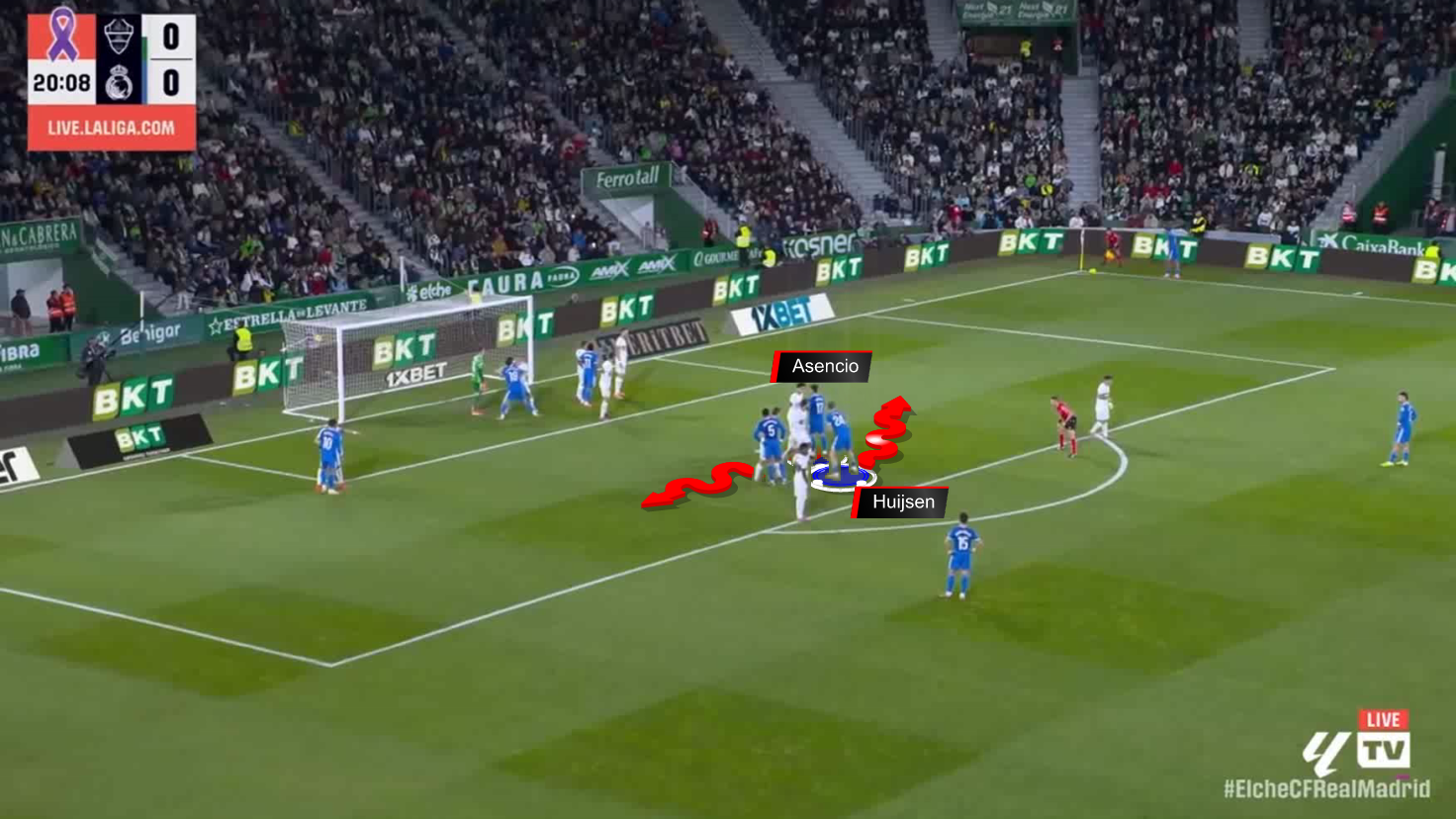
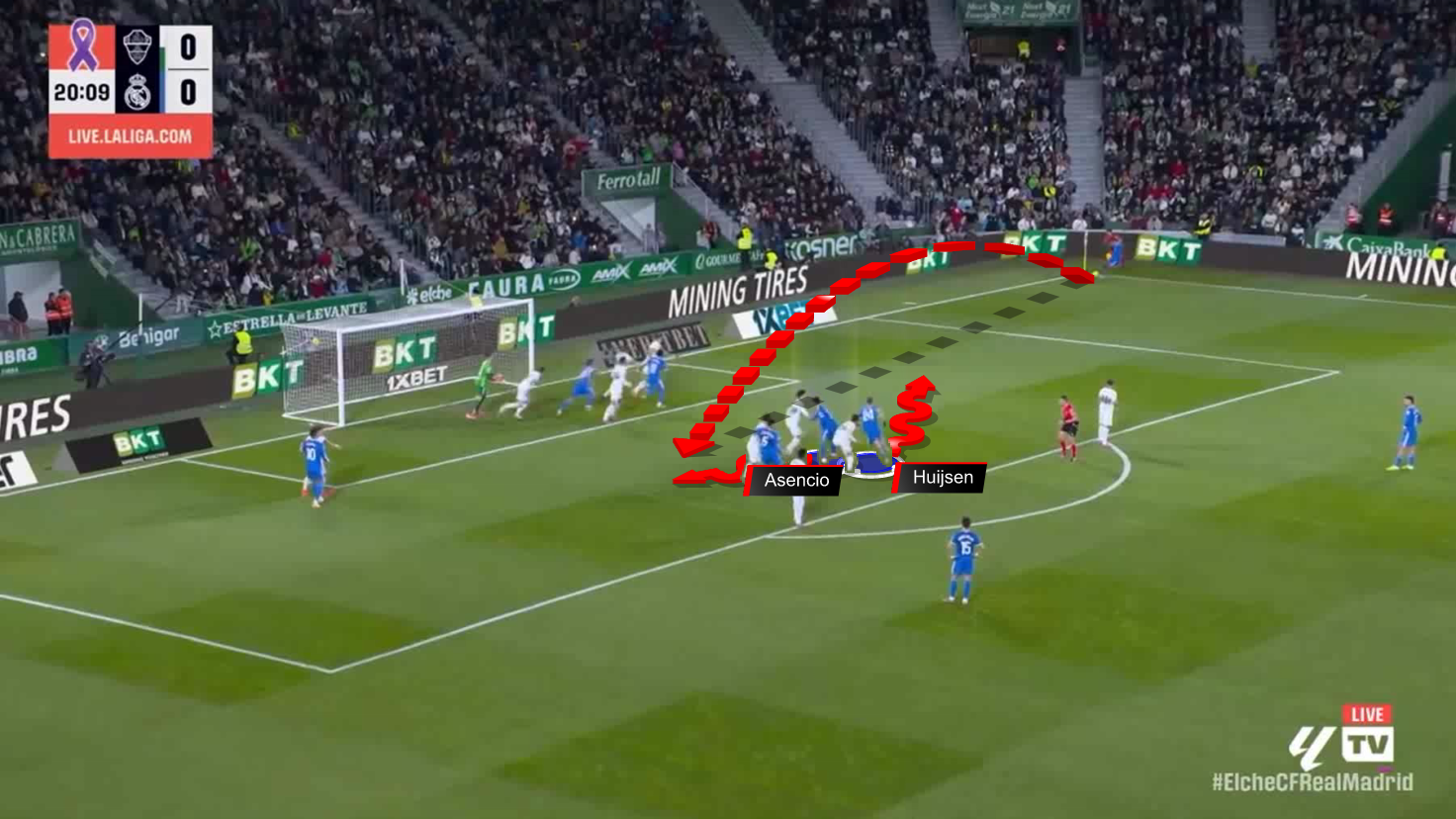
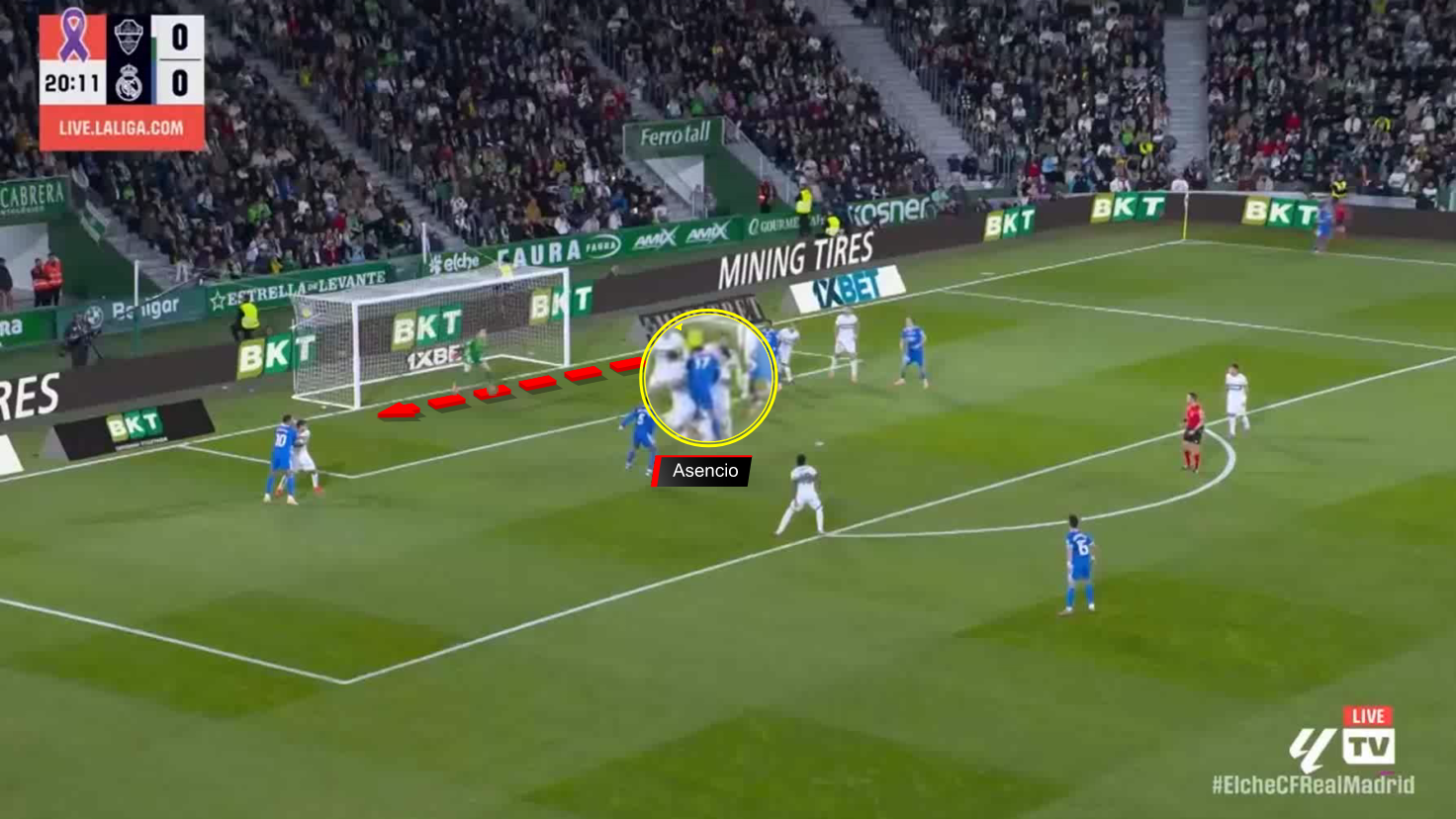 Here, Raúl Asencio and Huijsen intersect, with Huijsen moving towards the near post to draw the defender away and create space.
Huijsen then heads the ball before the goalkeeper makes the save.
When a corner kick is executed precisely at this moment, the attacker has a clear advantage in reaching the ball before the defender.
Therefore, the effectiveness of a corner kick depends not only on the quality of the delivery but also on the precise timing of the movement inside the penalty area.
Targeting The Near Post
One of the tactical patterns that has frequently appeared in Real Madrid’s corner kicks this season is targeting the near post.
This method aims to create a first touch that changes the ball’s trajectory inside the six-yard box, making it more difficult for the opponent to defend.
In this scenario, a player moves quickly towards the near post just as the corner kick is taken.
If he manages to get a header or a touch on the ball, it often results in a dangerous cross that rolls across the face of the goal.
At that moment, other players positioned themselves behind him inside the penalty area, giving them a chance to score from close range.
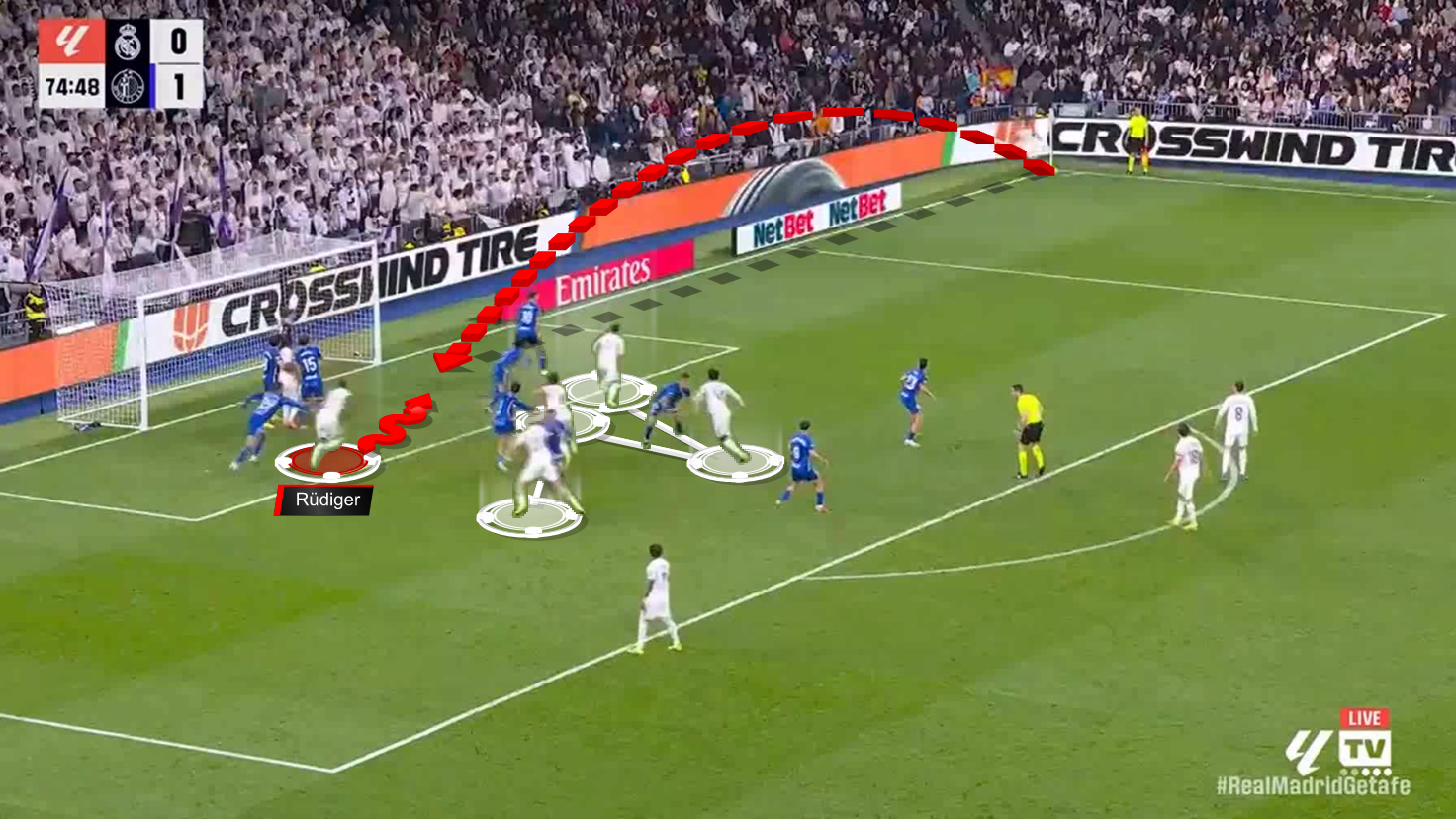
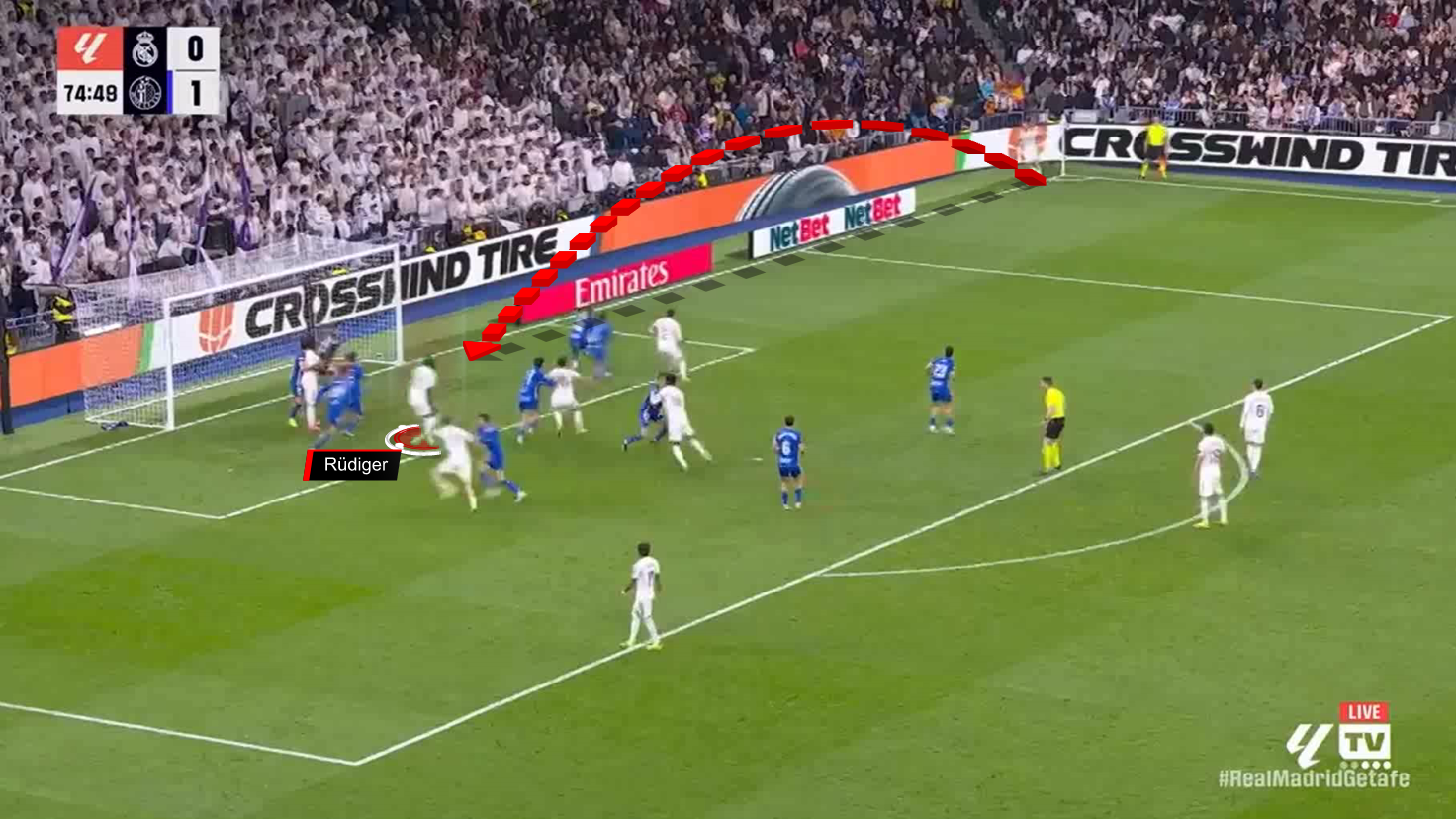
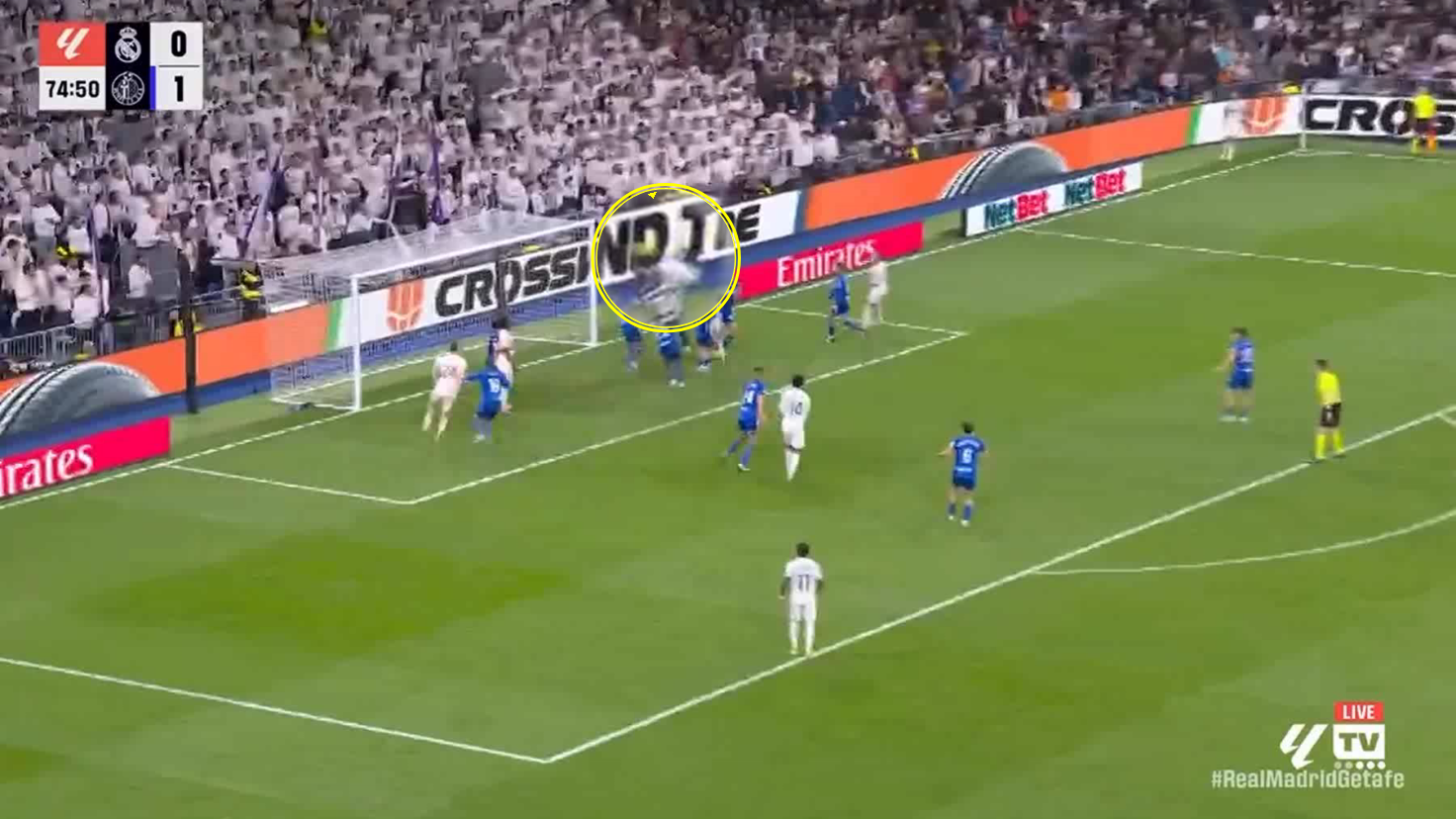 Here’s a cross from Franco Mastantuono, heading towards the goal, specifically the first post.
Here, Rüdiger moves diagonally to the near post, touches the ball towards the goal, with three players behind him.
This tactic is designed not only to score directly but also to create chaos in the penalty area.
When the ball moves quickly across the six-yard box, it becomes difficult for defenders to deal with it in an organised manner, increasing the likelihood of a rebound or a close-range shot.
Controlling The Second Ball
One of Real Madrid’s greatest strengths from set pieces this season is their pre-planning for second balls.
Instead of positioning all their players inside the penalty area, the team typically keeps two or three players outside or on the edge of the box.
The aim is to quickly deal with any ball cleared by the defence.
Having players like Federico Valverde and Bellingham in this area gives the team a great ability to quickly regain possession after a clearance.
Both players are capable of shooting directly from outside the box or sending the ball back into the penalty area.
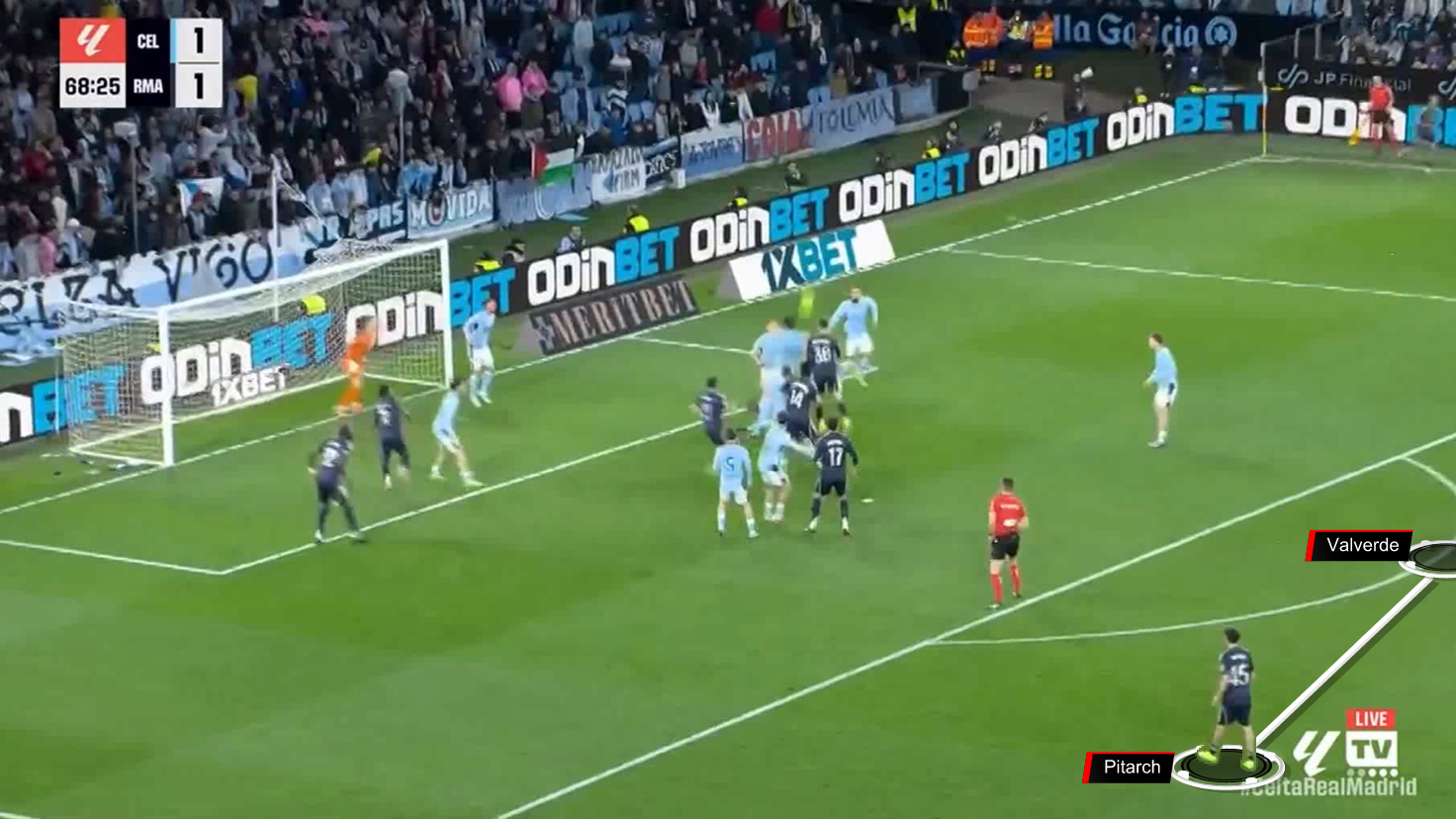
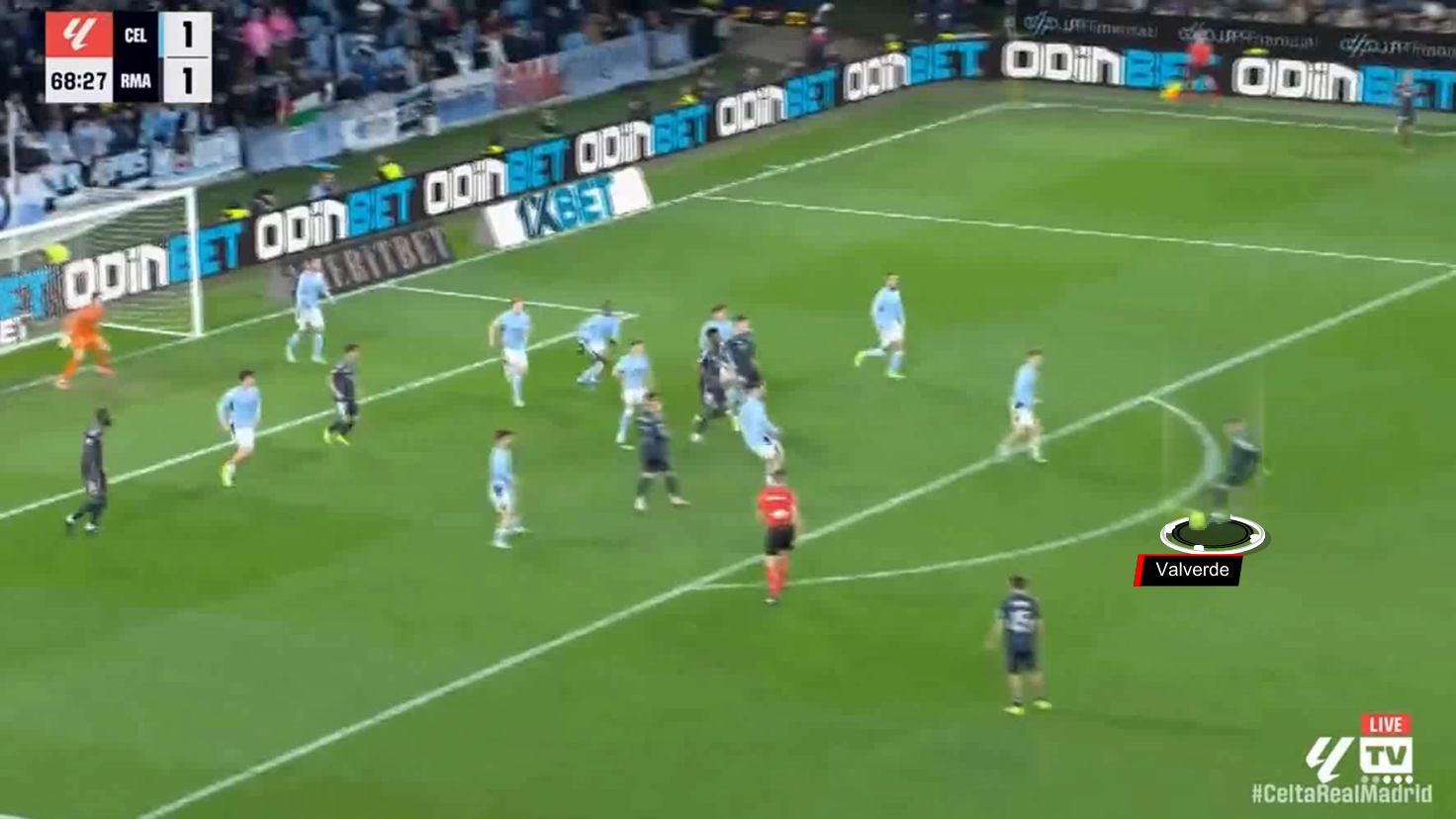 Here’s the corner kick in front of Celta Vigo, and Valverde and Thiago Pitarch are positioned on the edge of the penalty area.
After the clearance, the Uruguayan decided to shoot from the first touch, but it wasn’t on target.
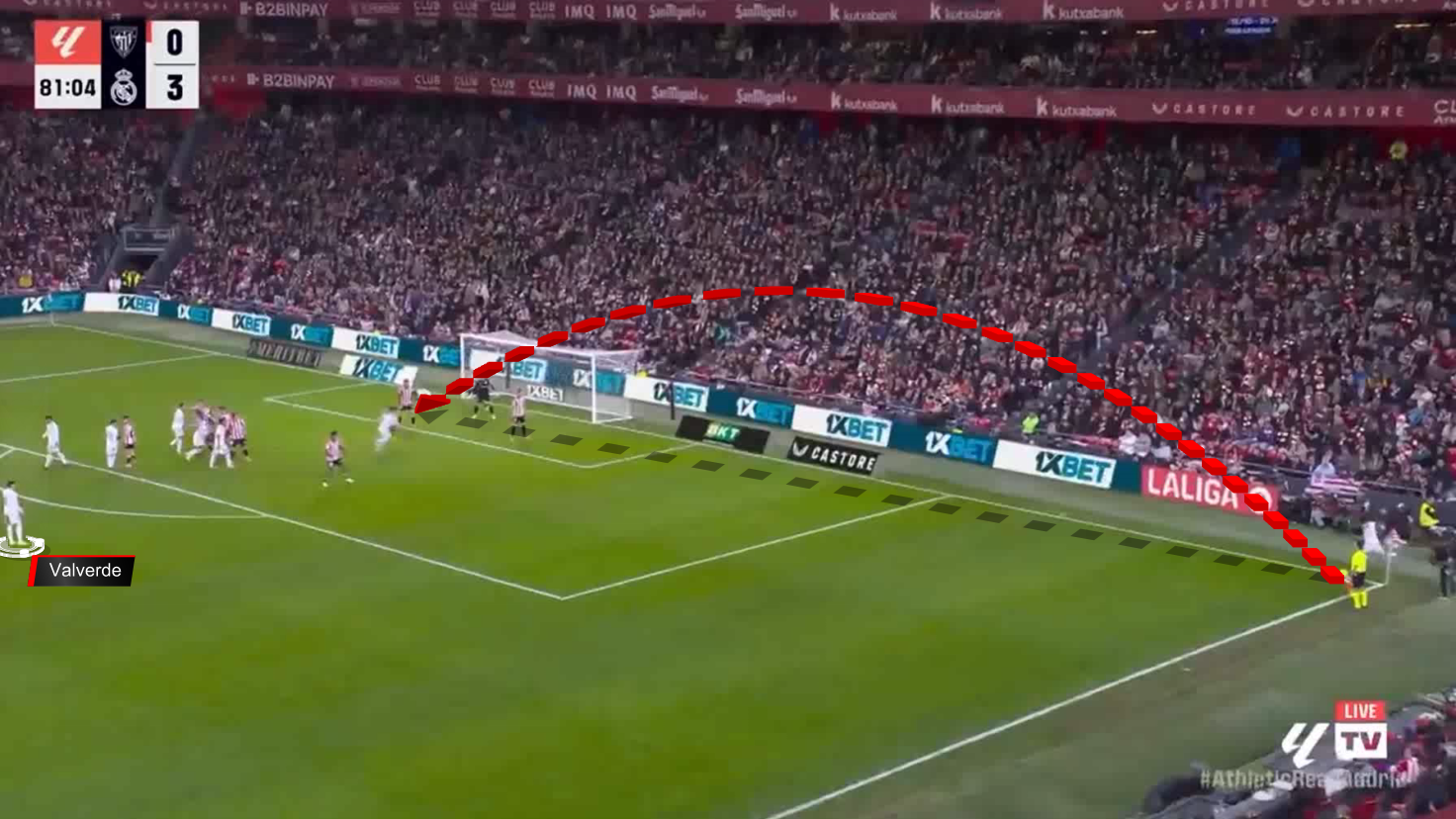
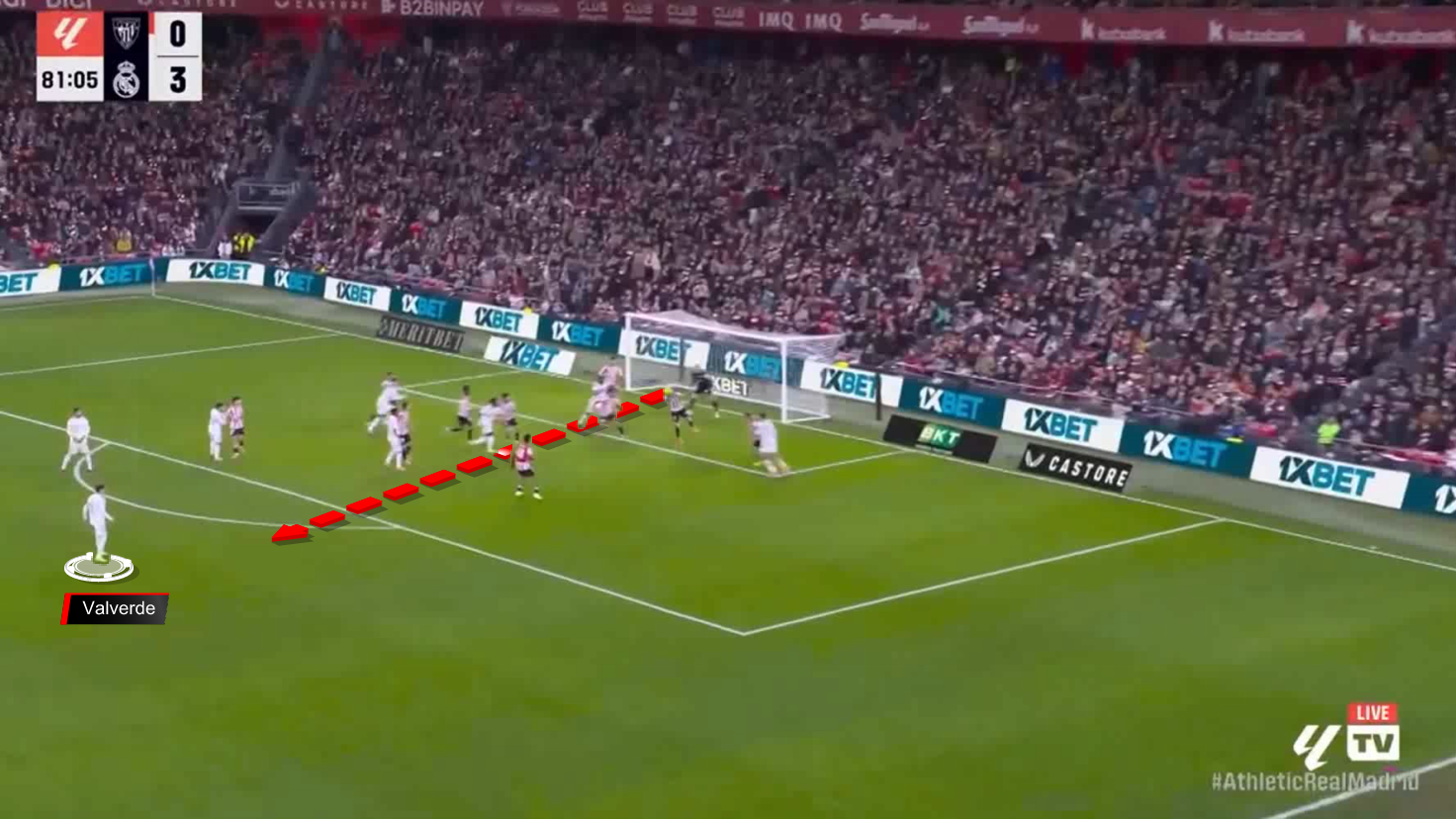
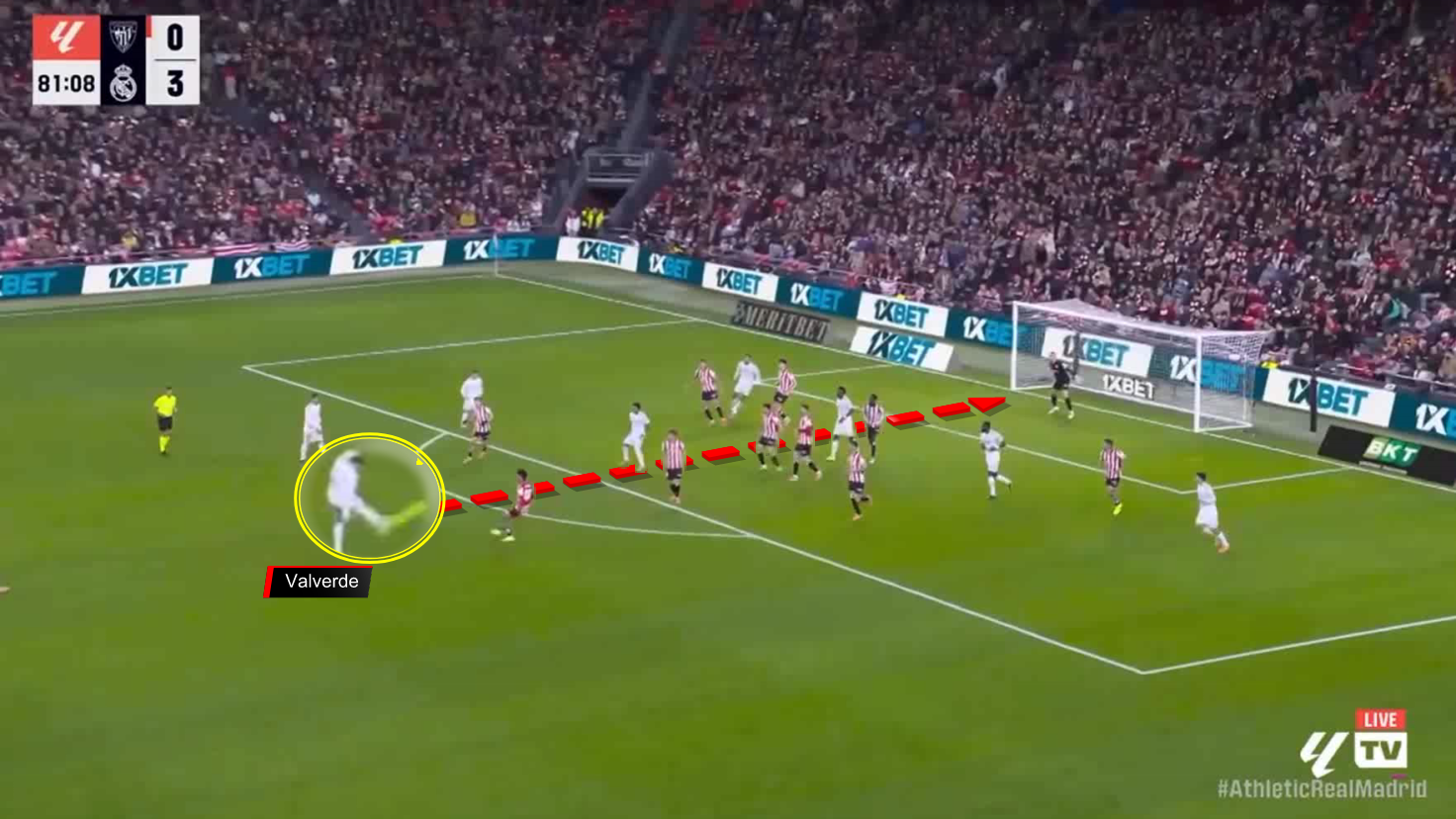 Here, Valverde receives the second ball and shoots it first time into the far corner, but the goalkeeper makes a brilliant save.
In this way, a corner kick transforms into a full-fledged attacking pressure phase.
Even if the defence manages to clear the initial ball, Real Madrid often retains possession and launches a new attack directly from the same position.
A Short Corner
In addition to traditional corner kicks, Real Madrid sometimes use short corner kicks as a way to change the angle of attack.
This tactic allows the team to draw a defender out of the penalty area and create additional space inside the box.
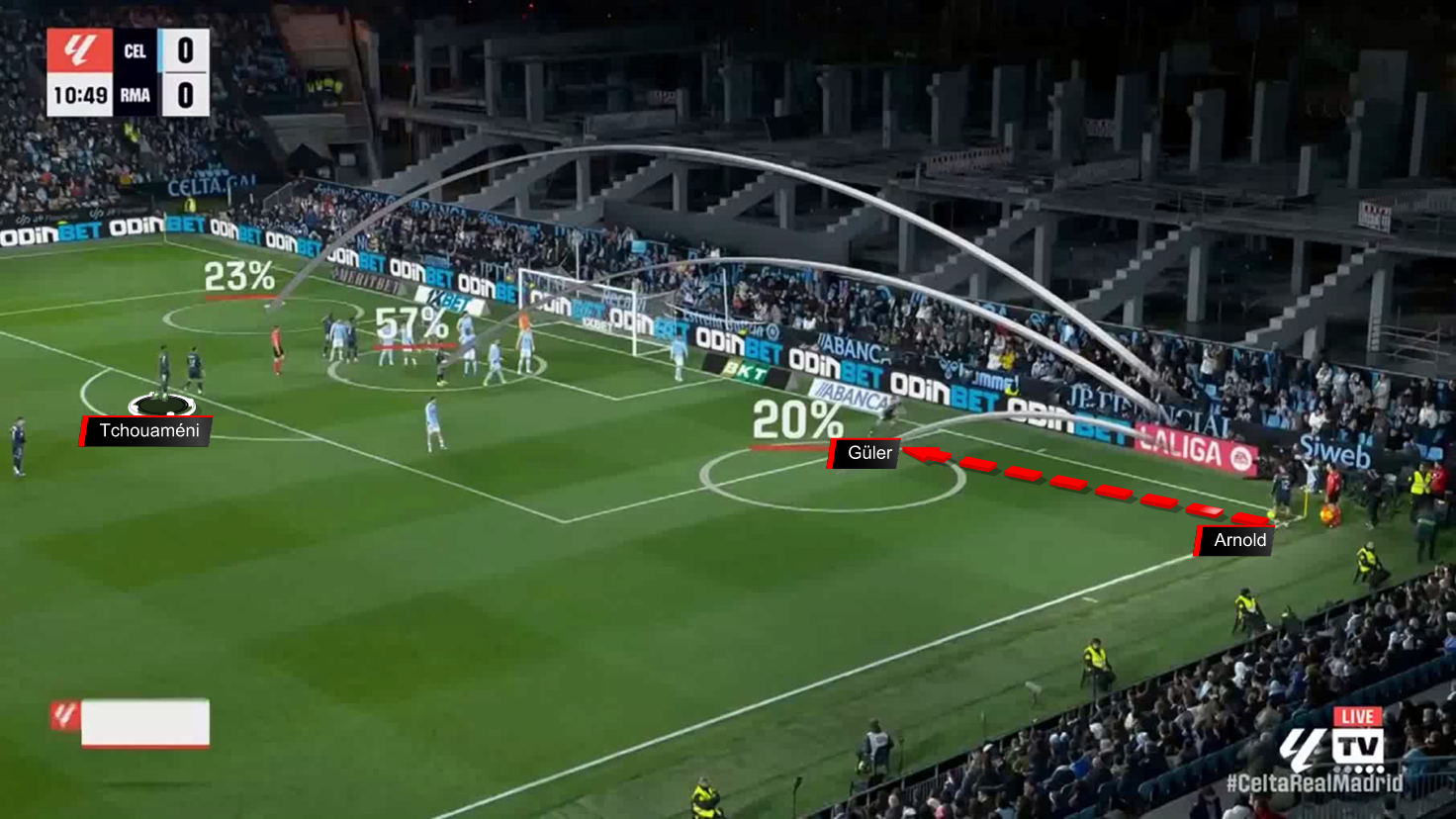
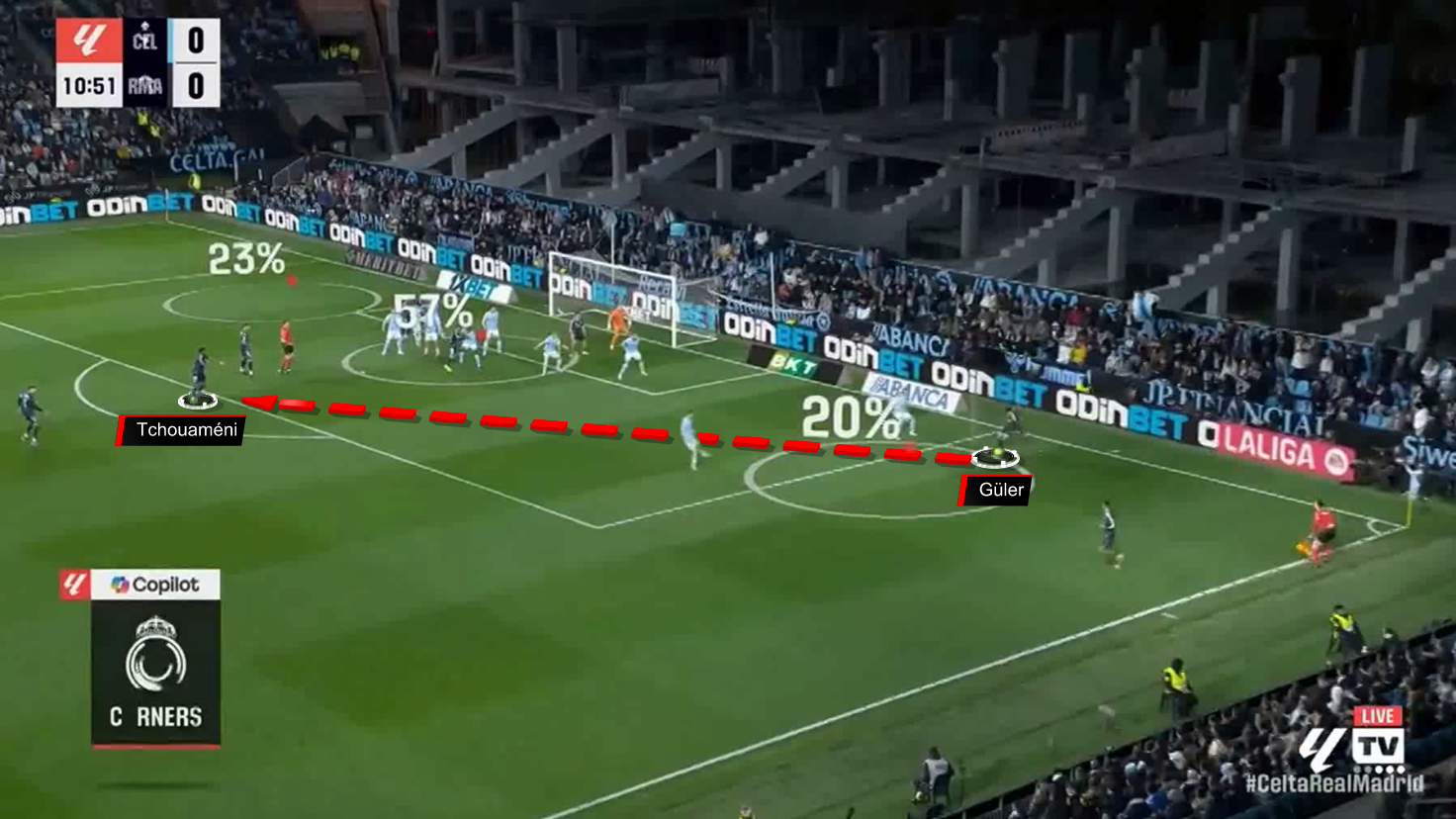
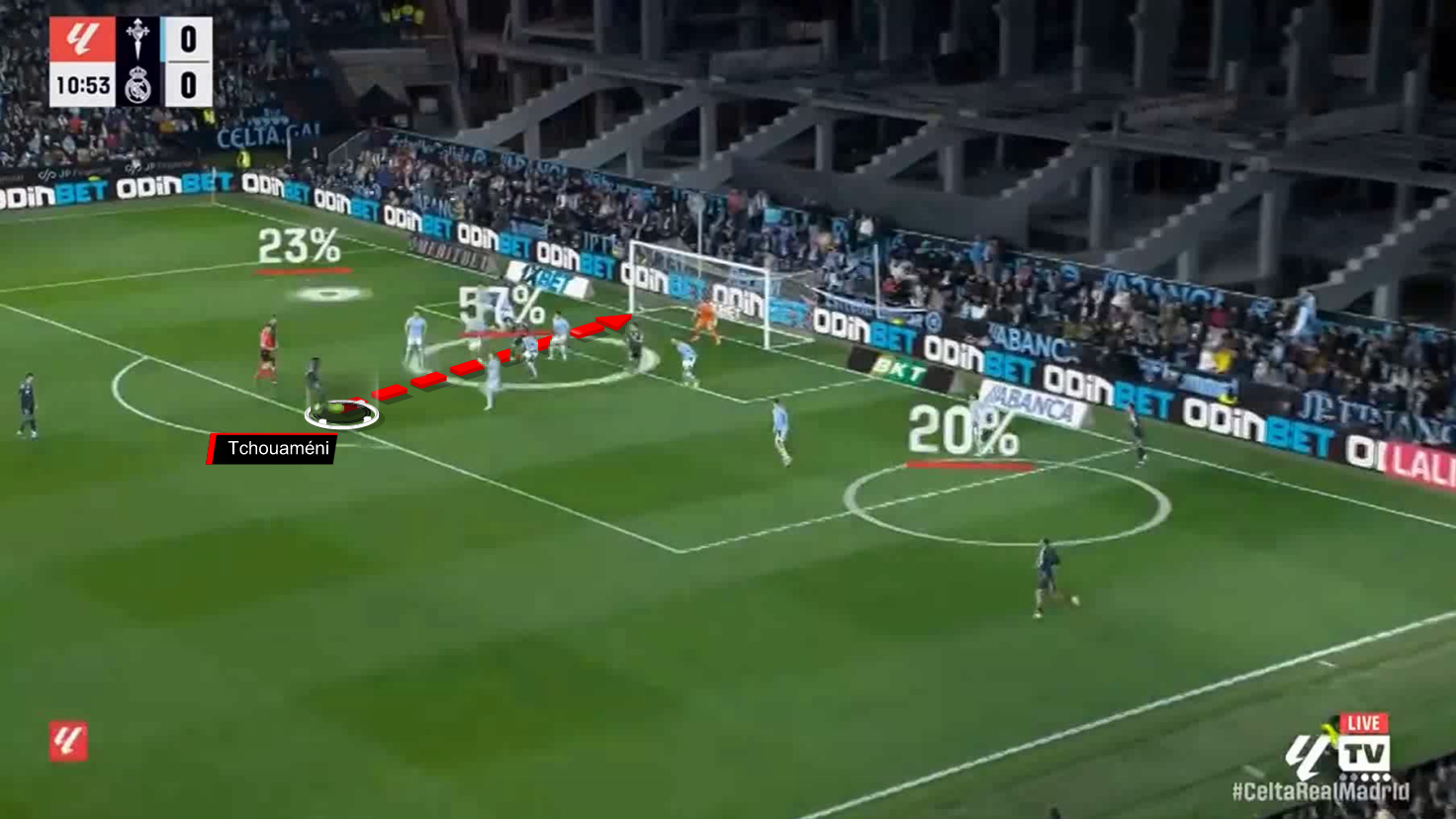 Here’s the short corner kick towards Arda Güler, who passed to Tchouaméni, who shot with the inside of his foot towards the far post and scored the opening goal.
The variety between direct and short corner kicks makes it difficult for defences to predict how the corner kick will be executed, giving Real Madrid an additional tactical advantage in these situations.
Conclusion
What will become clear in the 2025/2026 season is that Real Madrid no longer rely on set-pieces as a haphazard solution, but rather as part of a carefully planned attacking system.
The numerical advantage in the penalty area, the crosses, the targeting of the near post, and the preparation for second balls all reflect a clear tactical approach in this area.
For example, Real Madrid scored around 11–12 xG from set pieces in the 2024/2025 season, while they have already come close to the 10 xG mark in the 2025/2026 season, even though the season has not yet reached its final stages, which reflects an improvement in the team’s effectiveness in exploiting these attacking situations.
This development gives Real Madrid an additional weapon in matches where space is limited and penetrating organised defences is more difficult.
As the team continues to develop this aspect, corner kicks and set-pieces could become decisive factors in determining the outcomes of many matches this season.
