
As the Premier League season approaches its decisive phase, attention is increasingly shifting toward the intense fight at the bottom of the table.
While much of the spotlight traditionally falls on the title race and European qualification spots, the battle to avoid relegation often provides equally dramatic narratives and tactical intrigue.
In this data analysis report, we examine the statistical trends shaping the survival fight among the league’s bottom six teams, including Wolverhampton Wanderers, Burnley, West Ham United, Nottingham Forest, Leeds United, and Tottenham Hotspur.
These clubs are currently locked in a tightly contested struggle for survival as the campaign moves into its final stretch.
Tottenham Hotspur, once considered comfortably mid-table, have also been drawn into the conversation following a difficult run of results and the recent arrival of manager Igor Tudor.
This report will explore the underlying data behind this relegation battle, comparing performance metrics, attacking efficiency, defensive vulnerabilities, and overall trends that could ultimately determine which teams remain in the division.
Expected Points Reveal The True Shape Of The Relegation Fight
When analysing the relegation battle through underlying metrics, the gap between actual points and expected points offers important insight into performance sustainability among the bottom six.
Premier League 2025/2026 Table Vs Expected Points – Underlying Performance Highlights: The Relegation Battle

Leeds United stand out as the clearest statistical outlier, despite collecting only 31 points from 29 matches, their Expected Points total of 43.6 suggests a team performing far better than the table indicates.
Under manager Daniel Farke, Leeds have produced attacking numbers that should, in theory, place them closer to mid-table, but defensive instability and poor game management have repeatedly cost them results.
In contrast, Tottenham Hotspur (29 points, 35.1 xPts) and Nottingham Forest (28 points, 35.7 xPts) also show underperformance, though to a lesser degree.
West Ham United remain defensively vulnerable, conceding 54 goals while collecting 28 points from 34.2 expected points.
Meanwhile, Burnley and Wolverhampton Wanderers appear closer to their underlying numbers, suggesting structural limitations rather than simple variance.
Overall, Leeds may possess the strongest underlying profile among the bottom six, indicating potential for late-season recovery if performances stabilise.
Finishing Efficiency Within The Premier League Relegation Battle
When analysing attacking output among the bottom six, finishing efficiency provides another layer of insight beyond raw goal totals.
Among the relegation contenders, Leeds United again appear statistically stronger than their league position suggests.
Premier League 2025/2026 Goals Vs Expected Goals After 29 Matchweeks
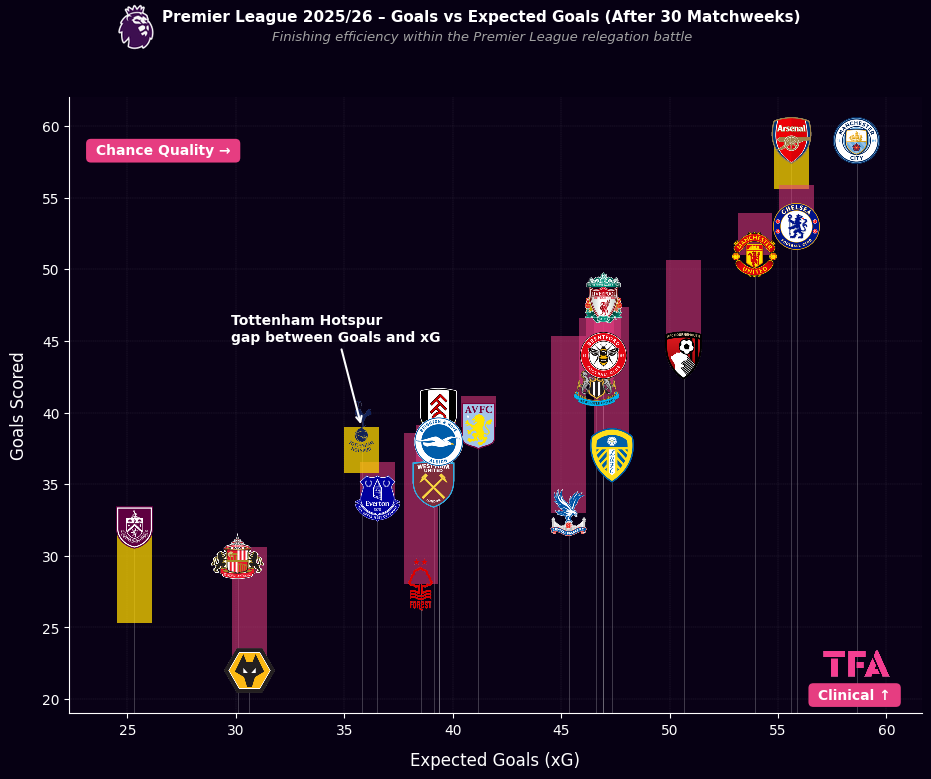
Under manager Daniel Farke, Leeds have generated 47.34 Expected Goals, one of the highest attacking figures among teams in the lower half of the table.
Their actual return of 37 goals indicates a significant underperformance in front of goal, suggesting issues with chance conversion and composure in key moments.
In contrast, Tottenham Hotspur have slightly outperformed their expected goals, scoring 39 times from 35.8 xG.
While this reflects a relatively efficient finishing rate, it also highlights a deeper issue: Tottenham’s attacking process is not producing enough high-quality chances overall.
Meanwhile, West Ham United and Nottingham Forest have struggled to consistently convert opportunities, further compounding their defensive weaknesses.
For Wolverhampton Wanderers and Burnley, the data suggests a more fundamental attacking limitation, with both sides generating comparatively low expected-goal numbers throughout the campaign.
Tactical Instability During Thomas Frank’s Tenure At Tottenham
Another factor behind Tottenham’s decline this season has been the tactical instability seen during the tenure of former head coach Thomas Frank.
Tottenham Hotspur Formations – Premier League 2025/2026
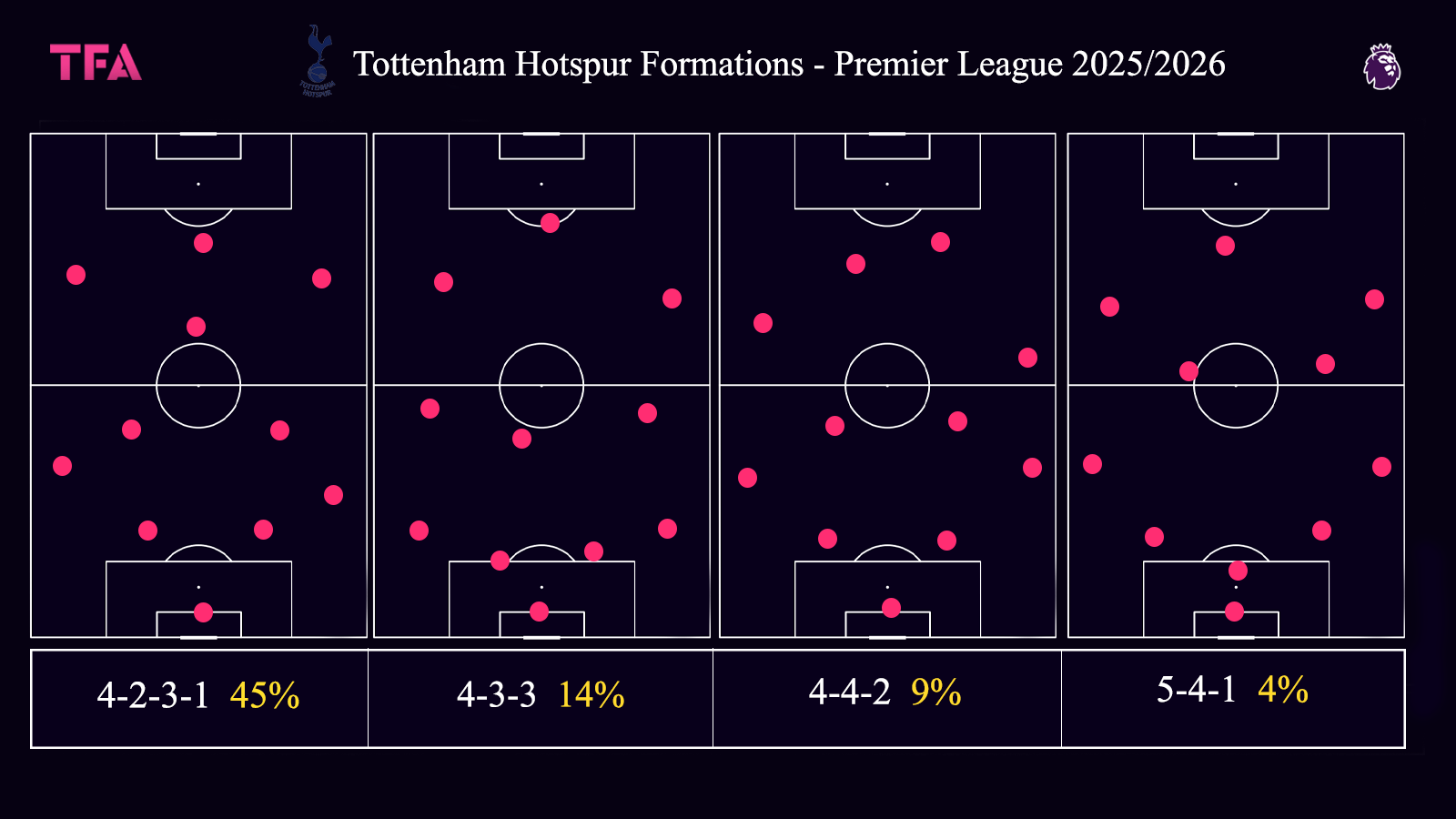
Throughout the campaign, Tottenham Hotspur frequently alternated between several formations, most notably a 4-2-3-1 structure used in roughly 45% of matches, alongside 4-3-3, 4-4-2, and even a more conservative 5-4-1.
While tactical flexibility can be an advantage, the constant switching between systems appeared to create confusion within the squad regarding positional responsibilities and pressing triggers.
Players such as Yves Bissouma, Pape Matar Sarr, and Djed Spence often had to adjust their roles depending on the structure, which disrupted midfield cohesion and defensive organisation.
As results deteriorated and Tottenham slid closer to the relegation zone, the club ultimately decided to make a managerial change.
The appointment of Igor Tudor was intended to stabilise the team tactically, introducing a more clearly defined pressing framework and defensive structure in an attempt to halt the slide and steer Spurs away from the bottom of the table.
Structural Fragility In Igor Tudor’s Pressing Styles
Under Igor Tudor, Tottenham Hotspur often employ an aggressive man-oriented pressing system designed to disrupt opposition build-up through tight individual marking across the pitch.
While this structure can initially compress space and apply immediate pressure on the ball carrier, it also introduces a recurring structural vulnerability.
The system relies heavily on each player maintaining positional discipline relative to their direct opponent.
When one player abandons his assignment, the entire structure can become destabilised.
Tottenham Hotspur Structural Fragility In Igor Tudor’s Pressing Styles
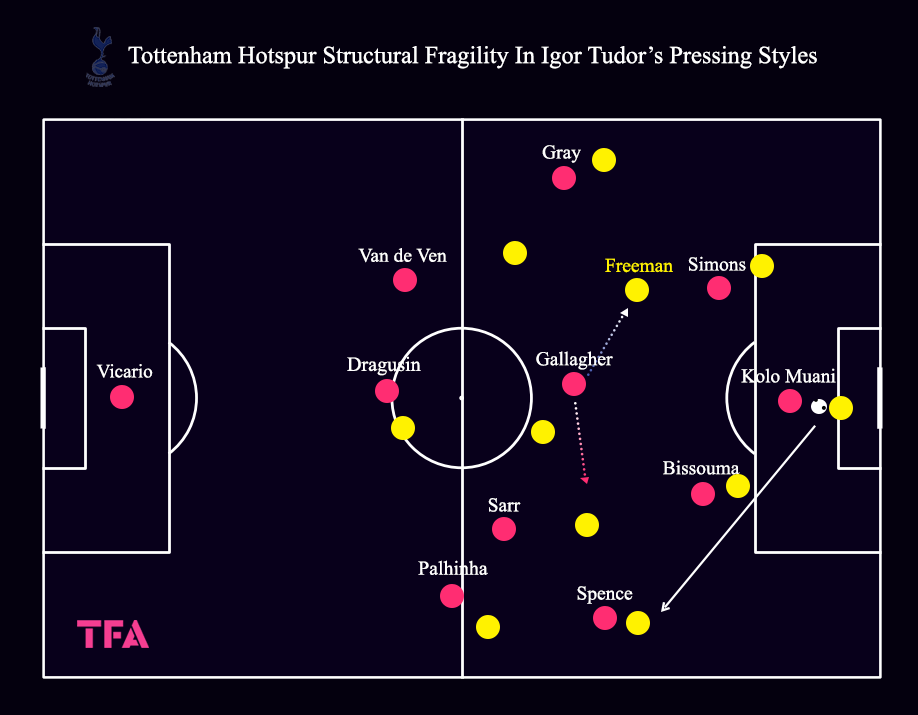
For instance, when Pape Matar Sarr loses track of a midfielder dropping deep, Conor Gallagher may step out of the midfield line to press, leaving his original marker free.
This triggers a chain reaction across the team: Yves Bissouma shifts laterally to cover central space, wing-backs such as Djed Spence or Archie Grey are forced to narrow, and the back three become exposed to vertical runs.
Small positional errors frequently generate exploitable gaps between Tottenham’s midfield and defensive lines.
Shot Volume & Chance Creation Within The Relegation Battle
Shot production provides further insight into the attacking dynamics shaping the Premier League relegation battle.
Among the bottom-six contenders, Leeds United again appear relatively competitive, registering 321 total shots, a figure that places them in the league’s mid-table range and reinforces the notion that Daniel Farke’s side are capable of generating attacking pressure despite their league position.
Premier League 2025/2026 Total Shots After 29 Matchweeks – Burnley Record The Lowest Shot Volume In The League
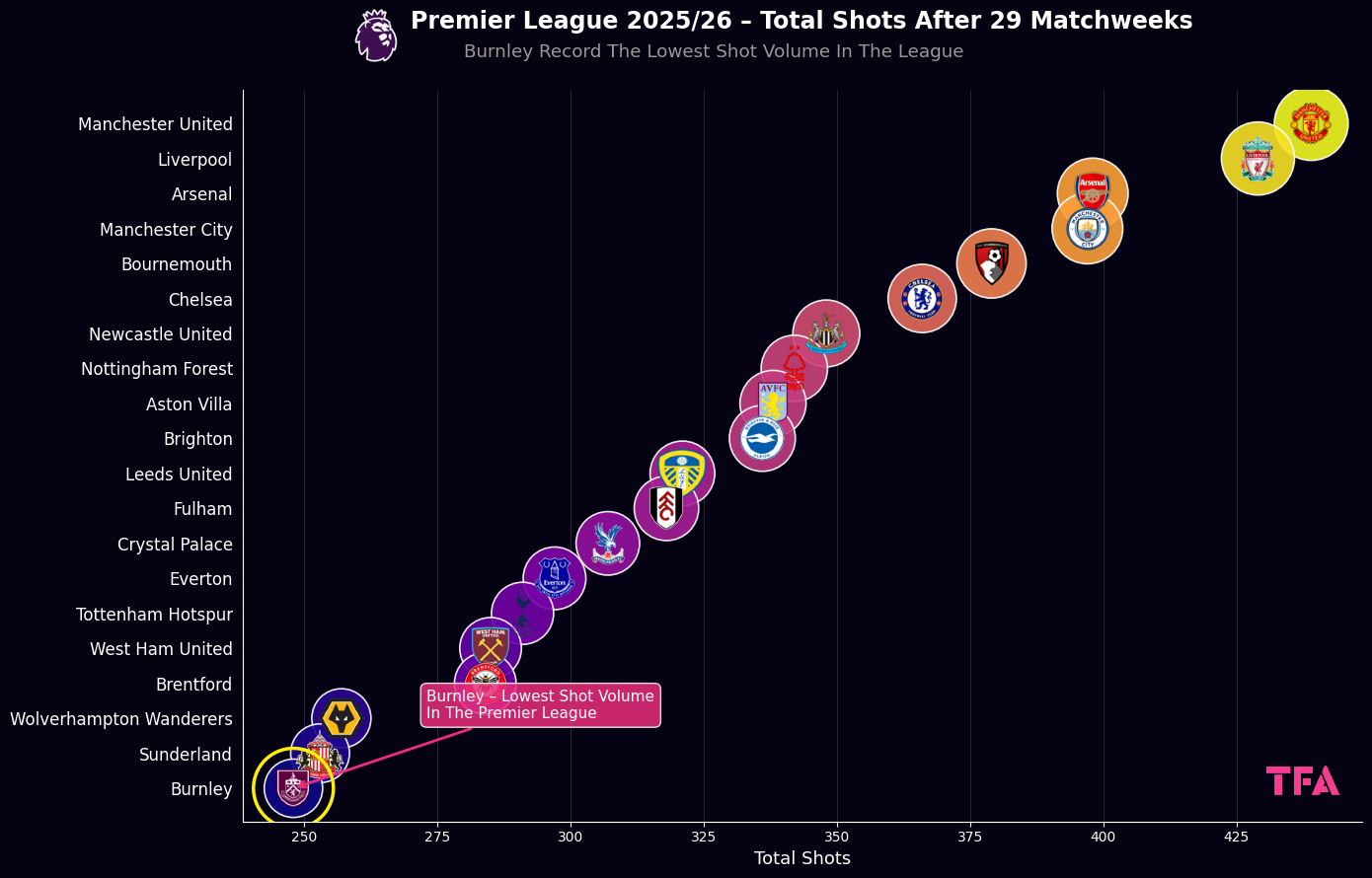
Nottingham Forest (342 shots) also rank higher than several teams outside the relegation fight, suggesting that their struggles stem more from defensive fragility than a lack of attacking activity.
Tottenham Hotspur (291 shots) and West Ham United (285 shots) occupy the lower half of the league in shot volume, indicating a more limited offensive process.
The most concerning profile, however, belongs to Burnley, who have produced just 248 total shots, the lowest figure in the league.
Under head coach Scott Parker, Burnley’s attacking structure has often prioritised defensive compactness and transitional moments; his side simply struggles to generate sustained attacking pressure, leaving them heavily reliant on low-probability long-range attempts.
Wolverhampton Wanderers’ Struggles At The Bottom Of The Table
We have already examined Wolverhampton Wanderers in greater detail in a separate report earlier this season, and their position at the bottom of the table continues to reflect many of the same structural attacking issues.
Despite some recent signs of improvement in results, including draw against Arsenal and a notable victory over Liverpool and Aston Villa, Wolves still remain firmly rooted to the foot of the Premier League table.
The core problem remains their attacking inefficiency.
Wolves have scored just 22 goals across 29 league matches, the lowest tally in the division, averaging only 0.62 goals per game.
Wolves Players By xG In The First 25 Matchdays – Premier League 2025/2026
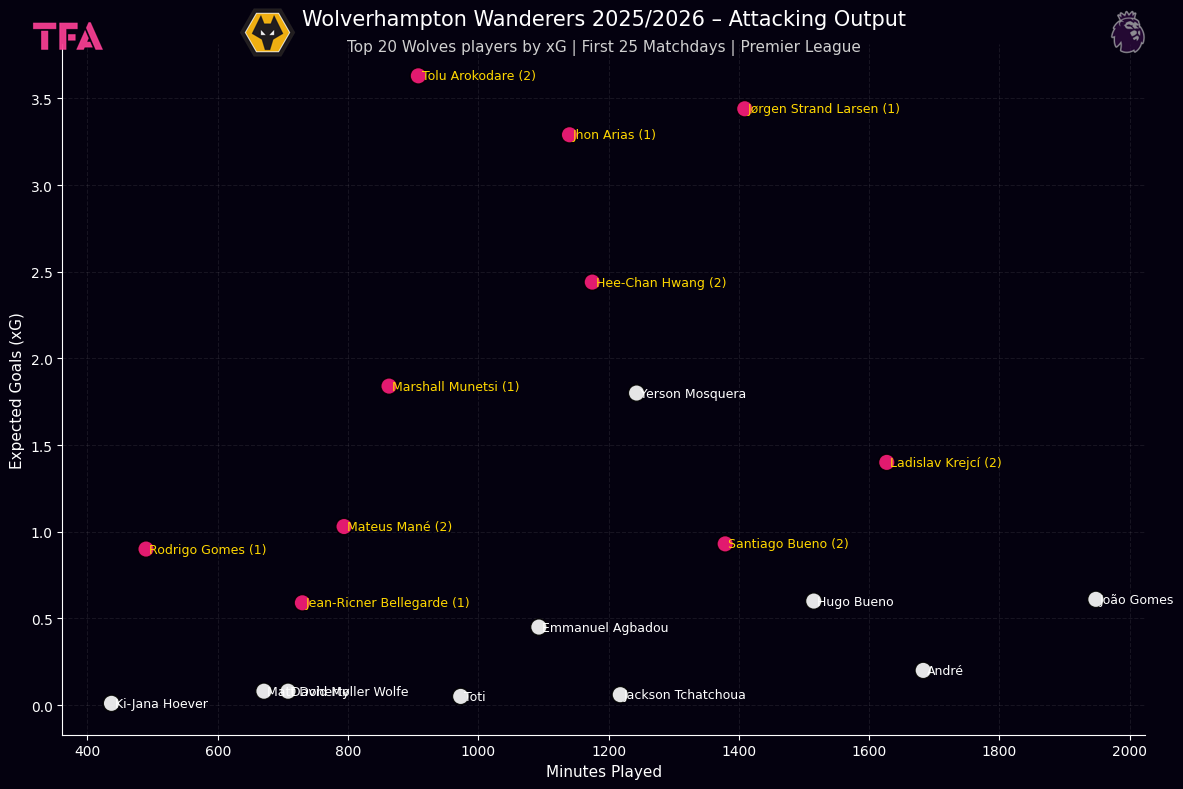
Their forwards often require relatively high expected-goals situations in order to convert chances, meaning the team struggles to score when the quality of opportunities drops.
When Wolves did generate a higher attacking output, such as in their win over West Ham, where their xG approached 2.2, they were capable of scoring multiple times.
However, such performances have been rare.
As a result, while recent results suggest slight momentum, Wolves still appear one of the most likely candidates for relegation unless their attacking process improves significantly.
West Ham’s Pressing Passivity In The Relegation Battle
Pressing intensity provides another important indicator when analysing the tactical profiles of the six teams involved in the relegation fight.
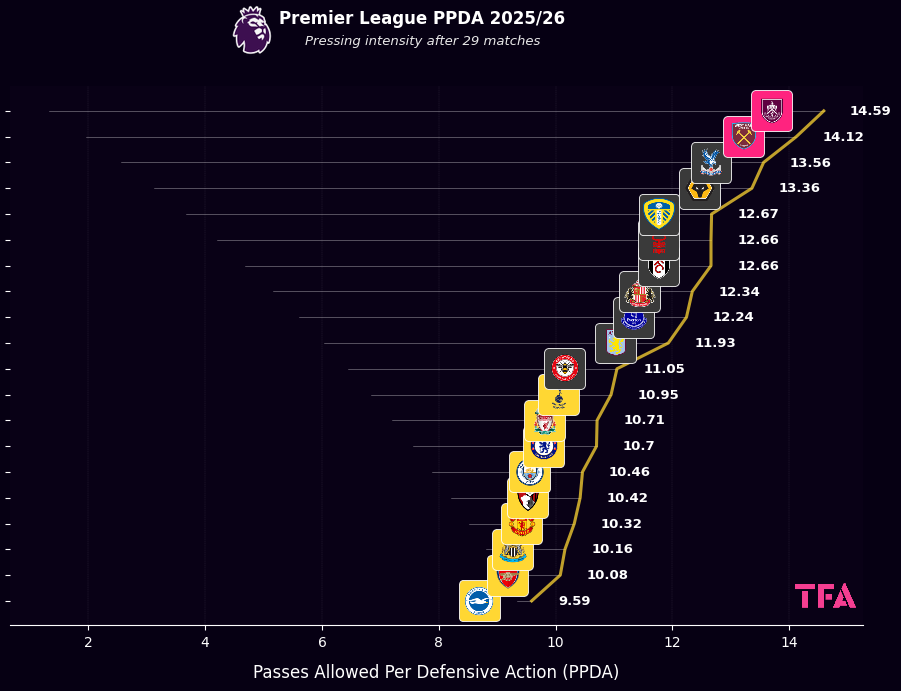
Among them, West Ham United stand out for their passive defensive behaviour, recording a PPDA of 14.12, one of the lowest pressing intensity within this group and among the highest figures in the league.
Premier League PPDA 2025/2026 – Pressing Intensity After 29 Matches
The London club appointed Nuno Espírito Santo on 27 September 2025 after dismissing Graham Potter, handing the Portuguese coach a three-year contract in an attempt to stabilise a struggling side.
Under Nuno, West Ham have generally favoured a deeper defensive structure built around compact mid-block positioning rather than aggressive high pressing.
This tactical choice is reflected in their PPDA figure, which indicates that opponents are allowed a relatively high number of passes before defensive pressure is applied.
In contrast, other teams involved in the relegation battle operate with moderately more proactive pressing numbers, ranging between roughly 10.9 and 13.4 PPDA, suggesting a greater willingness to engage earlier in the build-up phase.
Within this context, West Ham’s passive pressing structure may contribute to their defensive instability, as opponents frequently progress the ball with limited disruption before entering dangerous attacking zones.
Conclusion
As the Premier League season approaches its final phase, the relegation battle among the bottom six remains shaped by a combination of structural weaknesses, tactical decisions, and underlying statistical trends.
Leeds United appear to possess the strongest underlying attacking profile, with their expected points and expected goals figures suggesting performances that should yield better results if finishing and defensive stability improve.
Tottenham Hotspur, meanwhile, remains a tactically intriguing case under Igor Tudor, where an aggressive pressing model has introduced both defensive risk and potential for disruption.
West Ham United’s passive pressing approach under Nuno Espírito Santo may partly explain their defensive vulnerability, allowing opponents greater freedom in possession.
At the other end of the spectrum, Burnley and Wolverhampton Wanderers face more fundamental attacking limitations, struggling to generate sufficient shot volume and chance quality to compete consistently.
While several teams remain within touching distance of safety, structural attacking inefficiencies and defensive fragility will likely determine which sides ultimately fall short in the race for Premier League survival.
