
In the 2025/2026 season, Wolverhampton Wanderers have endured what is shaping up to be one of the most alarming campaigns ever recorded in the modern Premier League era.
Once regarded as a structurally stable mid-table side with a clear identity and competitive edge, Wolves have spiralled into sustained underperformance, defensive chaos, and attacking inefficiency on a scale rarely seen at this level.
This Wolves data analysis goes beyond surface-level results.
Through a detailed examination of key metrics and tactical patterns, we will dissect the structural and strategic failures that have defined their season.
From build-up organisation and progression issues in possession, to defensive instability, transitional vulnerability, and ineffective pressing schemes, the analysis will assess Wolves’ breakdown across all phases of play.
By contextualising the numbers within their tactical framework, we aim to uncover the deeper mechanisms behind what may become the worst campaign in Premier League history.
Wolves Build-Up Play & Long Balls: Structural Problems In Possession
Wolves’ build-up this season has often revolved around bypassing the midfield through long balls aimed at a target man such as Tolu Arokodare.
The idea is simple on paper: the goalkeeper or centre-backs hit diagonal or driven long balls into Arokodare, who uses his size to hold up possession, bring others into play, and flick the loose ball out wide.
From there, the team seeks to settle on the flanks and create chances through the wide areas.
Wolves Build-Up Pattern Vs Nottingham Forest

However, this pattern lacks variation and control. Wolves’ possession figures and expected goals (xG) metrics show they struggle to create high-quality chances from sustained build-up; their attacks stagnate when they can’t link midfield and attack organically.
Arokodare’s involvement often becomes a reset rather than progression, leaving Wolves predictable and easy to defend against.
In their goalless draw against Nottingham Forest, Wolves’ tendency to use long balls was evident.
Wolves Build-up Vs Nottingham Forest

The goalkeeper launched a long ball towards Arokodare, who battled with the centre-back and managed to nod it on into the path of wing-back Rodrigo Gomes dropping deep as a passing option.
Meanwhile, Adam Armstrong lingered behind the main striker line, awaiting a lay-off, when the ball reached Gomes out wide, the team failed to exploit 1v1 situations.
Crosses were misplaced, easily dealt with by defenders, or sideways passes recycled possession without penetrating the penalty area.
What looked like a chance to create a wide overload fizzled as simple final-third decisions were lacking, a recurring theme in Wolves’ season.
Midfield Possession Structures: Flank Overloads, Circulation & Positional Switching
When Wolves retain possession, there are phases in which their midfield appears structurally coherent.
They often manipulate possession by overloading one flank in the middle third, cycling short passes to draw opponents in, and then switching play into the opposite channel to penetrate between lines.
This can temporarily stretch defences and allows midfielders like Gomes to receive in advanced pockets.
Wolves In-Possession Tactics Vs Chelsea
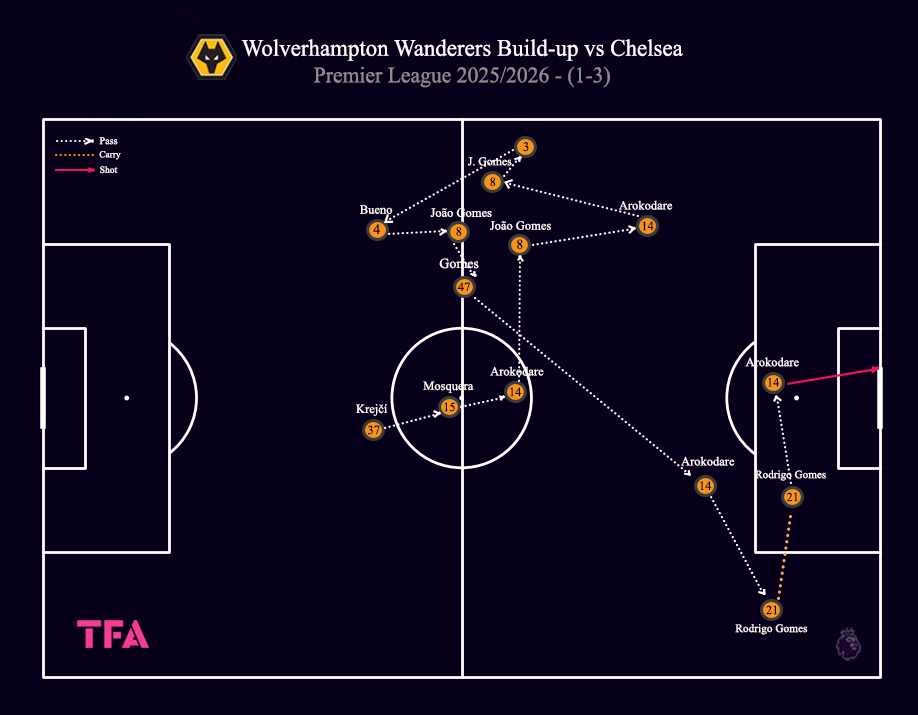
From there, the aim is to again drive play into the final third, either through diagonal switches or lapses into wide combinations before moving centrally.
This approach has created sporadic promising sequences and occasional high-value entries into the attacking third, revealing that Wolves’ issues aren’t purely technical but also about execution under pressure.
Here, in their defeat against Chelsea, Wolves exhibited patient build-up from midfield.
Wolverhampton Wanderers Build Up Vs Chelsea
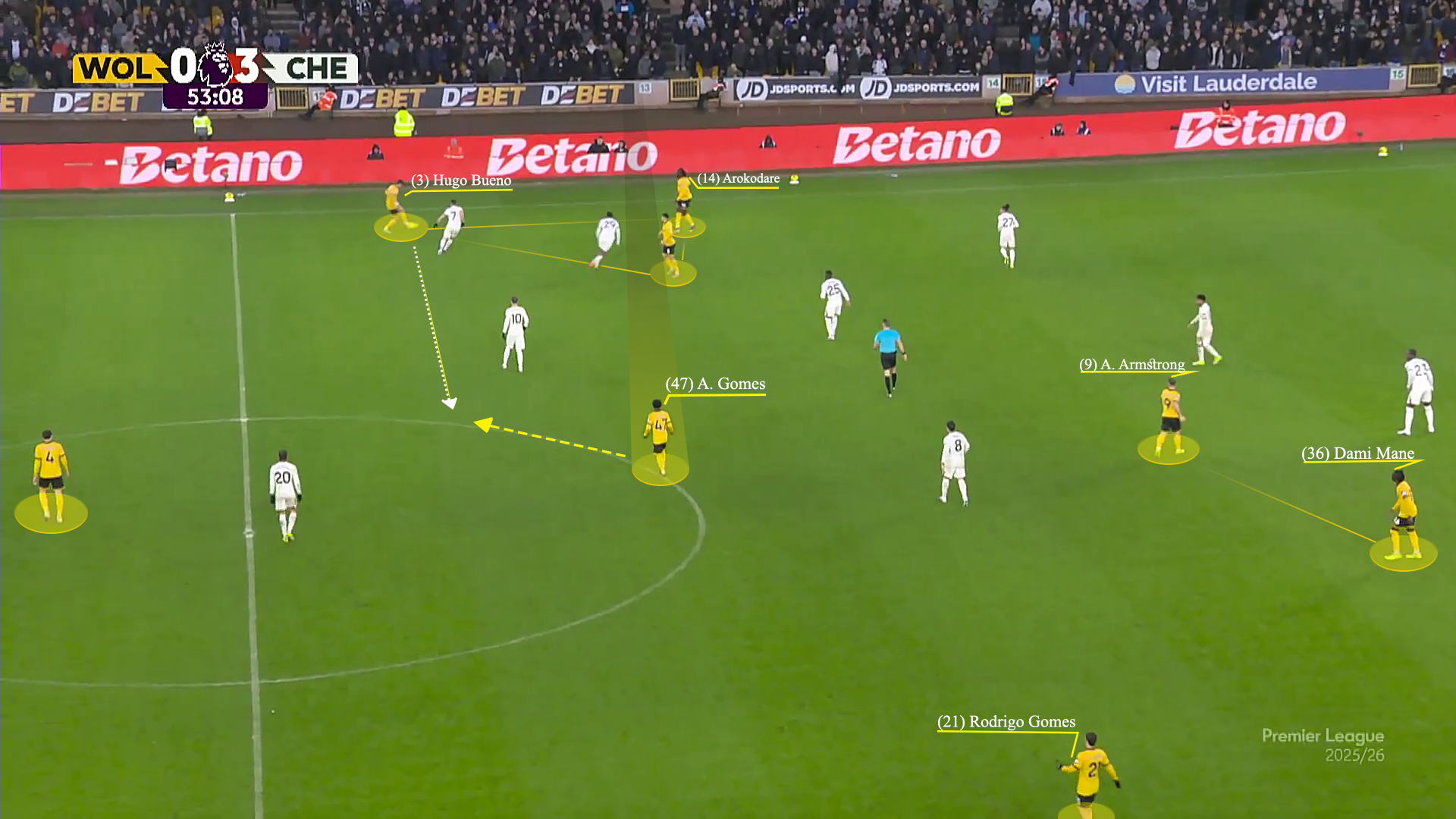
After a lengthy sequence of short passes and an overload on one side, Rodrigo Gomes dropped deep to provide a link for the trio, shifting play forward.
The ball eventually made its way into the penalty area, culminating in a shot that struck the bar, demonstrating the potential of this structured possession play.
Even in moments of apparent control, the final action lacked the precision and tempo needed to consistently breach Premier League defences.
Despite these different phases of play, long-ball transitions and structured possession overloads, both ideas are limited.
Wolves’ long-ball approach becomes predictable and fails to produce a consistent attacking threat without variation or fluidity in midfield.
Likewise, their short-pass build-up, while occasionally incisive, lacks regular end product, patterns are readable to opposition defenders, and don’t generate enough clear chances.
In essence, Wolves’ tactical setup provides mechanisms to control the ball but not to create frequent scoring chances, contributing to their low xG and overall struggles this season.
Wolves’ Striking Woes In The 2025/2026 Premier League
Wolves’ 2025/2026 Premier League campaign has been plagued by an acute lack of goals, with the team scoring just 16 goals in 26 matches, an average of 0.62 goals per game, the lowest in the division and symptomatic of their relegation-zone plight.
Premier League 2025/2026 Goals Scored After 25 Matchdays

This underscores a striking impotence in attack: even when creating possession or entering the final third, Wolves rarely produce enough high-quality scoring chances to consistently threaten opponents, leaving them dead last in the league’s goals scored charts.
Digging deeper into the goal data reveals that Wolves’ problems aren’t just about finishing; they’re about chance creation and the quality of those chances.
The club’s top scorers this season have managed only two goals each: Hwang Hee-Chan, Ladislav Krejčí, Mateus Mané, Santiago Bueno, and Tolu Arokodare, with others contributing sporadically.
Top Wolves Players By xG In The First 25 Matchdays – Premier League 2025/2026

This scattergun scoring profile suggests that Wolves lack a reliable finisher, but more importantly, it reflects a deeper issue: their expected goals outputs are consistently low relative to what is required to convert possession into goals.
Being at the bottom of the league for xG generation indicates that their attacking play rarely produces high-value shooting opportunities, and even when it does, the limited shot quality diminishes the likelihood of conversion.
Ultimately, the data indicate that Wolves need both higher xG thresholds and players capable of converting the few high-quality chances they create, a tactical and personnel problem rather than mere bad luck.
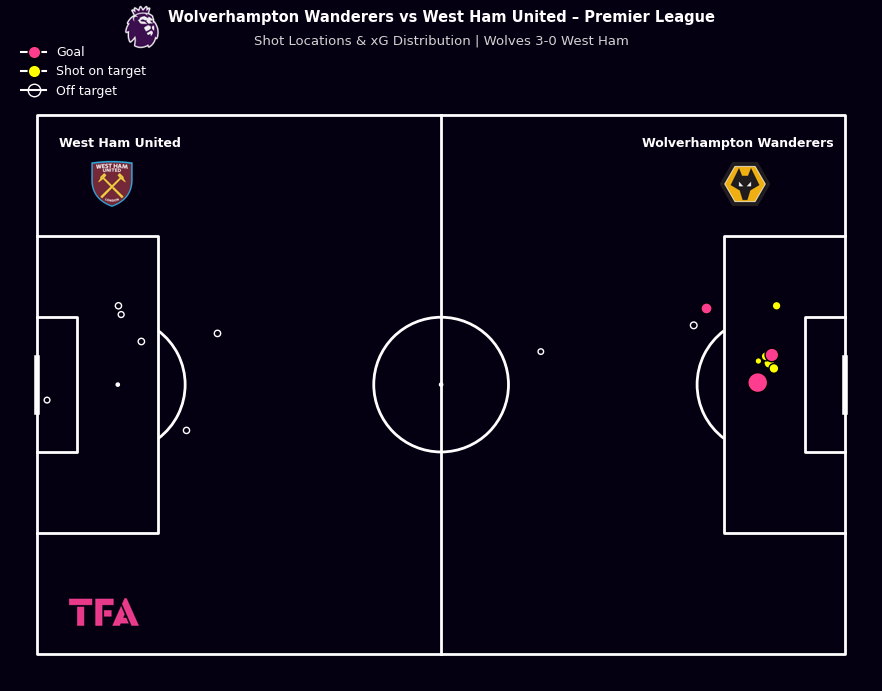
In their sole league victory vs West Ham, Wolves generated a team xG of around 2.24, close to two goals of expected value even before accounting for a penalty, showing that when their attacking model produces higher-value chances, they can convert and score multiple times in a match.
Wolverhampton Wanderers Vs West Ham United Shot Locations & xG Distribution – Premier League 2025/2026
Conversely, against Bournemouth, Wolves created a cumulative 2.11 xG from open play but failed to score, while Bournemouth converted 1.59 xG into two goals.
Wolverhampton Wanderers Vs AFC Bournemouth Shot Locations & xG Distribution – Premier League 2025/2026
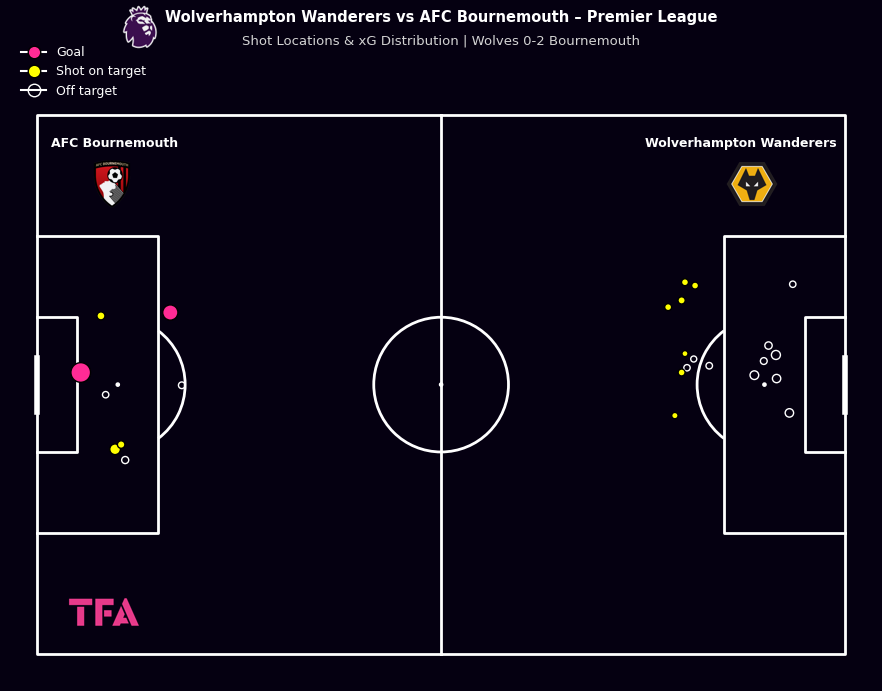
This contrast demonstrates how Wolves’ over-reliance on generating volume rather than quality scoring opportunities, combined with limited finishing threat, often leaves them unable to capitalise even with decent attacking possession.
These examples underline that Wolves’ struggles aren’t solely about having too few shots or goal scorers.
They need significantly higher xG generation per game, better shot locations, and more incisive chance creation, because even when xG figures are reasonable, the lack of genuine goalscorers means opportunities go unexploited.
Tactical Use Of Formations In 2025/2026 – Structural Instability & Output Decline
Wolves’ 2025/2026 season has been marked not only by poor execution but also by a clear lack of structural stability, as evidenced by their frequent changes of formation.
Wolves xG & xGA By Formation – Premier League 2025/2026
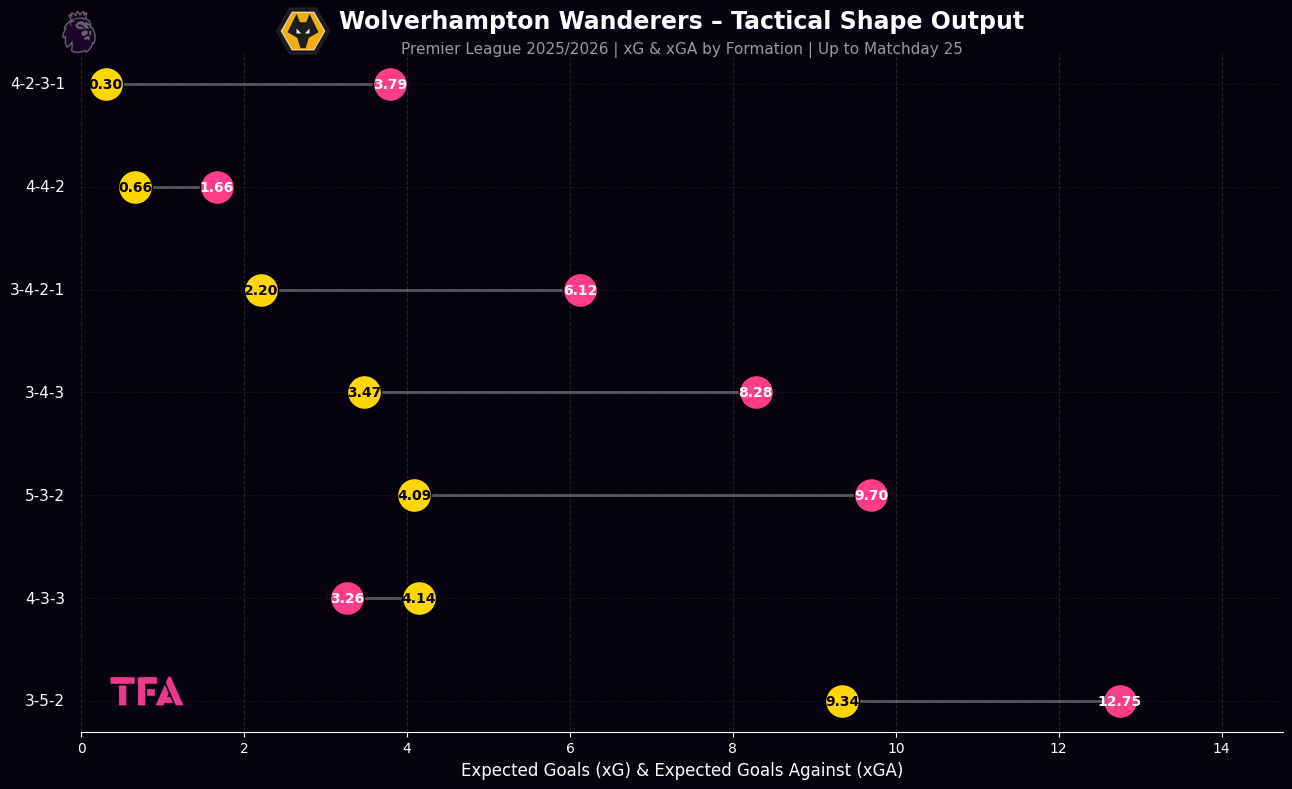
The most frequently used system, 3-5-2 (836 minutes), produced six goals from 9.34 xG (1.01 xG90) while conceding 12.75 xGA (1.37 xGA90), resulting in a negative xG difference of -3.41.
Tactically, this shape provided midfield density but failed to defend the wide channels, while its two-striker structure lacked creativity between the lines.
The 3-4-3 and 5-3-2 variations were even more problematic.
The 3-4-3 generated just 0.67 xG90 while conceding 1.61 xGA90, highlighting sterile wing play without central occupation.
Meanwhile, the 5-3-2, theoretically more defensive, conceded 2.13 xGA90, the worst defensive output among regularly used systems, suggesting that adding a fifth defender did not improve compactness but instead deepened passive defending.
The 3-4-2-1 also struggled defensively (2.16 xGA90), reinforcing the idea that Wolves’ back-three structures lacked coordinated pressing and transitional balance.
Interestingly, the 4-3-3, though used for only 233 minutes, produced the only positive xG differential (+0.88), with 1.6 xG90 and a relatively controlled 1.26 xGA90.
This indicates that a back-four structure provided better spacing in possession and more stable defensive distances.
Overall, the data suggest that Wolves’ formation changes were reactive rather than strategic; no system consistently balanced attacking productivity with defensive control, revealing a deeper issue: tactical identity fragmentation rather than mere structural experimentation.
Conclusion
Wolverhampton Wanderers’ 2025/2026 campaign cannot be reduced to poor finishing or unfortunate variance; it is the product of systemic tactical erosion.
Across all phases of play, the data reveals a side lacking structural clarity, attacking incision, and defensive cohesion.
Their build-up patterns oscillate between predictable long balls and sterile circulation, neither consistently generating high-value chances.
The underlying metrics confirm the visual impression, chronically low xG output, negative xG differentials across most formations, and defensive figures that expose transitional fragility.
Perhaps most telling is the fragmentation of identity.
Frequent formation shifts have not solved problems but amplified them, producing reactive adjustments rather than a coherent strategic framework.
Even in their rare positive performances, success required unusually high xG accumulation, an unsustainable condition for a team devoid of reliable scorers.
This has been a season defined by imbalance, structural, tactical, and psychological, where control without penetration and caution without stability have combined to create a historically poor Premier League campaign.
