
In the 2025/2026 Premier League campaign, Newcastle United’s performances have been characterised by a clear tactical imbalance, leaving them unable to consistently compete with England’s elite.
Despite moments of resilient defending and spirited pressure, the Magpies often lack a coherent offensive structure against top-six opposition, resulting in predictable build-up play and limited penetration through central channels.
Their rigid adherence to direct passing and long balls has frequently been exposed by opponents adept at controlling possession and exploiting gaps between the lines, notably in high-profile games against Liverpool and Arsenal.
This data analysis will examine Newcastle United’s tactical work rate, patterns of play and structural weaknesses that have contributed to underperformance against big teams, contextualising numerical trends with strategic insights.
We will focus particularly on tactical decisions in build-up phases, transitional vulnerabilities, and match-specific adaptations that have defined their season so far.
Newcastle United’s Defensive Fragility In Transition
One of the defining defensive issues undermining Newcastle United’s 2025/2026 Premier League campaign has been their recurring vulnerability immediately after losing possession, particularly against top-level opposition.
In high-profile defeats to sides such as Manchester City, Arsenal, and Liverpool, Newcastle’s attacking structure has consistently left the backline exposed during turnovers.
With full-backs such as Kieran Trippier or Tino Livramento advancing aggressively and midfielders such as Bruno Guimarães and Sandro Tonali positioned high to contest second balls, the team often lacks a stable, defensive platform behind the ball.
As a result, a single lost duel or misplaced pass in the build-up phase frequently triggers dangerous transition scenarios.
Newcastle concedes a disproportionately high number of shots and expected goals within the first 8–10 seconds following possession losses in their own or middle third.
Premier League 2025/2026 Fast Breaks Against – Newcastle United Most Exposed In Transition

Opponents are able to bypass Newcastle’s midfield line with one vertical pass, forcing centre-backs like Fabian Schär, Dan Burn, or Sven Botman into retreating 3v3 or 4v3 situations.
The absence of immediate counterpressure further compounds the issue, allowing ball carriers to attack open half-spaces at speed.
Rather than being an issue of effort, this reflects a structural problem in spacing and role allocation.
Against elite teams who excel in exploiting transitional moments, Newcastle’s attacking chaos repeatedly turns routine turnovers into decisive defensive crises.
Newcastle United’s Post-Isak Attacking Output: Volume Without True Cutting Edge
Since Alexander Isak’s departure, Newcastle United’s attacking output has become numerically respectable, but functionally limited in the 2025/2026 Premier League.
On the surface, the distribution of goals suggests some balance. Bruno Guimarães leads with eight goals, followed by Nick Woltemade with seven and Harvey Barnes with five, showing that goals have come from a spread of attacking players.
Premier League 2025/2026 Offensive Output Leaders – Top 30 Players By Goals After 24 Matchdays

This apparent diversity masks a deeper structural problem: Newcastle’s front line no longer routinely creates high-quality chances, particularly in away fixtures.
Without Isak’s ability to stretch defences vertically, occupy centre-backs, and convert half-chances, Newcastle’s attacks often stagnate into speculative efforts from sub-optimal zones.
Guimarães’ goals often arrive from second-phase actions or set-piece situations, while Woltemade and Barnes frequently benefit from loose balls rather than sustained positional superiority.
The result is an attack that appears productive in raw totals but lacks repeatable mechanisms to generate high-value opportunities against organised defences, particularly outside St. James’ Park.
Newcastle’s away attacking data underscores the issue: across their away matches this season, they have scored just 10 goals from an expected-goals figure of 11, generated from 128 shots, of which only 44 have hit the target.
Newcastle United Away Shot Map – Premier League 2025/2026

While the shot volume appears healthy, the underlying chance quality is extremely poor, with the majority of attempts carrying very low xG values.
This reflects an attacking process built on rushed shots, wide-angle efforts, and crowded central zones rather than clear box occupation.
Even when Newcastle sustains pressure, it rarely translates into high-probability finishes, reinforcing the sense of inefficiency rather than bad luck.
Newcastle United’s Underperformance Against Elite Opposition
The data strongly support the narrative of Newcastle United’s persistent underperformance against elite opposition during the 2025/2026 Premier League season.
In defeats against Arsenal, Manchester United, Liverpool, and Manchester City, Newcastle consistently fail to impose either territorial or attacking control.
Newcastle United Positional Attacks Vs Big Sides – Premier League 2025/2026
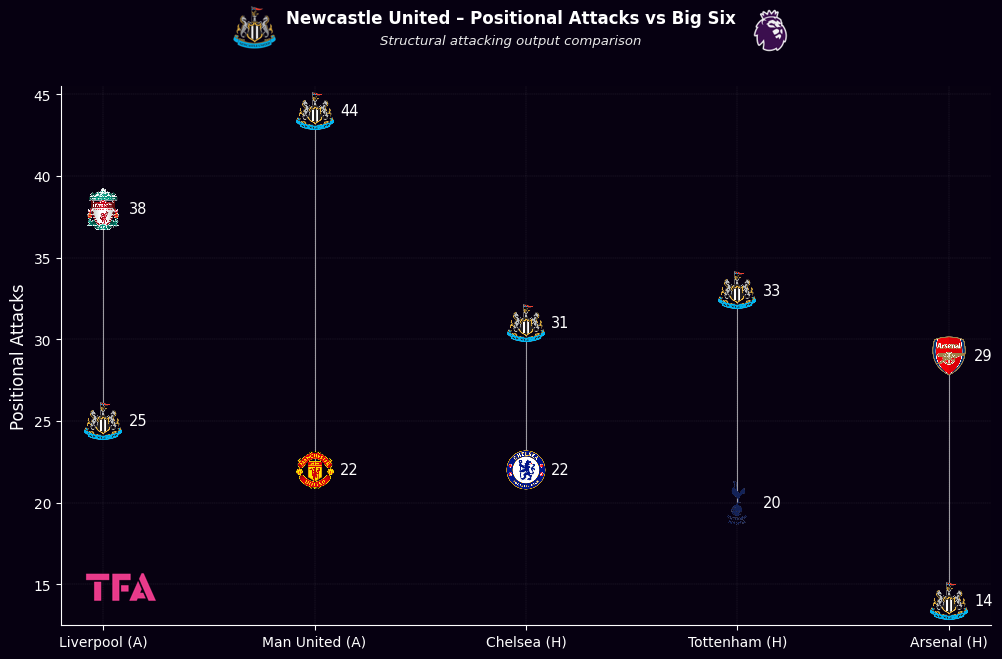
Across these fixtures, their average expected-goals output declines sharply, while shot quality deteriorates despite moderate shot volume.
Against top-six opposition, Newcastle averages well below 1.0 xG per match, while conceding significantly higher values, often exceeding 2.0 xG, highlighting a clear imbalance between attacking threat and defensive exposure.
Matches lost to Liverpool and Manchester City, in particular, underscore this issue.
Newcastle frequently records long spells without sustained possession, relying on direct attacks and low-probability shots following turnovers.
The data also show fewer positional attacks with shots, indicating difficulty in advancing the ball into dangerous areas through structured build-up.
Furthermore, offensive duels won remain relatively high, but this physical competitiveness does not translate into clear chances; instead, Newcastle are forced into rushed attempts from wide or deep areas.
These trends collectively point towards a tactical ceiling against elite teams.
Newcastle can compete in intensity, but lacks the positional structure, shot quality, and transitional control required to consistently challenge high-level opponents.
The 4–1 defeat away to Liverpool exemplifies one extreme of Newcastle’s attacking inefficiency.
Newcastle United Vs Liverpool Shot Map – Premier League 2025/2026

Newcastle generated just 0.43 xG from eight shots, with only two on target, reflecting an attack that struggled to enter Liverpool’s box with control.
Most attempts came from poor angles or under defensive pressure, highlighting an inability to sustain possession high up the pitch or create high-quality chances through structured play.
In contrast, the 1–0 defeat to Manchester United illustrates the opposite flaw; Newcastle recorded a higher shot count, firing 15 shots with four on target, but produced just 1.28 xG.
Newcastle United Vs Man United – Premier League 2025/2026

Despite the volume, the majority of attempts were low-probability, originating from outside the box or crowded central zones.
This pattern reinforces a recurring issue, Newcastle often mistakes activity for danger, generating quantity without genuine cutting edge.
Passive Pressing & Ineffective Ball-Oriented Pressure Against Possession-Dominant Sides
The data from the 2025/2026 Premier League season highlights a clear and recurring weakness in Newcastle United’s pressing structure when facing possession-dominant elite opponents.
PPDA figures in the attached dataset consistently indicate that Newcastle allows opponents too much time and space to circulate the ball, particularly against teams such as Liverpool, Manchester City, and Arsenal.
In the 4–1 defeat away to Liverpool, Newcastle recorded a PPDA of 11.52, a relatively passive figure that reflects delayed or uncoordinated pressure in advanced zones.
By contrast, Liverpool posted a PPDA of 8.92, underlining their ability to disrupt Newcastle’s build-up far earlier and more aggressively.
Newcastle United PPDA Vs Opponents — Premier League 2025/2026

This pattern is not isolated; against top-level sides, Newcastle’s pressing often lacks synchronicity between the front line and midfield, resulting in broken pressure lines and easy progression through the thirds.
The data also show higher average passes per possession conceded and increased match tempo for elite opponents, indicating that Newcastle struggles to slow circulation or force play into predictable areas.
Rather than compacting space centrally, Newcastle frequently retreats into a mid-block, allowing opponents to dictate rhythm and positional structure.
Newcastle’s defensive work rate appears active but inefficient; pressing actions are reactive rather than proactive and fail to generate turnovers in dangerous areas.
Against elite teams comfortable in possession, this passive pressing profile directly contributes to territorial dominance against Newcastle and sustained pressure phases that eventually translate into high-quality chances conceded.
Conclusion
The 2025/2026 Premier League data underlines a persistent tactical ceiling for Newcastle United, exposing structural flaws that have limited their ability to compete consistently with elite opposition.
While the Magpies display commendable intensity and work rate, their offensive organisation remains predictable, lacking mechanisms to generate high-quality chances, particularly in away fixtures.
Defensively, transitional vulnerabilities following possession losses and passive pressing against possession-dominant sides have repeatedly allowed top-tier opponents to exploit space and dictate tempo.
The absence of a coherent pressing structure and synchronisation between midfield and attack further compounds these issues, rendering their defensive work reactive rather than proactive.
Post-Isak, Newcastle’s attack has become numerically respectable yet functionally inefficient, producing volume without cutting edge.
Collectively, these trends illustrate a team capable of intensity but constrained by structural rigidity, insufficient transitional control, and limited positional sophistication, resulting in underperformance against the Premier League’s top sides and a mid-table reality that belies the club’s ambitions.
