
Aston Villa have learned to operate at two tempos without appearing to be a team with a split personality.
They can move the ball from side to side, making an opponent shuffle and reset, as well as go straight through a block with an early vertical pass.
Under Unai Emery, those routes are connected.
The slow phases are built to improve the next attack, and the fast phases are built to punish the moment an opponent loses control of their distances.
The forward depth has not matched that ambition.
Jhon Durán left last year, and the solutions behind Ollie Watkins have been inconsistent.
With Donyell Malen on loan to AS Roma and Evann Guessand failing to provide reliable output (now at Crystal Palace), Villa have looked one injury or one fatigue dip away from having to change how they attack.
Tammy Abraham arriving at 28 is a move that reads as much like squad design as it does sentiment.
The 2018/2019 loan spell still matters as he left on good terms with the fans and knows the club, but the more relevant issue is his tactical fit.
This Tammy Abraham scout report addresses the questions: What does Tammy Abraham change in the picture, and why might Emery see him as more than cover for Watkins?
The answers lie in how Villa creates shots and how opponents try to stop them.
Villa is a side that manufactures the edge of the penalty area and the penalty area in the same sequence.
When the edge becomes crowded and blocked, there is a need for someone who forces the defence back towards their own goal.
Tammy Abraham does that naturally, and he does it in a way that can be fitted into Emery’s team.
Tammy Abraham Player Profile & The Habits That Define Him
Tammy Abraham is a box striker, most comfortable attacking the space between centre-backs, timing runs across their line, and finishing from central areas.
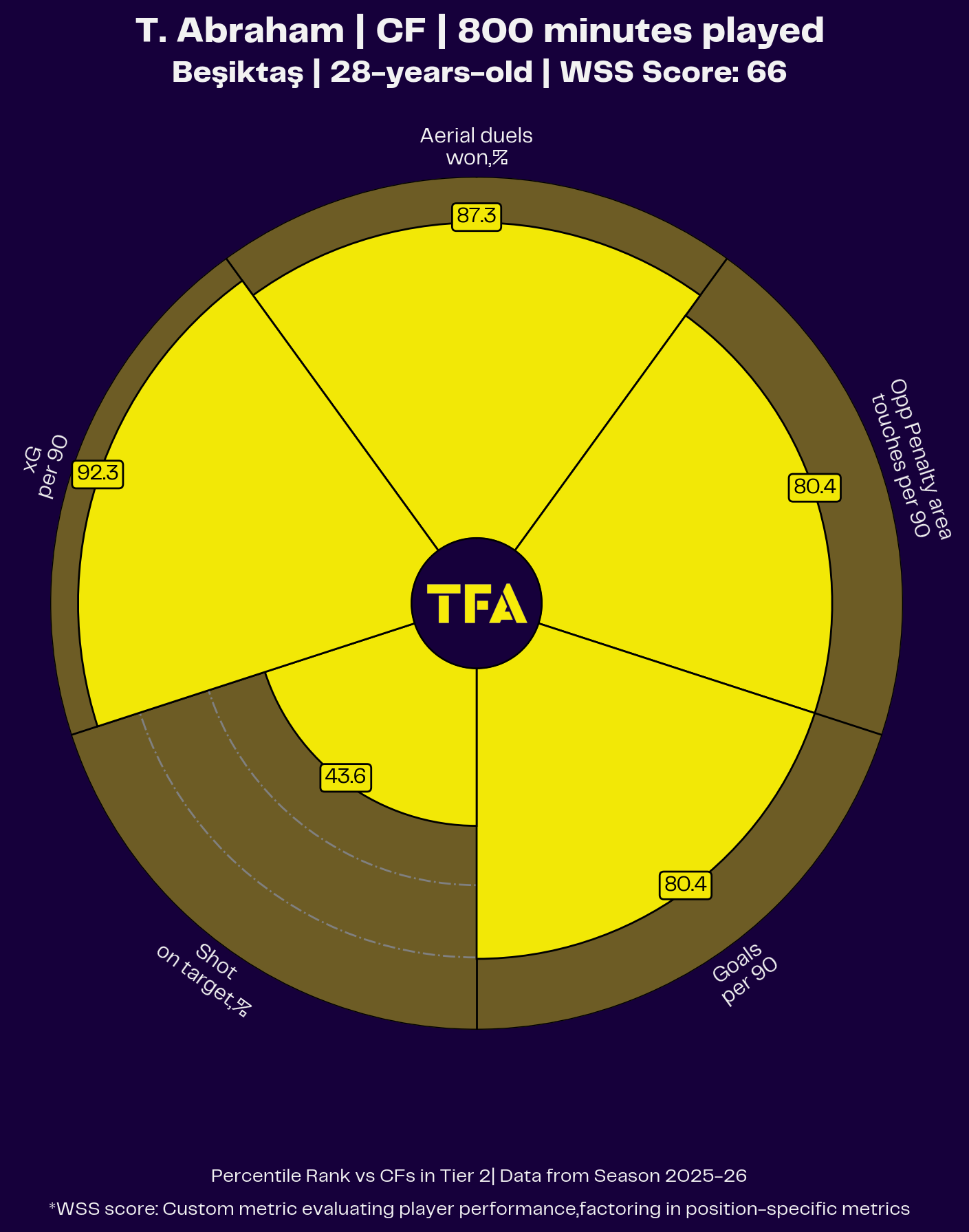
As shown by the pizza chart, which benchmarks Tammy Abraham against positional peers with the median set at 50%, he profiles as a striker who excels in and around the box.
He ranks highly in opposition penalty-area touches per 90, goal contributions, and aerial duels won.
Tammy Abraham Pizza Chart 2025/2026

In addition, as shown in the radar below, these metrics highlight several traits typically associated with more physical centre-forwards.
Abraham has also made a strong start to the 2025/2026 season with Beşiktaş, particularly in terms of touches in the penalty area and xG per 90.
Tammy Abraham Centre-Forward Radar 2025/2026
His movement is more closely linked to early intent.
He will take a shoulder position, then curve across the line to arrive at the near post lane or the six-yard area.
That curvature extends the onside window and asks the centre back to turn and run.
As seen against Lausanne Sport, Abraham uses his body shape and a curved pressing run to block the switch and deny the ball carrier access into that lane.
The arced approach also forces the opponent to take an additional touch, thereby giving Abraham time to close the angle.
Abraham then steps in to shut it down and can lead the counterattack.
He is also a deep runner in the inside channels.
In transitions, he can be dangerous going in behind.
In settled possession, he will still look for the moment a full back is caught high, or a centre-back is drawn out by a wide rotation.
Villa has used Watkins to stretch that space, and Abraham can do it too, but not as consistently.
In the air, Abraham is useful without being an explicit target.
He can win first contact and can compete to make second balls live.
As a result, he can provide Villa with a route out when the opponent constricts the pitch and the safe pass disappears.
As shown against Trabzonspor, Ersin Destanoğlu goes long from goal to Abraham, who wins the aerial duel and flicks on for the midfield runners to attack and capitalise on.
His link play is simple, but this can be valuable in the right context.
He can play layoffs and set the ball into a runner, then spin back into scoring position.
He is not a creator-first forward, and he does not excel at holding up the ball.
But when the ball does arrive at him, the next pass can be good enough for the attack to keep its tempo.
In a league match against Alanyaspor, Abraham receives the ball and quickly lays it wide, thereby bringing more players into the attack.
Abraham can press, but is better suited to screening and angling than to relentless chasing, as Watkins does.
However, this aligns well with the way Emery adjusts Villa’s pressing height based on opponent and game state.
Tammy Abraham Chance Creation & Finishing Mechanics
Tammy Abraham’s goalscoring tends to come from speed inside the box.
He is comfortable when it comes to meeting crosses from the near post and central areas, and he is a consistent second-phase striker.
As shown against AS Roma, Tijjani Reijnders’ initial shot is parried, but Abraham is already moving to attack the rebound, only for the save to push it out of reach.
When Theo Hernández delivers a cross, Abraham has adjusted his position inside the penalty area and scores with a header.
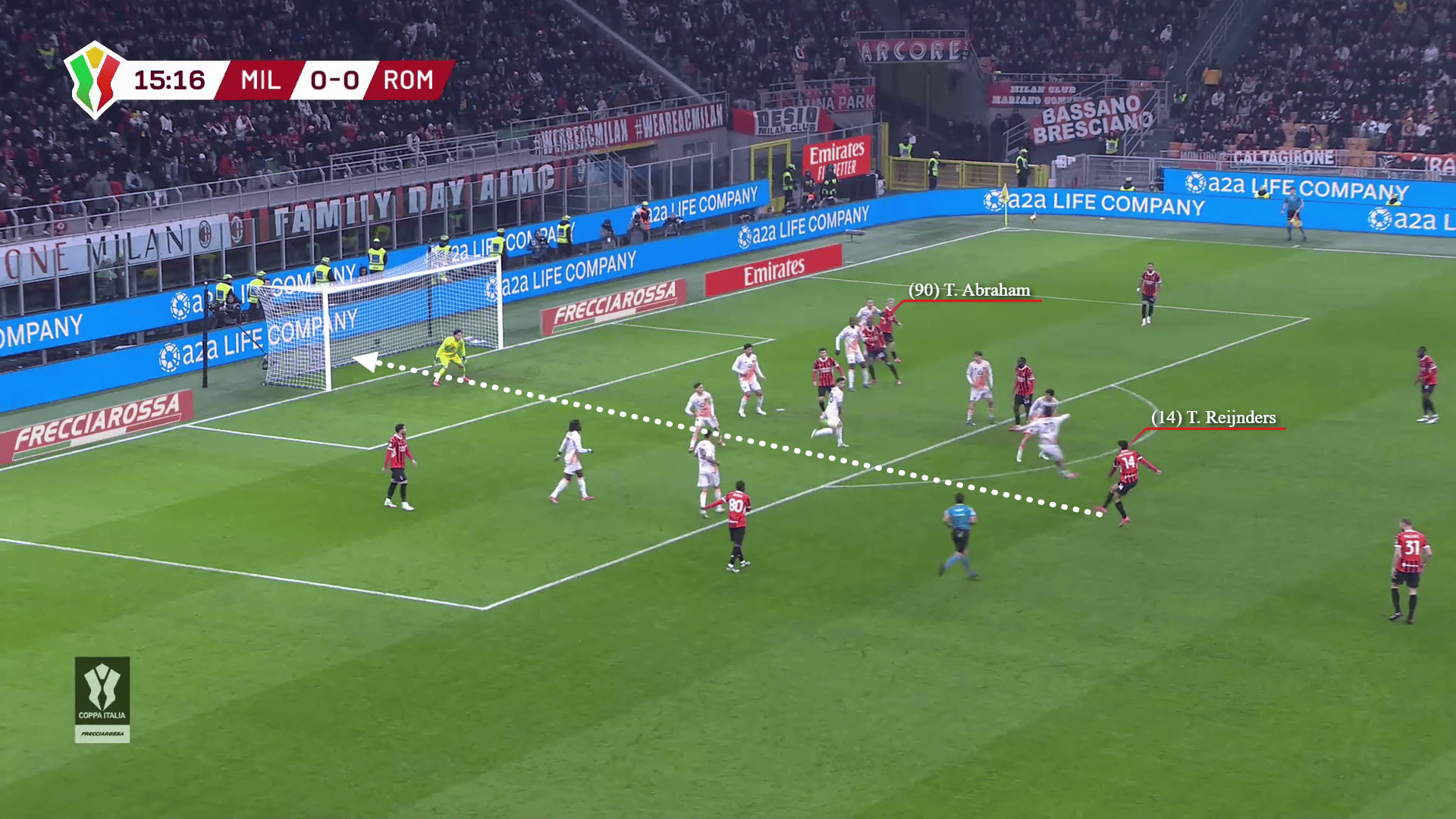
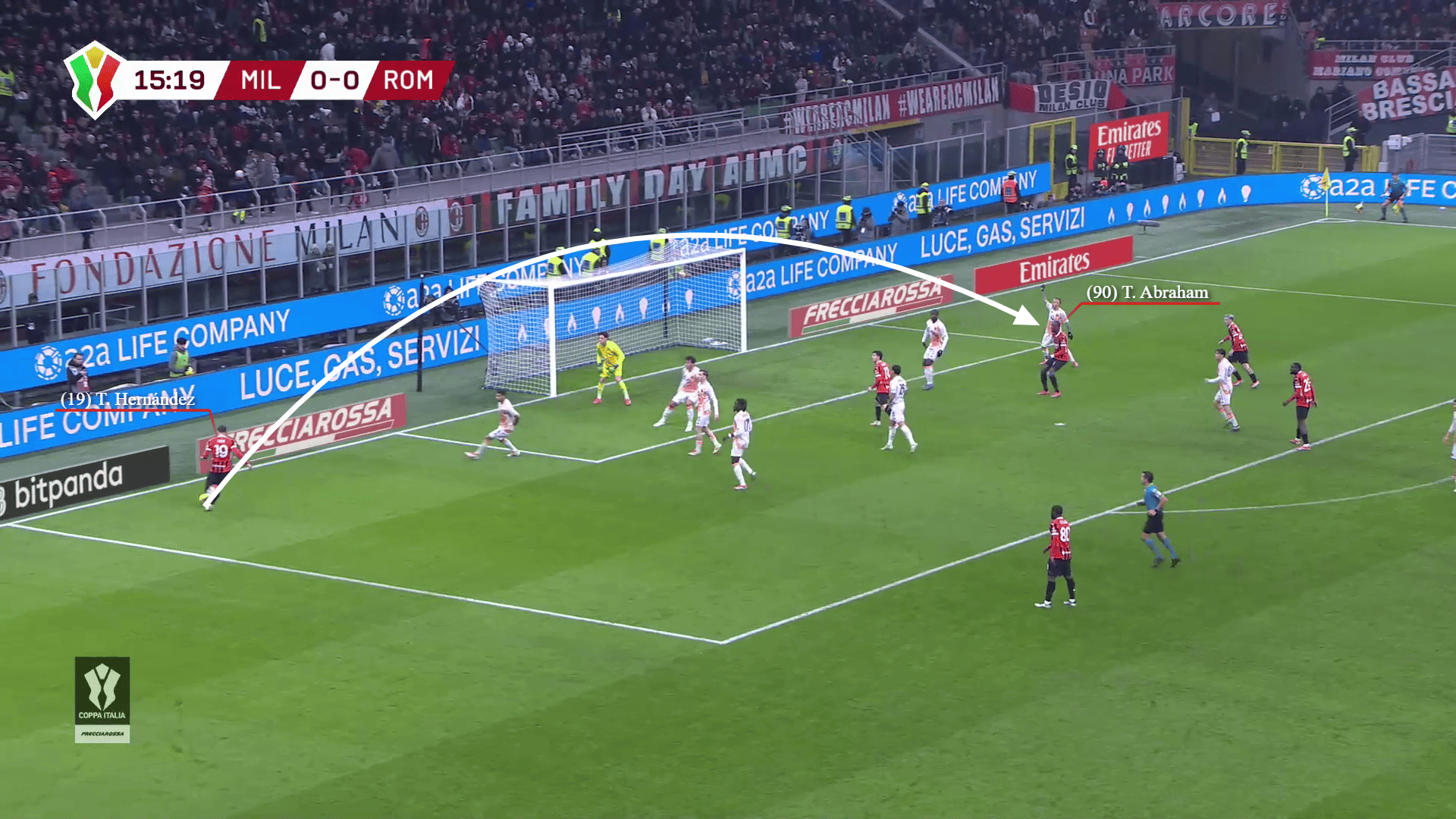
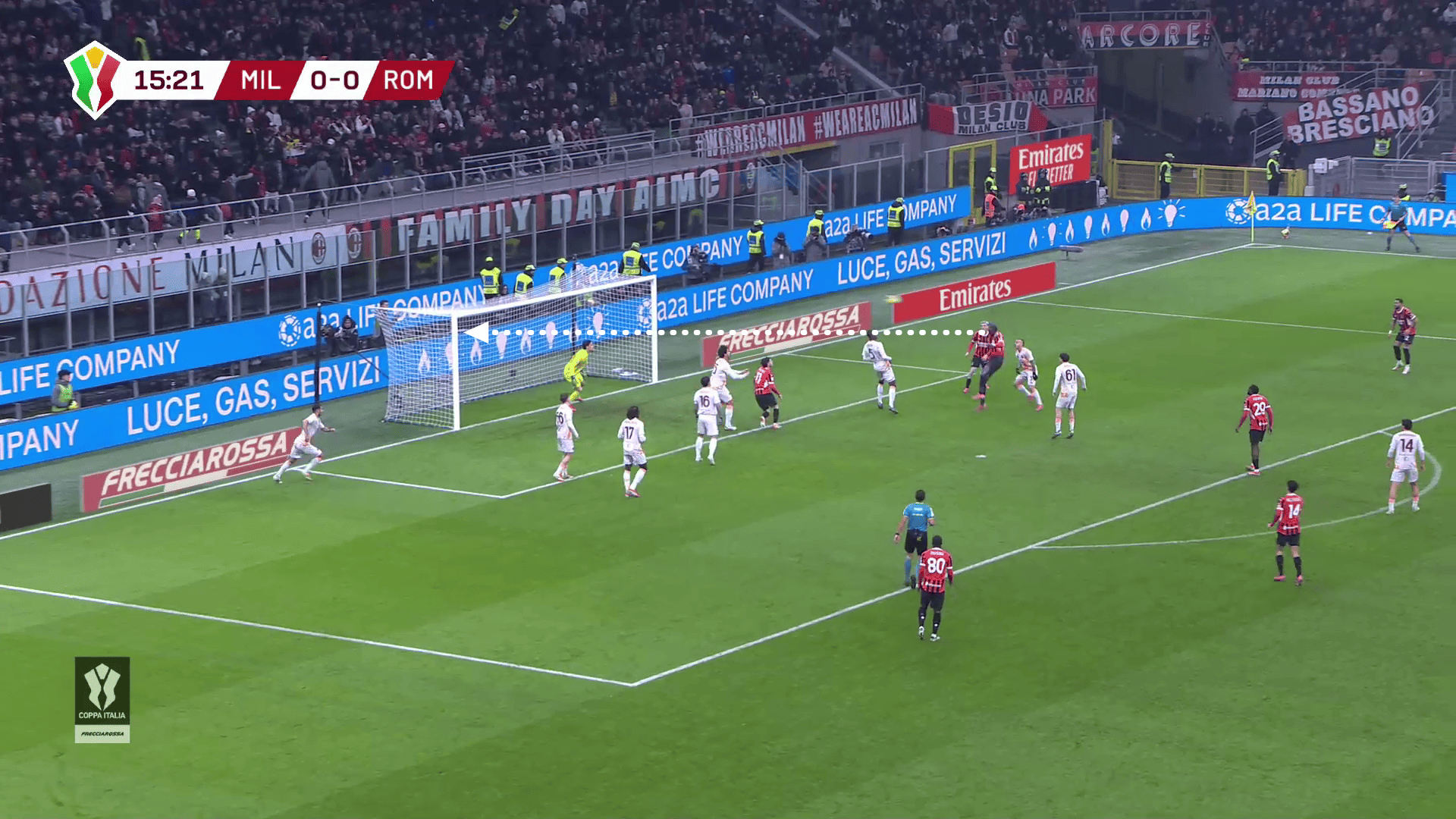
When a shot is blocked or a cross is half cleared, he stays high and attacks the next ball.
A team that takes shots at the top of the box will inevitably generate rebounds and loose clearances.
Abraham’s instinct is to be connected to the goal mouth, which would be beneficial in these scenarios.
Unai Emery Attacking Ideals In Three Principles
Wide to wide circulation with a purpose
The aim is to stretch the block horizontally, force midfielders to move, and then access a pocket at the top of the penalty area or in the half-spaces with a player facing goal.
The wide switches are used to move defenders away from their reference points, thereby creating space for the key pass.
From the video, Villa build from the back and initially progresses down the left side.
When the space opens to change the point of attack, Morgan Rogers spots it and switches play to Matty Cash on the right.
Villa also structures their rest attack so that, while circulating, they are already prepared for the moment they regain possession.
This allows them to attack with more bodies in advanced positions because the counterpressing shape is sufficiently effective at winning the ball back at a higher success rate.
This is one reason Emery’s teams can be patient without becoming passive.
The ball moves, but the team is also preparing to win it back.
Verticality When The Moment Appears
This is immediate directness after regaining.
Early balls into the channels and a willingness to play over pressure when the opponent’s distances are wrong.
Watkins has had great success with this because of his explosiveness and pressing recovery.
Abraham gives a different type of continuity.
He can still run, but he also gives you a higher contact point and a better option to make the first ball stick through a layoff.
Situational Pressing
Villa are aggressive when the opponent can be forced into errors and more conservative when the risk of being played through is high.
When Villa jumps, they want the first line to show the ball to a predictable side (premeditated), and then proceed from there.
Abraham’s best pressing contribution is to be part of that first line.
He can screen the pivot, angle the centre back’s passing options, and allow the wide players to press on triggers.
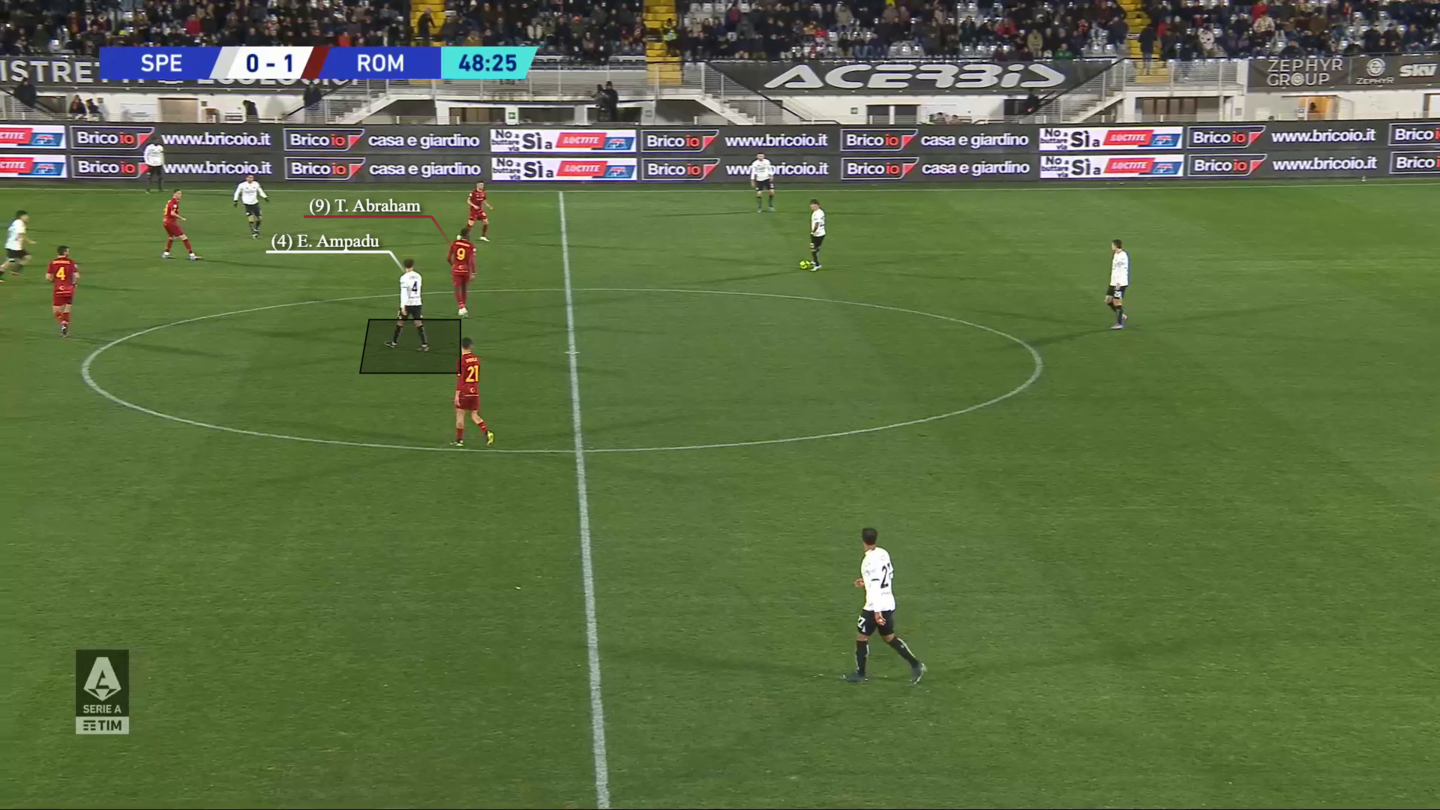
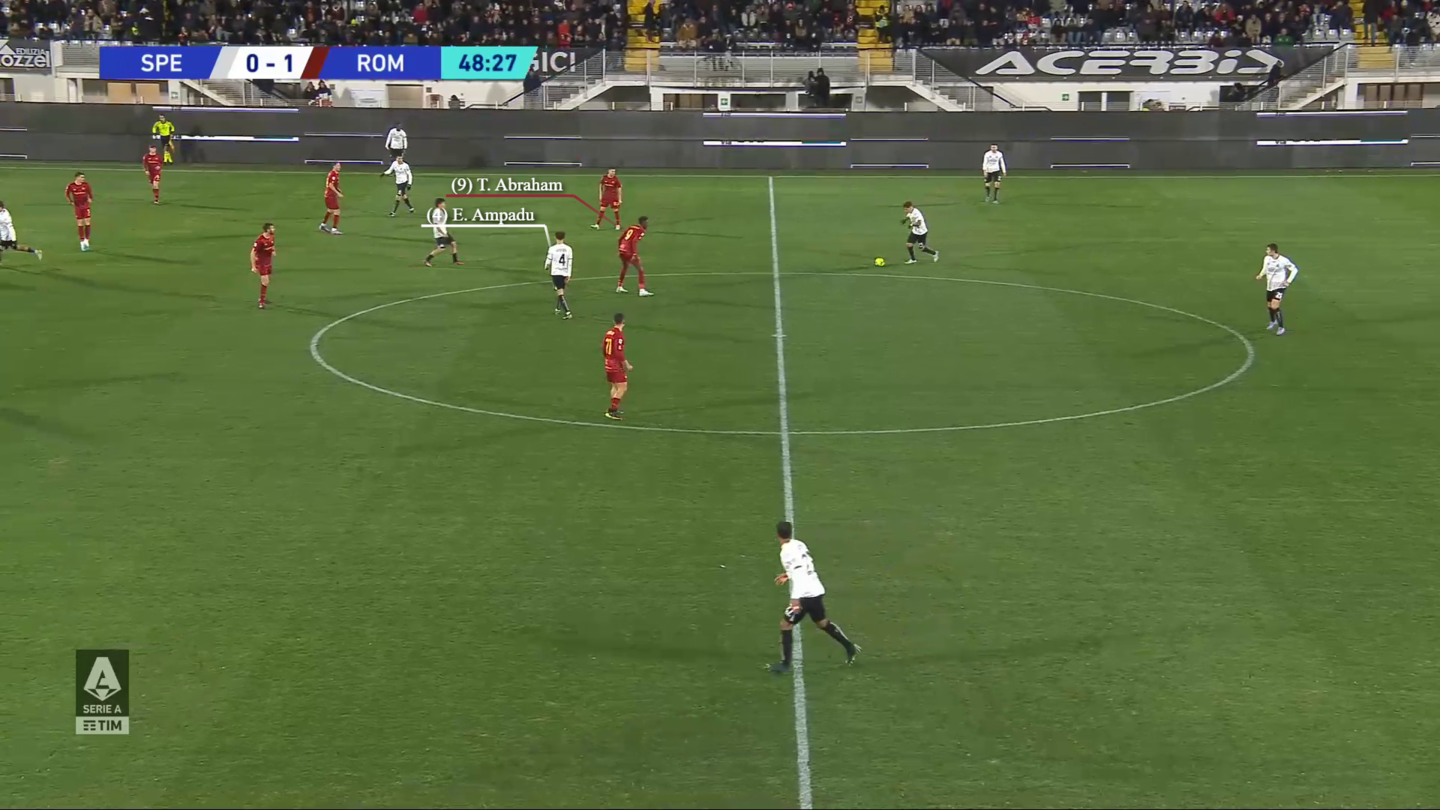
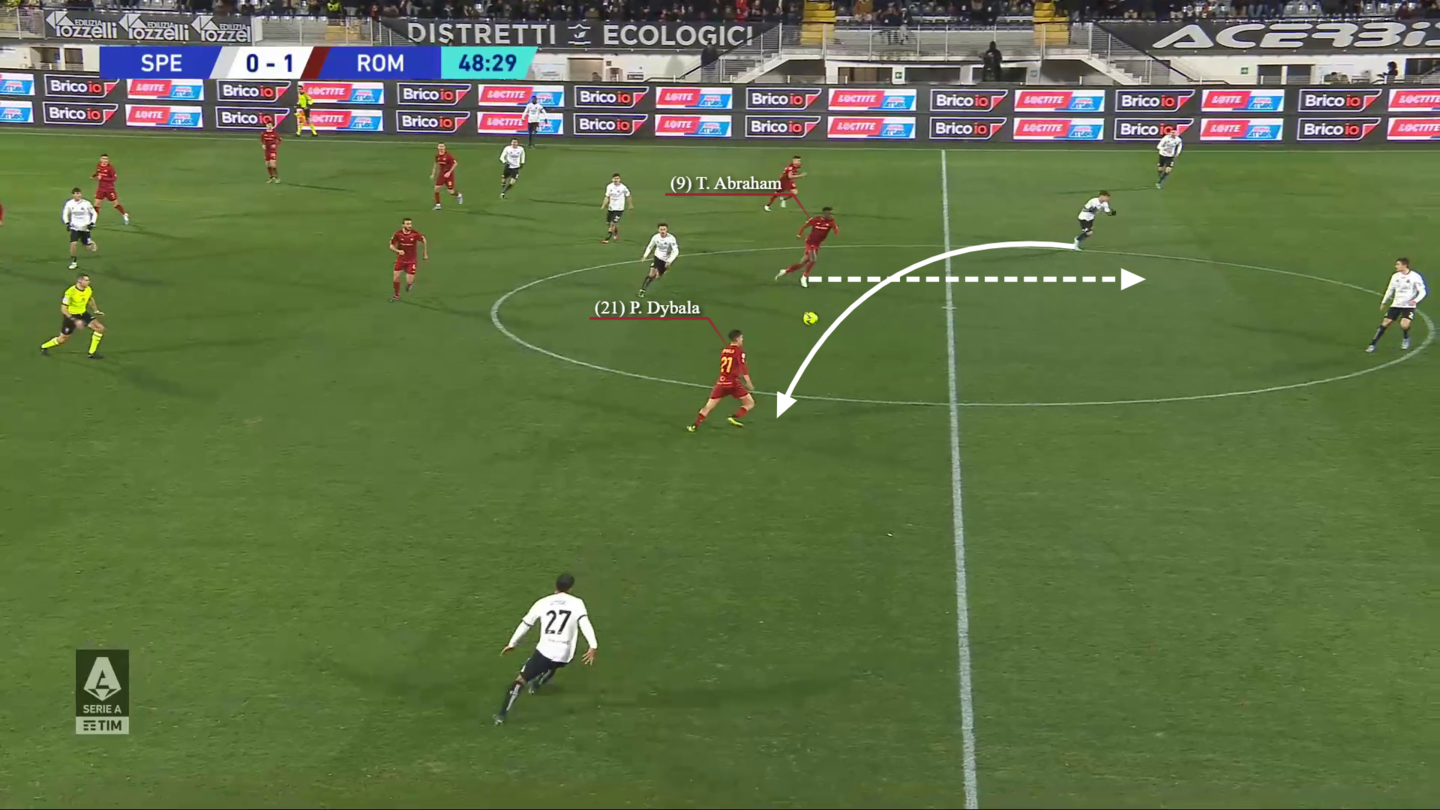
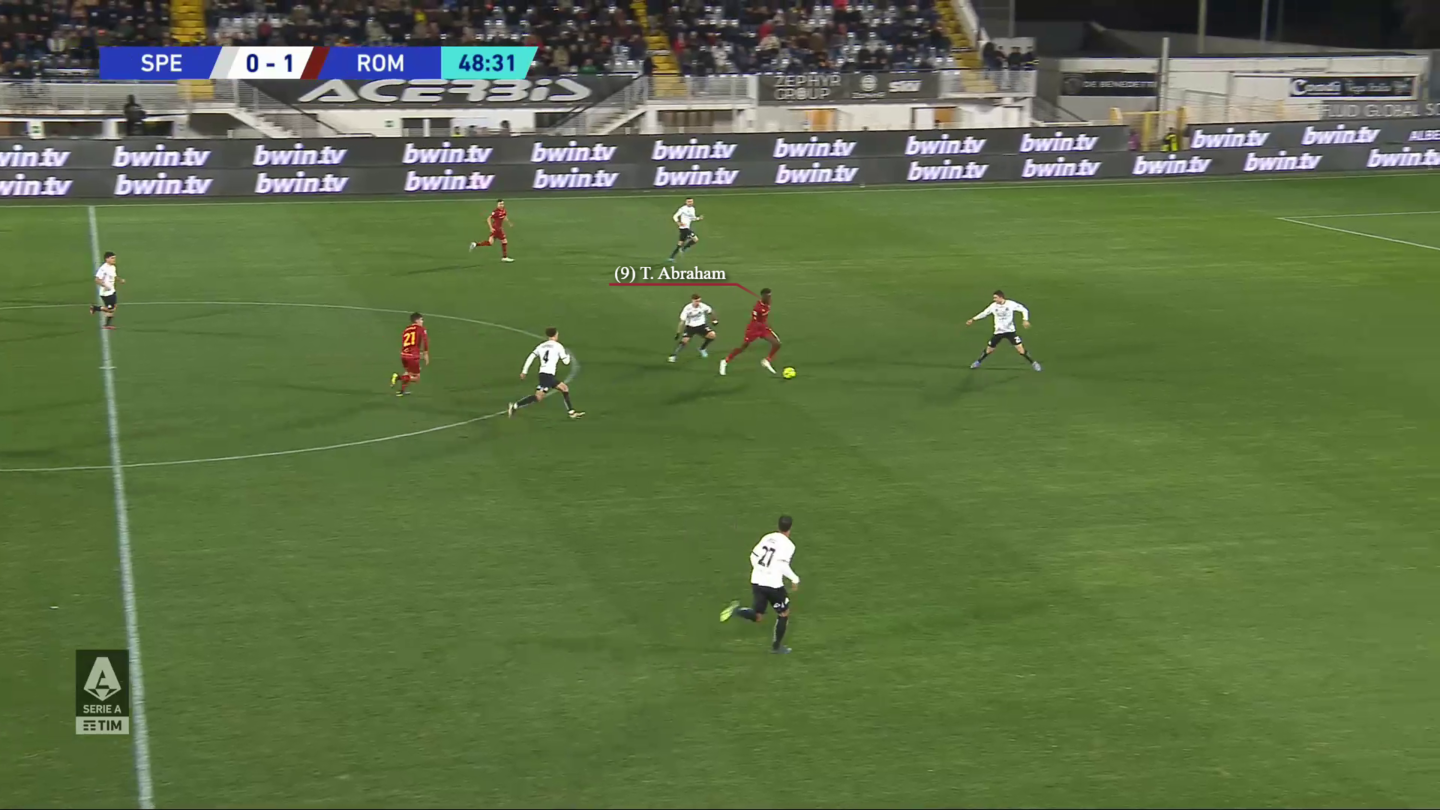
This is shown against Spezia, where the centre back looks to play into Ethan Ampadu, but Abraham blocks the passing lane and denies that option.
Forced to go longer, the defender attempts a crossfield pass, which Paulo Dybala intercepts.
That regain then sparks a counterattack, led by Dybala with Abraham joining the break.
Tammy Abraham In The Wide To Wide Route
Against low blocks, Villa reach the moment where the ball arrives at the top of the box, and the shooter is ready, but the opponent’s centre backs step out and block with confidence because the space behind them is protected.
Tammy Abraham changes this because, if he is stationed between the centre-backs, pinning them, the step-out becomes dangerous.
The opposition becomes susceptible to a slip pass or a cut back being redirected from six yards.
As shown against Fiorentina, Abraham combines with Christian Pulisic in a quick one-two, then bursts beyond the centre-backs to meet the slip pass and finish.
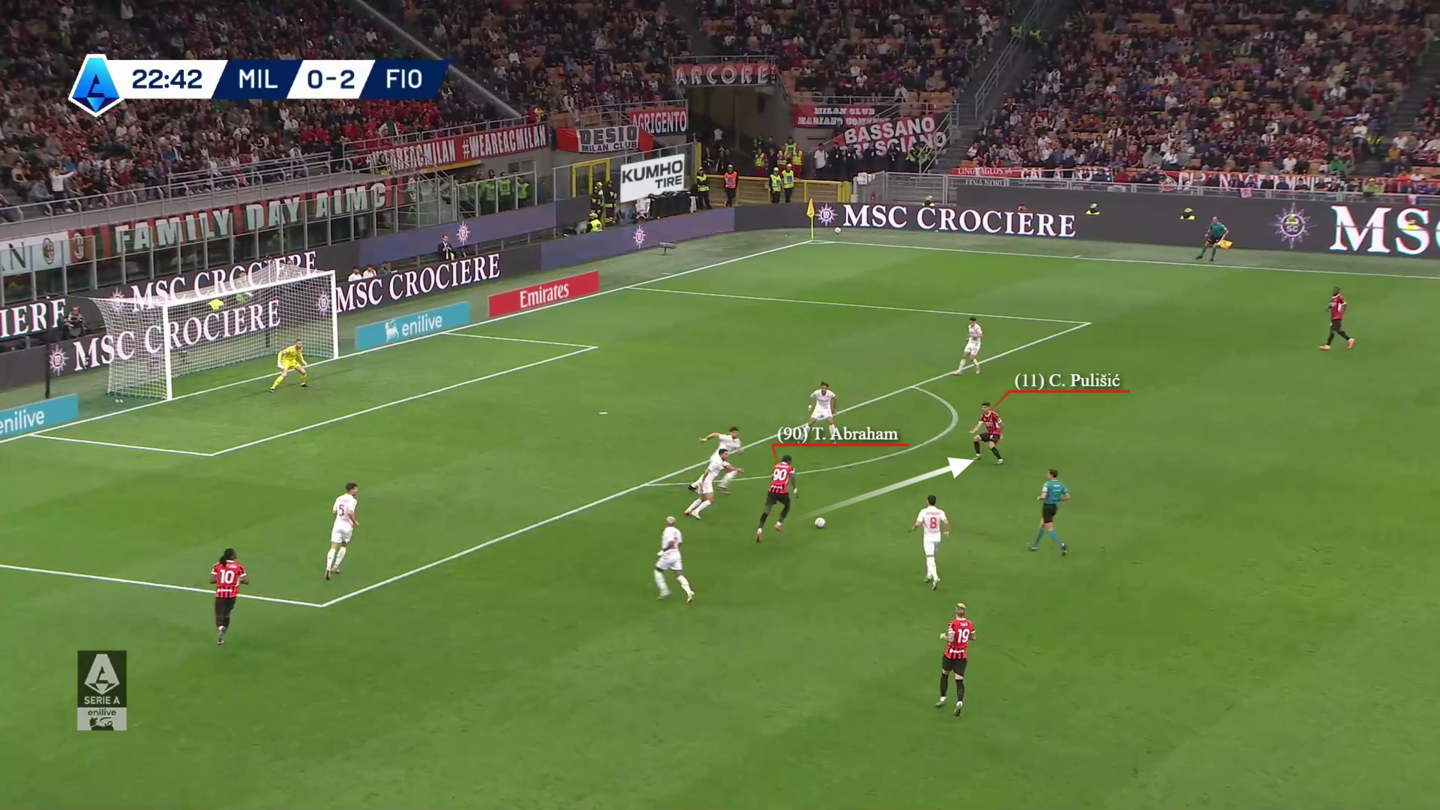
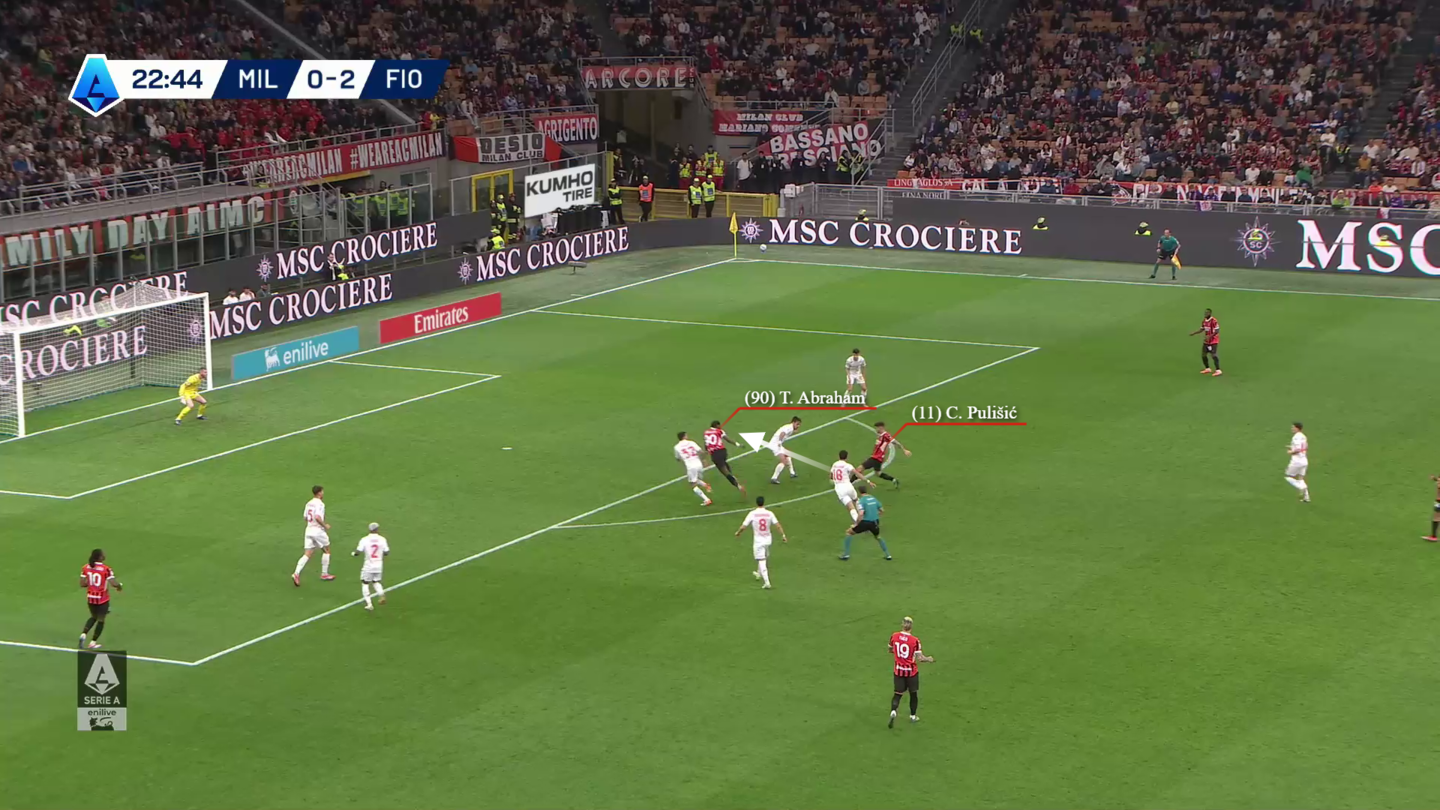
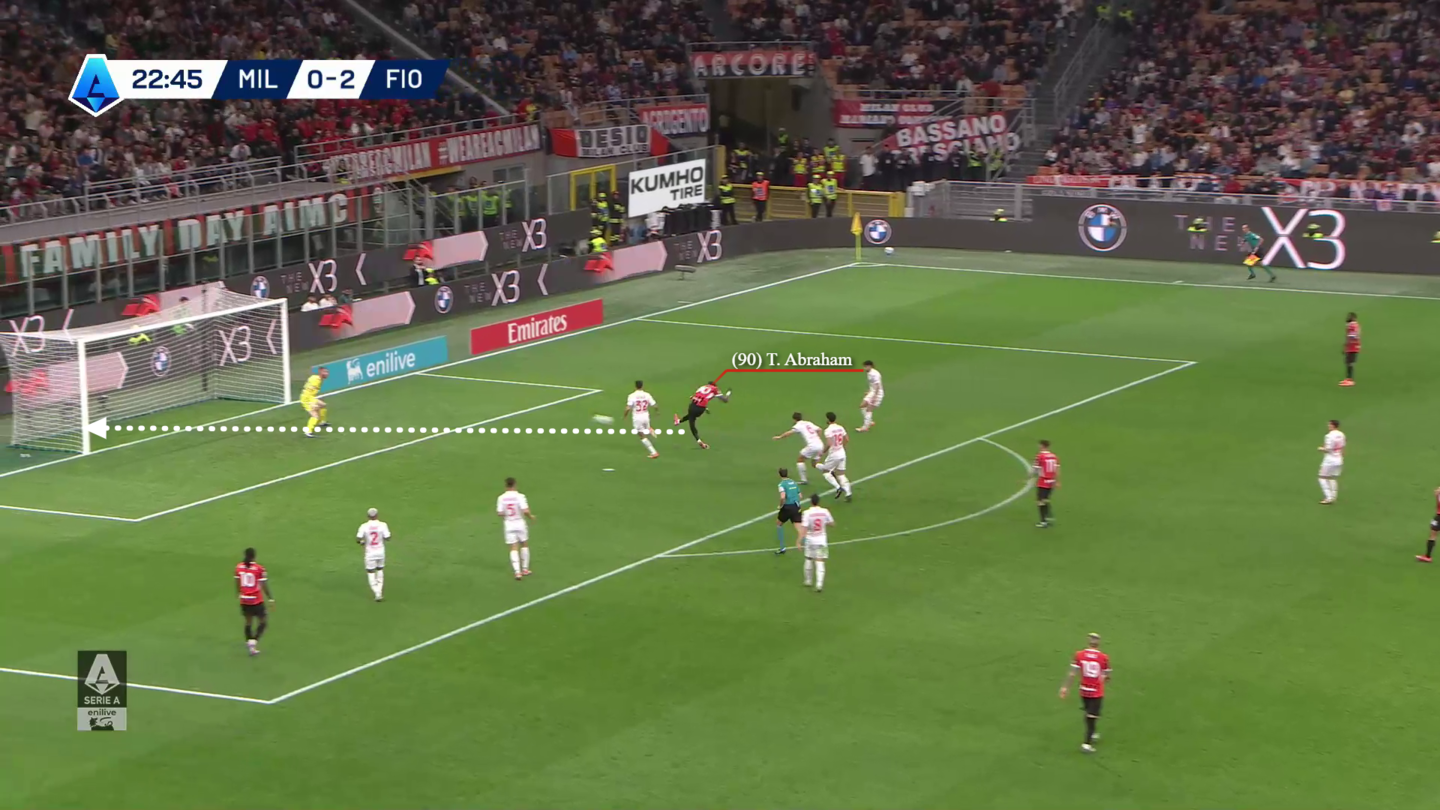
The defenders feel the threat behind them, so they defend deeper, and that deepening opens better opportunities at the edge, where players like Emiliano Buendia and Morgan Rogers have had success.
Abraham also increases the reward of wide service.
Villa-wide-to-wide patterns tend to end with a delivery after the opponent has shuffled for long periods.
Late in games, that constant lateral movement creates fatigue in the exact muscles you need for box defending.
Abraham can attack the near post and force centre-backs to defend facing their own goal.
There is a wider consequence, too.
When the central lane is occupied by a striker who wants to be around the six-yard box, full-backs become less eager to narrow early.
This can improve Villa’s crossing angles and allow their wide players to receive the ball with more space.
Tammy Abraham In The Direct & Transition Route
Tammy Abraham can run into channels to receive, especially into the inside channels, where he can get across the defender.
He can compete for first contact on longer passes, which gives Villa time to push up and compress the second ball.
Watkins seems to be the most natural single striker when the match plan is built around repeated high-intensity sprints into depth.
Abraham’s value rises when Villa expect longer spells in the final third, or when the game becomes necessary for a forward who can make the direct ball usable.
How Tammy Abraham & Ollie Watkins Can Coexist
A two-striker partnership could work if the runs are different and the spacing is protected (one stretches and one pins and connects).
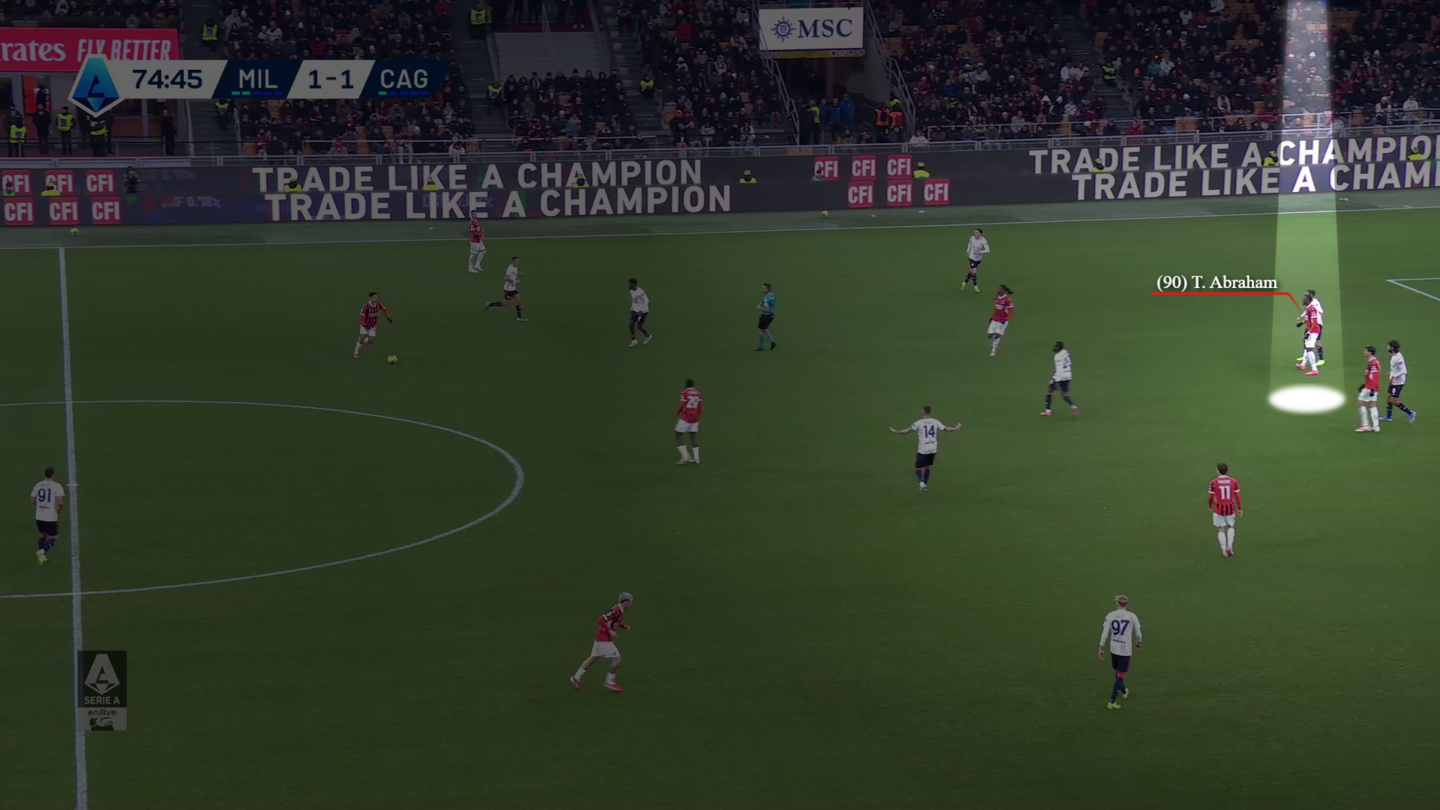
Ollie Watkins could be the runner into channels and behind the full-back, especially when the ball is in the opposite wide area, and the far-side channel opens.
In this case, Tammy Abraham should be the central reference who holds the centre backs, attacks in the first phase of play, and provides bounce passes for players arriving inside.
This can be played in a 4-4-2 or 4-2-2-2 formation, with two narrow attacking midfielders below.
There is a second variant that keeps the build-up structure.
A 4-2-3-1 on paper can become a front two only in the final third.
Abraham plays as the nine, and Watkins starts from the left and attacks the inside left channel once the ball enters the final third.
The advantage to this is that Villa keeps their wide spacing during circulation, then adds a second box runner at the moment of delivery.
The coaching instruction is to make Watkins a late arrival, but if he arrives too soon, Villa becomes narrow and predictable.
Tammy Abraham Off The Bench & Late Game Value
Some of Villa’s most frustrating matches consist of controlling territory and taking shots which are repeatedly blocked by a defence set on top of the area.
Tammy Abraham is the kind of substitution that shifts the opponent’s defensive reference from the edge to the six-yard box.
Furthermore, height and aerial competitiveness matter late in games, especially against tired defenders and a team chasing a goal.
Pressing Roles That Fit Emery’s Logic
If Emery wants to keep his situational pressing, there must be a division of labour between Watkins and Abraham.
Watkins can lead the first chase and trigger the jump when Villa decides to go after the build-up.
Abraham can screen the pivot and angle the pass.
That preserves Abraham’s energy for the work that most affects his output: quality movement within the box.
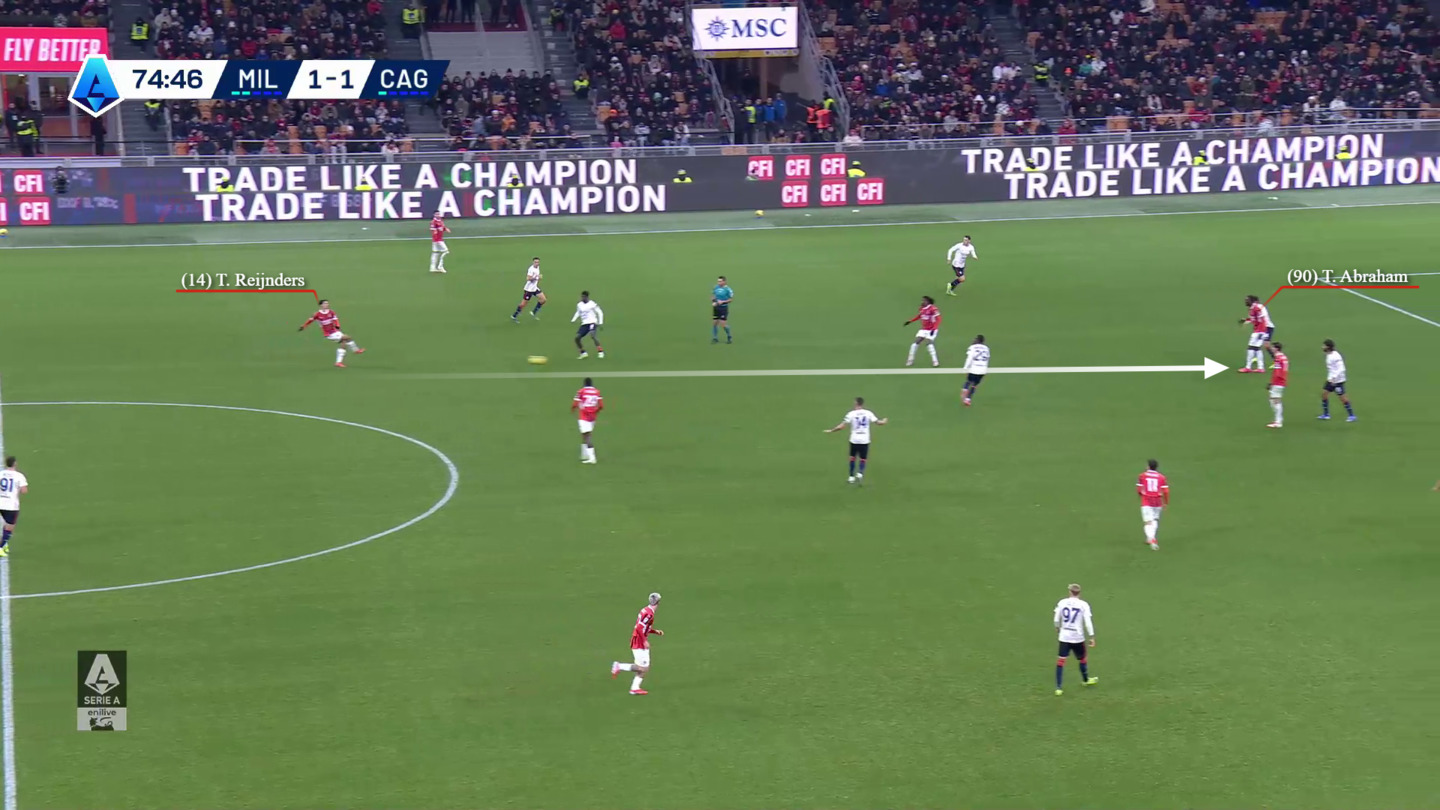
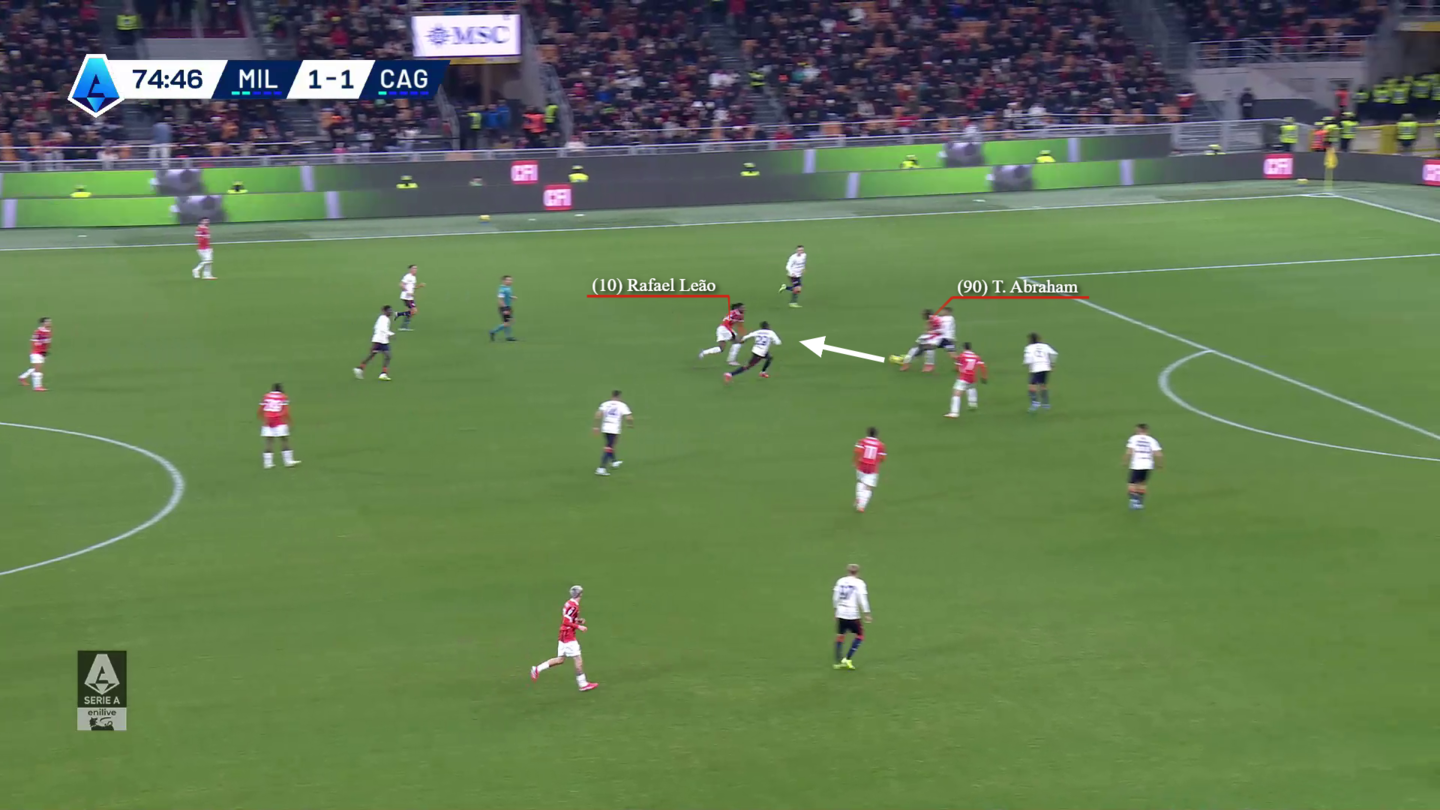
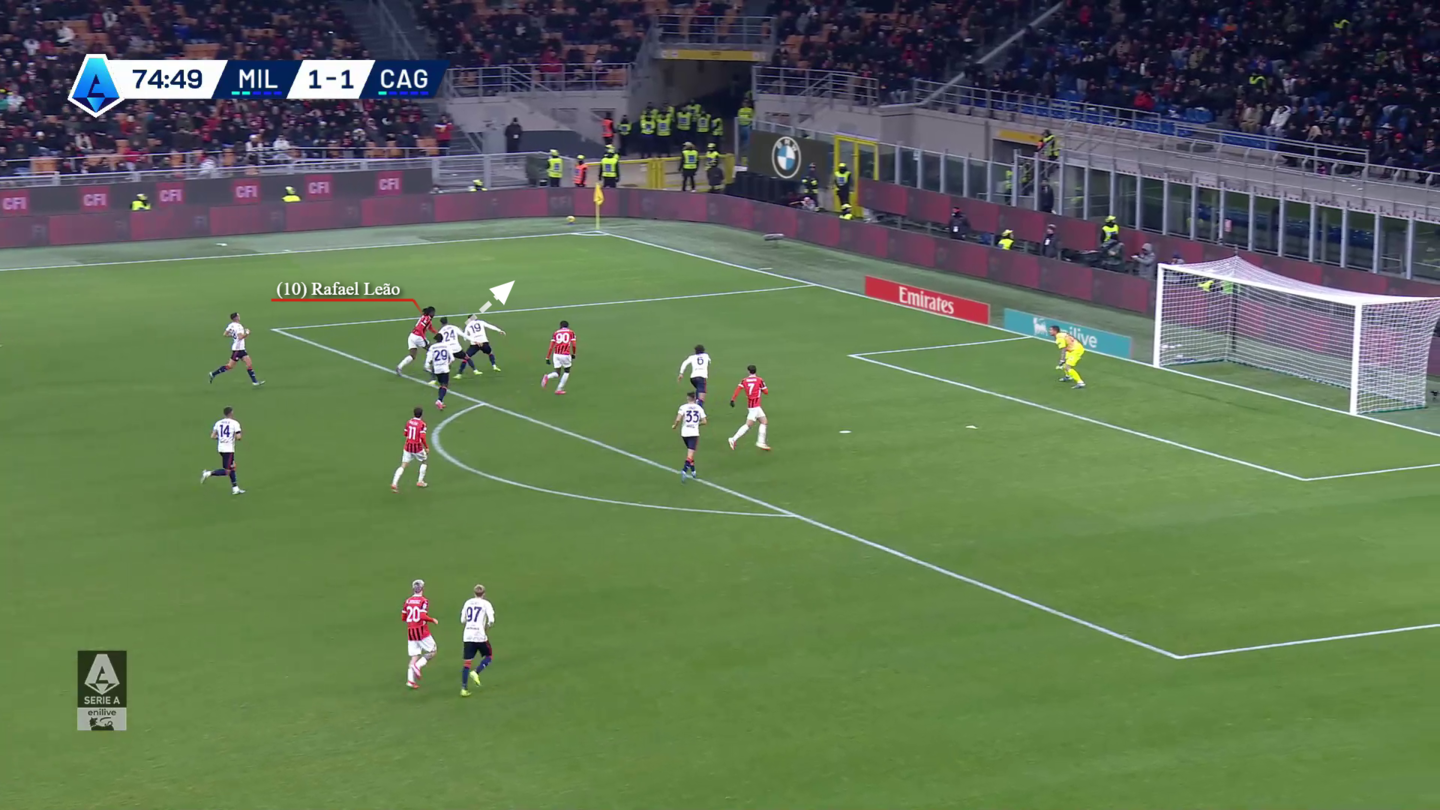
As shown against Inter Milan, Abraham’s box movement and eventual goal result from his alertness and constant adjustments to the ball’s changing position, and he is rewarded for it.
Conclusion
Tammy Abraham to Villa appears to be a sensible signing, as it adds variety in box presence (the game is won within the penalty area).
He relieves pressure on Watkins through rotation, but his bigger contribution is that he gives Emery a different weapon within the same game model.
