
Cesc Fàbregas’ project at Como is among the most interesting in Europe’s top five leagues at present.
After finishing second in Serie B two seasons ago, achieving promotion to Italy’s top tier for the first time since the 2002/2003 campaign, Fàbregas guided Como to 10th place last season.
At the time of writing, they currently sit in sixth place this term, on course to build on their solid first season back in the big time.
Alongside the high-profile coaching appointment, Como are drawing attention for their intent to develop young players.
Nico Paz is, perhaps, the poster boy for that element of Como’s strategy, with young Croatian starlet Martin Baturina also shining in recent weeks.
Another young talent worthy of some attention at Como is Jesús Rodríguez (185cm/6’1”, 77kg/169lbs), who joined the Italian side this past summer from Real Betis for €22.5m.
This Jesús Rodríguez scout report and player analysis outlines why the 20-year-old Spaniard is one of the most exciting young wingers to watch in world football right now, with a specific focus on his primary strength: Dribbling.
Jesús Rodríguez Stats
The data in Figure 1 tells us what type of winger Rodríguez is.
The four metrics used are custom-built.
Each one describes a certain aspect of a winger’s style of play.
A higher score in one metric and lower in another doesn’t necessarily tell us about quality so much as it tells us about style.
Each metric groups related actions that serve a similar purpose.
The metrics are composed of Wyscout’s raw data.
Inputs are measured and standardised across all wingers to have played at least 800 minutes in Europe’s top five leagues over the past calendar year.
The first metric displayed, ‘Ball Progression Score’, is a combination of progressive runs and dribbles that together indicate how much a winger moves the ball upfield, carrying it through space and under pressure.
Wingers who take more responsibility for advancing the ball from deep will perform better in this metric than those who tend to receive the ball while already occupying a more advanced position.
Secondly, ‘1v1 Threat Score’ combines the volume and success of both dribbles and offensive duels.
A high score in this metric is achieved through consistent success in the relevant areas rather than standalone moments of brilliance.
The aim is to numerically distinguish those who consistently beat their opponents 1v1 from those who attempt a high number of inefficient actions.
Next up, ‘Goal Threat Score’ is a combination of xG, shot volume, and touches inside the opponent’s penalty box.
The aim is to reflect chance quality, attacking intent, and threatening positioning.
Wingers with a high score on this metric regularly occupy dangerous areas and directly threaten the opposing goal.
Lastly, ‘Creative Threat Score’ combines assists, xA, and volume of accurate crosses.
This metric quantifies how consistently a winger creates chances for teammates by combining the quality of chance creation, realised outcomes, and repeated delivery success.
Wingers who consistently provide reliable final balls over time will achieve a higher score here.
Jesús Rodríguez Winger Percentile Ranks, Heat Map & Position Map
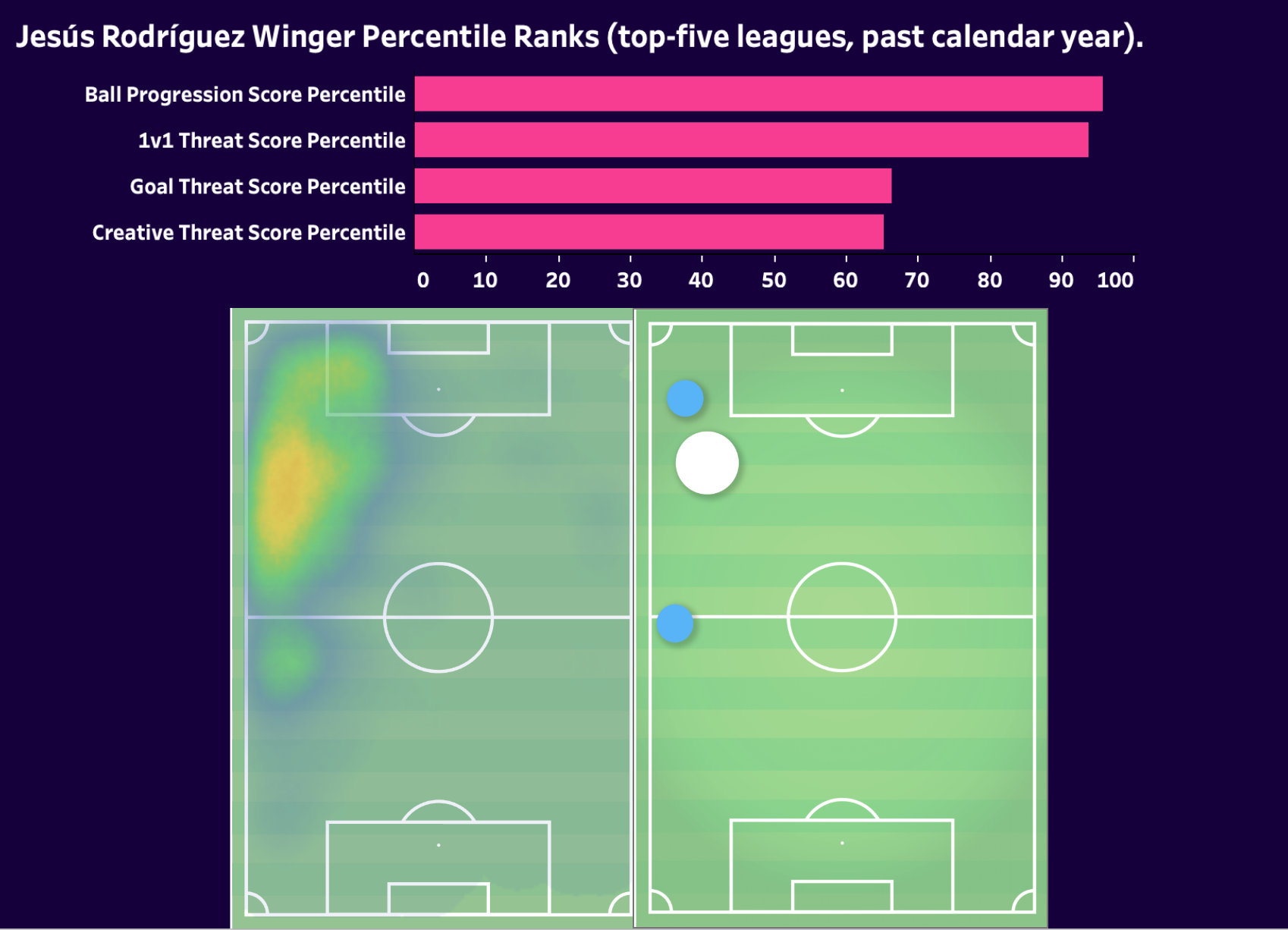
With all that in mind, when we view Jesús Rodríguez’s game through the outlined framework, Figure 1 presents a clear picture of his style of play and how the Como man influences games.
With his strongest performance coming in Ball Progression Score, the Spain U21 international is elite among top-five-league wingers at advancing with the ball.
Stylistically, this suggests a player who’s comfortable coming deep to collect the ball and drive with it, rather than waiting for play to reach advanced areas.
The heat map further supports this, as his actions are concentrated along the left flank in both the middle and final thirds.
This indicates a relatively high number of ball receptions outside the final third, followed by forward carries to enter that area of the pitch.
In moments when progress must come from individual action rather than structural factors, Jesús Rodríguez is an extremely valuable player for Cesc Fàbregas’ side.
The 20-year-old also has a highly impressive ‘1v1 Threat Score’, which reinforces the notion that his progression is not passive.
Jesús Rodríguez doesn’t carry the ball into open space; he regularly beats defenders with dribbles.
From my video analysis, which we’ll get to later, this is perhaps the strongest area of his game, even though it comes second according to the data.
Cesc Fàbregas typically lines up Como in a 4-2-3-1 shape with Jesús Rodríguez on the left wing.
Rather than being a half-space creator, Jesús Rodríguez generally provides the width for I Lariani in the final third, which the heat map again supports.
His wide-left positioning frequently isolates him with the opposing full-back, and his success in both dribbles and offensive duels suggests repeatable effectiveness in such scenarios rather than occasional flair, which may look good in a highlight reel but fails to provide on a consistent game-to-game basis.
By forcing opposing defenders to engage, Jesús Rodríguez can draw defenders in and simultaneously create space for teammates elsewhere, making him a destabiliser in the final third for Como.
Jesús Rodríguez’s Goal Threat Score and Creative Threat Score are both well above average but are not nearly as much a defining feature of his profile as the aforementioned two metrics.
His Goal Threat Score metric primarily suffers from the fact that he doesn’t mainly operate inside the box.
The former Real Betis player plays a supporting role in attacks, rather than being the main focal point.
Similarly, he profiles as a secondary creator who prioritises advantages over chances, not a winger whose role is built around repeated delivery or advanced playmaking.
All in all, Jesús Rodríguez profiles as a ball progressor and duel winner.
His ability to advance play, break lines, and disrupt settled defensive structures makes him an exciting prospect for teams that desire this profile in their squad.
Don’t expect him to be one of your team’s main goal threats or the main playmaker, however.
This profile aligns well with a system that values territory, control, and ball-carrying responsibility from wide players, like Fàbregas’ ultra-possession-dominant tactics, rather than a side that wants its wingers to function primarily as finishers or high-volume creators.
Jesús Rodríguez Dribbling
Jesús Rodríguez appears to be a difficult winger to defend against, owing to both the quality of his dribbling and his clear desire to make himself as unpredictable as possible.
For instance, while he’s clearly more comfortable on his stronger right foot, he doesn’t shy away from using his left at times.
Indeed, he’ll need his right foot for more difficult actions, but his left will suffice when closer to the goal, when covering less ground, or when requiring less power on the ball.
Going hand in hand with that, Jesús Rodríguez can carry the ball inside towards goal or go outside towards the byline, while he can also create via a cross from deep or just as easily knock the ball in behind and chase it down.
All of this keeps defenders guessing, so they can’t fully rule out any possibilities when defending against the Como man, and they must respond in the moment as he takes them on.
The example above shows Jesús Rodríguez knocking the ball down the line after some body feints, then crossing it into the box with his left foot against Udinese.
In another example, versus AC Milan, Jesús Rodríguez goes inside and weaves between defenders before forcing a block, which wins Como a corner kick.
While Jesús Rodríguez failed to test the opposing goalkeeper with a potentially dangerous dribble here, he did well to beat two defenders and get into a highly threatening position.
This shows what we discussed about Jesús Rodríguez disrupting opposing defences and potentially creating space for teammates elsewhere in the final third, as the alarm bells he’ll set off in opponents’ minds when he gets on the ball will create space.
Jesús Rodríguez Areas For Development
Jesús Rodríguez has great balance and agility, along with decent ball control, though he is prone to heavy touches, which he can work on to further enhance his dribbling and, crucially, his end product.
We see another example of the young Spaniard using that balance and agility to weave between defenders and open up a shooting opportunity for himself in the third clip.
The setup is fantastic, but the shot at the end is poorly placed.
At the moment, I’d say finishing is undoubtedly one of Jesús Rodríguez’s biggest weaknesses and a clear area for improvement.
He has a bit of a tendency to shoot off-balance at times, and even when he does get into strong shooting positions, he generally fails to make the most of those opportunities, so a lot of those chances at the end of his impressive dribbles go to waste.
This is probably the number one area I’d like to see coaches spend time working with Jesús Rodríguez to take his game to the next level.
Similarly, he has strong vision, and his dribbling creates significant opportunities for chance creation; however, he has yet to master the accuracy and weight of the final ball to fully capitalise on the chances he generates.
At the moment, Jesús Rodríguez mainly creates chances from his runs to the byline, followed by cutbacks, which can be extremely effective.
However, he requires a greater variety in his playmaking.
He is willing to try other balls, but he is not yet effective with them, as with his shooting.
Lastly, Jesús Rodríguez can still improve physically.
Adding a couple of kilograms of muscle and working on aspects of his game, such as jumping height and pace, would make him a more dynamic winger and add more weapons to his arsenal to trouble opponents who are already wary of his dribbling.
Physical improvement could enhance Jesús Rodríguez’s defensive game, which could also benefit from improvement.
Conclusion
To conclude this scout report, Jesús Rodríguez absolutely deserves some attention as one of the young bright stars propelling Como up the Serie A table.
However, he is raw.
His dribbling ability and footballing IQ are excellent.
Still, there are areas of his technical and physical game that need time and attention on the training ground.
Jesús Rodríguez is a winger I generally like to watch.
He’s brave on the ball and loves to take defenders on, but he has the potential to become a much greater direct goal threat and playmaker over the next 3-4 seasons if he applies himself on the training ground, potentially setting him up to go on and become one of the best wingers in the world by that time.
That will depend heavily on consistent application and doing the hard work when nobody is watching, which is where mentality and character come into play.
At present, from the outside looking in, Jesús Rodríguez demonstrates raw talent and potential, and it will be interesting to observe how he develops over the next few seasons.
