
Marco Palestra is a highly talented right-back who is currently playing for Cagliari on loan from Atalanta.
The Italian is being monitored by numerous top teams, including Juventus, Inter Milan, Arsenal, Manchester United and AS Roma.
He began his career in the academy at GS Assago before moving to Inter Milan’s academy and subsequently to Atalanta’s.
He continued to play for Atalanta’s youth teams until he joined the senior team, but did not yet receive his full chance.
It was fundamental for Palestra to receive a full opportunity in a senior Serie A team, so that he could build experience and demonstrate his abilities at a high level.
As soon as he did so during the first part of this season, he performed well enough to attract the attention of several teams and become a crucial player within Cagliari’s system.
His proven ability to make a difference on the right wing, through penetrations, overlaps, assists, and efficient playmaking, makes him a highly reliable right-back with outstanding qualities.
In this Marco Palestra scout report, we examine Marco Palestra’s traits as a right-back, positional versatility, playmaking and goal-contribution abilities.
Marco Palestra Positions & Roles At Cagliari
First, it is important to note that Palestra was initially a central midfielder before being converted to a winger and then to a right-back.
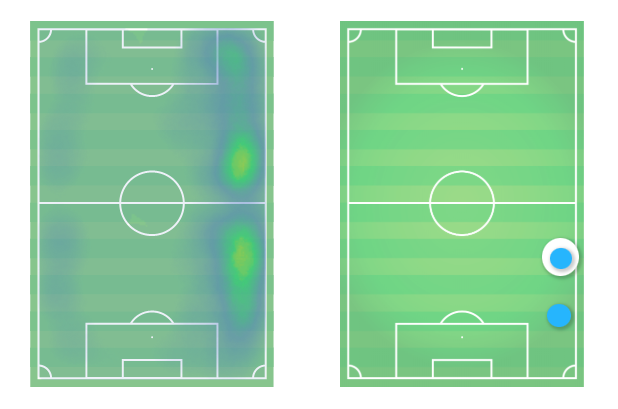
Marco Palestra Positional Map
The following positional map indicates that he is being used as a right-back and a right wing-back.
However, this does not change the fact that Marco Palestra has played in other positions, including as a right or left midfielder, particularly prior to this season.
Palestra uses his physical strength and dribbling skills effectively to win a large share of the duels he enters, and his success in offensive duels is among the factors that make him a distinctive right-back who can be highly useful in the attacking phase.
In general, Marco Palestra’s attacking numbers have been quite a bit better than his defensive statistics.
This can certainly be considered an advantage for Palestra, as right-backs with a proven and effective attacking contribution are uncommon at the highest level.
That’s why having a right-back with exceptional dribbling skills and a success rate comparable to Palestra’s is something that all teams want to have.
Marco Palestra has a relatively high dribbling success rate despite the fact that he attempts a lot of dribbles per game and relies a lot on beating his direct opponents in duels.
Additionally, his high average of dangerous passes per match aligns well with his excellent dribbling.
This means that Palestra’s dribbling is not merely showy; it has no concrete effect on the team’s attacks.
He exploits his dribbling and acceleration extremely well to create dangerous passing possibilities for himself in advanced areas of the pitch.
This quality should be further improved and worked on in order to make Palestra an even more crucial right-back.
In fact, players with excellent passing, exceptional acceleration, and dribbling abilities are afforded greater freedom to advance and are instructed to be more involved in attacking play in modern football.
Cagliari, Atalanta, or the coaching staff of Marco Palestra’s next team can exploit his attacking qualities to develop something similar to what Inter Milan’s head coaches achieved with Federico Dimarco, turning him into a clinical and pivotal attacking weapon for the team.
To reproduce something like that with Palestra, it will be important to work on the chemistry between Palestra and his teammates, especially in passing and movement without the ball, and to encourage Palestra to assume more attacking roles more regularly.
Additionally, goalscoring and goal contribution are areas in which Palestra can improve, given his potential.
He can increase his goal tally primarily by moving into the penalty area more often and engaging in set-pieces and crossing situations to exploit his height and excellent aerial ability.
That said, Palestra’s defensive numbers are worth improving, as his positioning and ability to win defensive duels can be significantly enhanced with time and experience.
At the same time, this season (his first active season in Serie A), he has averaged 5.29 defensive duels per match, with a 60.1% success rate.
Maintaining the same average and improving it will make Palestra much more reliable from a defensive perspective.
Nevertheless, from a defensive perspective, Palestra has performed well in aerial duels.
He wins an average of 51.4% aerial duels per game and can do even better if he focuses further on his jumping and timing of interventions, given that his height and physical strength allow him to win most of these aerial duels.
Marco Palestra Dribbling & Playmaking Qualities
Marco Palestra has demonstrated in recent seasons, and again this season, that he is very difficult to beat or stop when he accelerates on the right wing.
His acceleration and dribbling, along with his physical strength, allow Palestra to gain the advantage against most defenders.
He frequently uses this to pave the way for himself to launch crosses or passes towards the box.
Marco Palestra Body Feints & Dangerous Crossing From The Right Wing
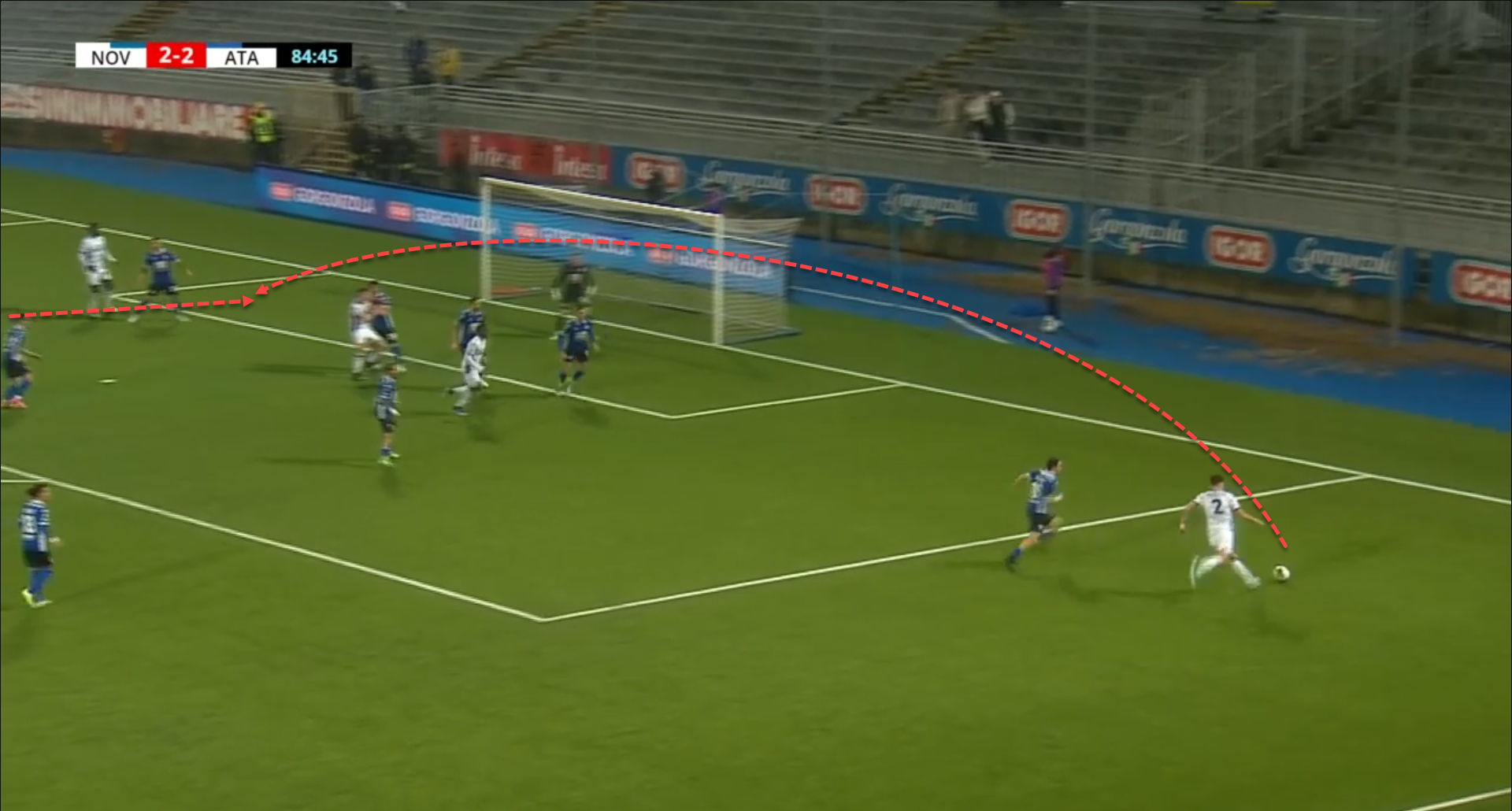
The following assist example illustrates Marco Palestra’s excellent dribbling skills and his ability to accelerate quickly, despite having attempted a body feint that should normally have limited his ability to re-accelerate.
The action demonstrates that Palestra handles such situations effectively and knows when and how to accelerate and when to slow down to confuse defenders through dribbles or body feints.
In this action, he feigned a left-footed cross and then executed a right-footed cross.
His ability to use both feet regularly, whether for crossing or passing, makes it difficult for defenders to predict which foot he will use, especially when he plans to feint and when he ultimately uses that foot.
Palestra demonstrated in this example that he can exploit this aspect effectively and uses it efficiently when dealing with defenders.
What is even more remarkable than the dribble and the acceleration is the quality of service.
In other words, Palestra succeeded in crossing to his teammate with pinpoint accuracy, who was coming from behind into the penalty area.
His cross was excellent also because he executed it while running and from a difficult angle, which highlights his ability to cross well from any spot on the right wing, and that’s very precious for full-backs or wingers.
Marco Palestra Left-Wing Actions
What makes Marco Palestra unique as a right-back is his ability to perform well in various positions, including the right and left wings.
The ability to play as a left winger and to be reliable in that position from an attacking perspective enhances Palestra’s versatility and offers valuable solutions for the coaching staff.
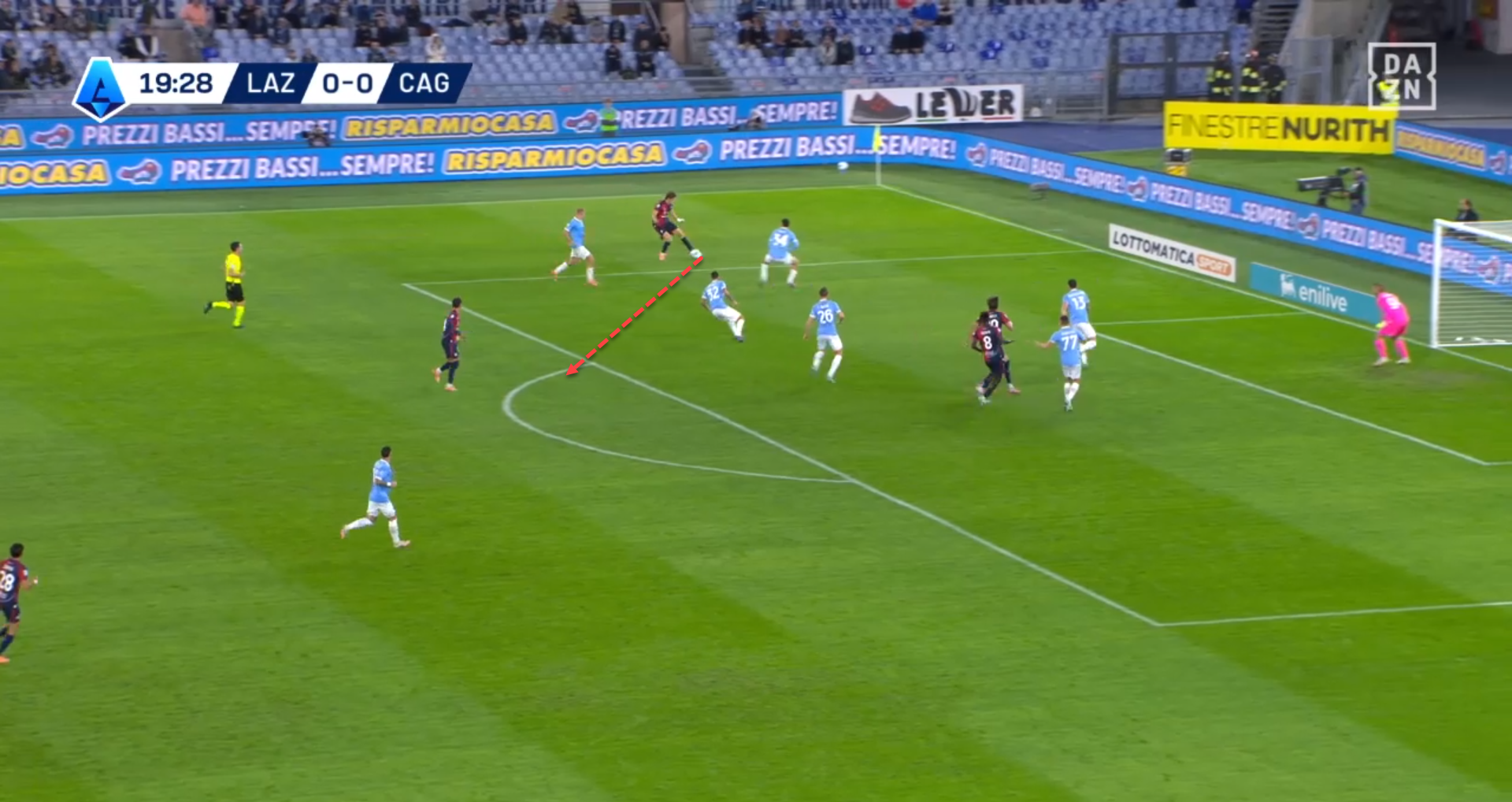
As a right-footed player with excellent left-foot ability, Marco Palestra is well-suited to play as an inverted winger.
The left winger position allows him to exploit his playmaking, acceleration, and dribbling to make the team more dangerous in the final third, as this role provides more opportunities to cut inside and diversify his penetration options.
The following image highlights one of his left-wing penetrations and his use of left-footed passes on that wing when the situation required left-footed play.
Providing key passes from the right or the left wing and using both feet make Marco Palestra’s playmaking threat unpredictable.
Marco Palestra Assist Vs Juventus
One of the things that helped Marco Palestra attract the attention of bigger teams is his ability to perform well against the “big teams” and create a significant threat against their defences.
His performance against Juventus exemplified this, as his attacking input in that game highlighted his ability to disrupt any defence.
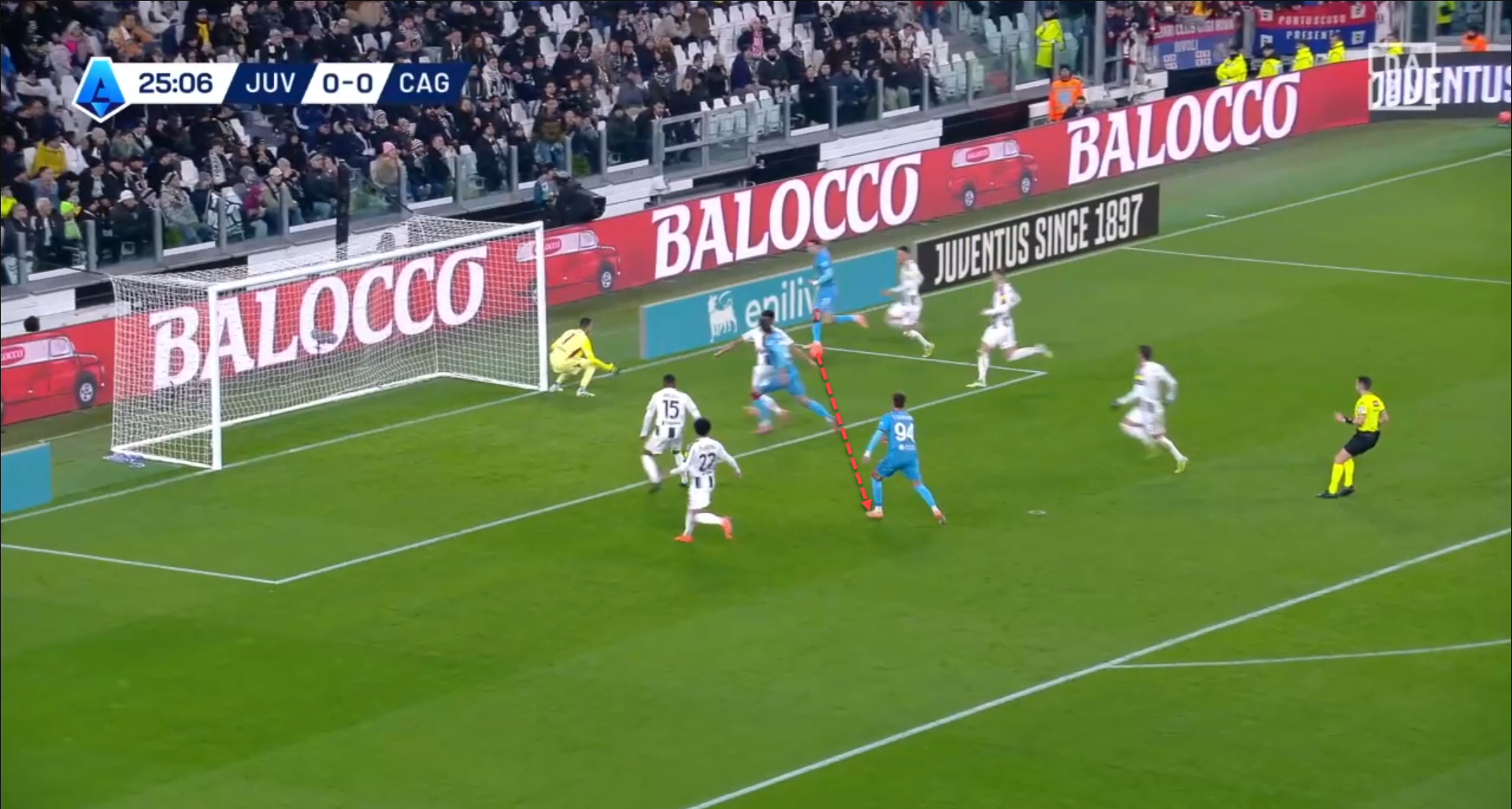
This assist demonstrates Marco Palestra’s excellent penetration and his precise decision-making about when to accelerate and when to pass.
In fact, Marco Palestra consistently demonstrates outstanding passing and crossing while running, delivering accurate, precise passes.
In this action, he surpassed his direct opponent and continued his run until he reached the goal line before providing a pass to his teammate.
Diversifying his penetrations and passing types from that right-wing is something that confirms Marco Palestra’s attacking and playmaking intelligence and makes him less predictable compared to other right-backs who often advance with limited ideas.
Marco Palestra Movements Without The Ball
Marco Palestra is also very useful in attack, thanks to his ability to provide solutions without the ball and to position himself well enough to receive passes in space and use them to make the difference.
Avoiding marking and asking for the ball in space allows Palestra to provide valuable attacking solutions for ball holders and to function as an advanced playmaker or second striker at times.
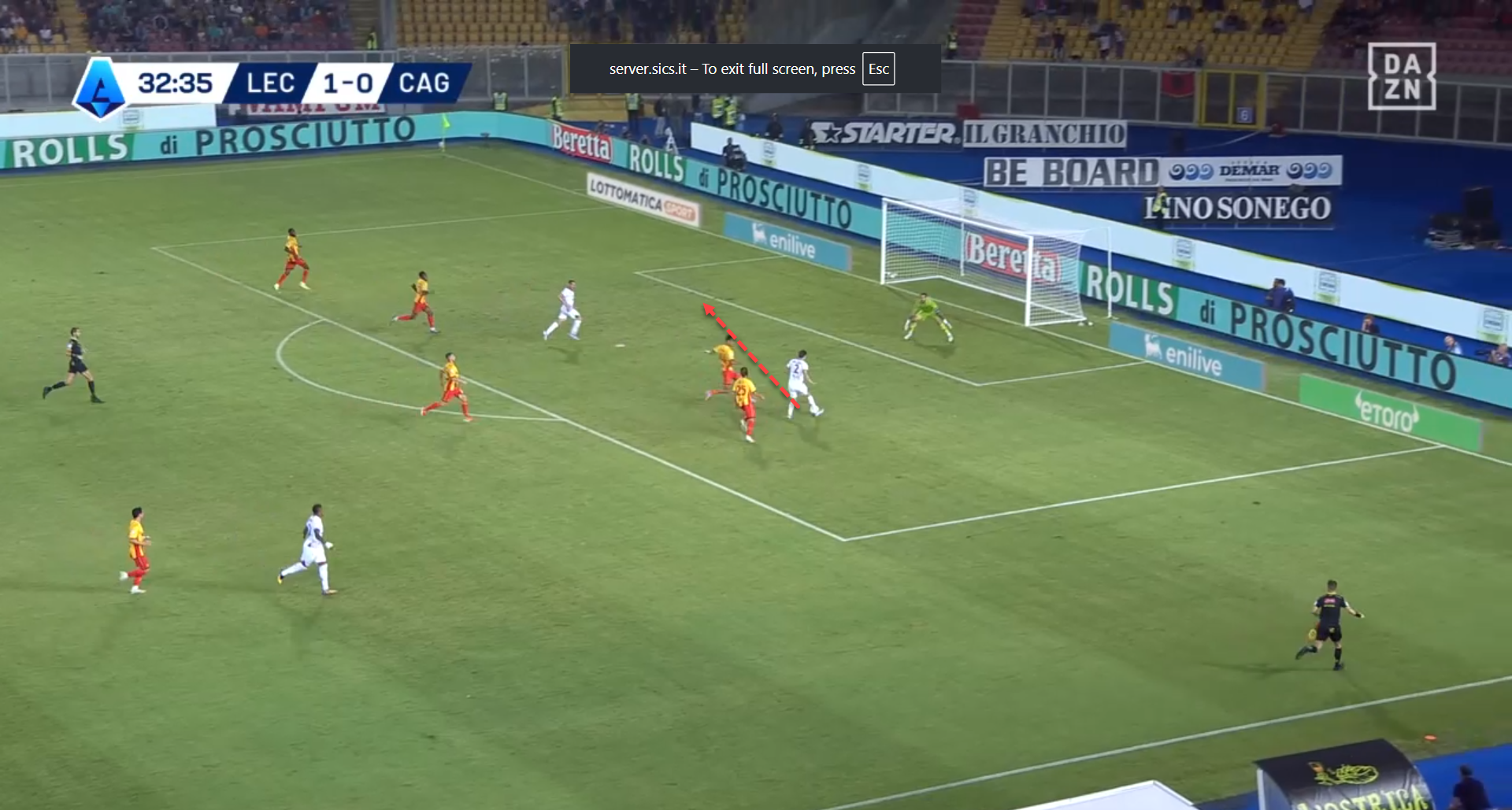
The following assist example highlights his ability to advance internally and ask for the ball in space.
And as soon as he receives the ball inside the box, he continues to run with it and avoids scoring by himself.
Despite the favourable situation, he chose to assist his teammate by drawing both defenders, as he knew his teammate would have a better scoring chance.
This maturity and ability to play for the team through playmaking make Palestra a concrete attacking weapon that can be further improved with consistency and work on his finishing.
Conclusion
Marco Palestra is among the best emerging right-backs in Serie A at the moment.
He needs to ensure consistency and avoid being distracted by the controversy surrounding which team he will be joining next.
Focusing solely on improving his performance for now will be beneficial, as he still needs to work harder on his shooting and finishing to become a more complete player.
Furthermore, improving his defensive numbers will be crucial for him to become a reliable right-back in both defensive and attacking phases.
That said, Palestra can play in other positions, particularly after his next move, as it will not be difficult for him to perform well as a right- or left-midfielder or winger.
