
Arsenal faced Crystal Palace in the EFL Cup quarter-final, and the Gunners qualified for the semi-finals by winning the penalty shoot-out after a 1-1 draw in regular time.
Arsenal looked more dangerous in front of goal throughout the match but were not clinical enough, which prevented them from winning in regular time.
On the other hand, Crystal Palace had few attacking options in this match and were unable to exploit the counterattacking opportunities they created as effectively as they should, which made their mission even more complicated.
Arsenal continue to confirm their excellent season on the results front, topping the league standings while also advancing in other competitions, such as the EFL Cup and the UEFA Champions League.
And for Crystal Palace, getting eliminated by Arsenal was not really a surprise, given that this loss will give them more time to prepare for their crucial Premier League matches, as they will have a less busy schedule.
In this tactical analysis, the aim is to explore why both teams failed to convert their attacking transitions into goals despite creating many counterattacking situations during this match.
The analysis will also look at Gabriel Martinelli’s crucial impact on Arsenal’s attacking performance and how he needs to be further exploited in this regard.
Arsenal Vs Crystal Palace Lineups & Formations
Mikel Arteta preferred to start the match in a 4-3-3 formation, with Kepa Arrizabalaga as goalkeeper, and a defensive line of Riccardo Calafiori and William Saliba as centre-backs, Myles Lewis-Skelly as left-back, and Jurriën Timber as right-back.
The midfield was composed of Christian Nørgaard as a defensive midfielder, and both Mikel Merino and Eberechi Eze as central midfielders.
In attack, he relied on Noni Madueke and Martinelli as wingers, with Gabriel Jesus as the main striker.
On the other hand, Oliver Glasner opted for a 5-3-2 formation, with Walter Benítez in goal and a defensive line comprising Chris Richards (right centre-back), Maxence Lacroix (central centre-back), and skipper Marc Guéhi (left centre-back).
Jaydee Canvot (right) and Tyrick Mitchell (left) played as wing-backs, while the midfield was made up of Adam Wharton, Yéremy Pino, and Jefferson Lerma.
Upfront, Crystal Palace relied on both Edward Nketiah and Jean-Philippe Mateta as the attacking duo.
![Arsenal Vs Crystal Palace [1–1] (8 vs 7 P) – EFL Cup 2025/2026: Failure Of Attacking Transitions – Tactical Analysis](https://totalfootballanalysis.com/wp-content/uploads/2025/12/Arsenal-Vs-Crystal-Palace-1–1-8-vs-7-P-–-Premier-League-20252026-Failure-Of-Attacking-Transitions-–-Tactical-Analysis-1.jpg)
Arsenal & Crystal Palace Failure In Counterattacking Conversion Into Goals
Arsenal started the match with greater ambition and a desire to score, whereas Crystal Palace resisted the Gunners’ continuous attacking threats thanks to their compact defending and counterattacking.
However, Crystal Palace were not clinical enough in converting their few counterattacking actions into goals.
The same applies to Arsenal, who were capable of scoring thanks to their attacking transitions and key passes to Madueke, but failed to do so for the reasons we will focus on below.
In fact, both teams were unable to capitalize on the opportunities in the first half and preferred to wait until the second half, scoring on set pieces instead.
Therefore, both teams will have to work on improving how they deal with counterattacking situations if they would like to keep their chances of winning complicated games high.
It is true that set-pieces are very suitable and rewarding when executed with specific plans and high-quality finishing; however, that does not mean that counter-attacks or open-play chances should be given secondary importance.
Both Arsenal and Crystal Palace could have taken advantage of their attacking transitions if they had used them more efficiently and made fewer rushed decisions, even though Arsenal got away with their numerous missed chances thanks to winning the penalty shootouts.
Arsenal Noni Madueke Missed Counterattacking Action
That said, Arsenal were capable of making things much easier for themselves if they had converted the first chance of the match into a goal, following a ball recovery made inside Crystal Palace’s own half and an excellent through pass from Martinelli into space.
Madueke was good enough with internal movement to meet the ball between two defenders, but was not good at all with finishing, as he made his shooting decision in a rush and without accuracy, despite having the necessary time and space to do so.
This type of chance was recurrent throughout the match, highlighting Arsenal’s failure to convert their quick attacking transitions into goals.
![Arsenal Vs Crystal Palace [1–1] (8 vs 7 P) – EFL Cup 2025/2026: Failure Of Attacking Transitions – Tactical Analysis](https://totalfootballanalysis.com/wp-content/uploads/2025/12/Arsenal-Vs-Crystal-Palace-1–1-8-vs-7-P-–-Premier-League-20252026-Failure-Of-Attacking-Transitions-–-Tactical-Analysis-2.png)
Arsenal Noni Madueke Decision-Making Inside The Box
Arsenal created some very similar situations but executed them poorly, either due to poor shooting decisions or inadequate decision-making inside the box.
Madueke got several goal-scoring chances during the first half but failed to convert those chances into goals mainly due to his inability to surprise the opposing goalkeeper, who predicted the English player’s shooting decisions and was able to anticipate his intentions.
The most remarkable situation occurred at the 21st minute when Madueke received a perfect long pass at the back of the defensive line, but Madueke failed to make the most adequate decision at that moment.
Instead of opting for a first-time shot, he preferred to control the ball and give enough time for the goalkeeper to get out of his goal and restrict most shooting angles as well as prevent Madueke from lobbing it.
![Arsenal Vs Crystal Palace [1–1] (8 vs 7 P) – EFL Cup 2025/2026: Failure Of Attacking Transitions – Tactical Analysis](https://totalfootballanalysis.com/wp-content/uploads/2025/12/Arsenal-Vs-Crystal-Palace-1–1-8-vs-7-P-–-Premier-League-20252026-Failure-Of-Attacking-Transitions-–-Tactical-Analysis-3.png)
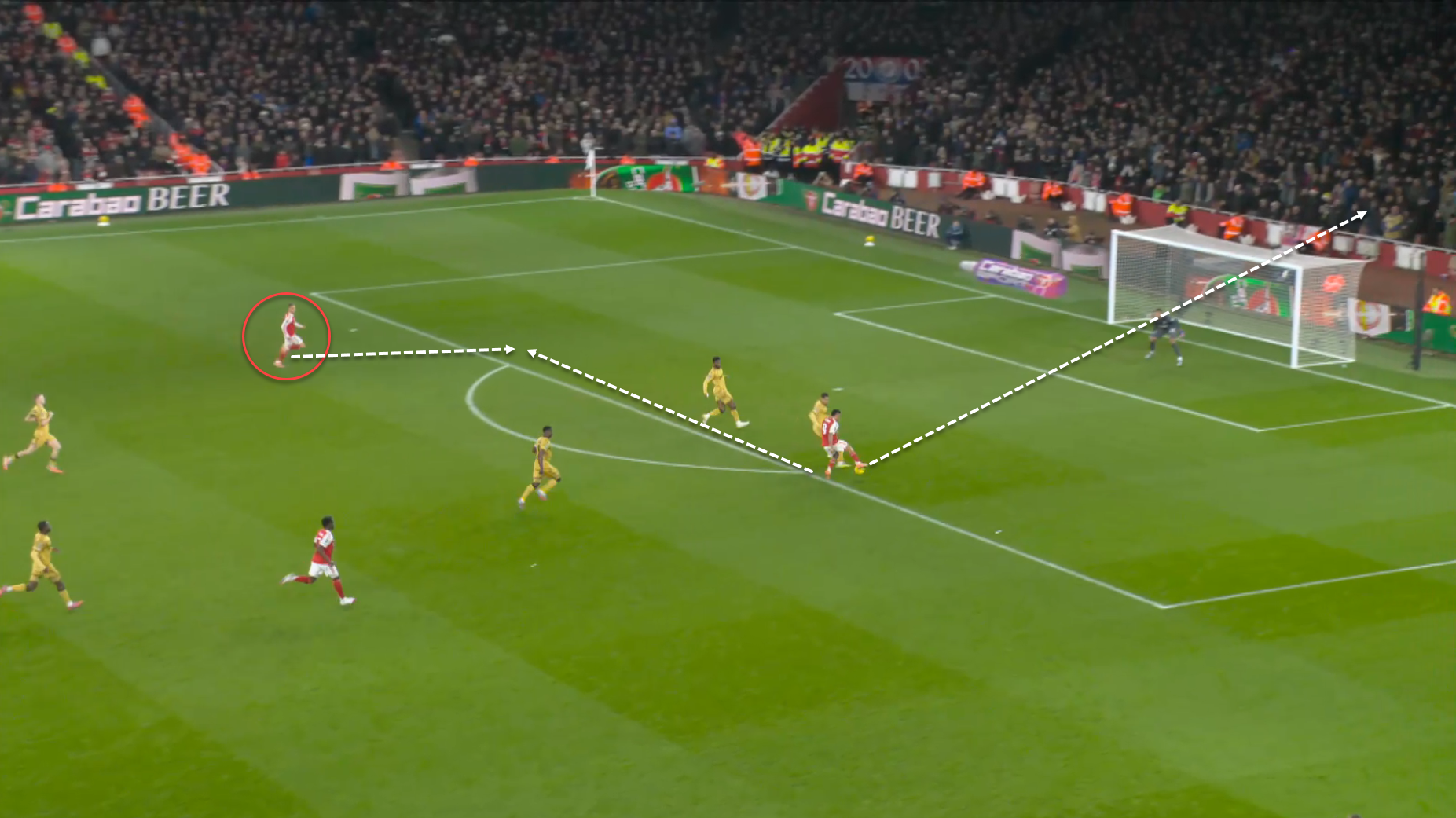
Arsenal Gabriel Jesus Poor Inadequate Decision-Making In Counterattacks
Furthermore, Arsenal continued to create dangerous chances without scoring, which made the issue of goalscoring even more noticeable to anyone watching the game.
The following action created during the second half not only highlights Jesus’ poor shooting finish that went off target, but also underscores that Jesus was capable of making a much simpler yet smarter decision, but was not tactically intelligent enough to do so.
We can say that he was too egotistical to do it as well, because Jesus got the ball in an inviting shooting situation, but as soon as he got it, he noticed he was being marked.
At that moment, Jesus stopped with the ball and could have opted for a through pass to his left to ensure more chances for converting the action into a goal.
However, he decided to go for the more complicated solution.
He shot off target despite knowing that scoring from that situation was difficult due to the tight marking applied to him, as opposed to his completely unmarked teammate.
Crystal Palace Inefficient Decision-Making In 2-v-2 Counterattack
Crystal Palace succeeded in exposing Arsenal’s defence on a few occasions, benefitting from their high defensive block and their desire to score as quickly as possible.
However, they were not crucial enough to convert their created chances into goals, and that’s exactly what prevented them from beating Arsenal in this game.
The following action shows one of Crystal Palace’s most dangerous chances of the match, as Mateta exploited the distant marking of Calafiori and served Mitchell quickly on the left wing.
The movement without the ball from both Mitchell and Nketiah was excellent, as both quickly exploited the space left behind by Mateta.
However, Mitchell’s decision-making during this action was poor: he preferred not to pass to Nketia, who was in a suitable position to receive, and opted for a shot from distance that went off target.
Dealing with 2-v-2 situations (which don’t come up often during games) with that unconvincing, inaccurate decision-making and execution cannot be acceptable for Crystal Palace, as they will need to work further on exploiting such situations more efficiently in the future, especially if they plan to rely on attacking transitions for their upcoming games.
![Arsenal Vs Crystal Palace [1–1] (8 vs 7 P) – EFL Cup 2025/2026: Failure Of Attacking Transitions – Tactical Analysis](https://totalfootballanalysis.com/wp-content/uploads/2025/12/Arsenal-Vs-Crystal-Palace-1–1-8-vs-7-P-–-Premier-League-20252026-Failure-Of-Attacking-Transitions-–-Tactical-Analysis-5.png)
Arsenal Gabriel Martinelli 1-v-1 Abilities & Crossing Solution
The game saw an excellent solo performance from Martinelli, who was exceptional in his duels against Crystal Palace’s defenders throughout.
He was the main source of threat for Arsenal and could have finished the game with more than two or three assists if his passes had been dealt with more clinically.
Martinelli’s performance further confirms that he can be extremely useful in providing attacking solutions to the team, using his pace, one-vs-one dribbling, and, more importantly, his accurate, dangerous crosses into the box and key passes.
Martinelli was the source of more than three concrete goal-scoring situations, and perhaps the most notable was the one Timber missed following Martinelli’s exceptional work from the wing.
The ease with which he surpassed not one but two opponents from the left wing and inside the box highlights the importance of having such a dynamic and dangerous winger within the team.
Martinelli created this goal-scoring situation thanks to his successful penetration and outstanding crossing, opting to play it to Timber, who was unmarked on the far post and did not cross the ball towards the crowded area.
Arsenal can do more to further exploit Martinelli’s dribbling and passing abilities, as they have to be more clinical with headers and finishing in general to avoid missing a high number of chances per match.
![Arsenal Vs Crystal Palace [1–1] (8 vs 7 P) – EFL Cup 2025/2026: Failure Of Attacking Transitions – Tactical Analysis](https://totalfootballanalysis.com/wp-content/uploads/2025/12/Arsenal-Vs-Crystal-Palace-1–1-8-vs-7-P-–-Premier-League-20252026-Failure-Of-Attacking-Transitions-–-Tactical-Analysis-6.png)
Conclusion
Arsenal succeeded in qualifying for the next round thanks to a penalty, but deserved the qualification more than Crystal Palace, mainly thanks to their superior number of created goal-scoring chances.
Goal-scoring teams will have to reconsider how they finish their created actions and work on improving their finishing accuracy in front of the goal, especially during counterattacks, as that’s what limited both sides in this match.
