
Jay Stansfield is a player who’s had real pressure on his shoulders from a young age and learned quickly how to deal with it.
Growing up around senior football through his father, the late Adam Stansfield, meant he was exposed to the realities of the game early, not just the academy version.
That grounding shows in how naturally he’s taken to men’s football.
After coming through Exeter City’s academy, he moved to Fulham at 16 and picked up first-team minutes while still a teenager.
The turning point came when his loan was repaid to Exeter.
Wearing his father’s retired number 9 brought a lot of attention, but instead of it becoming a distraction, he delivered.
Goals, intensity, and a real sense of responsibility defined that spell and set the tone for the next stage of his career.
His move to Birmingham City followed the same pattern.
What started as a loan quickly turned into something more substantial.
He became a key figure, earned the club’s Player of the Season award, and eventually secured a record permanent transfer.
His contribution in a title-winning, promotion campaign underlined that his progress was built on performance, not narrative.
At the international level, Jay Stansfield has continued to move step by step through England’s youth sides, earning minutes in high-stakes matches and showing he can handle top-level environments.
This Jay Stansfield scout report and player analysis will take a closer look at his journey from Exeter to Birmingham, his development since leaving Fulham, and the qualities that suggest he is a forward capable of operating at a higher level as his career progresses.
Jay Stansfield Stats
This pizza chart paints him as a clearly attack-minded, mobile attacker rather than a linking or aerial reference point.
Jay Stansfield Pizza Chart 2025/2026

His output in front of goal is solid, with goal contribution per 90 in the 74.5th percentile, shots per 90 at 70.4, and xG contribution per 90 at 66.65, showing he consistently gets into shooting positions and contributes directly to end product, even if the chances are more volume-based than elite quality.
He stands out as an attacking support/forward with the ball at his feet, posting a 78.0 percentile for dribbles per 90, which supports an attacking profile who attacks channels, pulls wide, and can beat defenders rather than playing fixed between centre-backs.
Off the ball, his work rate is a real strength, with a defensive duels per 90 percentile of 87.1 and a respectable 60.6% success rate, making him useful in pressing systems.
Where the profile drops off quite a bit is in build-up and physical presence: his passes per 90 (14.5 percentile), pass accuracy (8.5 percentile), and dangerous passes per 90 (8.5 percentile) confirm he offers very little as a connector or creator, while his aerial duels per 90 (15.9 percentile) and especially aerial duels won (2.1 percentile) underline that he is not the optimal option for long balls or crossing-heavy teams.
Overall, the data support an offensive profile best suited to high-tempo, vertical sides that value movement, pressing, and shot volume, rather than teams asking their number nine to link play or dominate physically.
Jay Stansfield Style Of Play
Jay Stansfield is a movement-led striker who plays off space rather than contact.
He’s at his best when the game has rhythm and verticality, using smart positioning, channel runs, and late arrivals in the box to get on the end of actions.
He suits being the lone forward in a 4-3-3 or 4-2-3-1, especially with natural width around him and midfielders willing to support from deep, as it allows him to stay high and focus on attacking the penalty area.
He can also operate in a two-striker setup, but works better next to a physical reference who can occupy centre-backs and free him to attack gaps.
A little slower, possession-heavy systems that ask the striker to constantly drop in and link play don’t play to his strengths.
He’s more effective in teams that attack quickly, play forward early, and give him space to exploit with his movement and timing.
Jay Stansfield Finishing
Jay Stansfield’s shooting technique is one of the strongest parts of his game and clearly underpins his confidence as a quality offensive power.
He strikes the ball cleanly off both feet, with good balance through contact, allowing him to shoot early and from different body positions without needing a perfect setup.
He’s comfortable finishing first time, especially off cut-backs or loose balls in the box, and shows good coordination when attacking balls in the air, timing his strikes rather than snatching at them.
From mid-range, he generates power without a big backlift and is willing to shoot through traffic, trusting his technique to get the ball away quickly.
He’ll also attempt longer-range efforts when space opens up, which speaks to his belief in his strike rather than forcing an extra pass.
Overall, he looks like a striker who backs his shooting ability, doesn’t shy away from responsibility, and has the technical base to create and execute chances for himself rather than relying solely on service.
— Footie Clips (@FootieClips) December 16, 2025
Jay Stansfield Dribbling
Jay Stansfield Work Rate
His work rate stands out in a more honest, functional way.
He works hard off the ball, presses with intent, and doesn’t drift through games waiting for chances.
You see him closing down centre-backs, curving his runs to cut off simple passes, and forcing defenders to make decisions quicker than they want to.
When possession is lost, he reacts fast and is willing to do some of the dirty work, whether that’s tracking back, contesting second balls, or occupying defenders to help others reset.
He keeps his intensity over 90 minutes and doesn’t shy away when the game turns physical or messy.
Even when he’s not getting much service, he stays connected to the game through effort and movement, which makes him dependable for coaches who want a striker that contributes without the ball, not just one who waits in the box.
Jay Stansfield Weaknesses
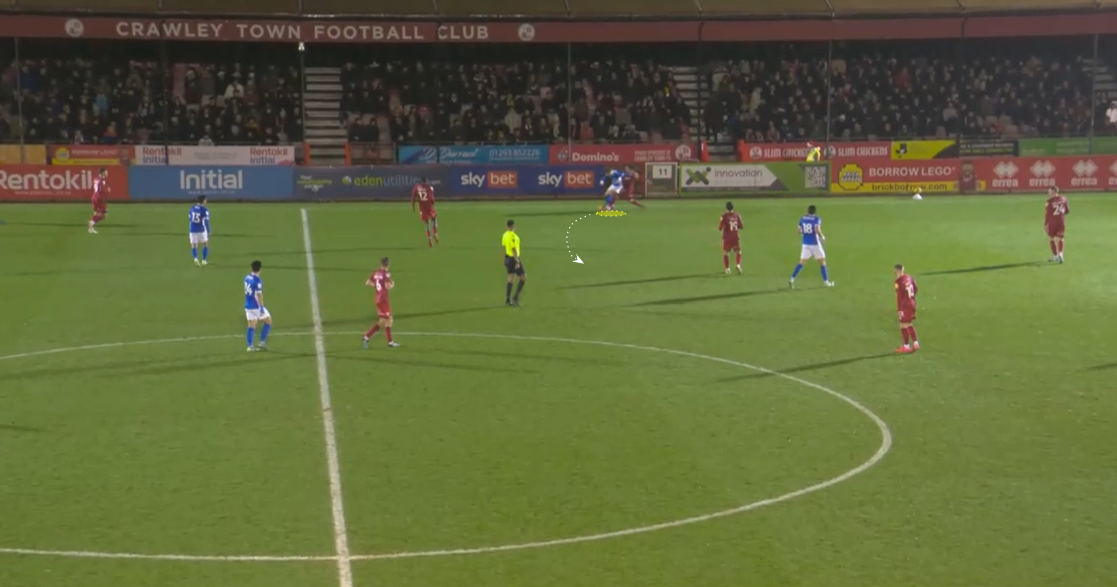
His weaknesses mainly come out when he’s asked to do more than attack space and finish moves.
He isn’t a natural link attacker and can drift out of games when his team has long spells of possession, offering limited support between the lines.
With his back to goal, he can struggle to hold defenders off, which makes it harder for his side to build through him or relieve pressure.
He also doesn’t give you much in the air, relative to his decent height.
When chances fall to him in crowded areas, he can rush decisions rather than take an extra touch.
I would say he’s less effective in tight, physical matches with little space, and more dependent on the team creating the right conditions around him rather than forcing his own influence.
Conclusion
Jay Stansfield profiles as a striker with a defined usage case rather than a universal solution.
His value comes from what he does without the ball as much as with it: attacking space aggressively, pressing well, and sustaining intensity across phases.
He consistently looks to destabilise defensive lines through movement and timing rather than through hold-up play or aerial dominance.
That clarity in profile is important.
He’s not half-formed, he’s specialised.
Stylistically, the Jamie Vardy comparison could make sense in terms of mentality and match approach.
Like Jamie Vardy, Stansfield plays on instinct, momentum, and confrontation.
He wants defenders turning, retreating, reacting.
Technically and development-wise, the closer reference is Ollie Watkins.
Watkins followed a similar path: initially movement-heavy, limited as a connector, then gradually improving his back-to-goal work and link play without sacrificing intensity.
Jay Stansfield has the same physical base and mobility to follow that trajectory if coached correctly.
From a systems perspective, he fits best in high-tempo, vertical teams that prioritise early forward passes, wide penetration, and aggressive counterpressing.
He could function as a lone striker, provided there is creative support behind him, or alongside a more physical partner in a two-man front, where his running can be maximised.
Slower possession-based sides that rely on their number nine to dictate the rhythm or dominate the air will expose his limitations.
At Premier League level, his current profile may align more with lower-table sides than with established possession-dominant teams, in my opinion.
He’s not ready to be a focal point, but he is already capable of contributing in structured roles where his strengths are protected and amplified.
If his link play and physical efficiency improve even marginally, his ceiling rises significantly.