
Arsenal took on Manchester City in the 2025/2026 EFL Cup Final at Wembley Stadium.
The Cityzens came out on top with a score of 0-2; Nico O’Reilly scored the two goals, both headers.
Man City were heavily dominant in terms of ball possession, also generating 2.29 expected goals to Arsenal’s 1.12.
The former’s pressing structure significantly influenced the possession statistics.
They were evenly matched in shots taken (10-10) and big chances (3-3), but Man City were more clinical.
In this tactical analysis, we will discuss Manchester City’s pressing structure, attacking ideas, and areas of struggle.
Arsenal Vs Manchester City Formations & Lineups
First, we’ll run through how Mikel Arteta and Pep Guardiola fielded their squads.
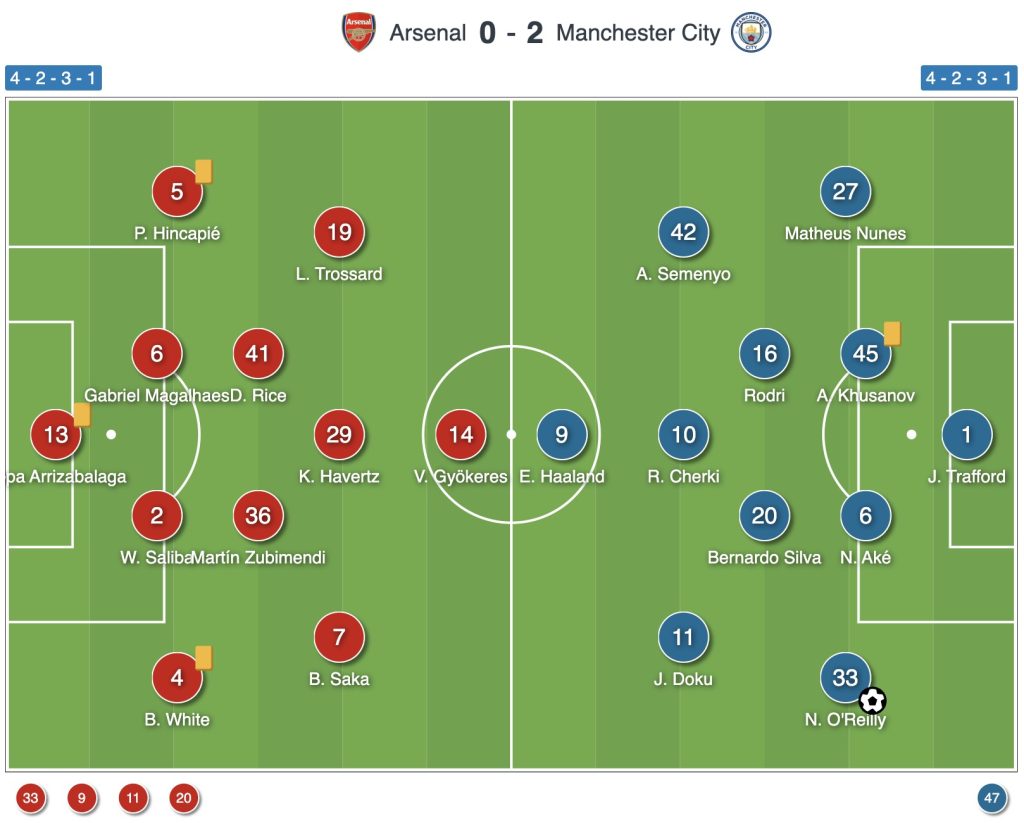
Arsenal played in a 4-2-3-1 formation.
Kepa Arrizabalaga started in goal.
The back four were Ben White (right-back), William Saliba (right centre-back), Gabriel Magalhães (left centre-back), and Piero Hincapié (left-back).
White and Hincapié were replaced by Gabriel Jesus (82’) and Riccardo Calafiori (65’), respectively.
Martín Zubimendi and Declan Rice played as the double pivot.
Skipper Bukayo Saka (right) and Leandro Trossard (left) played as the wingers; Kai Havertz operated as the attacking midfielder, behind the striker Viktor Gyökeres. Havertz and Trossard were substituted by Noni Madueke (66’) and Gabriel Martinelli (82’), respectively.
Man City played in a 4-2-3-1 formation.
James Trafford started between the sticks.
The back four were Matheus Nunes (right-back), Abdukodir Khusanov (right centre-back), Nathan Aké (left centre-back), and Nico O’Reilly (left-back).
Rodri and skipper Bernardo Silva played as the double pivot.
Antoine Semenyo (right) and Jérémy Doku (left) played as the wingers; Rayan Cherki operated as the attacking midfielder behind the striker Erling Haaland.
Cherki made way for Phil Foden (90’).
Manchester City Defending Tactics
Pep Guardiola deployed a new pressing strategy for this fixture, keeping in mind the way Arsenal prefer to progress the ball.
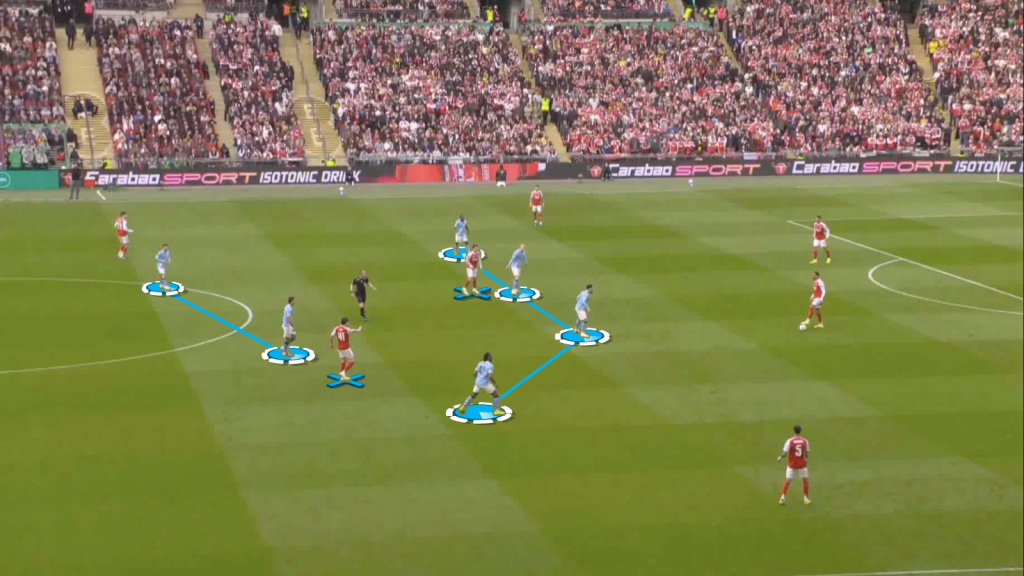
Man City maintained a 4-2-4 defensive shape in the opposition half.
They did not initiate an aggressive press; instead, they remained passive during Arsenal’s dynamic build-up.
The front four stayed compact, allowing no space for vertical passes through the central channel.
The aim was to keep Rice and Zubimendi out of the action for as long as possible; to progress the ball, the Gunners were forced to go around the block.
The only way was to find the full-backs and progress the ball from there.
Man City were prepared for situations when the ball went to the wide area.
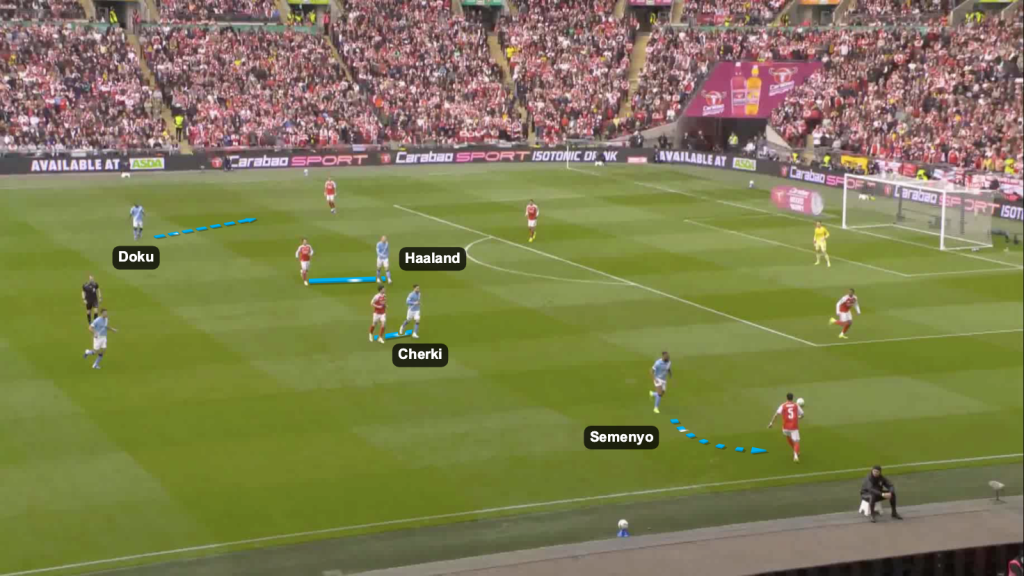
Haaland and Cherki, who stayed central, refrained from pressing the Arsenal centre-backs; they marked the pivots.
Meanwhile, when the ball went to the wide channel, Doku or Semenyo engaged in pressing by curving their run to prevent the pass down the line.
There were multiple situations where the wide City players anticipated a pass from a centre-back to the full-back.
The wide players started curving their runs earlier to take the full-back out of the game.
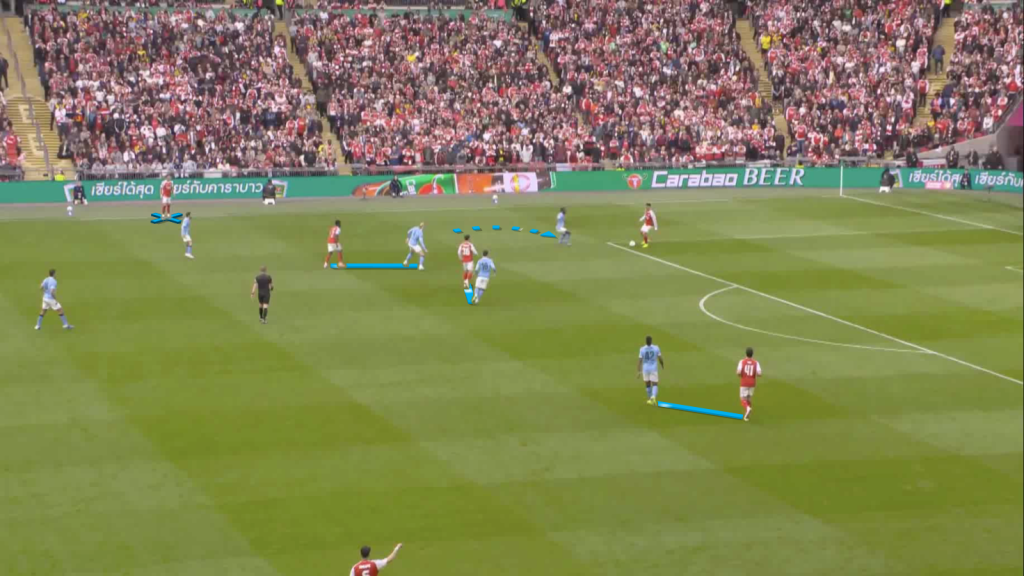
Doku curves his run to cut the pass to the full-back.
The centre-back is forced to play it back to the goalkeeper or go long.
This worked in situations where Haaland and Cherki did well to track Arsenal’s pivots.
Although they executed this pressing strategy quite well, there were scenarios where Arsenal squeezed in a few vertical passes into the half-spaces.
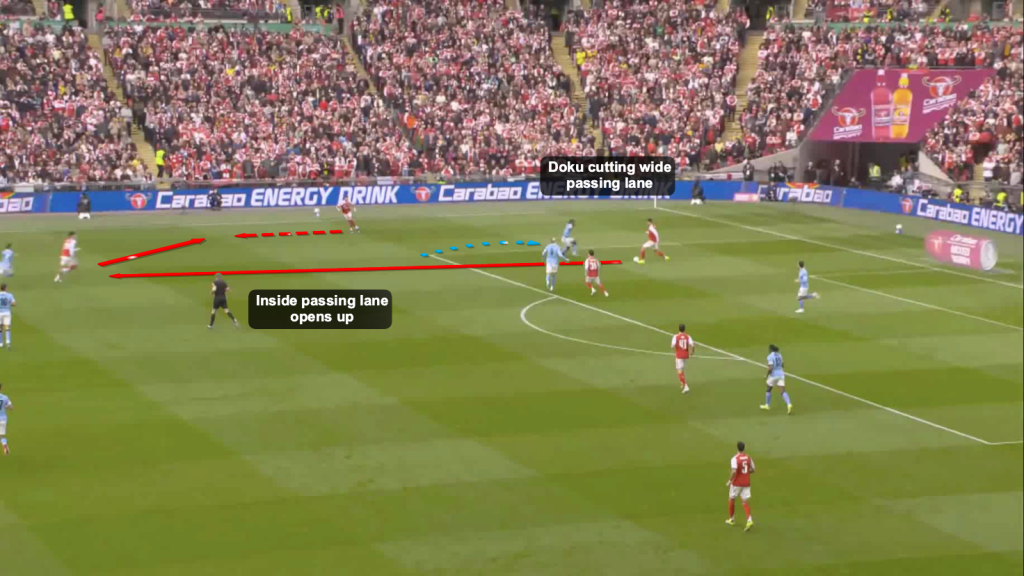 Haaland and Cherki track the pivots, and Doku curves his run to cut the wide passing lane.
However, Man City are late to track the attacking midfielder dropping into the half-space.
The Gunners execute an in-to-out pass to progress the ball; the full-back gets involved as the third man in the combination.
Man City fixed these lapses in concentration by keeping the second line of press closer to action.
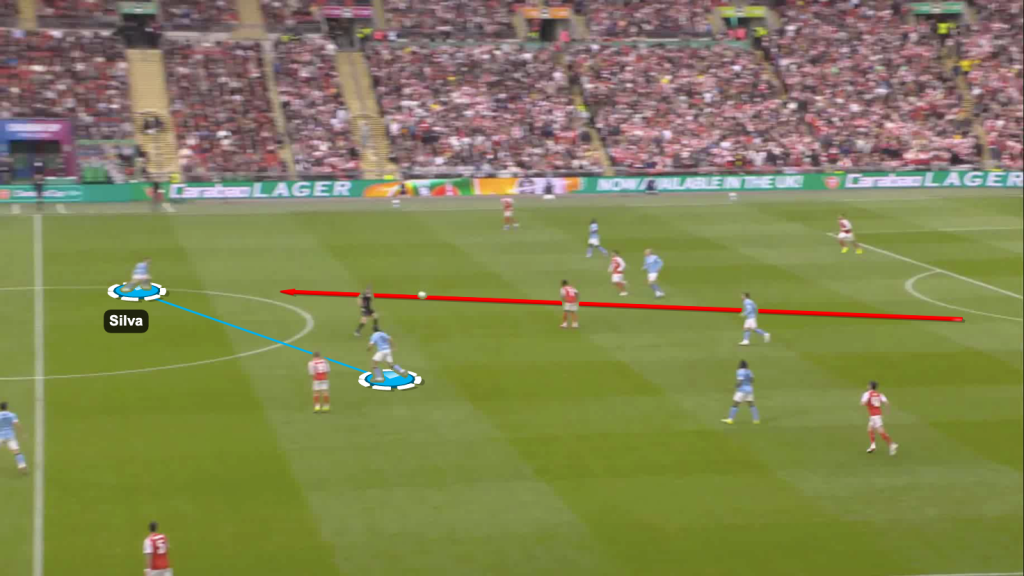
Arsenal manage to break City’s first line, but the pass is intercepted by Silva, who is a part of the second line, alongside Rodri.
Arsenal also repeatedly attempted to make positional rotations to achieve some build-up success.
However, City were efficient in dealing with the changes.
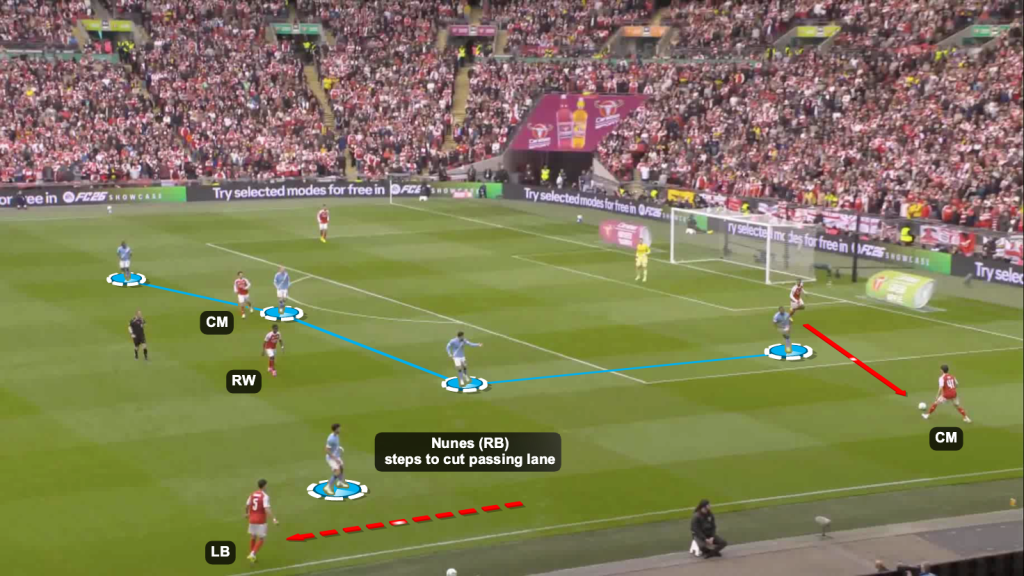
Rice (CM) peels wide to receive outside the structure; meanwhile, Hincapié (LB) moves up the pitch.
Additionally, Saka (RW) also dropped into the midfield to add numbers in build-up.
Man City dealt with this by pushing Nunes (RB) up.
This adjustment cut the forward pass, thereby suffocating Arsenal once again.
The Cityzens initiated aggressive press when Arsenal made static starts to their build-up.
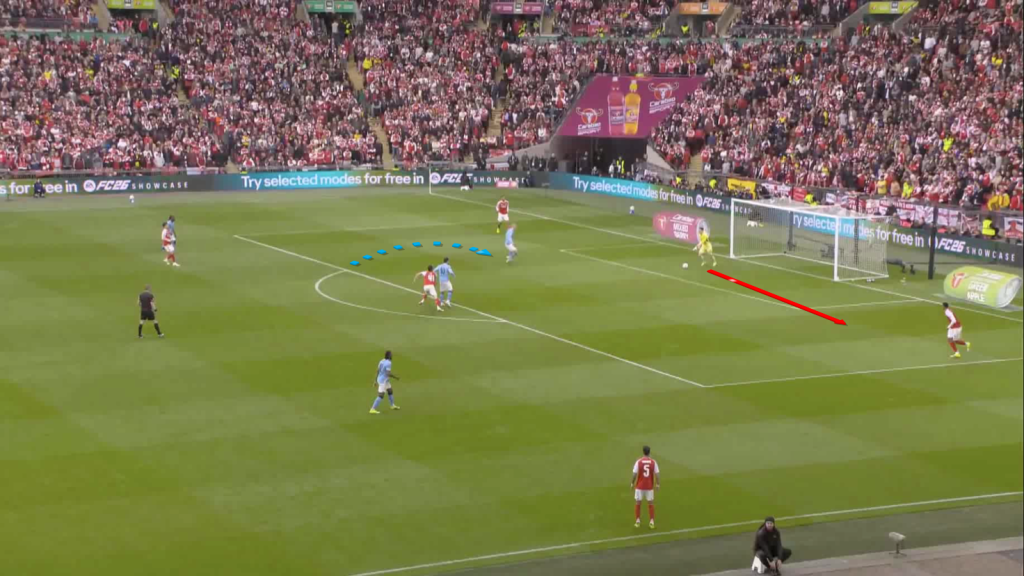
The objective was to force the ball to one side before squeezing the opposition in the wide area.
This usually resulted in rushed long balls, which were routine for Guardiola’s side to claim.
Meanwhile, Man City were guilty of getting caught flat-footed in their press at times.
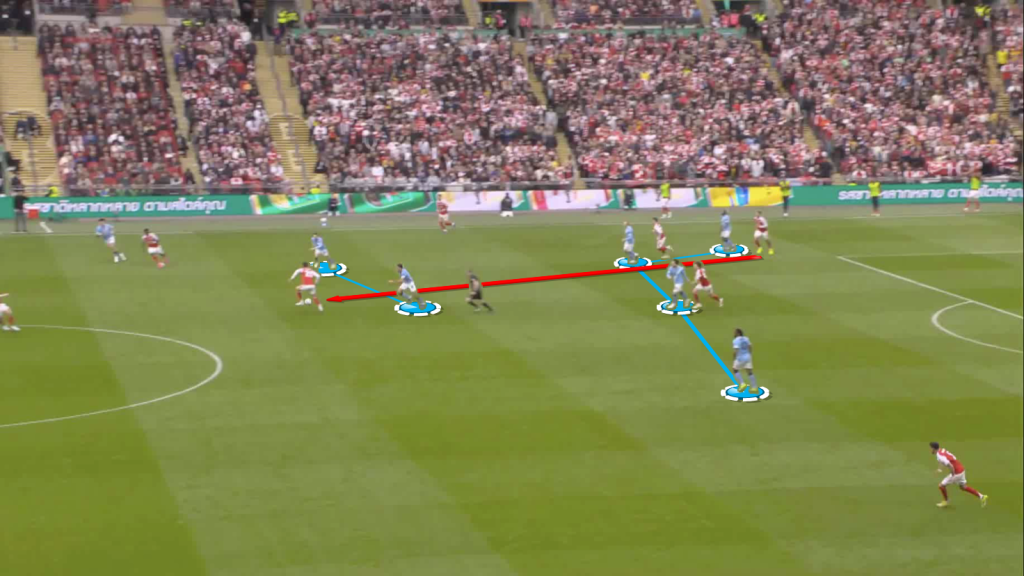
The Arsenal centre-backs managed to play some line-breaking passes into the midfield third, sometimes penetrating two lines at once.
Although it was not the most common sight, Arsenal found passes inside City’s structure in the attacking half as well.
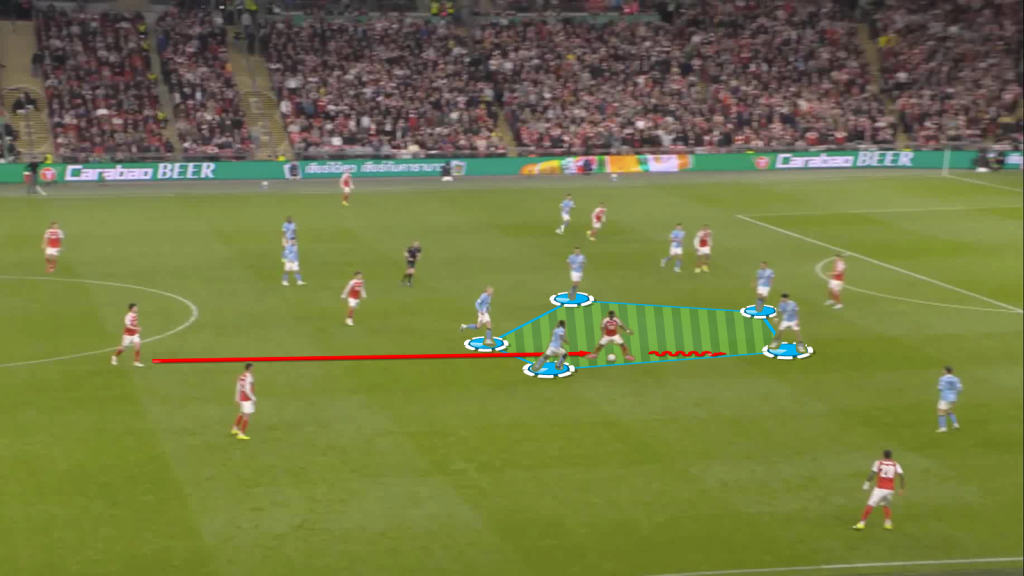
Madueke receives a vertical pass inside a pocket of space and immediately turns to drive with the ball and make a box entry.
Arsenal were unfortunate not to get more shots on target.
One of the shots on target came early in the first half.
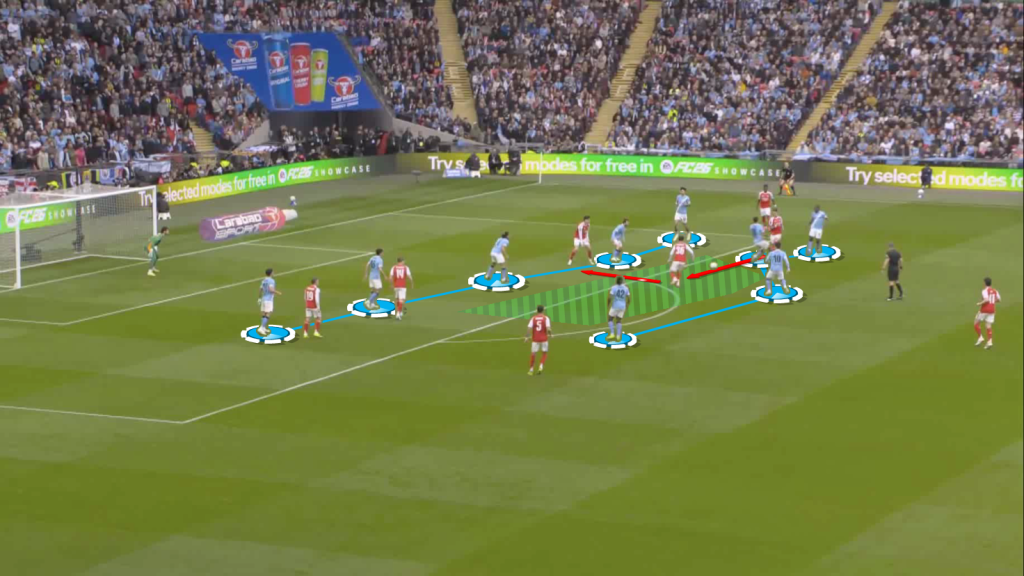
Man City left some space between the lines in the defensive third.
The opponents played a quick third-man combination to penetrate via zone-14 and get the ball in-behind for a close-range shot, which is saved by the goalkeeper.
This happened because Silva joined the back line, and Rodri stepped aggressively, only to get beaten by a pass.
Thus, there was nobody to occupy zone 14.
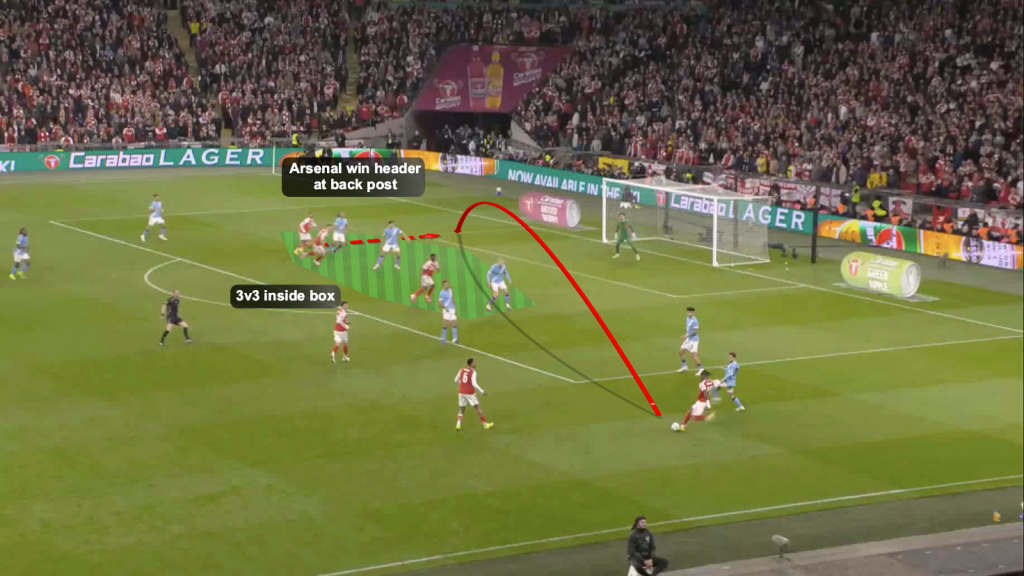
After taking the two-goal lead, Man City lifted their foot off the pedal, which left them at least slightly vulnerable defensively.
Arsenal got a cross into the back post; the situation inside the box is a 3v3, which was not favourable for the defending team.
Arsenal ended up winning the first contact, which could have been costly.
Long balls from slightly deeper were not defended convincingly at times.
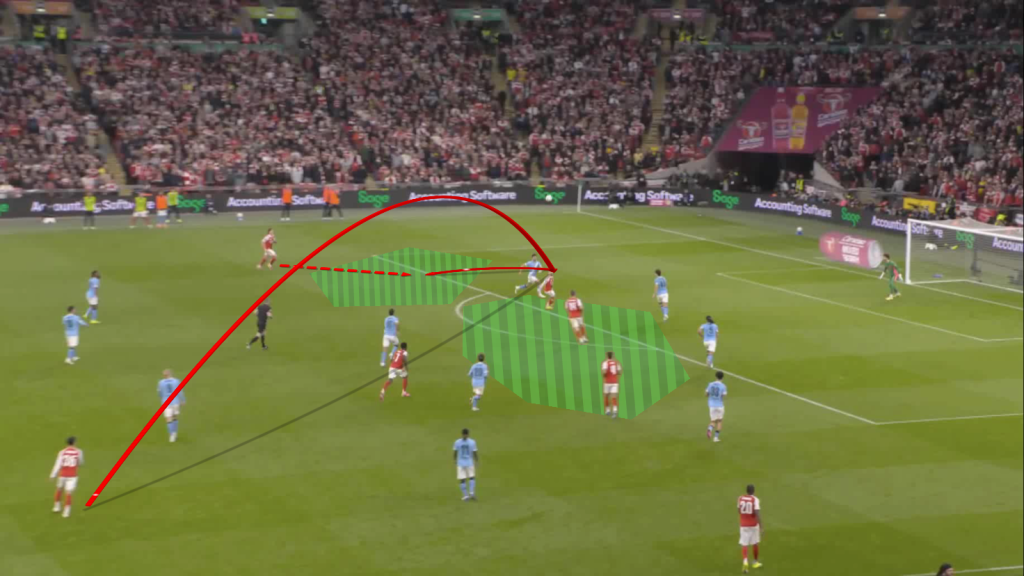
Another situation towards the end of the game.
Arsenal play a long ball from the middle third.
To react, Man City’s backline drops; however, the midfielders are slow to drop.
The initial runner flicks the ball for the wide player arriving late.
Since City’s midfield line did not drop to cover the space at the edge of the box, the second ball fell kindly for Arsenal.
The eventual shot went just shy of the far post.
Manchester City Attacking Tactics
During the build-up, Man City had one of the pivots drop between the centre-backs to offer numerical superiority in the first phase.
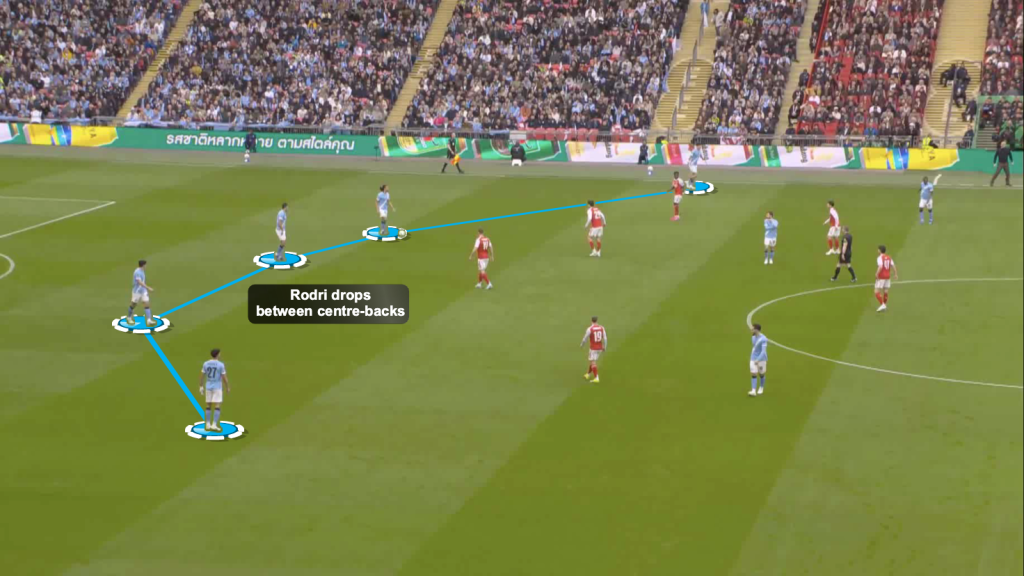
Rodri drops between the centre-backs; City’s resulting shape is a back five.
Meanwhile, Silva stays inside the structure.
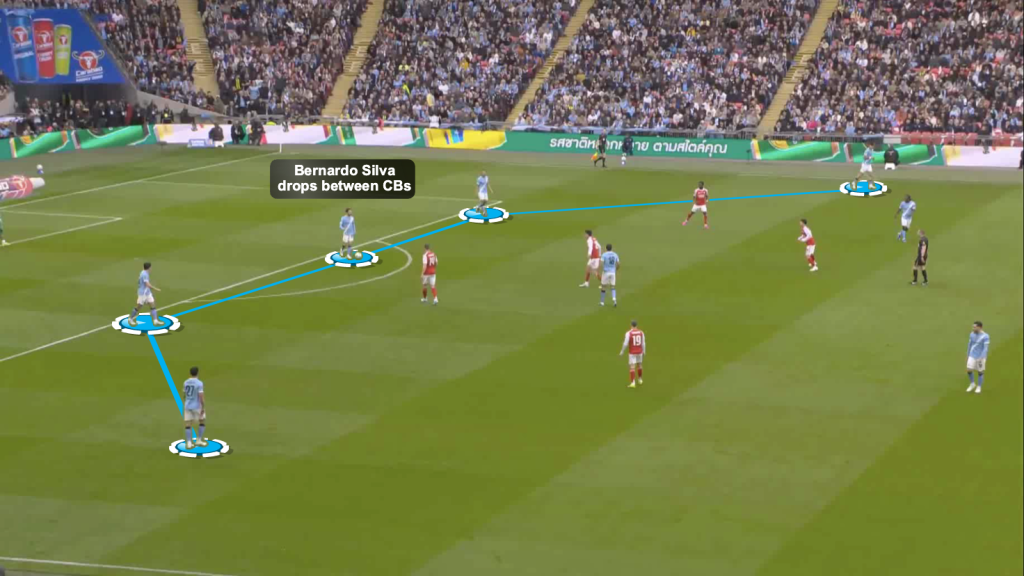
Similarly, Silva drops outside the structure to form a back five.
In this situation, Rodri stays inside the structure.
With the numbers outside the structure, Arsenal had a lot of ground to cover to block line-breaking passes from different angles.
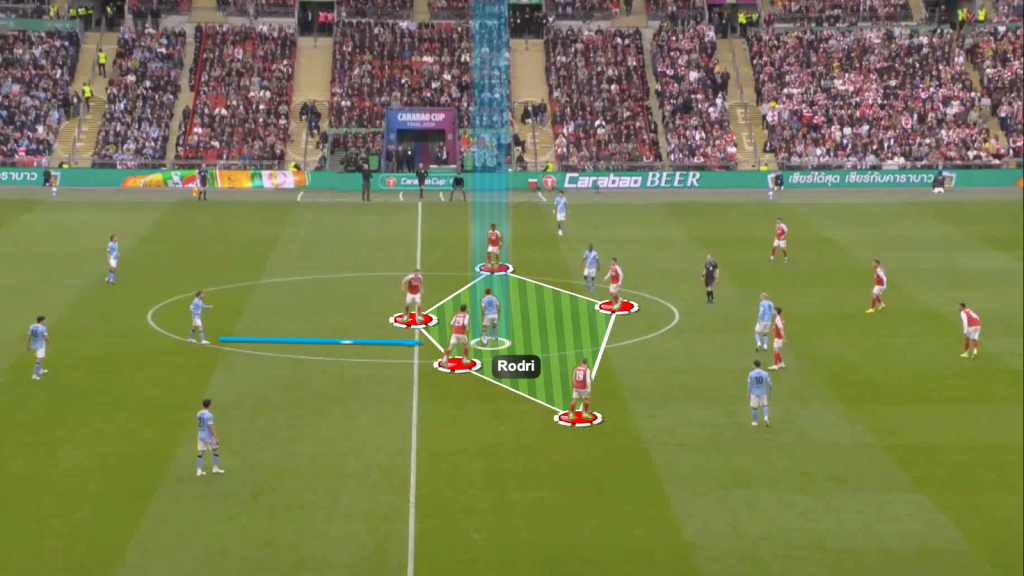
Rodri and Silva were efficient enough to receive inside the structure and move it forward.
Man City managed to frequently switch between playing through the structure or around it.
This kept Arsenal guessing and anticipating.
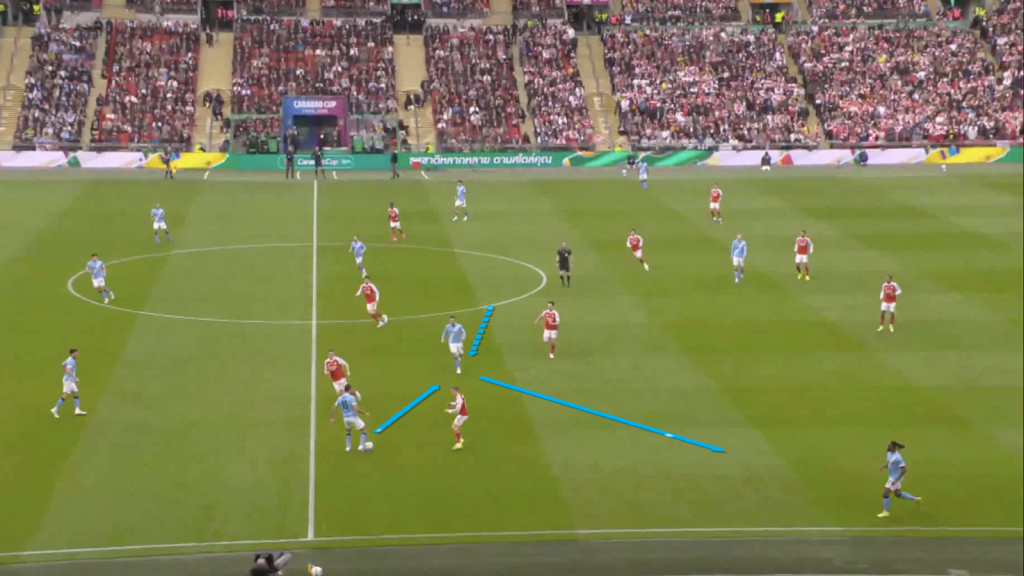
Man City played multiple in-to-out passes to bypass pressure.
Cherki arrives in the half-space to play a one-touch pass to Semenyo.
Upon reaching the middle third, Man City were in a 3-2-5 shape with the ball.
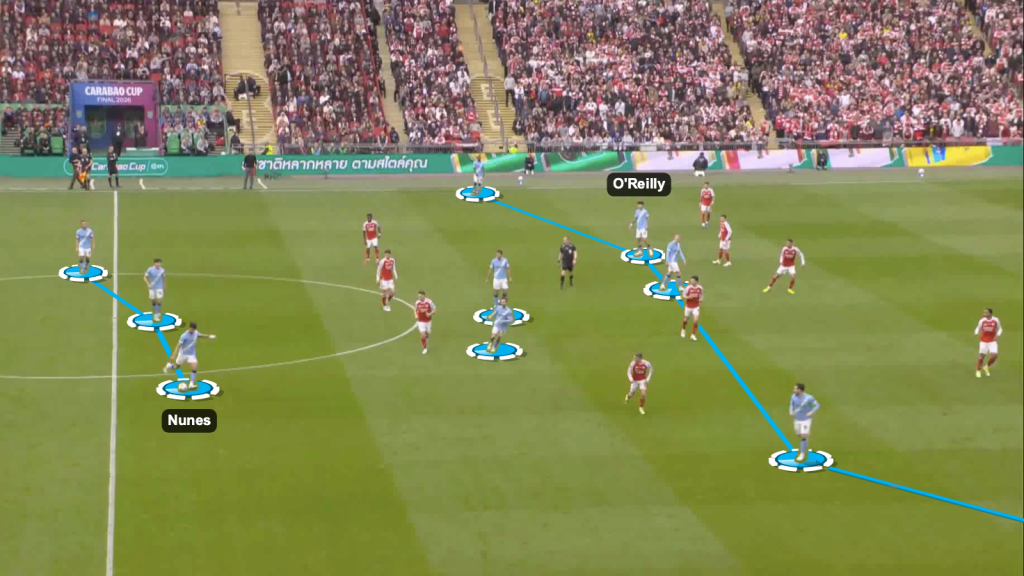
Nunes (right-back) stayed deep to complete the back three; meanwhile, O’Reilly pushed up to occupy either the wide channel or the half-space.
With five attackers, City had at least one player in each vertical channel.
While some players maintained a fixed position, others had the license to roam.
Cherki’s movements created confusion for the opposition.
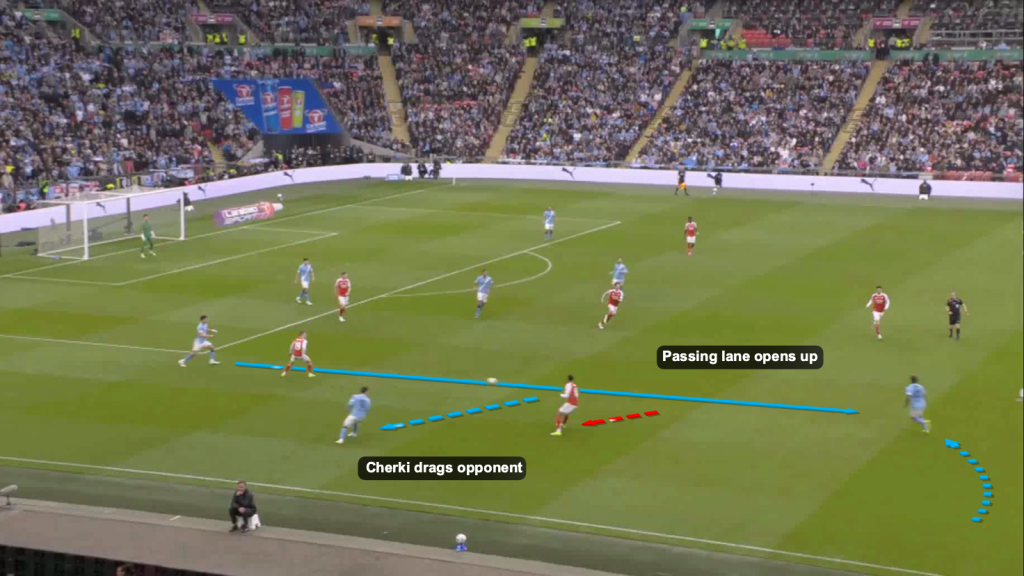
The Frenchman drifts to the wide channel, dragging an opponent with him.
This opens the passing lane in the half-space.
Simultaneously, Semenyo moves infield, receiving the vertical pass.
Man City’s positional rotations helped them move the ball forward effectively.
Silva was one of the players moving in and out of the structure.
As mentioned earlier, he dropped outside the structure to increase numbers in the build-up; similarly, he also moved up the pitch to increase numbers in attack.
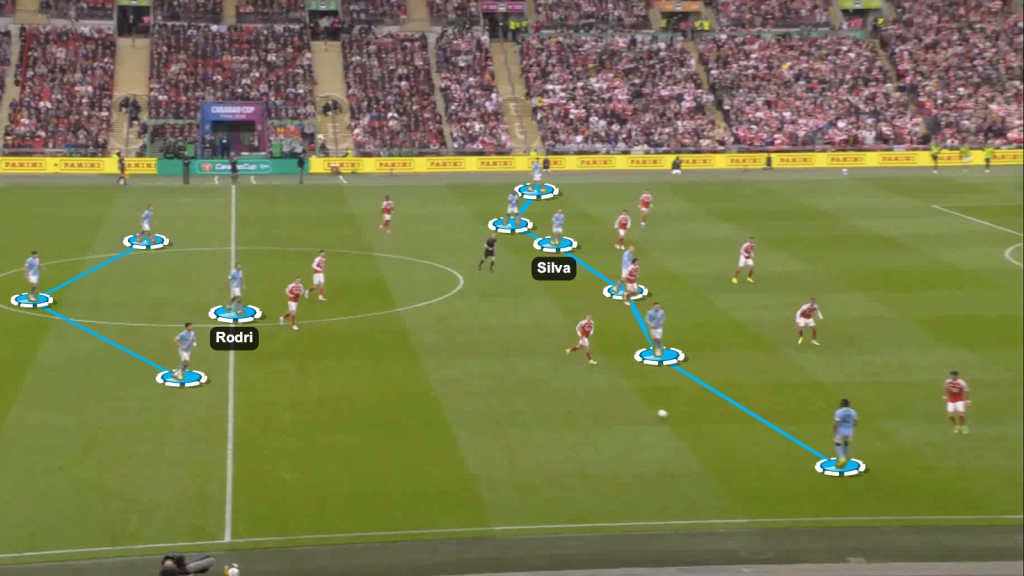
When Silva moved up, Man City’s shape changed to a 3-1-6.
All six of these attackers frequented the final third and contributed to 52 final-third entries and 24 touches in the opponent’s box.
O’Reilly’s positioning and movement crucially influenced the game.
The Englishman, although deployed as a full-back, was frequently seen operating in the half-space.
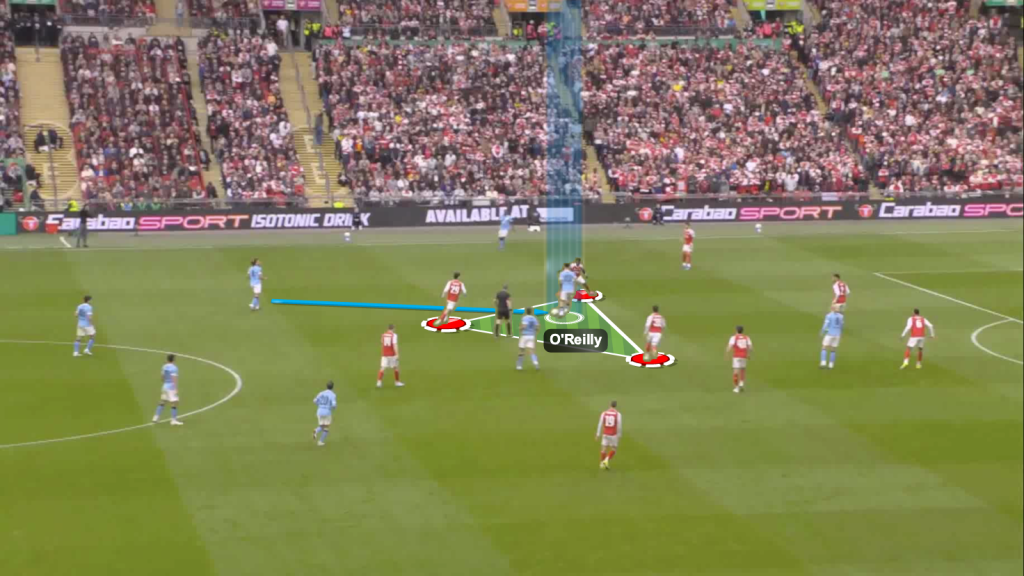
O’Reilly receives in a pocket in the half-space.
Additionally, he was also seen making late box arrivals, two of which yielded goals.
The moment Rodri switches play to Silva, O’Reilly starts making his way into the box.
Cherki makes an underlap to receive the through pass; he finds enough space to get a cross in.
Man City end up being fortunate, as the ball is spilt by the goalkeeper.
O’Reilly is present in the correct situation to guide it in with a header.
The second goal was another well-crafted one.
As the ball reaches the wide players, they are quick to create a 2v1 overload to exploit the space in-behind.
Once the options inside the box drag the Arsenal centre-backs, which opens enough space without him, O’Reilly attacks that with intent and momentum, and finds the back of the net.
Conclusion
Manchester City altered their pressing shape to a flat 4-2-4, with the front four staying deeper, cutting the inside passing lanes, and refraining from pressing the opposition centre-back.
Additionally, they usually cut passes to and from the Arsenal full-backs by City’s wide players curving their pressing runs.
Offensively, Man City did just enough by committing numbers up front.
With some players popping in and out of spaces, City had variation in the way they moved the ball, which kept their opponent guessing.
O’Reilly’s half-space and box presence made the difference, as the full-back scored two goals by virtue of his movement and positioning.
