Total Football Analysis
Once.Sport
  • Football Analysis
    • Data Analysis
    • Formations
      • 2-2-4 Formation
      • 2-3-5 Formation
      • 3-1-4-2 Formation
      • 3-2-2-3 Formation
      • 3-2-4-1 Formation
      • 3-1-6 Formation
      • 3-3-4 Formation
      • 3-4-1-2 Formation
      • 3-4-2-1 Formation
      • 3-4-3 Formation
      • 3-5-1-1 Formation
      • 3-5-2 Formation
      • 4-1-4-1 Formation
      • 4-2-2-2 Formation
      • 4-2-3-1 Formation
      • 4-2-4 Formation
      • 4-3-1-2 Formation
      • 4-3-3 Formation
      • 4-4-2 Formation
      • 4-5-1 Formation
      • 5-3-2 Formation
      • 5-4-1 Formation
      • 6-3-1 Formation
    • Head Coach Analysis
    • Match Analysis
    • Player Analysis
    • Recruitment Analysis
    • Set Piece Analysis
    • Tactical Theory
    • Tactical Preview
    • Team Analysis
    • Training Analysis
    • Tactical Analysis
    • Scouting Report
  • Competition
    • ALL Competitions
    • English Premier League
    • Champions League
    • La Liga
    • Bundesliga
    • Serie A
    • Ligue 1
    • Eredivisie
    • EFL Championship
    • FIFA World Cup 2022
    • WEURO 2022
    • Women’s Super League
    • NWSL
    • Belgian First Division A
    • A-League
    • Liga Profesional de Argentina
    • Austrian Bundesliga
    • Campeonato Brasileiro Série A
    • DFB Pokal
    • 1. HNL
    • Danish Superliga
    • EFL League One
    • EFL League Two
    • FA Cup
    • EFL Cup
    • Indian Super League
    • K-League
    • J1 League
    • Liga MX
    • Copa América 2021
    • Copa del Rey
    • MLS
    • Eliteserien
    • Euro 2020
    • Primeira Liga
    • Scottish Premiership
    • Allsvenskan
    • Europa League
    • UEFA Nations League
    • Liga AUF Uruguaya
  • Coaches
    • All Coaches
    • Alfred Schreuder
    • Ange Postecoglou
    • Antonio Conte
    • Arne Slot
    • Bo Svensson
    • Brendan Rodgers
    • Bruno Lage
    • Carlo Ancelotti
    • Christophe Galtier
    • Claude Puel
    • Claudio Ranieri
    • David Moyes
    • Dean Smith
    • Diego Simeone
    • Domenico Tedesco
    • Frank Lampard
    • Eddie Howe
    • Edin Terzić
    • Emma Hayes
    • Erik ten Hag
    • Ernesto Valverde
    • Gennaro Gattuso
    • Gerardo Seoane
    • Gian Piero Gasperini
    • Giovanni van Bronckhorst
    • Graham Potter
    • Igor Tudor
    • Imanol Alguacil
    • Jesse Marsch
    • Jonas Eidevall
    • Jorge Sampaoli
    • José Bordalás
    • José Mourinho
    • Julen Lopetegui
    • Julian Nagelsmann
    • Julien Stéphan
    • Jürgen Klopp
    • Luciano Spalletti
    • Lucien Favre
    • Manuel Pellegrini
    • Marcelo Bielsa
    • Marco Rose
    • Marco Silva
    • Massimiliano Allegri
    • Mauricio Pochettino
    • Maurizio Sarri
    • Mikel Arteta
    • Niko Kovač
    • Nuno Espírito Santo
    • Oliver Glasner
    • Patrick Vieira
    • Paulo Fonseca
    • Pep Guardiola
    • Peter Bosz
    • Rafa Benítez
    • Ralf Rangnick
    • Ralph Hasenhüttl
    • Roger Schmidt
    • Roy Hodgson
    • Sean Dyche
    • Sérgio Conceição
    • Simone Inzaghi
    • Sonia Bompastor
    • Stefano Pioli
    • Steffen Baumgart
    • Steven Gerrard
    • Thiago Motta
    • Thomas Frank
    • Thomas Tuchel
    • Unai Emery
    • Vincenzo Italiano
    • Xavi
  • Teams
    • ALL Teams
    • AC Milan
    • Ajax Amsterdam
    • Arsenal
    • AS Monaco FC
    • Atalanta
    • Atlético Madrid
    • FC Barcelona
    • FC Bayern Munich
    • Borussia Dortmund
    • Celtic FC
    • Chelsea FC
    • Everton F.C.
    • Inter Milan
    • Juventus F.C.
    • Leeds United F.C.
    • Liverpool FC
    • Manchester City
    • Manchester United FC
    • Paris Saint-Germain
    • Rangers FC
    • RB Leipzig
    • Real Madrid CF
    • Tottenham Hotspur
    • West Ham United
  • Players
    • ALL Players
    • Alisson Becker
    • Bukayo Saka
    • Erling Haaland
    • Harry Kane
    • Jack Grealish
    • John Stones
    • Julián Alvarez
    • Kalvin Phillips
    • Kevin De Bruyne
    • Kyle Walker
    • Kylian Mbappé
    • Lamine Yamal
    • Lionel Messi
    • Luis Díaz
    • Mohamed Salah
    • Phil Foden
    • Virgil Van Dijk
  • Contact
  • Write For TFA
No Result
View All Result
No Result
View All Result
Total Football Analysis
No Result
View All Result
Home Player Analysis

Nico O’Reilly Scout Report At Manchester City 2025/2026: From Academy Prospect To Undroppable – Player Analysis

Gillian Kasirye by Gillian Kasirye
February 25, 2026
in Player Analysis, Analysis, Manchester City, Nico O'Reilly, Pep Guardiola, Premier League, Scouting Report
0
Nico O’Reilly At Man City 20252026

Breaking through from the academy to senior football is difficult. 

Breaking through at Manchester City can feel close to impossible.

When the moment arrives, a player has to take it, and Nico O’Reilly has done exactly that, then pushed further by making the role his own.

O’Reilly has been at City since the age of eight, progressing through the age groups and into the senior picture at 20. 

He will be aware of the volume and quality of talent that cycles through Pep Guardiola’s squad, particularly after Rayan Aït-Nouri’s arrival from Wolves in the summer of 2025. 

It is both a credit to O’Reilly how quickly he has raised his level that he has used Aït-Nouri’s injury period to become effectively indispensable.

This Nico O’Reilly scout report outlines what makes Nico O’Reilly a high-level talent and how Guardiola has positioned his strengths to City’s benefit.

Tactical Context From Anfield

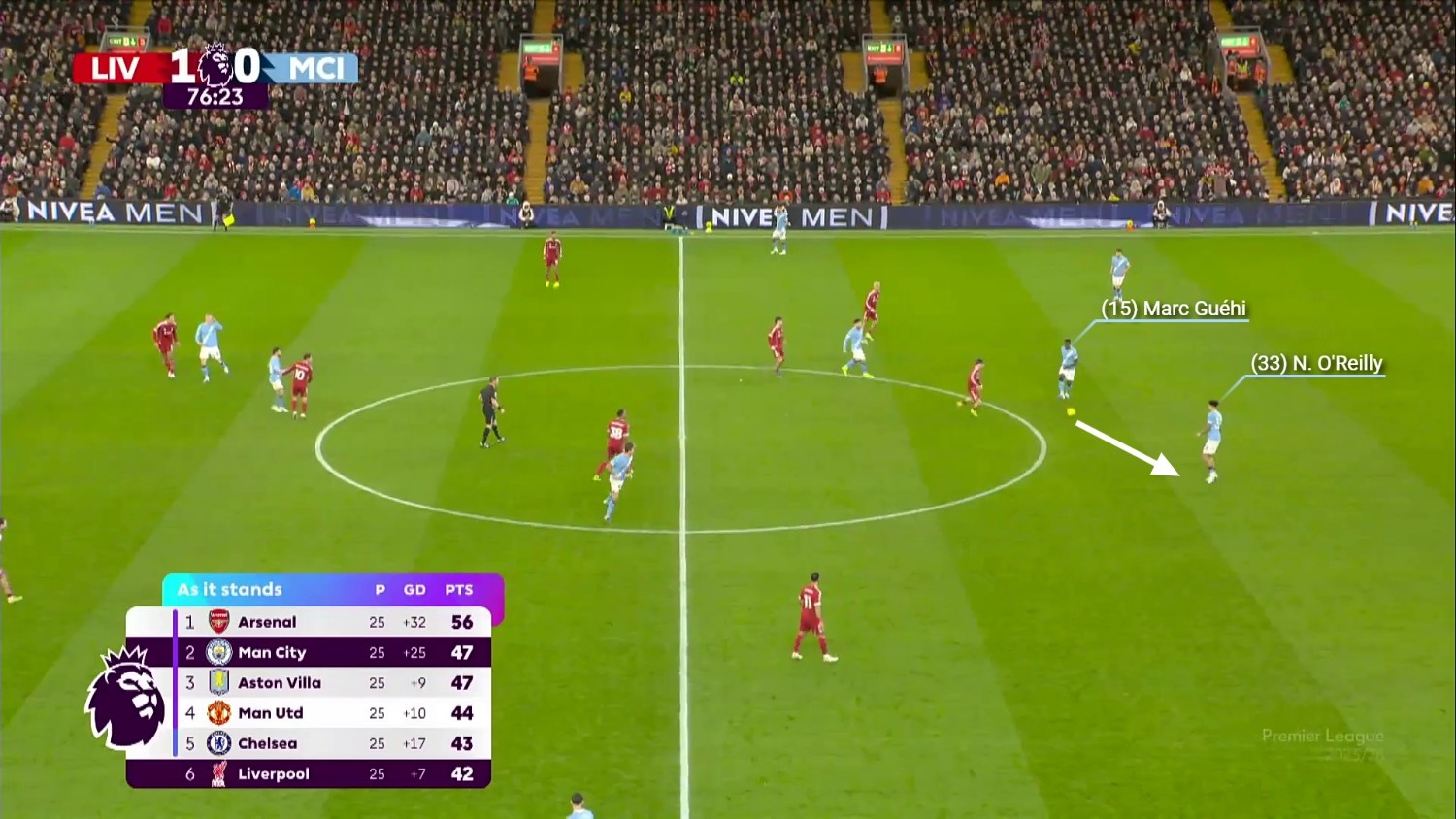
Used primarily as Manchester City’s left-back, Nico O’Reilly’s recent usage can be anchored to a very specific tactical demand that surfaced in their statement win over Liverpool. 

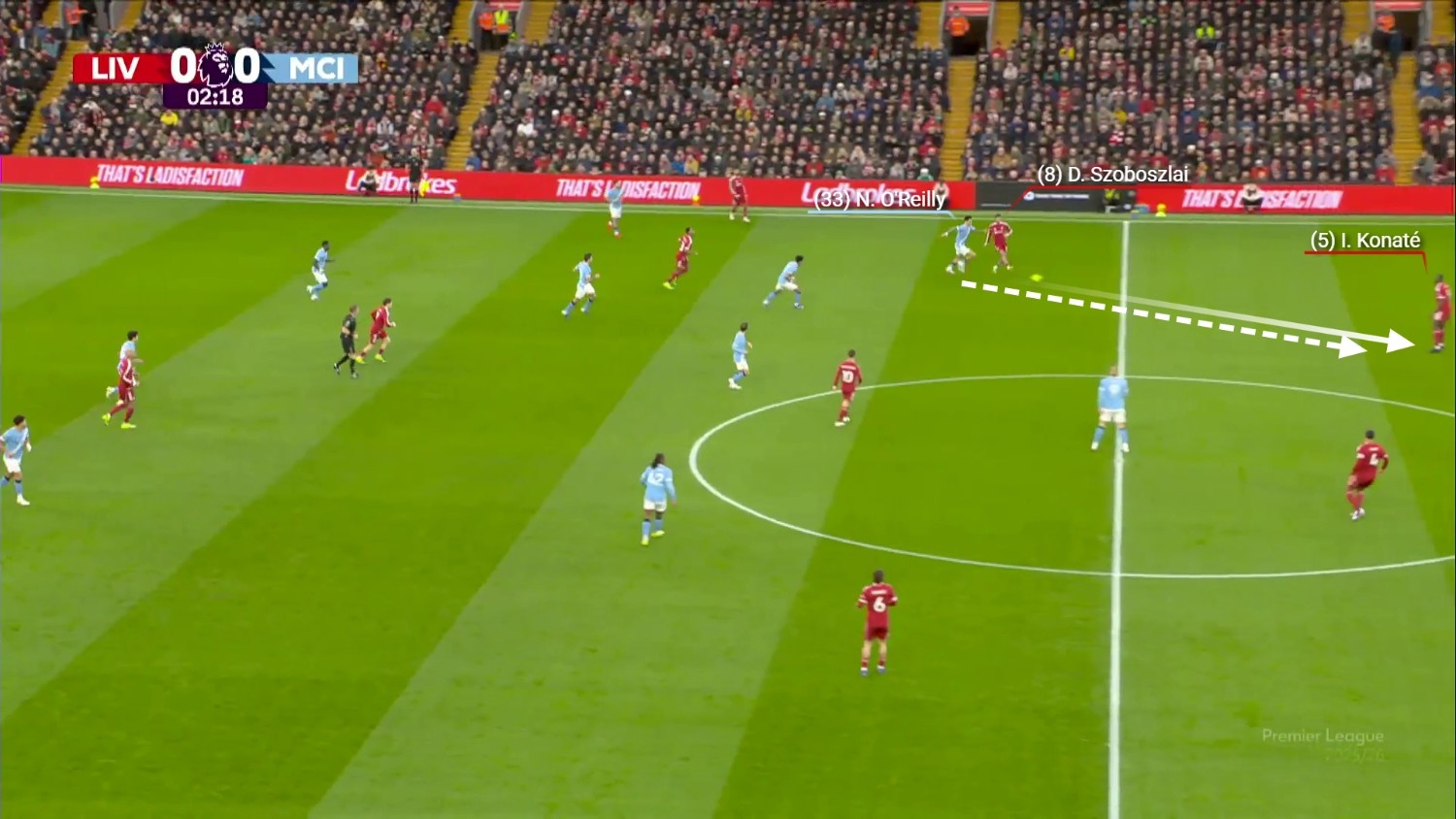
City pressed Liverpool’s build-up with a 4-4-2 diamond and looked to set a trap that funnelled play towards Ibrahima Konaté. 

Erling Haaland’s position encouraged the pass into Konaté; Omar Marmoush joined the first line to shut off central access, and the unit shifted across to keep matchups tight. 

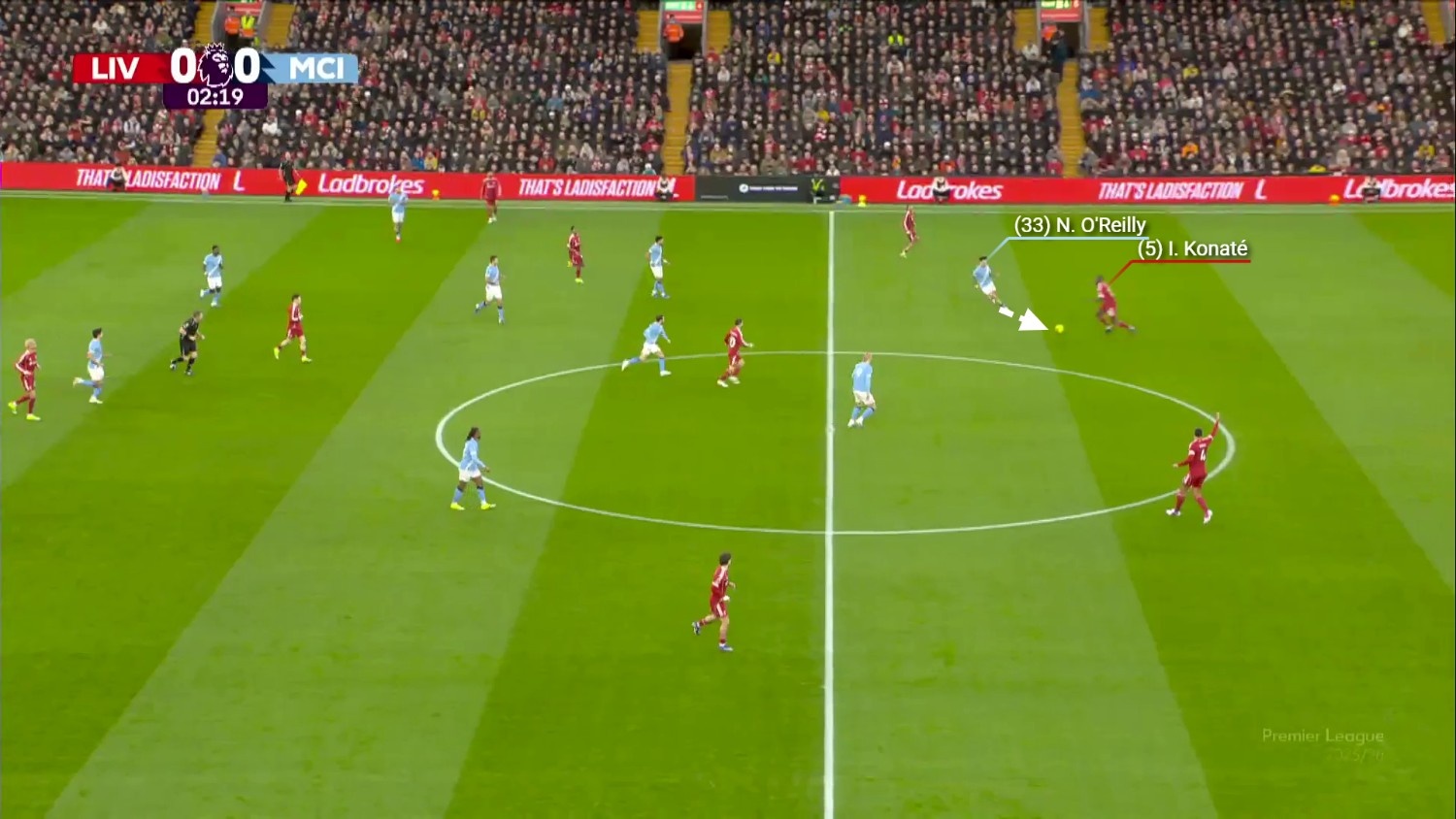
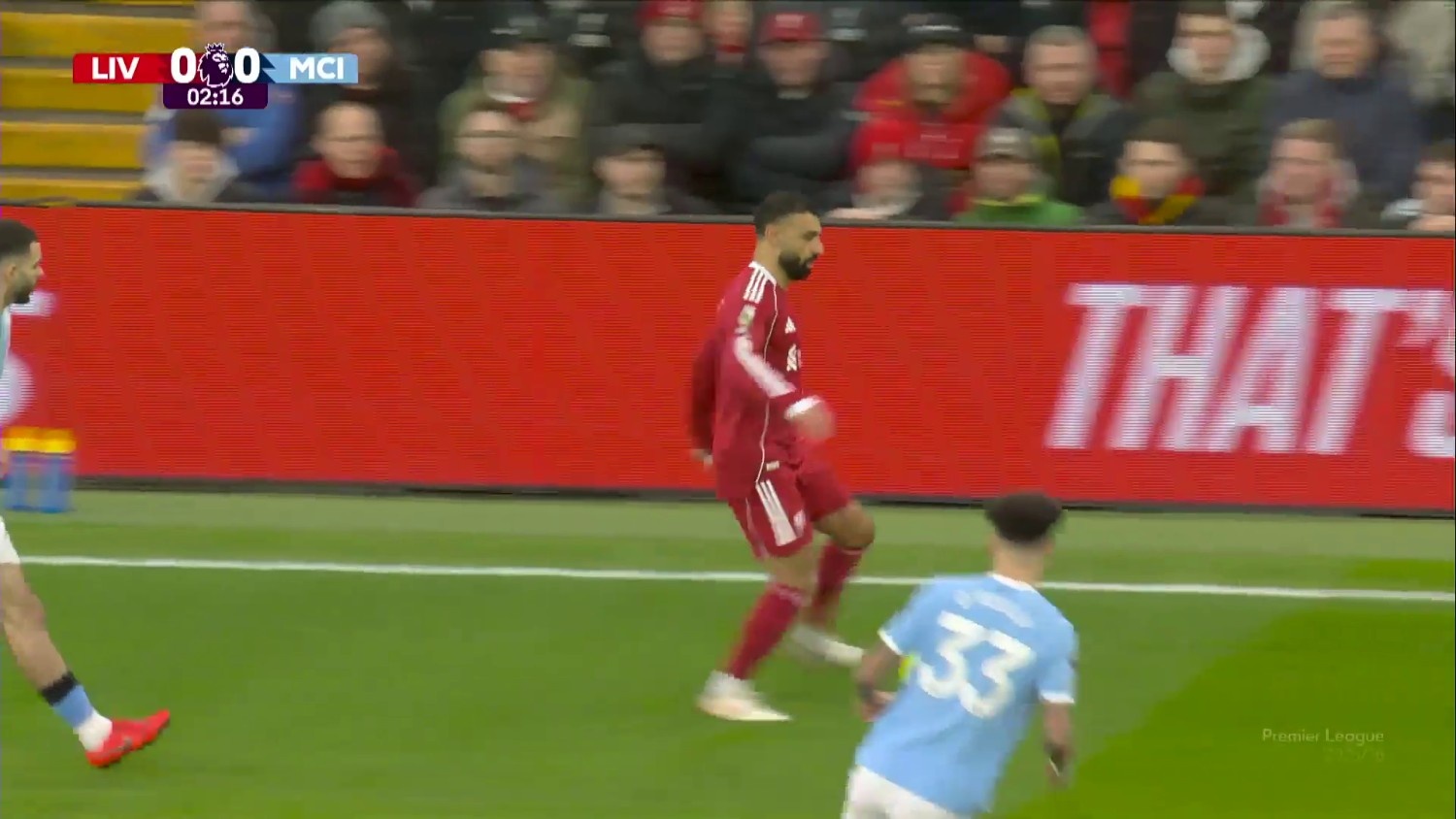
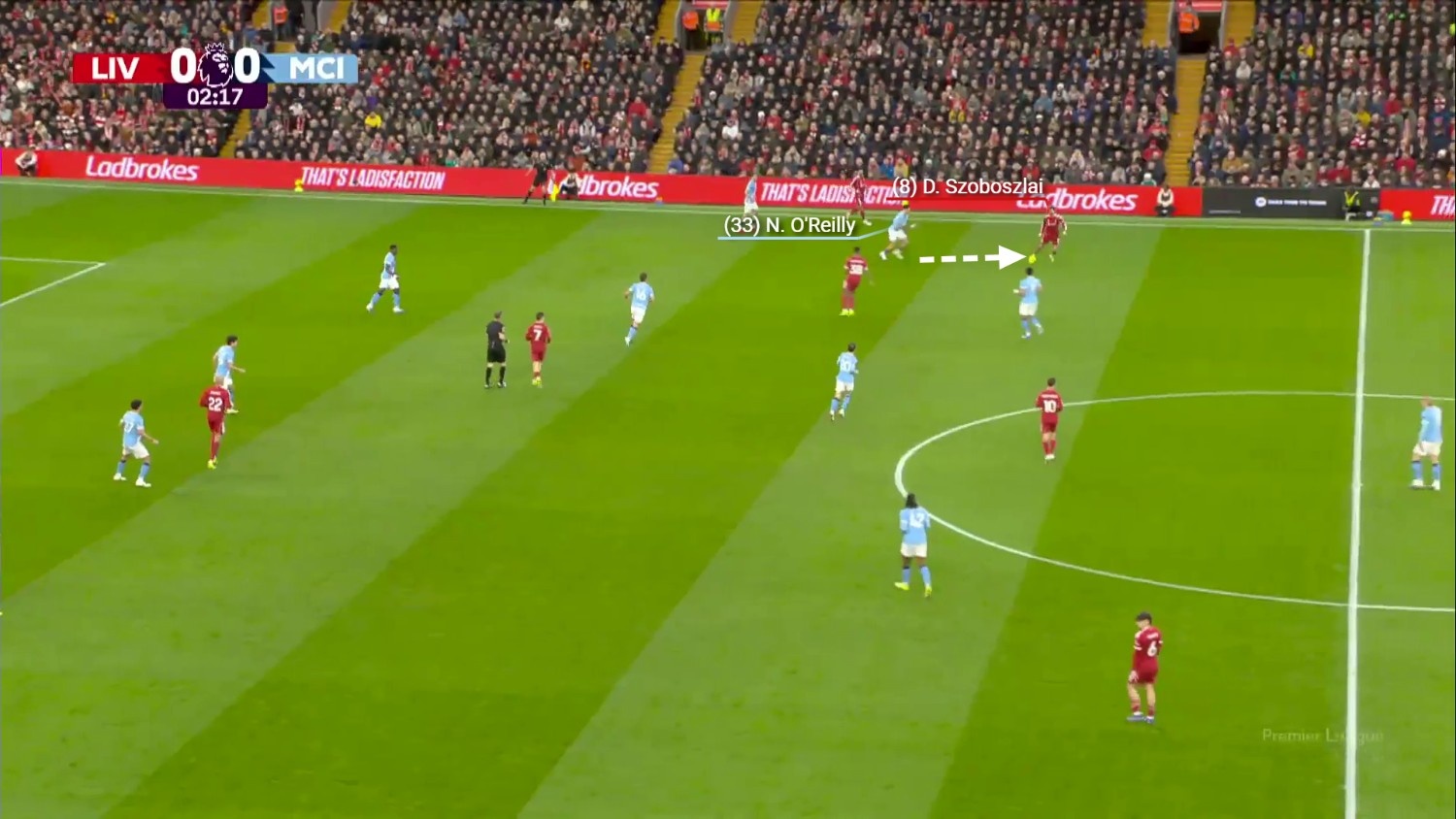
Within that mechanism, O’Reilly’s job was to jump out to press the wide pass once Liverpool were forced towards the outside, and his movement triggered the rest of City’s shift across. 

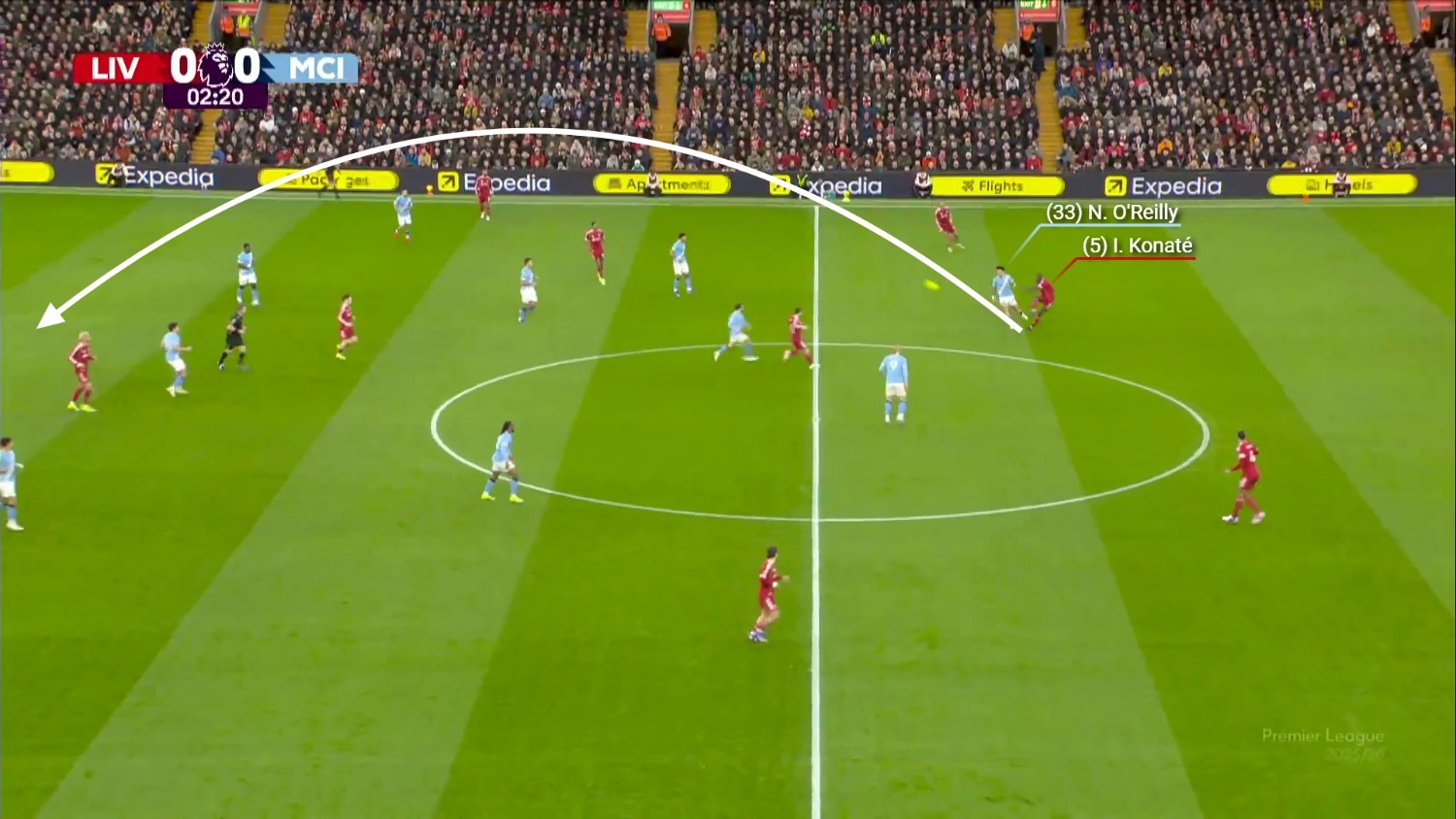
As shown in the images below, O’Reilly presses both Mohamed Salah and Dominik Szoboszlai, and when the ball reaches Konaté, he is able to shut him down with speed and aggression.

He times his run well, cutting off the return pass into Szoboszlai, and with O’Reilly’s pressure forcing the issue, Konaté resorts to a hopeful long ball towards the left side.
export 2026 02 25T032705.18

export 2026 02 25T032755.12

export 2026 02 25T032858.34export 2026 02 25T032936.11 export 2026 02 25T033018.91

It is a role that demands timing, aggression, and repeatability; the fact Guardiola trusted O’Reilly as the wide-jumper in a high-stakes away game speaks to where the staff sees his current reliability.

Nico O’Reilly In-Possession Profile

O’Reilly is not currently a “progressor” in the sense of constantly breaking lines with carries or high-risk vertical passes.

But more so from his strong ball-carrying. 

As shown in a pre-friendly fixture, O’Reilly is particularly strong when it comes to protecting the ball and carrying it over the thirds.

https://totalfootballanalysis.com/wp-content/uploads/2026/02/outputcompress-video-online.com-3.mp4

His value is that he retains the ball well under pressure and keeps City in structure. 

City’s dominance is built on the accumulation of actions that sustain territory and maintain spacing. 

This also leads to allowing the next player to receive facing forward. 

If you give the ball away cheaply, you lose the ability to counterpress with the right numbers and distances. 

O’Reilly’s best contribution in possession is about what he prevents. 

He prevents rushed decisions and poor spacing, as well as reduces the devastation of transitions against a stretched rest defence.

His ball retention is linked to his natural scanning behaviour, his body shape, and his pass selection under pressure. 
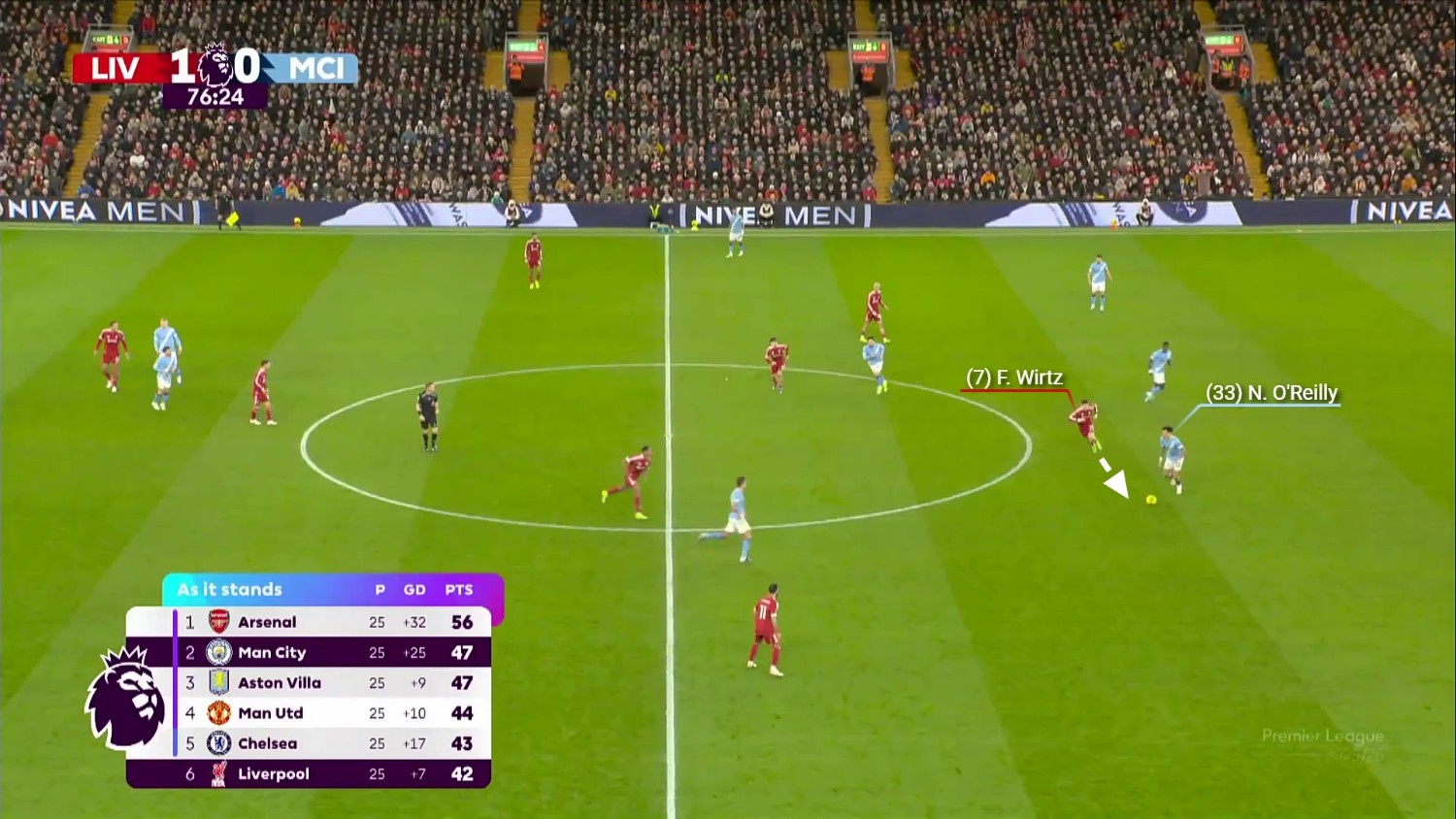
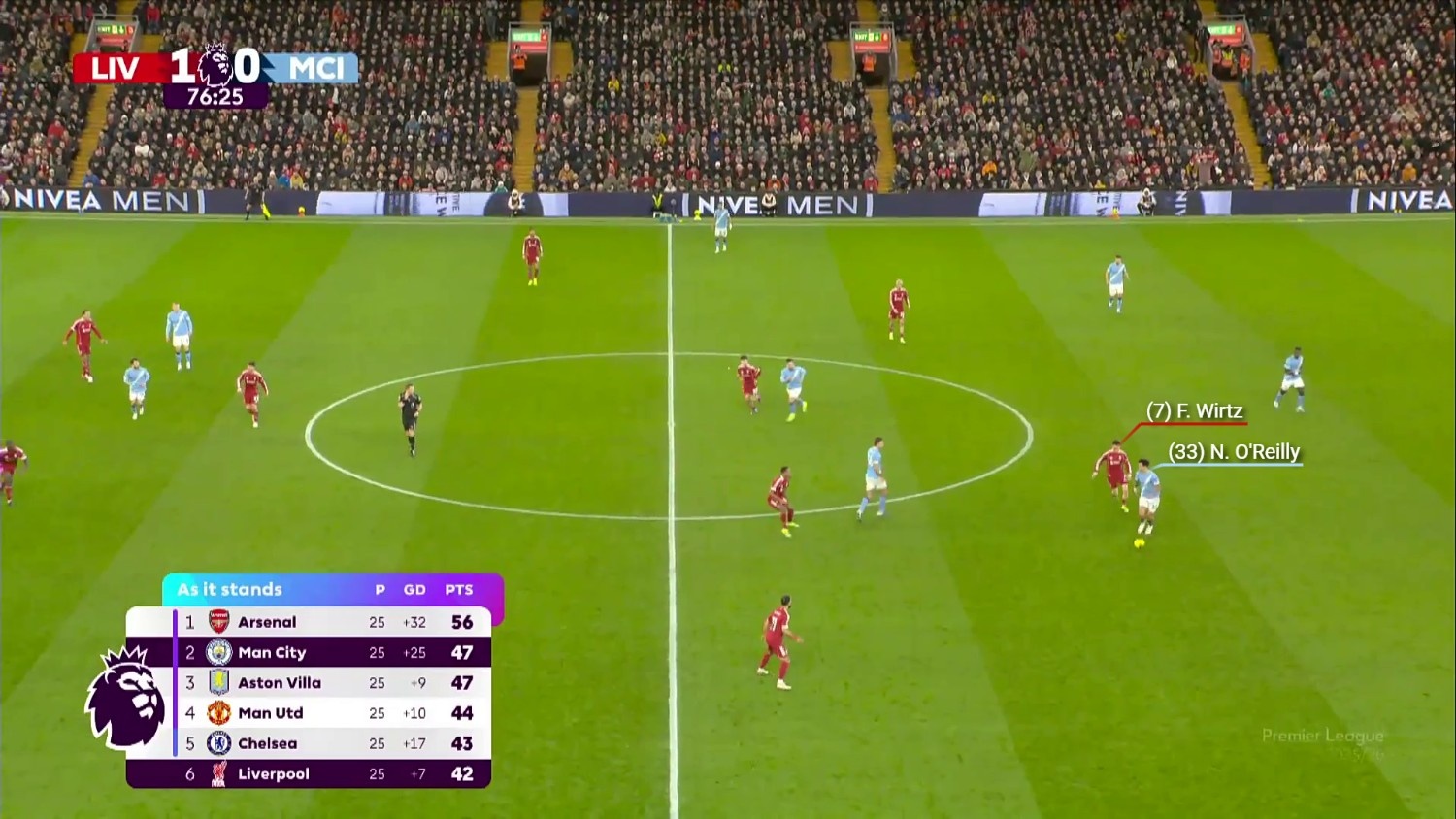
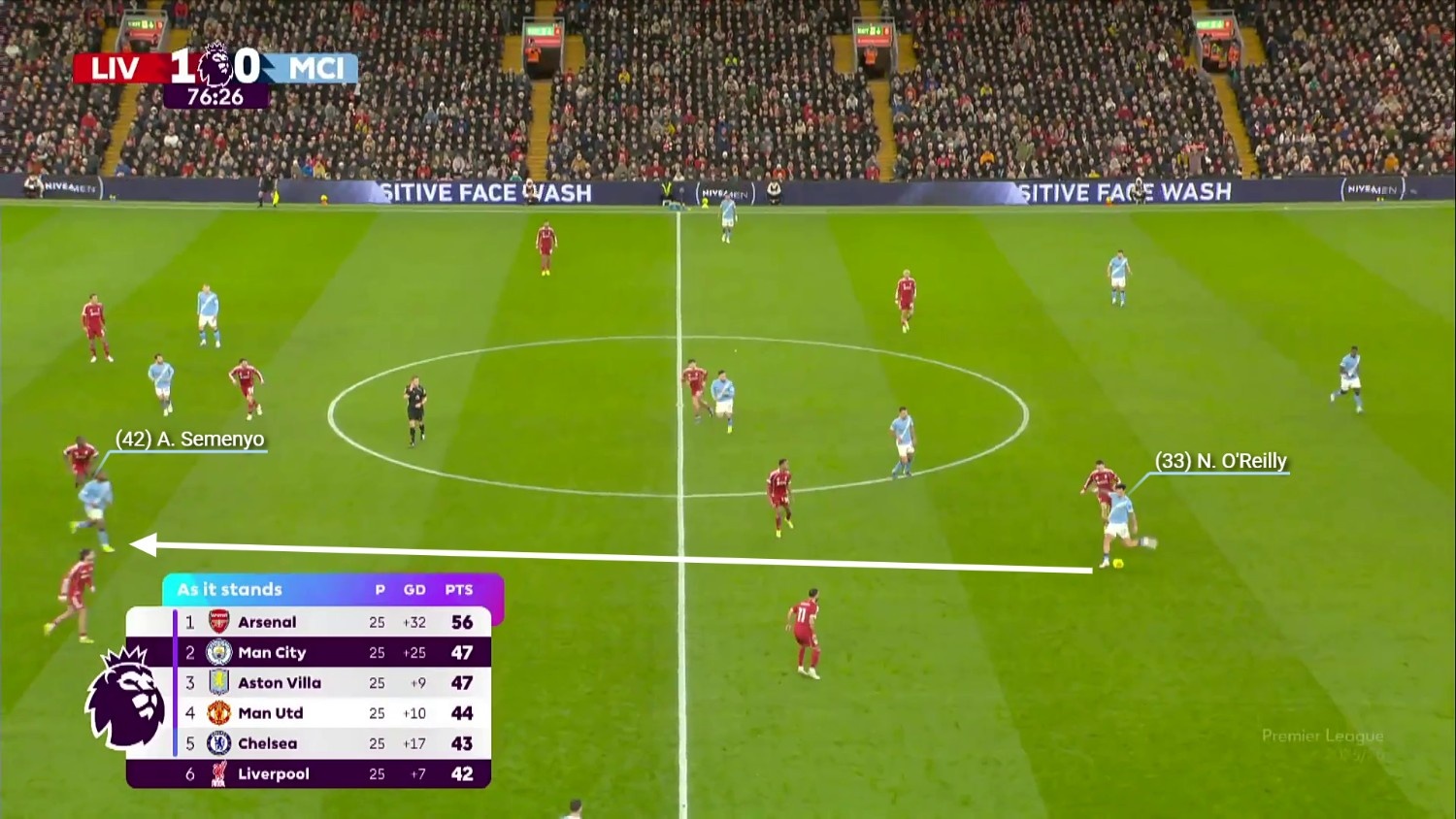
As shown in the images below, O’Reilly is being pressed by Florian Wirtz; in this situation, it would be easy to panic and go long to avoid being shut down and losing the ball.

Instead, O’Reilly’s open body shape lets him see his options.

He takes an extra touch to push the ball out and improve the passing angle, then threads a pass through Liverpool’s second line into the feet of Antoine Semenyo.

export 2026 02 25T035727.45 export 2026 02 25T035757.93 export 2026 02 25T035825.64 export 2026 02 25T035901.53

He tends to receive with an open hip when possible, so his first touch protects the ball from the nearest presser while keeping at least one forward option visible. 

When he cannot receive open, he uses his first contact to secure and pin the ball-side opponent long enough to create a third-man option.

This is why he can be valuable even without being a line-breaking passer. 

He reduces the number of “dead” touches in the build-up because he recognises when to carry to improve the angle and when to recycle to maintain occupation of the next line. 

A Small-Space Technician & Sustaining Manchester City Attacks

In possession, Guardiola’s modern wide defenders have been able to function as midfielders in small spaces. 

Nico O’Reilly looks increasingly like a small-space technician. 

In chaotic passages, a player who can take contact, protect the ball, and still make the next pass becomes disproportionately valuable.

As shown in the Champions League, O’Reilly is able to use light and little touches of the ball to get out of a crowded space.

https://totalfootballanalysis.com/wp-content/uploads/2026/02/outputcompress-video-online.com-4.mp4

What separates O’Reilly from being just a safe passer is how his technical security links to City’s ability to keep counterpressure alive.

His retention under pressure is a form of defence because it allows City to attack with more players committed without constantly fearing that one loose touch will launch a counterattack. 

When City does lose it, his positioning and reactions help them win it back. 

This is where his transition value becomes central to the scouting profile. 

He is very strong in transitions because of his instinctive ability to appear in the midfield line at the moment the opponent wants to break. 

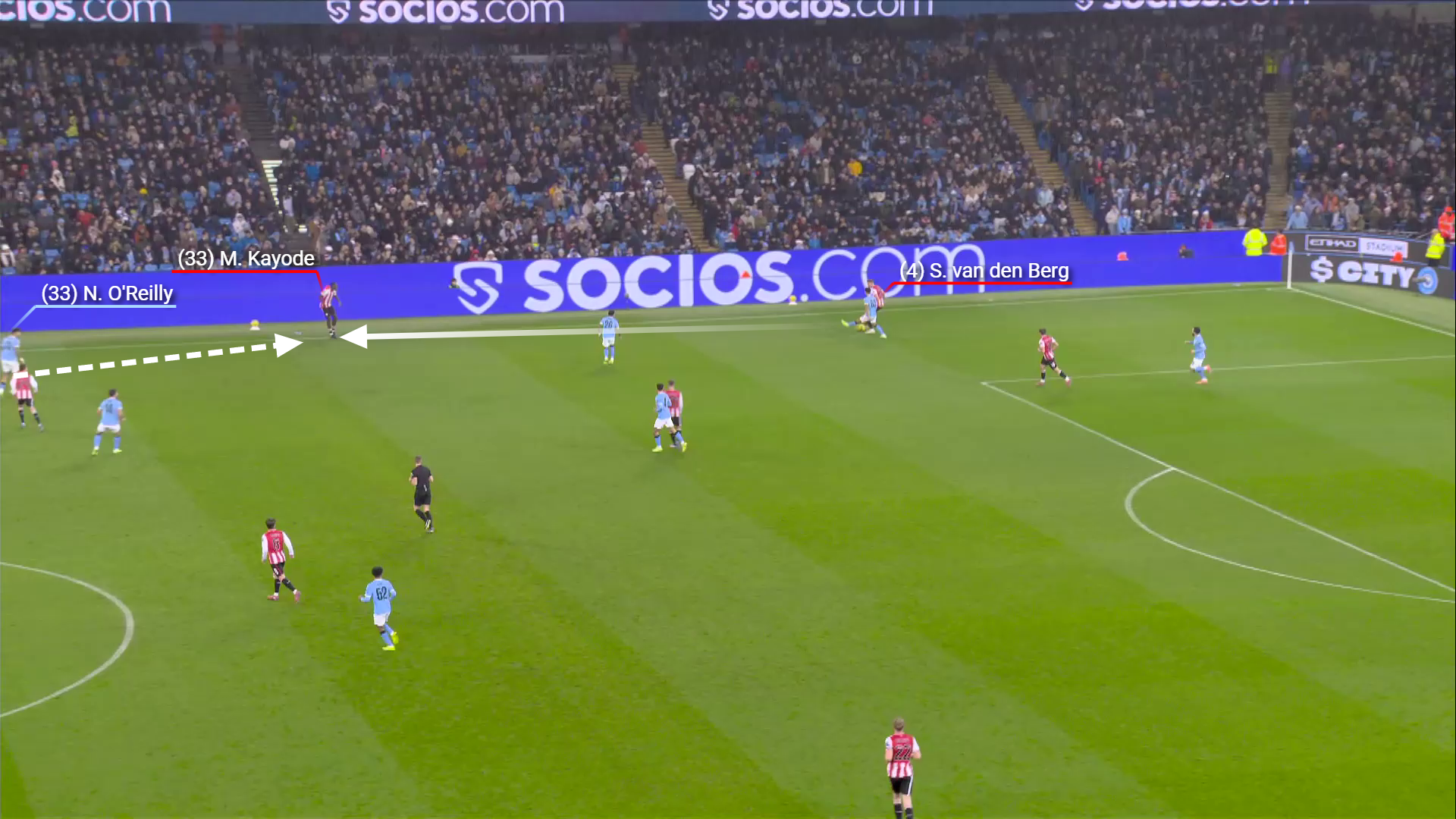
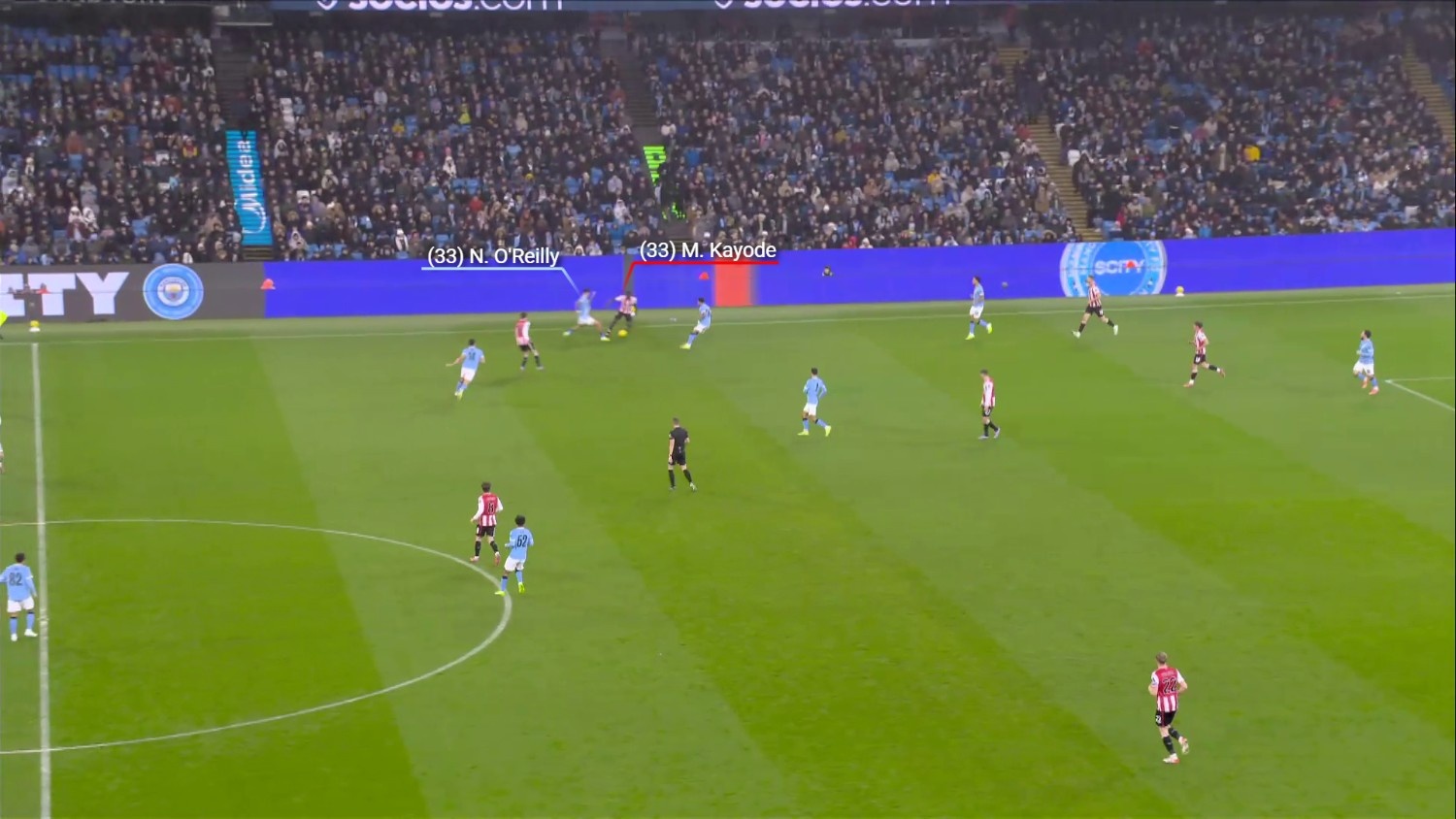
As shown against Brentford, O’Reilly begins pressing the moment Sepp van den Berg releases the pass to Michael Kayode.

He closes Kayode down quickly, wins the ball high up the pitch, and allows City to regain possession and attack from a more advanced position.
export 2026 02 25T041329.153

export 2026 02 25T041409.24

He has a good feel for where the next pass is going, and he positions his body to block or shut down the most direct route forward. 

Nico O’Reilly Height, Physicality & “Midfield Line” Defending

Nico O’Reilly’s physical profile enhances that. 

At around 6’4″, Nico O’Reilly gives City size in a squad that prioritises technical profile over raw physicality.

His size and timing help him slow runners, protect space, and win, or at least disrupt, second-ball contests. 

Against Liverpool, where the second half became more transitional and Liverpool’s best moments came in direct access to their front line, the value of having players who can halt momentum in midfield increases. 

O’Reilly’s instinct for positioning himself on the midfield line to stop counterattacks is therefore not just a nice extra; it is one of the main reasons he can be trusted in big matches. 

It reduces the number of central counters City concede, and it allows Rodri and the centre-backs to defend fewer open-field sprints.

As shown against Tottenham, O’Reilly applies relentless pressure on Mathys Tel in the corner, leaving him with little to no support and few options.

Teammates arrive to back up the press, City forces the turnover, and starts another attack.

https://totalfootballanalysis.com/wp-content/uploads/2026/02/outputcompress-video-online.com-5.mp4

Technically, his size also helps him “screen and step” in midfield spaces.

When the ball turns over, the priority is often to protect the centre and delay the vertical pass into the striker or the opposite-side runner. 

A bigger player expands his ability to block passing lanes without overcommitting, because he can hold a slightly wider stance and cover more of the direct lane.

But also, O’Reilly still had the strength to engage if the opponent tried to carry him through. 

However, 1v1 defending is not his biggest strength; with more experience as a full back, he is likely to develop a better understanding of when to shut down a cross and when to lunge to win the ball.

Nico O’Reilly Box-Crashing & Final-Third Contribution

In the attacking phase, his “small-space technician” label also suggests an under-discussed aspect of his future. 

Players who are good in tight areas and have the instinct to arrive rather than to stand can be developed into box-crashers. 

O’Reilly has that in his game, especially the speed and aggression of his underlapping runs.

Furthermore, he also contributes by attacking the second line into the area, arriving late and providing City with an additional body around rebounds and cutbacks. 

As shown against Newcastle United, O’Reilly takes up a central position and then attacks the box, which inevitably causes more chaos and concern for their defence.

Rather than charging in, he ghosts into the area, arriving late and untracked to find space.

That movement leaves him perfectly placed to meet Haaland’s cross and head it home.

https://totalfootballanalysis.com/wp-content/uploads/2026/02/outputcompress-video-online.com-2.mp4

That is important because low blocks also have the element of covering the cutback zone, and they try to prevent City’s midfield arrivals from shooting or finding the final pass. 

A player with Nico O’Reilly’s size can add threat on the edge of the box and on back-post situations without City needing to change their possession identity. 

Box-To-Box Midfielder Potential 

Nico O’Reilly is a box-to-box profile (based on his time in the EDS). 

Becoming a box-to-box midfielder in Guardiola’s side is possible because his strengths translate well to the modern interpretation of that role. 

The case for it is partly physical and partly tactical. 

Physically, he has the frame to compete in repeated duels, cover ground, and still arrive at both ends. 

Tactically, he already shows the instincts that good box-to-box profiles need in elite possession teams, because he understands where the danger is in transition.

He can operate in small spaces under pressure. 

The limiting factor, if it exists, is whether he can become a consistent line-breaking presence from central zones without becoming careless. 

A box-to-box midfielder at the highest level still needs to progress the team at some stage, either by carrying through pressure, punching passes into the half-space, or arriving as the third man beyond the ball. 

The encouraging aspect is that he does not need to turn into a high-risk passer to evolve. 

If he can add just enough forward threat through timed late box arrivals and selective vertical combinations, there is a strong likelihood that he can fulfil the box-to-box role. 

Conclusion

Nico O’Reilly has had a breakthrough of the ages and is firmly in the conversation for Premier League Young Player of the Year. 

More than that, he has an increasingly convincing case to start at the World Cup, particularly when you compare current form level, tactical responsibility, and two-way impact with alternatives such as Myles Lewis-Skelly and Lewis Hall, who are not operating at his level right now.

The most telling part of Nico O’Reilly’s rise is that he can already be discussed as one of the best left-backs in the league, despite that being, in many ways, a secondary position relative to his longer-term midfield profile.

His combination of tactical reliability, physical presence, and high-level decision-making is exactly why he has become so hard to leave out, for club and perhaps country.

Tags: England Left BackEngland National TeamHow Good Is Nico O’ReillyManchester CityManchester City FormationManchester City LineupManchester City NewsManchester City Style Of PlayManchester City Tactical AnalysisManchester City TacticsManchester City Transfer NewsNico O'ReillyNico O’Reilly GoalsNico O’Reilly Left BackNico O’Reilly Manchester CityNico O’Reilly NewsNico O’Reilly Playing StyleNico O’Reilly PositionNico O’Reilly Scouting ReportNico O’Reilly StatsNico O’Reilly Strengths And WeaknessesNico O’Reilly Style Of PlayNico O’Reilly Tactical AnalysisNico O’Reilly TacticsNico O’Reilly TransferPep GuardiolaPep Guardiola Coaching StylePep Guardiola FormationPep Guardiola Manager StylePep Guardiola Manchester CityPep Guardiola Manchester City TacticsPep Guardiola NewsPep Guardiola Strengths And WeaknessesPep Guardiola Style Of PlayPep Guardiola Tactical AnalysisPep Guardiola TacticsPremier LeaguePremier League NewsPremier League Tactical AnalysisPremier League TacticsWho Is Nico O’ReillyWorld Cup SquadYoung Player Of The Year
Previous Post

Atalanta Vs Napoli [2–1] – Serie A 2025/2026: Raffaele Palladino In-Game Adjustments That Changed The Outcome – Tactical Analysis

Next Post

Nobel Mendy Scout Report At Rayo Vallecano 2025/2026: La Liga’s Emerging Left-Footed Centre-Back – Player Analysis

Next Post
Nobel Mendy At Rayo Vallecano 20252026

Nobel Mendy Scout Report At Rayo Vallecano 2025/2026: La Liga’s Emerging Left-Footed Centre-Back – Player Analysis

  • About Total Football Analysis
  • Contact Total Football Analysis
  • Write For Total Football Analysis
  • Advertise
  • Privacy Policy
  • Cancellation / Refund Policy
  • Resources
  • Terms Of Service

© 2026 Total Football Analysis

No Result
View All Result
  • Football Analysis
    • Data Analysis
    • Formations
      • 2-2-4 Formation
      • 2-3-5 Formation
      • 3-1-4-2 Formation
      • 3-2-2-3 Formation
      • 3-2-4-1 Formation
      • 3-1-6 Formation
      • 3-3-4 Formation
      • 3-4-1-2 Formation
      • 3-4-2-1 Formation
      • 3-4-3 Formation
      • 3-5-1-1 Formation
      • 3-5-2 Formation
      • 4-1-4-1 Formation
      • 4-2-2-2 Formation
      • 4-2-3-1 Formation
      • 4-2-4 Formation
      • 4-3-1-2 Formation
      • 4-3-3 Formation
      • 4-4-2 Formation
      • 4-5-1 Formation
      • 5-3-2 Formation
      • 5-4-1 Formation
      • 6-3-1 Formation
    • Head Coach Analysis
    • Match Analysis
    • Player Analysis
    • Recruitment Analysis
    • Set Piece Analysis
    • Tactical Theory
    • Tactical Preview
    • Team Analysis
    • Training Analysis
    • Tactical Analysis
    • Scouting Report
  • Competition
    • ALL Competitions
    • English Premier League
    • Champions League
    • La Liga
    • Bundesliga
    • Serie A
    • Ligue 1
    • Eredivisie
    • EFL Championship
    • FIFA World Cup 2022
    • WEURO 2022
    • Women’s Super League
    • NWSL
    • Belgian First Division A
    • A-League
    • Liga Profesional de Argentina
    • Austrian Bundesliga
    • Campeonato Brasileiro Série A
    • DFB Pokal
    • 1. HNL
    • Danish Superliga
    • EFL League One
    • EFL League Two
    • FA Cup
    • EFL Cup
    • Indian Super League
    • K-League
    • J1 League
    • Liga MX
    • Copa América 2021
    • Copa del Rey
    • MLS
    • Eliteserien
    • Euro 2020
    • Primeira Liga
    • Scottish Premiership
    • Allsvenskan
    • Europa League
    • UEFA Nations League
    • Liga AUF Uruguaya
  • Coaches
    • All Coaches
    • Alfred Schreuder
    • Ange Postecoglou
    • Antonio Conte
    • Arne Slot
    • Bo Svensson
    • Brendan Rodgers
    • Bruno Lage
    • Carlo Ancelotti
    • Christophe Galtier
    • Claude Puel
    • Claudio Ranieri
    • David Moyes
    • Dean Smith
    • Diego Simeone
    • Domenico Tedesco
    • Frank Lampard
    • Eddie Howe
    • Edin Terzić
    • Emma Hayes
    • Erik ten Hag
    • Ernesto Valverde
    • Gennaro Gattuso
    • Gerardo Seoane
    • Gian Piero Gasperini
    • Giovanni van Bronckhorst
    • Graham Potter
    • Igor Tudor
    • Imanol Alguacil
    • Jesse Marsch
    • Jonas Eidevall
    • Jorge Sampaoli
    • José Bordalás
    • José Mourinho
    • Julen Lopetegui
    • Julian Nagelsmann
    • Julien Stéphan
    • Jürgen Klopp
    • Luciano Spalletti
    • Lucien Favre
    • Manuel Pellegrini
    • Marcelo Bielsa
    • Marco Rose
    • Marco Silva
    • Massimiliano Allegri
    • Mauricio Pochettino
    • Maurizio Sarri
    • Mikel Arteta
    • Niko Kovač
    • Nuno Espírito Santo
    • Oliver Glasner
    • Patrick Vieira
    • Paulo Fonseca
    • Pep Guardiola
    • Peter Bosz
    • Rafa Benítez
    • Ralf Rangnick
    • Ralph Hasenhüttl
    • Roger Schmidt
    • Roy Hodgson
    • Sean Dyche
    • Sérgio Conceição
    • Simone Inzaghi
    • Sonia Bompastor
    • Stefano Pioli
    • Steffen Baumgart
    • Steven Gerrard
    • Thiago Motta
    • Thomas Frank
    • Thomas Tuchel
    • Unai Emery
    • Vincenzo Italiano
    • Xavi
  • Teams
    • ALL Teams
    • AC Milan
    • Ajax Amsterdam
    • Arsenal
    • AS Monaco FC
    • Atalanta
    • Atlético Madrid
    • FC Barcelona
    • FC Bayern Munich
    • Borussia Dortmund
    • Celtic FC
    • Chelsea FC
    • Everton F.C.
    • Inter Milan
    • Juventus F.C.
    • Leeds United F.C.
    • Liverpool FC
    • Manchester City
    • Manchester United FC
    • Paris Saint-Germain
    • Rangers FC
    • RB Leipzig
    • Real Madrid CF
    • Tottenham Hotspur
    • West Ham United
  • Players
    • ALL Players
    • Alisson Becker
    • Bukayo Saka
    • Erling Haaland
    • Harry Kane
    • Jack Grealish
    • John Stones
    • Julián Alvarez
    • Kalvin Phillips
    • Kevin De Bruyne
    • Kyle Walker
    • Kylian Mbappé
    • Lamine Yamal
    • Lionel Messi
    • Luis Díaz
    • Mohamed Salah
    • Phil Foden
    • Virgil Van Dijk
  • Contact
  • Write For TFA
  • Login

© 2026 Total Football Analysis