
Jude Bellingham, the €100 million man, is off to a sensational start with Real Madrid.
The former Borussia Dortmund star scored in the season opener against Athletic Bilbao and added a brace over the weekend against Almería.
With three goals in his first two games, the English national team star couldn’t dream of a better start with his new club.
UD Almería had a dream start of their own in this match.
Going up a goal in the third minute of play, Sergio Arribas headed home on a counterattack against his long-time club.
However, Bellingham’s goals in the 19th and 60th minutes secured three points for Los Merengues.
This Real Madrid tactical analysis will examine some key trends that decided this game.
This game was full of end-to-end action for a match with 42 total shots, 24 to Real Madrid and 18 to Almería.
We’ll look at specific patterns in Almería’s attack, how Carlo Ancelotti has designed his diamond midfield and take a deep dive into Real Madrid’s final third play without a true #9.
Real Madrid Lineup

Vicente Moreno, the new Almería manager as of this past June, entered the match with his team set out in a 4-2-3-1.
Luís Maximiano, the former Sporting CP youth player currently on loan from Lazio, received the start in goal.
His backline consisted of Sergio Akieme, Edgar González, Chumi and Marc Pubill from left to right.
In midfield, the double pivot featured Iddrisu Baba and Lucas Robertone with Arribas in front of them.
Largie Ramazani started on the left-wing while Adri Embarba contributed from the right.
At the top of the system was Luis Suárez, the former Watford and Granada player.
Ancelotti went with the 4-4-2 with a diamond midfield that the side has used throughout the early stages of the season.
Andriy Lunin kept his place in goal ahead of Chelsea loanee Kepa Arrizabalaga.
The backline was unchanged from the Athletic Club match, featuring Fran García, David Alaba, Antonio Rüdiger and Dani Carvajal from left to right.
Aurélien Tchouaméni manned the base of the diamond with Toni Kroos and Fede Valverde to either side of him.
Bellingham played the #10 while Vinícius Júnior and Rodrygo kept the two forward roles.
Almería exploited the wings
After the match, Ancelotti told reporters, “‘Right now, [I have] no [doubts about the formation],’ Ancelotti said. ‘We played with two lines of four, and we felt comfortable. It doesn’t allow you to control the wings in defence, but it gives us variety in attack” (per ESPN).
Real Madrid’s inability to control the wings was evident from the start.
That’s precisely where Almería’s goal originated from.
After Maximiano collected a Madrid set piece, he quickly released the ball into the left wing to set the counterattack in motion.
Though numbers down, Ramazani and Robertone managed to beat a 2v3 scenario and drive into the Madrid defensive third.
Initially, Los Blancos looked well prepared to limit the success with the counterattack, but the Almería pair used the wing effectively to progress up the pitch.
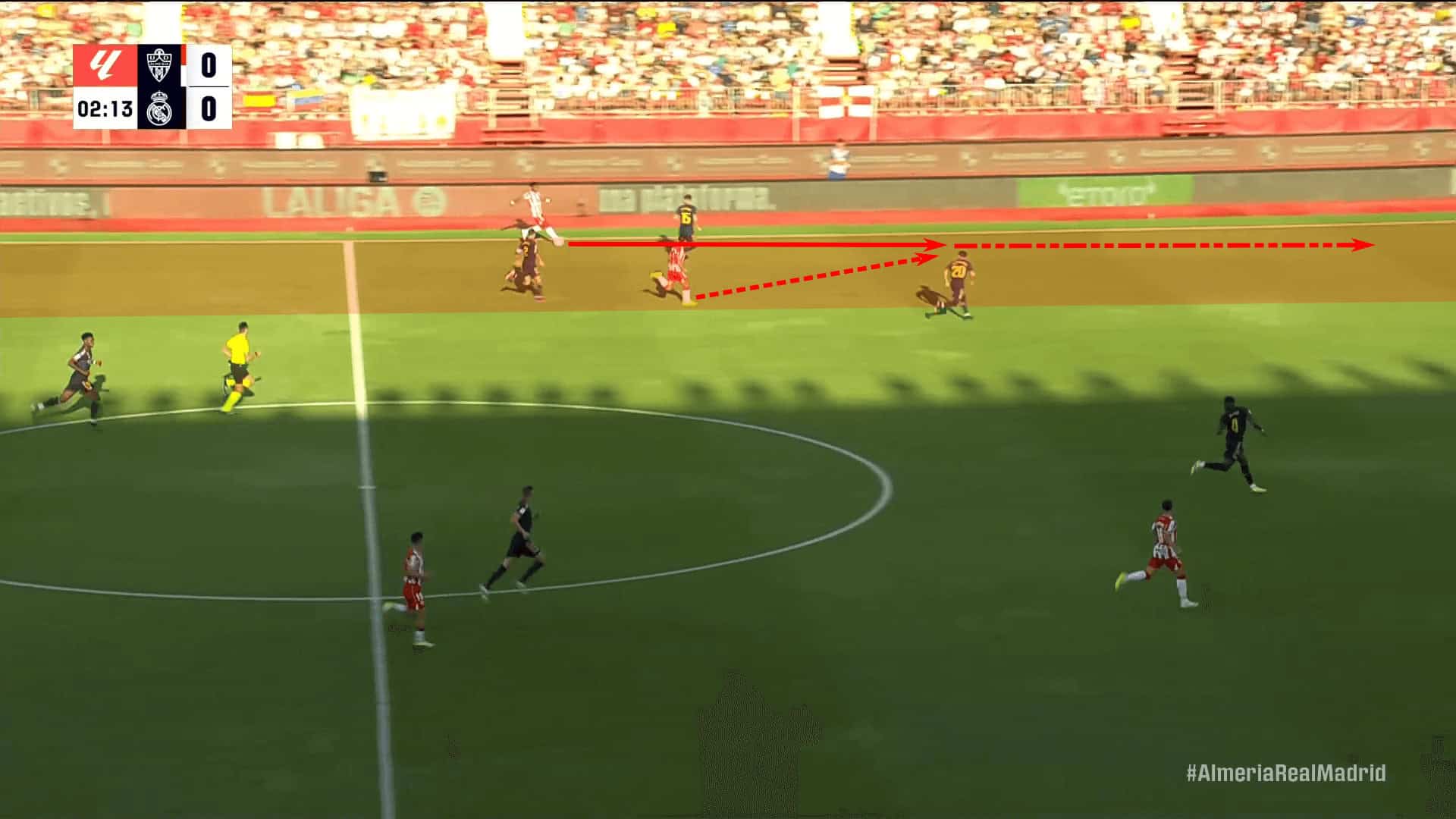
Arribas and Kroos are in the middle of the picture.
Arribas simply outran the German, moving off Embarba’s near post run to find an open header centrally and give the home side a stunning early lead.
Almería was very deliberate in attacking Real Madrid through the wings.
Looking at the progressive passes map from the match, we see that most of the endpoints of these passes were played into the wings, at least until it was time to attack the box.
The right side of the pitch was hectic, targeting Kroos and García rather than testing Valverde and Carvajal.

A similar pattern followed with regard to penetrating carries.
Almería used the wings very effectively in this match.
With Carvajal and García pushing high up the pitch, which we’ll discuss momentarily, Almería attacked Real Madrid’s 2-3 structure at the back during counterattacks.
Given Valverde’s mobility and defensive talent on the right, there was a very intentional effort to attack Real Madrid’s left.

With 18 shots, seven of which hit the frame, Almería had a lot of success getting into the box and getting their shots off.
Wyscout lists their counterattack success as four attempted, all finishing with shots.
Another seven shots came from set pieces, including a 4/4 performance on corner kicks.
While single-game xG should be taken with a grain of salt, Almería did manage a 2.3 xG, an excellent tally.
For the game, Real Madrid managed 2.81 xG, which gives both teams a sense of the quality of chances.
One interesting feature of Almería’s rest defence was the narrowness of the midfield four.
While the wide midfielders and forwards typically led the charge into the wings in transition, when Almería was in possession, the outside backs typically set the width in the formation.
In fact, the midfield took more of a rectangular shape.
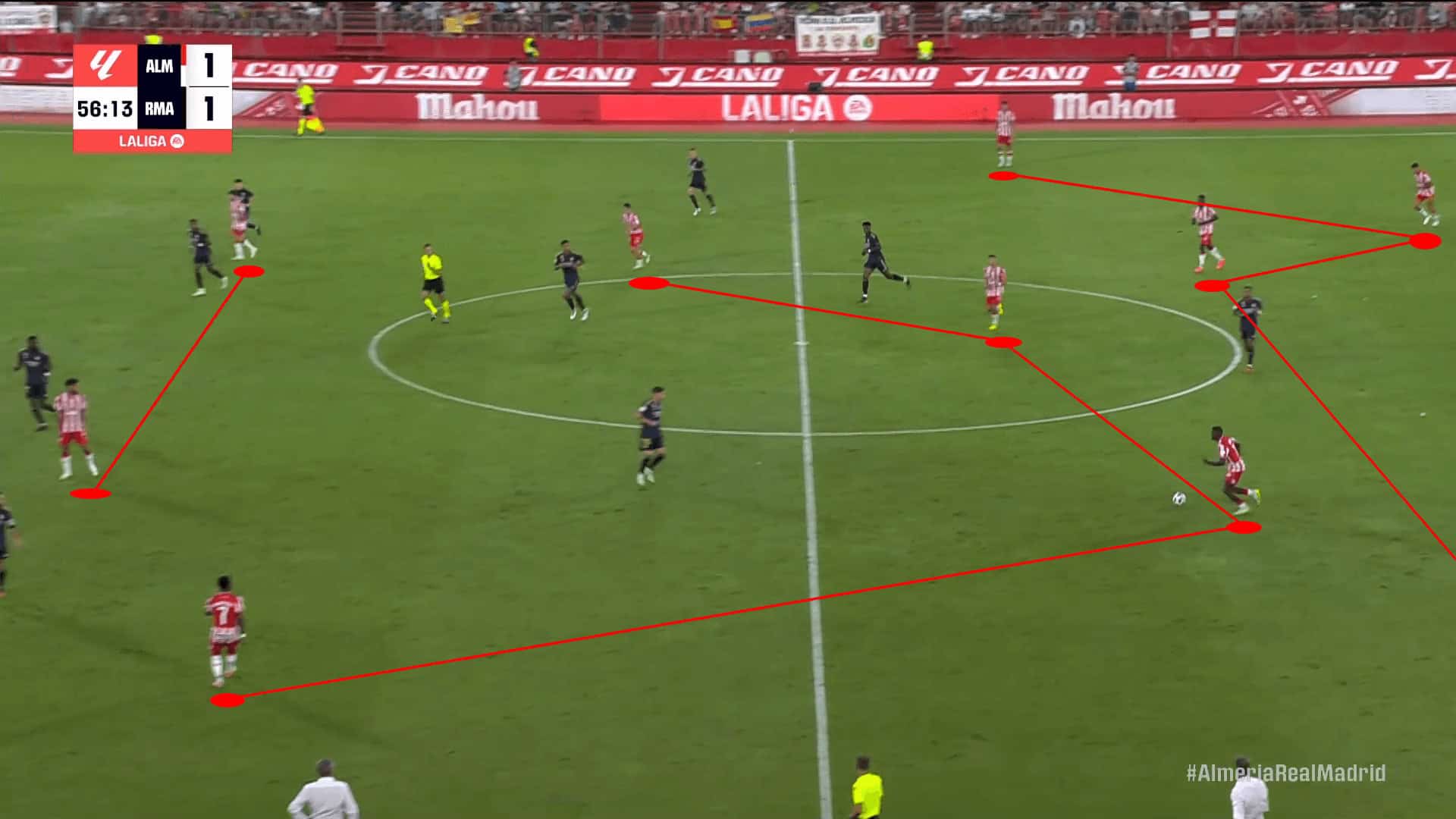
Notice the two wide midfielders getting into the half-spaces.
With the two forwards occupying all four members of the Real Madrid backline and Los Blancos midfield oscillated between a diamond shape and a flat three deep with Bellingham in front of them, Almería looked for pockets of space between the lines.
If they could get behind Valverde or Kroos, they could receive on the back foot and have a run at the backline.
They kept Real Madrid off balance and used controlled, high-tempo attacks to punish their opponent.
Ancelotti’s four-man midfield builds the pyramid
As detailed in a previous tactical analysis, Kareem Benzema’s departure to Saudi Arabia and the lack of a replacement put Real Madrid in a tight spot.
Rumours of Harry Kane and Kylian Mbappé arriving in the Spanish capital never came to fruition.
Other targets were available, but none were deemed suitable for the squad.
As mentioned in that previous analysis, from a data perspective, Rodrygo was one of the best replacements for Benzema.
His style of play fit within Ancelotti’s tactics, making him a suitable replacement if a world-class #9 was not brought in.
That’s exactly how this scenario has turned out.
Rodrygo is Benzema’s successor, at least for the short term.
But he doesn’t carry that burden alone.
Vinicius Jr has experienced more positional freedom this season than at any point in his Real Madrid tenure.
The €100 million man, Bellingham, also gives the side a classic #10 in the midfield diamond.
His relationships on the pitch are more closely tied to the movements of his two forwards than the three midfielders behind him.
Bellingham is essentially an auxiliary forward who engages in dynamic positional rotations with the two Brazilians, especially Rodrygo.
Given the young midfield talent in this squad and the veteran leaders in Luka Modrić and Kroos, one of the top questions of the summer was how Ancelotti would fit everyone onto the pitch.
The diamond midfield became the most reasonable solution.
Some adjustments were necessary deeper in midfield to get the most out of Bellingham’s unique skill set.
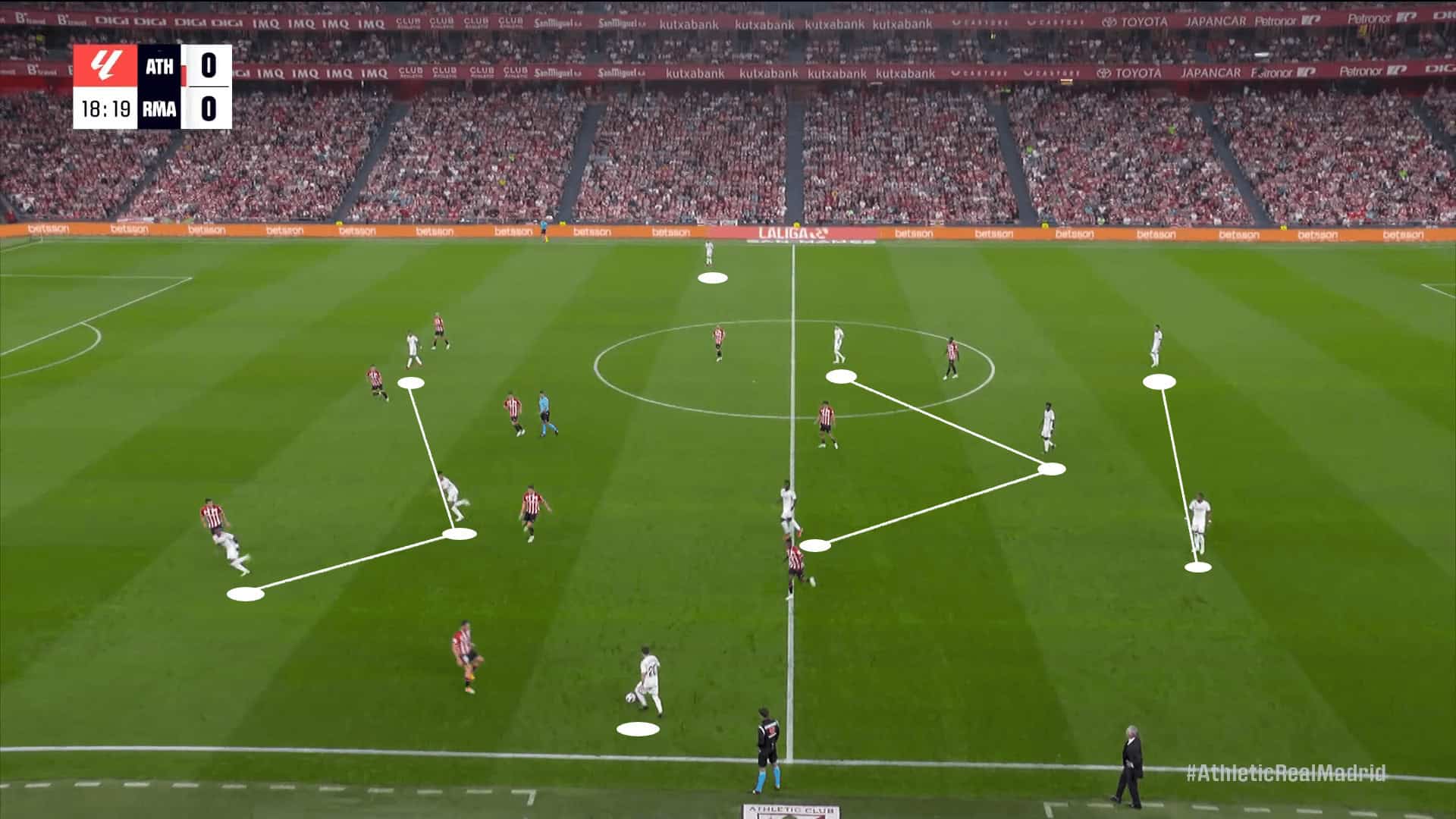
In line with contemporary rest defence structures, Ancelotti uses a 2-3 setup at the back, with the three deeper midfielders taking their position just in front of the two centrebacks.
That frees the two outside backs to push higher up the pitch, typically in line with Bellingham.
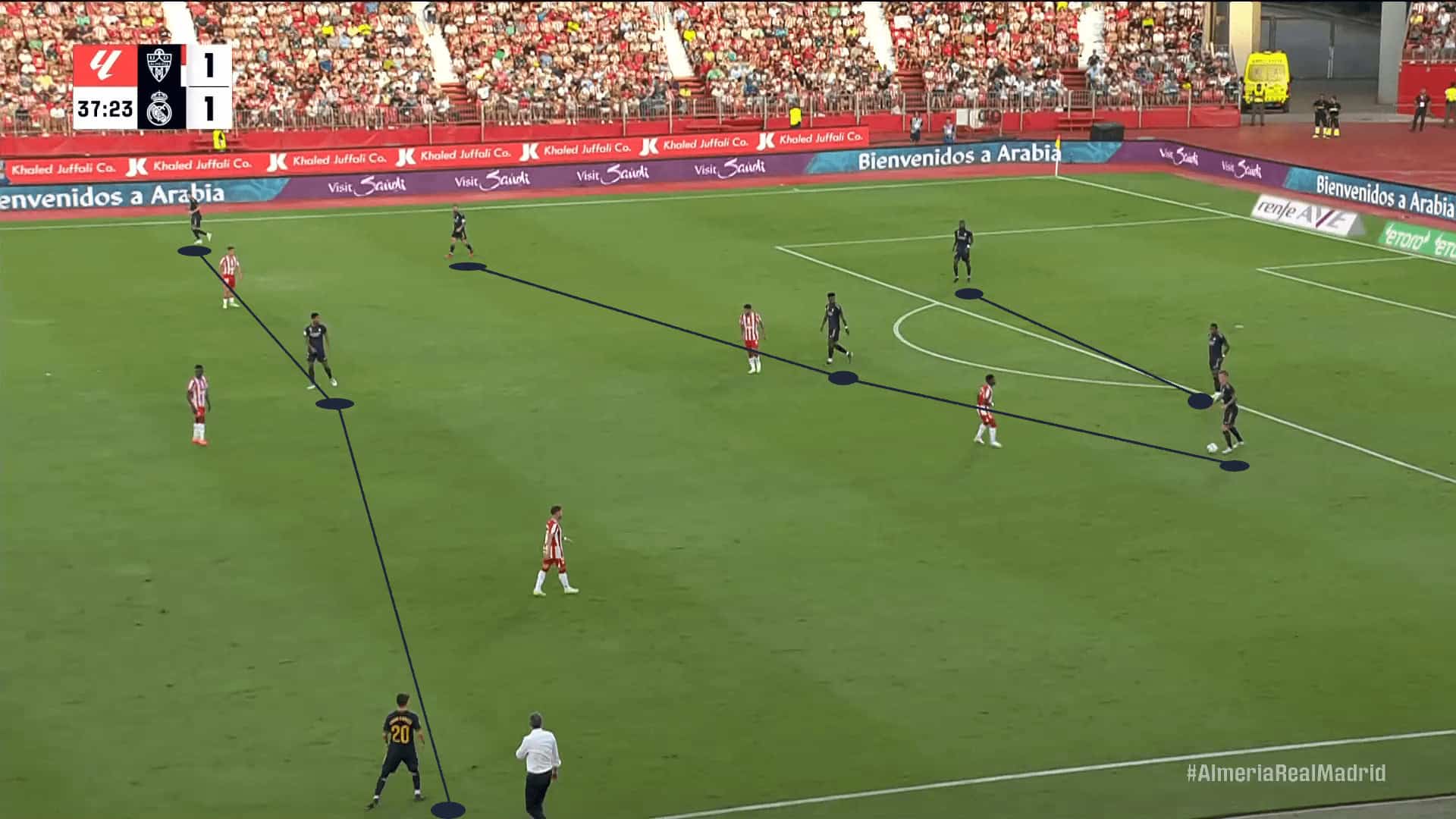
As Real Madrid moves into the middle third of the pitch, the two outside-backs take up high and wide positions.
They joined the forwards in that highest line while Bellingham and the two forwards alternated between stretching the opponent’s backline centrally and making checking runs into midfield.
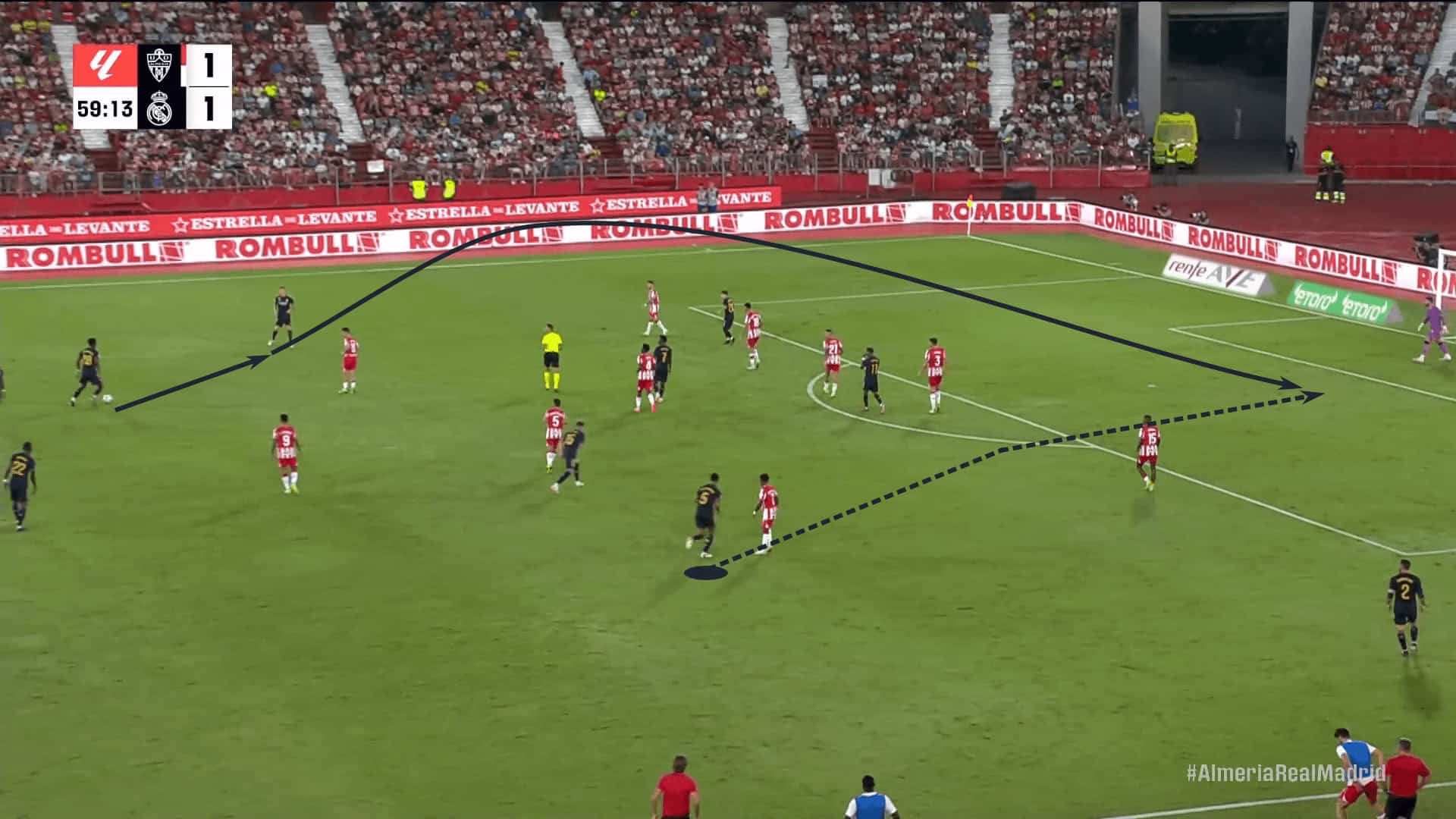
In the case below, García pushes up the left wing high and receives the long diagonal pass from Valverde.
With Kroos’ passing range, that same pass is targeted to move the team from left to right.
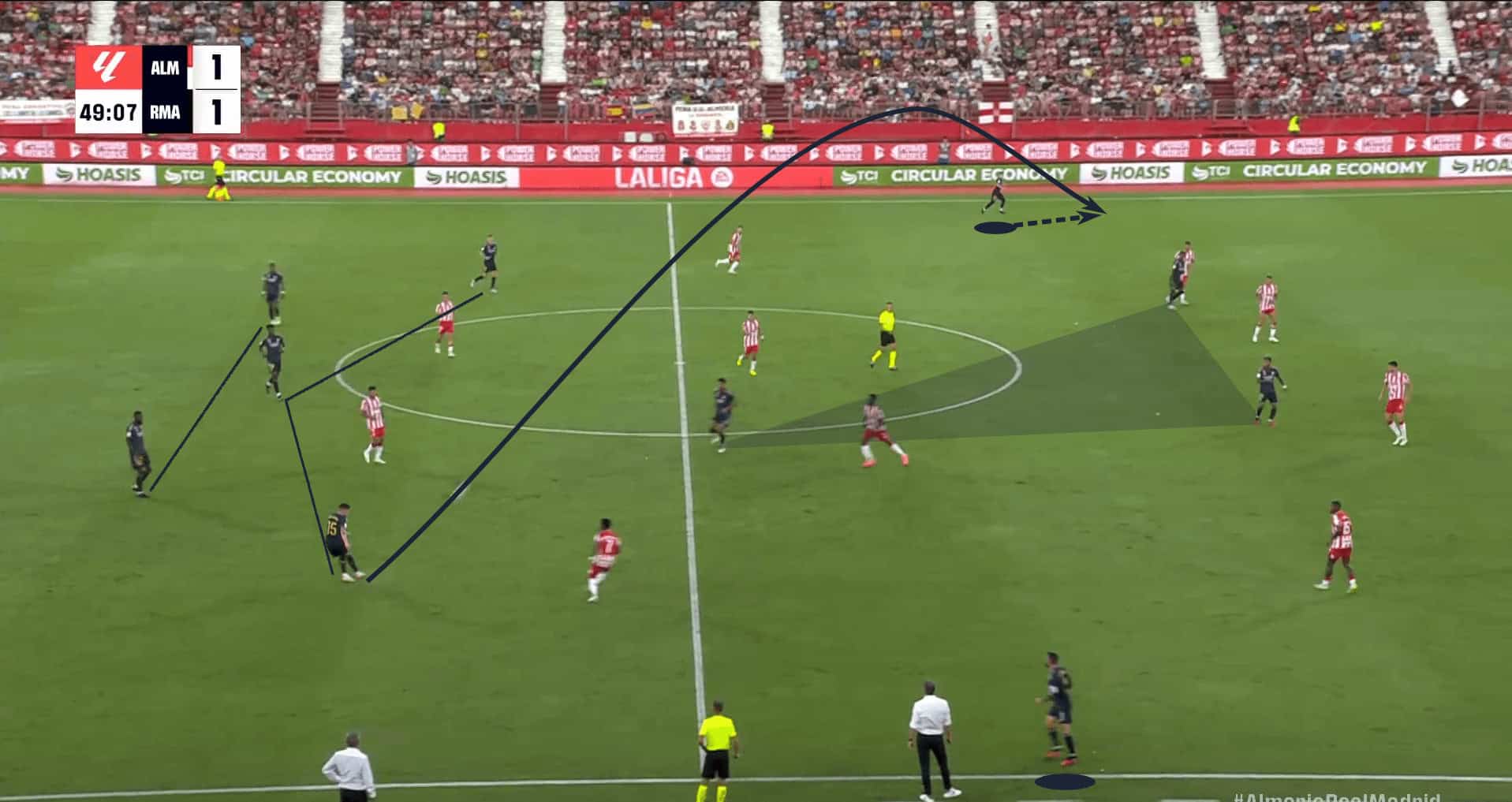
As Real Madrid connects their lines in the middle third of the pitch, it’s common to see Tchouaméni remain in the central channel while Valverde and Kroos move outside the opposition’s block to receive passes from the centrebacks.
From the half-spaces, they determine the attacking tempo and often direct the team’s progression into the attacking half of the pitch with forward passes coming from their feet.
The image below is a great example.
Within the 2-3-5 rest defence, Valverde receives the ball on the right half-space and is prepared to play forward.
Rodrygo made a late checking run into an open pocket of space, corresponding with Bellingham offering a run behind the Almería backline.

This setup was also used last week in the season opener against Athletic Club.
The three deeper midfielders gave Real Madrid coverage centrally to fight off opposition counterattacks and funnel play into the wings.
Real Madrid’s emphasis on the centre of the pitch is in stark contrast to last season.
While the right forwards had the freedom to come centrally last year, the default plan was to use Vinícius Júnior’s dribbling ability on the left wing to push the team up the pitch.
Last season, he averaged 13.67 dribbles per game, with 6.39 being successful.
That comes out to a 47% success rate.
Comparing this season’s heat map to last season, we are certainly seeing Vinícius Júnior in central positions with more regularity.
Granted, two matches is a small sample size, but one of the storylines of the season will be his adaptation to this new role.
Currently, he’s averaging 14.5 dribbles per game, and 6.5 of those are successful.
That brings his success rate down to 40%.

Given his importance in Real Madrid’s tactics during the past two campaigns, this new role will challenge him to adapt to the personnel around him.
He will still find opportunities to receive on the left wing and run at opponents, but the 2-3-5 structure requires him to move more centrally, which could limit his success on the dribble.
Should he struggle to have the same impact he has enjoyed in recent years, Ancelotti may have to return to the drawing board to help his star player reclaim his impact.
At least for now, Bellingham in the midfield has done the job.
Real Madrid’s final third play without a true #9
Over the past year or two, the seemingly clashing ideas of relationism and positionism have led to heated debates among football theorists.
One of the benefits of watching Ancelotti’s Real Madrid is how his squad blends the two schools of thought.
That’s especially the case this season without a true #9 in the squad.
Rodrygo may as well be the player embodiment of relationism, at least among players plying their trade in Europe.
With him operating as one of the two forwards and typically the more central of the two, this Real Madrid squad has had to find new ways to play off each other and attack the box.
Bellingham factors into this equation significantly.
Between Vinícius Jr.’s tendency to drift into the left wing and Rodrygo roaming to whichever spaces present opportunities, Bellingham has done well to understand his teammates’ playing styles and tailor his own to fit their movement patterns.
The match-winner in this one is a perfect example.
With Real Madrid holding possession on the left side of the pitch, Rodrygo slid left to create an overload.
As he pushed wide, Bellingham saw a gap emerge in the Almería backline.
Starting his run from deep in the final third, the Englishman got the jump on his mark and timed his run to the box to meet the delivery of García.
A brave header saw him take contact from the goalkeeper, but he was still able to provide the winner.
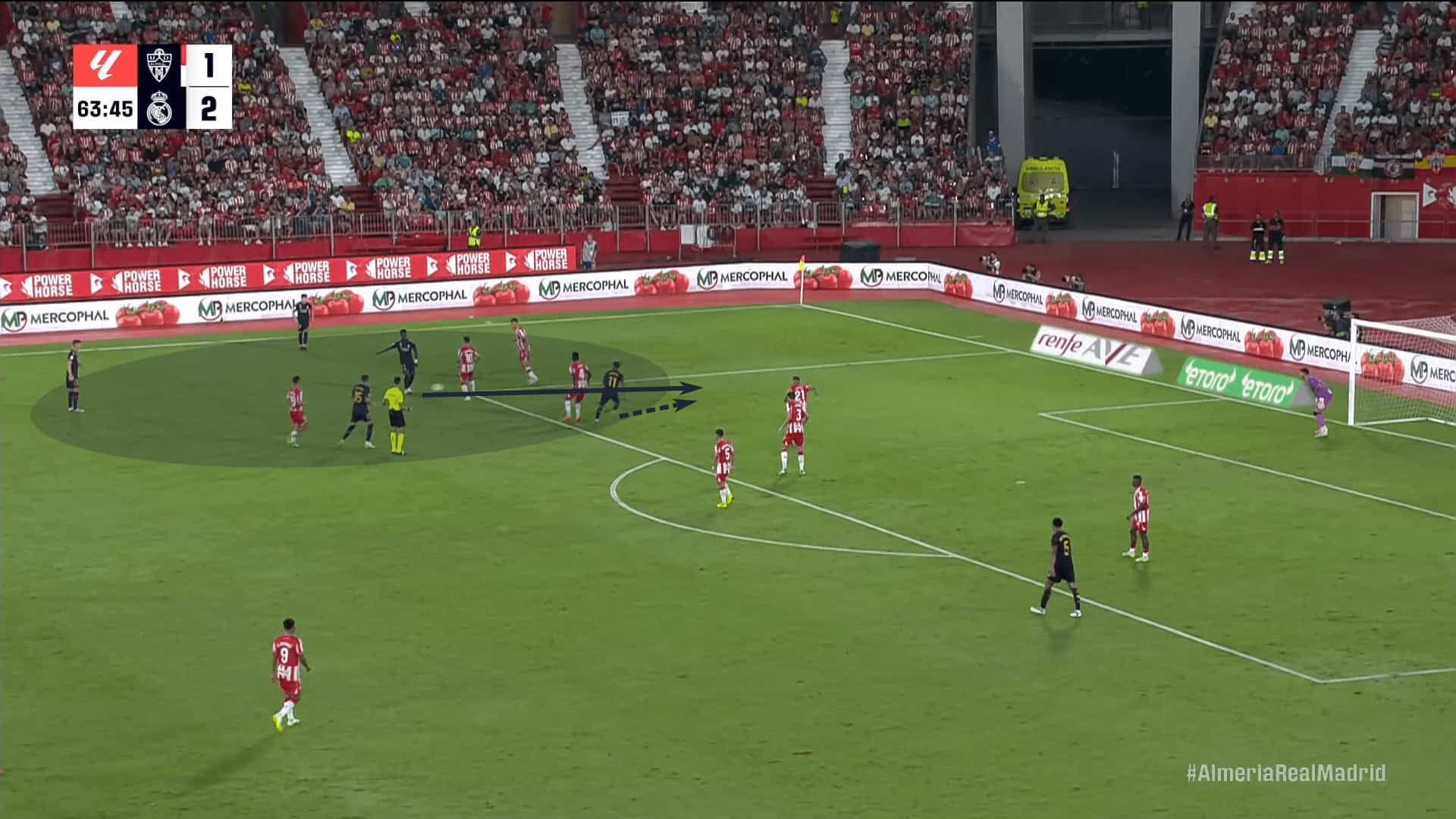
While Bellingham’s movements into the box are helping to fill the Benzema void, we’re also seeing relationist principles at play.
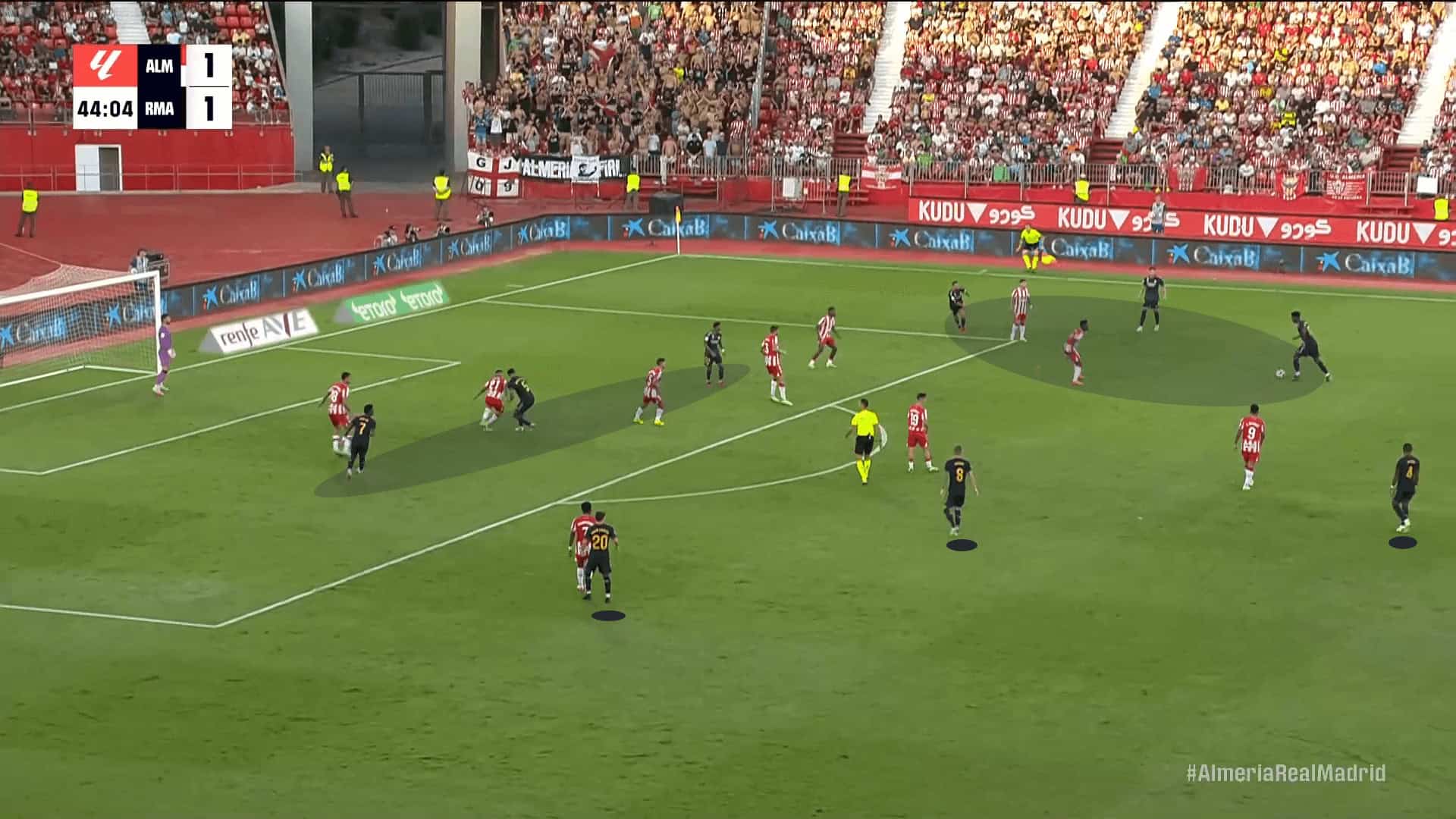
Shortly after the second goal, Real Madrid pushed five players into a condensed part of the pitch on the left wing.
They used that overload to play through the Almería backline and get Rodrygo into the box.
They could not progress any further, so they pushed the ball back to the wing and tried it again.
This time, they had seven players near the ball, Bellingham at the top of the box, Carvajal not far behind him and one player deep to offer coverage against the counterattack.
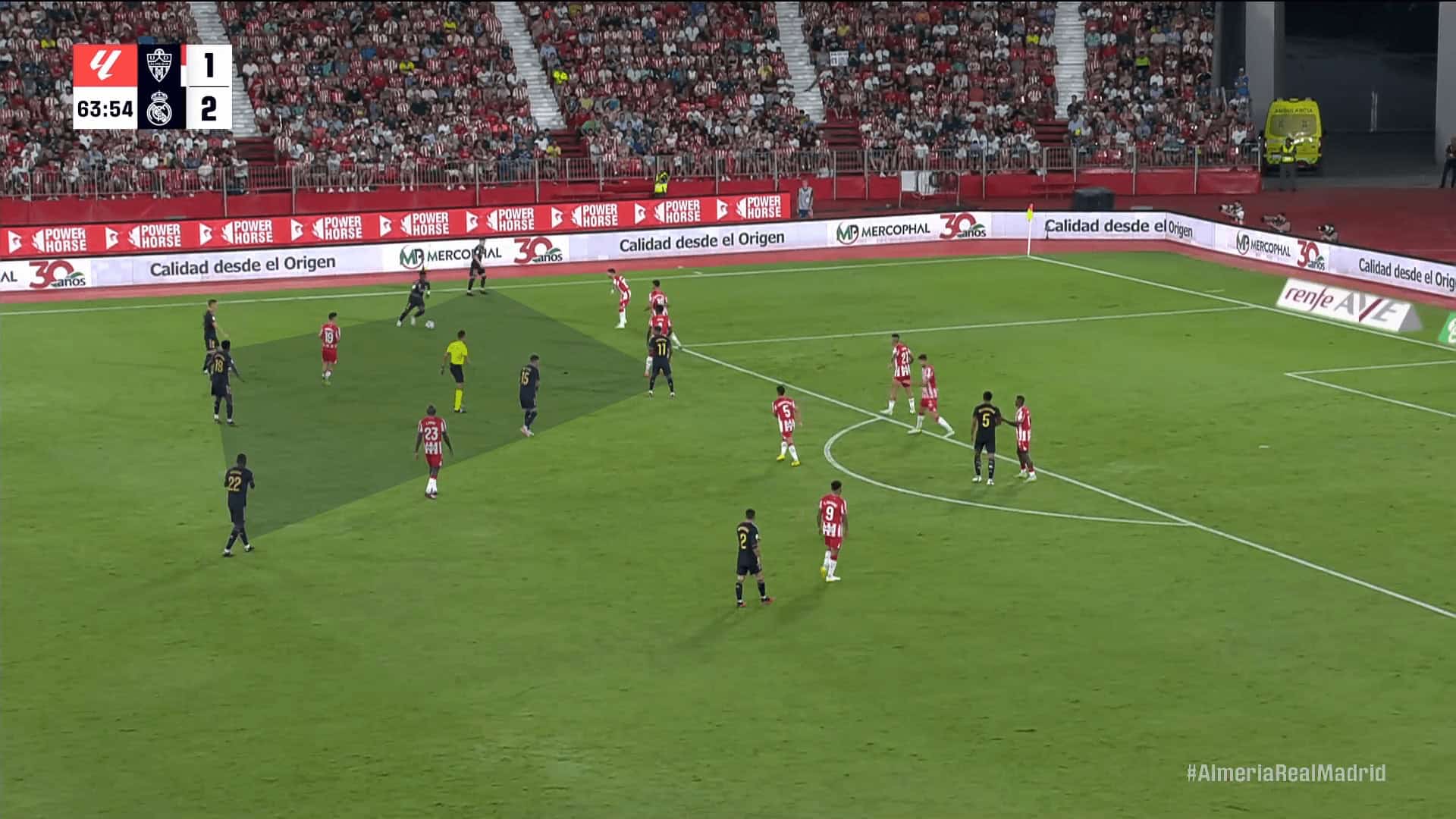
Interestingly, this side is equally comfortable pushing seven players to the ball while leaving limited numbers in high central positions to attack crosses, as it creates more moderate overloads on the wings and pushes more numbers into the box.
Late in the first half, Real Madrid attacked through a 3v2 on the right and 3v3 in the box.
With more moderate numbers, they were also able to get additional players just outside of the box to deal with any rebounds or clearances.
Without a traditional #9 in the starting XI, there’s no default pattern of attack or box entry.
Early signs point to this team continuing to keep opponents off balance through asymmetric structures and wingers taking a different approach to the two-forward system.
Real Madrid may struggle to defend the wings, which could lead to some high-scoring games, but expect them to continue successfully putting the ball in the back of the net.
Conclusion
After a dream start, Almería managed to exchange blows with Real Madrid and kept themselves in the fight, but ultimately, Los Blancos were able to complete the comeback and secure all three points.
This was an end-to-end match with lots of shots and quality opportunities.
From an attacking standpoint, both sides should be happy with the quality of the chances they created.
Real Madrid will be especially happy to finish off three of them.
Defensively, this was a very open game that both managers must investigate.
For Moreno, there’s a degree to which he can point to playing one of La Liga’s giants.
There’s still some work to do, but he’ll not come across a side with this level of talent every day.
Ancelotti will have a little more concern.
Though he can credit Almería for executing their tactics well, the openness of this game and the number of shots conceded are troubling.
Real Madrid did give away several good looks on goal, which may not work out so favourably against some of the top opponents in La Liga or the UEFA Champions League.
Some adjustments need to be made, which may be more an issue of personnel than system.
Expect experimentation as Ancelotti pushes this new system and game model on his talented young squad.
