
After parting ways with Saudi Pro League side Al-Nassr, Stefano Pioli has just rejoined Fiorentina as their new head coach on a three-year contract.
He has already started working with the team for the pre-season.
In fact, Pioli has already selected his pre-season roster, and that was announced on the club’s official page.
This means that Pioli has already started making his player choices and will soon begin working with the team.
Fiorentina finished sixth in last season’s Serie A with 65 points, which earned them a ticket to the 2025/2026 UEFA Conference League.
Additionally, it was a positive season for them, as they reached the semi-finals of the UEFA Conference League last season, only to be knocked out by Real Betis.
Raffaele Palladino guided the team well in all competitions last season, helping the team gain more experience and chemistry.
It was challenging to beat Fiorentina, especially at the Artemio Franchi, that season.
With Palladino’s departure at the end of this season, Fiorentina’s management decided to go with Pioli.
That was a wise choice mainly because Pioli represents a loved and respected figure among the fans, the club, and everyone surrounding the club.
During such a transitory period when fans are pushing for better results and more convincing performances next season, it was important to opt for someone who knows the city, the fans’ demands, and, more importantly, knows the club’s ambition, history, and margins of progress.
Therefore, few names could have been more suitable for Fiorentina’s bench than Pioli, given that Fiorentina was a very competitive team under his management in 2017, 2018, and 2019.
It is also worth noting that Pioli played for Fiorentina for the majority of his footballing career, from 1989 to 1995, which reinforces the fact that Pioli is a manager who knows Fiorentina and Florence more intimately than anyone else at the moment.
That said, having played for a team or being a head coach who has led the team during a specific period is not enough to succeed at that club this time.
That’s why it will be crucial to examine how Pioli developed compared to the last time he coached Fiorentina, his actual tactical preferences and beliefs, and how he can rebuild Fiorentina to become more competitive and powerful this season.
Therefore, this tactical analysis will examine Stefano Pioli’s coaching style and tactics, as well as his potential player choices for Fiorentina.
Stefano Pioli Coaching Style & Principles
It is fair to say that Pioli is a reliable head coach, especially for teams holding positions near the top four and seeking to bridge the gap and reach higher spots.
Pioli has been capable of bridging that gap between such teams and the league’s top teams, as he has often created surprises in Serie A.
The most outstanding achievement for Pioli remains, obviously, winning the Serie A title with AC Milan in the 2021/2022 season.
He rebuilt the team starting in 2019 following Marco Giampaolo’s sacking due to poor results.
Pioli was capable of leading the team back to glory after struggling to finish among the top four spots in the previous seasons.
In his first season with the I Rossoneri, he led Milan to a sixth-place finish after the team started the season catastrophically under Giampaolo.
In the following season, Pioli succeeded in leading Milan back to UEFA Champions League football after a seven-year absence, setting records for all-time away wins in a Serie A season, 16, and accomplishing an unbeaten series of 24 league games, their longest run since 1993.
Pioli then succeeded in winning the race against Inter Milan and lifted a Serie A title that Milan fans had awaited since 2011.
This confirmed that he can be a head coach who wins league titles, not just one who helps mid-table teams perform better.
At the same time, we cannot overlook Pioli’s spell at Lazio from 2014 to 2016, when he upgraded Lazio’s performances and helped them finish third in Serie A, just behind AS Roma and Juventus, enabling them to return to UEFA Champions League football after eight years of absence.
Pioli also experienced some less successful spells during his career, notably with Palermo and Inter Milan.
He failed to lead the Nerazzurri to a UEFA Champions League spot, finishing the season in seventh place with 39 points out of 69 possible.
That said, Pioli is a head coach who values interaction and chemistry with his players, and he easily develops a positive atmosphere filled with open communication and a positive attitude, allowing his players to perform at their best.
His approach can be considered successful with most players, as he usually avoids creating a lot of fuss or engaging in unnecessary confrontations with his players or the media.
This leads to maintaining serenity and calm within the team, which helps build a solid group, as seen with Milan, despite having strong figures and those with unique temperaments, such as Zlatan Ibrahimović, Rafael Leão, and Theo Hernández.
Succeeding in getting one of the best versions and performances of these players confirms that Pioli’s approach is successful and efficient.
Therefore, his task will be less complicated at Fiorentina from this perspective of squad and players’ management, as fewer players have complicated personalities within the squad.
Perhaps the most delicate personalities that Pioli will have to study how to deal with will be Moise Kean and veteran striker Edin Džeko.
It will be fundamental to win the trust of these two players, understand how to utilise them together, and motivate them to perform at their best.
Moreover, numerous players, like Hernandez, have already declared that Pioli allowed them to utilise their strengths and play without limitations.
This is very important, as it means that Pioli helps players reach their full potential with remarkable ease.
Stefano Pioli Formation At Fiorentina
Pioli’s preferred formation has always been the 4-2-3-1, a formation he frequently employed, especially with Milan.
He relied on two powerful central midfielders, explosive wingers, and a reliable striker.
That said, the Fiorentina formation used in the last part of the season under Palladino’s management was the 3-5-2 formation, meaning that the current roster is better qualified to play according to the 3-5-2 formation rather than Pioli’s preferred 4-2-3-1 formation.
Pioli indeed experimented with the 3-4-2-1 formation during his last games with Milan, but that was more likely a choice of urgency than a formation he truly believed in, given that his team was going through a negative period at the time and needed a tactical change.
Therefore, this means that Pioli will either switch to the 4-2-3-1 formation, which will require additional reinforcements to the squad, especially on both wings, or he will choose to continue with what Palladino left behind and work with the team using the 3-5-2 formation while trying to make it more effective.
In fact, the actual Fiorentina squad showed very positive signs last season when adopting the 3-5-2 formation, and that’s why it would be wise for Pioli to keep the same formation at least for the start of the season, before assessing and comparing which formation would be more beneficial for the team.
At the same time, it would be understandable for Pioli to switch immediately to the 4-2-3-1 formation.
He believes that this formation allows him to apply his preferred ideas and may achieve better results.

As mentioned above, Pioli firmly believes in the use of very powerful and versatile midfielders, considering them the most important players.
He usually instructs them to be omnipresent in the high-pressure and defensive phases and to play a fundamental role in terms of playmaking.
In addition to midfielders, Pioli gives more freedom to full-backs and wingers, allowing them to contribute extensively in terms of overlaps, crosses, shots from distance, and penetrations inside the box, both with and without the ball.
There are many examples of full-backs advancing to the box and scoring goals from the edge of the box or inside the box, especially at Milan.
Furthermore, finding a suitable advanced playmaker will be central to Fiorentina’s success next season.
Such players link midfield and attack and are particularly important in Pioli’s system.
That said, Pioli is not a very demanding head coach and can convert one of the central midfielders into an advanced playmaker if he finds someone who meets the needed criteria, as he did so with Rade Krunić at Milan.
Stefano Pioli Possible Player Choices At Fiorentina
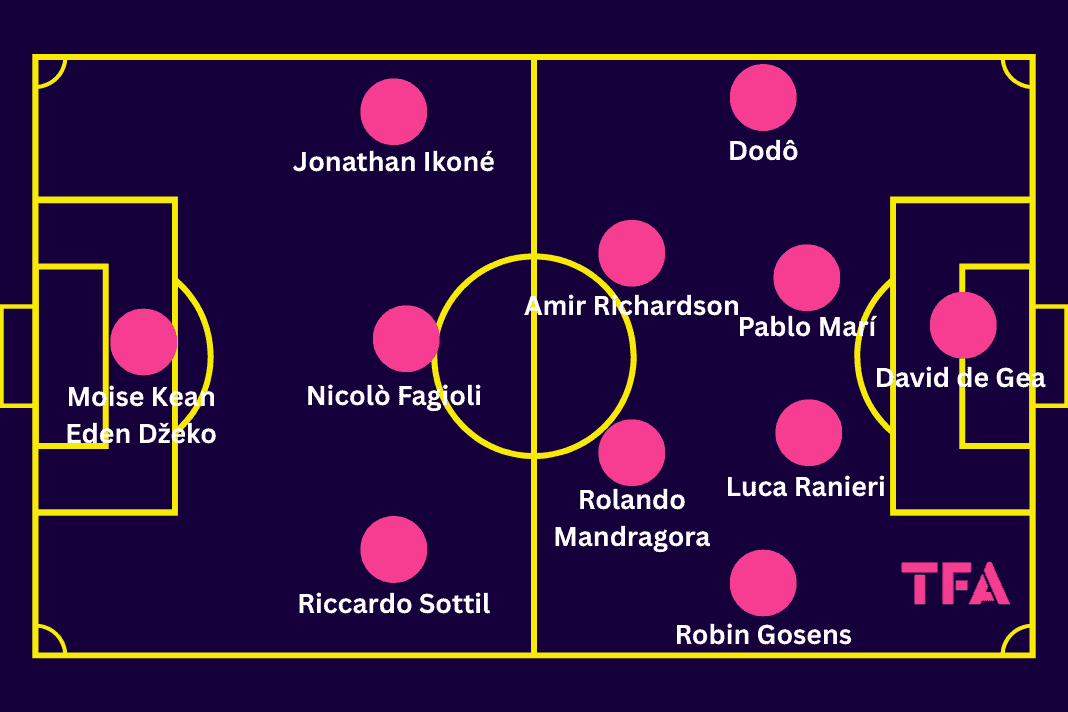
If he switches to the 4-2-3-1 formation, Pioli will most likely keep David de Gea as the starting goalkeeper, especially following his outstanding performances last season.
Pioli would confirm Luca Ranieri and Pablo Marí as starters for the centre-back positions, with Pietro Comuzzo and Marin Pongračić being the plan B choices.
For the full-backs, Pioli will have to pay attention to these two positions.
The players at his disposal are more accustomed to the 3-5-2 formation than the 4-2-3-1 formation, meaning they also perform better in the 3-5-2 formation, primarily because they excel in the attacking phase.
These two players are Robin Gosens and Dodô.
Therefore, if Pioli insists on the 4-2-3-1 formation, he will have to intensify training for both players to improve their adaptability to this formation and strengthen their defensive contributions before the start of the season.
Otherwise, it will be complicated for Fiorentina to have a balanced line-up according to this 4-2-3-1 formation with both Gosens and Dodô as full-backs.
In midfield, it will be crucial to utilise both Rolando Mandragora and Amir Richardson as the starting central midfielders, as there are no better options for these positions; Cher Ndour will serve as the backup option.
Fiorentina will have to reinforce this stance, however, as they must sign a quality midfielder if they want to compete seriously for the top spots.
Pioli’s best choice for the advanced playmaker position will be to convert Nicolò Fagioli into an advanced playmaker, as he possesses the necessary qualities to succeed in this role under Pioli.
At the same time, Pioli has two alternative options for that position: Albert Guðmundsson and Antonín Barák.
Pioli is expected to experiment with Guðmundsson in that position as well because he recently declared that he likes his abilities and believes that he can be very central to his project with Fiorentina.
For both wingers, Fiorentina will need to make some reinforcements, too, as the wingers on the roster are not capable of making the needed difference.
Whether Josip Brekalo or Riccardo Sottil is on the left wing, neither choice is convincing enough, so Fiorentina will have to make more valuable upgrades on that wing.
Potential Stefano Pioli Fiorentina Lineup
On the right side, Pioli will likely rely more on Jonathan Ikoné while waiting for an additional quality reinforcement on that wing, as Ikoné cannot be reliable for a whole season without a backup option, at least.
This will not be problematic for Pioli at the striker position, as he will rely on Kean as the central starting striker and on Džeko as the substitute striker who comes on in the second half to turn the tables and capitalise on his finishing experience.
However, in the context of changing to a 3-5-2 formation, Moise Kean and Džeko will form an attacking duo that can create a lot of danger to opponents, especially if Džeko is having his best run of form this season.
Conclusion
Following Pioli’s first press conference, Fiorentina are even more hopeful of achieving a top-four spot this season, as Pioli is keen to achieve great results with the team.
This version of Pioli appears to be a more mature, direct, and experienced one than the one who coached Fiorentina years ago.
Given that Pioli’s successes after coaching Fiorentina helped him gain more confidence and belief in his ability to improve the situation at Fiorentina, he has likely matured.
