
RB Leipzig hosted Bayern Munich in Gameweek 18 of the 2025/2026 Bundesliga season, losing 5-1.
Although they took the lead during the first half and dominated in terms of big chances (five) and shots (nine), the Bavarians put forth a display of their quality and ruthlessness, scoring five goals in the second period.
FC Bayern had more ball possession (63%), shots (14), and big chances (6) in the second half than the first, hinting at a major change in their approach after the break.
This game also had important individual events for the defending champions, including Jamal Musiala’s first appearance since his injury, Serge Gnabry scoring his 100th goal for Bayern Munich, and Michael Olise coming on as a substitute to score a goal and provide a hat-trick of assists.
Through this tactical analysis, we aim to focus on Bayern Munich’s second-half performance and how they outplayed their opponents.
RB Leipzig Vs Bayern Munich Lineups & Formations
Let us look at how Ole Werner and Vincent Kompany fielded their squads.

The hosts, Leipzig, played in a 4-4-2 formation.
Péter Gulácsi started in goal, behind a back four of Ridle Baku (right-back), Willi Orbán (right centre-back), Castello Lukeba (left centre-back), and skipper David Raum (left-back).
Xaver Schlager and Nicolas Seiwald were the centre-midfielders. Ezechiel Banzuzi replaced the latter at the 81st minute.
Yan Diomande (right) and Antonio Nusa (left) were the wingers. Andrija Maksimović came on for the latter at the 90th minute.
Rômulo played as the striker alongside attacking midfielder Christoph Baumgartner. They were replaced by Conrad Harder (81’) and Tidiam Gomis (84’) respectively.
The visitors, Bayern Munich, played in a 4-2-3-1 formation.
Skipper Manuel Neuer started between the sticks.
The back four were Tom Bischof (right-back), Dayot Upamecano (right-centre-back), Jonathan Tah (left centre-back), and Hiroki Itō. Bischof and Itō were substituted by Alphonso Davies (81’) and Min-jae Kim (86’).
Aleksandar Pavlović and Leon Goretzka played as the double pivot. The latter made way for Joshua Kimmich (46’).
Serge Gnabry played as the central attacking midfielder, while Lennart Karl (right) and Luis Diáz (left) played as the wingers, with Harry Kane up top. Musiala came on for Gnabry (87’) and Olise for Karl (56’).
Bayern Munich Second Half Defending Tactics
Bayern Munich attempted to press high against the ball in both halves.
However, Leipzig executed multiple progressions during the first period.
This was due to a disconnect in Bayern’s waves of pressure.
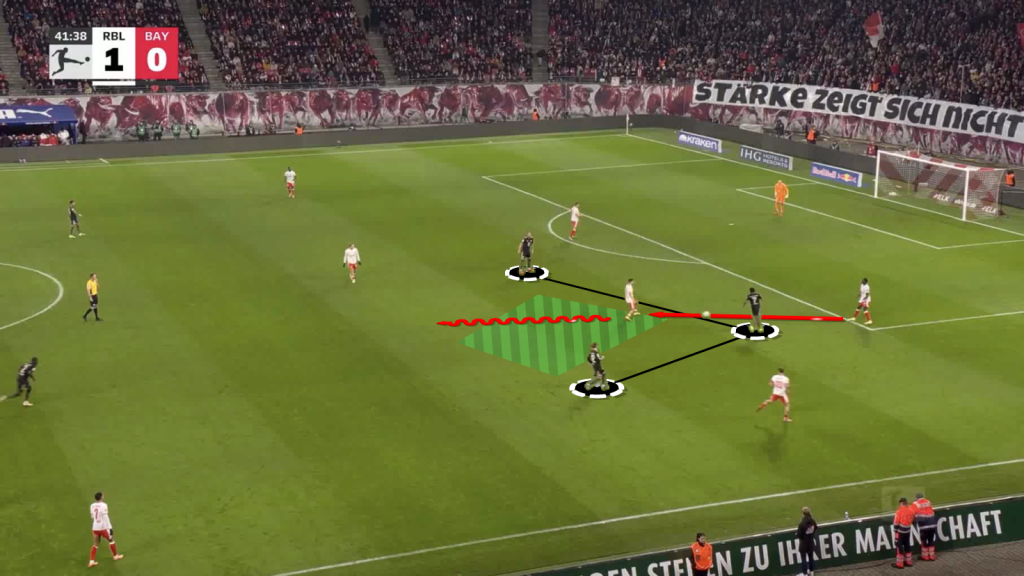
Three Bayern Munich players press high in one line, but the absence of the second line allows Leipzig to play through the press.
A midfielder drops into the space between the three Bayern attackers to receive the ball; since there is nobody to press him, he turns and progresses the ball.
The Bavarians solved this issue after the break.
They made sure to press in a vertically compact shape.
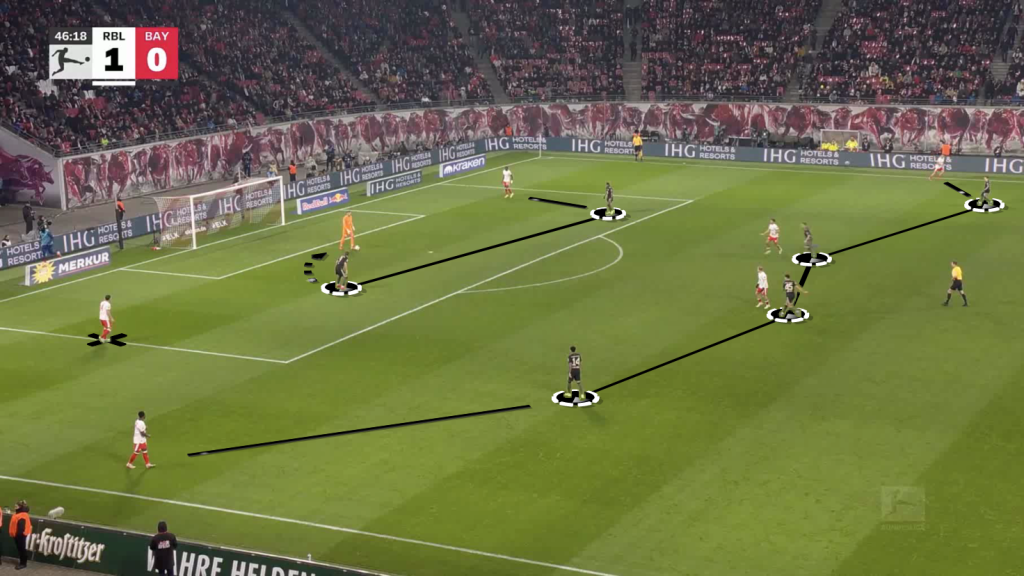
A 4-4-2 pressing shape is visible.
Gnabry steps alongside Kane to make a front two.
As Bayern’s pivots step to mark Leipzig’s centre-midfielders, they have no option but to go long.
In situations where Leipzig found a midfielder inside the Bayern Munich structure, a Bayern player was ready to press from deep, making sure the only way was a backward pass.
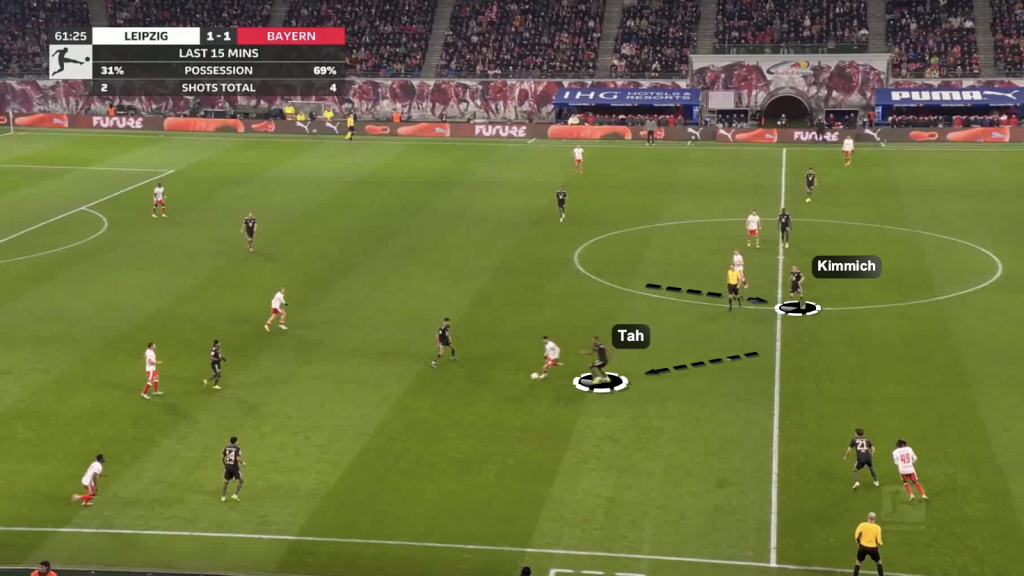
The centre-backs were also seen stepping up frequently.
Even if the opponent received the ball, he was either forced to play it backwards or hold onto it long enough to get tackled.
When one of the centre-backs stepped up, one of the pivots dropped to cover the void.
Tah and Kimmich are seen doing the same in the image above.
Gnabry’s equaliser also came from a similar situation.
Upamecano steps up at the right time to press Baumgartner, who is unaware of the threat.
Gnabry, fortunate with his positioning, gets onto the end of the second ball and buries it into the far bottom corner.
A high-pressing team that encourages their centre-backs to press as high as this needs to be adept at positional rotations in the defensive phase.
Bayern Munich put up a brilliant display in that regard.
Their defence was a bit shaky during the first half, which also reflected in the way they conceded the opener.
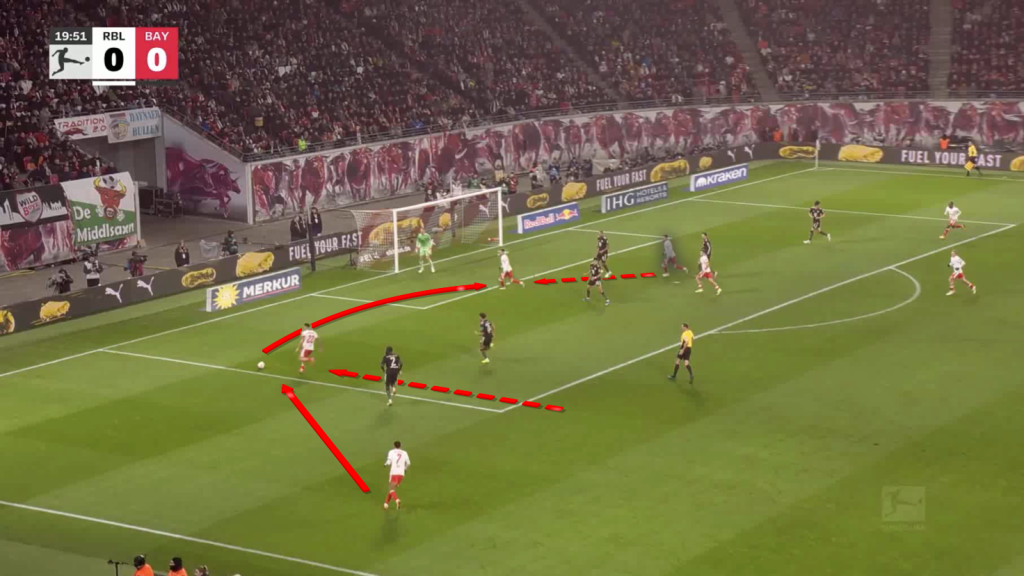
Raum went untracked when he made an underlapping run.
As he received the through pass, he whipped a first-time low cross, which was met by Rômulo at the near post.
The striker beat two opponents with a quick burst of pace to meet the ball.
Followed by the goal, the hosts created a few more situations that spelled danger.
The second half was much better in terms of second pressing actions after the opponents had either received the ball in an advanced position or beaten the initial press.
Leipzig play through Bayern’s first line of press; the midfielder on the ball gets enough time and space to pick out a forward pass.
However, as they attempt to make a final third entry, Bayern are proactive in closing the receiver down.
They end up winning the ball, which gives birth to a counterattack.
There were multiple occasions where Leipzig got the ball inside the Bayern Munich structure, but ended up getting dispossessed.
A part of the reason was the Bayern players applying pressure from all sides.
Kompany’s attackers were also prompt in carrying out second pressing actions to make ball recoveries.
Leipzig get away from the initial pressure by playing an exit pass.
However, Gnabry puts blindside pressure on the ball-carrier and makes a recovery.
These actions were carried out rapidly and helped the visitors set the tempo for the second half.
This also entailed that the hosts were a step behind in terms of ball retention and intensity.
Bayern Munich Second Half Attacking Tactics
Build-Up & Progression
Bayern Munich sought to exert greater control over the pace of play in the second half.
With Leipzig pressing aggressively in the mid-third, the visitors needed numerical superiority in the first phase of the attack.
More midfielders were seen dropping deeper and outside the opponent’s structure.
This led to two cases:
1) The opponents pressed with numbers: this opened spaces between the lines.
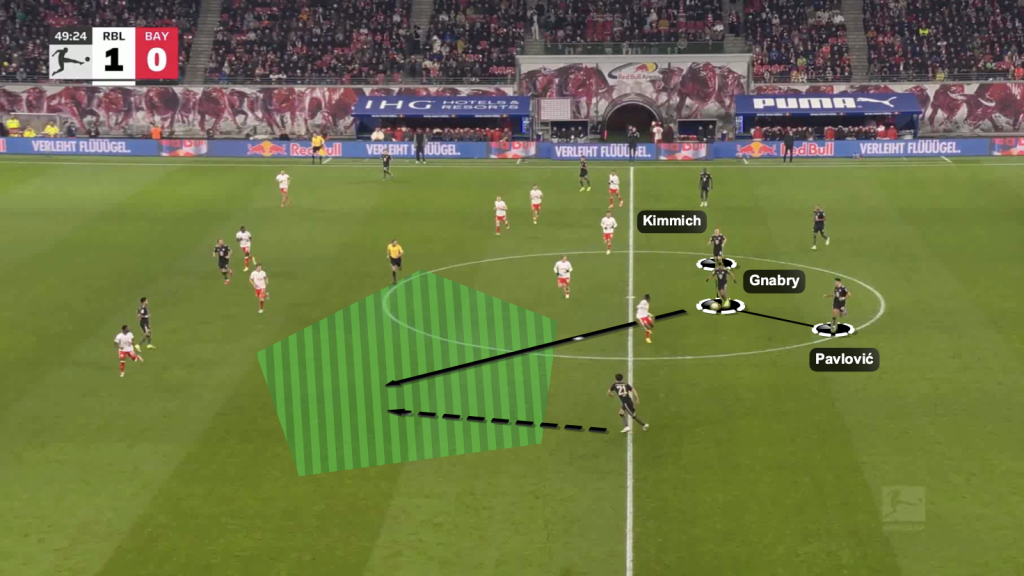
All three midfielders have dropped outside the structure; as a result, they step up, leaving space between the lines.
This allows progression: Gnabry releases Itō into space.
2) The opponents did not engage: this gave Bayern time and space, owing to which they slowed the game down in phases.
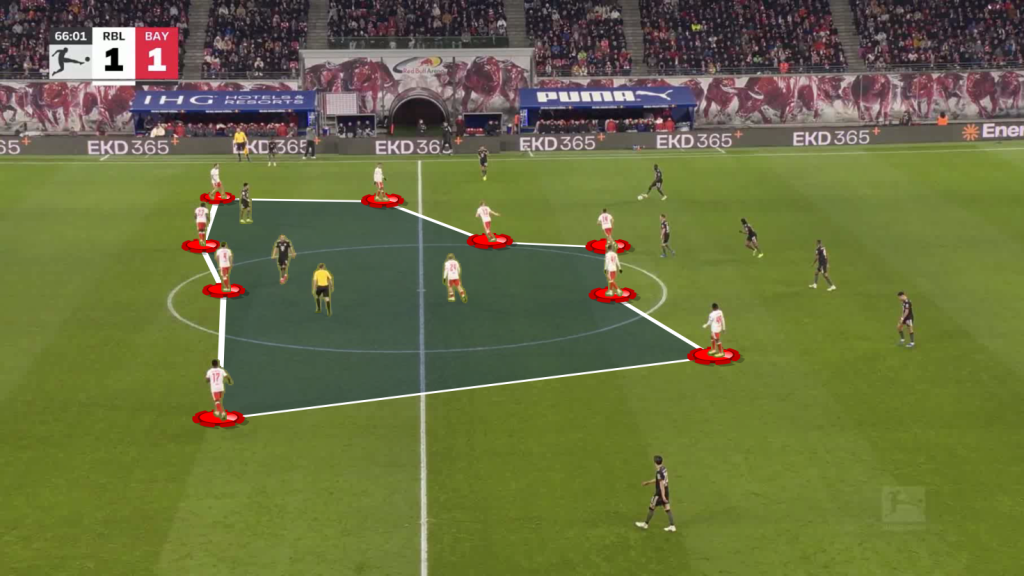
As shown, several Bayern Munich players have dropped outside the opponent structure.
The opposition stays in shape and opts against engaging in an unstructured press.
This gives Bayern enough time to have comfortable possession and go around the Leipzig block.
Leipzig did a decent job at executing the wide squeeze whenever Bayern had the ball in the wide channel.
They also pressed in a way that did not allow direct back-passes from the wide areas.
The visitors solved this by connecting passes through their midfielders to shift play.
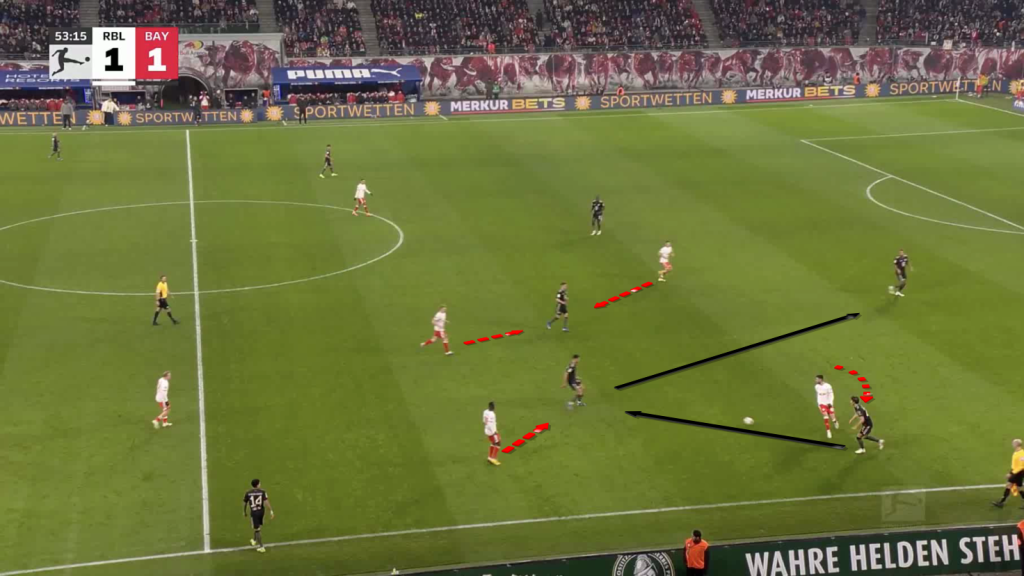
Rômulo curves his pressing run, which cuts the passing lane from the left-back to the centre-back.
Itō cannot play to Tah directly, so he finds Pavlović, who can play the pass.
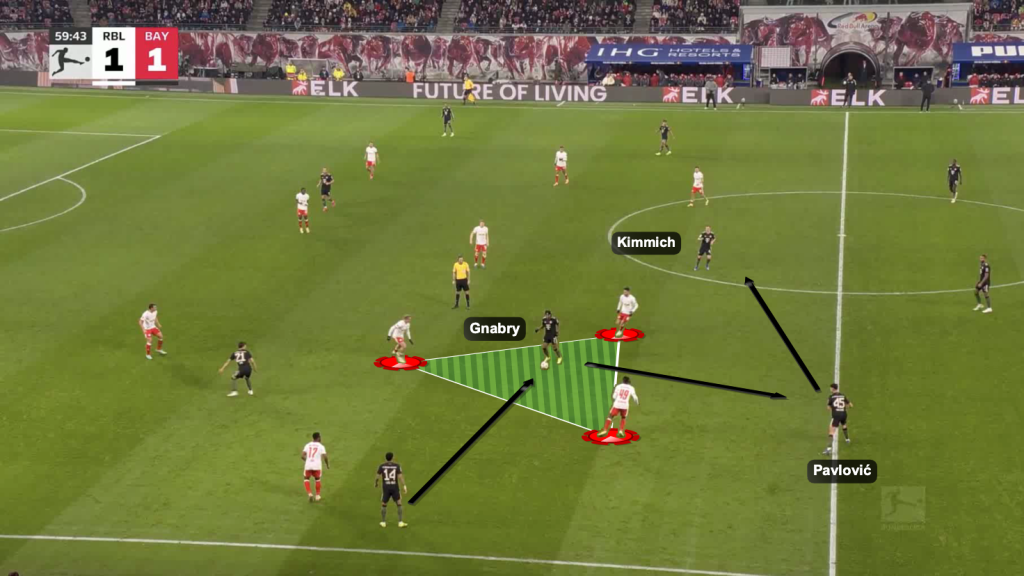
Gnabry receives in a pocket in the half-space before moving it backwards for a switch in play to the other side.
It was rare to see Bayern getting stuck in a wide area; they showcased their ability to effortlessly shift play by finding inside passes to change angles of support.
The Bavarians were seen using third-man combinations to exploit the space in-behind.
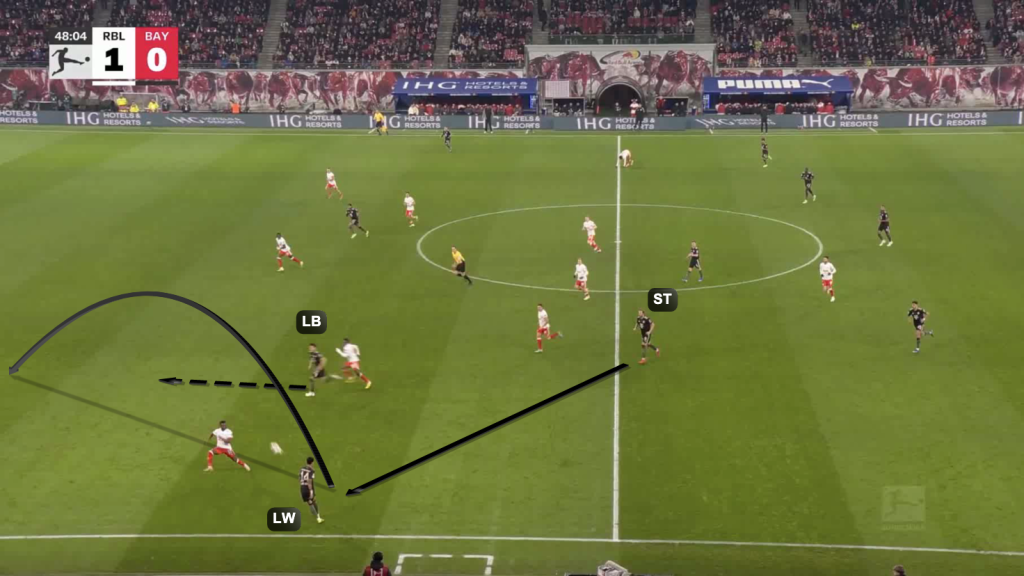
Kane plays a pass to Diáz, who releases Itō with a first-time pass into space, as the Japanese international makes a run in-behind.
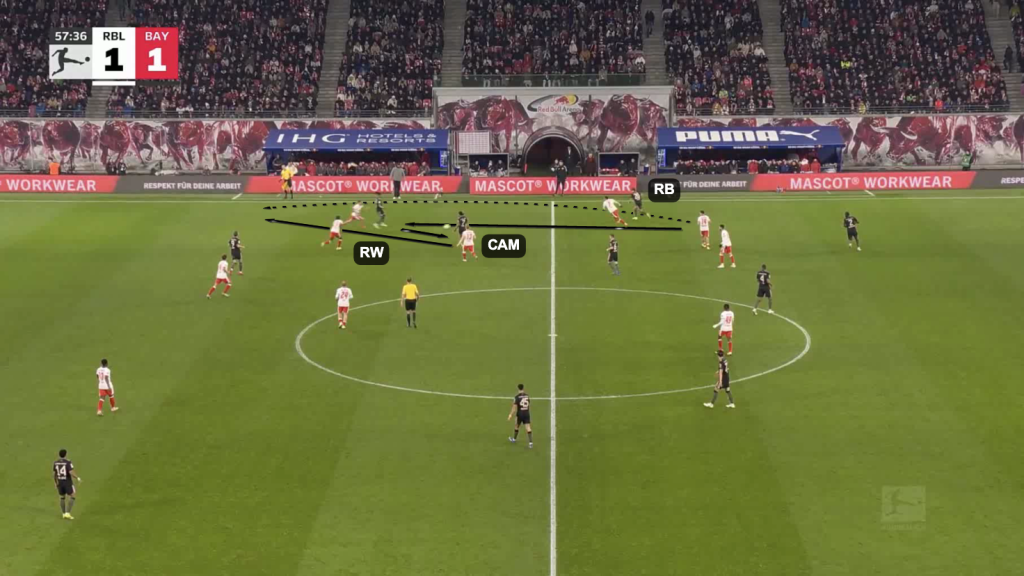
An example with intricate passes to capitalise on the space behind the backline.
Bischof finds Olise in the half-space, who sets it for Gnabry.
Due to the Frenchman receiving, two opposition defenders are dragged out of position.
This is the space Bayern exploits, as Gnabry plays a one-touch through pass for Bischof.
Constant movement and positional rotations amongst the Bayern players were tricky for Leipzig to track, as different players ended up receiving the ball in multiple areas.
Kane is a prime example of this; the Englishman popped up in several areas of the pitch, offering numerical superiority.
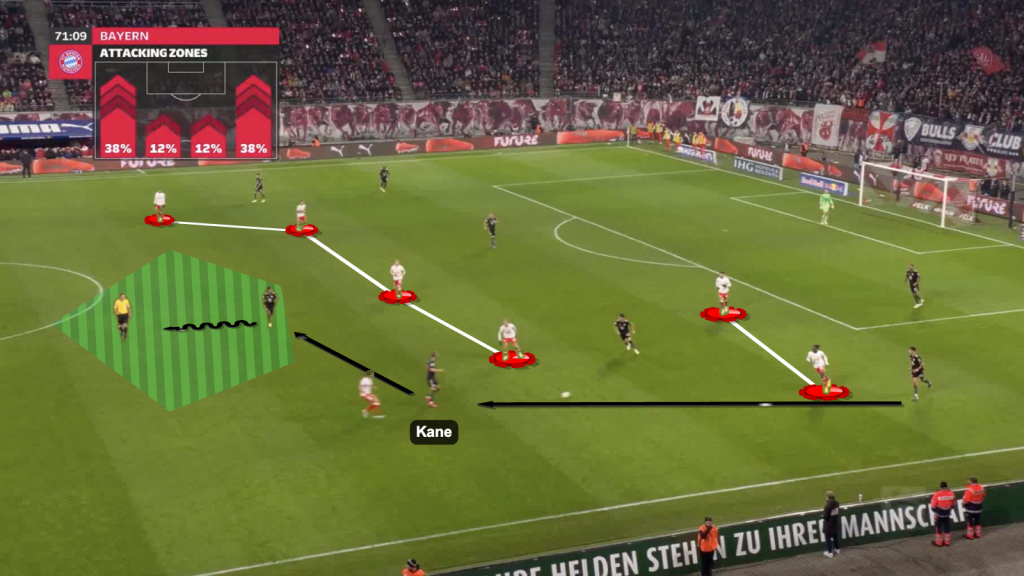
When all the other midfielders were zonally marked, the striker dropped to offer an extra outlet for progression.
There were occasions when Kane, upon receiving the ball, broke multiple lines of opponent press.
This propelled his side into counterattacking situations immediately.
Kompany’s players were also seen making movements to open space for others.
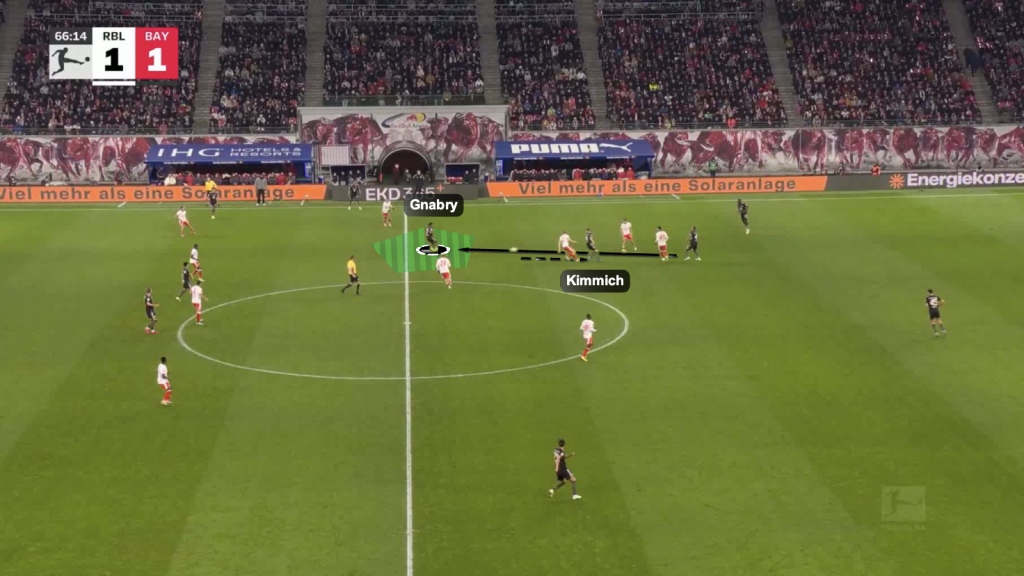
Kimmich moves away from the half-space, dragging an opponent in the process.
This opens the passing lane from Upamecano to Gnabry.
The attacker receives the ball without pressure and can progress instantaneously.
Attacking Third
Bayern Munich’s attacking third actions frequently resulted in either attempts on target or goals.
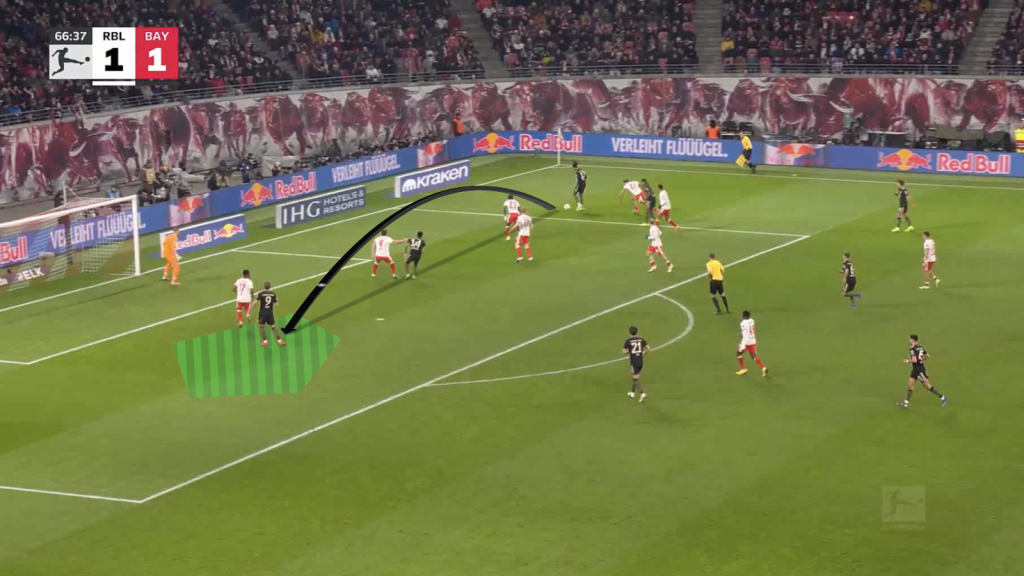
For Kane’s goal, Olise attracted multiple Leipzig players by dribbling down the line in the wide channel.
With all the Leipzig defenders focused on the ball, nobody tracks Kane closely.
Once Olise gets a yard of space, he whips a cross in for the Englishman to bring it down and find the finish.
Diáz posed a considerable threat with his ball-carrying down the left flank; the Colombian ended up creating multiple chances, one of which resulted in Olise’s goal.
Once released on transition, Diáz dribbles all the way to the penalty area before he plays a chipped pass into Musiala’s path.
The German cushions it for Olise’s finish into the near top corner.
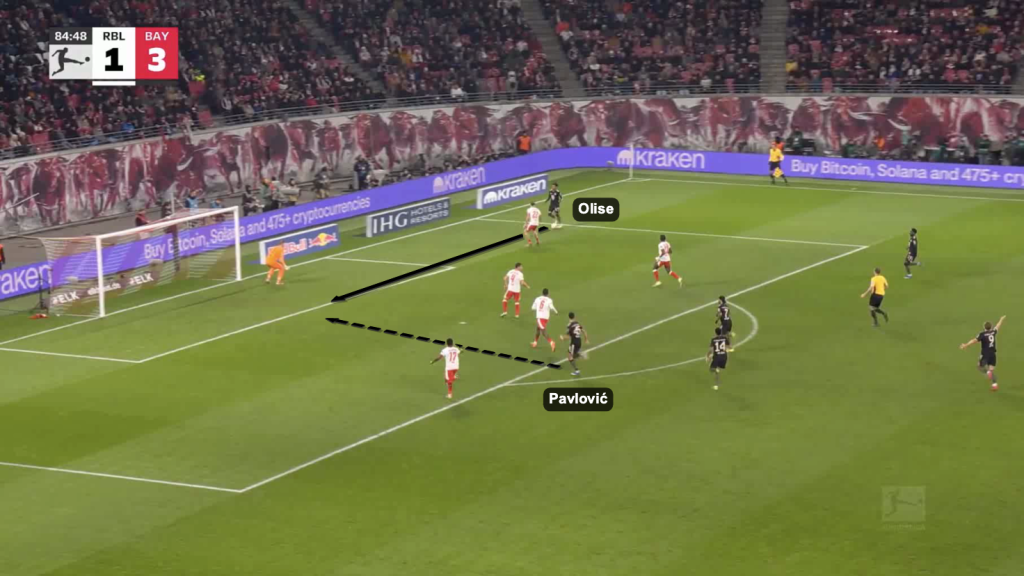
Pavlović’s goal was a byproduct of Olise running down the wide channel.
The Leipzig defenders were unorganised during this moment, which led to the German running to the far post untracked.
Conclusion
Bayern Munich fixed their press in the second half, adding vertical compactness to it.
With the second line of press always close behind, Leipzig faced difficulties in playing through Bayern’s press.
They also made sure to tighten their second pressing actions, which resulted in more ball recoveries, which in turn helped with ball retention and control.
Multiple Bayern Munich midfielders dropped outside the opponent structure in build-up moments to either attract pressure to find space behind the first line or to slow the game down when the opponents did not engage.
The Bavarians utilised third-man combinations, inside passes, and positional rotations to move the ball into space horizontally and vertically.
In the attacking third, they were quick to make use of the spaces available to get shots away.
With sudden bursts of pace and quick execution of technical actions, they ended up scoring five times.
