
After a turbulent campaign in 2024/2025, Juventus turned to Igor Tudor style of play in the closing stretch of the season, hoping for a course correction after Thiago Motta tactics had run out of steam.
The results were immediate: under Tudor tactics, Juventus rediscovered their edge, losing just once in the final nine matches.
That late surge secured a top-four finish and a much-needed return to the UEFA Champions League.
Yet, the real challenge lies ahead, sustaining this momentum across a full season.
Tudor is not a stranger to high-pressure environments. In recent years, he has led Hellas Verona during the 2021/2022 season, guided Olympique de Marseille to competitive heights in 2022/2023, and taken charge of Lazio.
He even has history within the Juventus set-up, having worked as Andrea Pirlo’s assistant.
His career trajectory reflects a coach unafraid to make bold tactical shifts, often revitalising sides in need of fresh energy.
In Turin, those shifts are already visible.
Motta’s possession-heavy, rigid structures were yielding diminishing returns, with the attack becoming predictable and sterile.
Tudor injected greater dynamism through structural tweaks, sharpening transitions and bringing balance between defence and attack.
While this rejuvenation has yielded positive outcomes, cracks remain, as seen in Juventus’ heavy defeat to Manchester City at the 2025 FIFA Club World Cup, which highlighted lingering vulnerabilities when tested against Europe’s elite.
This data analysis report uses tactical frameworks and data-driven analysis to evaluate Juventus’ future under Tudor in 2025/2026.
By drawing parallels with his impactful but brief spell at the end of last season, alongside insights from his work at Verona and Marseille, we aim to assess whether Juventus are genuinely on the path back to Serie A’s summit, or if Tudor’s revival is still a work in progress.
Igor Tudor At Marseille 2022/2023: A Tactical Gamble With Structure & Steel
Igor Tudor’s arrival at Olympique de Marseille in 2022/2023 was far from universally welcomed.
Seen as a gamble after Jorge Sampaoli’s sudden departure, he entered Orange Vélodrome as a relatively unknown figure outside Italy, and scepticism was high.
Supporters even booed his introduction before the opening match, while dressing-room friction with senior players like Dimitri Payet added further doubt.
Yet, despite the rocky beginnings and a managerial CV that did not suggest stability, Tudor managed to imprint a clear tactical identity at OM, one built on organisation, intensity, and adaptability.
What set Tudor’s Marseille apart from his Verona side was the shift away from reliance on wing-play and direct long balls.
Instead, OM operated with greater control through central areas, emphasising circulation and retention.
The presence of technical midfielders such as Valentin Rongier and Jordan Veretout allowed the team to recycle possession with an average of just under five passes per possession, while still maintaining the intensity that characterised Tudor’s earlier work.
Their pressing game was among the most aggressive in Ligue 1, reflected in a PPDA of 8.34 as shown below, signalling a side keen to disrupt opponents high up the pitch.
Olympique De Marseille Stats 2022/2023

Defensively, the structure blended counterpressing principles with a compact low block.
Marseille averaged over 72 defensive duels per match, winning a respectable 63%, complemented by around 37 interceptions, an indicator of their ability to anticipate play and recover quickly.
Although their aerial duel success hovered under 50%, Tudor’s system prioritised ground duels and second-ball recoveries, ensuring territorial control.
In attack, the team balanced positional patience with sudden bursts of transition, producing close to 32 positional attacks per match, about a quarter of which led to shots, alongside nearly two counterattacks per game.
This hybrid approach of high-intensity pressing, measured possession, and direct attacking moments ensured that Marseille consistently outperformed expectations.
Despite the turbulence surrounding his appointment, Tudor demonstrated in 2022/2023 that he could transform scepticism into a structured, competitive force.
Tactical Use Of Wing-Backs: Igor Tudor Wide Blueprint
One of the defining tactical mechanisms under Igor Tudor at Marseille in 2022/2023 was his reliance on wingbacks to stretch, destabilise, and ultimately create attacking value.
Unlike his Verona side, which leaned more on direct balls and wide overlaps, Marseille developed a nuanced dynamic where Nuno Tavares and Jonathan Clauss were both tasked with high-risk, high-reward roles.
Tavares, in particular, exemplified the offensive slant of this structure.
Although nominally a wing-back, his data illustrates how he functioned more as a wide forward than a defensive presence, frequently inverting into central pockets or driving high up the left flank to pin back opposing full-backs.
Nuno Tavares Winger Actions 2022/2023
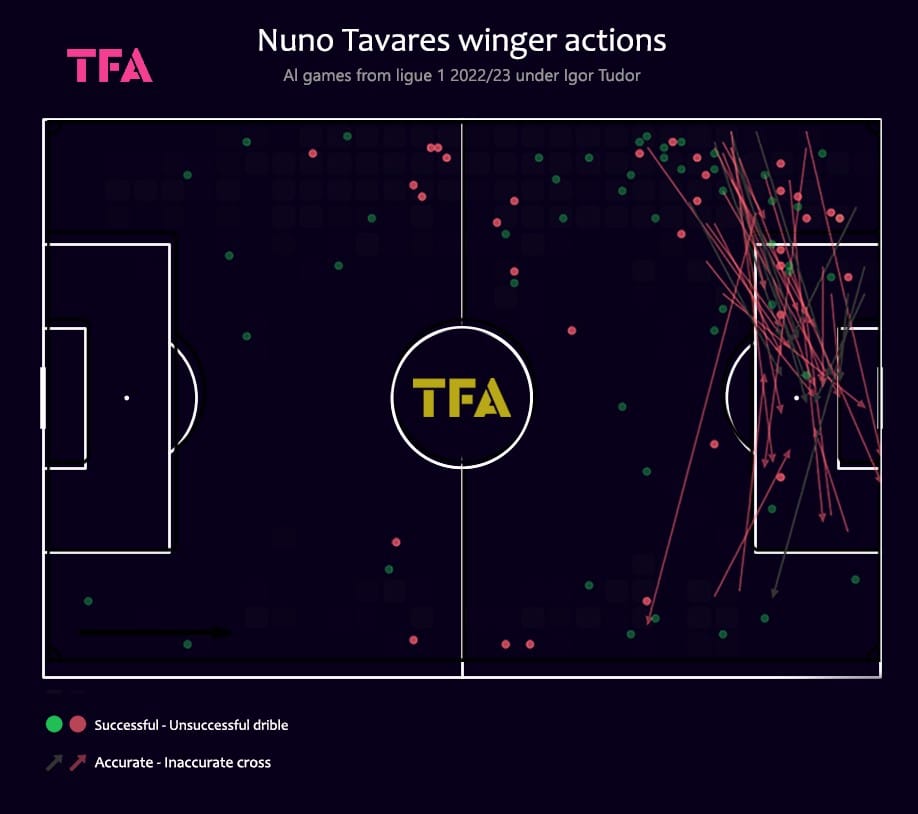
Statistically, Tavares’ profile captures this attacking identity.
Across Ligue 1, he recorded six goals and one assist, an unusually high output for a wing-back, underlining his advanced positioning.
His 84 shots, 21.4% on target, and 5.24 xG reflect his tendency to arrive in finishing zones rather than simply provide service.
In possession, he attempted over 1,700 passes, completing them at an accuracy rate of 78.5%.
His 136 long passes, at 53.7% accuracy, further emphasised his progressive intent.
The most telling metric, however, comes from his crossing and dribbling data: 171 crosses (27.5% accurate) and a remarkable 287 dribbles, with 55.4% success, positioning him as one of the most direct carriers in Tudor’s system.
Defensively, the numbers underline the imbalance of his role.
He engaged in 959 duels but only won 47%, a statistic that highlights his vulnerability when pressed into deep defensive scenarios.
With just 142 interceptions, his game was more about proactive ball progression than reactive defending.
In essence, Tudor accepted these trade-offs, prioritising Tavares’ ability to generate chaos and penetration over defensive security.
The wing-back became not only a source of verticality but a decisive offensive weapon, emblematic of Tudor’s willingness to gamble on a structure that fused risk with reward.
Igor Tudor Defensive Foundations In Build-Up
One of Igor Tudor’s most notable tactical principles at Marseille in 2022/2023 was the use of his defenders not only as guardians of the back line but as active participants in the build-up.
Rather than leaving central progression solely to midfielders, Tudor created a system where centre-backs were expected to contribute to ball circulation, particularly in accessing the final third.
The structure encouraged progressive passing, with defenders tasked to mix short circulation with occasional verticality, stretching opponents out of their compact blocks.
This approach created balance: patient possession when needed and avenues for breaking lines directly into attacking zones.
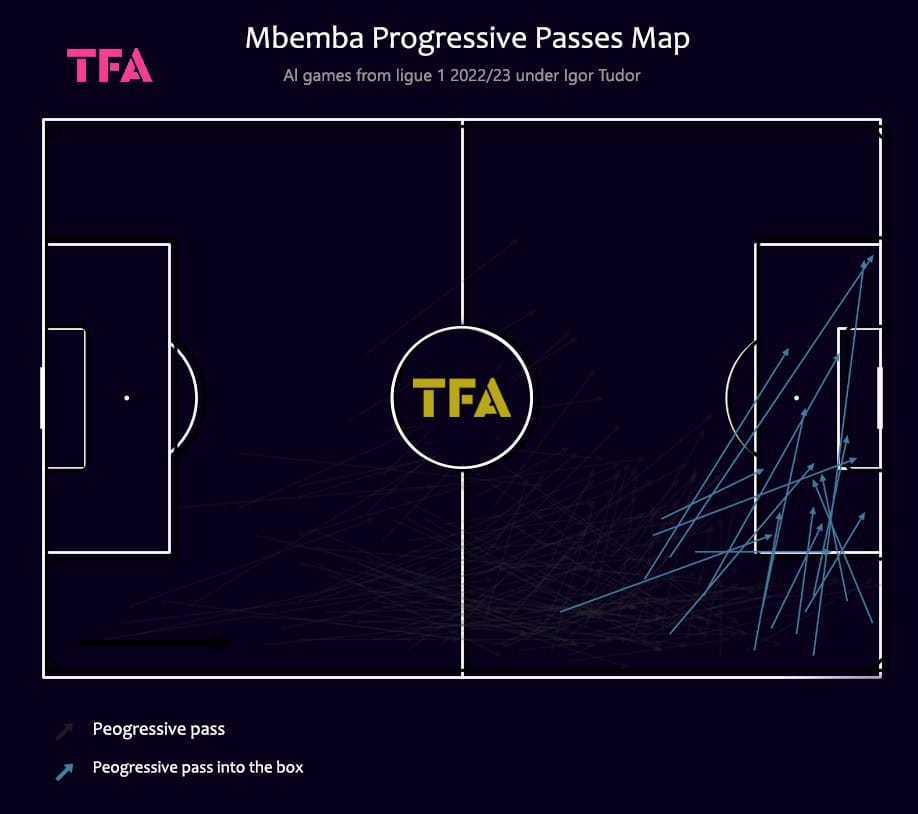
Chancel Mbemba Progressive Passes Map 2022/2023
Sead Kolašinac Progressive Passes Map 2022/2023
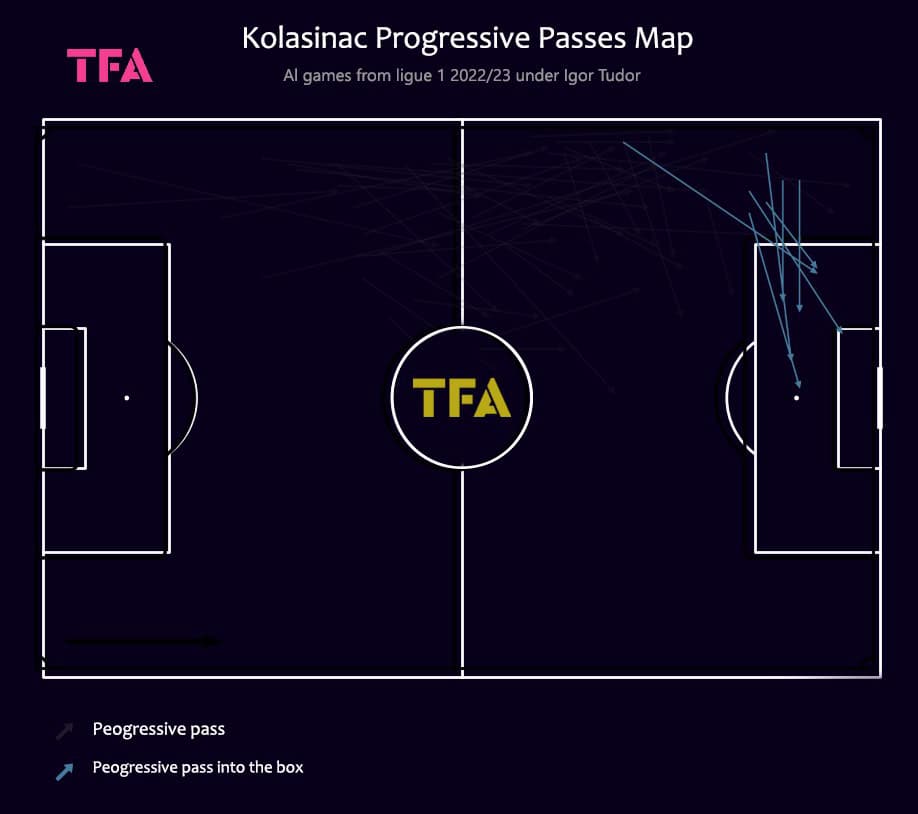
Within this framework, the data illustrates just how much responsibility rested on the defensive line.
Long passes were a constant feature, with a volume of over 190 attempts at 51% accuracy, while through balls were rarer but still purposeful, at 36 attempts with 25% completion.
Most significant, however, was the volume of forward progression: 891 forward passes attempted with 75% accuracy, alongside 287 passes to the final third completed at a remarkable 70%.
These numbers underscore the defenders’ dual responsibility of retaining possession and accelerating play.
A telling example comes from Chancel Mbemba‘s ball progression maps, which highlight his willingness to drive the ball forward from deep areas and connect directly with advanced players.
His passing profile supports this role: beyond the forward passes, he attempted 75 passes into the penalty area at 44% accuracy, while also contributing 60 crosses, a reflection of his license to step wide and overlap when necessary.
These elements typified Tudor’s blueprint: defenders as initiators of structured yet assertive build-up play.
Defensive Contributions & Structural Solidity
Tudor’s philosophy was not limited to progression with the ball; his defenders were equally defined by their work without it.
The Marseille backline operated within a counterpressing framework, transitioning swiftly from possession into defensive organisation.
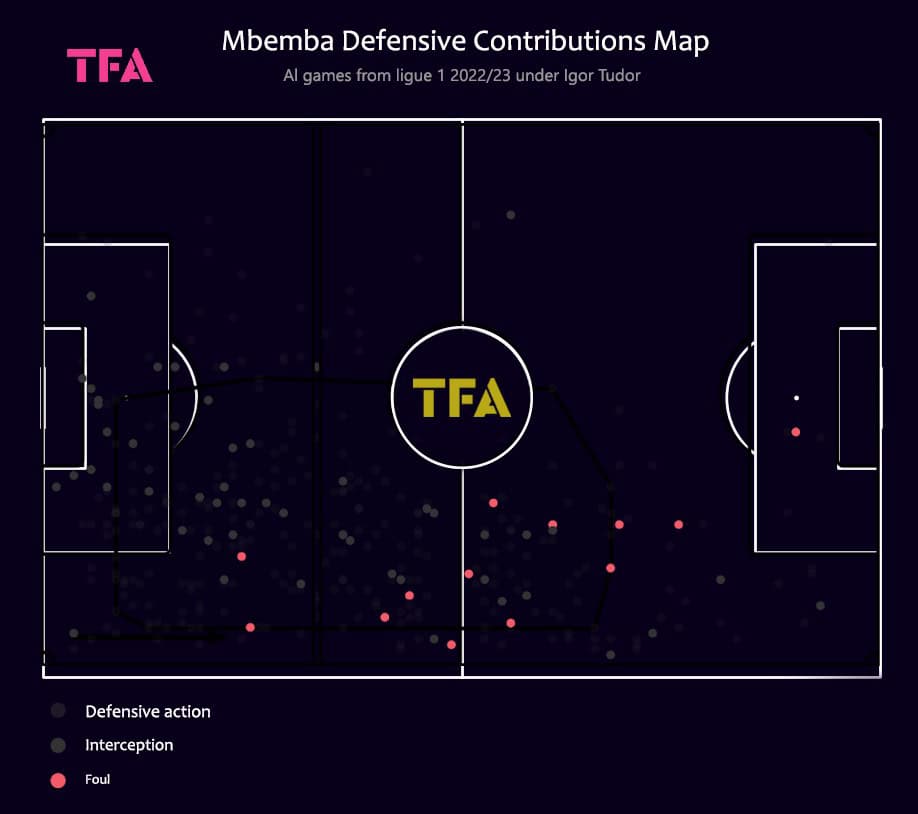
Chancel Mbemba Defensive Contributions Map 2022/2023
Sead Kolašinac Defensive Contributions Map 2022/2023
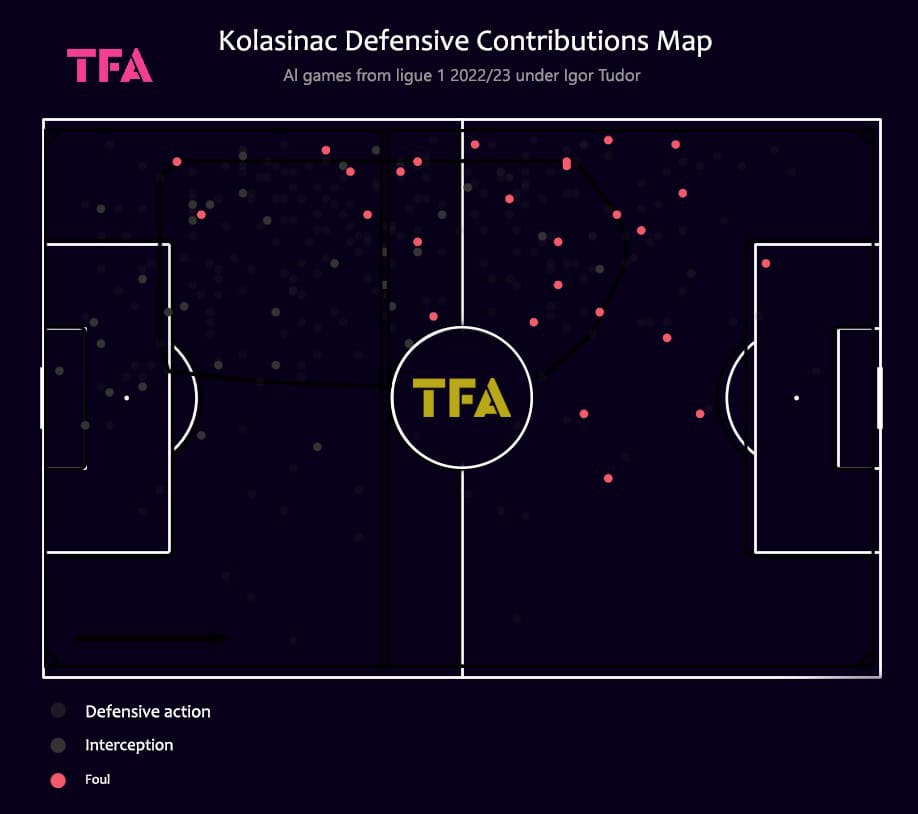
The maps above of defensive contributions for his players show both volume and consistency of actions, reinforcing how Tudor demanded his defenders to cover ground aggressively and protect space both centrally and wide.
Mbemba’s data is particularly instructive.
Across the campaign, he engaged in 268 defensive duels, winning 69% of them, an impressive level of efficiency given the high frequency of these engagements.
In aerial scenarios, he contested 161 duels, winning just over 60%, a valuable contribution in a league where physical strikers often target central defenders.
His involvement in loose ball duels, 97 in total with a 56.7% success rate, highlights his ability to contest transitions effectively.
Sliding tackles, albeit less frequent at six, were accurate at 83.3%, suggesting measured rather than reckless interventions.
However, the volume of interceptions (208) and recoveries (445 overall, including 27 in the opposition half) perhaps best reflects Tudor’s structure.
These figures show that the defensive line did not merely react to danger but actively anticipated and regained control, aligning with Tudor’s commitment to a proactive defensive block.
With 116 clearances and consistent contributions in stopping fouls when required, Mbemba epitomised the balance between aggression and discipline, embodying the defensive resilience that underpinned Marseille’s tactical identity.
Application Of The Blueprint At Juventus
When Tudor transitioned these ideas into his Juventus tenure, the adaptation was as much about philosophy as formation.
Where his predecessor had emphasised possession dominance, averaging nearly 60% of the ball, this often translated into sterile control rather than incisive chance creation.
Juventus easily accumulated expected goals against weaker opponents, but in 15 matches against Serie A’s top half, they produced only 15.8 xG, a sign of systemic inefficiency.
Tudor shifted the emphasis, moving away from relationist patterns of endless circulation into a more purposeful and direct approach.
He established Juventus in a 3-4-3 shape, with the build-up often morphing into a 4-2 base or even a 5-2, depending on opposition pressure.
Including Michele Di Gregorio as a proactive goalkeeper added an extra outlet, ensuring numerical superiority against pressing teams.
Central to this plan was Khéphren Thuram, whose flexibility in operating as a single pivot or alongside Manuel Locatelli allowed Juventus to adjust fluidly.
His capacity to receive under pressure, turn, and drive possession into advanced areas enabled the dual number 10s to play higher up the pitch, increasing attacking depth.
The broader tactical thread was continuity from Tudor’s Marseille blueprint: defenders remained pivotal in initiating play, but with Juventus, the emphasis was sharper verticality rather than patience.
His back line was still required to pass progressively, but the intent was quicker territorial gains and transition into attacking phases.
By combining structural solidity with a willingness to break beyond sterile possession.
Tudor offered Juventus a recalibrated identity that prized pragmatism and directness while still drawing on the ball-playing responsibility he had previously instilled in his defenders.
Vertical Chaos & Relentless Pressing: Hellas Verona Tactical Blueprint Under Igor Tudor
Igor Tudor’s Hellas Verona side of 2021/2022 left a distinct statistical footprint that underlined their tactical identity as one of the most aggressive and vertically minded outfits in Serie A.
Hellas Verona FC Stats 2021/2022
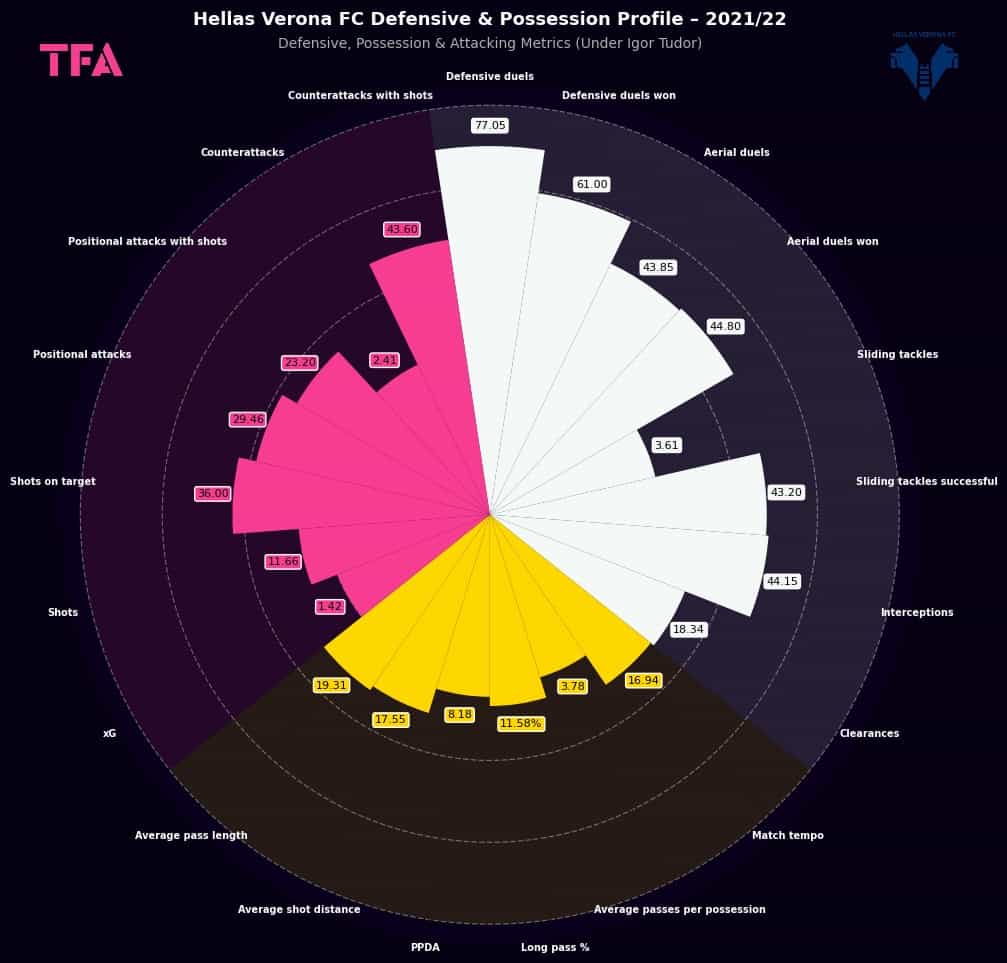
Defensively, the Mastini engaged in 77.05 defensive duels per 90, winning 61%, reflecting their commitment to contesting ground battles and disrupting opposition progression high up the pitch.
Although aerial engagements were less efficient, with 43.85 duels per match at just 44.8% success, their proactive groundwork compensated for this by intercepting 44.15 passes per game and clearing danger on 18.34 occasions.
The sliding tackle profile was modest (3.61 attempted, 43.2% successful), suggesting a preference for duels and interceptions over last-ditch interventions.
Tudor’s Verona were also Serie A’s standout high-pressing unit, registering the league’s best PPDA of 8.18, a figure that speaks volumes about their intent to suffocate opponents’ build-up.
Their average match tempo of 16.94 and an average of 11.58 passes per possession reveal a direct, high-frequency attacking rhythm, often punctuated by long balls (long pass share of 3.78%) to bypass congested areas.
The attacking data reinforces this verticality: an xG of 1.42 per game from 11.66 shots, 36% of which were on target, indicates efficiency in chance creation, albeit often from less optimal positions with an average shot distance of 17.55 metres.
Structurally, Verona generated 29.46 positional attacks per game, though only 23.2% ended with shots, highlighting their difficulty in breaking compact defences.
Instead, they thrived in transition, recording 2.41 counterattacks per match and producing shots in 43.6% of them, among the league’s most lethal conversion rates from breakaways.
Together, these numbers illustrate Tudor’s blueprint: a side defined by high pressing intensity, aggressive duelling, and vertical transitions, combining proactive defensive behaviours with an unapologetically direct attacking ethos.
Conclusion
As Juventus embark on the 2025/2026 campaign under Igor Tudor, the evidence from his early tenure and prior managerial stints provides a cautiously optimistic outlook.
The late resurgence last season and his tactical fingerprints already visible in Turin suggest that this is more than just a short-term bounce.
Instead, it hints at the foundation of a coherent identity that blends Juventus’ traditional pragmatism with a more aggressive, transition-oriented edge.
Tudor’s blueprint is neither nostalgic nor overly experimental; it draws directly from his successes at Verona and Marseille while tailoring the principles to Juventus’ resources.
His hallmark of verticality, pressing intensity, and defensive engagement remains intact, but he has coupled these with structural refinements that better suit Serie A’s top end.
The implementation of dynamic midfield pivots, proactive defenders, and wing-backs with licence to advance represents an attempt to align Juventus with Europe’s evolving tactical trends, without sacrificing the club’s ingrained resilience.
Yet, challenges remain.
Juventus’ heavy defeat to Manchester City at the FIFA Club World Cup was a reminder that, while progress is tangible, they are still vulnerable against elite, possession-dominant sides.
Sustainability across an entire campaign will hinge on depth, adaptability, and Tudor’s ability to maintain balance when the schedule intensifies.
Ultimately, Juventus under Tudor appear closer to rediscovering their competitive DNA.
If the tactical adjustments continue to take root, 2025/2026 could mark the beginning of a genuine ascent back towards Serie A’s summit.
The path is more straightforward, but the climb remains steep.
