
Italy is the home of defending.
As José Mourinho once said, if you want to study the art of defending, look no further than the partnership of Giorgio Chiellini and Leonardo Bonucci.
The country’s footballing heritage is synonymous with the love of defending.
In the modern age, where the responsibilities of a centre-back are evolving, the fundamental Italian principles remain alive and well in the promising development of Diego Coppola.
This player analysis and scouting report explains why Coppola is attracting interest from Serie A giants Juventus and AC Milan, as well as Brighton & Hove Albion, ahead of the summer transfer window.
Who Is Diego Coppola?
At 6’4” and just 21, Diego Coppola has quickly become a central figure in Hellas Verona’s backline.
Coppola’s development trajectory has been steady since he entered the club’s youth system and made his professional debut in 2021.
His performances have earned him minutes for Italy at various youth international levels.
At a glance, Diego Coppola playing style is the archetype of the “no-nonsense” centre-back: a defender who lives for the duels, accumulates tackles and has a natural instinct for putting his body on the line.
But as with many young defenders, the real test is whether his game, which is so effective in Verona’s direct approach under Paolo Zanetti tactics, can translate to a higher level.
This pizza chart highlights Diego Coppola’s no-nonsense, tough-tackling style at the heart of Hellas Verona’s defence.
He excels in defensive and aerial duels, ranking among the league’s best.
His percentile ranks show a focus on stopping opponents first.
All data used here is based on percentile values for players in his league and position, with the 50th percentile representing the league median.
Diego Coppola Radar Chart
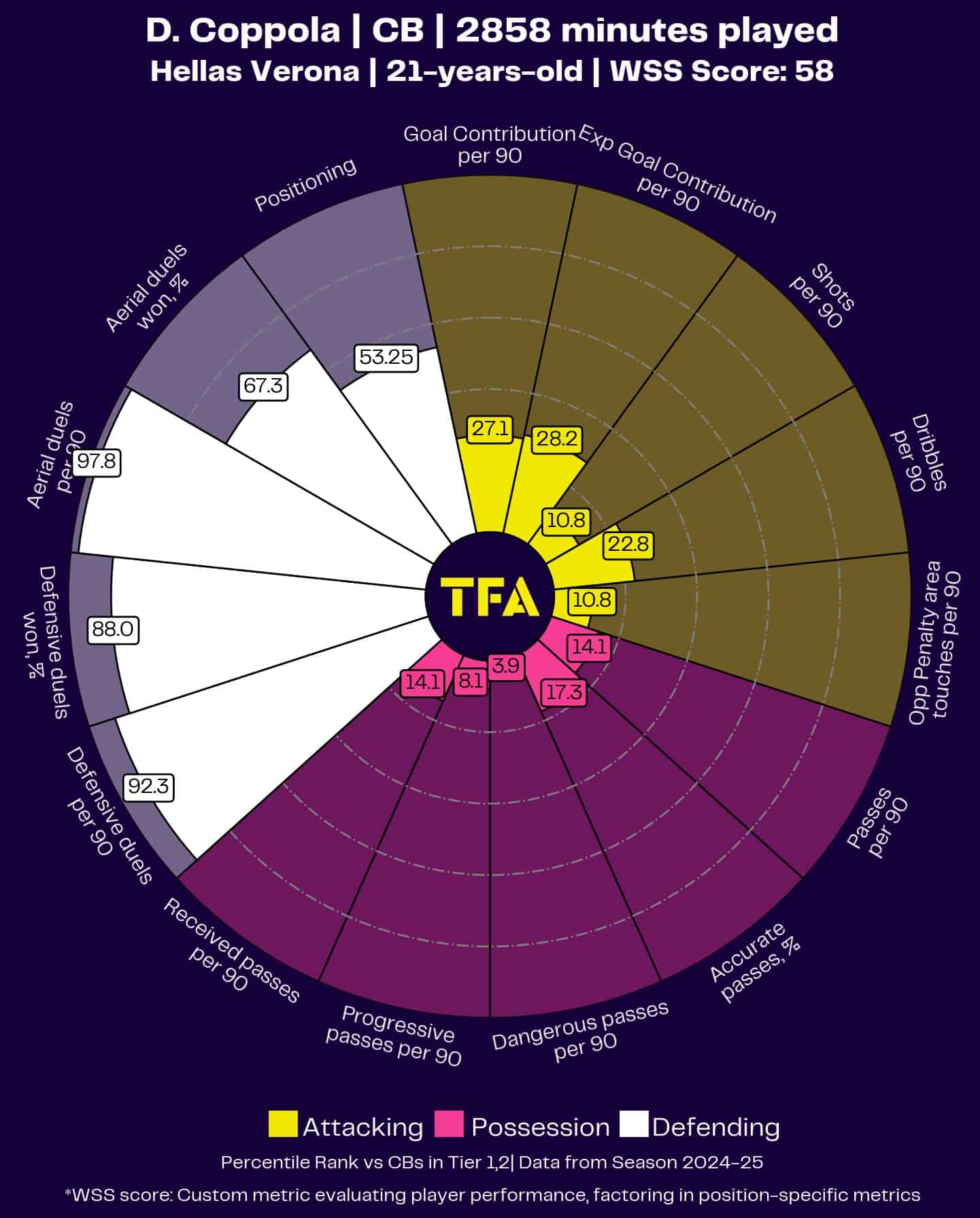 To understand Coppola’s game, it is important to look at his core defensive metrics.
Compared to centre-backs in Europe’s top five leagues, Coppola sits in the 88th percentile for tackles per 90 minutes (2.09), the 99th percentile for interceptions per 90 (2.31), and the 98th percentile for aerial duels won (3.94).
These figures show a defender who plays with relentless, front-footed aggression.
Diego Coppola Aggression & Front-Footed Defending
Coppola’s approach to defending is defined by his willingness and ability to step out of the defensive line and engage attackers early before the play becomes a serious threat.
This “front-footed” style is a double-edged sword.
On the one hand, it allows Verona to disrupt opposition build-up play high up the pitch, regain possession in advanced areas, and deny the opponent time to settle.
Coppola’s timing in these interventions is generally good.
He commits fully to tackles but does so with a measured understanding of distance and angle, rarely being caught flat-footed or overcommitting in a way that would expose his team.
His large frame and long stride allow him to cover ground quickly, both laterally and vertically.
This makes him excellent at closing down central attackers and wide players when drawn into the channels.
In one-on-one duels, particularly in wide areas, Coppola’s blend of size, agility, and assertiveness makes him a difficult defender to bypass.
He is quick to get “touch tight” to his man, using his body to shepherd opponents away from danger or force hurried decisions.
As shown in a league game versus Lecce, Wladimiro Falcone launches a ball to Nikola Krstović’s feet for him to receive.
Coppola aggressively meets Krstović, making it difficult for him to turn and enter the final third.
Krstović then loses the ball, and Hellas Verona win possession.
Diego Coppola Rashness
Nevertheless, it must be acknowledged that, while appreciated, Coppola’s aggressive style can sometimes make him rash in his tackling.
There are instances when his eagerness to step out and win the ball leads him to commit prematurely or overextend, especially against more experienced or technically gifted attackers who can exploit mistimed challenges.
This tendency towards rashness is not uncommon among young, front-footed defenders who pride themselves on disrupting play early.
His timing is overall impressive for his age, but it will require refinement as he gains more exposure to different attacking profiles and high-pressure scenarios.
This aspect of his game is highly coachable and tends to improve naturally as young defenders are exposed to a wider array of tactical situations and opposition.
In a league loss versus Lazio, Boulaye Dia plays a ball to Mattia Zaccagni, who then cleverly knocks the ball to his right to evade Coppola’s incoming tackle.
Coppola faces the choice of covering space and is split between engaging with the initial pass or closing down Zaccagni.
He then fouls Zaccagni.
Diego Coppola Anticipation & Reading The Game
However, what separates Coppola from his younger peers is his anticipation and reading of the game.
His interceptions per 90 minutes are among the very best in Europe, and this is a function not of defensive structure alone, but of an innate ability to sense the flow of play.
He is constantly scanning, adjusting his position to remain between the ball and his direct threat.
He also knows how to anticipate passes into the half-space or between the lines.
Coppola is improving his reading of transitional moments.
When the opposition is about to play a vertical pass or when a midfielder is receiving under pressure, he is quick to step in and cut out danger.
This quality is especially pronounced when he plays as part of a back three, where his responsibilities often include covering wider areas and sweeping behind more aggressive teammates.
His sense of timing (i.e. when to step up, when to hold his position, when to drop off) is maturing as he clocks more minutes into his game.
Systemic Context: Hellas Verona Defensive Structure
The tactical context of Hellas Verona style of play must be considered when evaluating Coppola’s style and statistical output.
Verona are a direct, transition-based side.
Their defensive structure is designed to absorb pressure and spring quickly into attack.
Coppola’s defensive numbers are, in part, a function of this system: he is required to defend more often and in more exposed situations than a centre-back on a team that dominates possession.
However, his reliability in these situations is what has made him indispensable to Verona.
As a result, this does not reflect favourably when observing his game from an in-possession lens.
His “body on the line” mentality (i.e. willingness to block shots, throw himself into challenges, and clear danger without hesitation) is a sign of a traditional Italian centre-back, and it is a quality that has not gone unnoticed by teams in both Serie A and the Premier League.
Diego Coppola Aerial Dominance
Aerially, Coppola is already among the most dominant centre-backs in Serie A.
His height gives him a natural advantage, but his timing, leap, and positional awareness allow him to win aerial duels, both in open play and at set-pieces.
On defensive corners and free kicks, he marks space or man with discipline, rarely losing track of his assignment.
He is usually first to the ball when it is delivered into the box.
In open play, Coppola is proactive in attacking long balls, often stepping into midfield to compete with centre-forwards and breaking up direct play before it can become dangerous.
In a league game against Cagliari, an outswinging corner is delivered into the box, and Michel Adopo looks to meet the ball, but the towering Coppola rises above everyone to head it away from danger.
This clearance allows Hellas Verona to step up and get into position to counter-attack as Cagliari is left unsettled.
Diego Coppola Limitations In Possession
As football evolves, the demands placed on centre-backs are changing.
Modern centre-backs are increasingly expected to contribute to build-up.
Teams that seek to control games through ball dominance require defenders who are comfortable receiving under pressure, capable of breaking lines with their passing, and able to carry the ball out of defence when necessary.
It is in this area that Coppola’s profile is less developed.
Statistically, his progressive carries per 90 (0.12) and progressive passes per 90 (1.54) are both in the bottom 5% of his peers.
In practical terms, this means Coppola is not currently tasked with building play or advancing the ball from the back.
His contributions in possession are limited to safe, lateral passes or long diagonals, typically aimed at exploiting Verona’s direct attacking transitions.
While he is capable of hitting a long ball, especially switches of play to the flanks, he does not regularly attempt or complete the sort of line-breaking passes that are demanded of modern-day centre-backs.
This limitation raises important questions about Coppola’s potential ceiling in teams that demand more in possession from their defenders.
It is possible that his low progressive metrics are a by-product of Verona’s tactical approach rather than a technical deficiency.
A team that spends little time in possession and prioritises rapid transitions over patient build-up is unlikely to ask its centre-backs to carry or distribute the ball in advanced phases.
On the other hand, there are signs that Coppola is more comfortable playing “safe” than taking risks with the ball at his feet.
Under high pressure, he tends to clear long, rather than attempt to play through pressure or link with the midfield.
This is not uncommon for young defenders, especially those who have developed in systems that value defensive solidity above all else.
Still, he will need to develop this area if he is to become a regular for a ball-dominant side at the highest level.
Back Four Or Back Three?
Coppola’s versatility is desirable.
He has played both in a back four and as part of a back three.
In a back four, his aggression and anticipation suit the “stopper” role.
He steps out to engage opponents while his partner provides cover.
In a back three, he can operate centrally, using his reading of the game to sweep behind more adventurous teammates, or on the right, where he is comfortable defending wide areas and duelling wingers.
Diego Coppola Future Potential
There are, inevitably, areas for improvement.
Coppola’s decision-making under pressure, especially in risky zones close to his own goal, can be further refined.
While largely well-timed, his aggression occasionally leaves space that can be exploited by clever movement or quick one-twos—something that might be punished more ruthlessly in the Premier League or by top-six Serie A sides.
Moreover, if he is to reach the top of the game, he will need to develop his ability to contribute to build-up play, receive under pressure, and circulate the ball confidently.
Conclusion
In conclusion, Diego Coppola style of play already possesses the core attributes of an elite centre-back: superb defensive output, physical dominance, anticipation, and an uncompromising mentality.
He is not the finished article, but his fundamentals are outstanding, and his coachability would be appreciated.
He is drawing attention from top clubs in Italy and England alike, and the next phase of his development will be important.
At the elite level, he must add ball-playing qualities, or he will remain a specialist in a more traditional, less-ball-dominant side.
Either way, Coppola represents a continuation of Italy’s proud tradition of defensive excellence.
