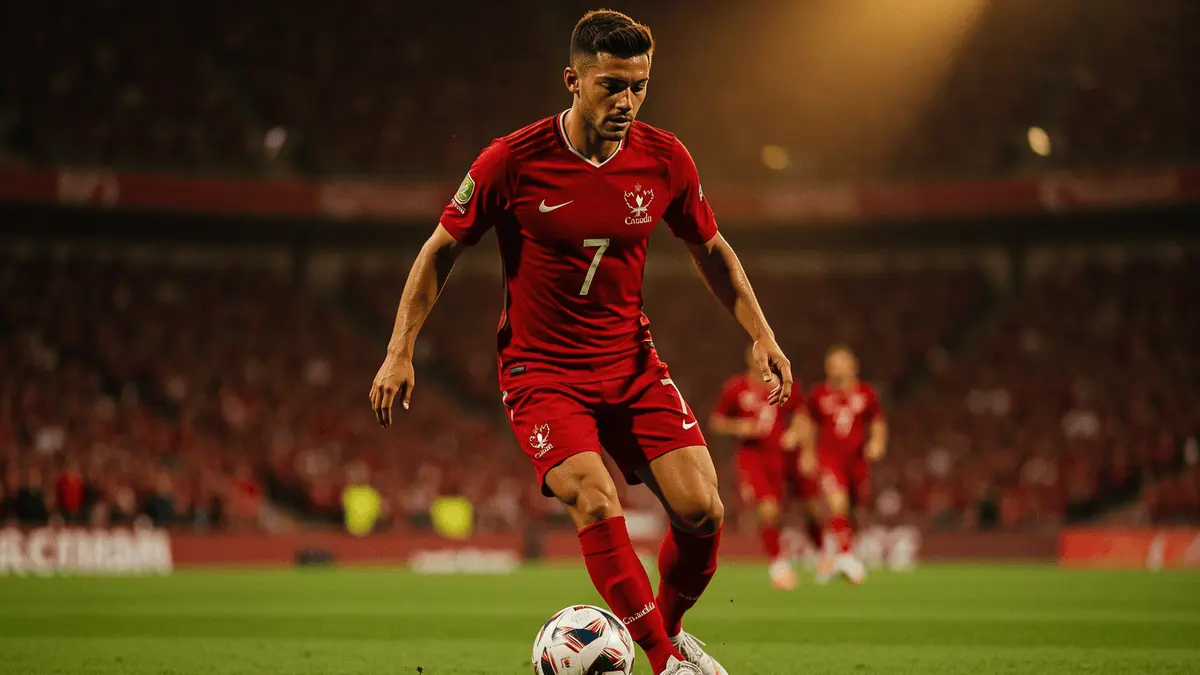
Canada defeated South Africa 1-0 in their 2026 FIFA World Cup Round of 32 fixture to record the nation’s first-ever progression to the knockout rounds of a men’s World Cup – a result that will anchor itself permanently in Canadian football history. The margin of victory was narrow, the goal arrived in the 92nd minute, and South Africa created enough to suggest the result was not inevitable. What made it so was the performance of Stephen Eustáquio, who operated across both phases with the kind of structural authority that reflects his years as a deep-lying playmaker at FC Porto. This tactical analysis examines how Eustáquio shaped Canada’s defensive organisation, directed their attacking transitions, and delivered the set-piece quality that nearly broke South Africa open before his late strike finally did.
Lineups & Formations
Jesse Marsch set Canada up in a 4-1-3-2 defensive shape in the opening exchanges, with Eustáquio operating as the pivot – the single midfielder behind a line of three tasked with screening the backline and intercepting passes into the half-spaces. Tajon Buchanan and Liam Millar started wide, narrowing their angles to funnel South Africa’s build-up into central zones. Jonathan David led the press from the front alongside a second forward, with Maxime Crépeau behind a back four that included Derek Cornelius.
South Africa organised in a conventional mid-block, looking to exploit the channels behind Canada’s high line on the transition. Their setup posed a structural problem for Canada’s press: the wide areas were available if South Africa could shift the ball quickly enough to bypass the midfield screen. That bypass rarely materialised, principally because of Eustáquio’s positioning. Ismaël Koné was absent from the squad entirely, meaning Eustáquio carried the midfield control responsibilities without a natural partner at kick-off – a context that makes his 8 recoveries and 3 tackles across the 90 minutes more significant than the raw numbers suggest.
Canada’s Defensive Structure and Pressing Geometry
Canada’s defensive approach against South Africa was calibrated differently from the aggressive, high-intensity press Mexico deployed on the tournament’s opening day. Marsch’s side aimed to compress passing lanes rather than hunt the ball relentlessly, sitting in a 4-1-3-2 shape that narrowed the interior corridors and invited South Africa to circulate wide.
Buchanan and Millar’s infield positioning was central to this mechanism. By narrowing from the flanks, they eliminated the inside passing options South Africa’s midfielders wanted to access, funnelling play toward Eustáquio’s zone. The Porto midfielder read these patterns consistently, stepping out of his pivot role to intercept rather than waiting passively for the ball to arrive. His recovery count of 8 – the highest in the Canadian squad – reflects how often that press geometry forced turnovers directly through his reading of the pass.
When South Africa bypassed the press by going direct over Eustáquio’s line, he responded by getting his body between the ball and the receiving striker, buying the centre-backs time to step and engage. The shift from the initial 4-1-3-2 into a 4-4-2 mid-block as the match progressed compressed the space further. South Africa’s attempts from range were the only output of their attacking play in extended periods – a structural outcome rather than a failure of individual quality.
Set-Piece Delivery and Chance Creation
Eustáquio’s attacking contribution was anchored in his delivery from dead-ball situations. His 5 completed crosses from 7 attempts – a 71% completion rate against a typical benchmark of around 30% – was the most visible statistical expression of his quality, but the context of those deliveries matters as much as the volume.
The first clear chance of the match originated from an Eustáquio free-kick cross that found Derek Cornelius in a dangerous position inside the box. Cornelius failed to convert, but the delivery itself – pace, trajectory, and placement – was the product of deliberate execution. Opta data cited by Sky Sports noted that Eustáquio’s chance creation from dead-ball situations in this match tied Andrea Pirlo’s record for most chances created from set-pieces in a single men’s World Cup knockout fixture, a benchmark that reframes his delivery as historically significant rather than merely efficient.
His overall tally of 5 chances created – the team high – confirms that his set-piece work was not isolated. Eustáquio generated chances from open play as well, consistently looking to play forward from midfield and involving himself in the combination sequences that preceded Canada’s most threatening moments in the first half.
Ball Progression and Forward Play
Eustáquio’s club profile at FC Porto has sharpened a specific quality: the ability to shift tempo through a single pass. Playing in a possession-heavy system in the Primeira Liga and in Champions League competition has embedded the instinct to play forward under pressure, find a bounce pass to maintain momentum, and then arrive late into space created by others. That instinct surfaced repeatedly against South Africa.
Every time Eustáquio received possession in his half, the direction of his first touch was toward the opposition goal. He used bounce passes to his midfield partner to maintain the attack’s forward momentum, then relocated to receive the return in a more advanced position. One sequence in the second half nearly produced a goal: Eustáquio directed a teammate to play quickly into Jonathan David, whose run was only denied by a last-ditch intervention from South Africa’s Mbokazi at the moment of David’s attempted finish.
The Porto-honed reading of tempo – when to slow and when to accelerate – allowed Canada to control the ball in phases without ceding the press-resistance that Marsch’s system demands. Eustáquio’s ability to sustain both functions simultaneously, screening in the defensive phase and progressing in the attacking one, is the structural quality that makes him irreplaceable in this Canada side, particularly with Koné unavailable.
In-Game Adjustments and Partnership Evolution
The introduction of Niko Sigur as Eustáquio’s midfield partner altered the tactical balance in Canada’s favour. Sigur brought box-to-box energy and a willingness to engage physically in defensive duels, which redistributed the defensive workload that Eustáquio had been carrying alone in the early stages. With Sigur covering the ground, Eustáquio was released to operate higher and wider in Canada’s attacking shape.
The arrival of Alphonso Davies further changed Canada’s attacking geometry. Davies and Eustáquio developed a left-side combination that South Africa could not consistently account for: Davies’ runs beyond the defensive line created the depth, while Eustáquio’s diagonal passes and overlapping runs from central positions opened the angles. The partnership generated several of Canada’s most dangerous moments in the second half, building directly toward the conditions that produced the winning goal.
That goal arrived in the 92nd minute. A headed clearance dropped to Eustáquio at the top of the box; he controlled, took one touch to set his stance, and drove a low right-footed shot through traffic into the corner. It was a finisher’s goal – composed under the pressure of a tense scoreline – and it came at the end of a performance that had already justified his selection as the match’s controlling influence.
Statistical Context
The numbers across Eustáquio’s 90 minutes reflect a player operating across both phases at a high level. 8 recoveries led the Canadian squad in the defensive phase; 5 chances created led it in the attacking one. His 71% cross completion rate – against a typical benchmark of 30% – is not a small deviation from the norm; it represents a fundamental difference in the quality and intent of delivery.
With approximately 60 caps for Canada and the captaincy, Eustáquio is not a player whose role in this system is under construction. He is its spine. The absence of Koné compresses the midfield creative responsibility onto a single player; that the statistics were spread evenly between defensive and attacking metrics rather than skewed toward one phase suggests Eustáquio managed that dual burden without visible degradation in either area.
Conclusion
Canada’s 1-0 win over South Africa carries a weight beyond the result. It is the country’s first appearance in a men’s World Cup knockout round, and Eustáquio’s performance was its structural explanation – not merely the goal, but the 90 minutes of defensive organisation, set-piece precision, and forward ball movement that made the goal possible. The pre-match tactical expectations for Canada centred on Marsch’s pressing intensity and their counter-attacking threat; Eustáquio satisfied both while adding a set-piece dimension that, according to Opta data, matched Pirlo’s benchmark for a knockout fixture.
Canada face a Round of 16 tie in Houston on July 4, with Morocco or the Netherlands awaiting. Either opponent will offer a midfield quality that tests whether Eustáquio’s Porto-trained tempo control holds up against sides with greater possession fluency and press-resistance. The continued absence of Koné means that question will be answered with Eustáquio carrying the full weight of Canada’s midfield engine once more.