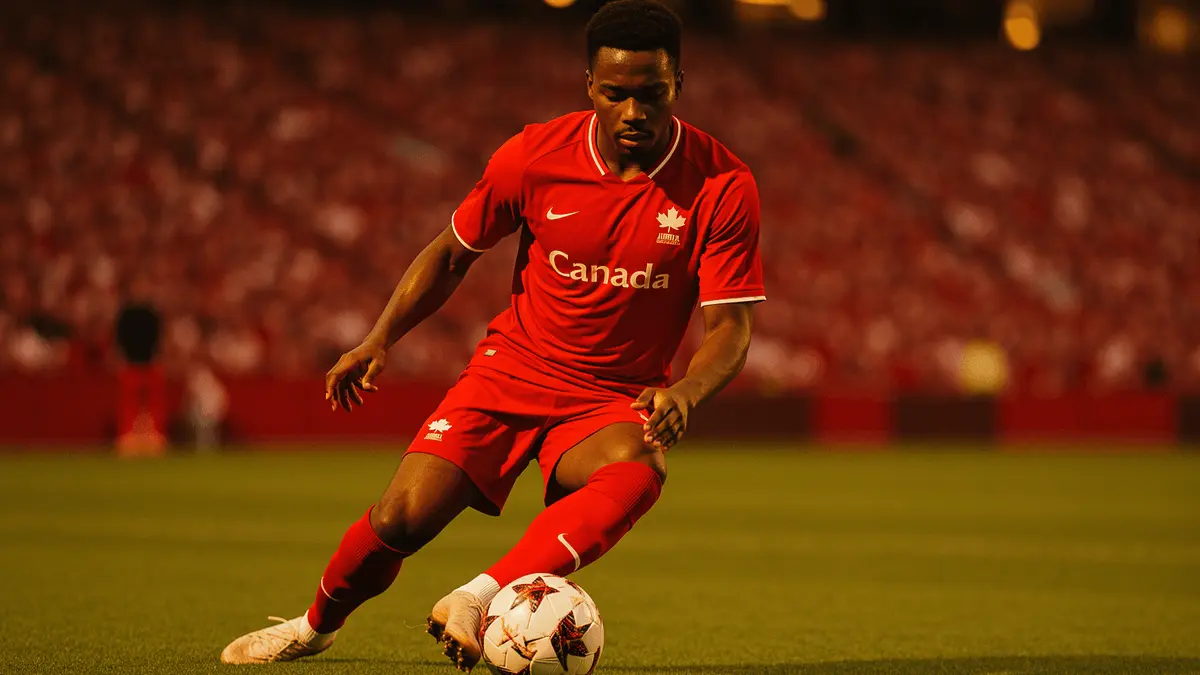
Canada’s 1-0 win over South Africa at SoFi Stadium in Inglewood delivered the country’s first men’s World Cup knockout victory and a first-ever Round of 16 appearance – a result built, structurally, on one player’s ability to function simultaneously as a defensive anchor, set-piece delivery unit, and attacking orchestrator. This analysis examines how Stephen Eustáquio shaped the match before, during, and well beyond the stoppage-time winner that will define the occasion in popular memory.
Canada’s Defensive Shape and the Role It Assigned to Eustáquio
Coach Jesse Marsch set Canada up in a 4-1-3-2 defensive structure, a shape designed less for aggressive pressing – nothing like the high-intensity press Mexico deployed on the opening day – and more for lane compression. The width was held by Tajon Buchanan and Liam Millar, whose primary defensive task was to narrow the inside channels and force South Africa’s ball-carriers into predictable patterns rather than winning the ball outright.
That compression served a specific purpose: it funnelled South Africa toward the half-spaces immediately in front of Eustáquio, where his reading of passing intentions made him a near-permanent obstacle. South Africa lined up in a 4-2-3-1 with a double pivot screening their back four, and their design when building through that midfield block was to find the lines between Canada’s defensive structure. Eustáquio’s positioning denied them that route repeatedly.
When South Africa abandoned the through-ball and tried to circulate shorter, the cover shadow Eustáquio generated meant the double pivot could rarely turn and play forward. When they went more direct over the top, he was disciplined enough to take up screening positions that allowed Derek Cornelius and the centre-backs to step aggressively without vacating depth behind them. The defensive shape, in practice, ran through him as its organising principle.
How the Block Held and Where South Africa Were Restricted
As the match settled, Canada’s shape compacted into a 4-4-2 mid-block, with Eustáquio shifting laterally with the ball rather than pressing up to win it. The effect was to deny South Africa any sustained central penetration. Their attempts to create from the double pivot were consistently picked off or recycled wide, where Canada’s fullbacks recovered quickly enough to reduce the threat.
Goalkeeper Maxime Crépeau faced relatively little direct pressure as a consequence. South Africa – whose earlier group stage performance against South Korea had shown a capacity to build through compact defences – were unable to replicate anything similar here. Ronwen Williams making five saves in the other goal underlines the asymmetry: Canada created far more genuinely threatening positions across the ninety minutes.
Eustáquio’s individual defensive contribution – eight recoveries and three tackles, both team-highs – reflects how central he was to sustaining that shape. Recoveries at that volume from a midfield controller typically indicate a player reading second balls and anticipating breakdowns rather than chasing play, which aligns with what the structural description suggests: he was positioned correctly, repeatedly, before South Africa’s attacks developed.
Attacking Orchestration: Crossing, Chance Creation, and Set Pieces
The defensive numbers are one dimension. The attacking output is where Eustáquio’s performance becomes genuinely exceptional. He created a team-high five chances, completed five crosses from seven attempted – a 71% cross completion rate against the broadly accepted baseline of around 30% – and took four corners as Canada’s primary set-piece delivery option.
The first meaningful chance of the match came from an Eustáquio free-kick cross that found Cornelius in a position from which he should have scored. It set the template for how Canada intended to hurt South Africa when they had dead-ball situations in the final third: precise delivery at pace to runners arriving from depth, rather than short routines designed to work space. The same delivery quality persisted throughout; the 5-from-7 crossing return suggests he was reading defensive trajectories accurately and selecting the right delivery window rather than simply executing technically.
In open play, Eustáquio consistently played forward on receiving possession. His combination with Liam Millar in the first half established rhythm through bounce passes in tight areas before Canada tried to advance; the pattern shifted in the second half as substitutions changed the personnel around him. The detail matters: Eustáquio did not merely maintain his own output as the match evolved – he recalibrated his attacking role to the altered structural context.
The Impact of Substitutions on Eustáquio’s Attacking Role
Niko Sigur’s introduction as a midfield partner changed the dynamic around Eustáquio significantly. Sigur brought box-to-box defensive coverage and aggressive pressing triggers that freed Eustáquio from the deeper defensive responsibilities he had been managing alongside his creative output. The result was a player able to operate higher and wider in possession phases without creating structural exposure behind him.
Alphonso Davies’ return from a hamstring injury at the 75th minute accelerated that shift further. Davies arriving on the left wing gave Canada an immediate wide threat capable of stretching South Africa’s back four, and Eustáquio’s combination play down the left in the final quarter-hour produced some of the most threatening moments of the match. Canada’s group stage build-up had established Eustáquio as the fulcrum of their attacking transitions, and the South Africa match confirmed he is at his most dangerous when given a direct partner who can accelerate beyond the last line.
Davies’ arrival immediately created a major opportunity that went spurned. The sequence that produced the decisive goal followed the same left-side corridor, with Eustáquio arriving into a central position in stoppage time to finish. The goal was not a moment of individual improvisation – it was the product of a structural pattern Canada had been building toward across the second half.
Leadership as a Structural Contribution
Beyond the statistical output, Eustáquio’s role as Canada’s on-pitch organiser – in the absence of Ismaël Koné – extended to verbal direction of his teammates’ movement. There were specific moments in which he directed teammates to play forward quickly into Jonathan David or into the path of a counter-attack, orchestration that nearly yielded a goal before Mbokazi’s last-ditch intervention stole the ball off David’s head.
This dimension of Eustáquio’s game – communicative leadership that shapes teammates’ decision-making rather than purely his own actions on the ball – is measurable only indirectly, but it explains why his effective influence on the match exceeded even the headline numbers. A player directing counter-attacks, organising the defensive block’s lateral movement, and managing set-piece delivery is functioning as a distributed tactical resource, not just a midfielder taking up good positions.
Koné’s continued absence makes this dimension even more structurally significant. Canada’s midfield against stronger opposition in the Round of 16 will need Eustáquio to sustain the full workload: defensive screening, progressive ball-playing, set-piece delivery, and verbal coordination of a group that loses creative depth without Koné available.
What the Performance Reveals About Canada’s System Under Marsch
Canada’s tactical approach against South Africa was calibrated rather than ambitious. The decision not to press as aggressively as they are capable of – and as Mexico demonstrated is possible at this level – reflected a pragmatic read of South Africa’s build-up tendencies. The 4-1-3-2 compacting into a 4-4-2 mid-block was built to deny centrally and absorb, then exploit transitions and set pieces. It worked because Eustáquio executed every phase of that plan at a high level within the same ninety minutes.
The cross completion rate alone merits emphasis. 71% from open play and dead-ball situations combined, against a broadly accepted benchmark of 30%, is not a sample-size anomaly at seven attempts – it reflects precision in delivery selection and execution under match pressure. Pair that with eight recoveries and five chances created and the picture is of a player whose positional intelligence is operating well above baseline.
Canada now face a Round of 16 tie – confirmed against either Morocco or the Netherlands in Houston on 4 July – against opposition whose structural quality will place significantly more demand on Eustáquio’s ball-retention and defensive positioning. Morocco’s pressing intensity and the Netherlands’ midfield depth both present challenges that South Africa, shaped around a defensive double pivot and a relatively limited attacking top end, did not. The system Marsch has built will need the same complete performance from its most important player, without the structural latitude a mid-table opponent provides.
Verdict
Eustáquio’s stoppage-time goal was the most visible moment of the match, and ESPN’s decision to name it the tournament’s Moment of the Day reflects its historical weight – Canada’s first men’s World Cup knockout victory, secured in front of a home crowd at SoFi Stadium. But the goal was the endpoint of a performance that had been complete long before it. Eight recoveries, five chances created, 71% cross accuracy, and the verbal organisation of Canada’s defensive and attacking structure in Koné’s absence constitute a performance that determined the result structurally, not just in the final minute.
Whether Eustáquio can sustain that output against the Netherlands or Morocco – opponents who will press Canada higher and threaten the half-spaces he himself exploited defensively – is the central question for Canada’s tournament continuation. Against South Africa, the answer to every tactical question Marsch needed answering ran through the same player. That dependency is both Canada’s greatest strength and the clearest structural risk as the knockout rounds intensify.