
At the time of writing, Marseille are one of just three Ligue 1 sides to remain undefeated in the league this season, along with PSG and Lens.
This season also welcomed the arrival of a new manager in the Stade Vélodrome dugout, with former Juventus player and coach Igor Tudor, among other clubs, replacing the enigmatic Jorge Sampaoli in Provence-Alpes-Côte d’Azur.
Total Football Analysis published a couple of in-depth analysis articles looking at Sampaoli and his tactics at Marseille.
One player who played a key, unique role at Marseille under the Marcelo Bielsa disciple was Valentin Rongier (172cm/5’7”, 66kg/146lbs), who recently signed a contract extension keeping him at the Ligue 1 giants until 2026.
Rongier has also quickly become a favourite of new boss Tudor, though in a different role to the one he performed under Sampaoli.
The 44-year-old manager who’d most recently coached at Serie A side Hellas Verona before joining Les Phocéens has said of his midfield general:
“Rongier gives me everything. He’s smart, he’s got the legs and knows how to time his runs. He’s underestimated by the press and the fans, but he really is a fantastic player!”
Indeed, the 27-year-old has shone for his club this term under Tudor, with Rongier even captaining Marseille for most of their Ligue 1 games so far this season.
The midfielder’s performances at club level have even resulted in some calls for Rongier to be considered by Didier Deschamps for the French World Cup squad ahead of the upcoming tournament.
This tactical analysis piece will look at why Tudor and plenty of others have been heaping praise upon Rongier this season.
Our scout report analyses the player’s role within his team’s setup and the new manager’s tactics while highlighting some key strengths and weaknesses of Rongier’s overall game.
Valentin Rongier Data Analysis
We’ll kick off this scout report by conducting a brief data analysis looking at how Rongier stacks up in some key areas versus other Ligue 1 central midfielders from the 2022/23 season so far.
On our visual in figure 1, alongside raw metrics from Wyscout, we’ve got ‘possession involvement’ (a combination of passes received per 90 and passes per 90), ‘positive passing’ (a combination of forward passes per 90, progressive passes per 90 and passes to the final third per 90), ‘penetrative passing’ (a combination of through passes per 90, passes to the penalty area per 90 and smart passes per 90) and, lastly, ‘creative passing’ (a combination of xA per 90, key passes per 90 and shot assists per 90).

From this, we could say that Rongier is a fairly well-rounded midfielder with a solid defensive contribution, a good duel success rate (for both ground and aerial duels) and a decent passing contribution for his side.
In particular, the Marseille man could be described as a relatively reliable passer, as his pass success rate demonstrates.
This is also evident from watching the player.
He tends to enter his duels aggressively and with the intent to ensure that he successfully emerges from that duel with the ball.
In terms of his aerial duels, in addition to the aforementioned aggression and intent, Rongier has a decent jumping height that helps the 172cm player compete with larger opponents in the air.
In terms of how he’s involved in possession, he is more heavily involved in positive passing than penetrative passing, which typically correlates with a heavier involvement in the build-up and ball progression phases of play than the chance creation phase of play.
It’s more common to see Rongier tasked with progressing his team into the opposition’s half and into the final third than it is to see him responsible for breaking the opposition’s last line of defence and getting his side into the box.
However, Rongier doesn’t rank very high for either of those two metrics when compared with other Ligue 1 midfielders from this season so far; he does rank quite high for possession involvement, however.
A big part of Rongier’s game at Marseille is neither driving his team forward into the final third nor sending them into the opposition’s box, rather it’s to find space to receive from his centre-backs behind the opposition’s first line of pressure and link up with teammates via short passes from there.
This will be analysed in greater detail in our next section of analysis, given its significance to the player’s role within Tudor’s tactics.

Last season, under Jorge Sampaoli, Rongier spent a lot of time, especially without the ball, playing essentially as a right-back.
He’d typically invert in possession to a more central position.
His heatmap from the 2021/22 campaign in figure 2 reflects this squad role.

This season, Rongier has played as either a right or left central midfielder in his team’s 3-4-2-1 shape.
This has seen him spend much more time in central areas of the pitch and less time in wider areas, as we see in figure 3.
His role this term has been a more familiar one for the midfielder compared to the rather unique role he performed last season under Sampaoli.
So far, he’s performed that role quite well, with Rongier really coming into his own under Tudor this season.
Valentin Rongier Off-The-Ball Movement
As we mentioned in the previous section, a big part of Rongier’s game is finding space to receive the ball just behind the opposition’s first line of pressure, which will be analysed in our next section of analysis.
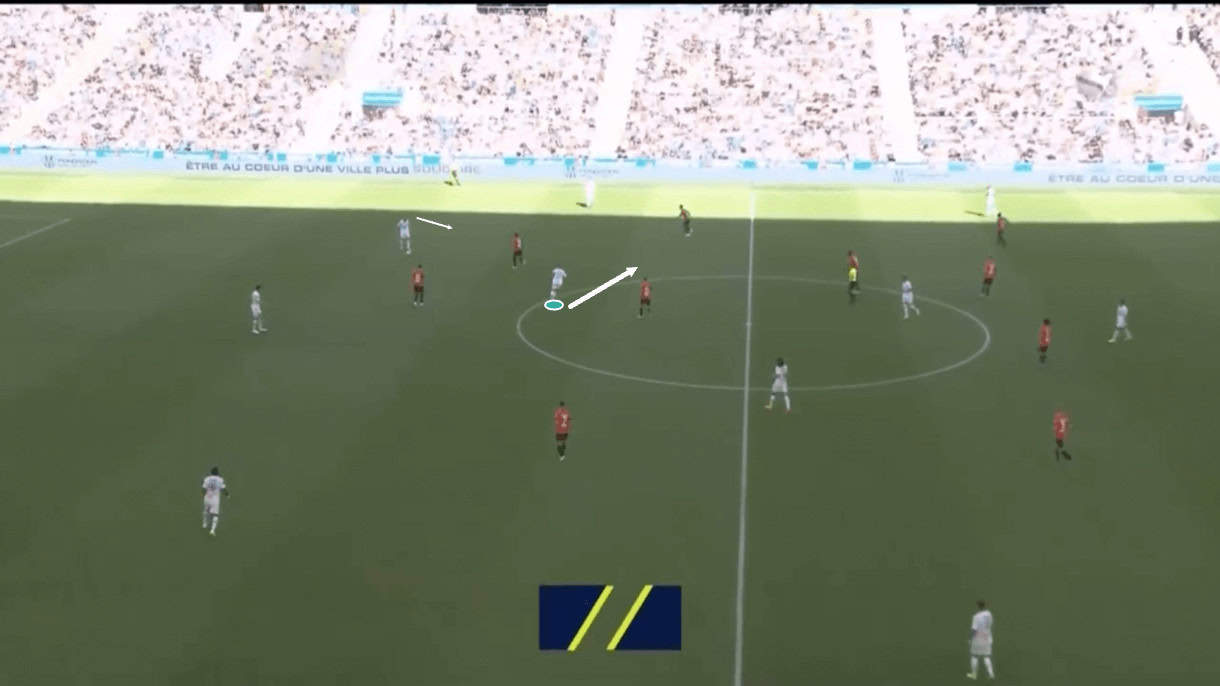
Figures 4-5 provide a typical example of Rongier’s movement in midfield behind the opposition’s first line of pressure as his team looks to progress into the opposition’s half — a part of the game where the significance of his role in the team is emphasised.
In figure 4, the player sees some space that could be exploited behind an opposition player in the first line of pressure and starts probing into that space as his left centre-back gets on the ball.
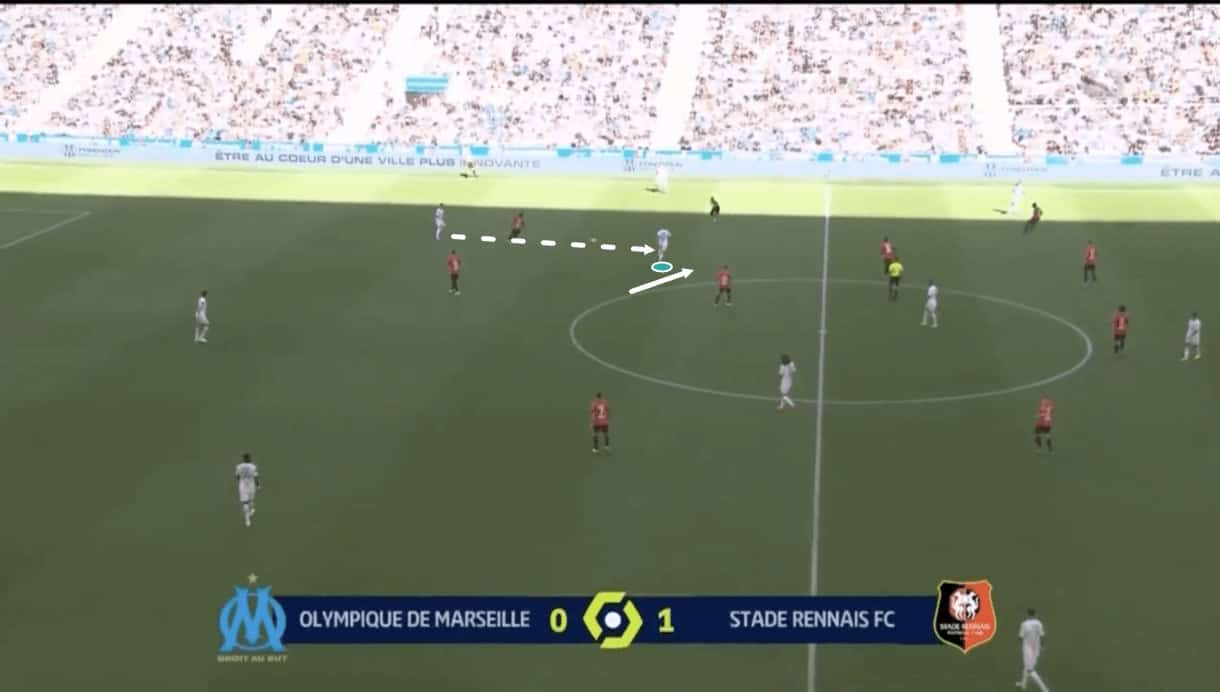
In Figure 5, as the play progresses, we see that Rongier’s movement gives the left centre-back the option he needed behind the opposition’s pressing forward to break through the first line of pressure and enter midfield.
From here, Rongier can drive his team into the opposition’s half and kick the attack up another gear.
This passage of play demonstrates, firstly, Rongier’s ability to move around and find space behind the opposition’s first line of pressure, thereby providing his team with a good passing option when looking to progress beyond them and into the middle third of the pitch.
From there, Rongier can play the role of ball progressor himself and drive the team forward after receiving in midfield as we saw in this particular example or, as is also common for the 27-year-old, he can link up with a teammate next to him, like his midfield partner or a wing-back, allowing them to receive facing forward and take the responsibility of driving the team forward.
The key aspect to note about Rongier here is the way his movement provides his team with options and contributes to their progress upfield.
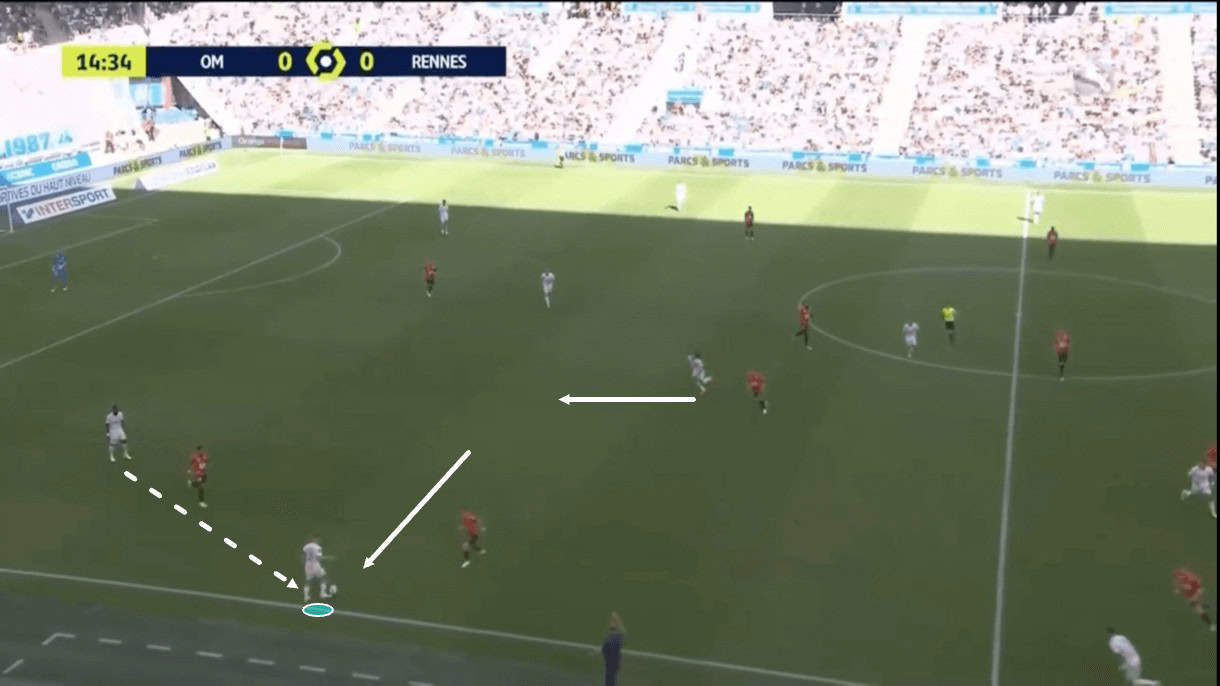
The midfielder can also occasionally be seen dropping out from the centre of the pitch to the wing, though, of course, we find him in this position far less often this season than we did last season.
In figure 6, we see an example of Rongier having moved out wide from the centre to receive behind the opposition’s first line of pressure after the right wing-back, Jonathan Clauss, had moved upfield, opening up this area of the pitch for Rongier to occupy.
As Rongier moved out wide, this opened space centrally for right-sided attacking midfielder Mattéo Guendouzi to drop into, which gives Rongier a passing option into midfield after he receives the ball from the right centre-back in figure 6.
Rongier is trusted a lot by Tudor to find space and occupy it where possible to aid his team’s ball progression.
At the same time, Tudor’s system features plenty of opportunities for rotations, as we see in the example here.
This can help free up Marseille players in key areas and make them more difficult to mark.
Rongier’s ability to find space and move into it is a key component of those tactics.
Valentin Rongier Passing
Our next section of analysis will look at Rongier’s passing game.
We know he’s quite heavily involved in possession for a team that has kept 55% of the ball, on average, in Ligue 1 this season — the sixth-highest possession percentage in the league.
The midfielder has, in fact, played more passes per 90 (60.1) than any other Les Phocéens player in 2022/23.
Again, though, a lot of this involved Rongier linking up with teammates via intricate short passing moves that rely heavily on the 27-year-old’s ability to quickly find space for himself to be a safe passing option for teammates.
This, then, naturally leads to the midfielder playing more passes as he’s frequently the free man that his teammates opt to find in space.

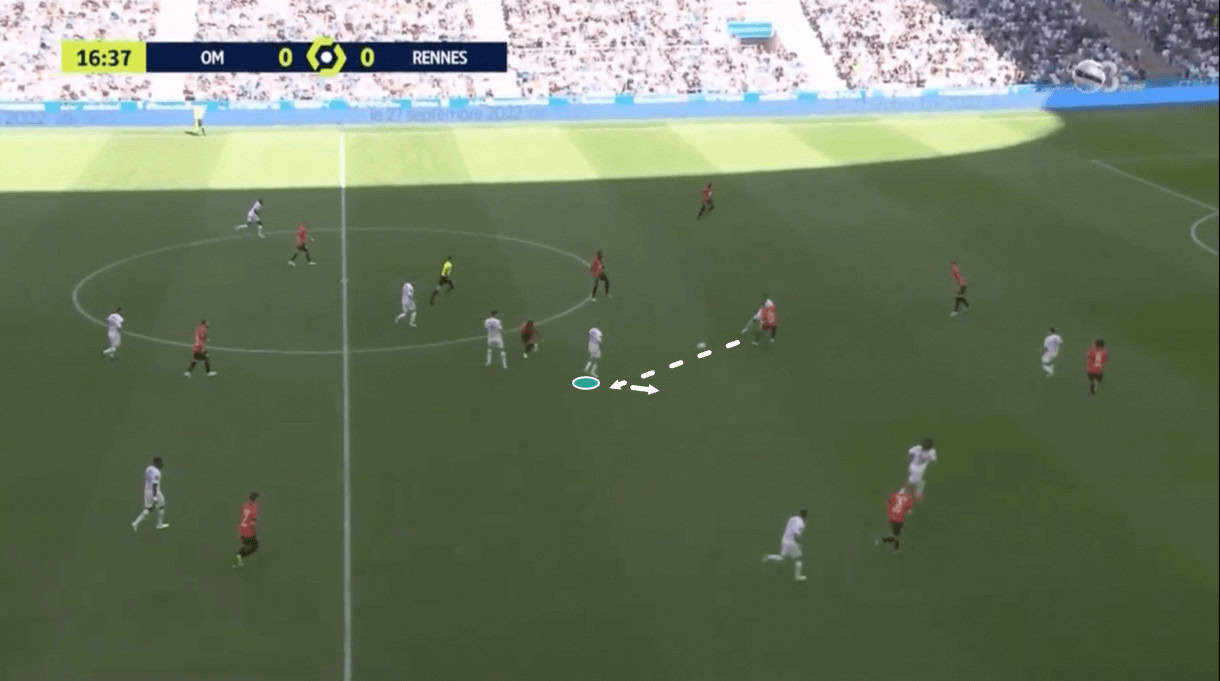
Figure 7 shows an example of this part of Rongier’s game.
After receiving the ball, he sends it into midfield in the upper-left quadrant before quickly changing direction to make himself available again in the upper-right quadrant.
After receiving the ball once more, the player sends it into midfield in the bottom-left quadrant, helping his team escape the opposition’s pressure from this more central position and isolate a winger with an opposing full-back on the other side of the pitch, allowing them to then break away into the final third.
Again, Rongier’s movement was crucial to the success of this move, but so too was the player’s vision and quick thinking on the ball, which created this opportunity for his team to escape the pressure and break away.
Rongier generally receives the ball quite well.
At the same time, he can improve at taking it on the half-turn when receiving from the centre-backs with his back to goal, he’s great at adding momentum to the attack via his first touch and driving his team forward when receiving while facing forward, as we see in figures 8-10.
Firstly, he receives the ball in space from a teammate further forward in a figure 8.
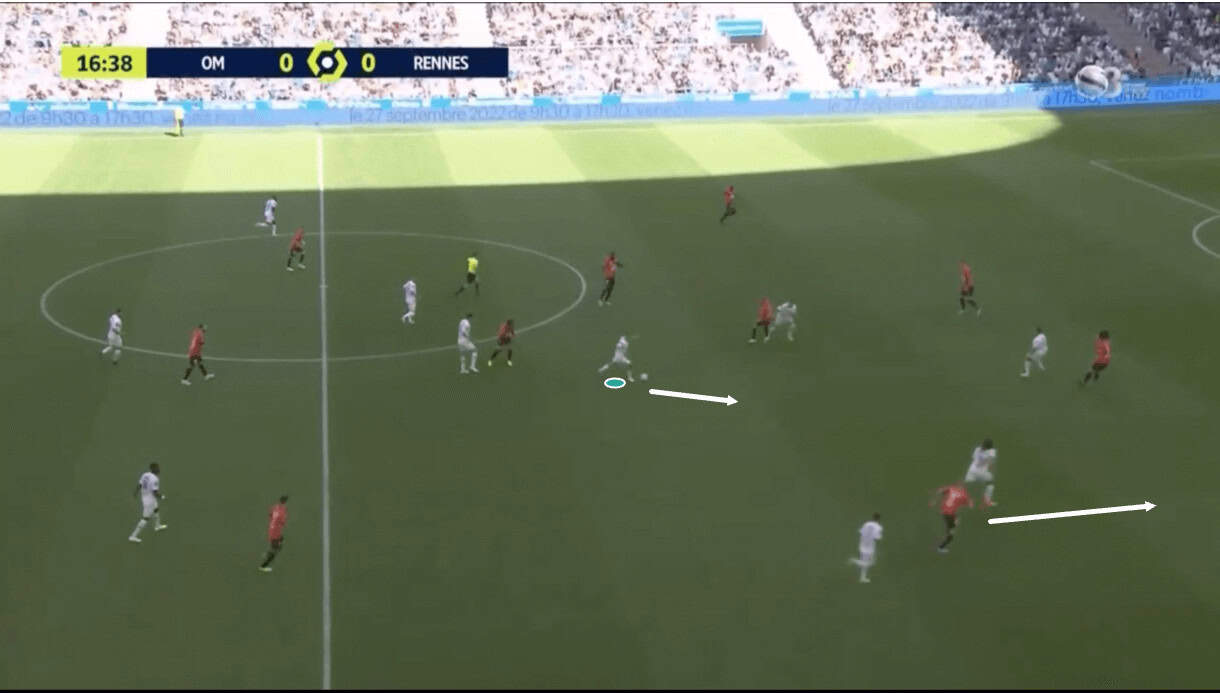
He then opens his body and takes a strong first touch into space on his right, adding some momentum to the attack at just the right moment as he sees some passing options to his right.
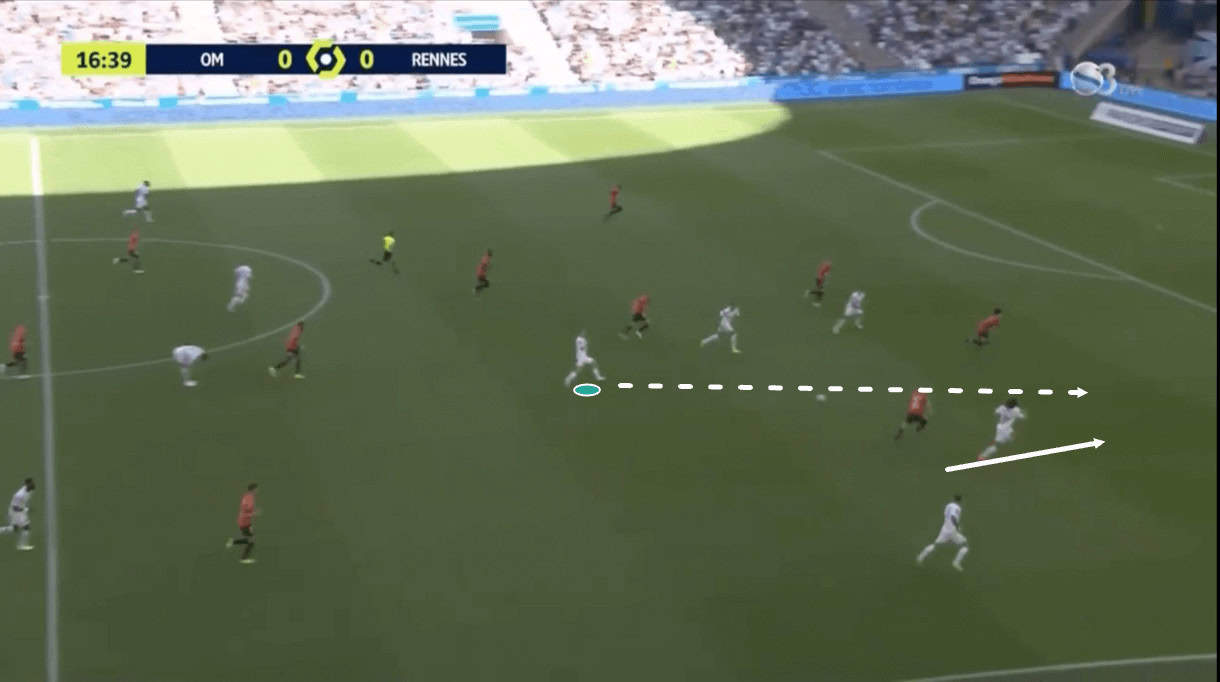
In figure 10, we see how the move ends with Rongier driving the through ball into Guendouzi’s running path, setting his teammate up to progress into the opposition’s penalty area.
The way Rongier received the ball here was fantastic, as it allowed him to inject some pace and life into the attack at a good moment to do so for Marseille’s attacking setup.
This ability to receive the ball with an open body and take a strong first touch in the right moment is typical of the midfielder’s game.

Rongier helped facilitate his team spreading the ball to the opposite, underloaded wing in Figure 7, thanks to his intelligent movement and quick link-up play.
He’s often required to perform this role directly this term, as seen in Figure 11.
Overloading one wing, dragging the opposition over there and creating an opportunity to isolate a player on the opposite wing versus the opposition’s full-back/wing-back is a key part of Tudor’s system at Marseille, hence why this ability to switch the play at the right moment after spotting an opportunity to do so is such an important part of Rongier’s skill set.
Often, he helps his team to make this move after some quick, intricate link-up play to escape pressure, but he can just as easily be the man to receive in space centrally, get his head up, spot the opportunity to exploit the opposite wing and switch.
The player’s vision and spatial awareness are crucial to perform this role effectively.
Valentin Rongier Defensive Ability
For the final section of this tactical analysis piece, we’re going to take a look at the Marseille midfielder’s defensive ability.
Rongier is an intense midfielder who can play as a ‘6’, especially in a double-pivot, or as an ‘8’.
He is good at closing players down aggressively, preventing them from progressing further forward and often forcing turnovers in dangerous areas for his team.

Figure 12 shows Rongier’s high regains from 2022/23, and this image just further illustrates the Marseille man’s effectiveness without the ball in advanced areas of the pitch.
Counterpressing is a particularly strong area of Rongier’s game, with the player having managed 30 counterpressing recoveries this season so far, along with five dangerous recoveries, indicating how his pressing can be a major playmaking asset for his team.
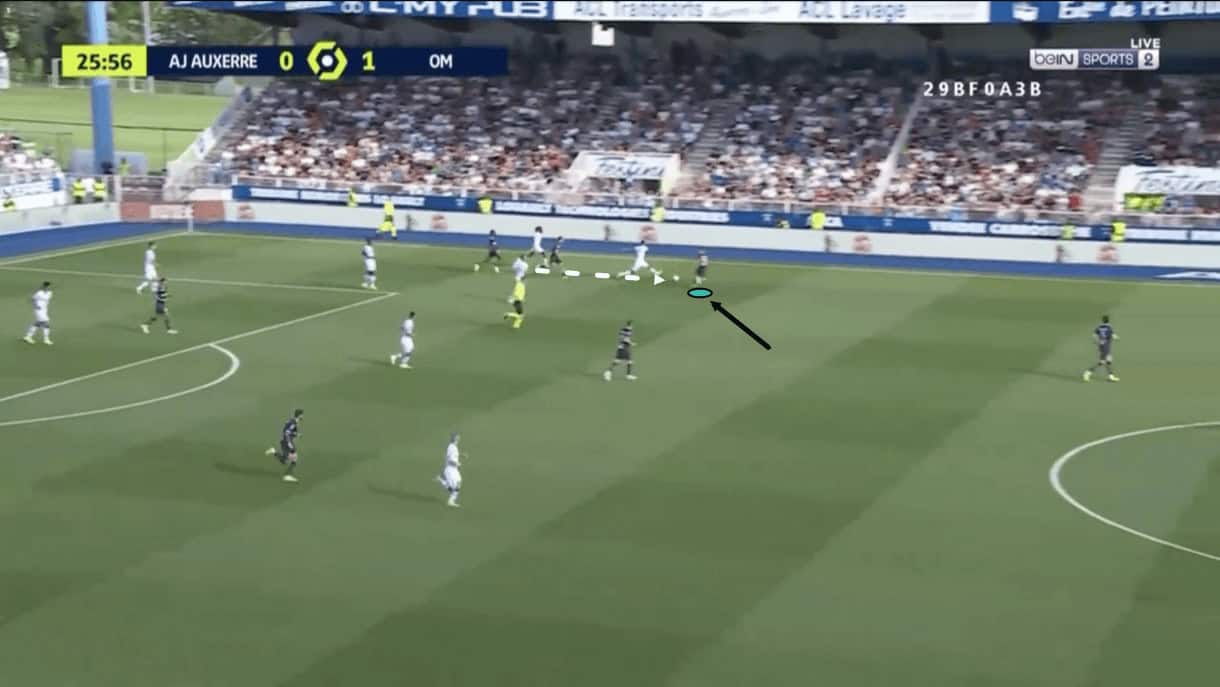
Figure 13 shows an example of Rongier’s counterpressing in action.
Here, the opposition are attempting to break away from deep inside their own half.
Still, as the ball is played out to this particular player who attempts to take it on the half-turn and carry it forward, he runs into the Rongier brick wall and gets dispossessed.
The midfielder’s positioning, pace, and movement are crucial here for Rongier to successfully close down the ball carrier as he receives on the edge of his box and regain possession for Marseille, ensuring that the opposition does not capitalise on his aggressive movement.
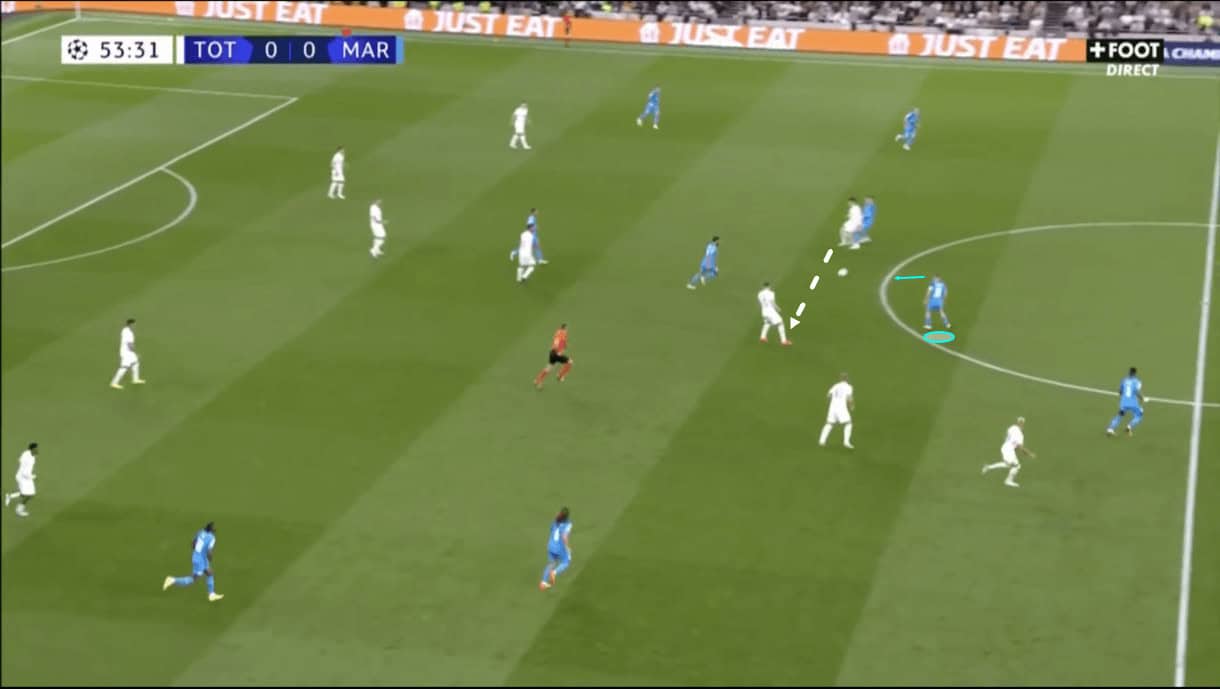
Lastly, Figures 14-15 show us an example of Rongier’s ability to close down the opposition in dangerous areas, preventing his side from being exploited by that situation in the process.
Starting with Figure 14, we see Marseille’s opponents, Tottenham Hotspur, passing the ball to a midfielder in some space with a free man to his right, allowing them to link up.
Rongier spots the danger and expertly prevents the danger from becoming a direct threat by aggressively closing the receiver down and driving him backwards, as we see in Figure 15.
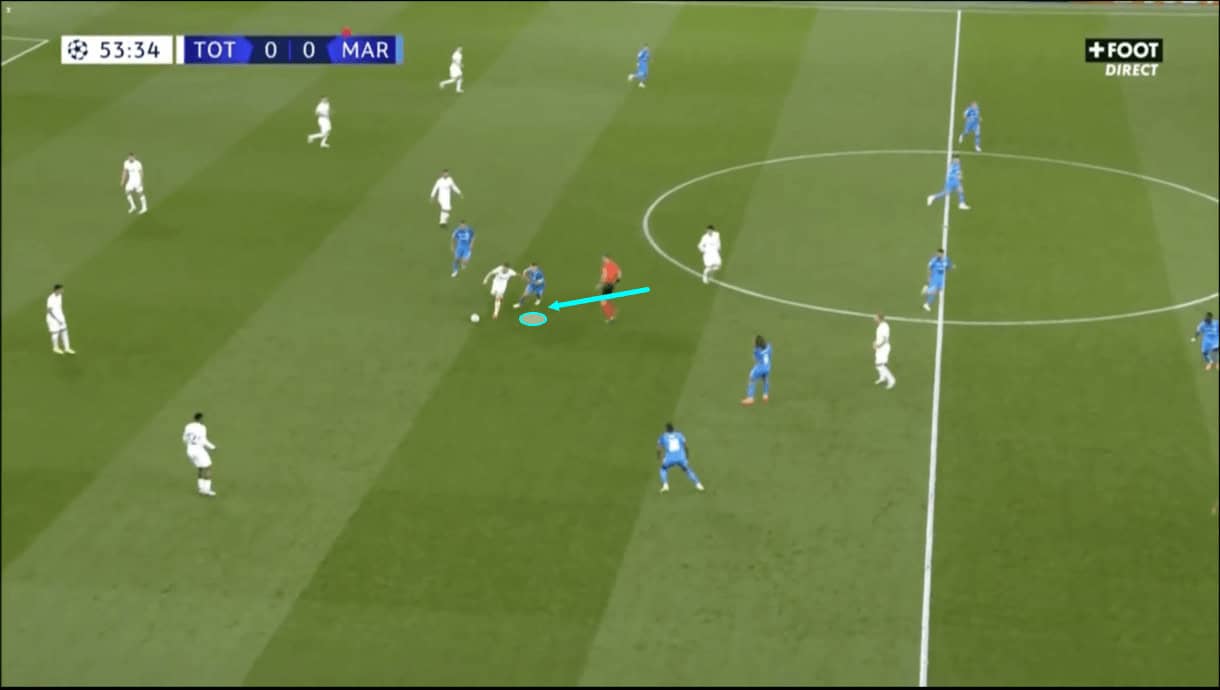
Rongier loves getting tight to attackers and enjoys being physical in his challenges.
He can be a bit of a terrier in midfield at times with how he relentlessly sticks with his opponent after committing to pressing them and nips away at them until either they’re dispossessed, a foul is called (which does, unfortunately, happen at times) or the ball is sent backwards into a less threatening position, which was the case in this instance.
So, as far as his defensive game is concerned, Rongier isn’t the player you want sitting in front of the backline defending mainly via his positioning; instead, he’s the type that needs to be let off the leash a lot of the time and given license to close down players aggressively.
Conclusion
To conclude this tactical analysis piece, we hope it’s clear from our analysis why Tudor declared that Rongier “gives [him] everything” on the pitch, both in terms of his well-rounded skill set and his effort levels.
His key strengths include positioning himself well and finding space off the ball, good vision, short passing ability, and pressing ability.
Meanwhile, Rongier can improve his ability to receive on the half-turn and play more line-breaking passes himself to elevate his game, potentially.
