
Barcelona secured the top spot in La Liga after defeating Atlético Madrid in Gameweek 19 of the 2025/2026 season.
The Blaugrana hosted Atleti at the Spotify Camp Nou, in its new look, aiming to extend their winning streak.
With a 3-1 victory, Barcelona not only recorded their fourth consecutive win but also retained first place, irrespective of the Athletic Club vs Real Madrid result in the same Gameweek.
Despite conceding a goal in the 19th minute, Barcelona remained composed and tactically controlled the game, scoring twice and securing the win.
“This was one of our best matches. I really appreciate what I saw during the 90 minutes. I think we deserved the three points. With the ball, we were able to impose more control and create more space, which was very positive. I think our performance today was on another level,” –Hansi Flick after the game.
This Barcelona Vs Atlético Madrid tactical analysis will break down how Hansi Flick tactics overpowered Diego Simeone’s defense to notch another win.
Watch Barcelona Vs Atlético Madrid Tactical Analysis
Barcelona Vs Atlético Madrid Lineups & Formations

Flick opted for the usual 4-3-3 formation for Barcelona
The three in midfield were Eric García, Pedri, and Dani Olmo, while Lamine Yamal played on the right wing with Raphinha on the left.
Robert Lewandowski occupied the centre-forward position.
Hansi Flick made five substitutions in the match.
Ferrán Torres for Olmo at the 66th minute, just after the latter scored the second goal of the game.
Marcus Rashford for Lewandowski at the 67th minute.
Marc Casado and Dro Fernández, for Pedri and Raphinha at the 74th minute.
Andreas Christensen for Yamal at the 88th minute.
Diego Simeone started with a 4-4-2 formation, with Jan Oblak starting between the sticks.
Rojiblancos’s back four were José María Giménez and Clément Lenglet at right and left centre-back, with Nahuel Molina and Dávid Hancko playing as right and left full-backs.
Their two midfielders were Johnny Cardoso and Pablo Barrios, while Giuliano Simeone was Atlético Madrid’s right winger with Alex Baena on the left.
Julián Álvarez and Nicolás González played just ahead as two strikers.
Simeone‘s substitutions were Koke for Cardoso at the 14th minute and Conor Gallagher for González at the 46th minute.
Thiago Almada for Baena, and Alexander Sørloth for Simeone, at the 62nd and 63rd minutes, respectively.
Antoine Griezmann for Koke in the 75th minute.
Barcelona Vs Atlético Madrid Shapes & Structures
Let’s begin by setting the scene and outlining both teams’ structures in and out of possession.
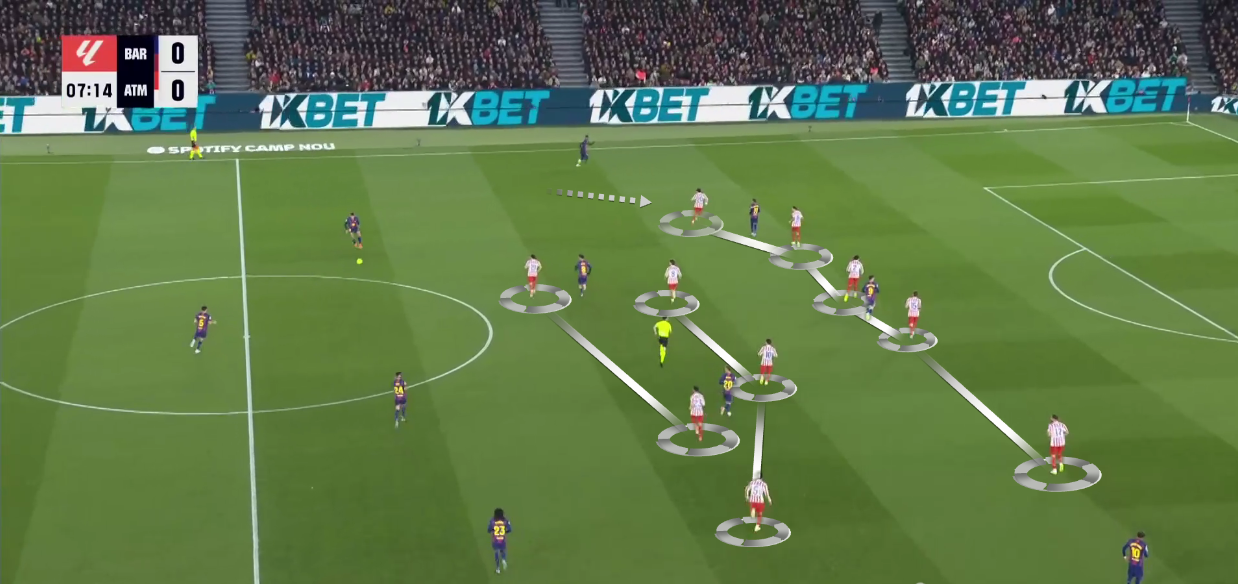
Atlético Madrid started with a 4-4-2 shape.
However, out of possession, especially in the mid and low blocks, Giuliano Simeone, the right winger, dropped into the defensive line as a wing-back on the right, becoming the fifth defender in the first line.
This adjustment turned the structure into a 5-3-2.
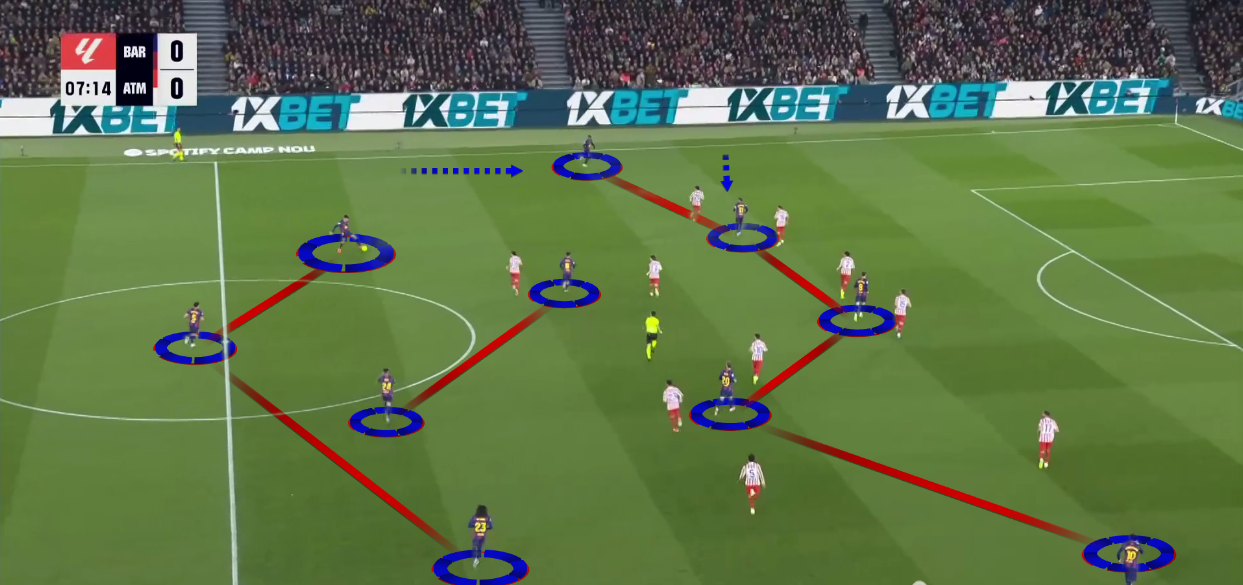
In contrast, Barcelona operated in a 3-2-5 structure.
Koundé, the right full-back, stepped inside to form the back three with Cubarsí and Martín, while Balde advanced high on the left to hold the width.
With Raphinha, the left winger, moving into the half-space, and Olmo, the right eight, positioning himself high, Barcelona established five players on the last line, ahead of the two sixes, Pedri and García.
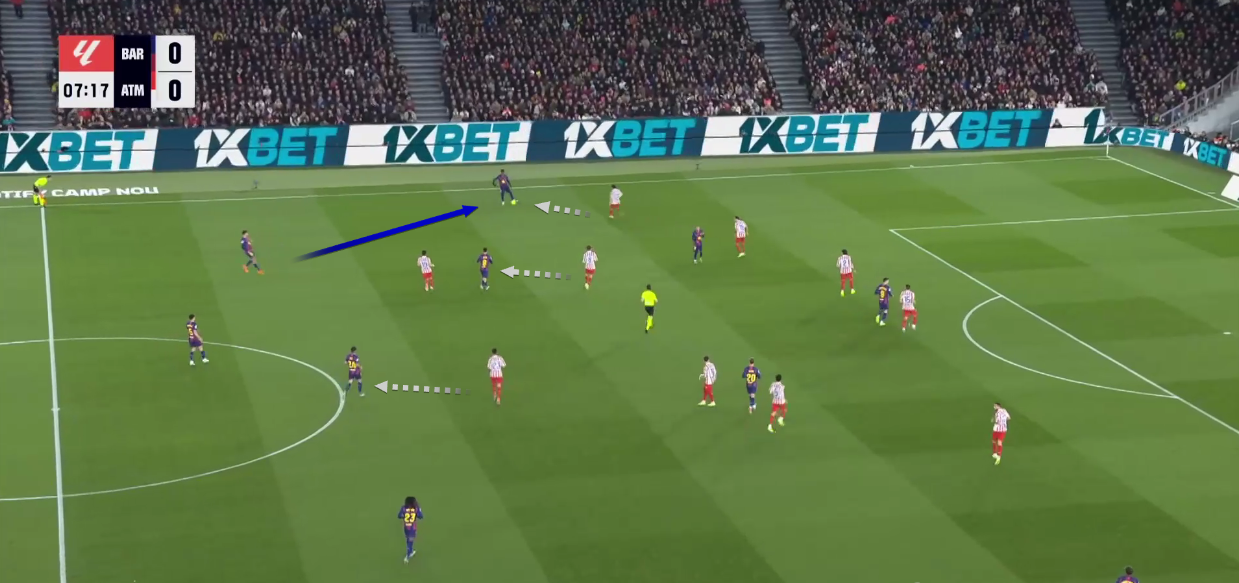
As the ball travelled to Balde on the left, Simeone, acting as the right wing-back, stepped out to press him.
In Atlético Madrid’s pressing scheme, Barrios tracked Pedri, González stayed with García, and Álvarez shifted towards the ball.
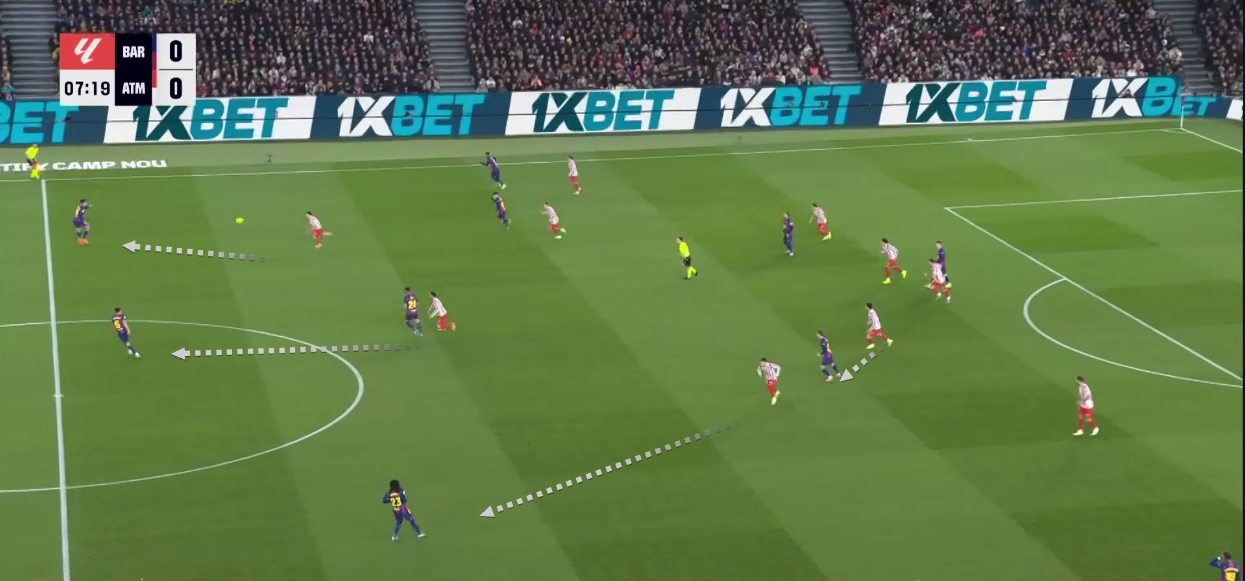
Atlético Madrid’s pressing trigger was the back pass.
When Balde played back to Martín, Álvarez closed him down, while González moved towards Cubarsí.
Baena stepped out towards Koundé, and Atlético Madrid’s left six tracked Olmo.
Through this, Atlético Madrid attempted to restrict Barcelona’s passing options and force them backwards or into uncomfortable situations where the receiver’s body orientation was compromised under heavy pressure.
Barcelona had prepared several solutions to progress through Atlético Madrid’s block.
Barcelona Attack Space In-Behind & Through The Left Half-Space
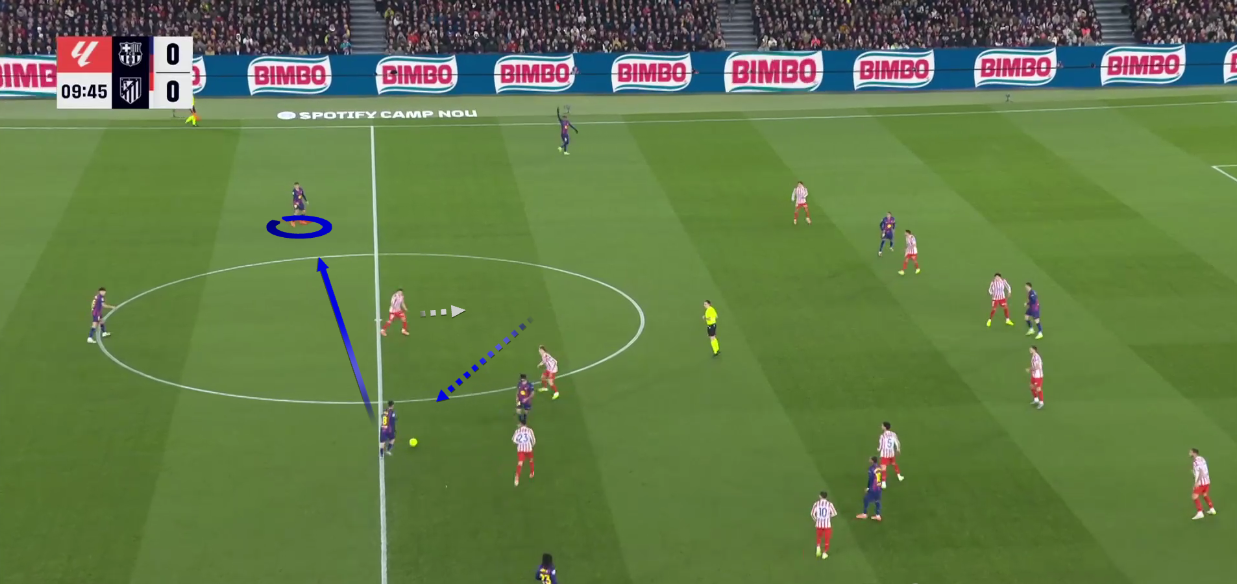
To avoid being closed on the left side, Pedri began to drop in front of Atlético Madrid’s forwards.
Barrios doesn’t follow him, allowing Pedri to play comfortably into Martín while Álvarez shifts centrally to block the middle and prevent Pedri from carrying forward.
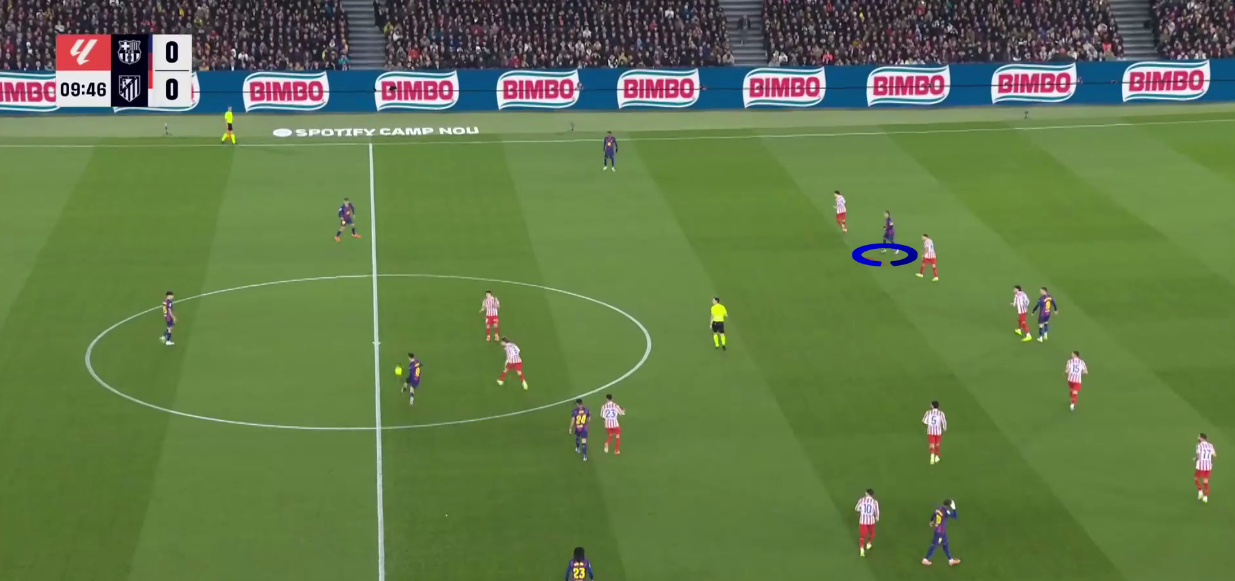
Meanwhile, Raphinha positioned himself in the left half-space.
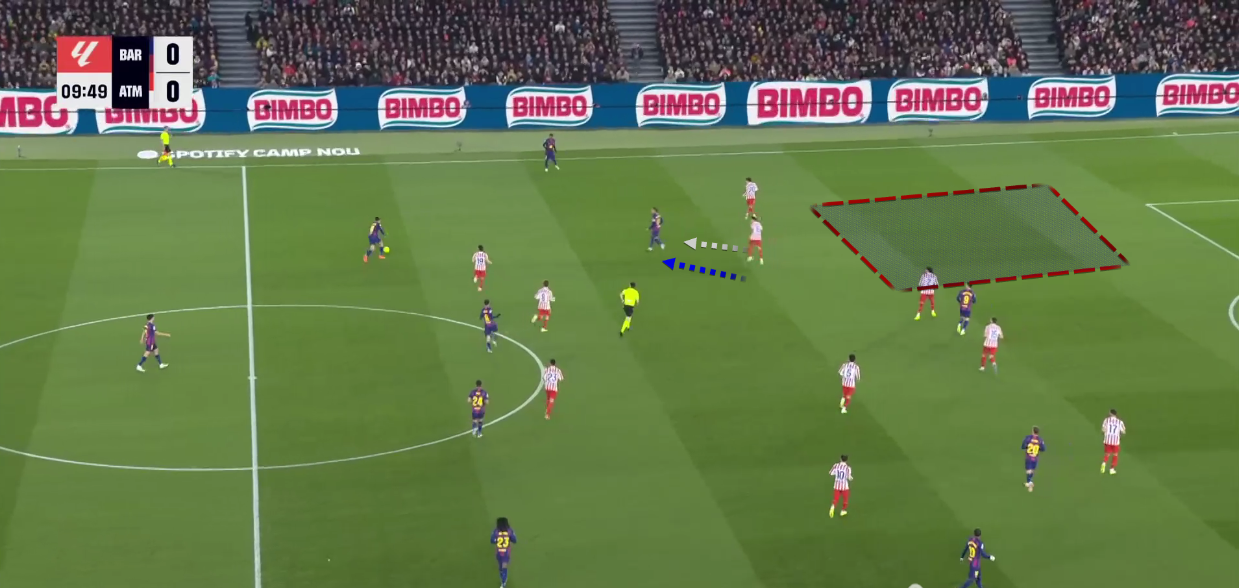 As Martín received Pedri’s pass, Raphinha began to drop, drawing Molina with him.
This movement created an ample space behind Molina.
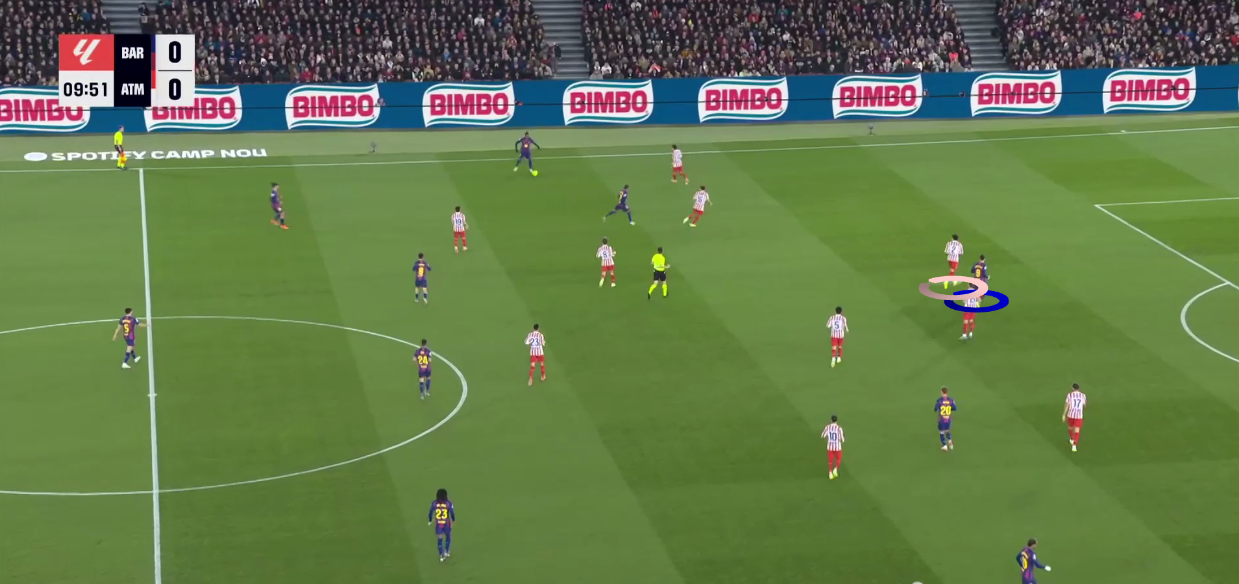
Lewandowski moves towards the ball side to occupy Atlético Madrid’s near centre-back.
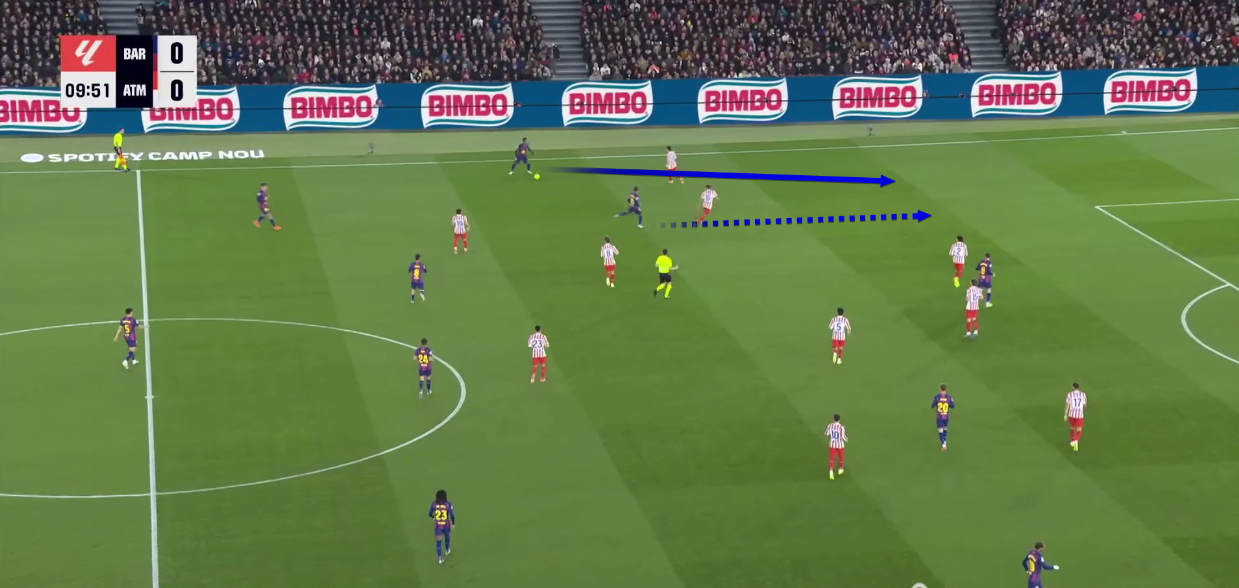
Lewandowski’s positioning prevented the near centre-back from shifting across to cover, keeping the space behind Molina open.
This allowed Raphinha to prepare his run, and Balde, after receiving from Martín, could play into that free space.
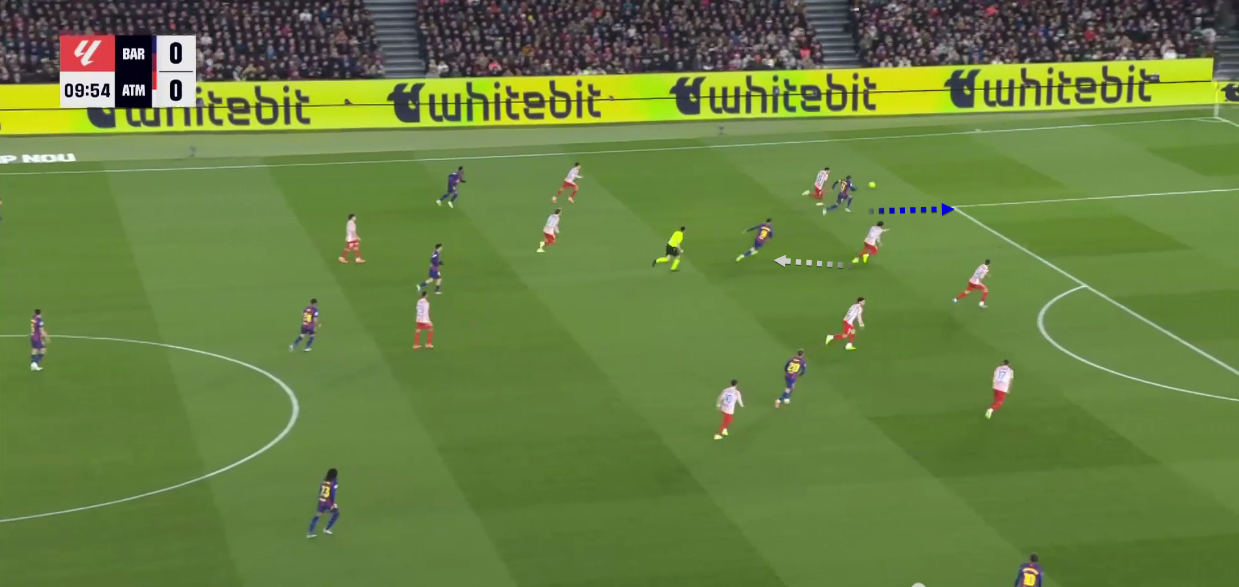 Here, Giménez was occupied with Lewandowski and unable to cover the space where Raphinha received the pass.
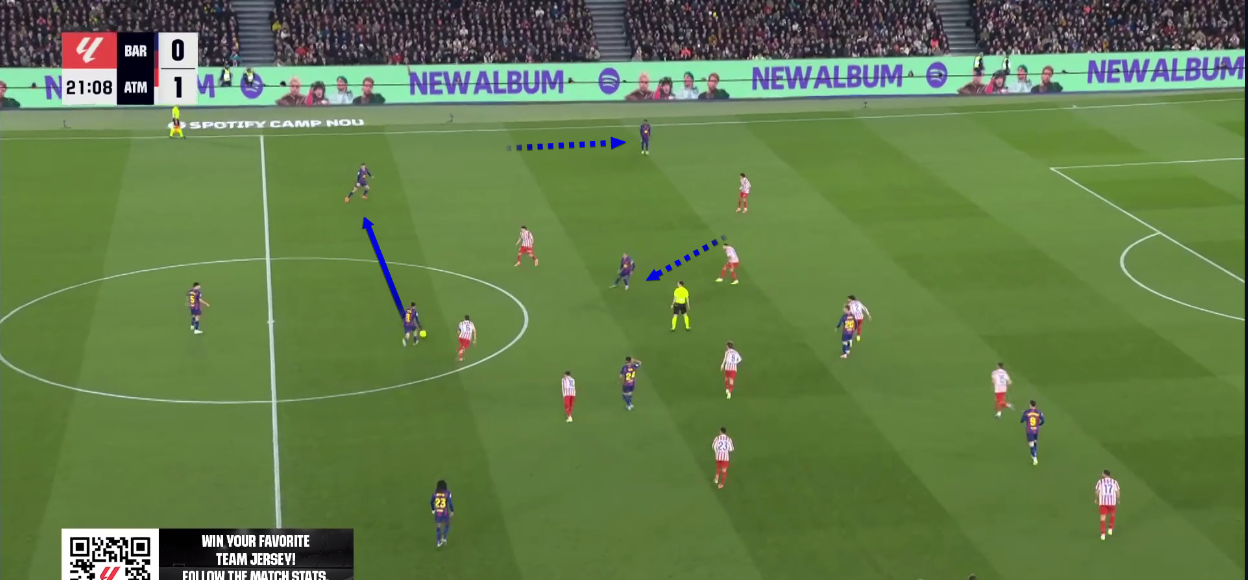 Once again, a similar situation appears.
Pedri drops, and Barrios does not follow him.
Balde holds a high position, and Raphinha stays in the half-space with Molina tracking him.
Álvarez drops centrally, opening the passing lane from Pedri to Martín.
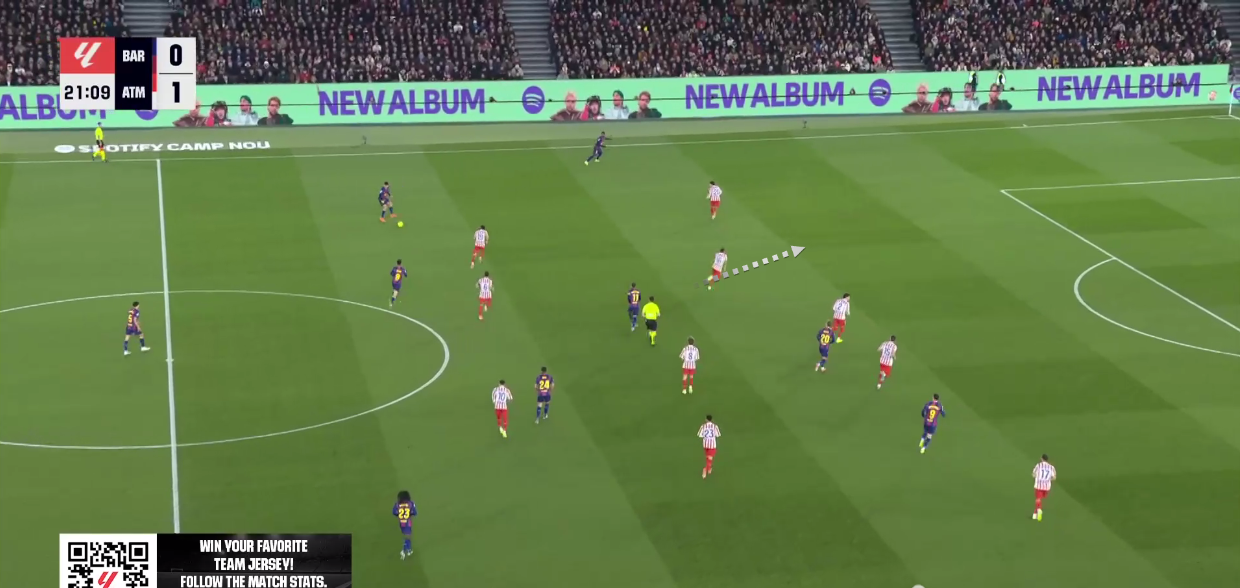 To avoid the earlier scenario, as Martín receives, Molina leaves Raphinha and quickly tracks back to close the space in Atlético Madrid’s defensive line.
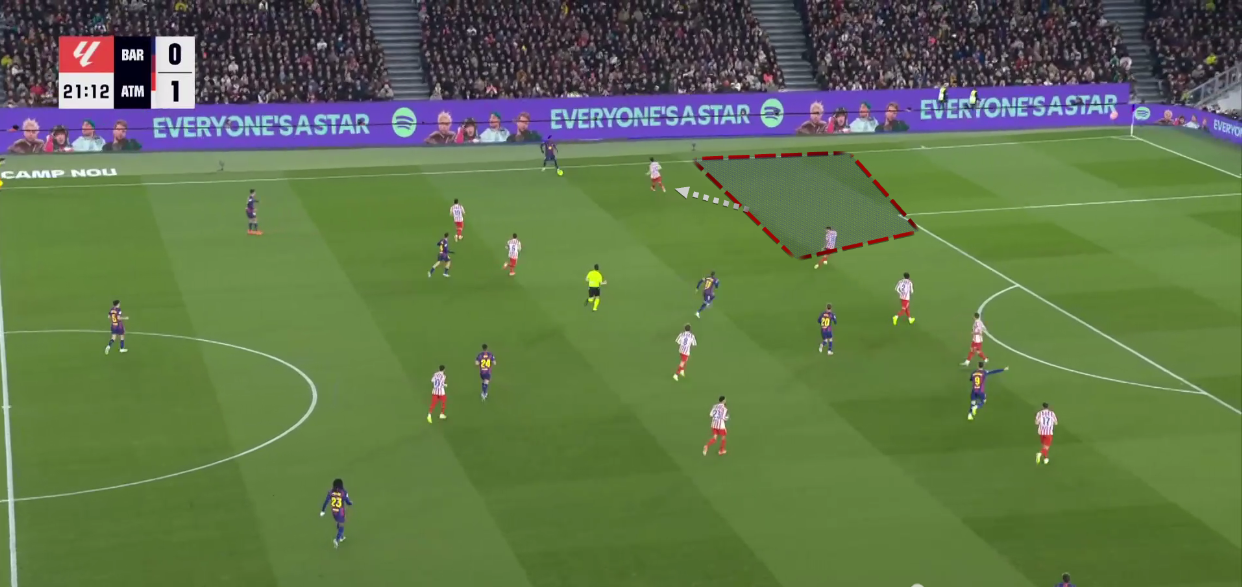 Simeone’s role is to push out and press Balde whenever he receives the ball.
That is precisely what he does here, and as a consequence, a space opens behind him, especially with Molina focusing heavily on Raphinha.
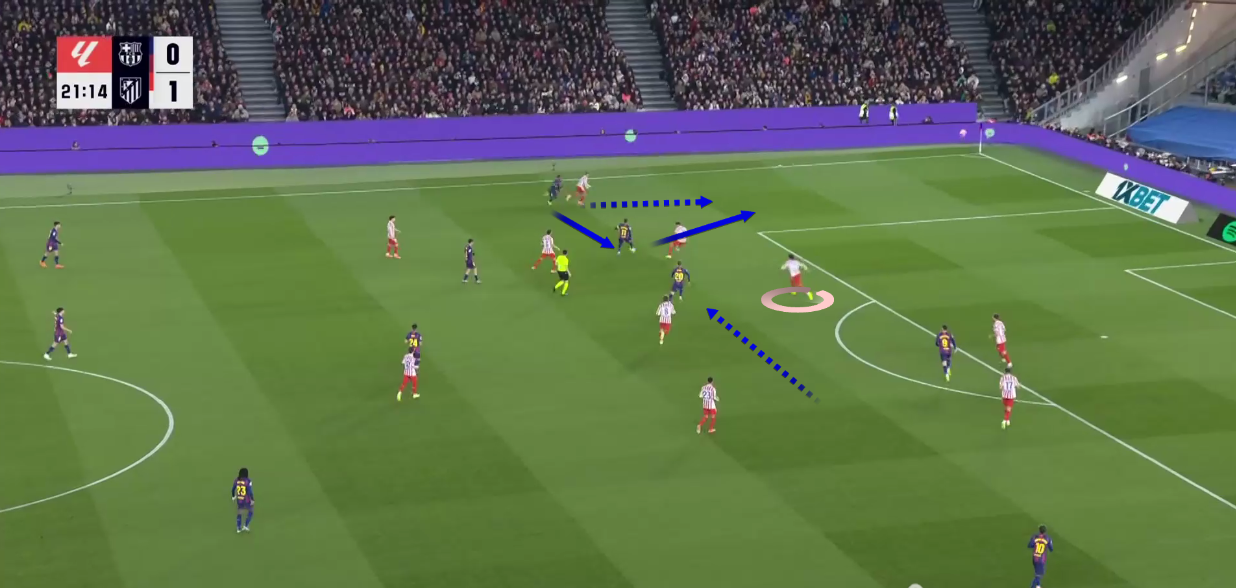
Barcelona looks to exploit that space.
Balde plays a one-two combination with Raphinha, escapes Simeone’s pressure, and moves into the exposed area.
This is helped by Molina staying occupied with Raphinha, while Olmo keeps Giménez’s attention.
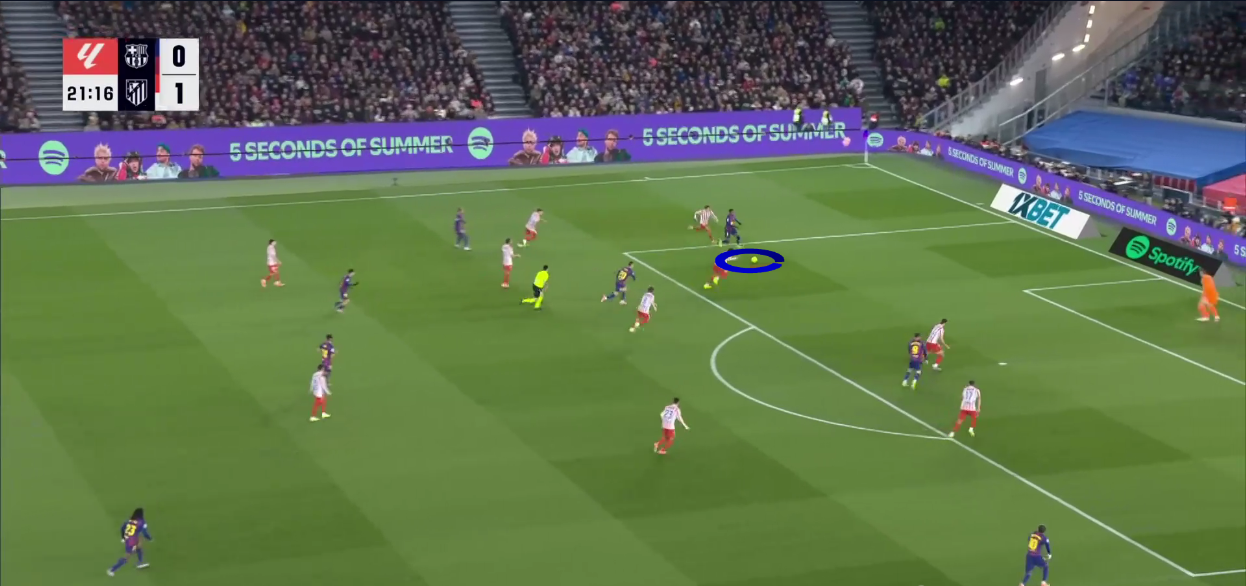
Balde receives the ball in a highly dangerous position.
Exploit Atlético’s Shifting Problems To Attack Through The Right Half-Space
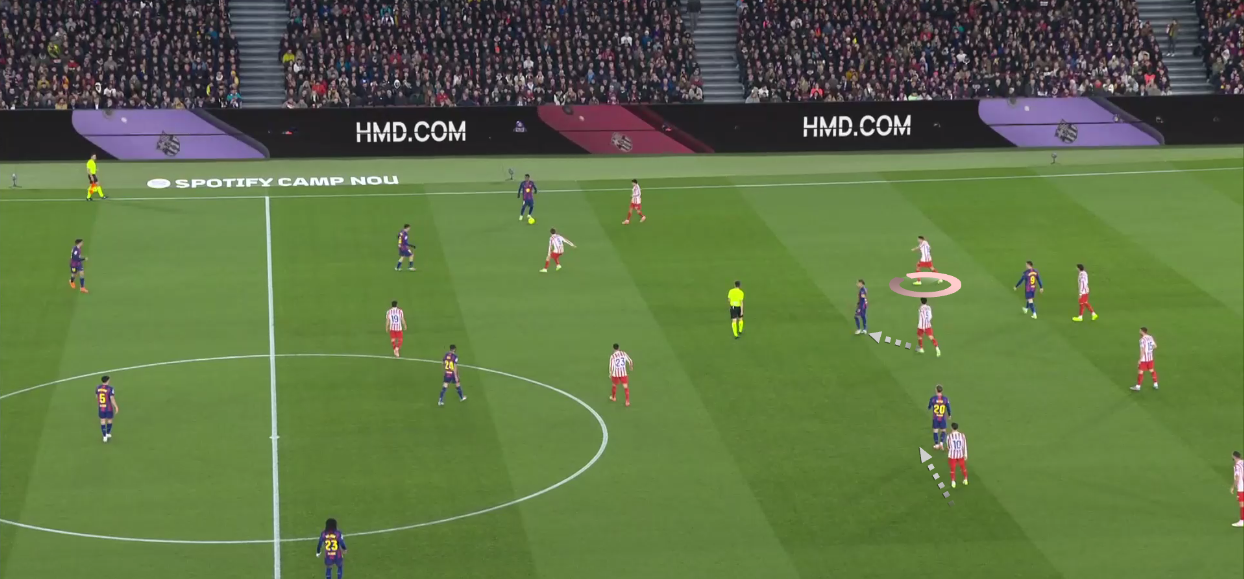 Atlético Madrid looks for a better way to manage Raphinha and Olmo in the central and half-space zones.
Here, Molina does not step high to Raphinha.
Instead, he signals for Cardoso to move towards him, as Raphinha is now more central and closer to Cardoso’s area.
Baena shifts inside to take Olmo.
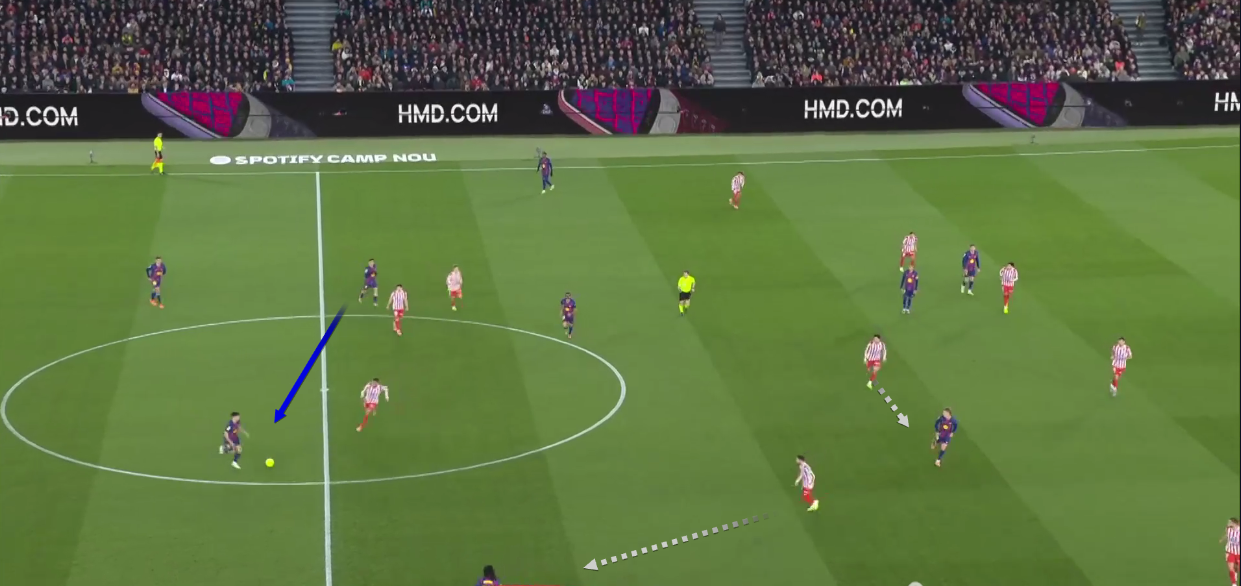 Barcelona anticipates Atlético Madrid’s structure, with Pedri playing into Cubarsí.
This triggers Baena’s usual movement towards Koundé, and Cardoso shifts onto Olmo.
However, Cubarsí gives the impression that he will play wide to Koundé, prompting Baena to press early.
This opens the passing lane from Cubarsí to Olmo, who is still free because Cardoso has not reached him.
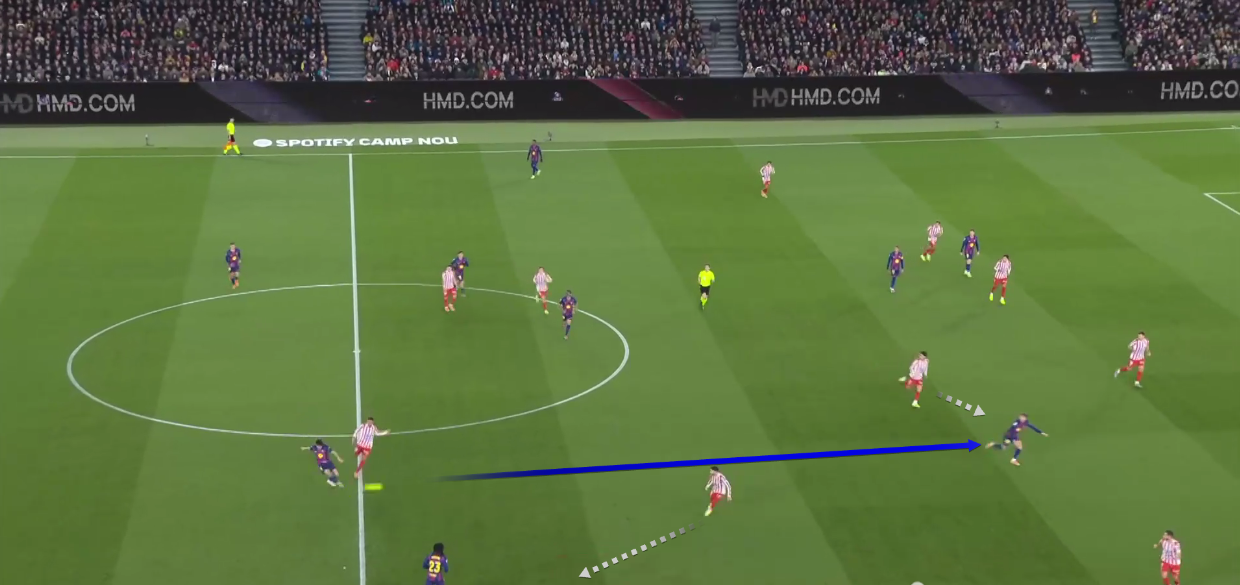 Cubarsí plays a high-quality vertical pass that breaks Atlético Madrid’s block.
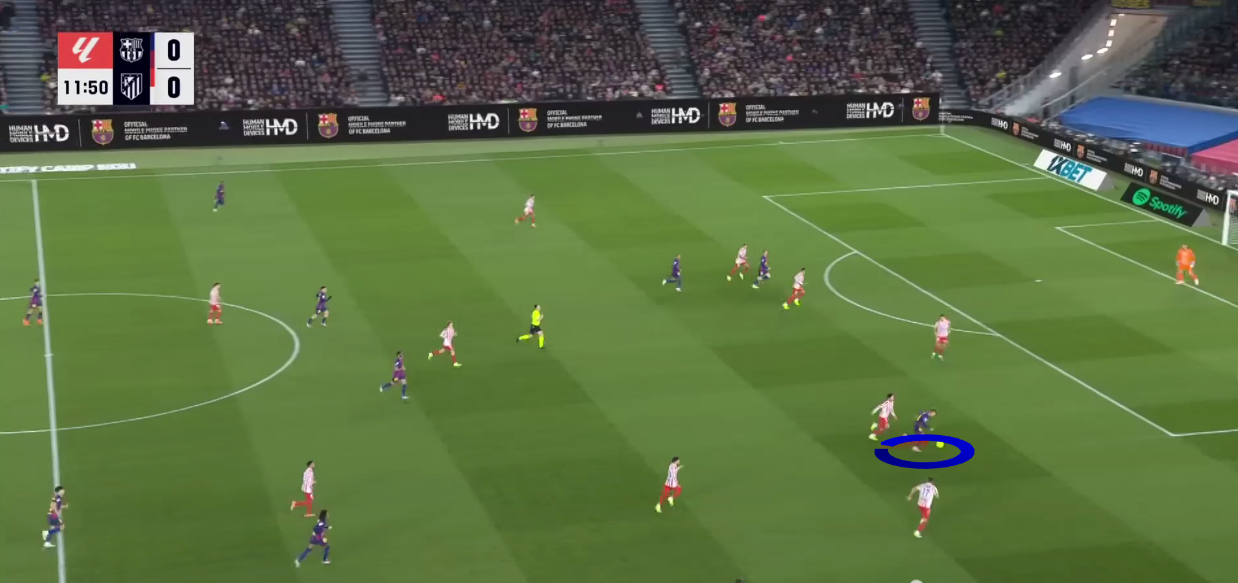
Olmo receives, turns, and carries forward.
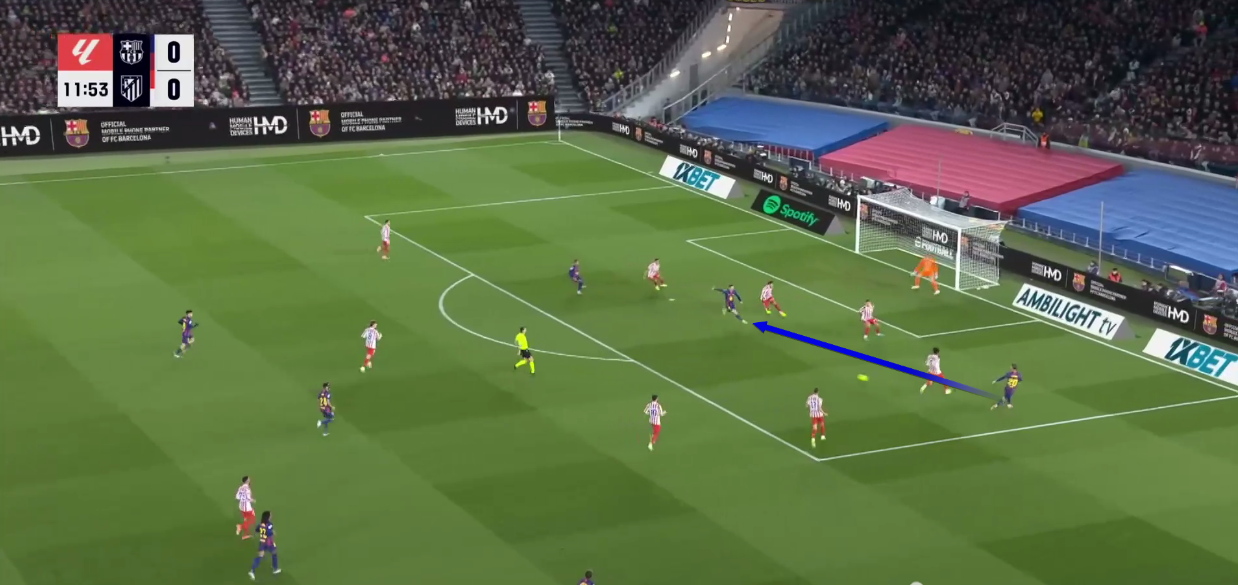
Barcelona breaks through Atlético Madrid and reaches a position where it can threaten the defensive structure.
Barcelona Attack Through The Middle
Another attacking method Barcelona used in this game was to break through Atlético Madrid’s block in the middle.
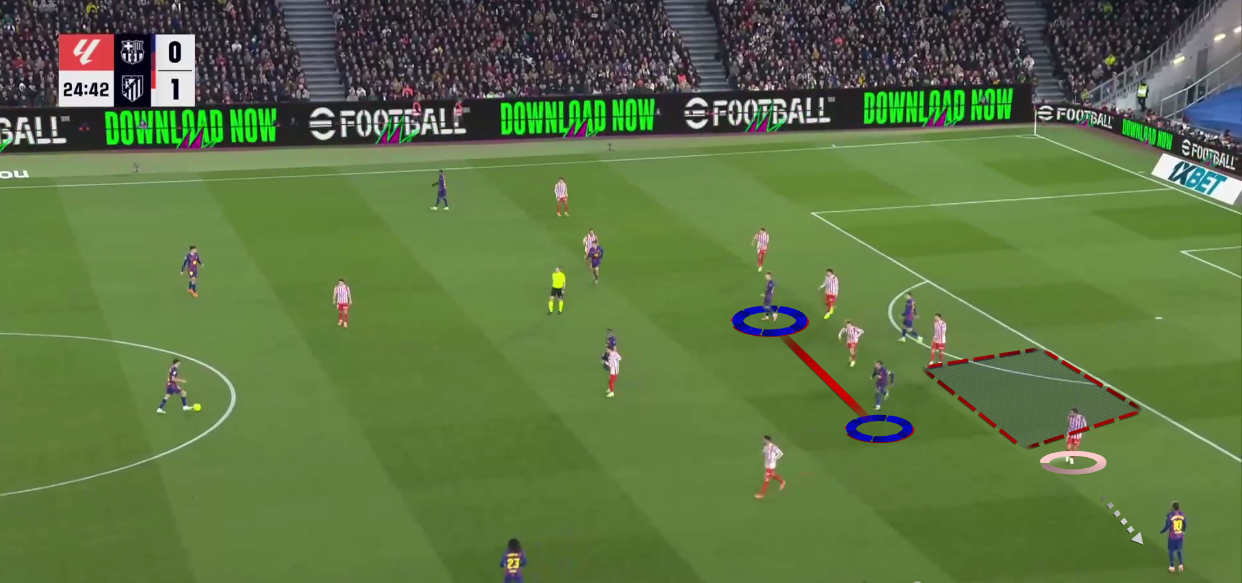 Before explaining this approach, it is essential to highlight a behavioural detail in Atlético Madrid’s defensive line, particularly with Hancko, the left full-back.
Hancko tends to move early and position himself close to Yamal, anticipating the moment the ball will be played to him.
This creates a gap in the defensive line between him and Lenglet.
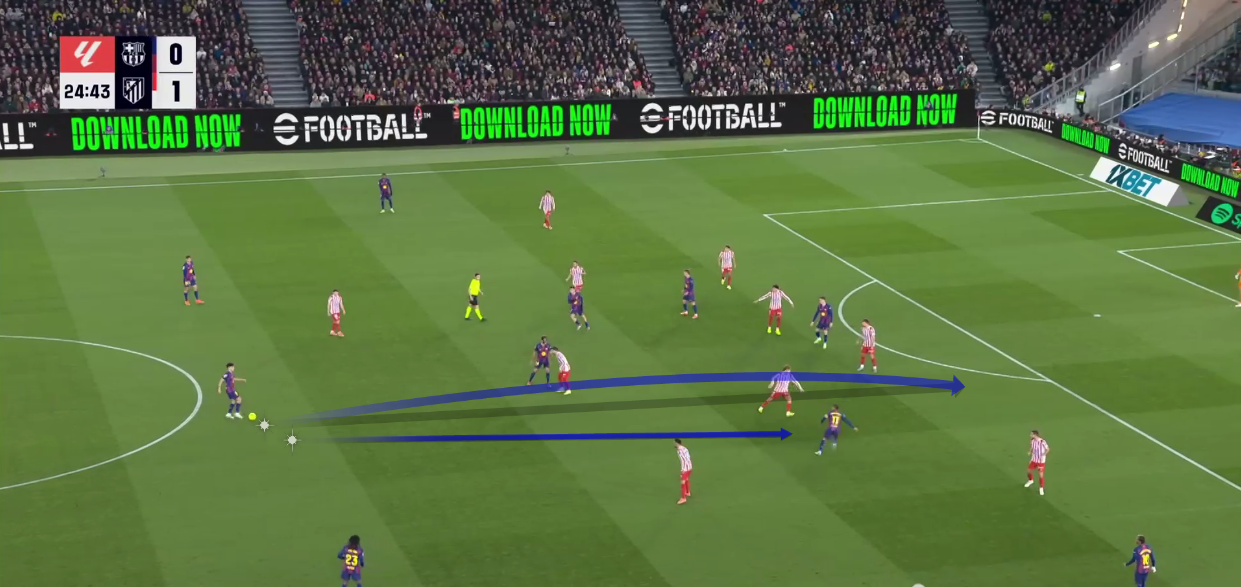
Raphinha (who has switched positions with Olmo at this moment) identifies that gap and asks for the ball, either through a ground pass or a long ball from Cubarsí, who is in possession centrally.
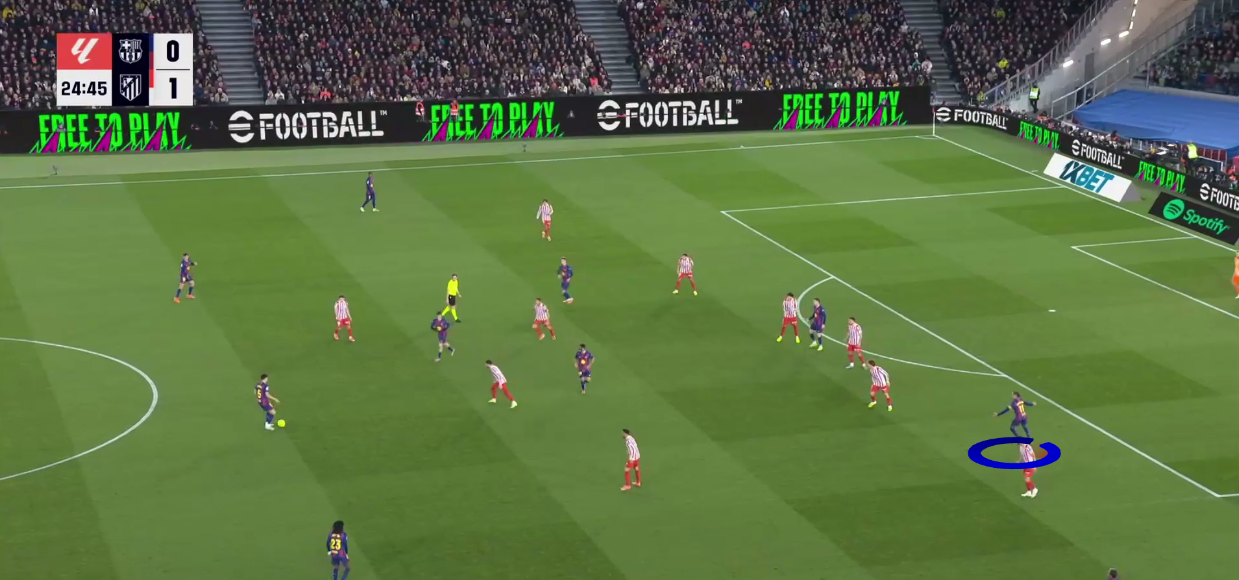
Cubarsí decides not to play the pass, and Raphinha shows his frustration.
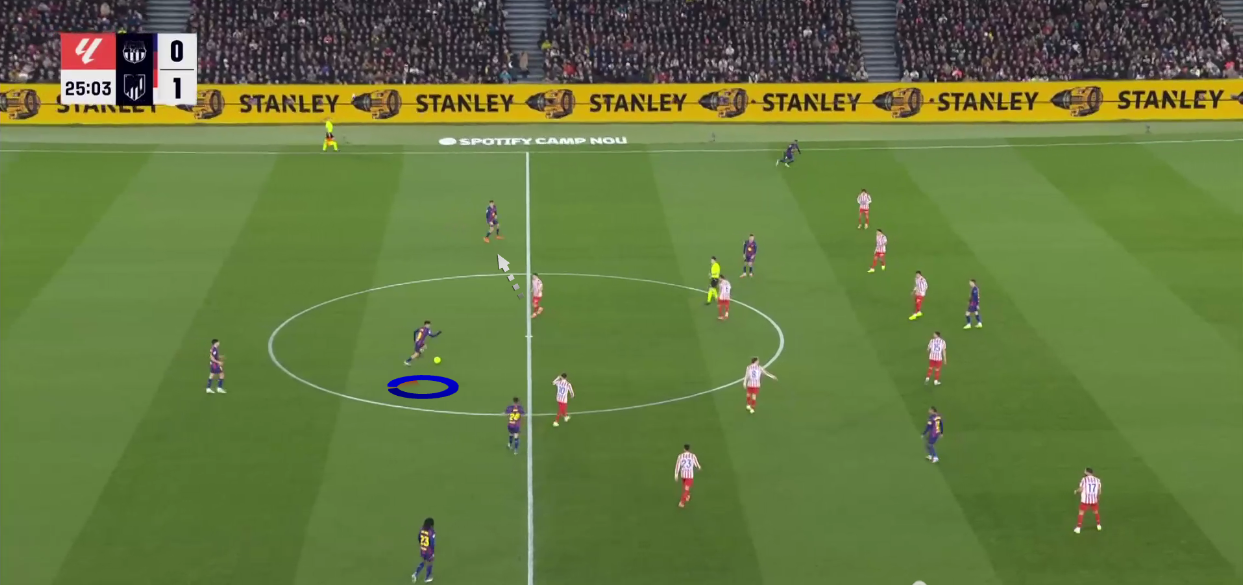
The ball circulates, and Pedri drops, as he often does, to receive possession.
Álvarez anticipates a pass to Martín, as it is a common pattern, and begins to move to block that option instead of dropping centrally to stop Pedri from advancing.
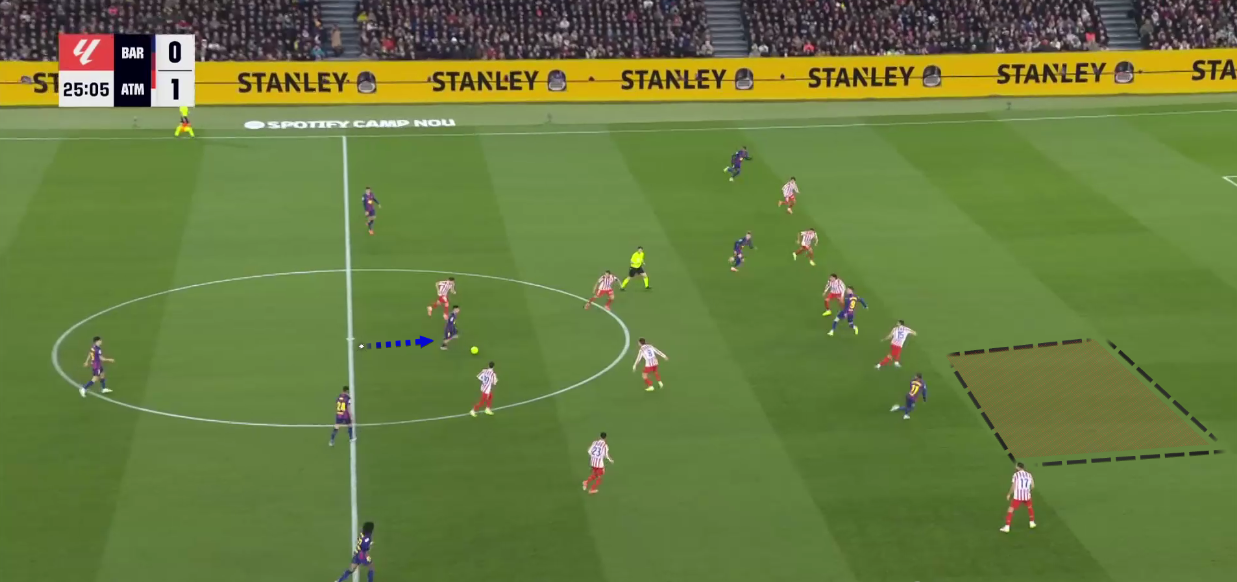
This gives Pedri space to carry the ball through the middle.
The gap between Hancko and Lenglet appears again, and Raphinha recognises it once more.
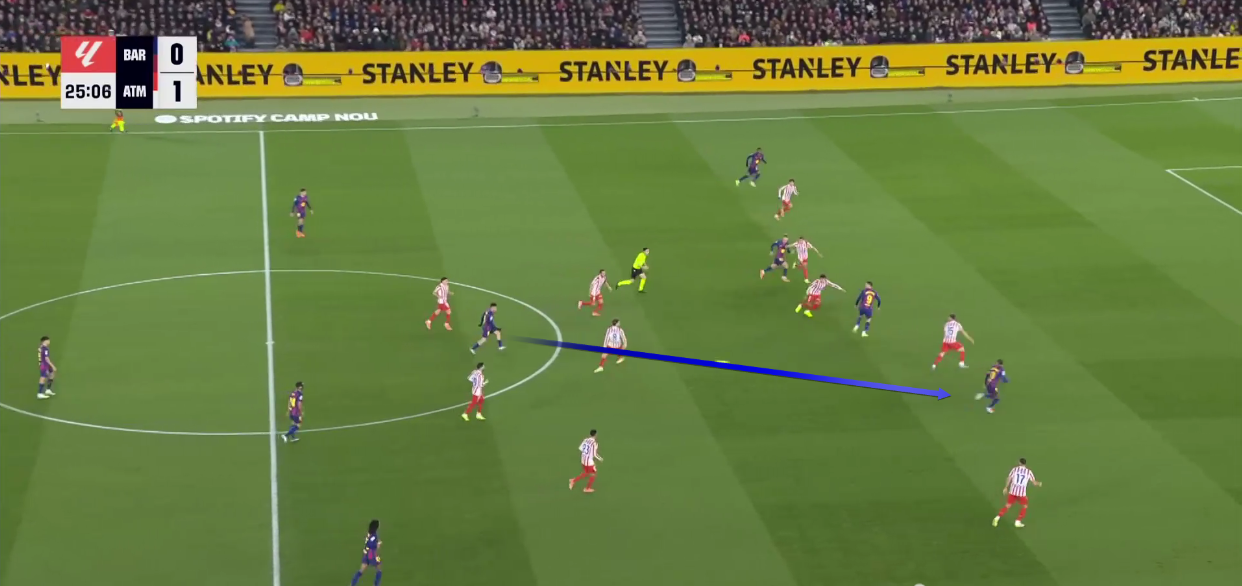 This time, Pedri rewards Raphinha’s movement and plays the pass.
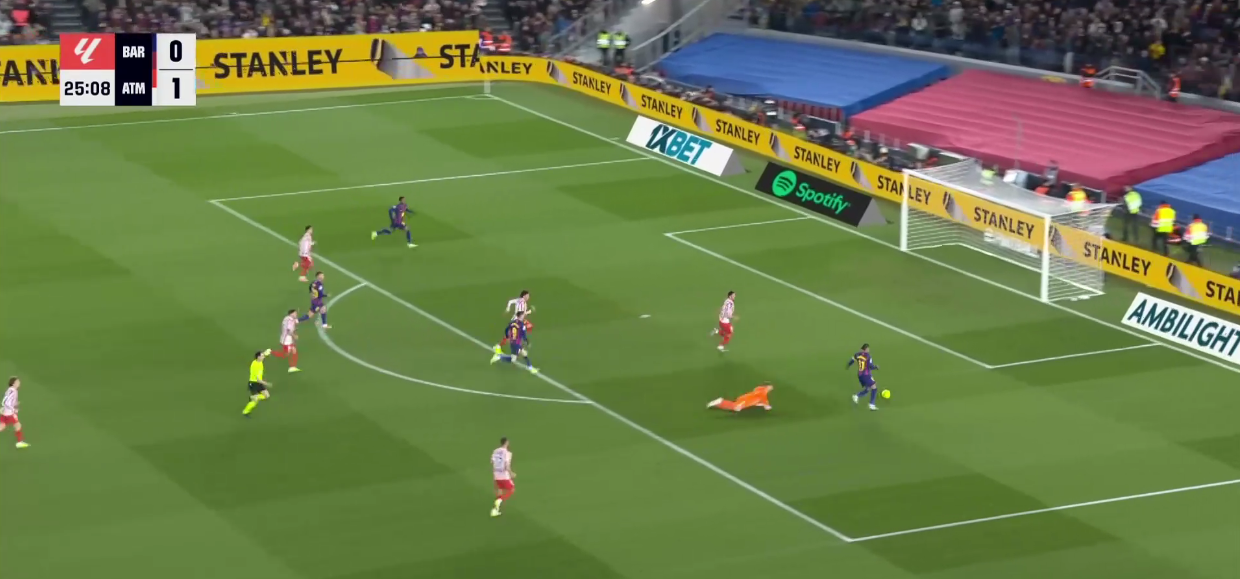
Raphinha receives Pedri’s pass, dribbles past Oblak, and scores Barcelona’s first goal.
Barcelona Finding The Free Six
Another attacking method Barcelona used was finding a free six to break through Atlético Madrid’s block.
To understand this, we must first examine how Atlético Madrid tries to control Barcelona’s midfield when the ball is on the right flank, especially with Koundé.
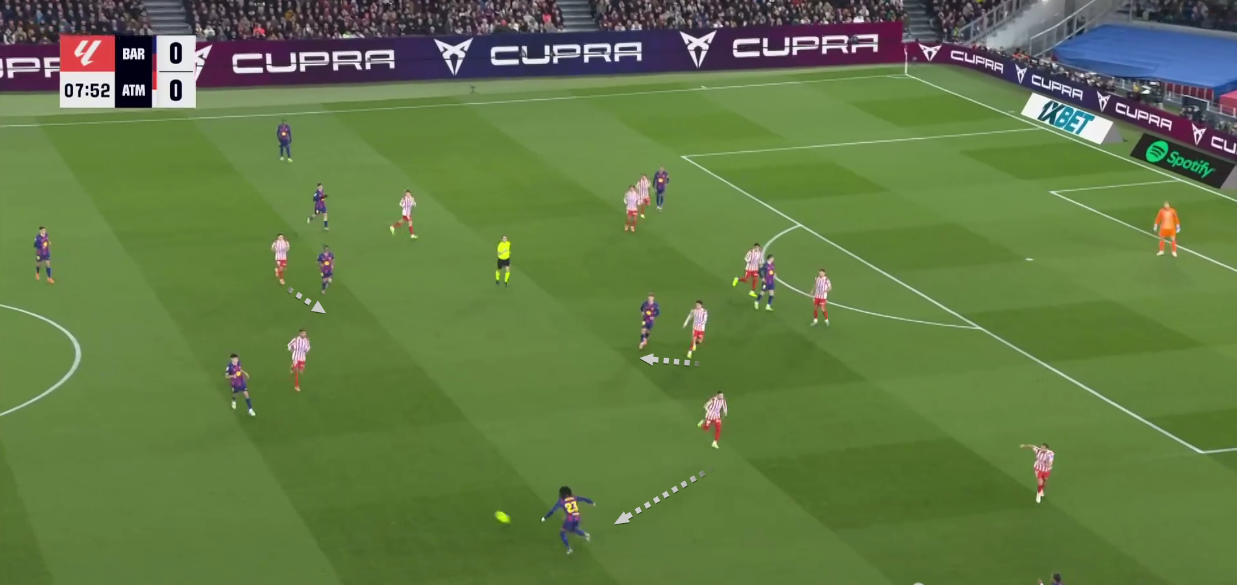 González presses Cubarsí, Baena pushes out to press Koundé, and Cardoso tracks Olmo.
To increase difficulty, Barcelona moves both sixes, Pedri and García, or at least one of them, toward the ball side, as García does here.
One solution for Atlético Madrid is to make the far centre-forward track Barcelona’s six, as Álvarez does with García.
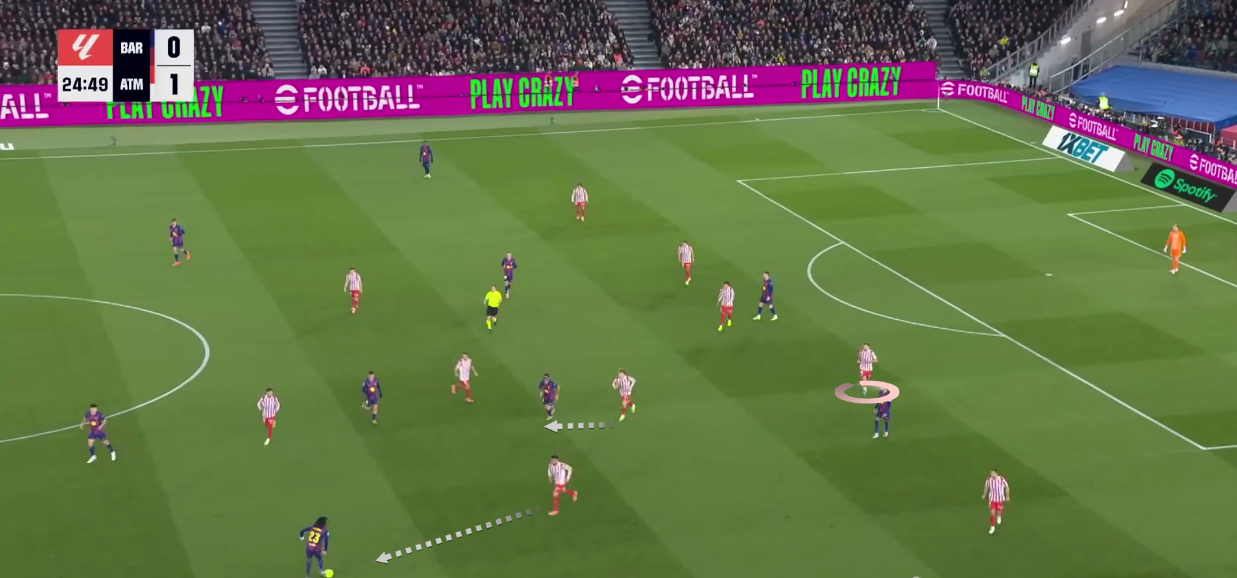 Another option for Atlético Madrid is having the six move toward García, as Barrios does here, leaving Olmo for Lenglet to pick up.
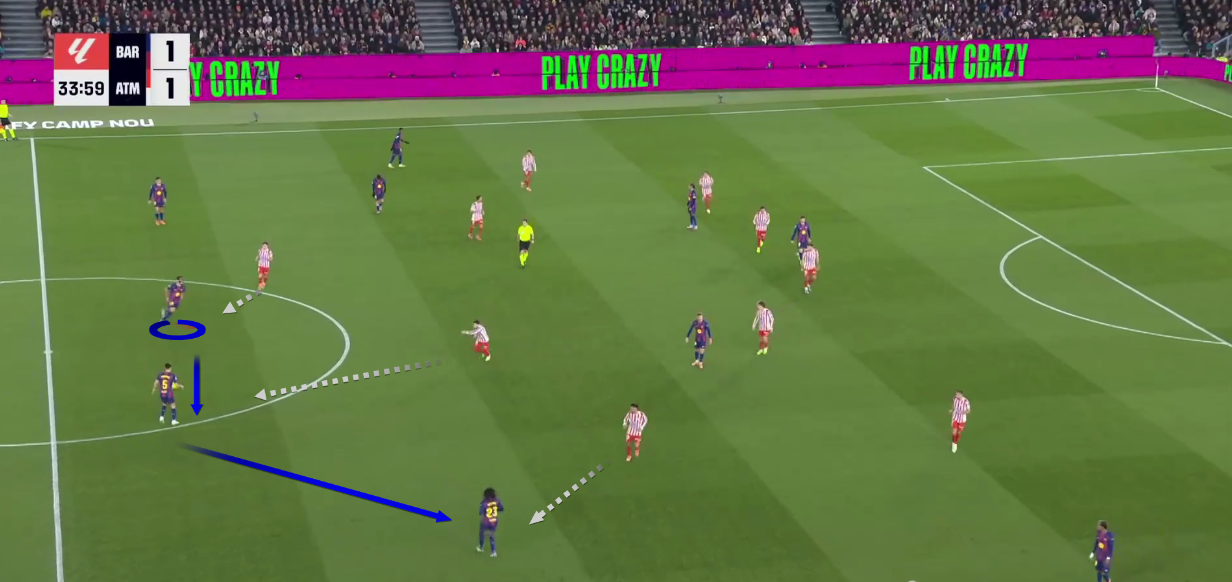 However, Barcelona has a plan to free García from Atlético Madrid’s block.
García uses Pedri’s method by dropping to receive, then playing into Cubarsí.
González presses, and as usual, Barrios (who has switched with Koke after his introduction for the injured Cardoso) stays with Olmo.
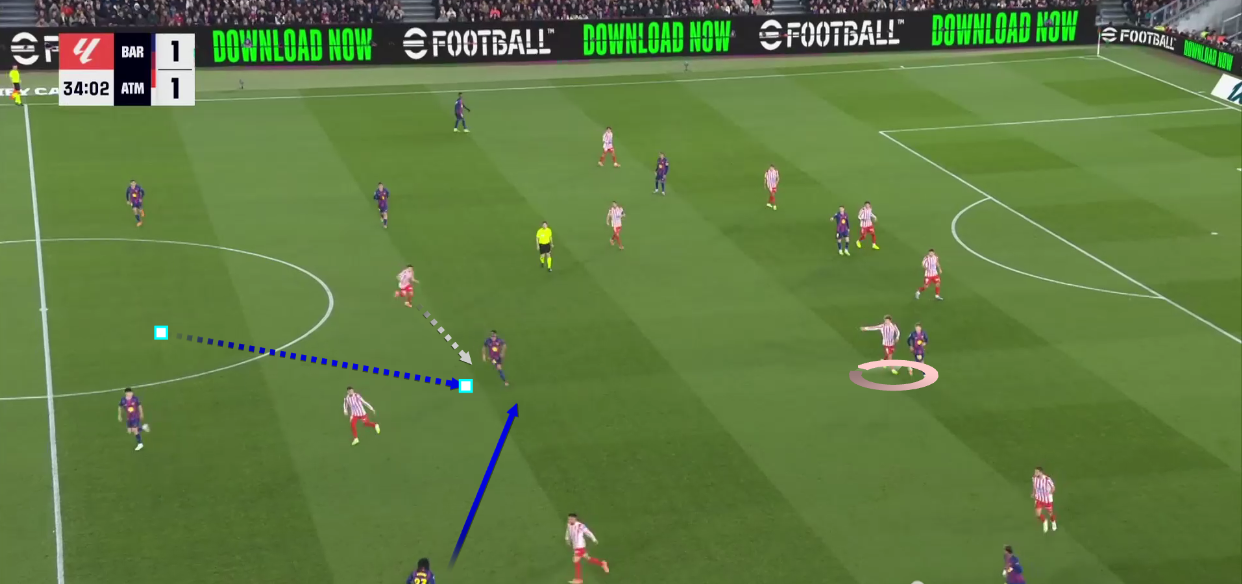
García then runs after releasing the pass and positions himself between the lines.
With Barrios occupied with Olmo and signalling to him, Álvarez should track García, but he does not.
García is free to receive Koundé’s pass.
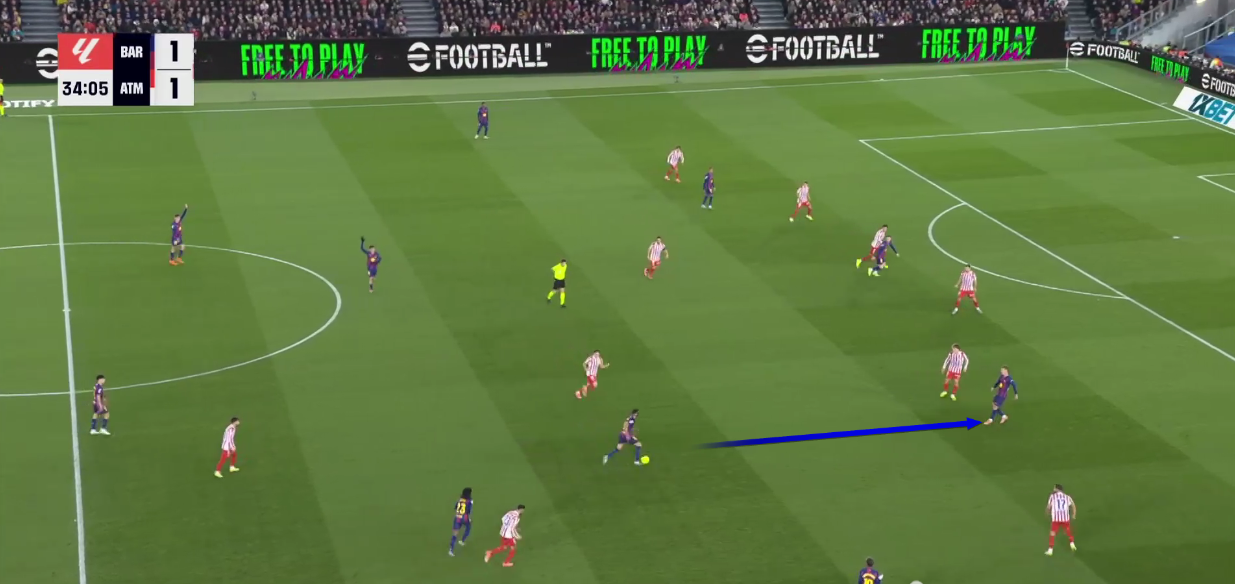 García receives, turns, and finds Olmo with a pass that avoids the direction of pressure.
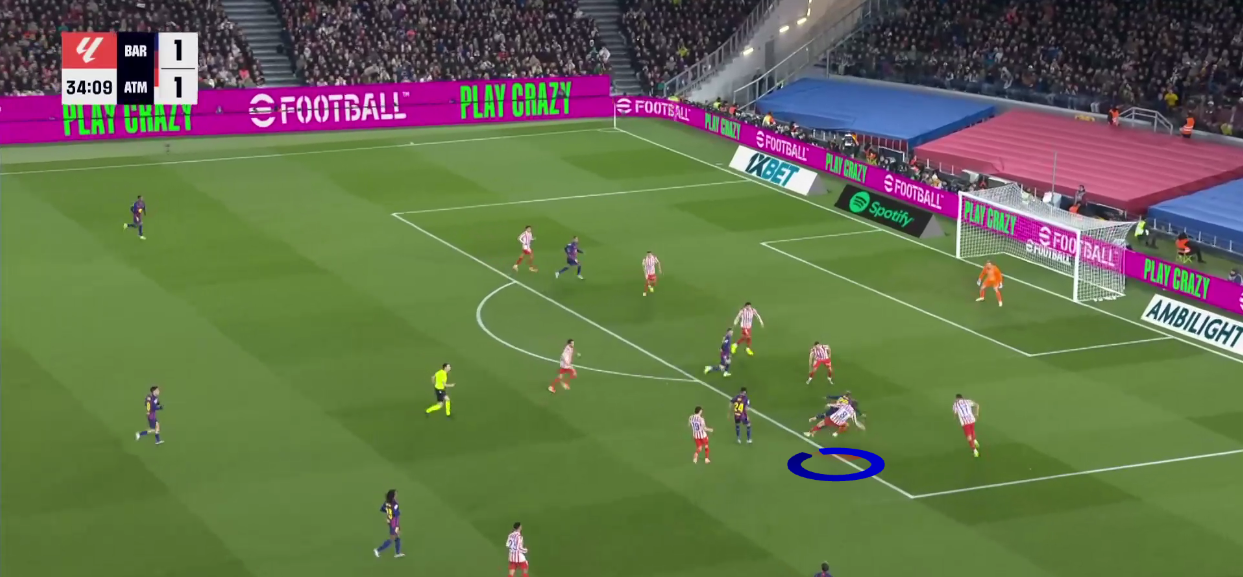 Olmo drives forward into the box, where he is tackled and wins a penalty for Barcelona.
In the second half, Barcelona continued to dominate and create chances, particularly at the start of the half, and scored their second goal in the 65th minute.
Following that, they lost possession for much of the remainder of the half, especially after Pedri, Raphinha, and Lewandowski were taken off.
Despite this, Atlético Madrid was limited to very few chances, none of which were converted into goals.
Conclusion
“We competed very well against a great team. We started with determination, but they are very good at playing through the middle, and they kept finding ways to hurt us. We could have done better defensively, but they are very good; the result is fair,” -Diego Simeone after the game.
In this match, Barcelona broke through Atlético Madrid’s defence in multiple ways.
They used wide play to attack the space behind the defensive line, exploited spaces within Atlético’s structure by passing to free players in the half-spaces, and also found gaps through the middle, which led to their first goal.
