
The competition in Ligue 1 is tight, with Paris Saint-Germain in first place with 30 points, while Olympique de Marseille and Lens are behind PSG with 28 points (at the time of writing).
Lens are in a good position compared to last season (eighth), achieving good results and still competing to get the title so far.
Looking at their stats, we found out that they scored eight of their 22 goals from set plays (36%), especially from attacking corners.
In set-pieces, Lens and PSG are the top scorers, each with eight goals.
However, Lens are better in XG from set pieces (4.12) compared to PSG (2.36).
They have scored all of their eight set-piece goals from corners, while PSG have scored five goals from corners, so we will dive into their offensive-corner tactics in this set-piece analysis.
In this tactical analysis, we will dissect their attacking corners and demonstrate how Pierre Sage‘s side excels in this area by utilising simple principles.
Lens Outswinging Crosses To Far Runners
First of all, Lens have simple tactics and principles that are effective, varied, and fit their players.
These aspects are the ones that really measure how good teams are at set-pieces, not just the tricks that look great on social media and short reels.
These tricks are sometimes important, but you can see an idea which may succeed one in 100 times, while you may rarely see reels for teams who are really good at set-pieces, and you may even consider many of their goals boring, repetitive and sometimes lucky.
Lens utilise out-swinging crosses, applying some important principles that match this kind of cross: framing the ball (cross trajectory), framing the goal, causing orientation problems for the man markers, and sometimes dynamic mismatch over the zonal markers.
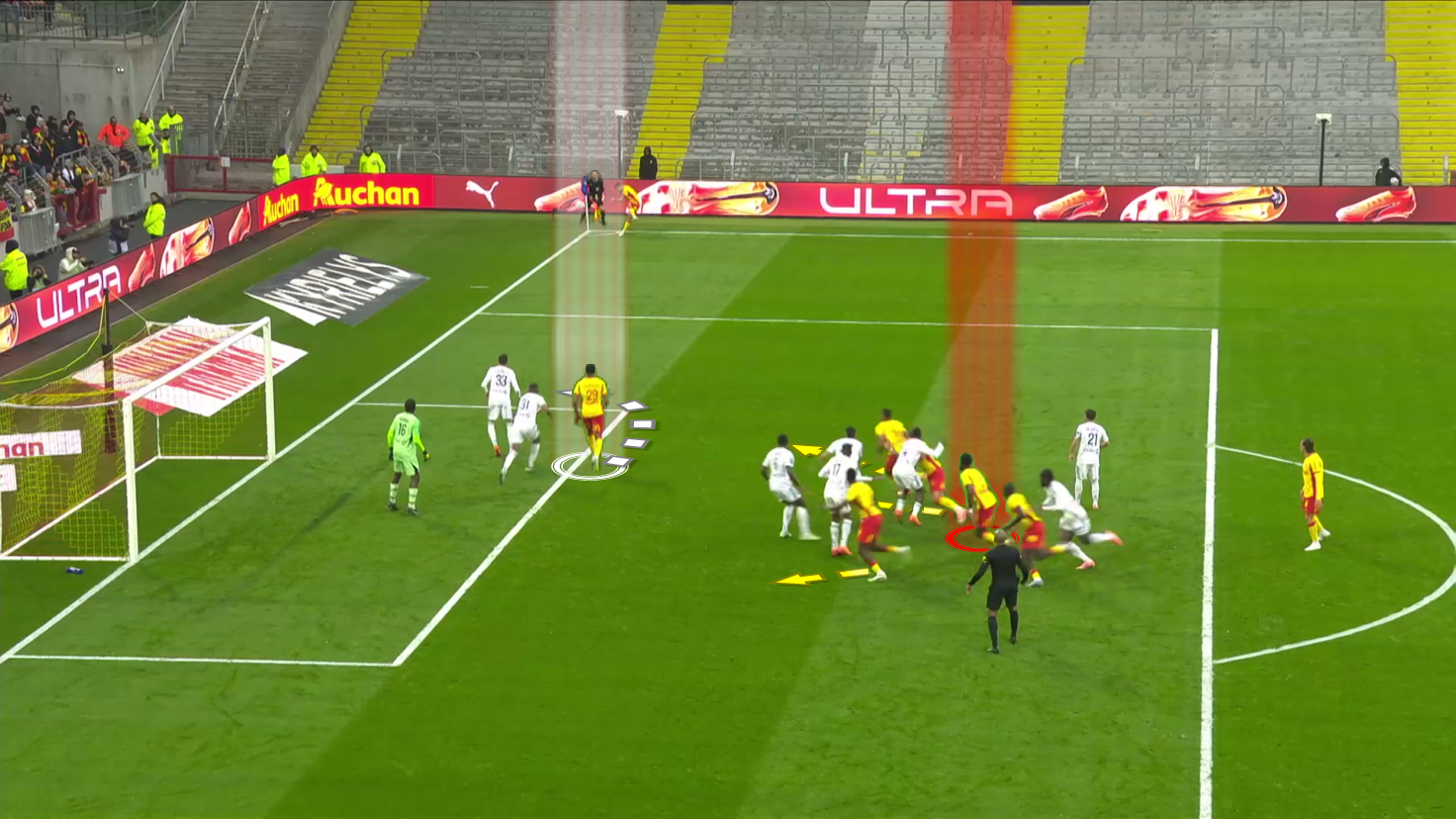
As shown below, they usually have a player who starts in the six-yard (white) behind the zonal defender on the near post (against man-marking and zonal marking systems) coming from his blind side.
This starting position allows the attacker to attack the area ahead of the zonal marker suddenly from the defender’s blind side, who usually finds it difficult to track the ball in the air and the attacker coming from his blind side at the same time.
The remaining players in the box usually act as far runners, standing vertically in a stack to prevent the man markers from sticking to them, so the man markers are forced to wait without knowing which direction each runner will run.
Let’s track the player in red (the last player in the stack).

As the taker moves, the stack begins to separate in different directions (yellow arrows), confusing the man markers.
This leaves the player in red a little bit far from his marker, which is called “separation”, so he can gain momentum over the awaiting man markers, who can also be easily manipulated because he needs to track the ball in the air at the same time.
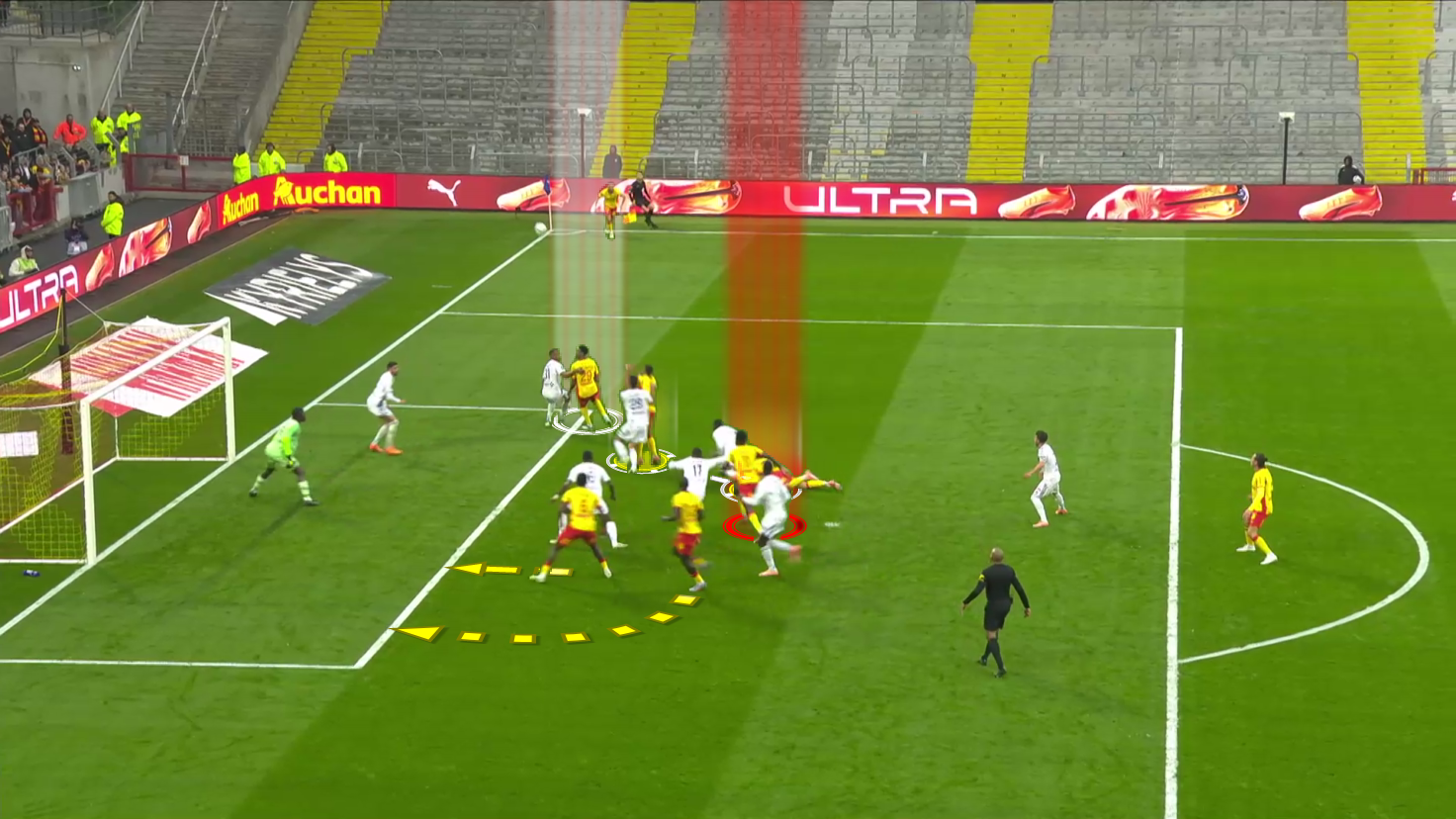
Below, the ball can reach the first runner from the six-yard (white) line or be passed to the player in red, which is considered ‘framing the ball’ (the out-swinging cross trajectory).
At the same time, the other two runners go to the far post to frame the goal in case the first player flicks it, or the ball saves it to be ready for the rebound.
The result was a goal!
 Using the same principles, they may add a small variation.
This time, the same early run (white) from the zonal defenders’ blind side and the same framing late run (green arrow).
However, the targeted player (red) this time will go around the stack while the first attacker in the stack will keep blocking his marker, preventing him from tracking the targeted player after getting around the stack, as we will see.
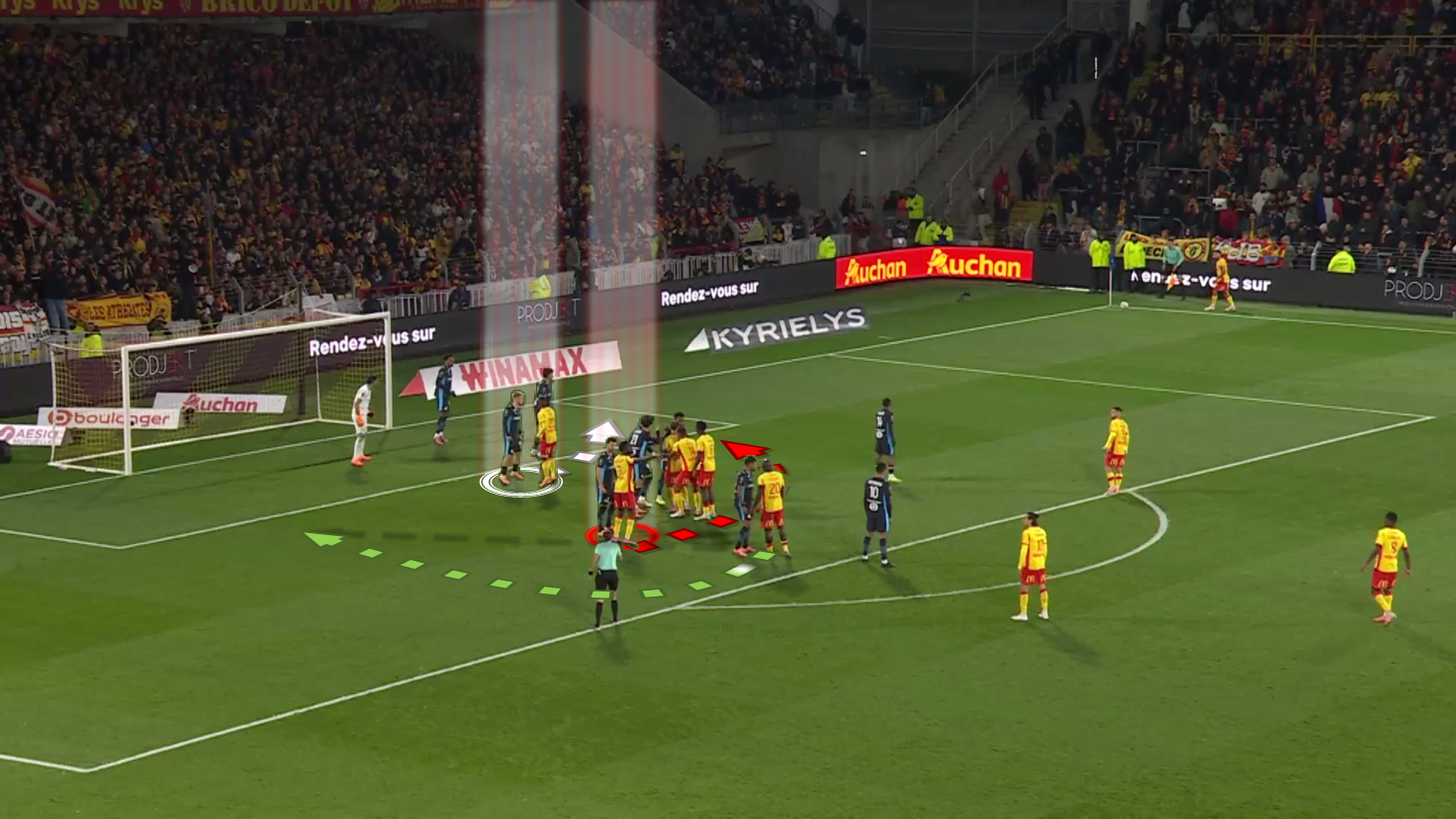
Below, the targeted player (red) turns around the stack to make a separation curve from his man marker, who runs behind him now, while the first layer of the stack (#1) keeps blocking his man marker.
The last runner (green) runs in the opposite direction of the ball, making it difficult for his man marker to keep tracking him and the ball simultaneously, which is considered an orientation problem for the defender.
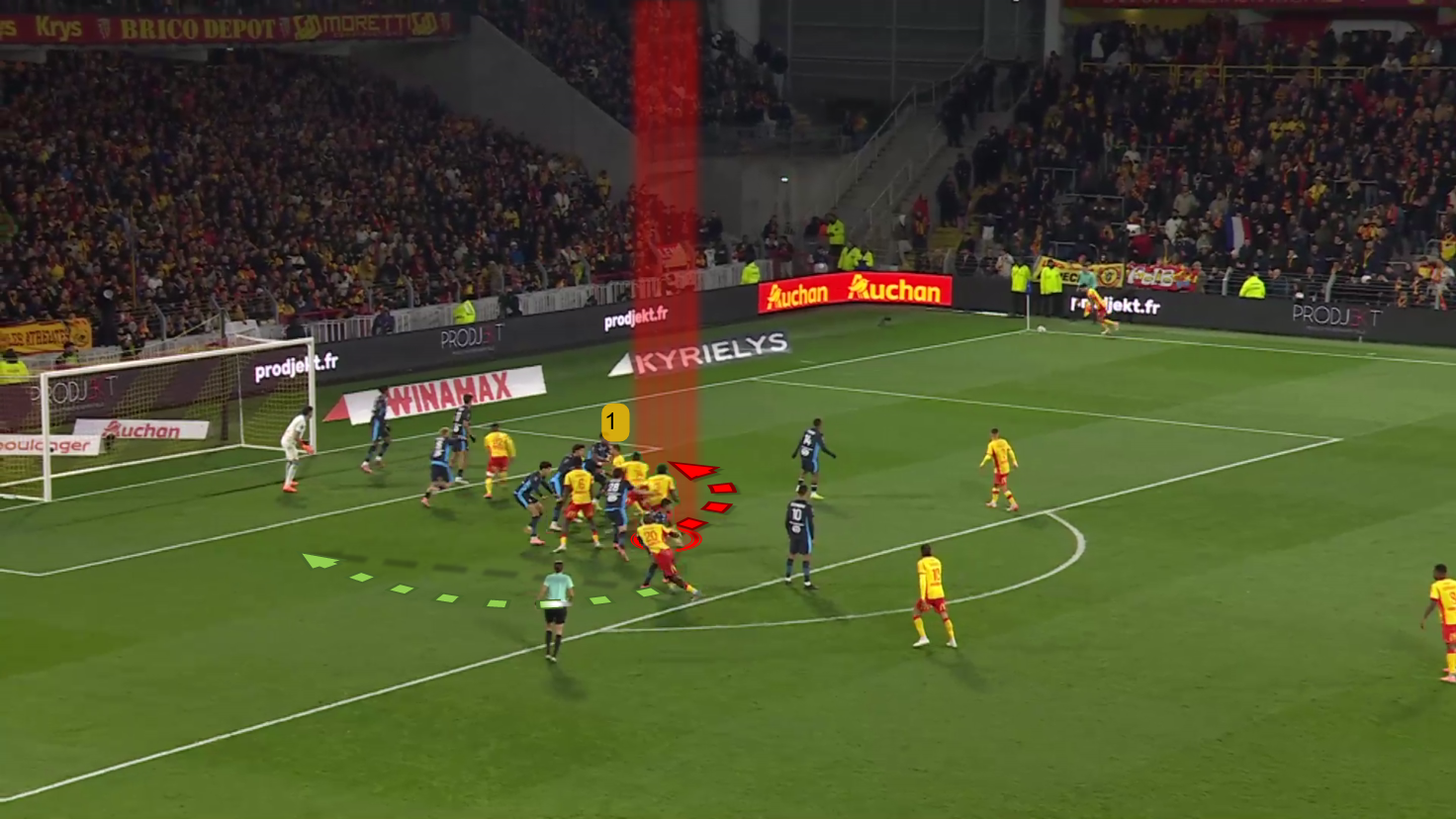
Here, the first runner drags the first zonal defender, and the ball reaches the player in red while the last runner (red) runs late, in good timing, to frame the goal without attracting the defenders’ attention, who focus on the first touch.
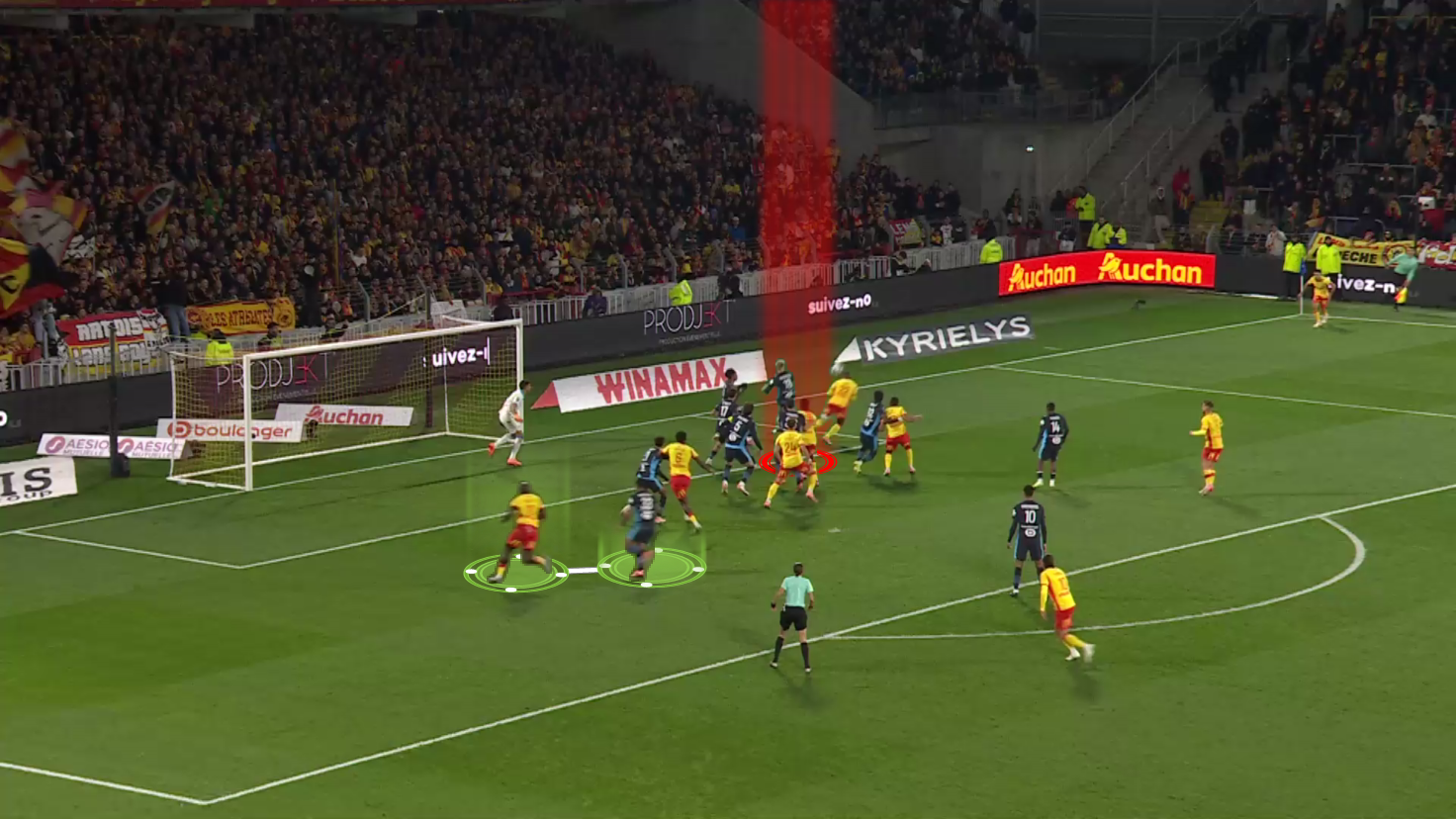
The cross may be overhit, and they are ready for that, too!
Below, Lens do the same thing: A runner from the stack to the near post while the last runner goes in an opposite direction, but if the ball passes, they will switch the roles (the green player will be the first targeted player who nods the ball back to one of the attackers on the near post).
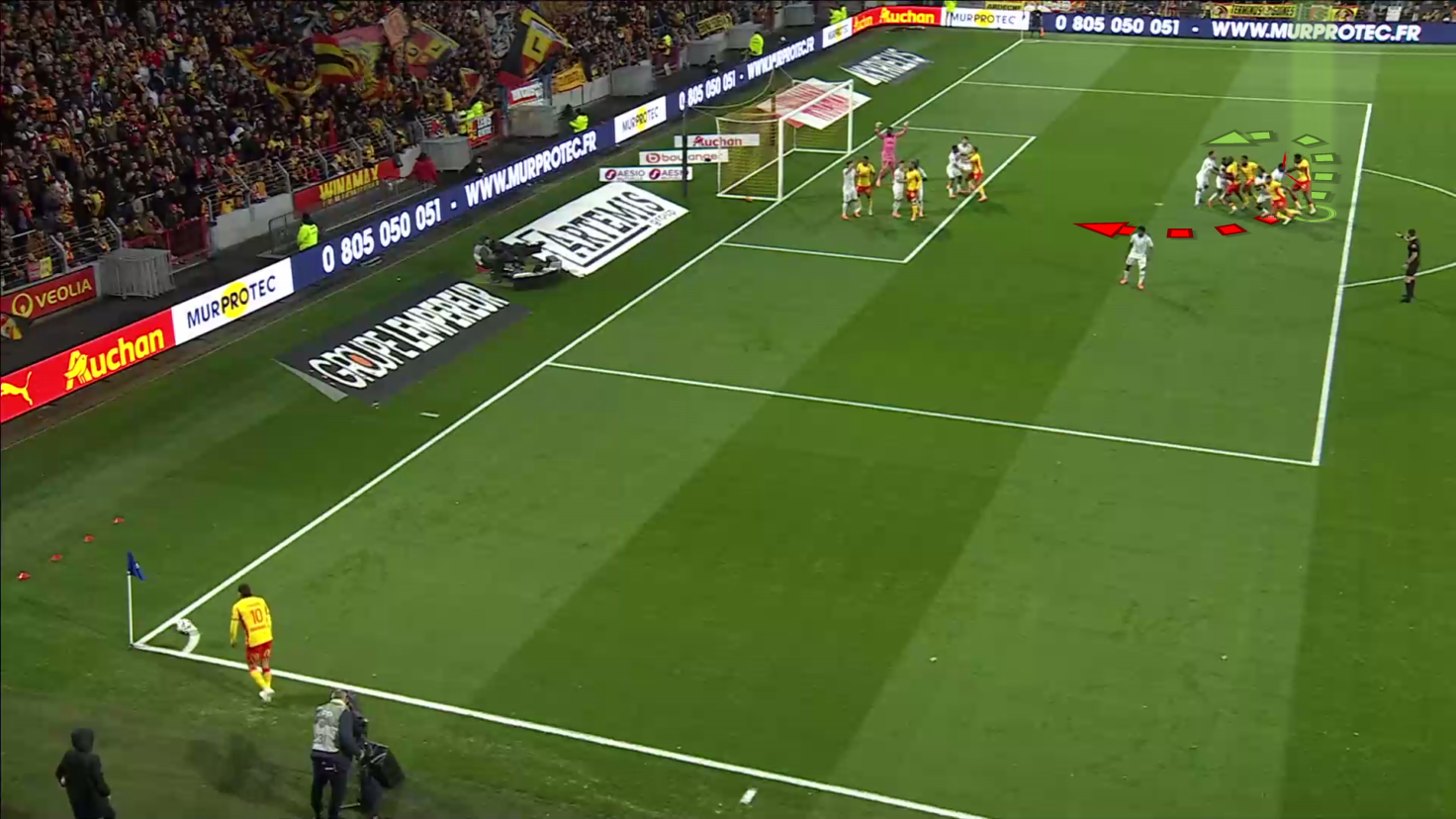
The orientation problem for the last man marker remains the same because it is difficult for him to start from such a high point, run in the opposite direction of the ball, and keep tracking both the attacker and the ball simultaneously.
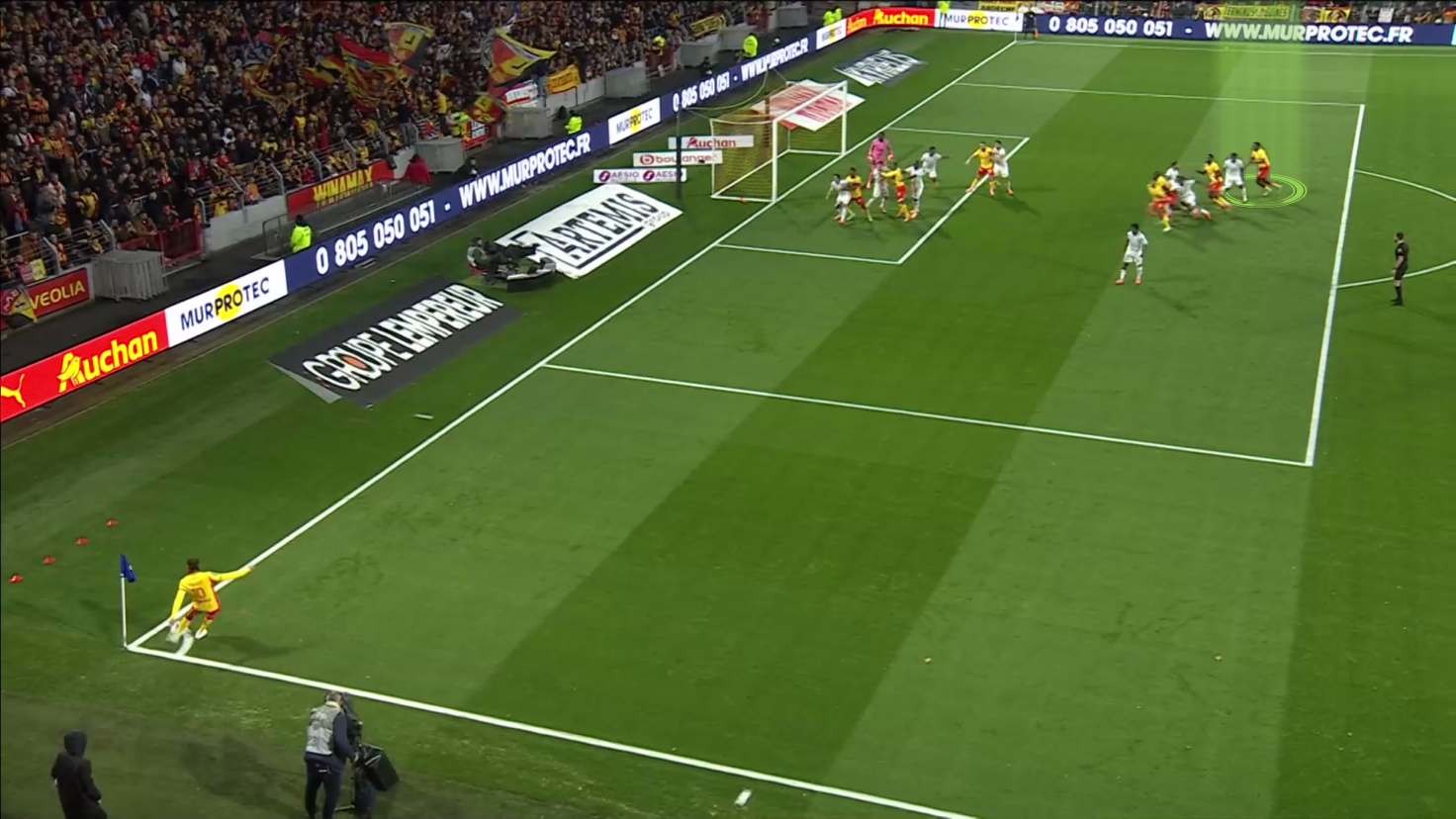
The last runner gets the ball, but at a far point so that he will nod the ball back to the near post, and it will find a player ending with a goal because they have three players (yellow arrows) ready for the headed pass near the goal, as in the two following photos.
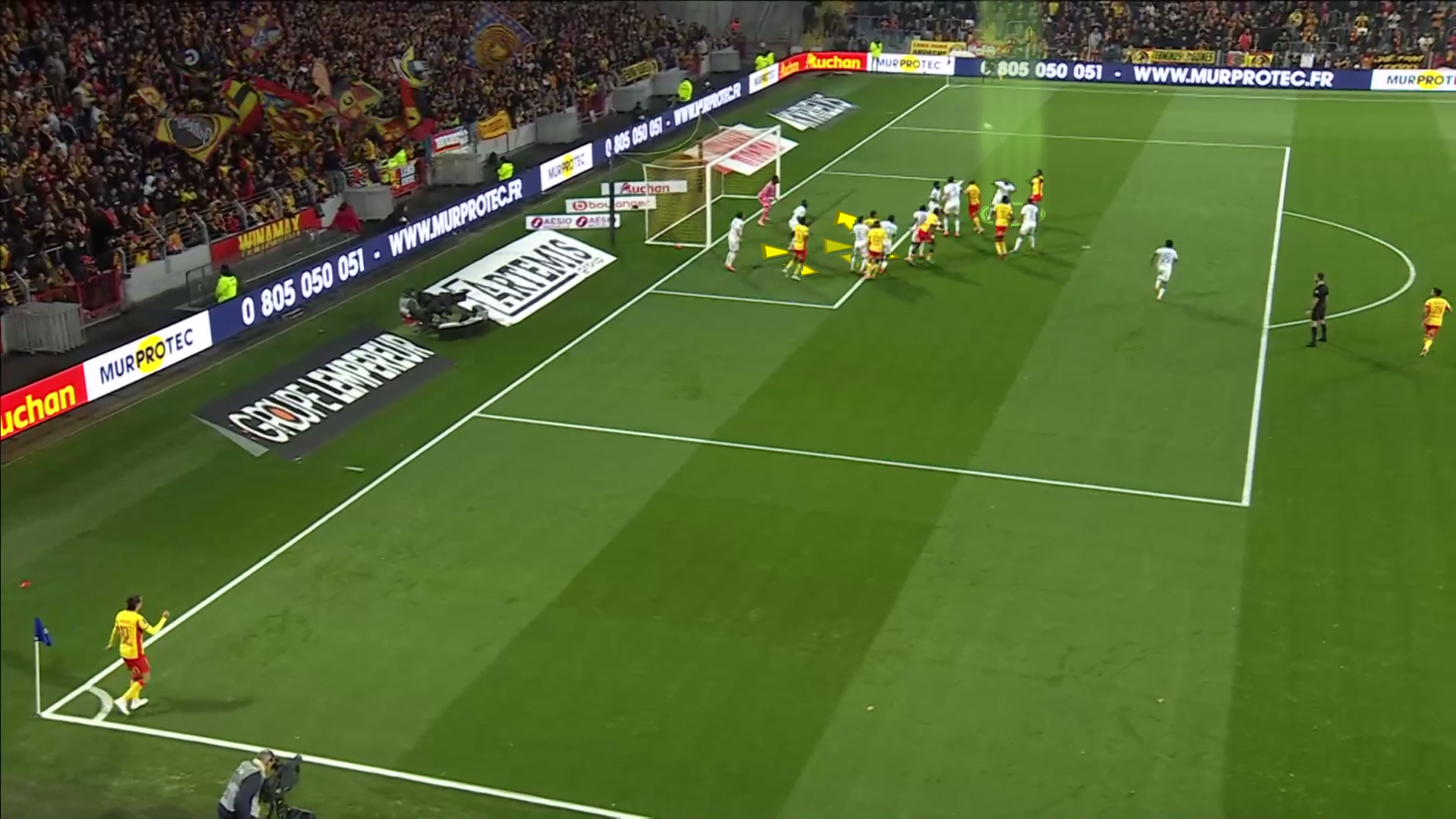
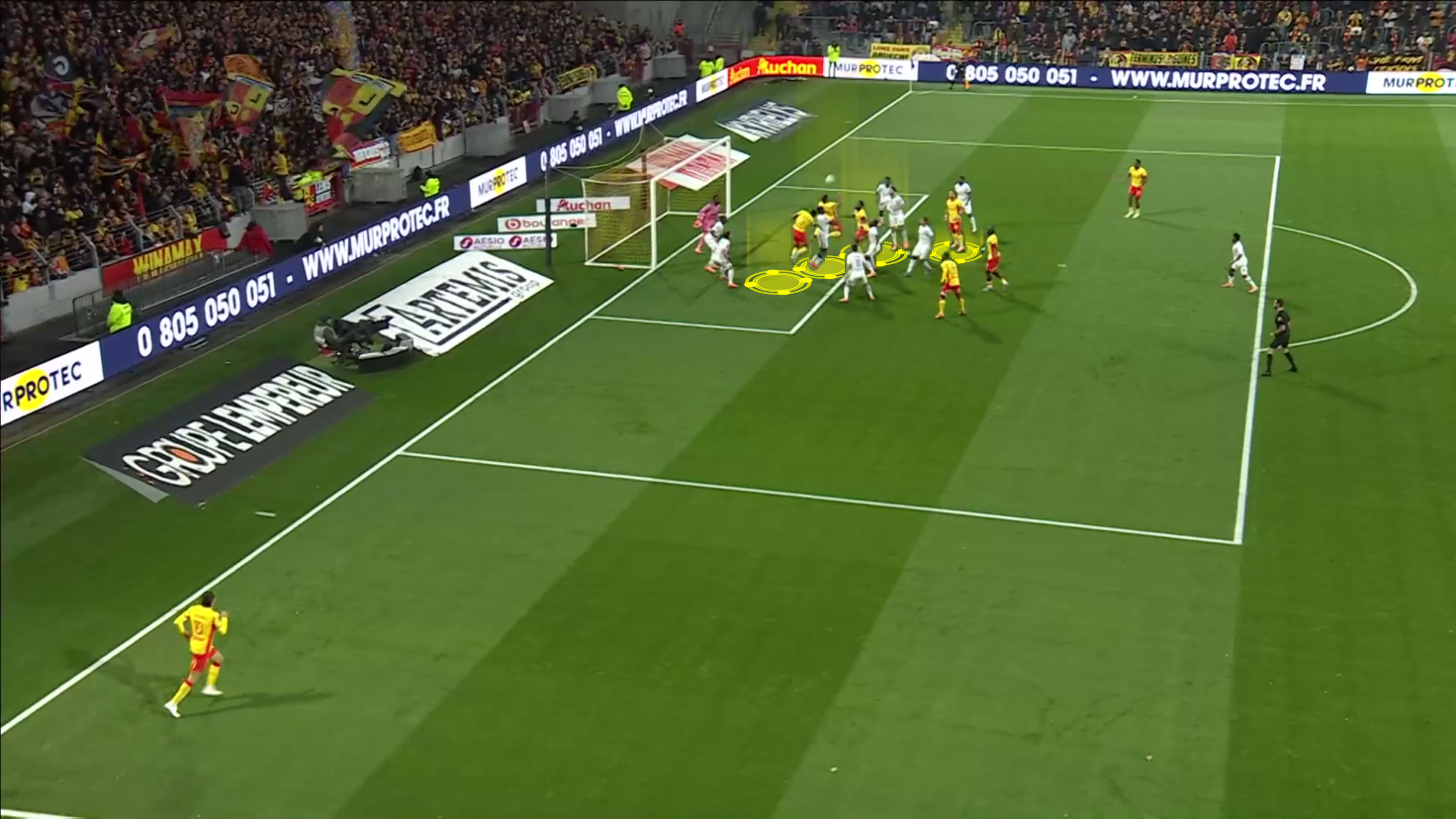
We should also highlight that sometimes the first attacker can get the first touch before the first zonal defender because of his starting position on his blind side.
As shown below, the first zonal defender can’t track the runner and the ball simultaneously.
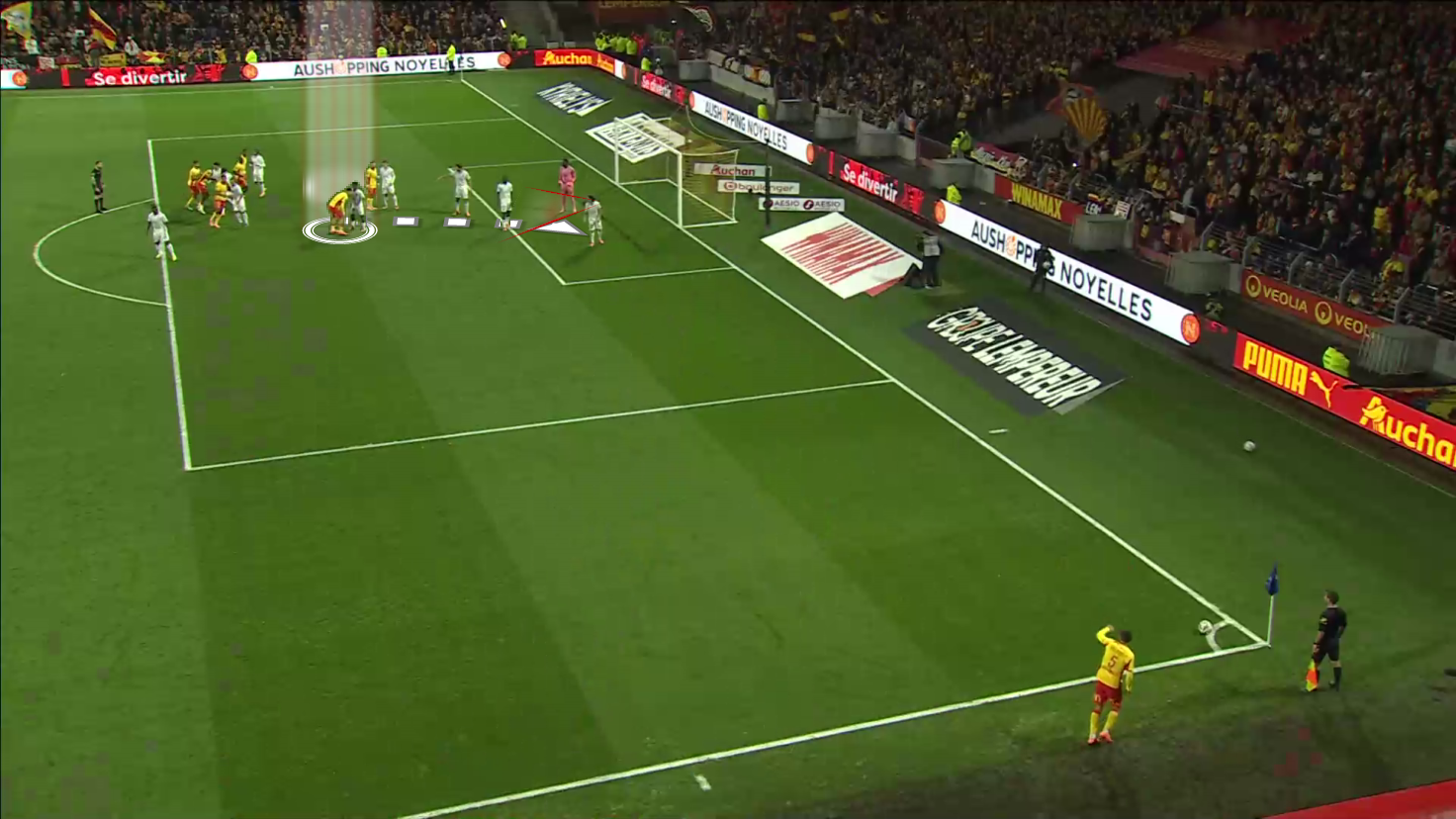
Hence, the first runner gets the ball behind the first zonal defenders while the other runners frame the goal to get the rebound, which already happened, ending with a goal.
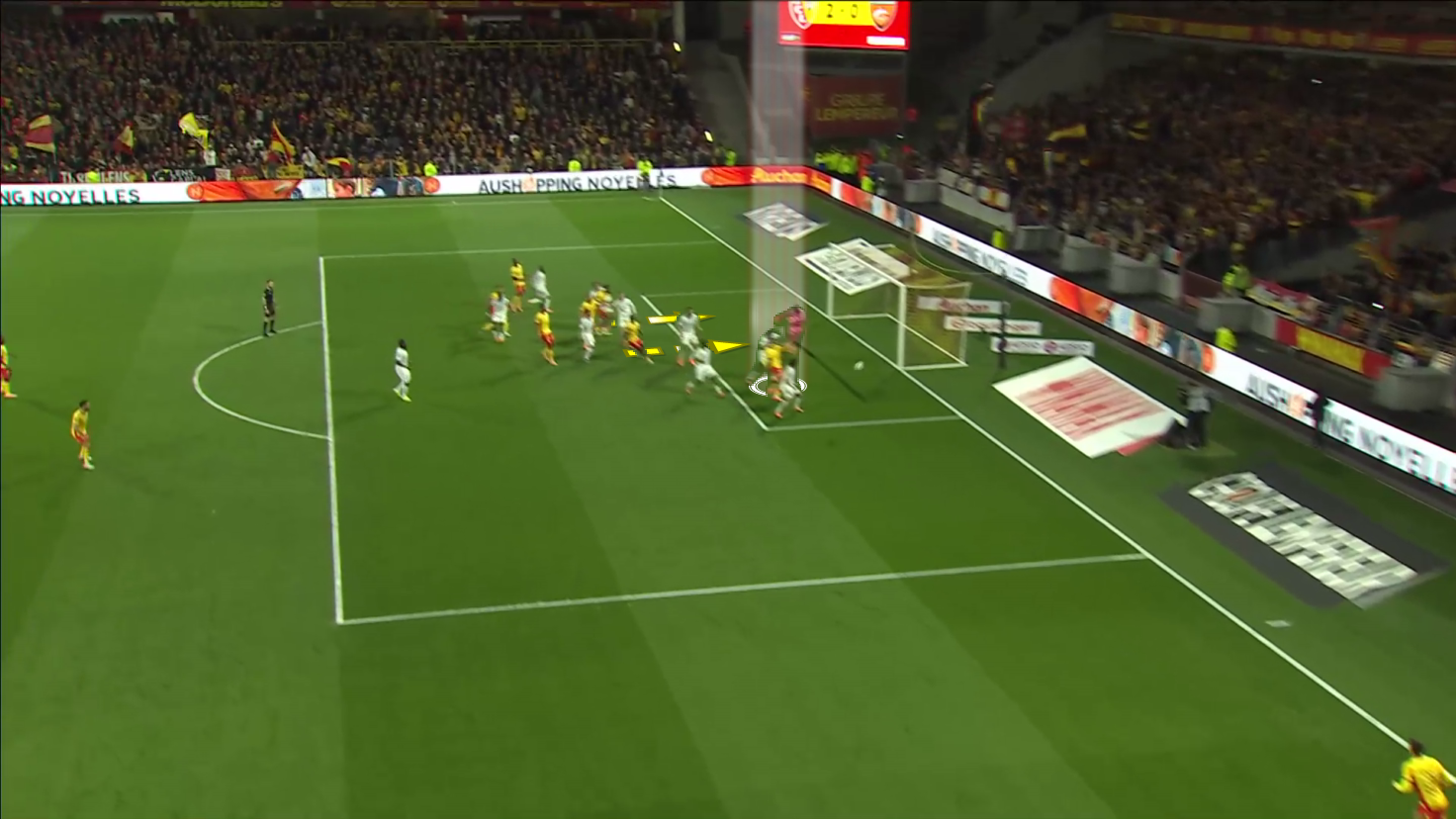
Lens In-Swinging Tactics As A Variation
When Lens use in-swing crosses, they target the area between the six-yard box and the penalty spot, as shown below.
In contrast to zonal systems, they exploit the same principles but add blocks, so you can see below the blue player ready to block the zonal defender with the same runs to the near post (white).
This time, the last runner (red) doesn’t have a man marker because there are two runners against one man marker now.
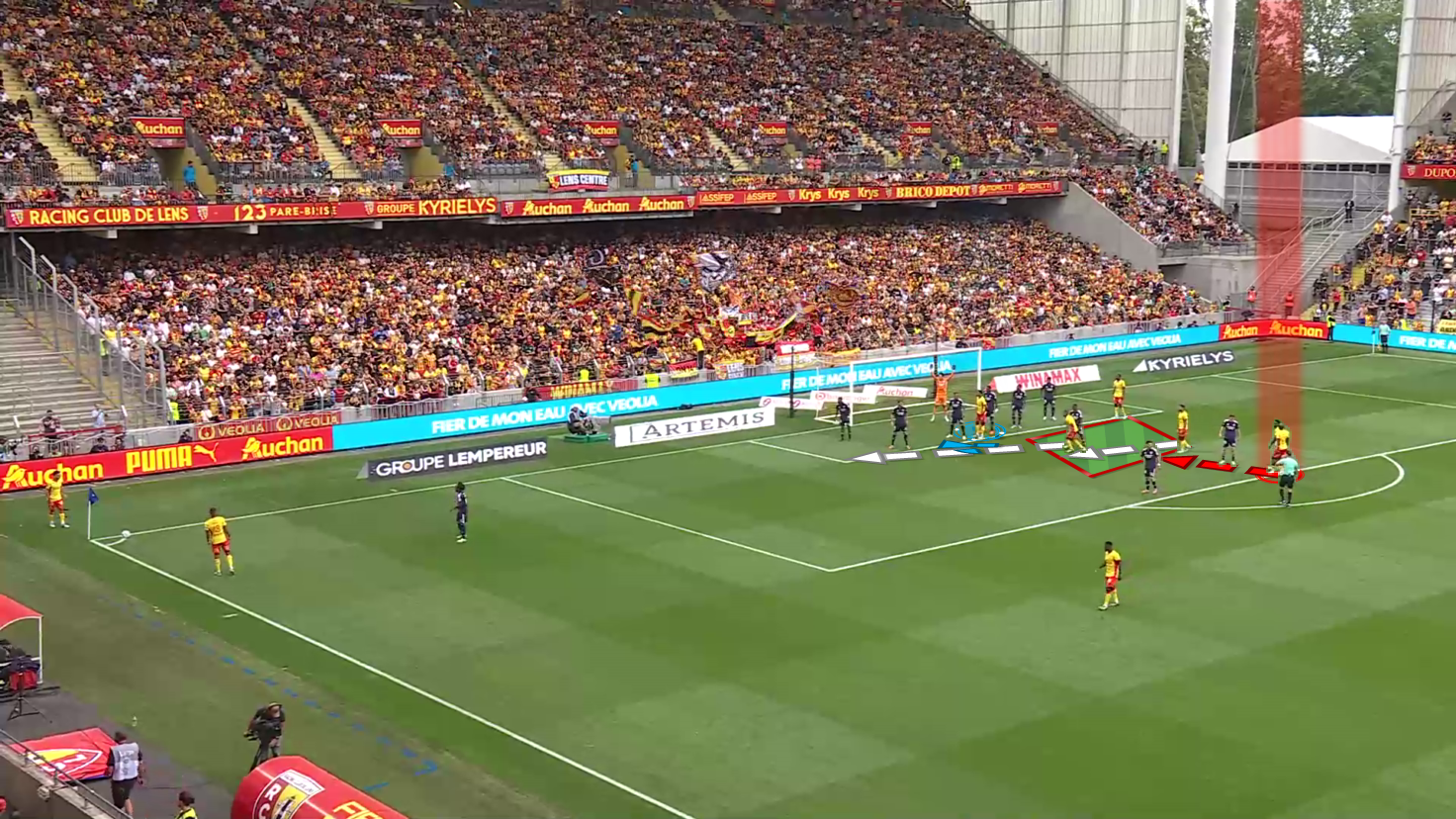
That means he will run all this distance free before reaching the evacuated target area, so he will jump from movement against any stationary zonal defender, which creates a dynamic mismatch over him, as shown in the two following photos.
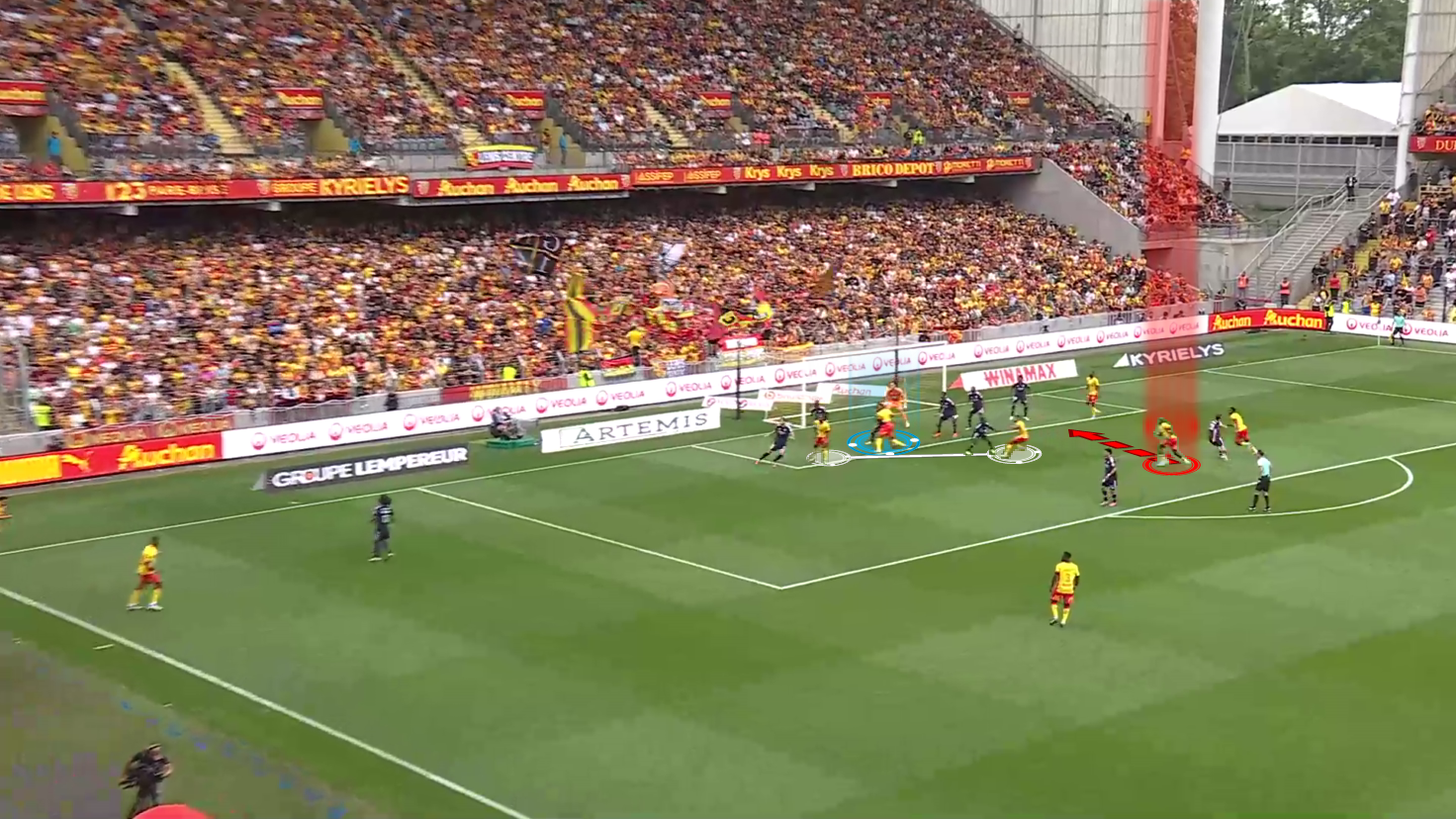
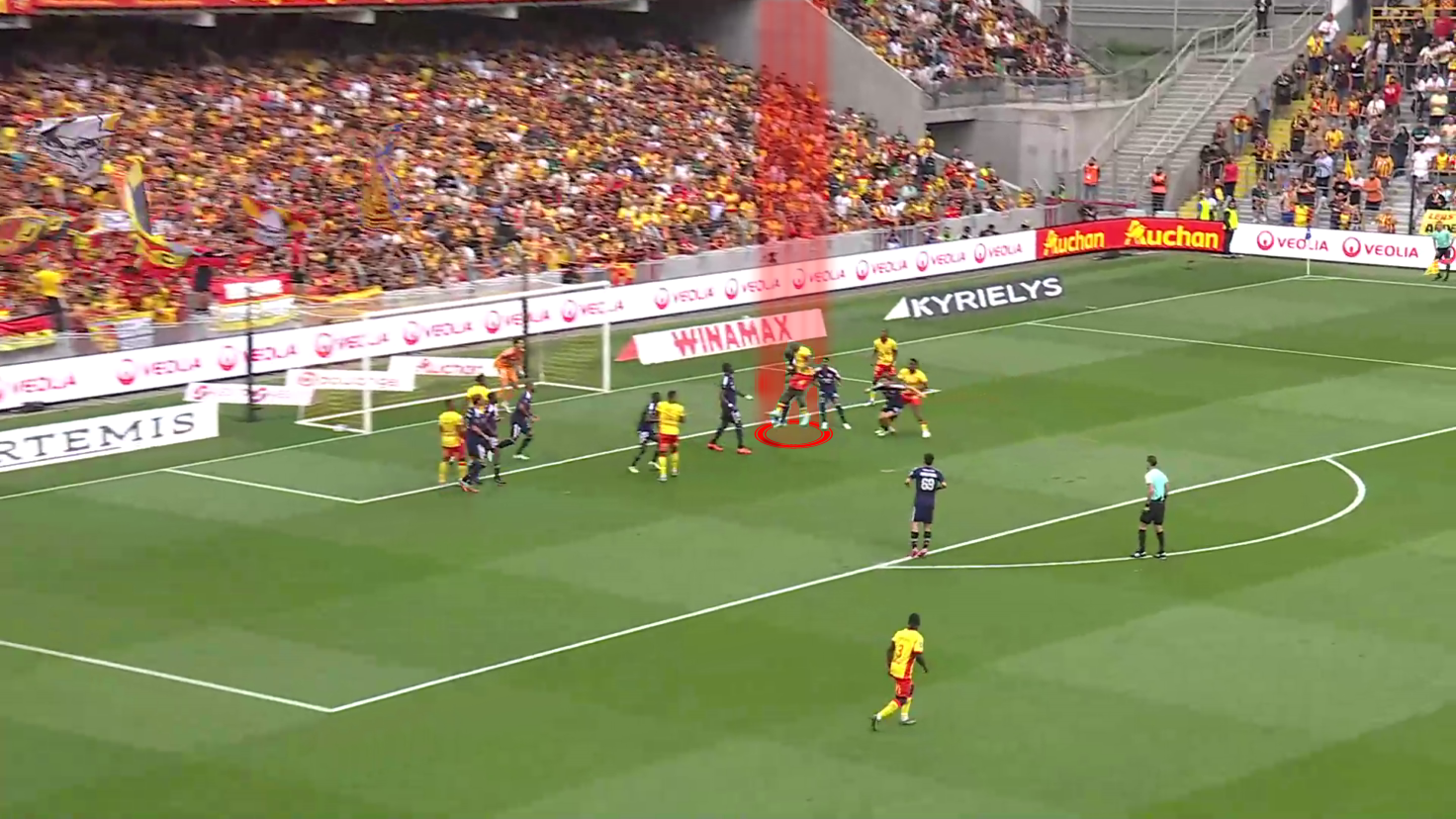
Lens also have another great variation using low-level crosses.
As shown below, the opponent defends with six zonal defenders, three players in the second defending line and a player on the edge of the box.
Lens’ idea is to ask a player to run from the edge of the box toward the taker to drag the edge-of-the-box defender with him, with another player from the second line (yellow) evacuating the targeted area.
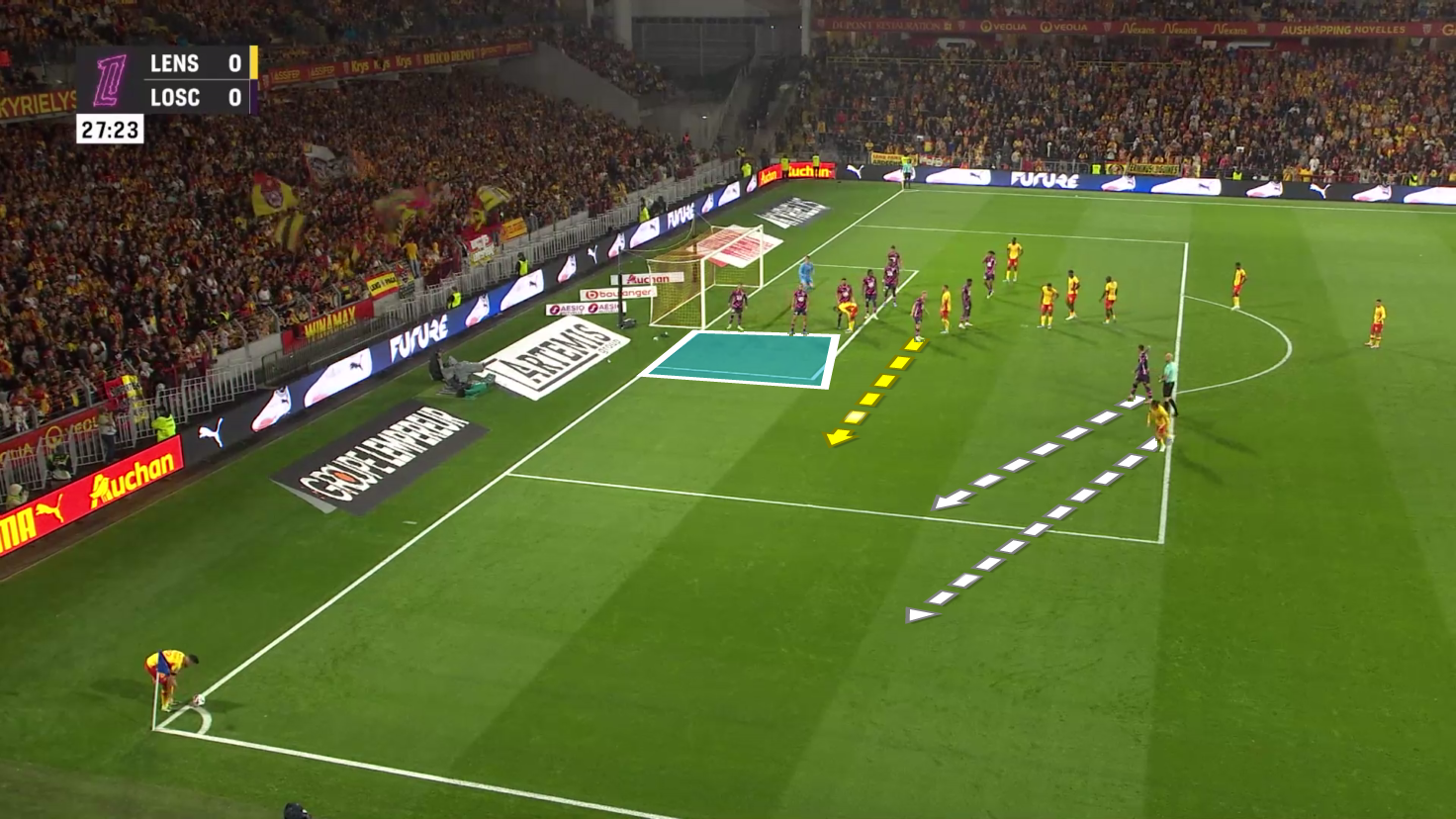
Against these zonal systems, the free runner can stand between the two defending lines and run surprisingly to the targeted area (red) with the help of the two blue players, who block and draw the attention of the two zonal defenders, preventing them from stepping up to the targeted area.
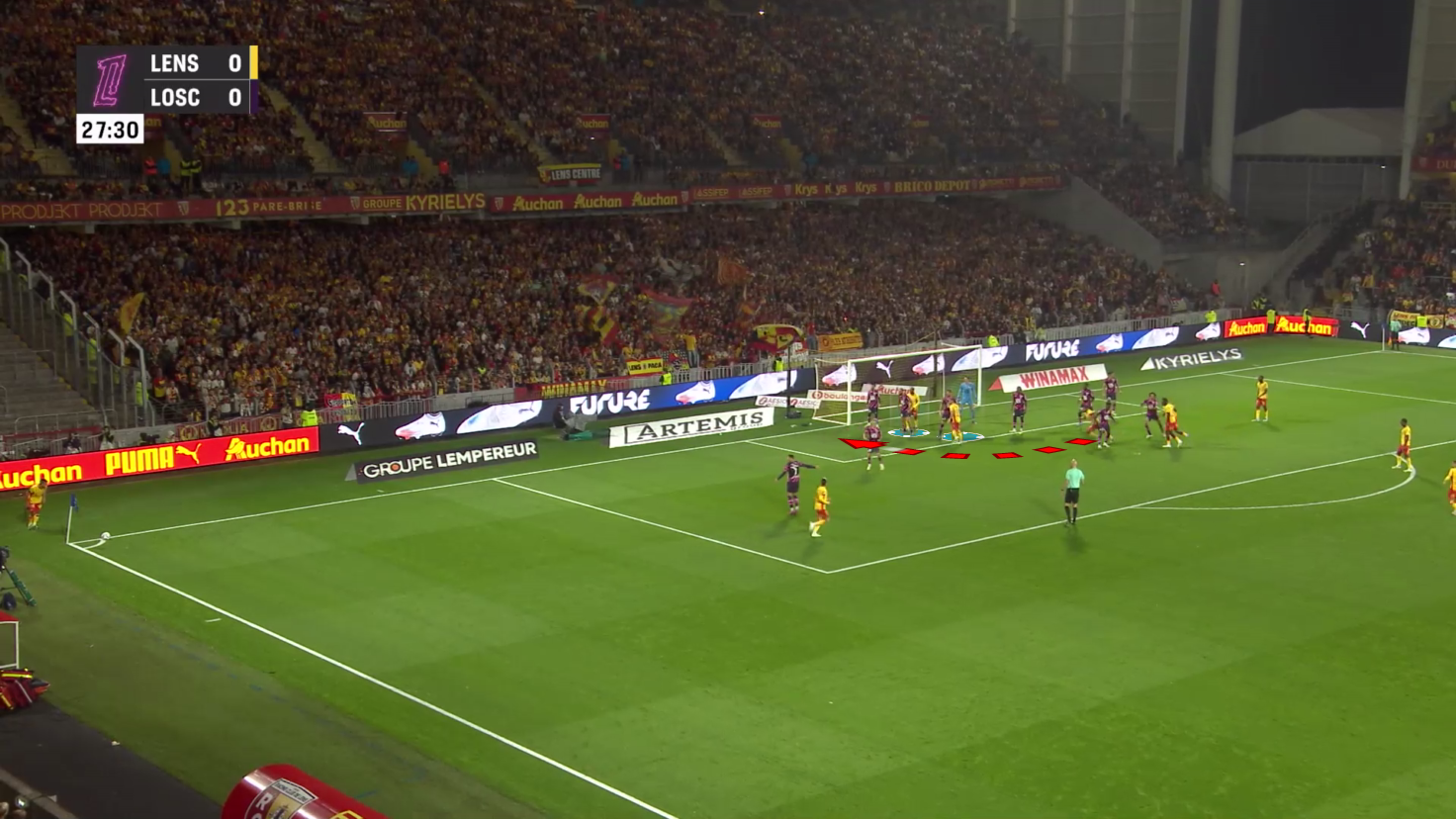
The plan works, and the result is a goal while also having players framing the goal in case the ball is rebounded.
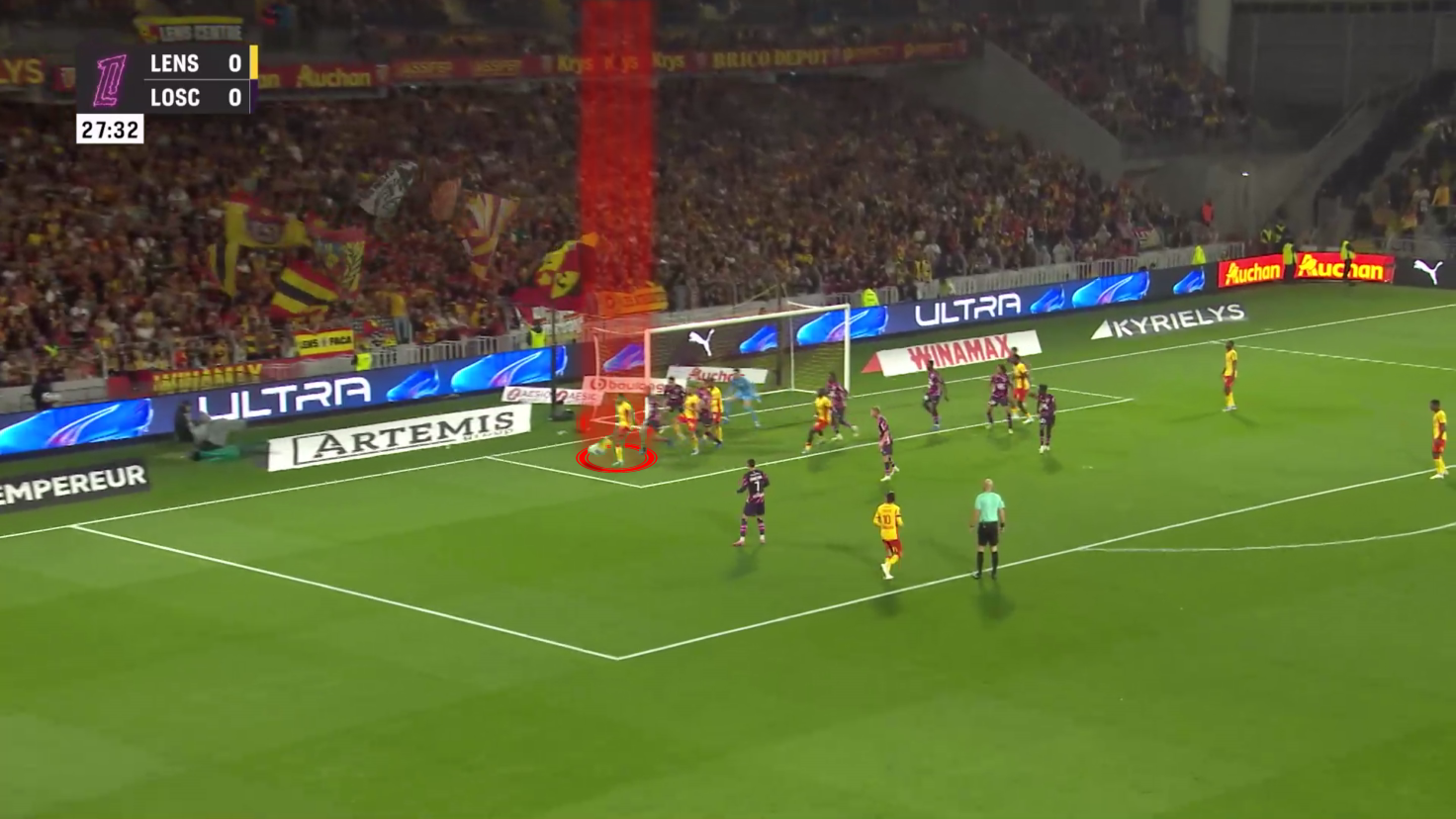
Lens Short Corner Tactics
Lens also have simple, creative short-corner ideas.
First of all, they try to find a quick 2-v-1 situation by asking one player from the edge of the box to run quickly to receive a pass from the taker after acting as just a rebound player from the beginning.
It works against teams that don’t have a close short-option defender, giving them time until the first zonal defender arrives, creating a 2-v-2 situation.
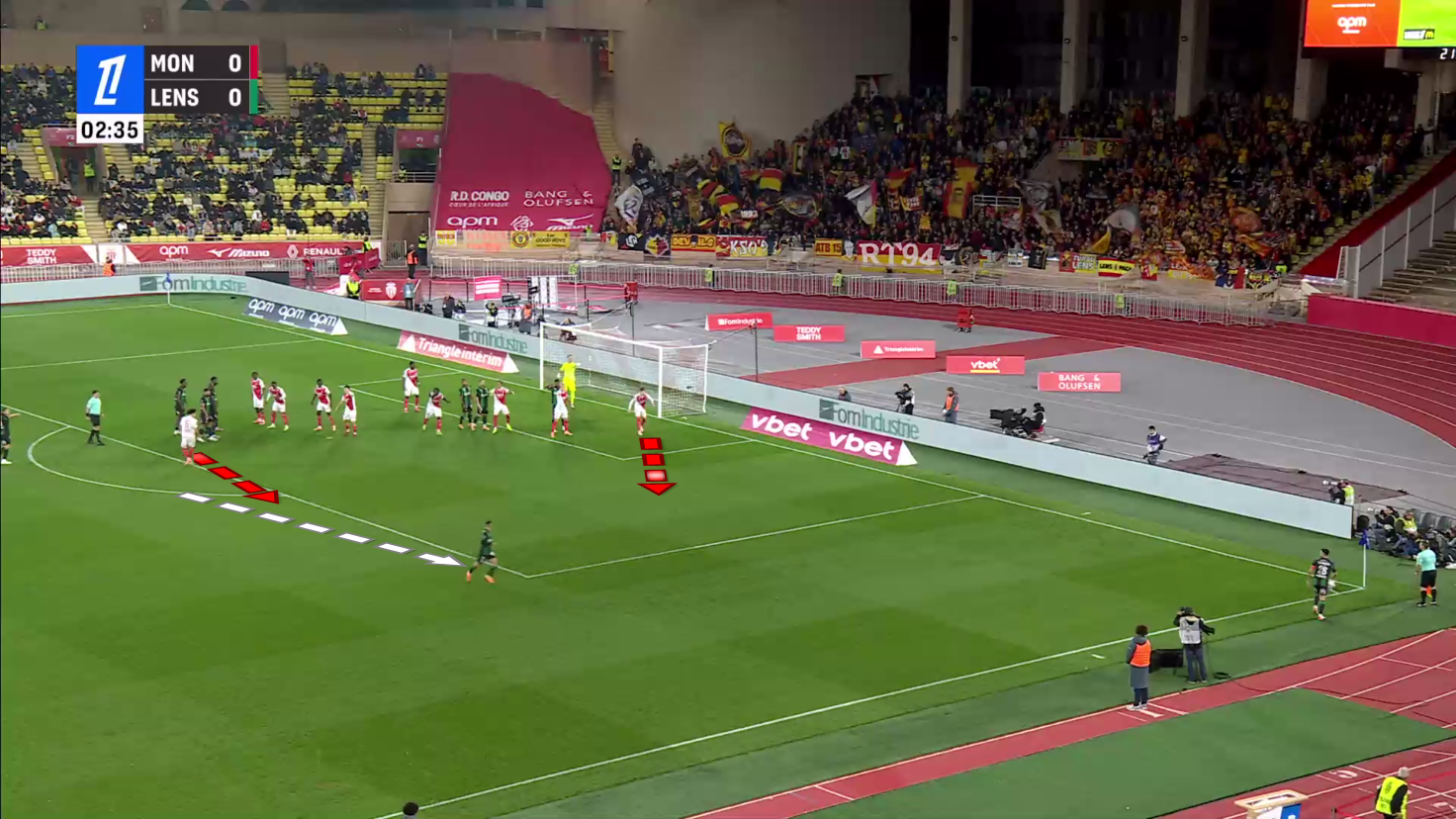
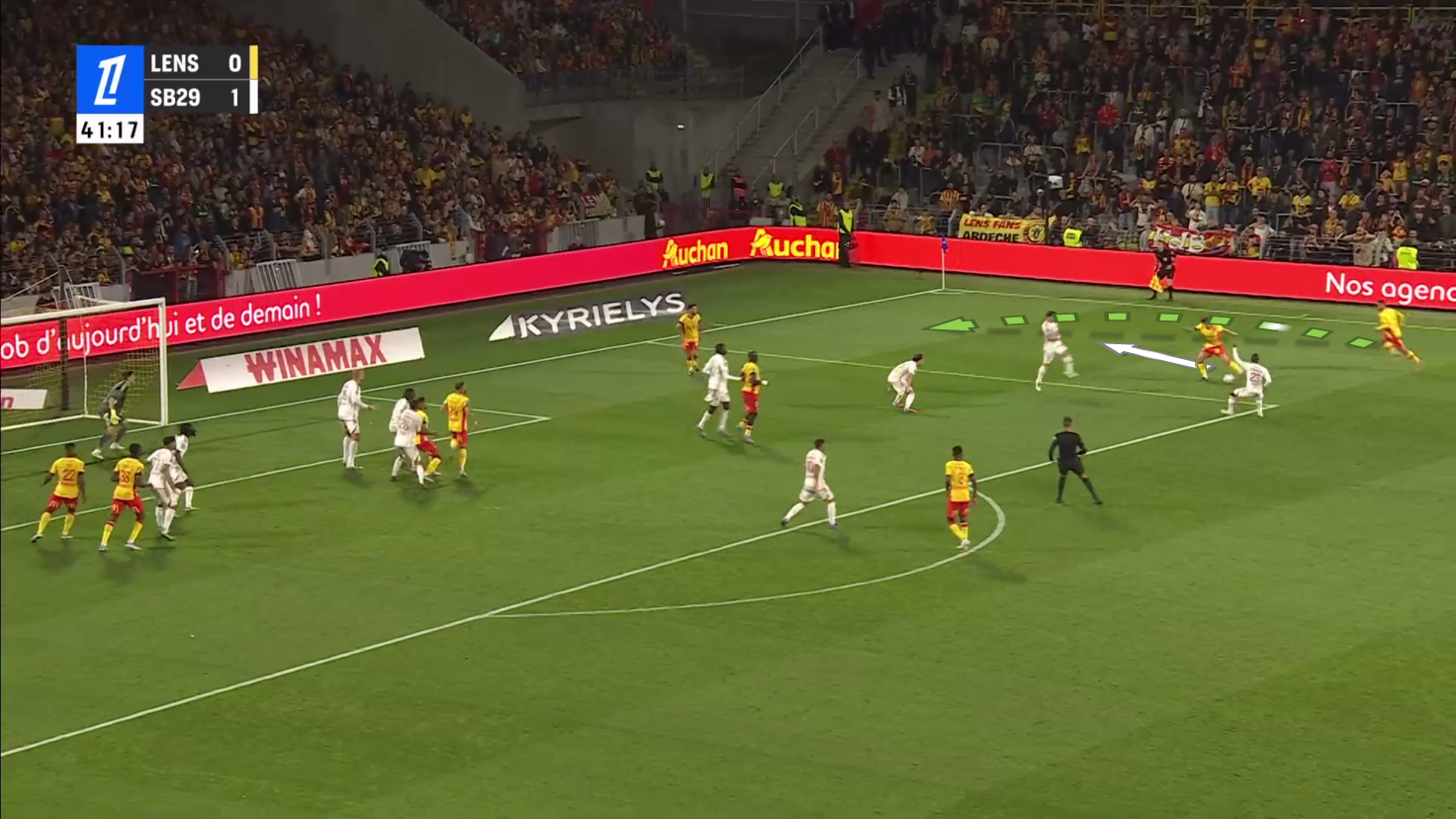
Lens ask a player to run from the box (yellow) while another short option appears on the flank (white arrow).
It makes the short-option defender (yellow) hesitate between following him and going to the player on the flank, leaving them nearly in a 3-v-2 situation.
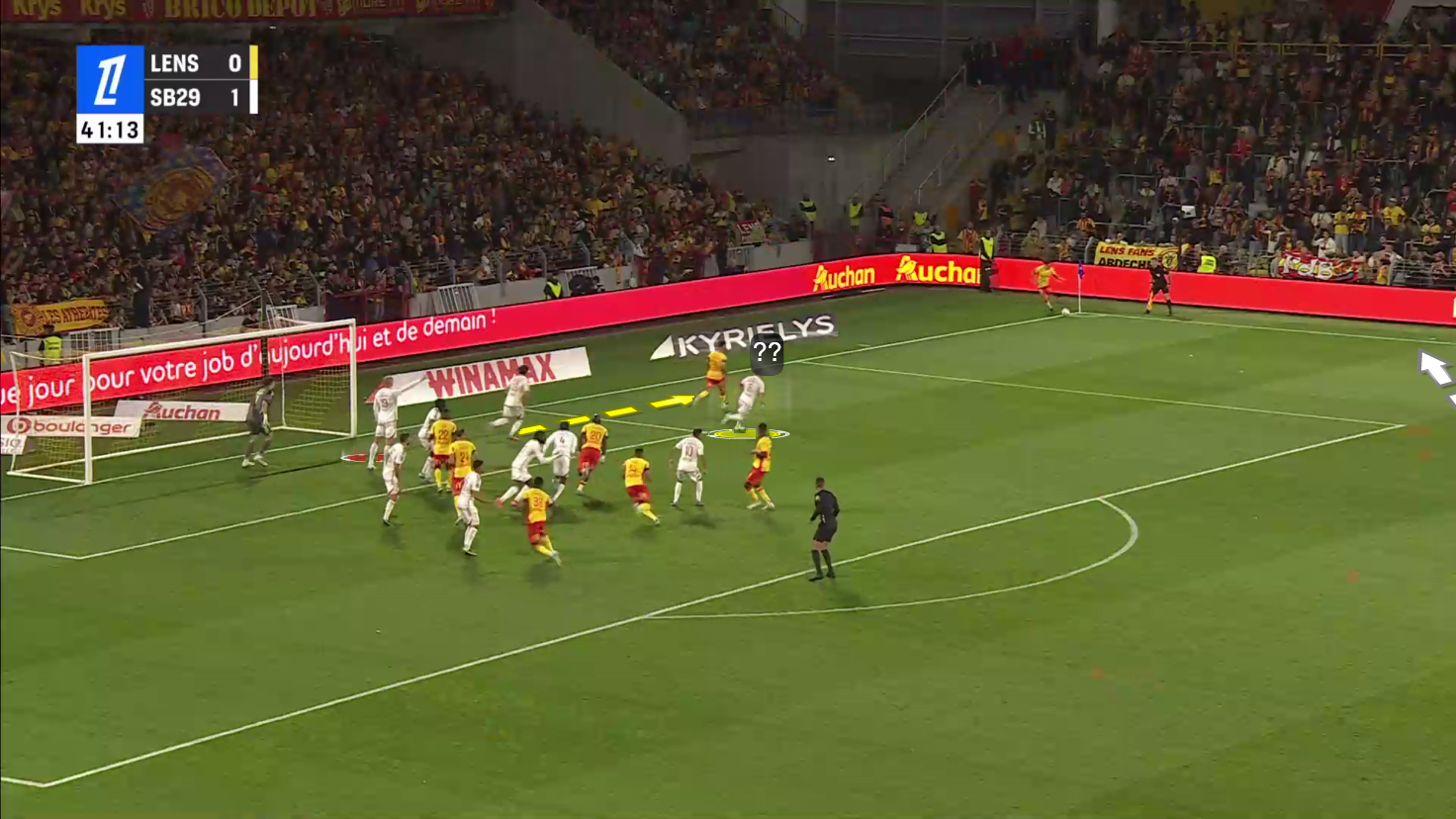
The receiver passes the ball back to the taker, leaving two attackers against the short option defender and the man marker, while the third attacker comes out of the shot to create an overlap run (green).
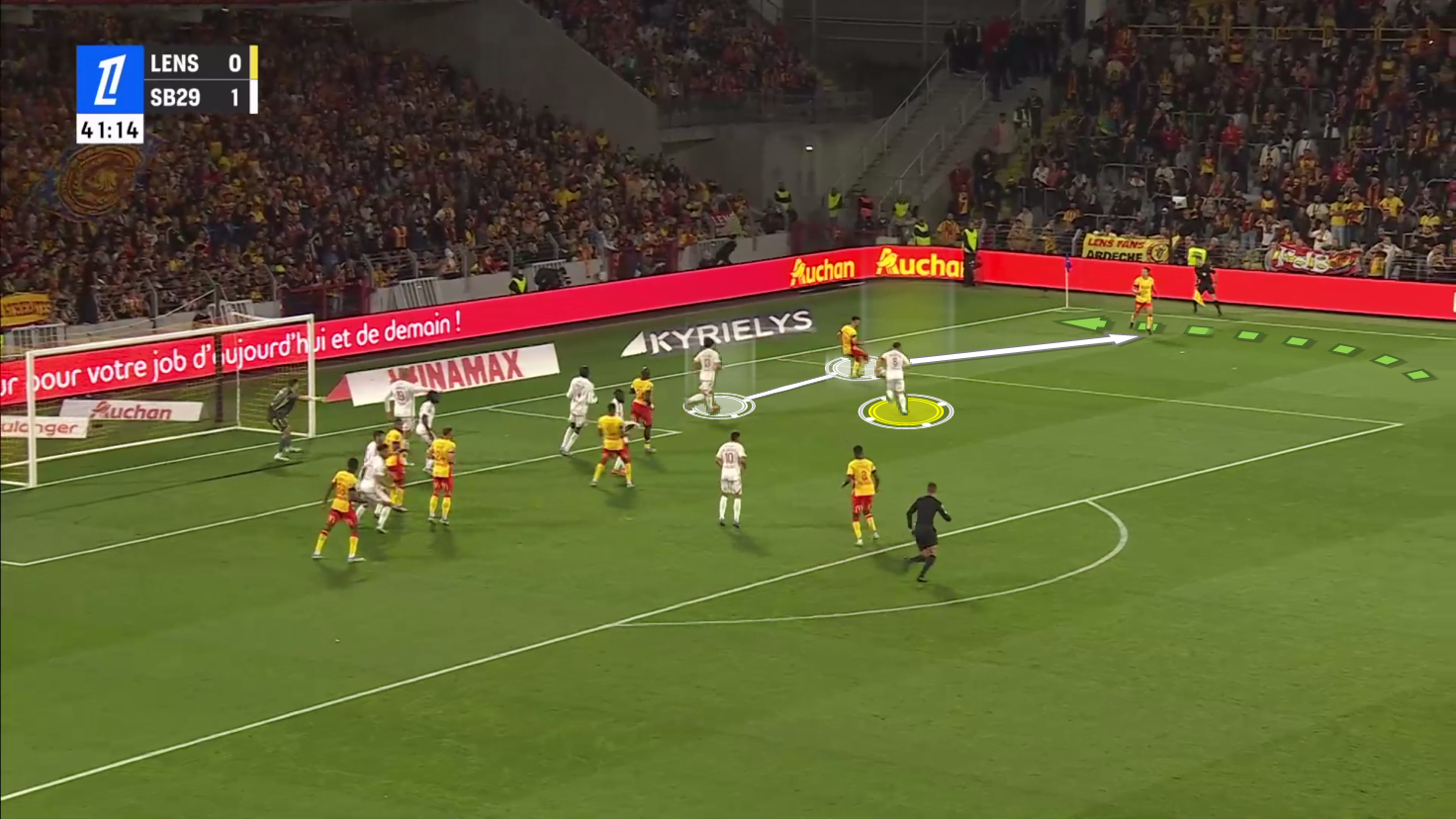
The taker acts as if he will send a cross, but passes to the player coming in, who runs an overlap.
Conclusion
In this analysis, we have shown how set-pieces helped Lens achieve great results, placing them third in Ligue 1 so far, behind Paris Saint-Germain F.C. and Marseille.
In this set-piece analysis, we have explained their tactics in attacking corners and how they utilise out-swing crosses with far runners in a stack, exploiting many common principles such as framing the ball, framing the goal, causing separation, creating orientation problems for the man markers, and sometimes dynamic mismatches over the zonal defenders.
We have also shown that they have in-swinging crosses and innovative short-corner variations.
